
July 23, 2026
Prepared by Diana Bozhyk
A Ukrainian F-16 shot down a Russian Su-35 fighter jet in the war’s first confirmed dogfight between the two aircraft types, the top US general told Congress this week. Russian forces attempted their first mechanized tank assault near Dobropillya in over a year — and lost 80 percent of the vehicles before they reached the front line. In Manila, Secretary of State Marco Rubio flatly rejected Russia’s claim that last August’s Alaska summit produced any peace agreement, telling Foreign Minister Sergei Lavrov that ending the war will require “new ideas” instead. And in Dnipropetrovsk Oblast, a Russian strike on a food-processing plant in Pavlohrad killed three people at lunchtime, part of a day that would leave at least eight Ukrainians dead by nightfall.
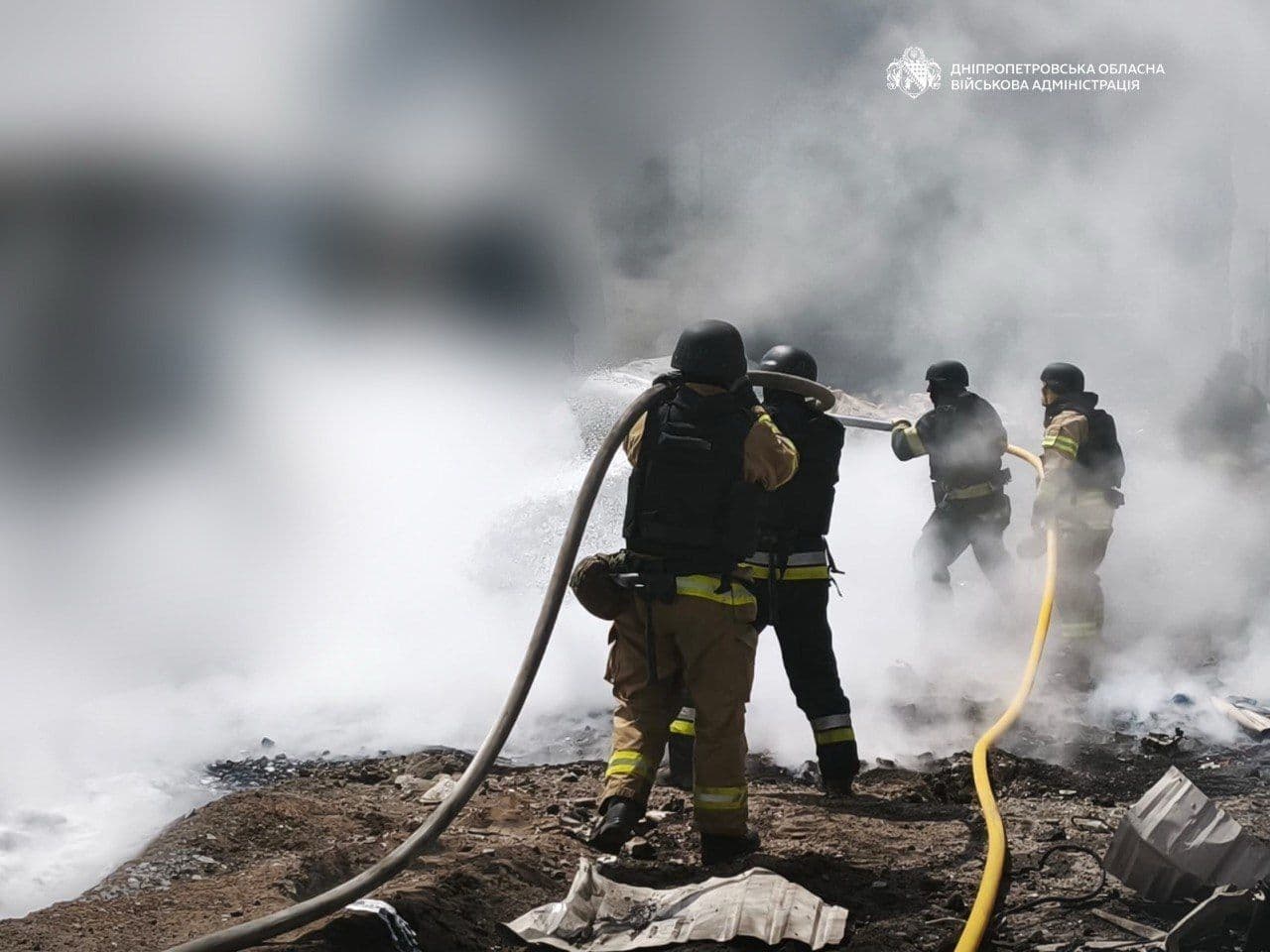
Emergency services extinguish a fire at an enterprise in Pavlohrad following a Russian attack. (Oleksandr Hanzha / Telegram)
THE DAY’S RECKONING
At around noon in Pavlohrad, a city that has spent the war absorbing people fleeing more dangerous places, a Russian guided bomb hit a food-processing plant and killed three workers where they stood. Two hundred miles east, near a town called Dobropillya, Russian tank crews tried something they hadn’t attempted there in over a year — a real mechanized assault, armor and infantry together — and Ukrainian defenders destroyed most of it before it ever reached the line. Above them both, somewhere over eastern Ukraine, a Ukrainian F-16 pilot did something no one on either side had done before: shot down a Russian Su-35, one of Moscow’s most capable fighters, in the first confirmed dogfight between the two jets in this war. And on the other side of the world, in a conference room in Manila, America’s top diplomat told Russia’s that whatever they think happened at a summit in Alaska last August, nothing was actually agreed — a quiet correction to a story Moscow has been telling for eleven months. One country tried something new in the air and on the ground today. The other tried the same old story in a new city.

Protesters hold placards during on the eighth day of a demonstration against Ukraine’s President’s decision to dismiss Ukraine’s former Defence Minister, in Kyiv. (Tetiana Dzhafarova / AFP via Getty Images)
TWO KILLED AT LUNCH, AND A DAY THAT KEPT GETTING WORSE
Ukraine woke up to an official toll that already sounded bad — five killed, 47 wounded overnight, spread across seven regions — and then the day got worse anyway. The overnight numbers came first: Russia launched an Iskander-M ballistic missile, five Kh-59/69 guided missiles, and 168 Shahed-type drones, of which Ukraine’s air defenses downed two missiles and 154 drones. What got through still found people. Kherson Oblast absorbed the worst of it, one killed and 20 wounded; Zaporizhzhia lost two people and 7 more were wounded, under a barrage that included 19 guided bombs, 678 drones, and 215 artillery strikes in a single day; a 60-year-old woman died in the village of Yurchenkove, Kharkiv Oblast, when a Russian drone found her directly; Sumy lost one person as a Russian strike set a petrol station ablaze; Dnipropetrovsk and Donetsk oblasts absorbed wounded without deaths, for now.
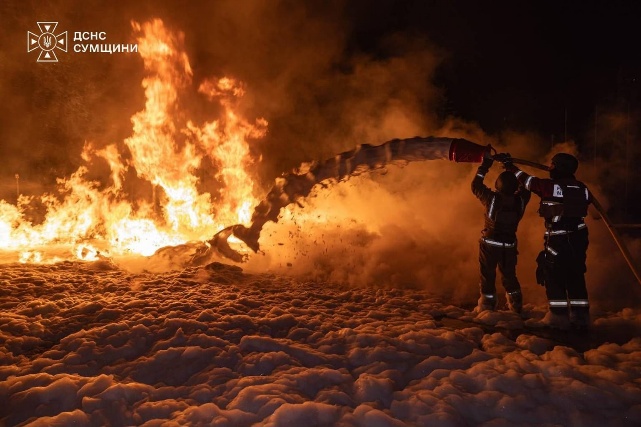
State Emergency Service personnel extinguish a fire at a petrol station in Sumy. (State Emergency Service / Telegram)
Then, around midday, Russia struck again — this time a food-processing plant in Pavlohrad, a Dnipropetrovsk Oblast city that has become a shelter for people displaced from more dangerous towns nearby. Three workers were killed and at least 28 wounded, including a 2-year-old girl; three of the injured remained in intensive care. It was the second time in a week guided bombs had hit this city; three days earlier, a similar strike on a Pavlohrad apartment building killed two people and wounded 18, including a 1-year-old and a 13-year-old. Across the wider region, Russian forces struck four separate districts more than 40 times over the course of the day, damaging 23 apartment buildings and a school. By the time anyone finished counting, the region’s toll alone stood at three dead and 32 wounded — a single afternoon’s arithmetic in a war that keeps demanding new sums.
AN EVENING ATTACK ON ZAPORIZHZHIA, AND BOMBS FALLING ON SLOVIANSK
As if the day hadn’t delivered enough, Russia saved a further blow for the evening. Five guided aerial bombs hit Zaporizhzhia City after the workday ended, wounding at least 25 people — six of them children, including a three-month-old infant — and tearing into a private medical center, a kindergarten, residential buildings, and parked cars across three separate impact sites. “At the end of the working day, Russian forces dropped five guided aerial bombs on residential neighborhoods, knowing that civilians would be harmed,” regional governor Ivan Fedorov said. President Zelensky condemned the strike directly on social media the same evening.
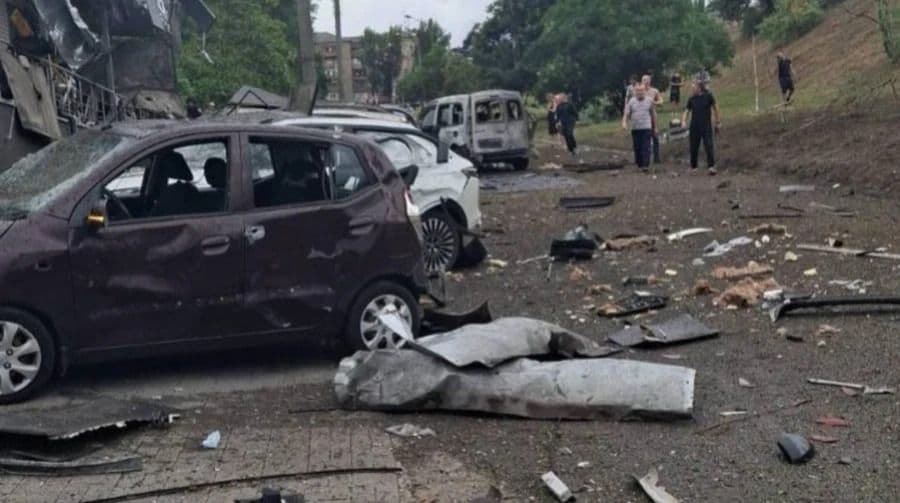
Debris and damaged cars after a Russian attack on Zaporizhzhia, Ukraine. (Zaporizhzhia Oblast Military Administration / Telegram)
Sloviansk, in Donetsk Oblast, took its own hit earlier the same afternoon: two Russian aerial bombs struck a residential district, wounding 14 people between the ages of 36 and 82 and damaging seven five-story apartment buildings badly enough that rescue crews had to suspend recovery work when the threat of a follow-up strike returned. “They are hunting civilians and trying to turn ordinary life into constant fear,” Donetsk governor Vadym Filashkin said. Two guided bombs, one afternoon, one more Ukrainian city added to a list that keeps getting longer rather than shorter.
A MECHANIZED ASSAULT FAILS AT DOBROPILLYA
For the first time in more than a year, Russian forces attempted a genuine mechanized assault near Dobropillya — tanks and armored infantry vehicles advancing together from the Ocheretyne direction, rather than the small infiltrating groups that have defined most of the fighting here for months. Ukrainian defenders destroyed roughly 80 percent of the vehicles before they reached Ukrainian positions, according to a Ukrainian military source; a second source suggested a similar assault may have happened nearby, though it couldn’t be independently confirmed. Ukrainian units typically publish footage of destroyed Russian armor within two or three days of an assault, so more evidence may surface shortly.
The failed assault came as Russian forces separately claimed to strike a Ukrainian command post near Dobropillya with guided bombs — a claim geolocated footage appears to support, even as the broader mechanized push collapsed. A few miles south, the fight for Kostiantynivka remained exactly as unresolved as it’s been for weeks: Ukrainian forces struck Russian infiltration positions in the city’s east, while a Ukrainian officer in the area described Russian units increasingly avoiding direct engagement, preferring to slip behind Ukrainian lines and hide equipment in foliage rather than fight head-on. Neither city changed hands. One of them almost changed hands with tanks, and didn’t.
THE REST OF THE LINE
Elsewhere, the front held its shape without much drama, which in this war counts as its own kind of news. Russian forces pushed without success in northern Sumy Oblast, northern Kharkiv Oblast, and the Velykyi Burluk direction, where Ukrainian defenders repelled attacks and struck back at Russian strongpoints. Near Pokrovsk, a Ukrainian corps spokesperson reported that Russian forces are deploying a homegrown satellite communications system called Rassvet — Russia’s answer to Starlink — alongside drone units from its elite Rubikon center, using cellular networks and mesh-relay technology to keep drone operations running despite Ukrainian jamming. Ukrainian forces answered by striking Russian supply trucks along two separate roads feeding the Pokrovsk front and hitting an airfield Russian forces had been using to launch attack drones.
Farther south, Russian assaults gained no ground in Novopavlivka or Oleksandrivka, where Ukrainian brigades reported counterattacking with small mobile groups and pickup trucks while jamming Russian drone signals badly enough that Russian operators are reportedly experimenting with frequency-hopping and AI-guided targeting to get around it. In Zaporizhzhia City, regional officials reported a surge in arson attacks on administrative buildings, tracing it to Russian intelligence services recruiting local residents through social media and dating apps to commit sabotage — a reminder that not every front in this war involves a rifle.
REACHING DEEPER INTO RUSSIA
Ukraine’s long-range strike campaign kept finding new targets well outside the front line. Drones hit a fuel and energy facility in Ulyanovsk Oblast’s Novospassky district, more than 480 miles from the fighting, sparking a fire at the NS-Oil refinery there. Farther south, a Wildberries warehouse — Russia’s rough equivalent of Amazon — burned near Voronezh City, roughly 120 miles from the front, in what would be at least the fifth such strike on the retailer’s facilities in two weeks. In the Republic of Bashkortostan, nearly 750 miles from Ukraine, drone debris sparked a fire at an industrial facility after a strike on a fuel pipeline dispatch station in the town of Subkhankulovo — among the deepest strikes Ukraine has conducted into Russian territory to date.
Closer to the fighting, imagery published this week showed the wreckage of a Russian Su-57 stealth fighter — one of Russia’s most expensive and advanced aircraft, worth an estimated $100 to $120 million — that crashed near Moscow during takeoff; Russia’s Defense Ministry blamed a malfunction rather than Ukrainian action, and the pilot reportedly ejected safely. Whatever the cause, it’s one more of Russia’s most capable jets that won’t be flying combat missions this month.
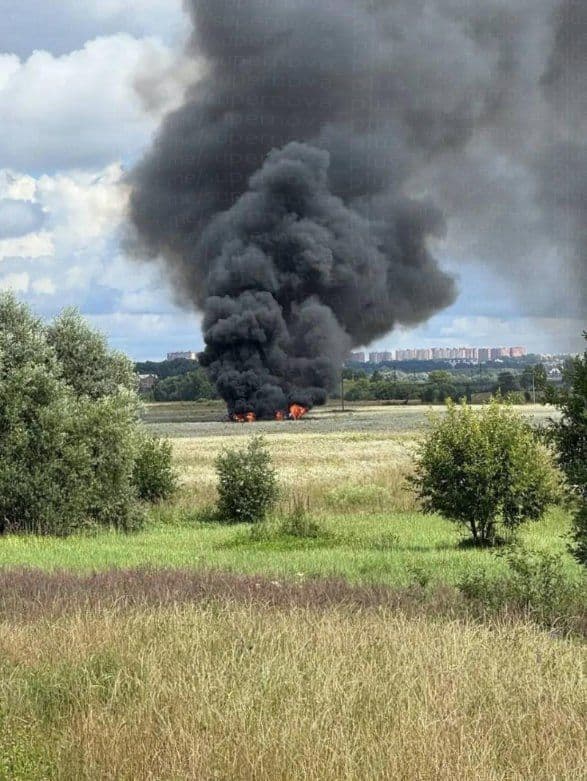
Footage purporting to show a military aircraft on fire after a reported crash in Russia’s Moscow Oblast. (Supernova Plus / Telegram)
SQUEEZING CRIMEA, AND NOVOROSSIYSK FEELS IT TOO
Ukraine’s siege of occupied Crimea’s power grid continued overnight, with drone strikes reported near electrical substations across the peninsula’s southern coast and at the Balaklava Thermal Power Plant near Sevastopol, prompting fresh outages that Crimea’s own occupation energy operator says are hitting the northwest, east, and south hardest. The pressure is spreading to the Russian mainland too: Reuters reported that Russian authorities have quietly banned naval vessel movement at Novorossiysk, Russia’s largest port, between midnight and 5 a.m. — an unofficial, verbally communicated restriction meant to protect ships from Ukrainian strikes. Kazakhstan’s government confirmed it has suspended loading at the nearby Caspian Pipeline Consortium oil terminal for the same reason, and is now limiting its own oil production to avoid overfilling storage it can no longer ship out.
There are signs Russia expects this to get worse before it gets better. Leaked documents published by the investigative outlet Void Group indicate Russian occupation authorities in Crimea are preparing to evacuate the families of Black Sea Fleet personnel and other military employees from the peninsula altogether. Separately, UNESCO added the ancient Greek ruins of Tauric Chersonese, in occupied Sevastopol, to its list of World Heritage sites in danger, citing years of illegal excavation and looting under Russian occupation — a quieter form of loss, but one Ukraine’s foreign ministry called part of the same pattern of impunity it’s trying to break.
THE GRAIN CORRIDOR GRINDS TO A HALT
Not a single commercial vessel entered a Ukrainian port on July 22, Agrarian Policy Minister Taras Vysotskyi said, after Ukrainian shipowners independently suspended calls given the risk of Russian strikes. “They attacked all the ships. They will intensify this,” Zelensky said, standing alongside visiting Irish Prime Minister Micheál Martin, adding that Kyiv had anticipated the strategy months ago and assigned an official specifically to protect the export route. Danish shipping giant Maersk and German carrier Hapag-Lloyd both confirmed they’re suspending service to Chornomorsk port, rerouting cargo to Constanta, Romania, instead — following Sunday’s missile strike on the grain carrier Golden Leo, which killed 10 crew members as it left Odesa.
The toll is no longer abstract. Ukraine’s Sea Ports Authority says Russia struck 23 port facilities and 17 civilian vessels in the first two weeks of July alone, killing 11 people, including foreign sailors and dockworkers. Maritime intelligence firm Lloyd’s List says the disruption is already pushing wheat prices higher as shipowners reassess whether Ukrainian waters are worth the risk — a slow-motion problem for a country that, before the war, supplied roughly 6 percent of the world’s wheat exports.
UKRAINE’S SHADOW FLEET TALLY PASSES 170
Ukraine’s drone campaign against Russia’s sanctioned oil-tanker fleet kept climbing this week. Commander Robert “Magyar” Brovdi reported 13 more vessels struck over 48 hours — dry cargo ships, tankers, and floating cranes among them — bringing the total hit since the campaign, nicknamed “Molochka,” began on July 6 to 172 vessels in 13 days. Brovdi’s forces also reported hitting 13 more energy facilities in occupied Crimea over the same stretch, part of the same sustained pressure that has made blackouts nearly routine on the peninsula.
The campaign’s logic is straightforward: Russia’s shadow fleet exists specifically to move sanctioned oil around Western price caps, and every tanker taken offline makes that evasion marginally harder and more expensive. Whether that arithmetic changes Moscow’s calculations is a separate question — but Kazakhstan halting its own oil terminal operations this week suggests the pressure is no longer confined to ships flying a Russian flag.
MANILA: RUBIO SAYS NO DEAL WAS MADE, LAVROV DISAGREES
Marco Rubio and Sergei Lavrov sat down together for the first time since September 2025, on the sidelines of a Southeast Asian foreign ministers’ summit in Manila, and walked away describing two different meetings. Rubio told reporters that ending Russia’s war will require “new ideas” and “new concepts,” explicitly distancing Washington from Russia’s repeated claims that a peace framework was already agreed at last August’s Alaska summit. “If, when peace comes, it’ll be because of some new idea,” Rubio said, adding that the US is “prepared to play that role in a positive way.”
Lavrov’s own account, relayed by Russia’s foreign ministry, insisted Russia remains committed to “understandings” reached at Alaska and warned that continued US weapons deliveries to Ukraine are “unacceptable.” He also accused European countries of pursuing a “destabilizing policy” aimed at inflicting a “strategic defeat” on Russia. The two accounts can’t both be true, and Washington has said so directly and repeatedly for eleven months; Lavrov keeps citing Alaska anyway, a sign the story is more useful to Moscow politically than it is accurate. Separately, Zelensky said he’d held a call of his own with Trump envoys Steve Witkoff and Jared Kushner, describing it as “a good, important conversation on how to reinvigorate diplomacy” — modest, incremental movement on a track that’s been frozen for six months.
A PATRIOT INTERCEPTOR, TIMES THREE
Ukraine’s chronic shortage of Patriot interceptors — the only weapon in its arsenal that reliably stops Russian ballistic missiles — picked up three separate threads of good news this week, none of which will help this month. Zelensky announced that Ukraine and US defense contractor Raytheon have agreed to jointly produce Patriot interceptor missiles, following talks that began at the NATO summit in Ankara; no timeline was given. Separately, Lockheed Martin’s newer, cheaper interceptor — the PAC-3 ACE, priced at less than half the roughly $4 million cost of the current model — remains at least 36 months from production. And Germany continues assembling older PAC-2 interceptors domestically under a $4.7 billion deal, with deliveries to Ukraine not expected before 2027.
None of it changes the math for right now: current PAC-3 interceptors are built only in the US and, under license, in Japan, and Lockheed has said it cannot guarantee delivery timelines even as it scales annual production from roughly 650 missiles toward 2,000 by 2033. Three paths toward more interceptors are now open. All three lead somewhere past this winter.
HISTORY IN THE AIR: A UKRAINIAN F-16 DOWNS A SU-35
Somewhere over eastern Ukraine, in an engagement the Pentagon only described as having happened “recently,” a Ukrainian F-16 fighter shot down a Russian Su-35 — the first confirmed air-to-air kill between the two jet types in the war, according to Gen. Dan Caine, chairman of the US Joint Chiefs of Staff, testifying before the Senate. Multiple reports suggest the engagement took place around July 8, involving a Ukrainian MiG-29 that lured the Su-35 into range by faking an attack on a ground target, after which two F-16s moved in and one scored the kill.
The Su-35 forms the backbone of Russia’s combat air fleet, filling in for a Su-57 stealth fighter program that’s been plagued by production delays — only 30 to 40 aircraft delivered so far against much larger ambitions. Caine also praised Ukraine’s defense industry directly in his testimony, telling senators the country’s manufacturers are “doing incredible work” scaling their own capabilities. According to Ukraine’s General Staff, Russia has now lost 436 aircraft and 353 helicopters over the course of the war — a tally this single dogfight adds one more entry to, but the first of its specific kind.
FEDOROV DRAWS A LINE, ZELENSKY LOOKS BACKWARD AND FORWARD
The standoff over Ukraine’s defense ministry hardened rather than resolved this week. Fedorov, who has met repeatedly with Zelensky since his firing, said flatly he won’t accept any role except his old one, rejecting an offer that reportedly included deputy prime minister for military innovation. “There are only three positions in the country that, alongside the troops on the battlefield, actually shape the course of the war: the president, the defense minister, and the commander-in-chief,” Fedorov said. “That is why I will not accept any position other than defense minister.” With that demand still unmet, protest organizers confirmed nationwide demonstrations will resume July 24.
Zelensky, for his part, tried to lower the temperature around the men who just lost their jobs. He said former commander-in-chief Syrskyi and former General Staff chief Andrii Hnatov will keep working alongside Ukraine’s new military leadership, mentoring incoming commander Drapatyi rather than stepping fully aside. “There are things Syrskyi did that may not always be visible, but it is very important that we do not lose them,” Zelensky said, adding that Drapatyi’s newer ideas shouldn’t sit “in drawers” either. It reads like an attempt to have it both ways — honoring the men the public wanted gone while insisting their knowledge still matters — and whether Ukraine’s soldiers see it as reassurance or as evasion will likely become clearer at Friday’s protest.
IRELAND’S MONEY, AND A REFINERY IT CAN’T QUITE EXPLAIN
Irish Prime Minister Micheál Martin used a Kyiv visit to announce a new €125 million aid package — €100 million for non-lethal military equipment including air defense support, and €25 million for repairing energy infrastructure ahead of winter — bringing Ireland’s total wartime support past €670 million. “Civilian casualties are at their highest since the full-scale invasion began,” Foreign Minister Helen McEntee said in announcing the package.
The visit came with an awkward footnote. Martin also addressed growing criticism of the Aughinish Alumina refinery in County Limerick — owned by Russian aluminum giant Rusal — which continues shipping alumina, the raw material for aluminum, to Russian smelters despite the war. An Irish government review found no definitive proof the material reaches Russian weapons manufacturers, Martin said, but couldn’t rule it out either; official figures showed 83 percent of Ireland’s alumina exports went to Russia in early 2026, though Ireland’s enterprise minister later revised that figure down to roughly 45 percent, citing inaccurate data. Zelensky asked the Irish government directly to examine whether the plant could be sanctioned under Irish law. It’s a small reminder that even Ukraine’s most committed allies sometimes have their own uncomfortable supply chains to explain.
A MONASTERY, A CHEESEBURGER, AND A CHANGE OF HEART
Laura Loomer, a prominent ally of US President Donald Trump who once called Ukraine a state “full of Nazi apologists” and argued it should surrender to Russia, stood inside Kyiv’s 11th-century Kyiv Pechersk Lavra monastery this week and said the opposite. Bare-headed, in a tan pantsuit, she described a June 15 Russian drone strike on the site — Ukraine’s holiest Orthodox complex, rebuilt after Soviet forces destroyed it in World War II — that cracked meter-thick walls and split religious icons. “If you talk about Christianity so much, why would you ‘drone’ the oldest monastery in Ukraine?” she asked in a video address, naming fellow American commentators Tucker Carlson and Candace Owens as figures still defending Russia as a Christian stronghold.
Ukrainian outlets covered the reversal largely at face value, crediting the visit with reaching audiences other messaging can’t. “Such visits help show a foreign audience the real scale of Russian crimes against Ukrainian cultural heritage,” Ukraine’s Zerkalo Tyzhnia wrote. Loomer, who has 1.9 million followers on X and reportedly retains real access to Trump, also posted images of herself eating a McDonald’s cheeseburger near a Kyiv metro station heavily damaged in a May missile strike that killed four people — a juxtaposition her team framed as a tribute to Ukrainian resilience. Whether one influencer’s change of heart moves any policy in Washington is unclear. That it happened at all, loudly and on camera, is itself the story.
RUSSIA PAYS WIDOWS TO HAVE CHILDREN IT CAN’T REPLACE
Russia’s State Duma passed a bill this week offering state-funded fertility treatment — IVF and artificial insemination, though not surrogacy — to widows whose husbands died fighting in Ukraine, provided they don’t remarry and can produce notarized consent signed before the husband’s death. It’s one more entry in a growing list of incentives Russian officials are offering to reverse a demographic collapse the war has only accelerated: Russia’s total fertility rate fell to 1.305 children per woman by the end of 2025, its lowest since 2006, and the government has stopped publishing detailed birth and death data since spring 2025.
Valentina Matviyenko, speaker of Russia’s upper house of parliament, made the underlying pitch explicit this month, urging young Russian women to “fall in love early, marry early, start a family early” rather than prioritize careers, warning that the alternative is “tears into the pillow, loneliness, and no happiness.” It’s a strange kind of national bargain being offered in real time: the state that keeps sending husbands to die in Ukraine is now offering to help their widows have children anyway — not to undo the loss, but to keep the population numbers from reflecting just how large it’s become.
WHAT WEDNESDAY INTO THURSDAY COST
By the time Thursday’s toll was fully counted, Ukraine had lost workers at a lunch shift, children at a kindergarten, and neighbors in an apartment block that will need seven separate repair crews. It had also, in the same 24 hours, destroyed a tank assault before it reached the line and put a fighter jet in the history books. Rubio told Lavrov to his face that Moscow’s favorite story about Alaska isn’t true, and Lavrov kept telling it anyway. Whatever comes of any of this — the interceptors still years away, the grain ships still not sailing, the protest still scheduled for tomorrow — none of it arrived because anyone stopped fighting today.
A PRAYER FOR UKRAINE
1. For the Workers of Pavlohrad’s Lunch Shift
Lord, three people went to work at a food-processing plant on an ordinary Thursday and did not come home, and dozens more, including a two-year-old girl, were carried out wounded. Hold their families through a grief that arrived with no warning at all, and comfort the three still fighting in intensive care tonight. Protect this city that has already sheltered so many people fleeing danger elsewhere, and now must absorb it directly, twice in one week.
2. For the Three-Month-Old Child of Zaporizhzhia
Father, an infant too young to walk or speak was among six children wounded when bombs fell on a kindergarten and a medical center this evening, in neighborhoods that should have been safe at the end of an ordinary working day. You hold what we cannot: the fear a parent feels counting fingers and toes after a blast. Heal this child completely, and give her family strength for the nights of watching still ahead of them.
3. For the Neighbors of Seven Broken Buildings in Sloviansk
Lord of shelter, seven apartment blocks in Sloviansk took damage today, and the fourteen people wounded there ranged from 36 years old to 82 — a whole neighborhood’s worth of ordinary lives interrupted at once. Rescue crews had to stop their work when the danger returned before they’d finished, forced to leave people waiting inside damaged homes. Protect those still waiting for help tonight, and give the rescuers who paused today the chance to finish the work tomorrow.
4. For the Pilot Who Made History, and Every Pilot Still Flying
God of courage, one Ukrainian pilot did something no one on either side of this war had done before, and lived to tell of it, while a whole crew of pilots and ground teams made that single moment possible without ever appearing in the headlines themselves. Watch over every pilot still flying missions the rest of us will never hear about by name, in aircraft older and more outmatched than the enemy’s. Let skill and courage keep outpacing the danger, for as long as this war asks it of them.
5. For Every Widow Grieving Far From the Front
God of comfort, on both sides of this war, women are grieving husbands who will not come home, and some are being offered fertility programs and cash instead of the thing they actually asked for, which was for their families to stay whole. Hold every widow, Ukrainian and Russian alike, whose grief no government policy can actually resolve, and whose loss no new child could ever simply replace. Give them people around them who grieve with them rather than move quickly to solve them.
In Your mercy, in Your justice, in Your time — bring this war to its end, and let the ending be worthy of what Ukraine has endured.