
July 25, 2026
Prepared by Diana Bozhyk
Russian missiles hit Kyiv for the second time in three days overnight, setting an 18-story apartment building on fire, less than 48 hours after a strike on a defense exhibition killed 10 people outside the capital. In Siberia, Kazakhstan’s president told Vladimir Putin to his face that the war should be frozen and negotiations resumed — a rare public rebuke from one of Russia’s closest allies. Russia killed at least 11 people and wounded 70 more over the day, with Sloviansk and Sumy absorbing the worst of it, even as Ukraine’s own drones reached deeper into Russia than ever, striking oil infrastructure from the Caspian Sea to the Ural Mountains.
THE DAY’S RECKONING
Just after midnight, explosions rolled across Kyiv again — missile debris tearing into an apartment building’s seventh and eighth floors, a fire in a district most residents had hoped wouldn’t see another strike so soon after Friday’s. Nobody died this time, but the message was the same one Zelensky had delivered hours earlier: Russia had readied missiles for another massive attack, and the clock on his 48-hour warning was still running. Eleven hundred miles east, in the Siberian city of Omsk, something rarer happened — Kazakhstan’s president, sitting beside Putin on camera, said the war should simply stop. “It is a shame, young people are dying,” Kassym-Jomart Tokayev said, in words Putin’s own allies almost never say to him directly. By the end of the day, Sloviansk had absorbed yet another battering, Sumy had lost three delivery drivers to a drone that hunted its own rescuers, and Ukrainian strikes had reached targets on the Caspian Sea nearly a thousand miles from the nearest trench. Two countries, once again, spent the same 24 hours proving they’re nowhere near finished.
SLOVIANSK’S SECOND DAY OF DEVASTATION, AND SUMY’S TRIPLE LOSS
By the time anyone finished counting Friday’s toll, it stood at six dead and 30 wounded in Donetsk Oblast alone, almost all of it concentrated in Sloviansk. A morning glide-bomb strike killed five people and wounded 27, tearing into 16 apartment buildings, 21 houses, and the already-damaged Honorary Consulate of Latvia; a second wave later the same evening added three more deaths and further damage before the day was done. Sloviansk, home to more than 40,000 people who’ve chosen to stay, now sits within range of both guided glide bombs and the FPV drones that increasingly hunt civilians directly rather than waiting for them to wander into a strike zone.
Sumy’s loss came with its own cruelty. A jet-powered Russian drone struck a Nova Poshta courier facility overnight, killing three drivers — aged 43, 48, and 53 — and setting off a fire rescuers couldn’t approach at first because Russian forces kept the threat of a follow-up strike alive, a tactic Ukrainian officials call a “double-tap.” Two of the men died at the scene; the third died of his injuries on the way to the hospital. Added together with strikes on Kharkiv Oblast (one killed, 14 wounded), Zaporizhzhia (one killed, 19 wounded), Kherson (four wounded), and Chernihiv (three wounded), the day’s overall toll reached 11 dead and 70 injured — a single 24-hour stretch, repeated with only minor variation, for the fifth consecutive year.
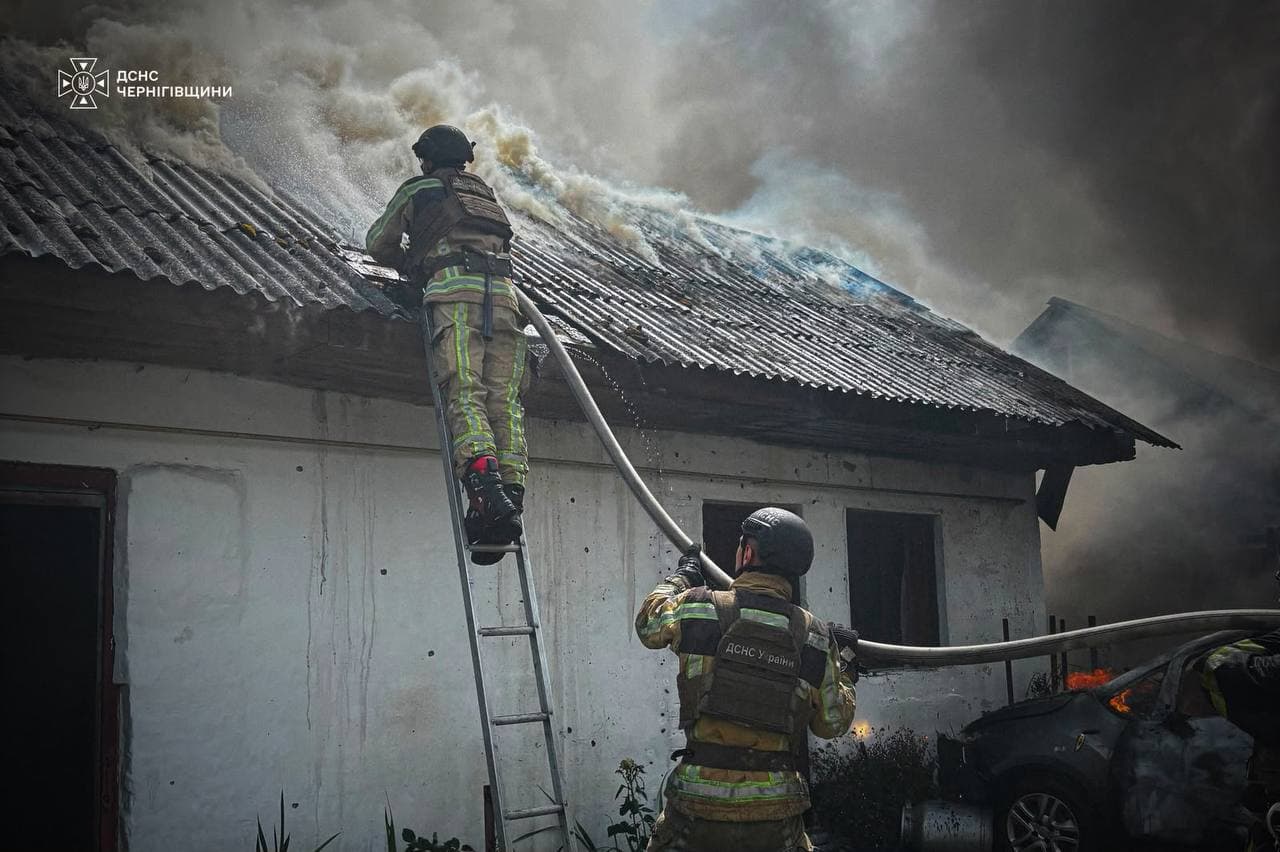
Firefighters work to extinguish a blaze following a Russian strike in Chernihiv Oblast, Ukraine. (Local authorities/Telegram)
A SECOND WAVE: ZAPORIZHZHIA’S WATER PLANT AND KHERSON’S ARTILLERY
The day’s violence didn’t stop once the overnight numbers were tallied. Saturday brought a fresh round: three guided bombs hit Zaporizhzhia City, one of them striking a facility that purifies and delivers the city’s drinking water, killing one woman and wounding 11 more, including three children. Rescuers pulled the woman from the rubble but couldn’t revive her. Hours earlier, Russian artillery had shelled two districts of Kherson, hitting a multi-story apartment building and killing a 47-year-old man outright, wounding two more severely enough to require ongoing treatment; the shelling damaged three more apartment blocks, five private houses, a school, and a garage.
Neither strike came with the scale of Friday’s Kyiv attack, but together they made a point Ukrainian officials have been making for months: the front line barely needs to move for the war to keep finding new civilians. A water treatment plant and an apartment courtyard are not military targets by any reasonable definition, yet both burned on the same Saturday afternoon.
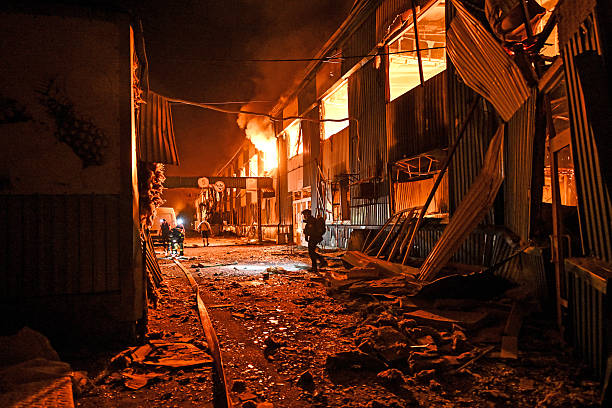
A shopping complex burns following a Russian attack in Zaporizhzhia. In the early hours of Saturday, July 25, Russian troops struck the city with drones, igniting a fire that spread through shops and trading pavilions over an area of about 900 square metres. A 63-year-old man was injured in the attack. (Dmytro Smolienko/Ukrinform/NurPhoto via Getty Images)
KYIV STRUCK AGAIN, AND AN ORGANIZER FACES CHARGES
Just after midnight, air raid sirens sent Kyiv residents back into shelters for the second time in three days. Missile debris hit an 18-story residential building in the Shevchenkivskyi district, sparking a fire between the seventh and eighth floors; a second fire broke out at a non-residential site in Solomianskyi district. No one died this time — a rare piece of good fortune rather than a change in Russian targeting — but the strike arrived exactly within the 48-hour window Zelensky had warned about the previous evening.
Accountability moved faster than usual on the other strike. Prosecutor General Ruslan Kravchenko announced the detention of the chief organizer behind Friday’s defense exhibition, the one a Russian ballistic missile hit in Bucha Raion, killing 10 people and wounding about 100. Investigators found the event — which drew over 300 people, including military personnel and government officials — had been arranged without authorization from military command or regional administrations, at an open location where the nearest shelter, just 34 square meters, sat roughly 100 meters away. Invitations went out nine days in advance, with the exact time and location shared a full 24 hours before the strike. “Hundreds of people were in conditions of obvious security risk from the very beginning,” Kravchenko said. A separate legal review will examine whether police, the security service, and local authorities failed to catch the risk themselves.
FRONTLINE: UKRAINE ADVANCES AT OLEKSANDRIVKA WHILE DOBROPILLYA HOLDS
Ukrainian forces confirmed further details this week about the mechanized assault Russia attempted near Dobropillya on July 22, one Ukraine had already been repelling. National Guard Commander Oleksandr Pivnenko said elements of two full Russian combined arms armies — including a tank division — pushed from multiple directions during a four-hour assault, attempting to reach settlements near Shakhove before being turned back. Russian forces have made no further confirmed progress in the area since.
The more interesting movement came farther south, in the Oleksandrivka direction, where Ukrainian forces have quietly been advancing for days. Military observer Kostyantyn Mashovets reported Ukrainian gains toward the Hulyaipole–Velyka Novosilka road, an important supply route for two Russian armies, forcing Russian commanders to redirect troops meant for their push toward Orikhiv just to hold the line. Russian forces are compensating for the setback by leaning harder on glide bombs, according to a Ukrainian drone interceptor commander in the area, after Ukrainian counter-drone units made ordinary Shahed and Geran attacks less effective there. It’s a small pocket of the map moving the wrong way for Moscow, in a war where small pockets are usually all either side gets.
DEEP INTO RUSSIA AND ONTO THE CASPIAN SEA
Ukraine’s long-range campaign reached further this week than it has in months. Zelensky confirmed strikes on an oil refinery in Tyumen, a logistics facility in Yekaterinburg, a fuel depot in Rostov-on-Don, and an industrial plant in Kirov supplying Russian weapons components — the second consecutive day Kirov’s defense plant has been hit. Ukraine’s Security Service separately claimed strikes on Rostov-on-Don’s air defenses, destroying a radar tied to Russia’s S-400 system, a Tor-M2 launcher, and an electronic warfare unit, along with two warehouses storing FPV drones.
The most striking expansion came at sea. SBU drones struck the Filanovsky oil platform and a Russian Molniya-class missile boat in the Caspian Sea, along with sanctioned cargo vessels Ukraine says ferry military supplies between Iran and Russia. One of those vessels turned out to be Iranian-flagged; Tehran claims the strike killed one sailor and wounded another, condemning it as “an act of aggression” and summoning Ukraine’s chargé d’affaires in protest. Zelensky didn’t address the Iranian vessel directly, but did say the strikes produced “very good results,” and the SBU offered its own line: “The Russian war will return to its home harbor.” Whether hitting a vessel tied to Iran was intentional or incidental, it’s a reminder that Ukraine’s war has started drawing in the countries that keep supplying the other side.
PUTIN’S NEIGHBOR SAYS STOP
Kazakhstan’s president did something almost no one close to the Kremlin does in public: he told Putin, on camera, that the war should end. Speaking alongside Putin at a Russia-Kazakhstan forum in Omsk, Kassym-Jomart Tokayev said the conflict should be “frozen” and negotiations resumed under a revised Istanbul framework, adding that its underlying causes remain “not entirely clear” even to Russia’s own allies. “It is a shame, young people are dying,” he said. “All this has to be stopped.”
Putin didn’t respond in the public portion of the meeting; Kremlin spokesperson Dmitry Peskov later told reporters flatly that “a freeze as such is impossible,” reasserting that Russia must first achieve its territorial objectives — the same maximalist demands Putin has repeated since 2022, now aimed at a military that isn’t advancing the way it once was. Tokayev’s own praise for Putin’s “diplomatic flexibility” at last summer’s Anchorage summit softened the rebuke somewhat, but the core message still landed: even a government that has never condemned Russia’s invasion is now saying, out loud, that it doesn’t understand why the fighting continues.
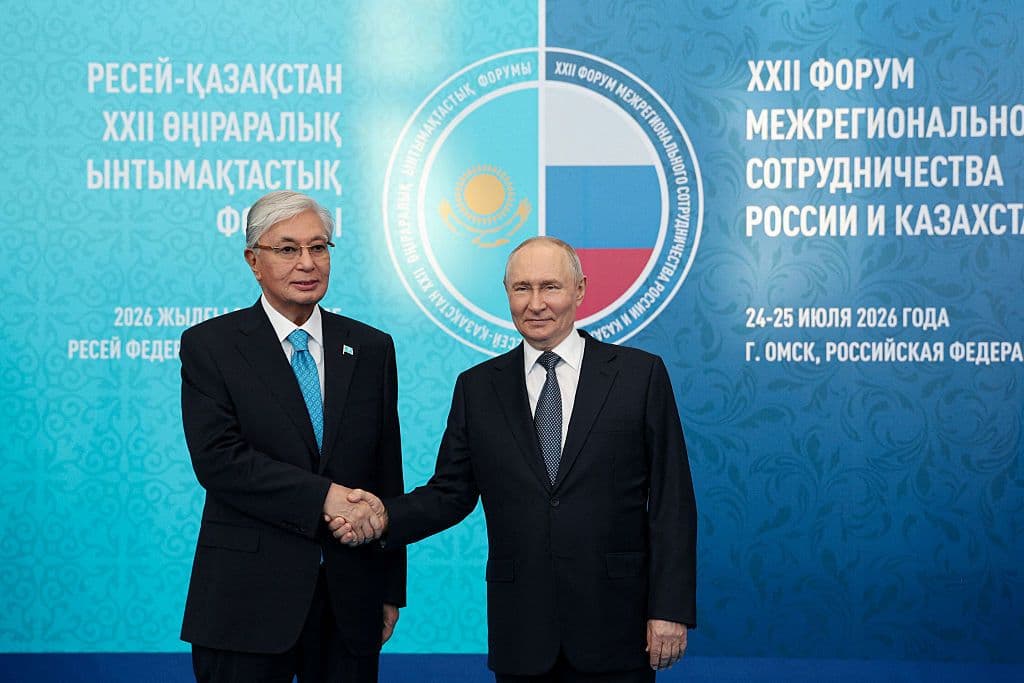
Russia’s President Vladimir Putin (R) greets Kazakhstan’s President Kassym-Jomart Tokayev during the 22nd Russia-Kazakhstan Forum of Interregional Cooperation in Omsk. (Vyacheslav Prokofyev / POOL / AFP via Getty Images)
WASHINGTON DRAWS A LINE AT SEA
The Trump administration formally warned Ukraine against striking non-Russian vessels in the Black Sea, after Ukrainian drones disrupted operations at a terminal carrying oil linked to US energy giant Chevron. According to the Wall Street Journal, the warning followed a meeting between Chevron CEO Mike Wirth and senior US officials, after Ukrainian forces struck four tankers near Novorossiysk, one of them chartered by Chevron. The terminal in question serves the Caspian Pipeline Consortium, which carries Kazakh crude — including from Chevron’s Tengiz field, roughly 12 percent of the company’s entire global output — through Russian territory to the Black Sea, accounting for about 2 percent of daily global oil supply.
The episode captures an awkward reality Ukraine’s naval campaign keeps running into: the infrastructure it wants to choke off from Russia often carries other countries’ oil too, and Washington is willing to say so plainly when American corporate interests sit in the crossfire. The pipeline itself remains undamaged, but the disruption already forced Kazakhstan to cut its own oil production for lack of storage space — collateral pressure on a neutral country’s economy from a war it isn’t part of.
BRUSSELS LETS MEMBERS SELL SEIZED OIL
Buried inside the EU’s newly finalized 21st sanctions package is a provision letting member states confiscate and sell oil seized from Russia’s sanctioned shadow fleet tankers — turning ships once quietly impounded into a direct source of revenue for the governments that catch them. The measure adds financial teeth to a broader pattern of European boarding operations that has already intercepted several shadow fleet vessels in recent months.
It’s a small provision inside a much larger package, but a telling one: rather than simply immobilizing seized tankers indefinitely, the EU is choosing to monetize them, converting Russia’s own sanctions-evasion fleet into a funding source for the effort to sanction it further.
RUSSIA’S MATH PROBLEM, AND NORTH KOREA’S REINFORCEMENTS
Zelensky laid out Russia’s recruitment crisis in blunter numbers than usual this week: from January through July, Russian forces suffered roughly 222,500 casualties — 131,000 killed, 93,000 wounded — while recruiting only about 221,000 new personnel over the same stretch, a rate of roughly 31,600 losses against 31,570 recruits every month. “A significant share of those wounds are severe, as frontline medical care in Russia is catastrophically poor,” Zelensky said. Independent estimates suggest the gap may be even wider: Ukrainian intelligence previously found Russia signed only about 70,500 new contracts in the first three months of 2026, well short of both its own target and the roughly 90,000 signed in the same period last year.
Zelensky said the shortfall is why Russia is now looking to Pyongyang for help: Moscow wants an additional 30,000 North Korean troops, with preparations underway in Voronezh Oblast since June to receive them, alongside more North Korean ballistic missile launchers. It would mark a sharp escalation from the roughly 15,000 North Korean soldiers Russia has used so far, mostly in rear-area roles freeing up Russian troops for the front. Zelensky also warned that Russia is preparing a formal wave of involuntary reserve call-ups for autumn — timed, analysts believe, to land after Russia’s own parliamentary elections in September, when the political cost of forcing more Russians to fight will be easier to absorb.
A SATELLITE ACCUSATION: RUSSIA, IRAN, AND US BASES IN THE GULF
In his evening address, Zelensky made a claim with implications well beyond Ukraine’s own war: that Russia has been feeding Iran satellite imagery of American and Gulf military installations amid the US-Iran conflict. “Since the beginning of July, we have recorded active Russian satellite surveillance of the Gulf states and US military facilities located there. These images subsequently appear in Iran,” Zelensky said, citing a pattern of Russian satellite passes timed both before Iranian strikes, apparently for planning, and afterward, apparently to assess damage. He said four air bases — two in Bahrain, one each in Jordan and Kuwait — fell within Russian satellites’ area of interest on July 19 and 20 alone.
If accurate, the claim suggests Russia’s cooperation with Iran has moved well past drone supply into active intelligence-sharing against American assets — a serious allegation Zelensky offered without independent corroboration, delivered at a moment when Washington’s attention is already split between Ukraine and the Middle East. It’s the kind of claim that, true or not, is designed to remind Washington that the war it’s trying to wind down in Ukraine and the one it’s fighting with Iran may not be as separate as they look.
WILDBERRIES REACHES THE URALS, AND GAS RUNS SHORT
Ukrainian drones struck a Wildberries logistics facility in Yekaterinburg, nearly 1,100 miles from Ukrainian territory, setting fire to vehicles in the parking lot and forcing an evacuation; the company said the center resumed operations later the same day. The strike also disrupted an all-Russian athletics competition in the same city, halted over drone threats — a small, almost surreal sign of how far the war’s disruption now reaches into ordinary Russian life. It’s part of a Wildberries campaign that has now run nearly a full week without pause.
Russia, meanwhile, extended its gasoline export ban through the end of 2026, with officials saying they’ll consider lifting restrictions on diesel exports only “as the market recovers.” The shortage has pushed some Russians to cross into Kazakhstan for cheaper fuel — gasoline that costs roughly $0.59 a liter in the Kazakh city of Uralsk sells for nearly $1.30 in parts of Russia — prompting Kazakh authorities to restrict border crossings to once daily and report 61 attempted fuel-smuggling operations caught in just two days.
ZELENSKY, LOOMER, AND A PEACE DEAL ANYWHERE TRUMP WANTS
In his continuing conversation with US influencer Laura Loomer, Zelensky said he’s ready to sign a peace agreement wherever Trump chooses to host it, including the White House Oval Office or Mar-a-Lago. “It depends on President Trump,” he said, framing the venue as irrelevant next to the question of timing. He also used the interview to directly deny allegations of drug use that have circulated among some US commentators, including a claim involving French President Emmanuel Macron, calling the people spreading it “crazy people” and declining to name which pro-Russian commentators he considers credible.
Separately, SpaceX CEO Elon Musk told the Economist that a complete Russian withdrawal from Ukraine is “unrealistic” and urged a “pragmatic” settlement instead, while confirming publicly for the first time that Russian forces have obtained Starlink terminals through smuggling networks rather than direct sales, prompting SpaceX to build a verification “whitelist” that has occasionally cut off legitimate Ukrainian civilian users along with the intended targets. Two men close to the war’s biggest outside stakeholders — one running the platform much of Ukraine’s battlefield communication depends on, another representing the country fighting the war itself — spent the week describing two very different paths to the same word: peace.
A CONTESTED DEATH TOLL ON THE AZOV COAST
Russian occupation authorities claimed a Ukrainian strike killed 12 people, including four children, at what they described as a seaside “tourist camp” near Kyrylivka in occupied Zaporizhzhia Oblast, with occupation head Yevgeny Balitsky saying eight more people remain missing. Russian Foreign Ministry spokesperson Maria Zakharova used the claim to accuse Ukraine of deliberately targeting civilians. No Ukrainian source has confirmed a strike on the recreation center itself; a former Mariupol mayoral adviser reported that Ukrainian forces struck Russian military positions near the same site, and Ukraine has not commented on the Russian casualty claim at all.
Russia has repeatedly used unverified claims like this one to accuse Ukraine of civilian targeting, particularly at moments when Russian battlefield setbacks need a counter-narrative. That doesn’t make the claim automatically false — only unconfirmed, and worth treating as exactly that until better evidence surfaces from either side.
UKRAINE’S STARLINK COUNTERINTELLIGENCE, AND ITS OWN SATELLITE AMBITIONS
Ukraine’s Security Service detained a Dnipro resident accused of illegally activating more than 1,000 Starlink terminals for Russian forces, using a scheme built on stolen identities and a Russian handler’s instructions delivered over Telegram — the largest such network the SBU has dismantled yet, following a smaller case involving 76 terminals uncovered just a day earlier. All 1,000 terminals have been blocked.
Ukraine is also working to reduce its reliance on Starlink altogether. Satellite firm Stetman is advancing a $1.1 billion plan to build a 360-satellite constellation under direct Ukrainian government and military control, with the first 120 satellites planned for launch — via SpaceX itself — in 2027. It’s a strange loop: Ukraine building its own satellite independence partly atop the launch capacity of the same company whose existing network keeps needing to be defended from Russian infiltration.
QUIET SIGNALS: A FIRE AT ENGELS, A DOWNED SHAHED IN KUWAIT
A fire broke out overnight at Russia’s Engels-2 airbase in Saratov Oblast, home to the strategic bombers Russia uses to launch cruise missiles at Ukrainian cities, just over a week after Ukraine confirmed destroying a Tu-95 bomber there. Russian authorities reported a drone threat over the region the same night, though local residents said they heard no sounds of an attack, and independent monitors caution the fire may be unrelated to any strike at all. Neither government has offered an official explanation.
Farther from the war entirely, the US military reported its first combat use of the Merops interceptor drone — a system tested in Ukraine — destroying an Iranian-made Shahed drone over Kuwait. It’s a small footnote next to everything else this week, but a telling one: a weapon refined on Ukrainian battlefields is now defending American forces on the other side of the world, evidence that this war’s technology keeps outrunning its geography.
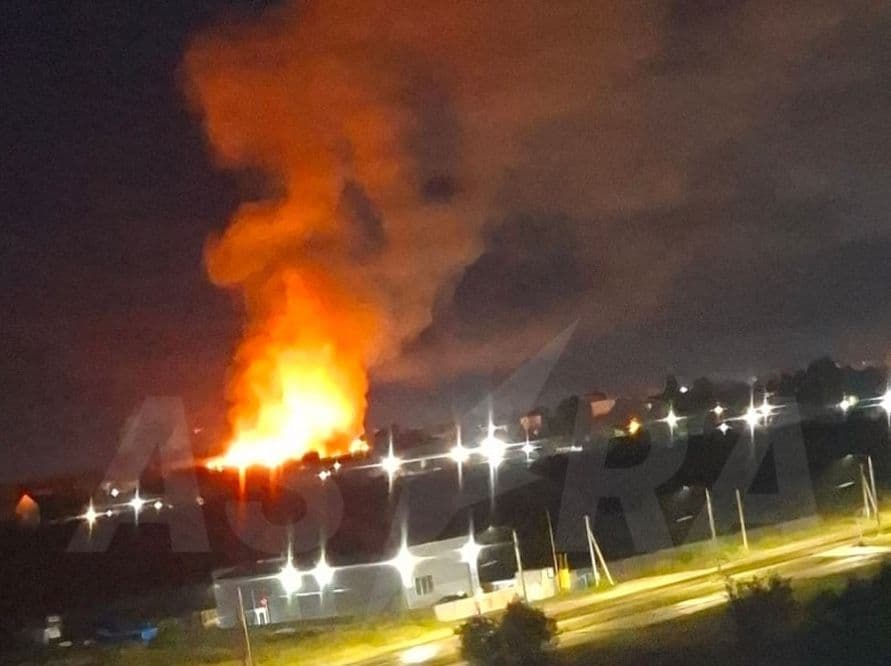
Flames and plumes of smoke reportedly rise from the area of the Engels-2 military airfield overnight. (Astra / Telegram)
WHAT SATURDAY CONFIRMED
By the time Saturday folded into Sunday, Ukraine had buried people in three different regions and was still counting the cost of a Kyiv strike that, this time, killed no one. Kazakhstan’s president had said what almost nobody in Moscow’s orbit says out loud, and Peskov had said no anyway. Ukrainian drones had reached the Caspian Sea and the Ural Mountains in the same 24 hours Russian drones reached a Sumy delivery van and a Zaporizhzhia water plant. Nothing about the shape of this war changed today. It simply kept confirming, in a dozen different cities, that it isn’t finished yet.
A PRAYER FOR UKRAINE
1. For the Three Drivers of Sumy
Lord, three men who spent their days delivering packages to other people’s doors did not come home, killed by a strike built specifically to catch the rescuers who came after them. Hold their families through a grief made harder by how deliberately it was caused. Protect every courier and driver still on Ukraine’s roads tonight, doing work that has quietly become dangerous.
2. For the Woman at the Water Plant
Father, a woman working to bring clean water to her city was pulled from rubble that rescuers could not undo, and eleven more were wounded beside her, including three children. Even the most basic necessities of daily life — water, electricity, a working stove — have become targets in this war. Comfort those who loved her, and protect every worker still showing up to jobs the rest of us rarely think to call dangerous.
3. For Sloviansk, Struck and Struck Again
Lord of shelter, a city already reduced to 40,000 residents absorbed bombs twice in a single day, and still some choose to stay rather than leave the only home they have left. Protect those who remain, and give wisdom to those still deciding whether it’s time to go. Let this city’s endurance be met, eventually, with actual safety rather than just another morning survived.
4. For a Leader Who Said the Quiet Thing Aloud
God of truth, one head of state, sitting beside the man waging this war, said plainly that it should stop. Give courage to anyone in a position to say hard truths to power, however small that courage looks next to what’s actually needed. Let honest words, even from unlikely places, chip away at what silence has allowed to continue.
5. For a Country Still Waiting on the Missiles That Haven’t Come Yet
God of peace, tonight Ukraine sits inside a warning window that hasn’t closed, unsure whether the worst of this week has already happened or is still somewhere ahead in the dark. Steady every family checking the sky before checking anything else, and every parent deciding whether to wake a child now or wait for the sirens to decide for them.
In Your mercy, in Your justice, in Your time — bring this war to its end, and let the ending be worthy of what Ukraine has endured.