
July 26, 2026
Prepared by Diana Bozhyk
A Russian drone equipped with its own camera struck a crowded Chernihiv supermarket in broad daylight, killing a 9-year-old girl and one adult and wounding 25 people doing nothing more dangerous than buying groceries. Overnight, Russian missiles and drones killed at least seven more people and wounded 58 across six regions, while Kyiv absorbed its third missile strike in four days. And in St. Petersburg, Vladimir Putin marked Navy Day by canceling his own parade for the second year running, delivering a speech about Russian naval power to a city too worried about Ukrainian drones to actually show any ships.
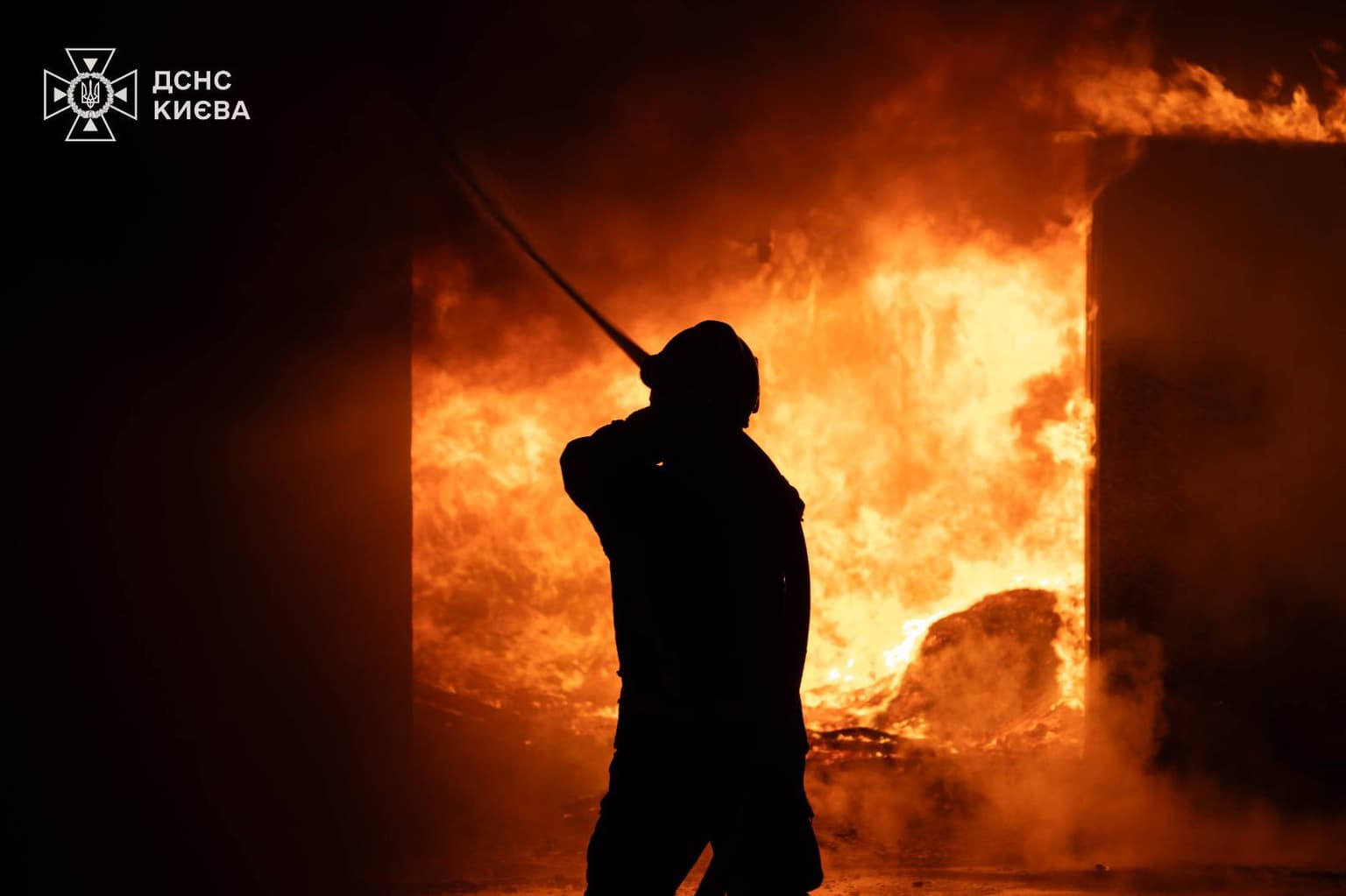
Firefighters extinguish a blaze in the aftermath of a Russian missile attack on Kyiv overnight. (Ukraine’s State Emergency Service/Telegram)
THE DAY’S RECKONING
The drone that hit the ATB supermarket in Chernihiv on Sunday afternoon had a camera mounted on it, which means someone was watching, in real time, as it flew into a building full of people doing their weekend shopping. A 9-year-old girl died there, along with one adult; 25 more were wounded, three of them children. It happened in daylight, at a chain store more than a million Ukrainians visit every single day, which is either the least defensible target of the war or exactly the point. The night before had already delivered its own toll — seven dead, 58 wounded, spread across six regions before most people woke up — and Kyiv, for the third time in four days, spent part of its morning watching smoke rise from an apartment block that had already caught fire twice this week. Eleven hundred miles northeast, Vladimir Putin stood in St. Petersburg and gave a speech about the might of the Russian Navy, in a city where the actual ships stayed in port and the internet kept cutting out. One country buried a child today. The other canceled a parade.
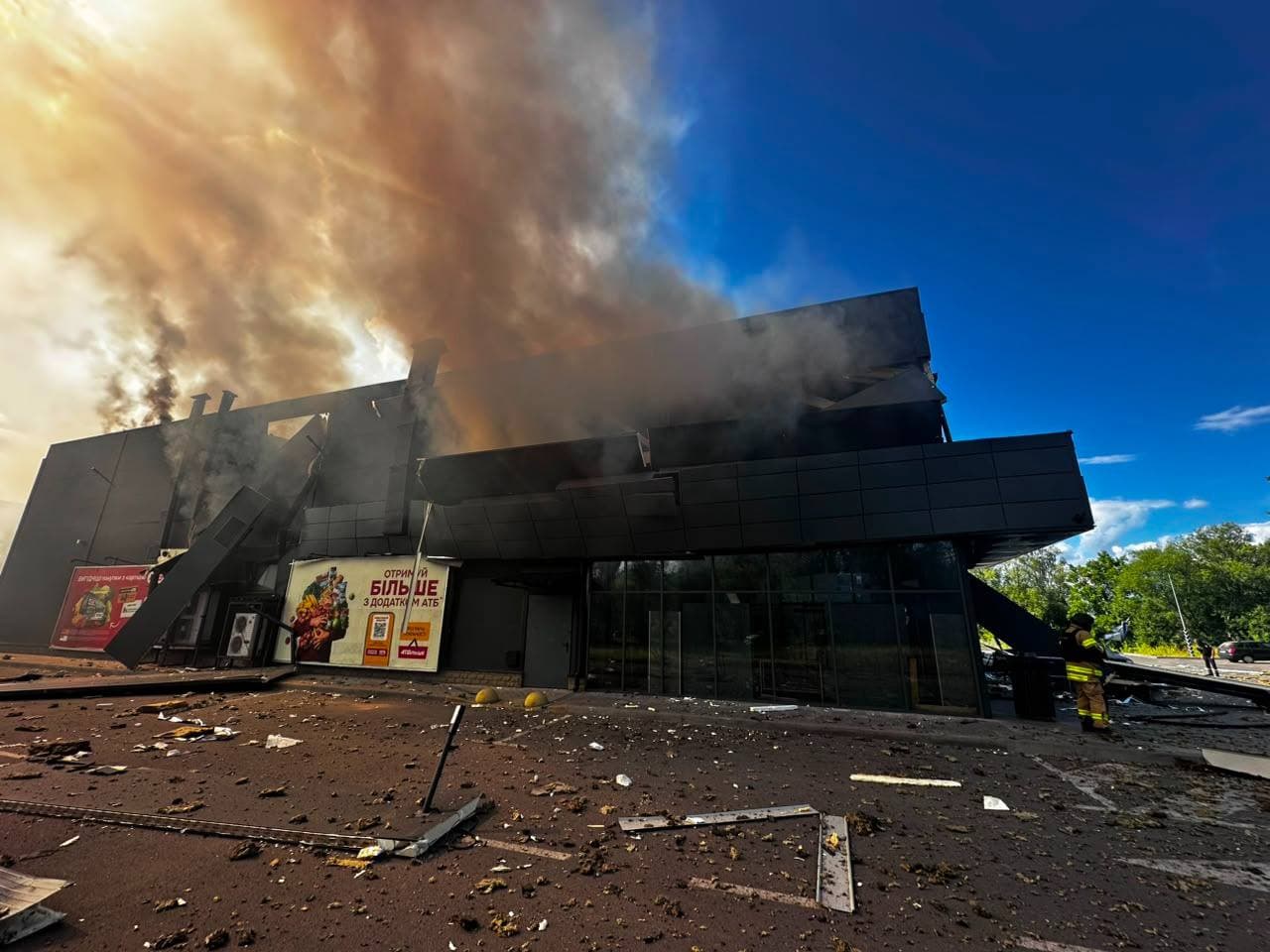
An ATB supermarket in Chernihiv after being attacked by a Russian drone. (Dmytro Bryzhynskyi / Telegram)
A SECOND WAVE OF DEATH: CHERNIHIV’S SUPERMARKET AND THE OVERNIGHT TOLL
Russia’s overnight barrage arrived first, the way it usually does: one Kh-59/69 cruise missile, seven Iskander-M/S-400 ballistic missiles, and 136 drones, launched from four directions inside Russia and occupied Crimea. Ukrainian air defenses downed most of it — the missile, five of the seven ballistic weapons, and 104 drones — but what got through still killed. By the time regional governors finished counting, the toll stood at seven dead and 58 wounded across six oblasts: two killed and four wounded in Dnipropetrovsk, where an FPV drone caught a 74-year-old woman inside her own car and a second strike an hour later killed a 35-year-old woman near a supermarket; one killed and 14 wounded in Kharkiv; two killed and 24 wounded in Kherson, where strikes hit homes, a church, and a gas station; one killed and 12 wounded in Zaporizhzhia Oblast, which absorbed 1,029 individual strikes across 50 settlements in a single day; one killed and eight wounded in Sumy; and three wounded, no deaths, in Kyiv itself.
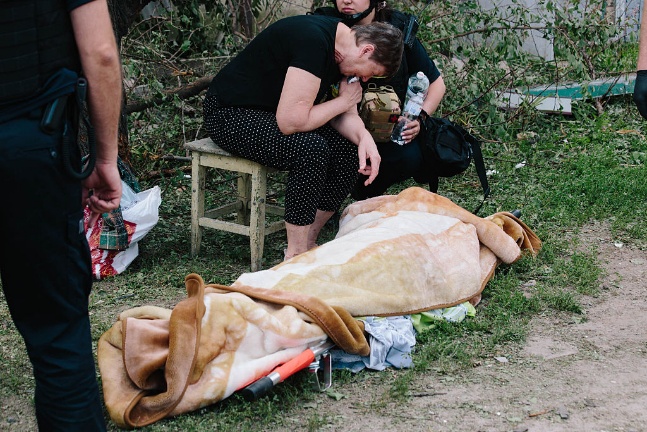
The family member of a woman killed in a Russian strike cries next to her body in Kharkiv. (Pavlo Pakhomenko/NurPhoto via Getty Images)
Then came Chernihiv, hours later and separate from that overnight count entirely. A camera-equipped Russian drone struck an ATB supermarket — Ukraine’s largest retail chain, serving more than a million shoppers daily — in the middle of the afternoon, killing a 9-year-old girl and one other person, wounding 25 more. “This indicates that these are not acts of war; they are acts of terrorism,” said Ukrainian lawmaker Fedir Tymoshko, pointing to the camera as evidence the strike was deliberately aimed rather than accidental. President Zelensky called it “a completely cynical drone strike” against “a regular supermarket,” and Chernihiv declared July 27 a day of mourning. Separately, one more person was killed the same day in strikes on front-line Druzhkivka, Donetsk Oblast — a toll too late for anyone’s morning tally, and too ordinary, in this war, to make many headlines beyond it.
KRYVYI RIH BURNS, AND A GRAIN SHIP FINALLY SINKS
Russian forces struck an Epicentr hypermarket in Kryvyi Rih early Sunday, igniting a fire that spread across more than 16,000 square meters of a store selling everything from hardware to sporting goods. Firefighters kept working through ongoing air raid alerts, and officials were still confirming casualties as the fire was brought under control. It was one of at least two attacks on ordinary retail spaces in Ukraine on the same day — a hypermarket in the morning, a supermarket by afternoon — that shared nothing in common except the fact that neither one was a military target by any definition either side could defend.
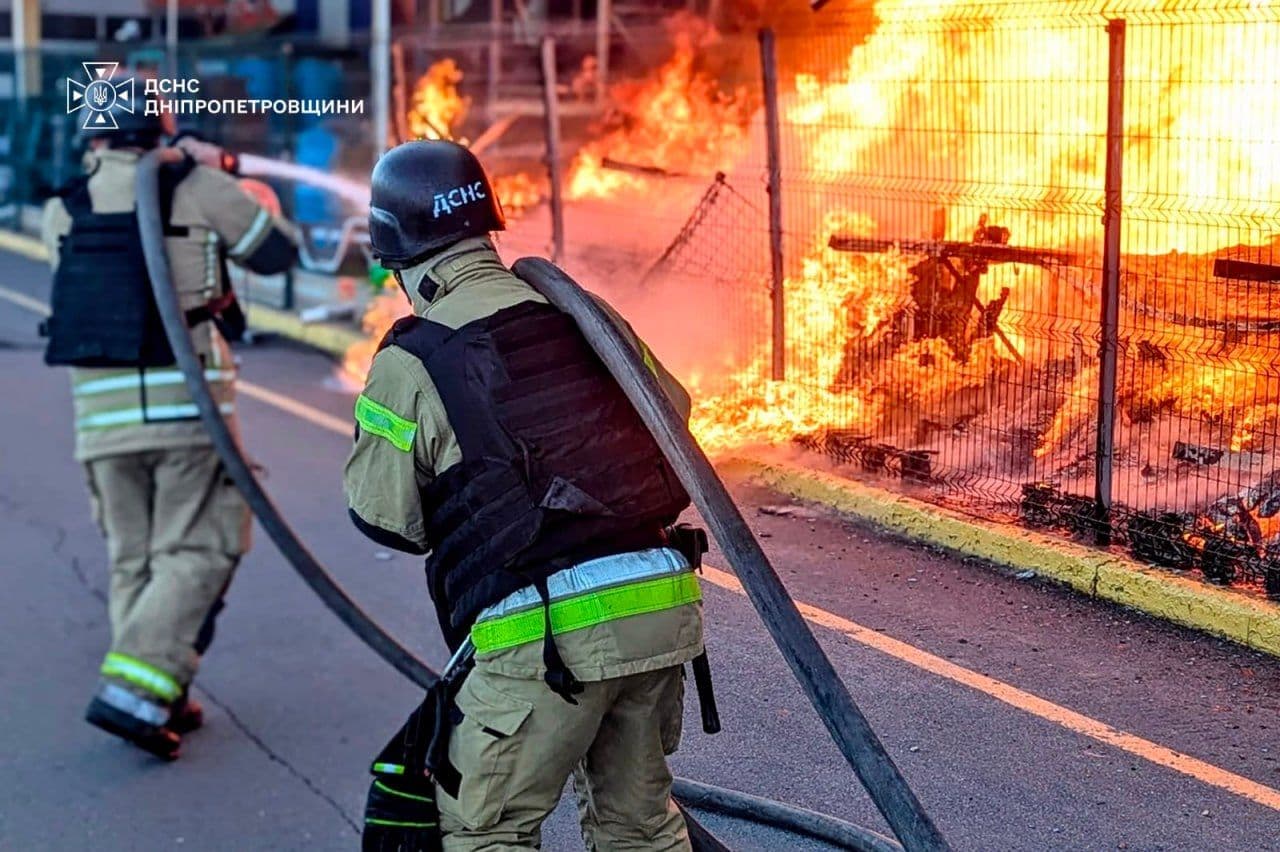
Firefighters contain a fire at the Epicenter building materials supermarket in Kryvyi Rih, Dnipropetrovsk Oblast, after the site was hit by a Russian strike on the morning. (State Emergency Service of Dnipropetrovsk Oblast)
At sea, a different kind of ending arrived. The Golden Leo, the grain carrier Russian cruise missiles struck off Odesa on July 19, finally sank this week, a week after the attack that killed 10 of its crew and pilot. Ukraine’s Sea Ports Authority said the ship’s hull and superstructure never recovered enough seaworthiness to stay afloat, and confirmed no one remained aboard when it went down. The sinking came as Russian forces struck yet another civilian vessel the evening before — a Palau-flagged cargo ship carrying 2,800 tons of corn to Greece, hit by a double drone strike as it left an Odesa-region port. Seven crew members and a Ukrainian pilot were rescued; two sailors remained missing at the time of reporting, thrown into the water by the initial blast.
KYIV STRUCK A THIRD TIME IN FOUR DAYS
For the third time since Friday, Russian missiles reached Kyiv, injuring three people — two men and a woman — in the Solomianskyi district and setting fires across the Desnianskyi, Shevchenkivskyi, and Solomianskyi districts. Debris struck the same 18-story residential building hit earlier in the week, this time damaging its upper floors further; a warehouse, several vehicles, and an abandoned structure also caught fire. No one has died in any of the three Kyiv strikes since Friday’s arms exhibition attack, a run of good fortune that has more to do with timing than any change in what Russia is aiming at.
THE FRONT HOLDS, BUT ZAPORIZHZHIA LOSES ITS TRAINS
Along most of the line, today looked like most other days this month: Russian forces pushed without success near Sumy, north of Kharkiv City, in Kupyansk and Borova, and in Hulyaipole and western Zaporizhzhia, while Ukrainian troops held or, in places like Hrafske northeast of Kharkiv, cleared out Russian positions Moscow had claimed to hold. Near Pokrovsk, Russian forces claimed to seize two settlements, Shevchenko and Bilytske, though ISW flagged the Bilytske footage as likely AI-altered — a recurring pattern of staged claims — while a Ukrainian brigade reported Russian forces are now conducting reconnaissance and demining routes north of Pokrovsk, preparing for a larger push toward Dobropillya. Near Kostiantynivka, ISW identified a Russian drone unit operating on the battlefield for the first time — the “Soulless” unit of the 242nd Motorized Rifle Regiment — one more small sign of how many different Russian formations have now cycled through this single contested city.
The war’s quieter cost showed up in Zaporizhzhia’s train schedule. Ukraine’s infrastructure minister confirmed that passenger trains have been unable to reach Zaporizhzhia City for three straight days, as sustained Russian drone strikes on rail logistics have effectively cut the city off from the rest of the country’s rail network. No single strike made that happen; it’s the accumulated weight of strikes on tracks, junctions, and rolling stock that did, a kind of siege that doesn’t require capturing a single meter of ground.
DEEP STRIKES: CRIMEA, TYUMEN, AND THE CASPIAN SEA AGAIN
Ukraine’s General Staff confirmed strikes on a Chornomornaftogaz gas and oil facility near occupied Vnukovo, Crimea — infrastructure Russia seized from Ukraine back in 2014 and has used since to fuel its occupation forces — along with a ground relay station that extends the range of Russian Shahed and Gerbera drones, a road bridge in occupied Donetsk Oblast, a drone storage site, and a Russian troop concentration in Luhansk Oblast. Separately, the General Staff confirmed a July 25 strike on the Tyumen Oil Refinery, one of Russia’s largest, with an annual capacity of roughly 7 million tons of fuel feeding Russia’s military-industrial complex.
The Caspian Sea saw fresh escalation too. Ukraine’s Security Service claimed strikes on two vessels, the Port Olya 2 and the Begey, which it says moved military cargo between Russia and Iran. This time, Iran’s response went further than yesterday’s condemnation: Tehran’s Foreign Ministry formally stated it “reserves the right to defend its national interests and security,” and a pro-Iranian Telegram channel circulated an uncorroborated map claiming all of Ukraine sits within range of Iran’s Khorramshahr-4 ballistic missile. Whether that’s a genuine threat or posturing, it marks the second consecutive day Ukraine’s naval campaign has pulled Tehran directly into its own rhetoric about retaliation.
ZELENSKY’S NEW TARGET LIST AND A WEEK OF BOMBARDMENT
Zelensky said Russia has thrown a genuinely enormous amount of ordnance at Ukraine over the past week alone: roughly 1,700 drones, more than 1,630 guided aerial bombs, and 95 missiles, more than half of them ballistic. “We need to thwart Russia’s reliance on ballistic terror,” Zelensky said, repeating his now-familiar appeal for faster interceptor deliveries — “every interceptor missile is literally helping to save lives right now, as long as it is here, in Ukrainian systems, rather than in our partners’ warehouses.”
After meeting with military leadership, Zelensky announced Ukraine has updated its list of priority targets for deep strikes into Russia, aiming to maximize pressure on “their real impact on Russia and its ability to continue and prolong this war.” He said Ukrainian weapons can now reliably strike targets more than 3,000 kilometers away — reaching the Ural Mountains and Siberia, not just Moscow and St. Petersburg — and that Ukraine has carried out more than a thousand deep-strike combat missions since the start of the year. “The strategic depth that has long been a Russian advantage is now becoming a particular problem for the political and military leadership of Russia,” he said, noting that Russian air defenses remain clustered around a handful of high-value sites, leaving most of the country’s vast territory comparatively undefended.
WILDBERRIES HIDES THE EVIDENCE
Russia’s largest online retailer has started hiding its own military inventory from search results. Following a string of Ukrainian strikes on its warehouses that began July 18, Wildberries quietly stopped returning results for search terms like “everything for the SVO” — using Russia’s own euphemism for the war — a query that reportedly used to surface more than 200,000 products, including military helmets and body armor. Typing the same search now returns “no suitable products found.” The obfuscation is only partial: related searches like “SVO accessories” still turn up first-aid kits, tactical backpacks, radios, and drone components.
It’s a small, telling move. Wildberries isn’t removing the goods — just the evidence that they were ever easy to find, at the exact moment Ukraine has been citing that inventory as justification for treating the company’s warehouses as legitimate military targets.
A QUIETER NAVY DAY
Russia canceled its main Navy Day parade in St. Petersburg for the second consecutive year, citing unspecified security concerns rather than the obvious one: Ukrainian drones have grown capable enough to reach the city that hosts it. Putin delivered his remarks from the Admiralty building instead, praising the Russian Navy’s role in the war and reasserting territorial claims well beyond Ukraine — Russia’s presence in the Arctic’s Franz Josef Land, control of the Northern Sea Route, and a vow to defend Kaliningrad “by all available means” against any threat. Russian Navy chief Alexander Moiseyev used the occasion to announce the Navy is forming its own unmanned systems regiments, the first activated within the Northern Fleet on July 1, specifically to help protect Russian vessels from the drone strikes that have made the Black and Azov seas increasingly hostile territory for Moscow’s ships.
The parade’s absence said more than Putin’s speech did. St. Petersburg — his hometown, once considered safely beyond Ukraine’s reach — experienced internet blackouts during the visit itself, and has already absorbed a Wildberries warehouse strike this month along with a June attack on its oil terminal timed to Russia’s own economic forum. A navy with 20 new ships commissioned this year and 21 more planned still can’t guarantee its own showcase event won’t become a target.
PEACE TALK WHISPERS: PESKOV’S “PREMATURE,” ZELENSKY’S PROPOSALS
Kremlin spokesperson Dmitry Peskov said it was too early for Moscow to comment on reports that the US and Ukraine are coordinating a possible partial aerial ceasefire — a step short of ending the war outright, but one both sides have reportedly been discussing behind closed doors. “We do not know how credible these reports are or where they come from,” Peskov said, adding that Russia would need to see how any new proposal aligned with its own interests before responding further.
Zelensky offered a more direct account from Ukraine’s side, saying his government has already given Russia’s political leadership the proposals needed to end the war “with a worthy peace.” He confirmed a recent call with US envoys Steve Witkoff and Jared Kushner and said a meeting with Trump may happen soon, possibly around Senator Lindsey Graham’s funeral on July 28. For now, both sides are describing a diplomatic track that exists mostly in reported detail and public hedging — real enough to comment on, not yet real enough for either side to confirm what’s actually on the table.
ROMANIA’S THIRD STRAIGHT DAY
A Romanian F-16 shot down a drone that crossed into Romanian airspace near the Danube Delta — the third straight day Romania has intercepted an unidentified drone along its border with Ukraine. Investigators confirmed the July 24 drone was a Russian Shahed; the origins of Saturday’s and Sunday’s remain under investigation. “It is inadmissible and intolerable for the Russian Federation to continue violating Romania’s airspace, which is also NATO and European Union airspace,” President Nicusor Dan wrote, and Romania’s foreign ministry summoned Russia’s ambassador for the second time in two days.
Three consecutive incursions in three days is not a pattern Romania can easily write off as accidental drift. Whether intentional testing or simple carelessness on Russia’s part, it’s the kind of repetition that keeps NATO’s eastern members increasingly convinced the war’s edges are widening, one drone at a time.
A POLISH DRONE GUIDES A UKRAINIAN STRIKE
In a smaller story from the Bakhmut sector, Ukraine’s 26th Separate Artillery Brigade credited a Polish-made FlyEye reconnaissance drone with helping guide a HIMARS strike that destroyed a Russian ammunition depot, triggering a secondary explosion that also wiped out an artillery system. The 11-kilogram drone, hand-launched and ready to fly within about 11 minutes, has an operational range of roughly 50 kilometers and has been in Polish military service since 2010; Poland expanded its production into Ukraine last year to meet wartime demand. “For the soldiers of the 26th Separate Artillery Brigade, there is no greater joy than effectively striking enemy targets,” the brigade’s press service said. It’s a small technical footnote next to everything else this week, but a useful reminder that not every weapon making a difference in this war was built in Ukraine or Russia at all.
WHAT SUNDAY LEFT BEHIND
By the time Sunday folded into Monday, Ukraine had buried a 9-year-old girl killed while her family shopped for groceries, and was still counting bodies from strikes that arrived before most people’s alarms went off. Russia, meanwhile, spent its national navy holiday explaining why the parade wasn’t safe to hold in its own founder’s city. Both facts describe the same war from opposite ends: one side absorbing violence in places that were never supposed to be dangerous, the other unable to fully protect even its own celebrations from the consequences of starting this in the first place.
A PRAYER FOR UKRAINE
1. For the Nine-Year-Old Girl of Chernihiv
Lord, a child went shopping with her family on an ordinary Sunday afternoon and did not come home, killed by a drone someone watched fly toward her in real time. There is no way to make sense of that, and we do not ask You to. Hold her family in whatever comes after unbearable loss, and hold this city as it marks a day of mourning for a nine-year-old.
2. For the Two Women of Dnipropetrovsk
Father, a seventy-four-year-old woman died inside her own car, and an hour later a thirty-five-year-old woman was killed near a supermarket in the very next settlement over. Different ages, different mornings within the same hour, the same indifferent violence finding each of them separately. Receive them both, and comfort the families now grieving two losses that arrived almost side by side, on a day that offered them no warning at all.
3. For the Sailors Still Missing at Sea
Lord of the waters, two sailors were thrown overboard when a grain ship burned off Odesa, and search crews are still combing the dark water for them tonight while their families wait for any word at all. Whatever the outcome, be with those families now, and with the rescuers still searching long after most people would have given up hope. Let this searching not be in vain, and let word reach their loved ones soon, whatever that word turns out to be.
4. For Every Passenger Whose Train Never Comes
God of small mercies, a whole city has gone three days without a single train reaching it, cut off not by any single blow but by the accumulated weight of strikes on ordinary rail lines. Hold Zaporizhzhia’s residents in this quieter kind of hardship — not death, but disconnection, uncertainty, delay. Let this city’s link to the rest of the country be restored, and restored to stay.
5. For the Space Between a Proposal and a Peace
God of patience, tonight two governments describe a possible ceasefire neither one will yet confirm out loud, leaving an entire country to keep living inside the gap between what might be discussed and what is actually true. Give wisdom to everyone negotiating in rooms Ukrainians cannot see into, and give Ukraine’s people the strength to keep waiting on words that keep arriving secondhand, through leaks and hedged statements rather than any real certainty.
In Your mercy, in Your justice, in Your time — bring this war to its end, and let the ending be worthy of what Ukraine has endured.