
July 27, 2026
Prepared by Diana Bozhyk
President Zelensky traveled to Portsmouth to meet Britain’s brand-new prime minister, Andy Burnham, in his first face-to-face talks with a foreign leader — securing a promise to share UK jamming technology and build a drone factory on British soil. Iran’s foreign minister escalated a maritime dispute with Ukraine into open insult, calling Zelensky a “freeloader” after a Ukrainian strike on a vessel in the Caspian Sea, while President Trump said he’d simply ask Vladimir Putin whether Russia is helping Iran target American bases. Russian attacks killed at least nine Ukrainians and wounded 76 more overnight, and the toll from Friday’s arms exhibition strike near Kyiv rose to 11 dead as its organizer was formally charged.
THE DAY’S RECKONING
Andy Burnham has been Britain’s prime minister for exactly one week, and he spent part of it standing on the deck of a Ukrainian minesweeper in Portsmouth, telling Volodymyr Zelensky he had Ukraine’s back “one hundred percent.” It was a good day for handshakes and a rough one for everything underneath them. Nine Ukrainians didn’t live to see this Monday’s evening news, killed overnight in strikes on six different regions; the man who organized Friday’s deadly arms exhibition sat in a Kyiv courtroom and heard a judge order him held for 60 days, as the death toll from that single strike climbed to 11. On the Caspian Sea, a dispute over one drone strike on one obscure vessel spiraled into Iran’s foreign minister calling Ukraine’s president a name usually reserved for barroom arguments, not diplomatic cables. And deep inside Russia, Ukrainian drones reached a fuel depot that a regional governor himself admitted was hit by “the largest mass attack” his region had ever seen. Different countries, different kinds of damage — all of it happening on the same ordinary Monday.
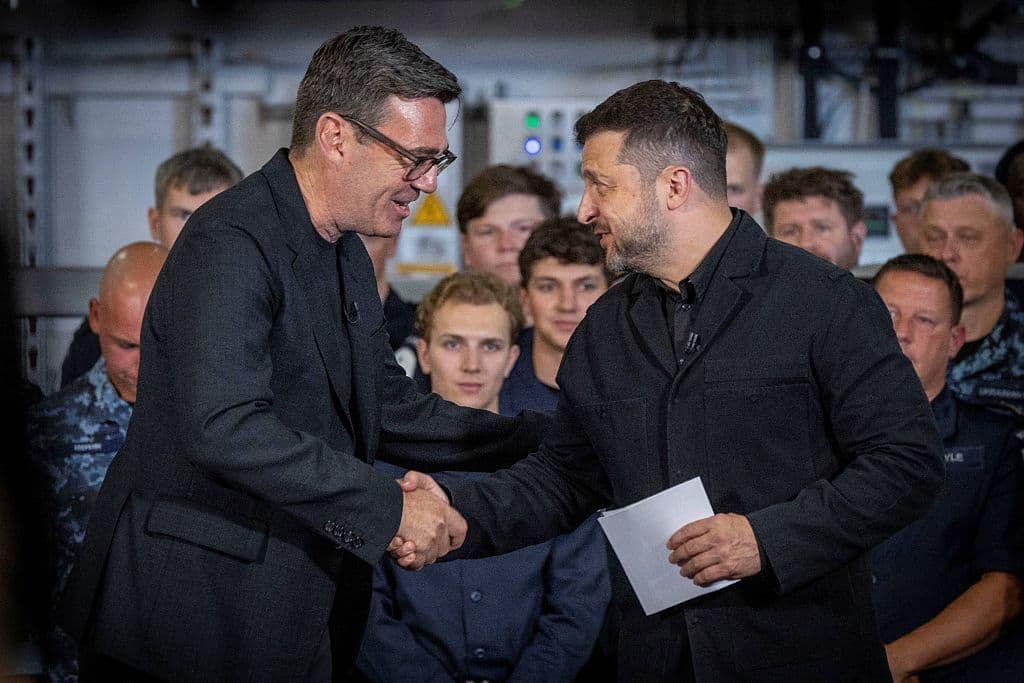
U.K. Prime Minister Andy Burnham (L) shakes hands with President Volodymyr Zelensky (R) as they meet with troops on the south coast of England. (Simon Jones / Pool / AFP via Getty Images)
ZELENSKY IN PORTSMOUTH: BURNHAM’S FIRST FOREIGN GUEST
Andy Burnham used his first meeting with any foreign leader since becoming British prime minister to host Volodymyr Zelensky aboard a Ukrainian naval vessel in Portsmouth — a choice of venue, and of guest, that Burnham’s own office said was “intended to send a very clear message.” “We are with Ukraine one hundred percent,” Burnham said standing beside him. “I will honor every commitment the UK has made to Ukraine in full.” The two leaders had already spoken by phone within hours of Burnham replacing Keir Starmer the previous Monday; this marked their first meeting in person, and Britain’s fifth prime minister to serve since Russia’s full-scale invasion began.
The visit produced something more concrete than reassurance. Downing Street announced it will share the intellectual property behind “Stone Cloak,” a tablet-sized jamming device that helps prevent Russian air defenses from tracking and targeting the drones it’s fitted to — technology the UK has already gifted to Ukraine by the thousands, now handed over in full so Ukrainian factories can mass-produce it themselves. Zelensky, for his part, pitched something in return: a joint drone factory to be built in Britain, telling Sky News “we’re ready to share all our experience with the UK, and I hope that the UK will do the same.” The two also visited roughly 200 Ukrainian sailors and marines who’ve spent three weeks training at a British naval base for future Black Sea mine-clearing missions — a small, practical example of the £25 billion in total support Britain has committed since 2022.
“I DON’T HAVE TIME FOR TALKS”: ZELENSKY ON FEDOROV AND WHAT COMES NEXT
In the same Sky News interview, Zelensky was asked directly whether he’d reinstate Mykhailo Fedorov as defense minister, and gave the closest thing to a final answer he’s offered yet: no, in substance, even without saying the word. “I don’t have time for talks,” he said. “I don’t have time to listen to one side, then to listen to another side, because two sides are not ready to meet each day. And I don’t need to find who is right and who is not right.” He said he respects both Fedorov and the general he fired, Oleksandr Syrskyi, and pushed back on the idea that Ukraine’s recent run of successful long-range strikes belonged to Fedorov alone, calling it instead a coordinated effort across the security service, military intelligence, and frontline units.
Zelensky also used the interview to admit, plainly, a problem his government rarely states so bluntly: “We don’t have enough missiles to defend, this is a problem.” He said Russia continues expanding ballistic missile production faster than sanctions can constrain it, and that Ukraine needs more interceptors “as quick as possible” — a request complicated, he acknowledged, by Washington’s attention being pulled toward its own war with Iran. “I understand the United States is focusing on the Middle East, but because of this, we had this challenge, and for us, it’s a big challenge,” he said, adding that Ukrainian society remains “very strong, but of course, tired” after more than four years of full-scale war. With American Patriot interceptors still scarce and licensed production years from delivering anything, Ukraine is also backing “Freyja,” a joint European anti-ballistic missile system Kyiv hopes could produce a working prototype within twelve months — a homegrown alternative born from the same shortage Zelensky was describing.
NINE KILLED OVERNIGHT, AND CHERNIHIV’S DAY OF MOURNING
Russian strikes killed at least nine people and wounded 76 more across six regions overnight into Monday. Zaporizhzhia Oblast took the heaviest toll — two killed and 13 wounded as Russian forces struck 45 separate settlements — while a 40-year-old woman died and 22 more were hurt in Kharkiv Oblast. In Mykolaiv, strikes on port infrastructure killed two men, aged 50 and 48, and damaged three civilian ships; a separate drone strike wounded two more residents. Sumy Oblast reported nine wounded, Donetsk’s front-line communities of Kramatorsk and Dobropillya three wounded, and Nikopol, in Dnipropetrovsk Oblast, two more, including a 6-year-old boy. A fuller accounting from Donetsk’s regional prosecutor’s office put that region’s toll alone at four killed and 18 wounded, including an 11-month-old baby caught in the blast alongside her 27-year-old mother. Separately, a jet-powered Shahed struck a railway repair crew in Donetsk Oblast, killing one worker and injuring two more.
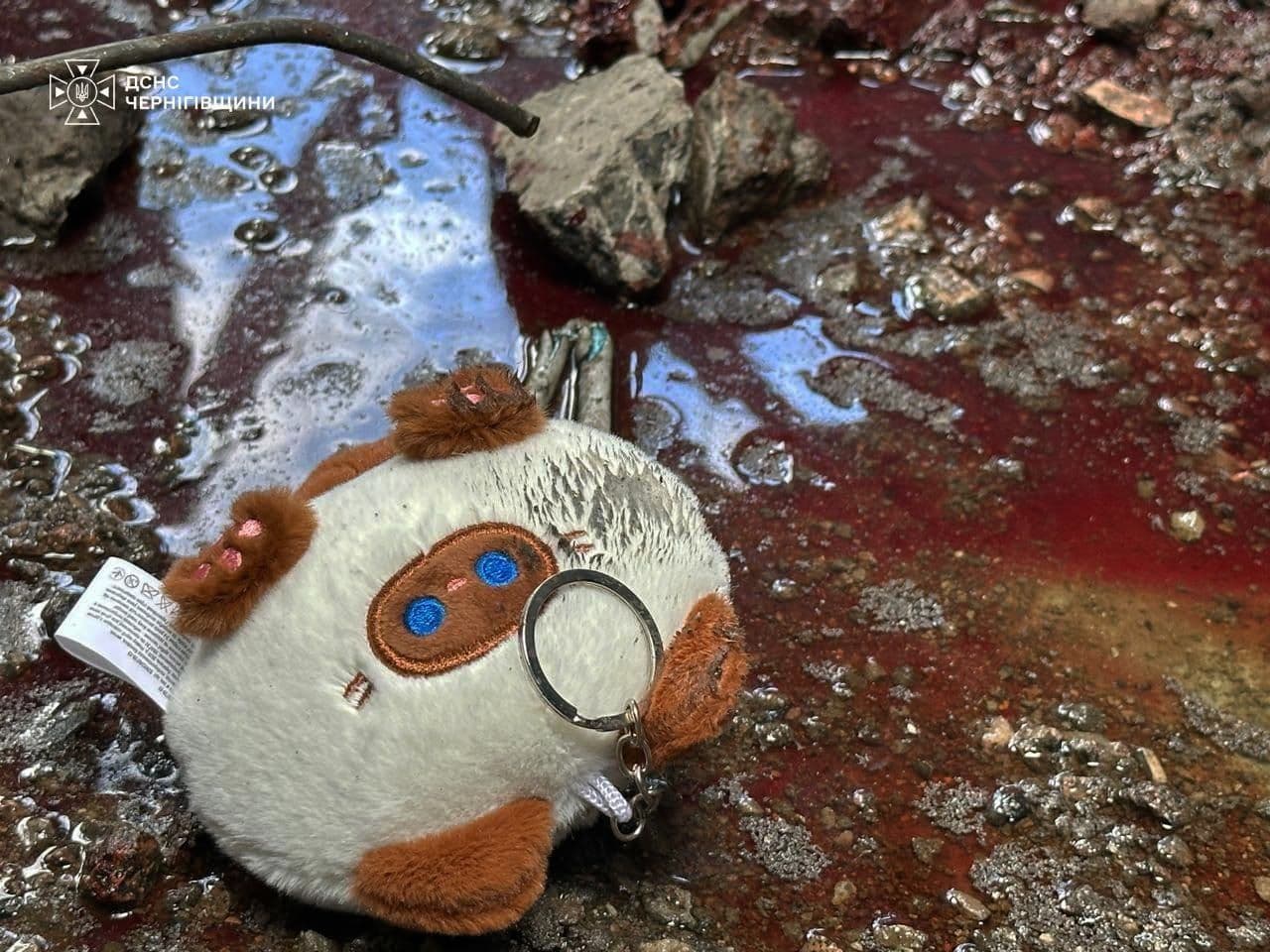
The wreckage at an ATB supermarket in Chernihiv following a deadly Russian drone strike in the afternoon. (Ukraine’s State Emergency Service / Telegram)
Chernihiv, meanwhile, spent Monday burying its dead from Sunday. The city observed a day of mourning for the two people, including a 9-year-old girl, killed when a Russian jet-powered drone struck a crowded ATB supermarket the previous afternoon. Ukraine’s military intelligence agency published new detail on who was responsible: a unit called Combat Group 3 of the “Grom-Kaskad” drone brigade, which HUR says specializes in strikes on civilian targets and recruits well-connected Russians — officials, lawmakers, “regional warlords” — offering them short-term contracts and veteran status without ever sending them near the actual front. “For every war crime committed against the Ukrainian people, there will be fair retribution,” the agency said.
ROSTOV, TAGANROG, AND RUSSIA’S DEEPEST WOUNDS YET
Ukraine’s long-range strike campaign found new targets across a stretch of Russian territory it hadn’t touched with this intensity before. Zelensky confirmed Ukrainian drones struck an export terminal in Rostov-on-Don, killing two people and wounding five, according to the regional governor; a nearby strike hit the city of Taganrog as well. Much farther east, in the Udmurt Republic, drones hit a strategic state fuel reserve near Sarapul — a facility storing large stockpiles of petroleum and emergency fuel — prompting the regional governor to call it “the largest mass attack” his region has experienced in the war so far. Ukrainian forces also struck oil facilities in Yaroslavl Oblast, more than 1,300 kilometers from Ukraine’s border. “With our retaliations, we are returning the war to Russia, so that in the end a decent peace has a chance,” Zelensky said. Ukraine’s air defenses also notched a rarer win overnight, intercepting a Russian Forpost-R — a heavy reconnaissance drone capable of carrying laser-guided glide bombs — over Kursk Oblast, only the sixth confirmed downing of that type since the invasion began.
The reach of these strikes is starting to show up in unlikely places. Wildberries reportedly evacuated its logistics center in Sarapul as a precaution, though the facility itself wasn’t damaged. Ukraine’s air force disclosed that fragments recovered from recent Russian missile strikes carry factory markings dating back only three weeks to two months — evidence, officials say, that Russia is firing missiles almost as soon as they leave the production line. Russia’s own defensive scramble is visible too: open-source trackers have counted roughly 24 new Pantsir air defense towers built around Moscow City in just the past two months, a buildup that says as much about the capital’s nerves as any official statement could.
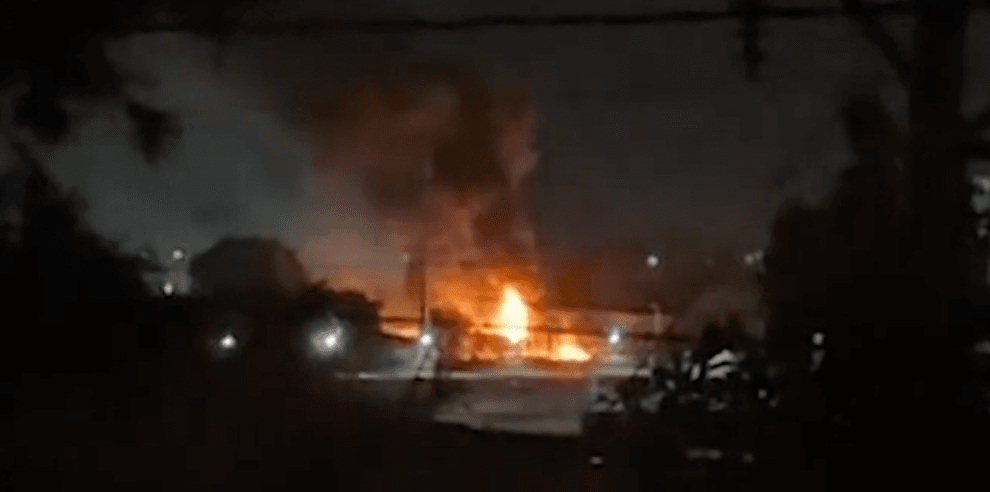
A screenshot from a video purportedly showing the results of a Ukrainian drone attack on a port facility in Rostov-on-Don, Russia. (President Volodymyr Zelensky / Telegram)
CRIMEA’S POWER GRID, KAZAKHSTAN’S OIL, AND A PENINSULA RUNNING DARK
Ukraine’s siege of occupied Crimea’s electrical grid kept tightening. Commander Robert “Magyar” Brovdi reported 18 more energy facilities struck across occupied Ukrainian territory in the past three days, 14 of them in Crimea alone, bringing the year’s total to 154 substations hit. Crimea’s Russian-installed energy operator confirmed power restrictions across the northwest, east, and south of the peninsula, saying outages are now occurring “on short notice” with some settlements unable to receive power at all; Sevastopol’s own occupation governor said the city’s electricity had been “temporarily restricted” simply to keep the wider regional grid from collapsing entirely.
The pressure has spread well past Crimea’s borders. An industry source told Reuters that Kazakhstan has more than halved its daily oil output — down to roughly 1 million barrels a day from June’s 2.16 million — after Ukrainian strikes forced the closure of its main Black Sea export terminal near Novorossiysk. Kazakhstan’s energy ministry said the Caspian Pipeline Consortium resumed operations after a full week offline, but the disruption has already cost the country real production capacity it can’t easily recover. A neutral country’s oil industry, thousands of kilometers from any front line, is now absorbing collateral damage from a war it isn’t fighting.
Ukraine’s military intelligence separately confirmed the destruction of a Russian S-400 air defense launcher and its radar in Crimea, struck overnight between July 25 and 26 east of Hlazivka. Ukraine’s Navy says the cumulative pressure has forced Russia to visibly pull back: aviation and naval activity in occupied Crimea has dropped for “some time,” and only three Russian submarines remain operational in the entire Black Sea, all of them sitting idle at Novorossiysk rather than putting to sea. A fleet built to project power is instead mostly staying in port, waiting out a threat it hasn’t found an answer to.
AN ORGANIZER FACES HIS CHARGES, AND THE TOLL RISES TO ELEVEN
A Kyiv court ordered Vasyl Honcharuk, the organizer of Friday’s defense industry exhibition, held in pretrial detention for 60 days without bail, formally charging him with culpable negligence resulting in death. The death toll from that single Russian ballistic missile strike has climbed to 11, prosecutors said, with around 100 more wounded. Honcharuk’s lawyers called the detention unjustified and declined to discuss the case in detail, saying “many specific circumstances” still need to be established; one lawyer had asked, unsuccessfully, for Honcharuk to be released into his personal custody instead.
The central mystery investigators are still working through is how Russia knew where and when to strike at all. A spokesperson for Ukraine’s Council of the Defense Industry, which didn’t organize the event but represents companies that attended, said no details about the location were ever made public — invitations went out only through closed industry channels, and even the registration link never disclosed the venue. Somehow, two ballistic missiles found it anyway.
GOLDEN LEO’S FINAL COUNT: INDIA JOINS THE PROTEST
New detail emerged this week on the full human cost of the Golden Leo, the grain carrier Russian missiles struck off Odesa on July 19 before it finally sank, adrift and burnt out, over a week later. At least four of the ten crew members and pilot killed in the strike were Indian nationals, prompting New Delhi to file a formal diplomatic protest — a démarche — with Russia’s chargé d’affaires days after the attack, calling the targeting of commercial shipping a threat to “the safety, security, and stability of international maritime commerce.”
The Golden Leo is one entry in a longer, grimmer ledger. The Marine Executive, a shipping industry journal, estimates Russia has attacked between 20 and 28 commercial vessels in the greater Odesa area during July alone, under flags including Togo, Tanzania, the Marshall Islands, Liberia, Panama, and Antigua and Barbuda — a run of strikes shipping analysts link to retaliation for Ukraine’s own drone campaign against Russia’s shadow fleet, which has now hit 126 vessels in the Sea of Azov and 70 in the Black Sea since early July. Almost all of Ukraine’s strikes target a ship’s bridge or engine room specifically; Russia, by contrast, has largely reverted to conventional strike aircraft firing older anti-ship cruise missiles at whatever civilian traffic remains willing to sail Ukrainian waters at all.
IRAN CALLS ZELENSKY A “FREELOADER,” TRUMP SAYS HE’LL ASK PUTIN
The diplomatic fallout from Ukraine’s Caspian Sea strike on an Iranian-linked vessel escalated sharply. Iranian Foreign Minister Abbas Araghchi accused Ukraine of attacking the ship “at Israel’s behest” to draw Europe into the conflict, offered no evidence for the claim, and called Zelensky a “freeloader” in a public post, warning that the strike “cannot go unanswered.” Zelensky, for his part, didn’t back down when Sky News asked whether he was worried about Iranian retaliation: “What do you expect, if Iran transferred new technologies to Russia from the first year of the war? These were Shahed drones. They transferred thousands of these drones in the first year of the war. Then they issued licenses. What did they do? Did they attack us? I think so.”
The dispute reached Washington too. Asked aboard Air Force One about Zelensky’s separate claim that Russia has been feeding Iran satellite imagery of US and Gulf military bases, Trump said simply, “We’ll find out if that’s true. I’ll ask Putin about it.” He downplayed the stakes even if true, comparing it to Russian-supplied air defenses failing to protect Venezuela during a recent US strike there: “It hasn’t had much impact because we’ve knocked the hell out of [Iran].” It’s a strange triangle — Ukraine and Iran trading insults over a ship, with Washington’s president shrugging that whatever Moscow is doing to help Tehran probably isn’t working anyway.
PUTIN’S HISTORY LESSON, AND TOKAYEV’S QUIET REBUKE
Vladimir Putin used a meeting with Russian Navy personnel to repeat, once again, that Russia “did not start any war” against Ukraine, insisting Moscow only responded to hostilities “unleashed by the Kyiv regime with Western support.” He went further than his usual talking points this time, claiming “left-bank Ukraine” had historically been “part of Russia” and that Soviet authorities had originally meant to keep Donbas inside Russia proper before Bolshevik leaders transferred it to Soviet Ukraine — a historical claim Ukraine and independent historians reject outright. “Now you have to return everything to its proper historical course,” Putin said.
The rebuke from Kazakhstan’s president over the weekend hasn’t stopped echoing. Russian journalist Dmitri Kolesev called Tokayev’s on-camera plea to end the war “a slap in the face” for Putin, arguing it exposed Putin’s long-repeated talk of the war’s “root causes” as invention rather than history: “There are no root causes; Putin simply made them up.” Croatian outlet Večernji list was blunter still about what comes next: “Putin won’t stop until he is forced to do so.” Two very different men, an ocean apart in outlook, arrived at roughly the same conclusion about the man they were describing.
Putin backed his rhetoric with paperwork the same day, signing a decree setting Russia’s authorized armed forces strength at 2,426,130 total personnel — an increase of 27,000 over the figure he set just six weeks earlier in June. It’s a far smaller jump than the increases of well over 100,000 Russia added in each of the war’s first three years, suggesting either that Russia’s existing structure needs less filling out now, or that a larger expansion is being held in reserve for whatever comes after September’s elections.
WILDBERRIES ERASES THE PAGE ENTIRELY
Russia’s largest online retailer took its self-censorship a step further this week. Wildberries’ “Everything for the SVO” page — using the Kremlin’s own euphemism for its invasion, a page that reportedly listed military helmets, body armor, and other battlefield gear as recently as May — now shows no products at all when searched directly. Russian outlet Dozhd found the page still redirected from search engines inside Russia even as its own listings emptied out. Related searches still surface tactical backpacks, radios, and drone components regardless; the retailer appears to be managing appearances rather than actually removing dual-use inventory from its shelves.
The company has reason to be nervous. Ukrainian strikes have now hit Wildberries facilities in Tambov, Krasnodar, Nevinnomyssk, St. Petersburg, and Yekaterinburg over the past two weeks, with total damage estimated between $2 and $3 billion, plus several hundred million more in cleanup and repair costs. Zelensky has been explicit about why the warehouses are targets at all: “logistics centers involved in supplying the Russian army with drone components, navigation equipment, and other military hardware,” not the ordinary shopping site Wildberries prefers to present to the outside world.
A STOLEN $1.28 MILLION, AND A BEATING IN WROCLAW
Ukraine’s anti-corruption bureau charged a former top Foreign Ministry official, Oleksandr Bankov, with embezzling roughly $1.28 million in foreign donations meant to support Ukraine during the earliest, most desperate days of the full-scale invasion. Investigators say Bankov, the ministry’s state secretary from 2020 to 2024 and a former ambassador to Romania, persuaded international donors and Ukrainian diplomatic staff abroad to funnel aid money into an NGO under his control, then laundered it out through currency conversion centers for personal enrichment. The Foreign Ministry said it has “zero tolerance” for the conduct and cooperated fully with the investigation.
Separately, in Poland, police arrested two men suspected of a nationality-motivated beating of a young Ukrainian couple on the streets of Wroclaw. “Brutal violence will never go unpunished,” Poland’s interior minister said, though a third suspect remains at large. Ukraine’s foreign minister thanked Polish authorities for their swift response, but also used the moment to press Warsaw’s own politicians: “I appeal to certain Polish politicians to stop fueling hostility, which ultimately turns into concrete acts of violence on the streets.” Polish police logged 180 hate crime reports against Ukrainians in the first half of 2026 alone, up more than 30 percent from the same period last year, part of a documented souring in Polish public opinion since a dispute erupted over a Ukrainian military unit named after a World War II-era group tied to historical massacres of Poles.
GAS STATIONS GONE: THE HIGHWAY RUSSIA EMPTIED
Every single gas station along the stretch of the E40 highway between Poltava and Kharkiv has now been destroyed by Russian strikes, regional officials confirmed, with the last one hit in the town of Valky on Sunday. It’s a quieter kind of damage than a missile on an apartment block, but a deliberate one: the highway is one of only two major logistics routes running from Kyiv to front-line positions in eastern Ukraine, and Russian forces have been systematically targeting fuel stops along it for months, even as Ukraine’s own strikes squeeze Russia’s refining capacity in the opposite direction. Of roughly 200 gas stations Russian strikes have destroyed across Ukraine so far, 80 sat in Kharkiv Oblast alone. For now, Ukraine’s more diversified fuel market has kept the damage from becoming a full-blown crisis — but a local council member’s advice to motorists making that drive was blunt: bring your own fuel, and don’t expect to find more along the way.
ROMANIA EXPELS A DIPLOMAT
Romania ordered a Russian embassy staffer out of the country within five days, declaring him “undesirable” after a weekend in which Romanian forces intercepted three separate drones along the Ukrainian border in as many days — the third of them shot down by an F-16 over the Danube Delta on Sunday morning. Foreign ministry officials showed Russia’s ambassador physical fragments from the first downed drone, confirmed as a Russian Shahed, when they summoned him to deliver the expulsion notice. Romania’s military has now spent an estimated €1.5 million intercepting the three drones, including its first-ever combat shootdown of the war, carried out on Friday with help from Italian Eurofighter jets stationed nearby after Italian pilots engaged the drone but couldn’t down it themselves.
“It is unacceptable that the Russian Federation continues to violate Romania’s airspace, which is simultaneously NATO and European Union airspace,” President Nicusor Dan said. Three incursions and one expulsion in a single weekend is the kind of pattern that stops looking accidental the longer it continues — and NATO’s eastern members are increasingly saying so out loud.
REPARATIONS, RHETORIC, AND RUSSIA’S COMPENSATION DEMAND
As Ukraine and its allies calculate the cost of rebuilding what Russia has destroyed, Russian lawmakers are floating a demand that runs the opposite direction entirely. A senior State Duma official told Russian media that Moscow will seek compensation from European countries for their “contribution to the conflict,” while a Federation Council member representing occupied Donetsk argued the West must eventually pay for bombed cities, schools, and hospitals — some $13 billion in damage, by one Russian official’s estimate, in territories Russia itself occupies and shells. Russia separately wants back the roughly $300 billion in Russian state assets Western countries froze after the 2022 invasion.
The numbers moving the other direction dwarf that figure. The Kiel Institute for the World Economy puts total Western aid to Ukraine at more than €384 billion through January 2026 — €114.6 billion from the US, €270 billion from Europe — while the Washington-based Center for Strategic and International Studies estimates Russian losses on the battlefield alone have reached 1.4 million people, including 450,000 killed, as of June. Two governments, measuring the same war in entirely incompatible units: one counting what it’s spent defending itself, the other counting what it thinks it’s owed for attacking.
WHAT MONDAY ASKED OF EVERYONE
By evening, Ukraine had a fresh set of numbers to sit with — nine dead overnight, eleven confirmed from Friday’s exhibition strike, a highway with no working gas station left on it — and one new alliance photograph, a president and a week-old prime minister standing together on the deck of a minesweeper. Iran spent the day trading insults with Kyiv over a single ship. Russia spent it insisting, for perhaps the hundredth time, that none of this was its idea to begin with. Nothing about the war’s shape changed on this particular Monday. It simply added one more day’s evidence to a ledger that keeps getting longer on every side of it.
A PRAYER FOR UKRAINE
1. For the Forty-Year-Old Woman of Kharkiv
Lord, a woman went about an ordinary Monday and did not survive it, one name among nine added to yesterday’s count and forgotten by most of the world by dinnertime, along with twenty-two neighbors left wounded around her. You do not forget her, and You do not forget them either. Hold her family through the particular loneliness of grief that arrives on a day too ordinary for anyone else to remember, and give her city strength for tomorrow’s count.
2. For the Eleven-Month-Old of Kramatorsk
Father, a baby not yet old enough to walk was wounded alongside her young mother when war reached into what should have been the safest room in their house. Heal her small body completely, and give her mother strength that doesn’t yet feel possible. Let this child grow up knowing only the ending of this war, never its middle.
3. For the Dockworkers of Mykolaiv
Lord of the harbor, two men doing ordinary port work were killed when strikes hit ships and docks overnight, in a place built for loading grain, not absorbing missiles, while two more residents nearby were wounded by a separate drone the same night. Receive them, and comfort everyone who worked alongside them and now returns to the same docks tomorrow anyway, because the work and the wages don’t stop for grief. Protect every worker whose job has quietly become a front line without anyone asking them first.
4. For a Diplomat Turned into an Insult
God of peace, an argument over a single ship escalated into name-calling between nations that both claim to want this war to end, trading accusations instead of finding any common ground at all. Soften whatever pride keeps leaders reaching for insults instead of answers, on every side of every table involved. Let cooler judgment prevail before more than words start moving across that particular sea, and let this dispute fade rather than deepen.
5. For a Country Measuring Its Losses Against a Highway With No Fuel Left
God of provision, an entire stretch of road between two cities now has nowhere left to refuel, one more quiet inconvenience layered onto everything else this war has taken from ordinary daily life. Provide for the ordinary needs war keeps interrupting — fuel, power, safe passage, a full night’s sleep — even as bigger losses take up all the world’s attention and this smaller hardship goes largely unnoticed.
In Your mercy, in Your justice, in Your time — bring this war to its end, and let the ending be worthy of what Ukraine has endured.