
August 11, 2026
Prepared by Diana Bozhyk
President Trump announced Moscow agreed to free ailing American Robert Gilman after four and a half years in Russian custody, releasing him without any prisoner exchange. Zelensky said internal Russian documents obtained by Ukrainian intelligence confirm the Kremlin is preparing a mass mobilization for this fall, timed to follow staged elections it has already rigged by barring the country’s only anti-war party from the ballot. Seven steel workers were killed at Zaporizhstal and a children’s hospital in Kyiv was damaged overnight, part of a barrage so intense that Ukraine’s Air Force has stopped publicly reporting missile counts entirely, citing security concerns. And Russia’s Supreme Court finalized Yabloko’s disqualification from September’s elections, closing the last legal door for anyone hoping to vote against the war from inside the country waging it.
THE DAY’S RECKONING
Robert Gilman spent four and a half years inside a Russian prison for a drunken bar fight his family always disputed, watched his sentence quietly extend by a decade on fresh charges, and finally boarded a plane home Tuesday after Donald Trump picked up the phone and asked Vladimir Putin to let him go — no trade, no Russian operative sent back in exchange, just an old man’s health finally outweighing whatever use Moscow had for keeping him. On the same day, seven steelworkers in Zaporizhzhia didn’t get to go home at all, killed when a North Korean missile found their plant in the middle of the night shift. Zelensky spent the day holding two different kinds of proof in his hands: intelligence documents confirming Russia is building toward a fall mobilization it will time to land right after an election with no real opposition left in it, and a quieter, more mundane fact — Ukraine’s own Air Force has simply stopped telling the public how many missiles are coming, because saying so has started to help the people firing them. One man came home today. A country’s steelworkers didn’t. And an election with only one real outcome left just got a little more certain of it.
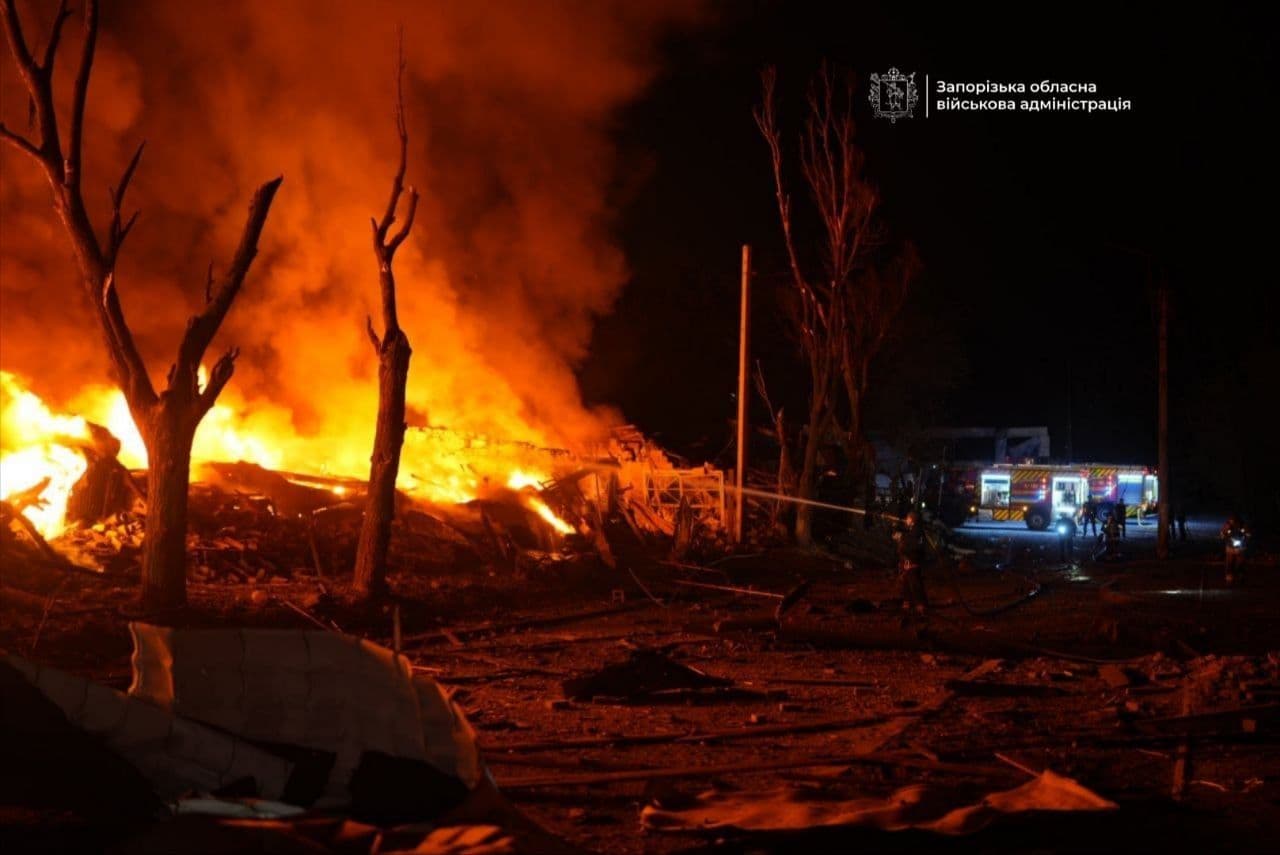
The aftermath of a Russian missile and guided aerial bomb attack on Zaporizhzhia, Ukraine. (Ivan Fedorov / Telegram)
ZAPORIZHSTAL AND A CHILDREN’S HOSPITAL: THE OVERNIGHT TOLL SHARPENS
The overnight barrage that hit Kyiv and Zaporizhzhia in the early hours of Tuesday came into fuller, grimmer focus as the day went on. Metinvest confirmed that a Russian ballistic missile strike on Zaporizhstal — one of Ukraine’s largest steel and pig iron producers, among the few such plants Russia’s war hasn’t already destroyed — killed seven workers and wounded 21 more, damaging the coke and blast furnace production lines badly enough to halt operations entirely. Governor Ivan Fedorov put Zaporizhzhia’s citywide toll at 52 wounded across the oblast, with homes, businesses, and power infrastructure damaged by a mix of ballistic missiles and guided glide bombs; Zelensky confirmed Russia used both North Korean-supplied KN-23 missiles and Zircon hypersonic cruise missiles against the city specifically.
In Kyiv, a Russian missile damaged a children’s hospital, cracking a gas line and shattering windows, along with nearby businesses; one civilian was wounded elsewhere in the capital as a warehouse burned in the Shevchenkivskyi district. Russia’s Defense Ministry claimed separate strikes on Nova Poshta and a Kyiv logistics hub the same night. It was part of a broader pattern Ukraine’s own military has started treating as a matter of operational security: the Air Force reported downing 98 of 120 drones launched overnight but, for the first time, declined to disclose how many ballistic missiles were fired or intercepted at all — a policy shift Bloomberg reported began as a direct response to Russian efforts to exploit the previously published numbers.
KRAMATORSK’S CHURCH BURNS, SLOVIANSK’S MARKET HIT
Russian strikes reached two more Donbas cities during the day. In Kramatorsk, a strike set fire to a church dome, burning through roughly 140 square meters before firefighters brought it under control; no one was hurt there. In Sloviansk, Russian forces struck the city’s central market at midday, when it was full of shoppers, wounding at least four people between the ages of 36 and 82. “This is what Russian terror looks like in its usual form,” Donetsk Oblast officials said, calling the strike militarily senseless and aimed purely at civilians. In Dnipropetrovsk Oblast, a 58-year-old woman was wounded in Nikopol district as Russian forces struck the region nearly 50 times, continuing a pattern of near-daily bombardment that has made Nikopol one of the most consistently targeted places in the entire war.
TRUMP-PUTIN CALL FREES ROBERT GILMAN
President Trump announced that Russia agreed to release Robert Gilman, a 32-year-old American English teacher and former US Marine, on humanitarian grounds following a direct call with Putin — the culmination of growing alarm over Gilman’s health after he was hospitalized in June with what an advocacy group described as a “dissociative stupor” brought on by what they called abusive treatment in custody. Gilman had been detained in Voronezh since January 2022, initially sentenced to four and a half years for allegedly attacking a police officer while drunk, a charge his family disputed from the start; a Russian court added 10 more years in 2025 over three further alleged assaults. He’s now en route to Washington with his mother before continuing to Texas for treatment.
Trump was explicit that no prisoner exchange took place — Moscow, he said, didn’t ask for anyone in return, an unusual departure from the trades that have typically freed detained Americans in recent years. “Thank you to my incredible Team, including Special Envoy for Peace Missions, Steve Witkoff, Special Envoy for Hostage Response, Adam Boehler, Senior Director for Counterterrorism, Sebastian Gorka, Jared Kushner, and the many others who made this possible,” Trump wrote. Secretary of State Marco Rubio welcomed the release while noting the work isn’t finished: “We are still seeking the immediate return of all other unjustly detained Americans, including wrongful detainee Stephen Hubbard.”

Former U.S. Marine Robert Gilman (left) en route to the U.S. after his release from a Russian prison. (Donald Trump/Truth Social)
ZELENSKY: RUSSIA’S DOCUMENTS CONFIRM FALL MOBILIZATION
Zelensky said Ukrainian intelligence has obtained internal Russian documents confirming the Kremlin is preparing a mass mobilization wave for this fall, timed deliberately to follow September’s staged parliamentary elections. “Everything is confirmed by internal Russian documents,” he said, citing a report from HUR chief Oleh Ivashchenko. “Putin’s plan is not particularly complicated. He wants to create the impression that Russians supposedly support the war — every party still permitted to run is, one way or another, against peace.” He said Russia plans to mobilize “several hundred thousand” people by year’s end, with a comparable wave to follow next year, layered on top of contract recruitment already underway.
Separately, Ukraine’s Center for Countering Disinformation said Russia is preparing to falsify voting results in occupied Donetsk, Luhansk, Zaporizhzhia, and Kherson oblasts, with instructions from Putin’s administration to report turnout above 65 to 70 percent and at least 70 percent support for United Russia. Zelensky confirmed Russia’s growing dependence on North Korea flows directly from this pressure: “This is the first time in Russian history that they no longer have a secure strategic rear… they cannot wage war without supplies from North Korea.” He said Ukraine’s own intelligence and security services have been given specific tasks to complicate Russia’s mobilization plans, without offering further detail.
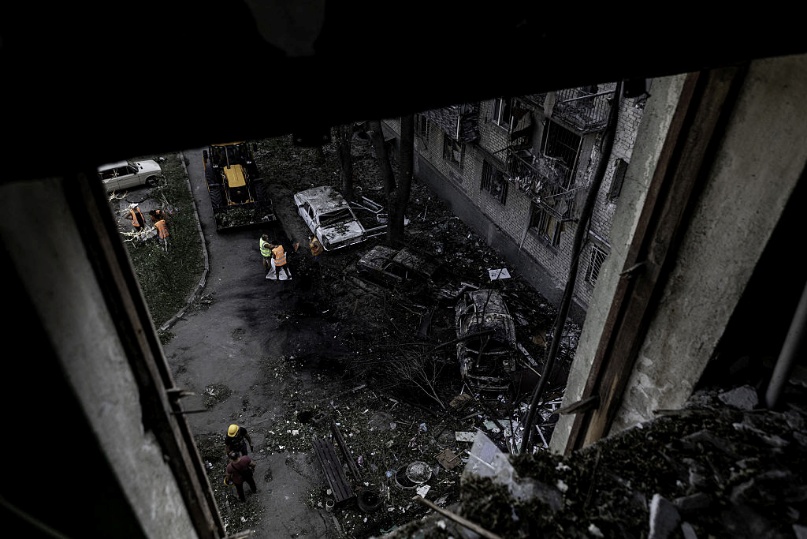
The aftermath of a Russian attack on Zaporizhzhia, which killed seven workers of the Zaporizhstal steel plant and injured another 24. (Niccolo Celesti/Anadolu via Getty Images)
UKRAINE STOPS REPORTING MISSILE NUMBERS AS A SECURITY MEASURE
Ukraine’s Air Force has quietly abandoned its practice of publishing how many Russian missiles are launched and intercepted during major attacks, a shift that began days earlier after Ukraine failed to intercept a single one of 28 ballistic missiles fired at the country in a single night. A person familiar with the matter told Bloomberg the change was made specifically as a security measure in response to how Russia has been using the published figures. The policy leaves outside observers with a far foggier picture of exactly how badly Ukraine’s air defenses are struggling — though the scale of Tuesday’s attack, which reportedly involved more than a dozen ballistic missiles including North Korean KN-23s and killed nine people nationwide, offered its own answer regardless.
YABLOKO’S FINAL DEFEAT
Russia’s Supreme Court finalized what had been expected since Monday: Yabloko, the only registered Russian party still openly opposing the war and calling for a ceasefire, is barred from September’s State Duma elections. The ruling, upheld from a lawsuit filed by the nationalist Rodina party, cites alleged copyright violations and extremist slogans; a Central Election Commission representative separately alleged the party received foreign funding from the US and Germany, a claim Yabloko leader Nikolai Rybakov rejected as mislabeled domestic donations. Party founder Grigory Yavlinsky said the ruling shows the Kremlin is genuinely frightened of Yabloko’s anti-war message, however marginal its actual electoral threat — the party won just 1.34 percent of the vote in 2021, short of the 5 percent threshold for seats, and hasn’t run a candidate since the full-scale invasion began.
ISW assesses the move less as fear of Yabloko winning seats than fear of what visible public support for an anti-war platform might do to the Kremlin’s ability to sell September’s results as genuine. “The Kremlin is scared,” said Yulia Navalnaya, widow of the late opposition leader Alexei Navalny. “It’s not even so much about support for Yabloko. It’s about the fact that millions of Russians now have a chance to say what they truly think about Putin and the war.”
EUROPE’S PATRIOT SHORTAGE DEEPENS AHEAD OF WINTER
Politico reported that European countries are struggling to find enough Patriot interceptors to help Ukraine survive an expected Russian winter offensive, with US supplies strained and no meaningful new production likely to arrive before the attacks begin. “We are literally fighting for every missile,” Foreign Minister Andrii Sybiha said. Germany, already among Ukraine’s largest suppliers, says it’s approaching its own limits: “We are really reaching our limits here,” German Brigadier General Jürgen Schrödl said. “We also have to ensure our own protection.” Norway’s defense minister called the current burden-sharing unsustainable for Europe long-term, while Poland, Spain, and Greece all face fresh pressure to identify additional interceptors — Poland has already sent just five PAC-3 missiles, and Greece is weighing a Ukrainian request for as many as 200 older PAC-2s without having committed to anything yet.
The gap traces back to Washington. “The American administration could have helped, but they don’t do this. And as the result it’s been hard with everyone else,” a senior Ukrainian official told Politico. Trump, for his part, pushed back directly on the idea the US owes Ukraine more: “We want missiles too,” he said, a comment that lands awkwardly next to his own earlier walk-back of a promise to license Ukrainian Patriot production, which US Ambassador to NATO Matthew Whitaker now says won’t be finalized before winter regardless.
DEEP STRIKES: ORSK, VORONEZH, AND A FIRE 6,000 KILOMETERS AWAY
Ukrainian forces struck the Orsknefteorgsintez refinery in Orsk, Orenburg Oblast, more than 1,500 kilometers from Ukraine’s border, sparking a fire and prompting temporary flight restrictions in the area; the facility processes roughly 6 million tons of crude annually into gasoline, diesel, and aviation fuel. The same overnight campaign hit a Wildberries logistics hub in Voronezh Oblast, killing a 49-year-old man and wounding two more when falling drone debris struck them, according to the regional governor — bringing the number of Wildberries facilities struck since mid-July to roughly 20, with total damage estimated between $1.1 and $2.2 billion and the company potentially needing as much as $14.4 billion in additional funding to recover.
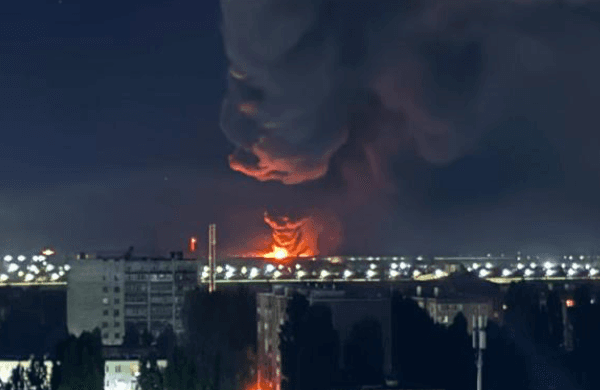
What purports to be a fire burning in the village of Novaya Usman in Russia’s Voronezh Oblast following a reported Ukrainian strike on a logistics hub belonging to major online retailer Wildberries overnight. (Supernova Plus/Telegram)
Farther afield, monitoring channels reported a fire at an oil refinery in Komsomolsk-on-Amur, in Russia’s Far East — more than 6,000 kilometers from Ukraine and well outside the range of any known Ukrainian weapon, leaving its cause unexplained — alongside another fire at a power plant in Angarsk, Irkutsk Oblast, some 4,300 kilometers away. Ukraine’s Special Operations Forces separately reported striking 43 locations across occupied Crimea and southern Ukraine overnight, destroying a Buk-M3 air defense system and hitting a shadow fleet vessel in the Black Sea. Whether the more distant fires were Ukrainian strikes, accidents, or something else entirely, the range now genuinely in question says as much about how far this war has already reached as any confirmed strike would.
A GRAIN ROUTE THROUGH MOLDOVA
Ukraine is exploring a rail corridor through Moldova to Romania’s port of Constanta as a safer alternative for grain exports, after Russian attacks intensified against Black Sea shipping and ports. Kyiv has asked Moldova for a 50 percent discount on freight rates in exchange for guaranteeing a set cargo volume; a former Moldovan Railways chief estimated the route could eventually handle 4.5 million metric tons of grain annually, roughly 10 percent of Ukraine’s total exports. Moldovan Prime Minister Vasile Tofan welcomed the potential revenue, dismissing domestic farmers’ concerns about competition: “Let’s not look for enemies in places where there are none.”
The push comes as Ukraine’s own export forecasts keep sliding — Agriculture Minister Taras Vysotskyi cut his 2026-27 grain export forecast to 38 to 40 million metric tons, down from an earlier 43 million, with independent analysts at APK-Inform projecting an even steeper 8.6 percent drop. Ukraine ships more than 90 percent of its grain through seaports; every disruption to that route now translates almost directly into a smaller harvest reaching the world market.
OMAN’S OIL DISASTER: A SHADOW FLEET TANKER LEAKS FOR WEEKS
A sanctioned shadow fleet tanker, the Caroline Bezengi, has been leaking oil into a protected marine area off Oman’s coast since explosions aboard the vessel in early June, with Greenpeace estimating the resulting slick has grown from 45 square kilometers in late July to as much as 600 square kilometers by early August — Omani officials put the figure at 390 square kilometers, still enough to threaten nesting sea turtles, breeding seabirds, and the rare Arabian Sea humpback whale. The ship, sanctioned by Ukraine, the EU, UK, Canada, and Switzerland as part of Russia’s sanctions-evading fleet, was carrying an estimated 800,000 barrels of oil when it began leaking; no party has claimed responsibility for whatever caused the explosions. Omani authorities say they’ve activated a national spill response plan, attempting to plug the hull and stabilize the vessel while diving teams assess the damage. It’s a quiet, unglamorous illustration of exactly the risk European regulators have been warning about as they’ve expanded inspections of aging, uninsured tankers moving sanctioned Russian oil around the world’s oceans.
DRAFT EVASION CRACKDOWN: 76 OFFICIALS CHARGED
Ukraine’s National Police said 76 draft office officials have now been charged across 428 criminal cases tied to illegal draft evasion nationwide, with roughly 2,500 potentially unlawful exemptions under investigation and 6,500 improper military medical commission rulings already annulled. “The law must apply equally” to conscripts and to the officials responsible for mobilization decisions, acting police chief Maksym Tsutskiridze said, while cautioning against letting individual abuses turn into a blanket campaign against every draft officer or medical ruling. The crackdown follows a searches earlier this month in Zakarpattia Oblast tied to more than 1,000 alleged illegal exemptions in a single region — a reminder that the tension between an army needing replacements and a population increasingly reluctant to supply them runs through Ukraine’s own institutions, not just its front lines.
KONOVALETS COMES HOME
The remains of Yevhen Konovalets, founder of the Organization of Ukrainian Nationalists and a central figure in the country’s early 20th-century independence movement, were exhumed in Rotterdam for reburial at Ukraine’s National Military Memorial Cemetery outside Kyiv. Konovalets was assassinated in the Dutch city in 1938, killed by a Soviet agent who had infiltrated his organization and handed him a bomb disguised as a box of chocolates. His repatriation follows that of Andriy Melnyk, another prominent nationalist leader, as Ukraine works toward establishing a national pantheon honoring historical and contemporary figures — though officials say no formal list of who belongs there has been finalized yet.
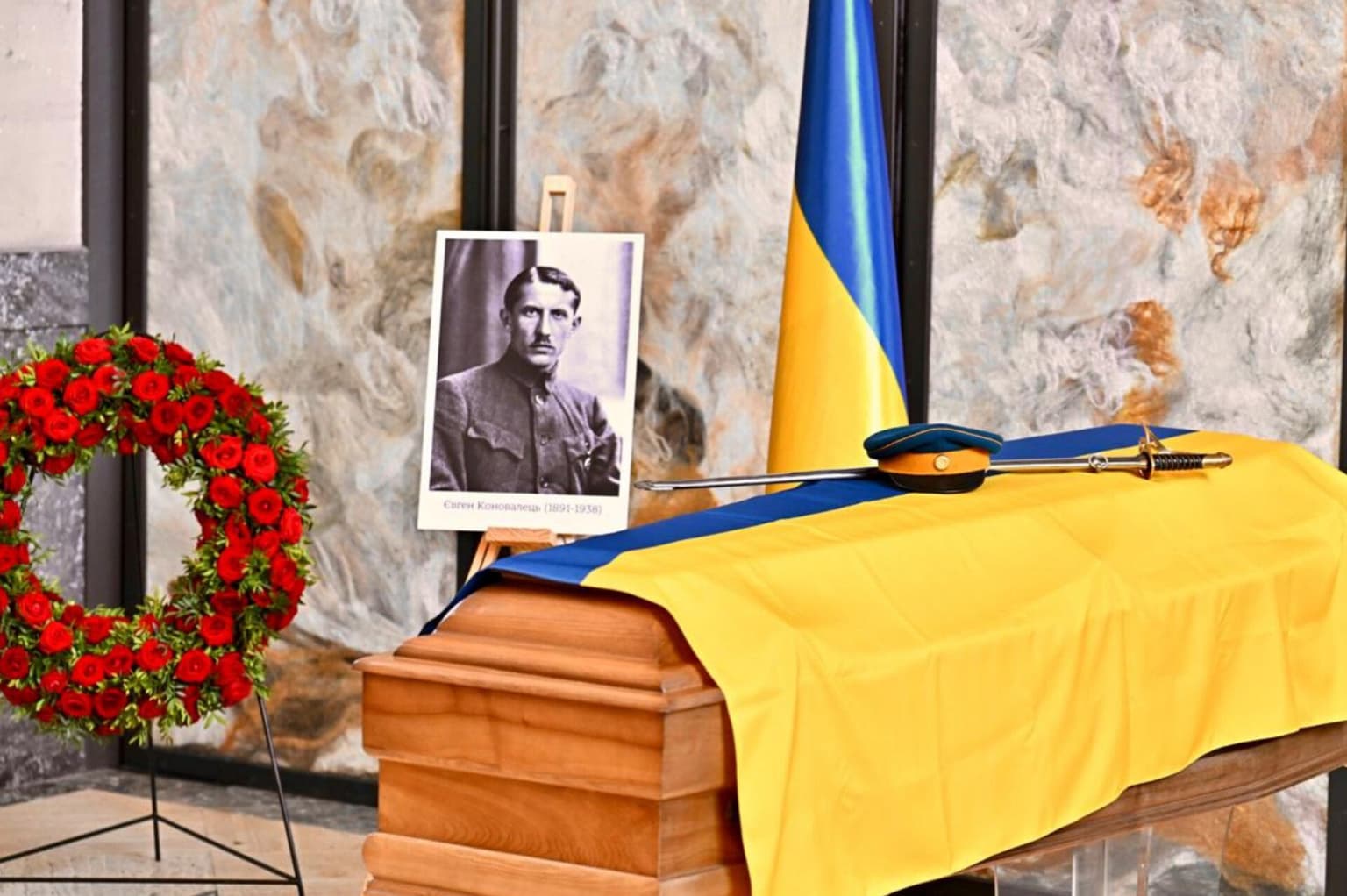
An exhumation of the remains of Colonel Yevhen Konovalets was carried out, at Crooswijk Cemetery in Rotterdam. (President’s Office)
NOTES FROM ELSEWHERE
Hungary’s parliament elected Andras Baka, a former Supreme Court chief and nominee of the governing, pro-European Tisza party, as the country’s new president, succeeding a predecessor Tisza’s supermajority removed early as part of a broader push against allies of Euroskeptic former Prime Minister Viktor Orban. Romanian military divers destroyed two Russian-made Gerbera drones found drifting near the Neptun Deep gas project in the Black Sea, roughly 90 nautical miles off Constanta — Ukraine confirmed the drones weren’t its own. And Leica removed a Kremlin-linked Russian photographer, Valery Melnikov, from its shortlist for the prestigious Oskar Barnack Award following scrutiny of his years working for Russian state media while photographing occupied Mariupol, a decision he called unjustified on Instagram.
WHAT TUESDAY CONFIRMED
By the time Tuesday’s fires were finally counted, Ukraine had lost seven steelworkers and gained one freed American, watched its only real hope for an anti-war voice in Russian politics get formally erased, and learned that the war’s next mobilization is no longer a guess but a documented plan with a date attached. Zelensky called it what it was: a Kremlin trying to look strong at an election with no real opposition left in it, while quietly building the machinery to send hundreds of thousands more Russians to a war it still won’t call a war. Nothing about Tuesday resolved anything. It simply made the shape of what’s coming a little harder to deny.
A PRAYER FOR UKRAINE
1. For the Seven Workers of Zaporizhstal
Lord, seven men went to work a night shift at a steel plant and did not come home, killed by a missile built in a country most of them had never seen. Hold their families through grief made heavier by how ordinary the danger has become. Comfort the twenty-one wounded beside them, and this plant that has survived so much only to lose this much in a single night.
2. For Robert Gilman, Coming Home at Last
Father, a man spent more than four years in a foreign prison for a charge his own family never believed, and today he is finally on a plane toward healing rather than another cell. Restore what captivity took from him, in body and in mind. Comfort his mother beside him, and remember every other person still waiting for the call that finally sets them free.
3. For the Shoppers of Sloviansk’s Market
Lord, an ordinary midday crowd buying bread and vegetables became a target simply for being together in one place. Heal the wounded, and hold this city that keeps absorbing violence built for no reason but cruelty. Let the market reopen, and let it stay a place of ordinary life rather than a memory of this day.
4. For a Country Watching Its Last Legal Door Close
Lord of justice, the only Russians who could vote against this war from inside their own country lost that option today, one more sign of how completely dissent has been sealed off. Give courage to those still speaking anyway, in whatever quiet or dangerous way remains open to them. Let honesty survive somewhere, even where the law no longer protects it.
5. For the Hundreds of Thousands Not Yet Called Up
God of mercy, tonight a mobilization is being planned for men who don’t yet know their names are on a list, timed to arrive right after an election built to look like consent rather than the coercion it actually is. Protect these men and their families from a summons neither chose. Give wisdom to everyone working to complicate what’s coming, and mercy to the ordinary people who will bear the weight of it regardless.
In Your mercy, in Your justice, in Your time — bring this war to its end, and let the ending be worthy of what Ukraine has endured.