
August 16, 2026
Prepared by Diana Bozhyk
Ukraine knocked out seven of Wildberries’ ten largest warehouses overnight, adding a Rostov Oblast rocket-fuel plant and a rare Crimean missile launcher to the week’s growing target list. Russia answered with a week’s worth of numbers Zelensky called out directly: more than 1,550 drones, nearly 1,560 glide bombs, and 62 missiles fired at 13 Ukrainian regions, killing seven people and wounding dozens more in a single overnight barrage on Kyiv, Kryvyi Rih, and Kremenchuk. Ukraine, meanwhile, tested a longer-range interceptor drone and revealed its own strike forces are running at just 14 percent capacity for lack of funding.
THE DAY’S RECKONING
Seven out of ten. That’s how many of Russia’s largest Wildberries warehouses Ukraine has now knocked offline since July — a level of precision most military campaigns would call a decisive victory. It happened again overnight: two more logistics hubs near Moscow in flames, a rocket-fuel plant in Rostov Oblast burning, a rare missile launcher in Crimea destroyed.
And still, none of it stopped what came next. Russia answered with a week’s worth of violence delivered in a single overnight package: ballistic missiles into Kryvyi Rih and Kremenchuk, a historic book market burned in Kyiv, a 19-year-old dead in Kramatorsk, a man killed in his own car in Sumy. Zelensky put a number on the past seven days alone — over 1,550 drones, nearly 1,560 glide bombs, 62 missiles — and the number that mattered more was smaller and simpler: seven people killed in a single day, nationwide. Two militaries, grinding forward on separate tracks, neither one closer to actually ending this.
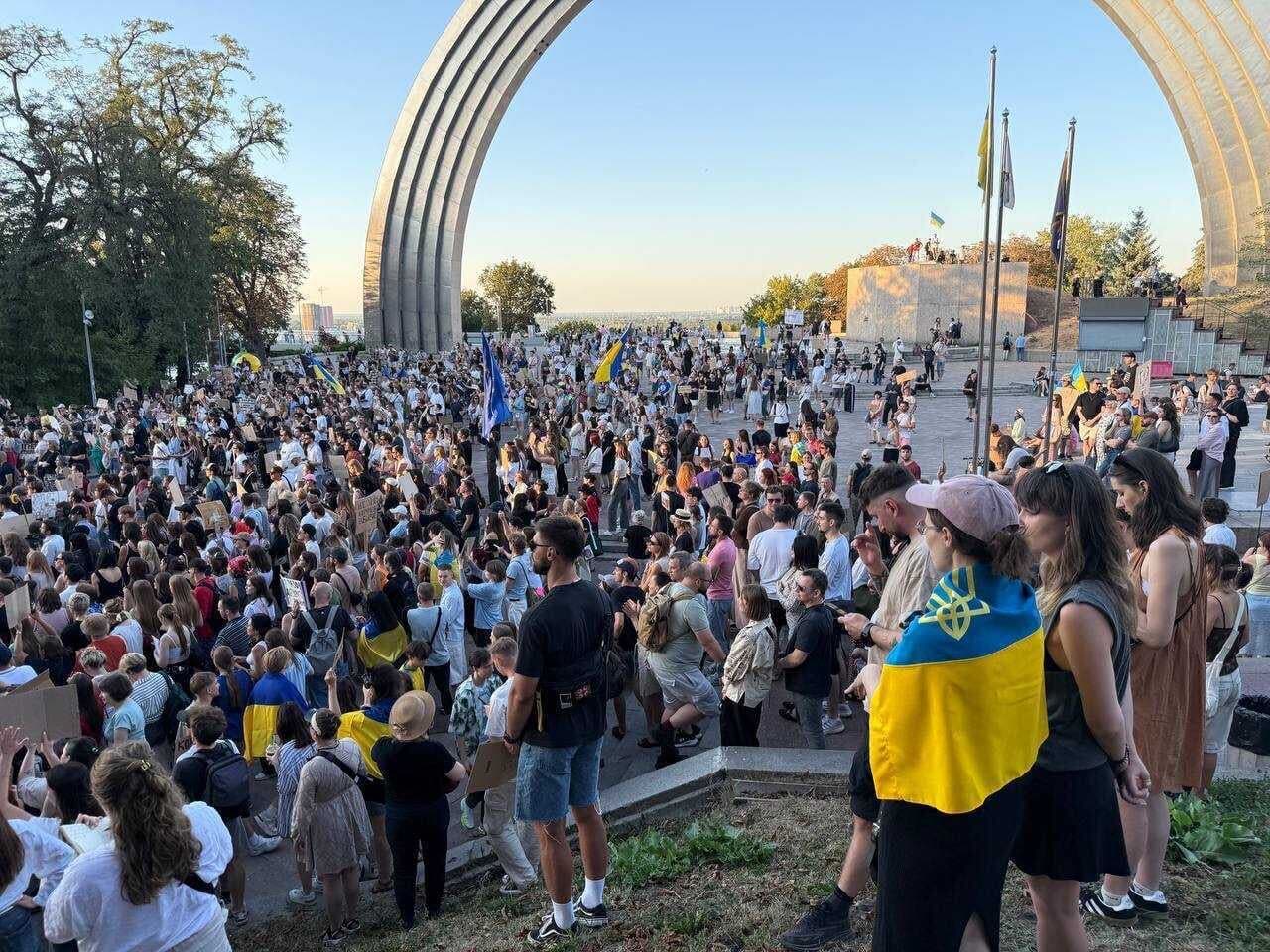
A couple of thousand demonstrators gathered at Kyiv’s Arch of Freedom of the Ukrainian People. (Yevgeniya Doluda)
UKRAINE CRIPPLES WILDBERRIES’ TOP WAREHOUSES
Ukraine’s monthslong campaign against Russia’s largest online retailer reached a new milestone overnight: seven of Wildberries’ ten biggest logistics centers in Russia are now disabled, according to Ukraine’s Ministry of Defense.
The latest strikes hit the company’s single largest hub — a 2.7-million-square-foot complex in the Koledino Industrial Park near Podolsk, in Moscow Oblast — along with a second warehouse in nearby Domodedovo. Wildberries’ own press service confirmed the Podolsk strike caused a fire and forced the company to reroute its logistics chains entirely; Moscow Oblast’s governor separately confirmed both strikes. Ukrainian officials maintain the targeting logic is straightforward: Wildberries supplies dual-use goods, including drone components and navigation equipment, to Russia’s military, making its warehouses legitimate targets rather than purely civilian infrastructure. Reuters reported earlier this month that Ukrainian strikes had already destroyed roughly a fifth of the company’s entire warehouse footprint nationwide — and that fraction has only grown since.
The same overnight window brought a separate, more explosive strike: the Kamensky Plant in Rostov Oblast, which manufactures solid rocket fuel for Russian multiple-launch rocket systems and other munitions, caught fire after a Ukrainian strike. Ukraine’s General Staff also confirmed new damage assessments for two earlier strikes — a petrochemical facility in Tobolsk hit August 10, and the Orsk oil refinery hit August 11, both now confirmed to have sustained more extensive internal damage than initially known, disabling core processing units at each site rather than just denting peripheral equipment.
A RARE AND EXPENSIVE TARGET DESTROYED IN CRIMEA
Not every Ukrainian strike targets something replaceable. This one did the opposite.
Ukraine’s navy destroyed a Russian Bastion-M coastal missile system near occupied Rezervne in Crimea overnight — a weapon Russia uses specifically to launch Onyx supersonic and Zircon hypersonic cruise missiles at southern Ukraine. Unlike Shahed drones or artillery shells, which Russia can churn out by the thousands, Bastion systems are scarce and expensive, meaning every one destroyed meaningfully reduces Russia’s capacity to launch some of its hardest-to-intercept weapons. Ukraine’s navy said the strike caused significant losses in both equipment and personnel, though the full extent is still being assessed.
The strike is part of a broader pattern Ukraine’s Unmanned Systems Forces commander, Robert Brovdi, has described as deliberately undermining Crimea’s role as a staging ground for the rest of Russia’s war — hitting rail bridges, fuel depots, power infrastructure, and air-defense systems on the peninsula to open gaps that Ukrainian drones can then exploit. But Brovdi also delivered a blunter warning alongside the news: his forces are currently operating at only 14 percent of what they’d need to fully execute that strategy, a shortfall he attributes directly to delays in Western funding. Fully funded, he said, Ukraine could be striking up to seven times more targets than it currently manages — a gap between capability and resourcing that, by his own account, is actively costing Ukraine ground in a campaign that’s otherwise working.
MEANWHILE, AT THE ACTUAL FRONT — THE NORTH AND EAST
Away from headline strikes, the ground war held its shape, with claims outrunning confirmed reality on both sides.
Near Kharkiv City, Russian forces claimed to have seized the village of Kudiivka, framing it as a “gateway” toward the city itself — a claim a source tracking Russia’s own military grouping directly refuted, saying Russian troops are fighting inside the village but haven’t actually established any real foothold there, with some Russian units even cut off from their main force. In Vovchansk, roughly 300 civilians remain in a community where Russian forces now control every road in and out, meaning only Ukrainian forces can still conduct evacuations under constant drone fire. Near Kupyansk and Borova, fighting continued without confirmed movement on either side, while Ukrainian forces kept striking Russian air-defense systems and supply depots in occupied Luhansk Oblast.
Around Slovyansk, Russian forces intensified a punishing campaign of glide bomb strikes — hitting residential neighborhoods continuously from the night of August 15 through the following evening, and reportedly striking the city’s Novokramatorsk Machine Building Factory and high-rise apartment buildings in nearby Druzhkivka. The bombardment isn’t random: it’s a deliberate effort to sever the supply routes feeding Ukraine’s “Fortress Belt” defensive line ahead of future Russian offensive operations. Near Kostyantynivka, Ukrainian forces successfully cleared Russian infiltrators from part of the town’s western edge, even as Russian units attempted a river crossing further south to outflank neighboring Druzhkivka from a new direction.
MEANWHILE, AT THE ACTUAL FRONT — THE SOUTH
Further south, the same pattern repeated: exaggerated Russian claims of a collapsing Ukrainian line, and a reality that mostly held.
Kremlin-aligned commentators continued flooding social media with claims that Russian forces control several villages Ukraine liberated during its recent Oleksandrivka counteroffensive — claims independent researchers assess as part of a deliberate campaign to muddy the record of Ukraine’s gains there. Independent analysts continue to assess that Ukraine secured roughly 240 square miles of tactically significant territory in that operation and, notably, managed to restore elements of coordinated tank-and-infantry maneuver rarely seen elsewhere on this front. Near Dobropillya and Pokrovsk, Russian forces kept up glide bomb strikes against Ukrainian drone crews and staging areas without making confirmed progress on the ground.
Ukraine, for its part, kept degrading Russian logistics behind the line: strikes hit ammunition and equipment warehouses in occupied Karlivka, while a fire tore through a shopping center in occupied Donetsk City after separate Ukrainian strikes. A Ukrainian monitor tracking the occupied region reported that sustained Ukrainian pressure is now forcing Russian forces to constantly alter their supply routes, deploy jamming equipment on transport convoys, and assign several armed escort vehicles to guard every single convoy — a level of caution that itself reflects how degraded Russian logistics have become. Near Zaporizhzhia city, Russian forces struck back at Ukrainian infrastructure directly, hitting a bridge over the Dnipro River with a glide bomb in an apparent effort to disrupt Ukrainian supply lines on the western bank, while Ukrainian forces separately struck a railway bridge Russia relies on near Svitlodolynske.
A WEEK’S WORTH OF VIOLENCE IN ONE NUMBER
President Zelensky put a figure on the past seven days that’s worth sitting with: over 1,550 attack drones, nearly 1,560 glide bombs, and 62 missiles — most of them ballistic — fired at 13 Ukrainian regions between August 9 and 15. Overnight brought the latest installment: Onyx anti-ship missiles, a mix of Iskander-M, S-400-derived, and North Korean KN-23 ballistic missiles, Kh-59 and Kh-69 cruise missiles, and 106 Shahed-type and decoy drones, launched from six separate points inside Russia and occupied territory. Ukrainian forces intercepted three cruise missiles and 85 of the drones; the rest struck 13 locations, with debris landing at three more.
The human toll landed hardest in Kryvyi Rih and Kremenchuk. A ballistic missile strike on Kryvyi Rih’s ArcelorMittal steel plant killed two workers and injured 13 more, partially halting production at one of Ukraine’s major industrial employers — the same plant Russia had already struck once, fatally, back in 2022. In Kyiv, overnight strikes sparked a massive fire at the century-old Petrivka book market, one of the capital’s oldest retail landmarks, destroying entire rows of stalls and their inventory, while separate strikes damaged buildings and injured several people elsewhere in the city. In Sumy, a Russian drone deliberately struck a civilian car, killing a 59-year-old man and injuring his wife. By day’s end, Russian attacks had killed at least seven people nationwide and injured 51 more. “Protecting lives is necessary. Russia must be stopped,” Zelensky said, renewing his call for allies to release more air-defense interceptors from storage rather than let stockpiles sit unused while missiles keep landing.
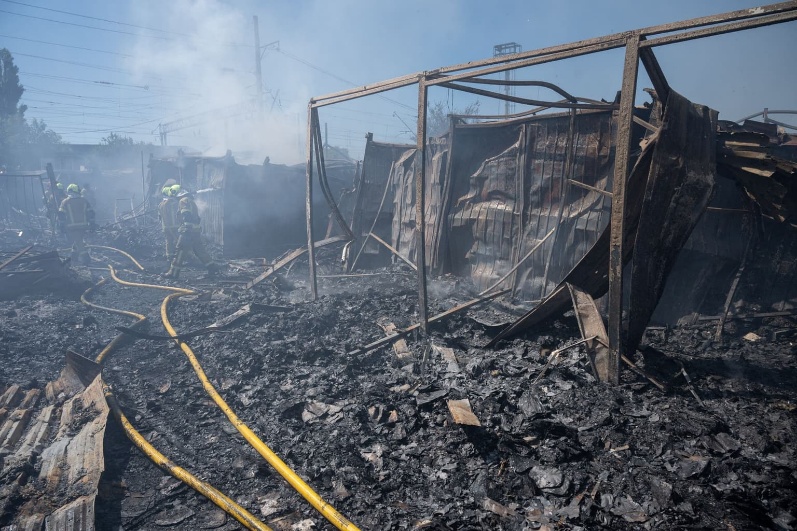
Emergency service personnel work at the site of a Russian missile strike that heavily damaged the Pochaina market in Kyiv, Ukraine. The attack destroyed dozens of commercial pavilions across the complex, which is recognized as one of the capital’s largest flea and book markets. (Danylo Antoniuk/Anadolu via Getty Images)
ODESA HIT TWICE IN ONE DAY
Odesa absorbed two separate Russian strikes within hours of each other, a reminder that daytime attacks on Ukrainian cities have become just as routine as nighttime barrages.
The first hit a Nova Poshta postal facility operating inside an Epicentr shopping center on the city’s outskirts, struck by what regional officials described as a jet-powered attack drone — a faster, harder-to-intercept variant increasingly favored by Russian forces for exactly this kind of daytime precision strike. The blast injured four people, including a 42-year-old woman and three men in their thirties and forties, three of whom required hospitalization. Hours later, a second jet-powered drone strike hit residential infrastructure elsewhere in Odesa Oblast, destroying two houses outright and injuring five more people.
Odesa’s exposure isn’t incidental. The city and its surrounding oblast sit close enough to occupied Crimea and the Black Sea that Russian drones and missiles can reach it with minimal warning time, and its port infrastructure — critical to what remains of Ukraine’s grain export economy — makes it a recurring target regardless of the human cost involved in hitting a functioning city block to get there. Two strikes, two different weapons, one day: for Odesa, that’s simply become the baseline.
KRAMATORSK: A DRONE, AN ENTERPRISE, A 19-YEAR-OLD DEAD
Kramatorsk absorbed another blow in a war that’s made the city one of eastern Ukraine’s most consistently targeted places. Russian drones struck an enterprise in the city center, killing a 19-year-old employee and injuring seven others, according to Donetsk’s regional governor. A separate strike hit a postal facility elsewhere in the city on the same day.
Kramatorsk sits less than 12 miles from the nearest Russian positions, a proximity that makes it a near-daily target for drones and glide bombs alike. The city’s strategic value comes from its role as a transportation and logistics hub — a junction of major road and rail routes that Ukraine depends on to keep its eastern defenses supplied. Capturing it, or simply degrading its ability to function, would bring Russia measurably closer to controlling the remainder of Ukrainian-held Donetsk Oblast.
For the people who still live and work there, that strategic significance translates into something much simpler: a workplace that can become a crime scene on any given afternoon, with no warning beyond an air-raid siren most residents have long since learned to live around rather than fully escape. The city has absorbed this kind of violence in waves for years, and each new strike adds to a toll residents increasingly measure not in single incidents but in how much of ordinary life — going to work, walking to the post office, simply staying home — has quietly become an act of risk they accept because there’s nowhere safer left to go.
UKRAINE TESTS A LONGER-RANGE INTERCEPTOR DRONE
As Russia keeps upgrading its attack drones with faster engines, Ukraine is racing to keep pace on the defensive side — and a new interceptor just outperformed its own design targets by a wide margin.
Ukrainian developer Ukrainska Bavovna announced that its “Last Shadow T200” interceptor drone — built specifically to hunt down Shahed and Geran attack drones, Gerbera decoys, and Molniya strike drones before they reach their targets — reached a range of 76 miles during recent combat trials, well beyond the 43 miles originally expected when the aircraft was designed. It can fly at speeds up to 186 miles per hour, operate at altitudes above 16,000 feet, and stay airborne for roughly an hour at cruising speed. Both the airframe and its warhead have already been approved for use by Ukraine’s defense ministry.
The design includes a movable camera meant to improve target detection and a video system that can switch channels and frequency bands specifically to defeat Shtora, a Russian system built to jam or spoof drone video feeds — a small but telling detail in a war where both sides are locked in a constant, granular contest over whose electronics can outsmart the other’s first. Interceptor drones like this one now account for roughly 40 percent of all Ukrainian kills against Russian Shahed-type and other long-range attack drones, a rapidly growing share that reflects just how central homegrown interceptor technology has become to Ukraine’s air defense, even as the country continues to run short of the traditional missile-based systems it still depends on for the hardest-to-stop threats.
FEDOROV: UKRAINIAN BALLISTIC MISSILES WITHIN MONTHS
Ukraine’s former defense minister believes his country is close to crossing a significant technological threshold — one that would let Ukraine strike Russia with a weapon type it has so far only had to defend against.
Mykhailo Fedorov, dismissed from his post in mid-July amid a reported clash with then-Commander-in-Chief Oleksandr Syrskyi, told CBS News that Ukraine could be capable of using domestically produced ballistic missiles against targets inside Russia within three to six months. Fire Point, the same manufacturer behind Ukraine’s Flamingo cruise missile, tested a ballistic missile prototype in June, and Fedorov said he expects an actual strike using the weapon before the year is out. “We need to defeat Russia in every technological cycle,” he said, adding that Russia continues advancing just as quickly on its own side of that race. Ballistic missiles travel faster and are generally harder to intercept than cruise missiles, which could give Ukraine a meaningfully different offensive option than the long-range drones and cruise missiles it has relied on so far.
Fedorov declined to detail why he believes he was actually dismissed, telling CBS simply that he didn’t want to relitigate it for an American audience, though he didn’t rule out eventually returning to government. His removal has continued to reverberate politically: protesters marched through Kyiv again, demanding his reinstatement, as Ukraine’s parliament prepares to return from recess and potentially vote on confirming acting Defense Minister Yevhen Khmara in his place.
A DRONE OVER LATVIA MIGHT NOT HAVE BEEN AN ACCIDENT
A drone incident along NATO’s eastern border that initially looked like ordinary electronic-warfare fallout may carry a darker explanation, according to a neighboring government.
Lithuanian Prime Minister Mindaugas Sinkevičius said he could not rule out that the drone NATO fighter jets shot down over Latvia earlier this week was part of a deliberate Russian “false flag” operation, rather than simply a Ukrainian strike drone knocked off course by Russian jamming, as initial assessments suggested. A false flag operation, in this context, would mean Russia deliberately steering or launching a drone toward NATO airspace specifically to test the alliance’s response, probe its detection capabilities, or manufacture a pretext for escalation — a materially different and more alarming scenario than an accidental intrusion.
Sinkevičius offered no additional evidence to support the theory beyond raising it as a genuine possibility worth investigating, and NATO has not publicly revised its original assessment. But the comment itself matters: it reflects a rising level of suspicion among the alliance’s easternmost members that incidents along the Russian border deserve more scrutiny than they’re currently getting, particularly after a summer that’s already included a Russian missile crash-landing on Polish soil and a foiled Russian assassination plot on NATO territory in Warsaw.
PUTIN AND KIM MARK AN ANNIVERSARY, DEEPEN AN ALLIANCE
Russian President Vladimir Putin and North Korean leader Kim Jong Un exchanged messages marking the 81st anniversary of Korea’s liberation from Japanese colonial rule, using the occasion to publicly reaffirm a military partnership that has become increasingly central to Russia’s war effort.
Putin said cooperation between the two countries would continue “in all the sectors,” while Kim praised ties that he said “carried forward the history of common struggle for justice.” Behind the diplomatic language sits a concrete and growing military relationship: North Korea has supplied Russia with troops, artillery ammunition, and increasingly sophisticated ballistic missiles, including the KN-23 and KN-24 systems Russia has used repeatedly against Ukrainian cities. Zelensky has said North Korean missiles were involved in an August 11 attack on Zaporizhzhia, and that a North Korean missile likely killed six members of a single family in Kryvyi Rih just weeks ago.
Zelensky has also warned that Russia is preparing to receive another 30,000 North Korean troops, on top of the roughly 14,000 Pyongyang already sent to fight alongside Russian forces in Kursk Oblast back in 2024. The relationship is now formalized under a mutual-defense treaty the two leaders signed in 2024, obligating each country to assist the other if attacked — a pact that, in practical terms, has so far flowed almost entirely in one direction, with North Korean weapons and soldiers propping up a Russian war effort that shows no sign of slowing down.
A WAREHOUSE BURNED, A MARKET LOST, AN ALLIANCE DEEPENED
By nightfall, both sides had spent the day proving what four and a half years of war has made obvious: neither one can be starved into stopping. Ukraine took out the economic infrastructure feeding Russia’s war machine one warehouse at a time. Russia answered by burning a 30-year-old book market to the ground and killing a 19-year-old at his job in Kramatorsk.
A missile launcher in Crimea is gone. A rocket-fuel plant in Rostov is burning. A drone flew 76 miles further than its own designers expected it to. And on the other side of the world, two authoritarian leaders traded warm messages over an anniversary, each one quietly reinforcing a partnership that keeps this war supplied with soldiers and missiles neither country has to look its own public in the eye about. Nothing today changed the war’s shape. Everything today made clear how entrenched that shape has become.
A PRAYER FOR UKRAINE
1. For the Nineteen-Year-Old in Kramatorsk
Lord, a young man went to work today and did not come home. Nineteen years old, his whole life still ahead of him, ended in a strike on the very enterprise where he earned his living. We cannot make peace with a war that takes people this young, this ordinary, this unprepared for an ending. Comfort his family and coworkers, and let his death be remembered as a person lost, not simply a number added to today’s count.
2. For the Man Killed in His Own Car in Sumy
Father, a 59-year-old man was killed by a drone while simply driving with his wife, an act as ordinary as any could be. She survives him, injured and now alone in a way she wasn’t yesterday. Hold her through what comes next — the funeral, the empty seat, the quiet that follows loss like this. Let her find people willing to sit with her, not just today, but in the long months of grief still ahead.
3. For the Booksellers of Petrivka Market
Lord of small, ordinary places, we lift up the vendors of Kyiv’s oldest book market, watching decades of stalls and stock burn in a single night. Their loss will not make headlines the way a factory or a missile does, but it is real — livelihoods, memories, a piece of the city’s character reduced to ash. Give them strength to rebuild, and give Kyiv’s people reason to return and support them when they do.
4. For Those Fighting With Fewer Resources Than They Need
God of provision, we pray for the soldiers and engineers doing everything they can with a fraction of the resources this fight actually requires — interceptor crews stretched thin, drone units operating at a sliver of capacity, air defenses asked to stop missiles they cannot always catch. Move the hearts of those with the power to fully fund what’s already working. Let delay not cost more lives than it already has.
5. For an Alliance of Cruelty to Find Its Limits
God of justice, we pray against the deepening partnership arming this war from abroad — the missiles, the soldiers, the quiet diplomatic cover extended between regimes that answer to no one but themselves. Give the world’s democracies the resolve to counter what authoritarian alliances keep strengthening. Let no partnership built on shared cruelty outlast the courage of the people still resisting it.
In Your mercy, in Your justice, in Your time — bring this war to its end, and let the ending be worthy of what Ukraine has endured.