
August 31, 2026
Prepared by Diana Bozhyk
Russian sources told The Economist that Vladimir Putin intends to deploy up to 400,000 more troops to Ukraine after September’s elections without declaring formal mobilization, even as the second batch of Russia’s homegrown Starlink rival, Rassvet, failed to reach its intended orbit. Ukrainian forces struck a Wildberries warehouse nearly 1,000 miles inside Russia and hit retail and energy targets in Belgorod overnight, while Kyiv endured a fifth consecutive day of jet-powered drone attacks that Ukrainian officials say are deliberately designed to exhaust air defenses rather than destroy any single target. Putin met separately with Xi Jinping and Narendra Modi at a Shanghai Cooperation Organization summit as Russia’s foreign minister accused NATO of turning the Arctic into a new front, and Zelensky said he held a “detailed and constructive” call with US envoys Steve Witkoff and Jared Kushner about a possible visit to Kyiv.
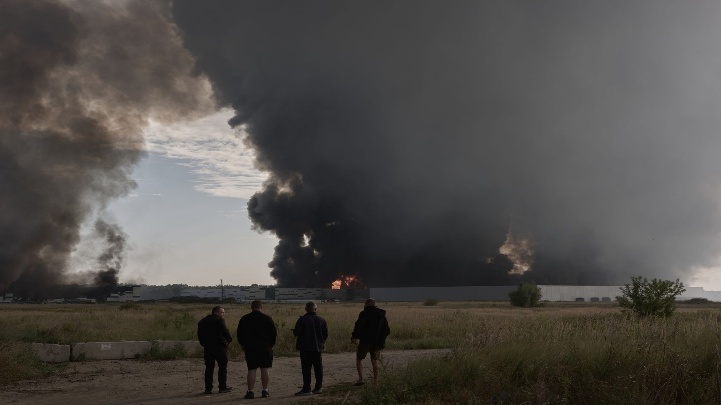
Local residents and warehouse workers watch a massive fire burn at a commercial storage facility following a Russian drone strike in Boryspil, Kyiv Oblast, Ukraine. (Kostiantyn Liberov / Libkos / Getty Images)
THE DAY’S RECKONING
Vladimir Putin doesn’t need to announce a mobilization if he never calls it one. That’s the quiet plan Russian sources described today: up to 400,000 more men pushed toward the front through regional coercion and contract pressure, timed to avoid the exact backlash Russia’s only real mobilization triggered back in 2022. No declaration. No headline. Just more soldiers, arriving the way soldiers have arrived all year — one pressured signature at a time.
Everything else about today moved on its own track, but pointed the same direction. Russia’s answer to Starlink failed its second launch in a row, leaving Moscow further behind in a technology race it’s rushing to close. Ukrainian drones reached nearly a thousand miles into Russia to hit a Wildberries warehouse, while Kyiv absorbed a fifth straight day of drones designed less to destroy any one target than to simply keep the city exhausted. Putin spent his day shaking hands with Xi Jinping and Narendra Modi, projecting strength on a stage built for exactly that purpose. And in Washington, two American envoys who still haven’t visited Kyiv talked about maybe, finally, setting a date. Nothing today resolved. Everything today kept its own accounting.
RUSSIA’S STARLINK RIVAL FALTERS AGAIN
Russia’s effort to build its own alternative to Starlink suffered a second consecutive setback, with none of the 16 Rassvet satellites launched on July 19 reaching their intended 550-kilometer operational altitude as of today, according to satellite-tracking data. Many ended up stranded between 300 and 400 kilometers, with at least two now heading for atmospheric reentry — well short of even the reduced altitude target, let alone the 870 kilometers Russia originally planned.
The failure compounds an earlier one: of the first 16 Rassvet satellites launched in March, only 12 successfully reached their target altitude, meaning just 37.5 percent of all launched satellites across both batches have reached sustainable orbit. Russia’s aerospace developer, Bureau 1440, says it plans “dozens” more launches to deploy “hundreds” of satellites, but the country’s heavy reliance on the costly, scarce Soyuz-2.1b launch vehicle — used only six to eight times for all space launches since 2022 — makes that timeline implausible; at current pace, Russia could manage at most 128 satellites over four years, and not all of those would necessarily reach orbit successfully. Ukraine’s own strikes are compounding the delay: Ukrainian forces hit the Progress Space Rocket Center, which builds Soyuz-type launch vehicles, in mid-August, and attempted a strike on the Plesetsk Cosmodrome — the site Russia launches Rassvet satellites from — on August 23, just two days before Russia’s next Soyuz launch went ahead regardless.
PUTIN PLANS A COVERT MOBILIZATION AFTER SEPTEMBER’S ELECTIONS
Russian sources told The Economist that Vladimir Putin remains committed to deploying between 300,000 and 400,000 additional troops to Ukraine, using regional government pressure and coercive contract-signing rather than a formally declared mobilization that would risk the kind of domestic backlash Russia saw in 2022. Officials in Penza Oblast have reportedly intensified exactly this kind of recruitment since June, detaining and pressuring men into signing military contracts across multiple cities in the region.
Publicly, Russian officials keep denying any such plan is underway. Security Council Deputy Chairman Dmitry Medvedev said Russia doesn’t need mobilization because it already has enough contract soldiers; UN Ambassador Vasily Nebenzya offered an identical denial days earlier. Neither claim squares easily with a recruitment system that’s struggled to consistently hit its own monthly targets, or with a Kremlin that appears to be deliberately building the administrative and coercive infrastructure to expand force generation quietly, whenever Putin chooses to activate it more aggressively. Analysts continue to assess this remains a personal decision for Putin, contingent on how he reads both the battlefield and his own regime’s stability — meaning the current posture keeps every option open without committing to any of them in public before votes are cast.
PUTIN COURTS XI AND MODI AS LAVROV THREATENS NATO OVER THE ARCTIC
Vladimir Putin met separately with Chinese President Xi Jinping and Indian Prime Minister Narendra Modi today ahead of the Shanghai Cooperation Organization summit in Kyrgyzstan, using both conversations to deepen cooperation on the Northern Sea Route — the Arctic shipping corridor Russia increasingly views as an alternative to Black Sea and Caspian routes now complicated by Ukrainian strikes and European vessel seizures. Putin offered China a permanent visa-free travel arrangement, and Kremlin aides said he’d hold additional bilateral meetings with Iran’s president and other leaders during the two-day gathering.
The same day, Foreign Minister Sergei Lavrov published an article accusing NATO of militarizing the Arctic in a “direct threat” to Russian security, warning the alliance’s growing presence risks “catastrophic consequences” and that Moscow is prepared to respond through unspecified “asymmetric” means. Russia’s ambassador to Norway offered a parallel message, claiming Russia poses no threat to Norway while framing any Russian activity as purely reactive to NATO’s own escalation. It’s a familiar rhetorical pattern Moscow has used since 2022 — casting its own military posturing as defensive while treating routine allied exercises as provocation — deployed here specifically to discourage NATO from expanding its Arctic Sentry mission, launched earlier this year partly in response to Russia’s own military buildup in the region.
WASHINGTON REACHES OUT TO BOTH SIDES AT ONCE
President Zelensky said today he held a “detailed and constructive” call with US envoys Steve Witkoff and Jared Kushner, discussing a possible date for their long-delayed first visit to Kyiv. “This trip would be very useful for working out decisions toward peace,” Zelensky said, adding that both men “know many of the details” of the battlefield situation already. In his evening address, though, he struck a far less hopeful note: Ukrainian and allied intelligence both indicate Putin personally still wants to keep fighting, not end the war. “We will see what the U.S. president’s envoys can accomplish,” he said. “September can change a lot.”
The outreach came the same day US Treasury Secretary Scott Bessent met Russian Finance Minister Anton Siluanov on the sidelines of the G20 summit in North Carolina — Siluanov’s first in-person appearance at a major international gathering since Russia’s 2022 invasion — reportedly to discuss a Washington-backed 28-point peace framework. A Ukrainian official told reporters Kyiv knew nothing about the meeting in advance. The original 28-point plan, drafted last November, was widely criticized as a near-total capitulation for Ukraine and was later trimmed to 20 points before Russia rejected those changes too, leaving negotiations stalled well before today’s quiet, parallel diplomatic overtures on both ends.
MEANWHILE, AT THE FRONT: A COMING BATTLE FOR SLOVYANSK AND KRAMATORSK
Ukrainian military observer Kostyantyn Mashovets offered his most detailed assessment yet of the fight building around Ukraine’s two anchor Fortress Belt cities, describing Russian forces consolidating positions northeast of Kostyantynivka and pushing small infantry groups to within roughly seven kilometers of the Kramatorsk airfield. Russian command has diverted the entirety of its 3rd Army Corps and a significant portion of the 8th Combined Arms Army specifically to reinforce operations near Kostyantynivka rather than attempting a wider envelopment of Druzhkivka — a sign, Mashovets said, that Ukrainian defenses along the Kazennyi Torets River are still holding well enough to force Russia into slower, costlier frontal assaults rather than the sweeping maneuver Moscow would prefer. He assessed Russian forces could reach the immediate approaches of both Slovyansk and Kramatorsk as early as this fall, but that actually seizing either city by year’s end remains unlikely given how badly Russia continues struggling to complete envelopment operations.
Elsewhere, Ukrainian forces advanced southeast of Olhivka near Borova and cleared Russian infiltrators from several villages northwest of Lyman, with even Kremlin-aligned sources acknowledging Ukrainian counterattacks are actively cutting off a Russian salient there. Near Hulyaipole, Ukrainian forces destroyed a Russian drone ground station, while a Ukrainian intelligence commander reported Russian troops on the Kinburn Spit in Kherson Oblast are disguising themselves in civilian clothing and hiding among the area’s remaining civilian population — a war crime under the Geneva Conventions that also prevents Ukrainian forces from striking otherwise legitimate targets without risking civilian casualties.
UKRAINE STRIKES A WAREHOUSE 1,000 MILES FROM THE BORDER
Ukrainian drones struck a Wildberries logistics facility in Yekaterinburg, Sverdlovsk Oblast — nearly 1,000 miles from Ukraine’s border, the deepest confirmed strike yet against the retailer — with debris also damaging three apartment buildings and injuring four residents, according to regional officials, though no fires were reported at the warehouse itself. The same overnight window brought a fresh round of strikes on Belgorod, where Ukrainian forces hit seven separate warehouses; satellite and ground footage confirmed damage extending beyond the previously reported Ozon sorting center to include the Belgorod thermal power plant, a transport company’s facility, and a telecommunications tower.
Separately, Russian sources confirmed Ukraine’s strike on the Kirishi Oil Refinery in Leningrad Oblast forced a partial suspension of operations there, while satellite imagery showed Ukrainian forces struck the Yaroslavl Oil Refinery’s pipe rack at least twice. Ozon and Wildberries together account for roughly 8.5 percent of Russia’s GDP and support more than 4 million jobs, according to Reuters — a scale that explains why Ukraine’s months-long campaign against both companies keeps generating measurable economic strain rather than simply destroying isolated buildings. Separately, a Ukrainian drone struck a Russian-flagged cargo vessel, the Omskiy-107, near Novorossiysk; the crew abandoned ship, and it later drifted across the Black Sea before running aground near Istanbul.
KYIV’S FIFTH DAY: THE SHIFT TO ATTRITION
Kyiv entered a fifth consecutive day of Russian drone attacks today, with strikes injuring eight people in the village of Pohreby just north of the capital and sparking a major fire at an ATB supermarket warehouse in the Desnianskyi district. Debris damaged a residential building in Obolon, a café in Holosiivskyi, and additional sites in Pechersk and Shevchenkivskyi districts, while Ukrainian forces intercepted 96 of 121 drones and a Kh-59 cruise missile launched overnight — roughly 79 percent, a lower rate than Ukraine has managed on calmer nights.
Ukrainian analysts describe a deliberate tactical shift underlying the barrage. “The goal is not only to hit a specific target, but to keep Ukrainian air defenses in constant combat readiness. That is extremely difficult technically, psychologically, and physically,” said Viktor Kevliuk, a reserve colonel at the Center for Defense Strategies. Air Force spokesperson Yurii Ihnat said jet-powered drone deployments increased roughly fivefold in July compared to June, framing the shift bluntly: “Russia is trying to turn the question from whether Ukraine can intercept 80-90% of drones into whether it can do so every day for weeks and months without exhausting disproportionately expensive resources. This is no longer simply a matter for air defense. It is a matter for the war economy.” Russia has launched nearly 800 jet-powered drones over the past four days alone, capable of speeds up to 600 kilometers per hour — roughly four times faster than older Shahed models.
REGIONAL CASUALTIES ACROSS THE COUNTRY
Russian strikes killed at least seven people and injured 45 more nationwide over the past day, spread across six oblasts. Donetsk Oblast bore the heaviest toll, losing four people with seven more injured, according to regional governor Vadym Filashkin. Zaporizhzhia Oblast lost two people and counted three injured; Kherson Oblast lost one person with 16 injured. Dnipropetrovsk Oblast reported five injured region-wide, plus two more hurt in a separate industrial-facility fire in Kryvyi Rih. Kharkiv Oblast counted four injured over the same period.
In Odesa Oblast, Russian forces struck a Nova Poshta postal terminal directly, though officials reported no injuries at that specific site. The scattered, region-by-region nature of the toll has become the war’s defining rhythm by this point — no single strike dominating headlines, but the cumulative daily total remaining brutally consistent regardless of which specific city or village happens to absorb the worst of it on any given day. Combined with the toll from Kyiv’s own fifth day under fire, the country’s overall casualty count for the past 24 hours climbed well past 50, spread thin enough across so many regions that no single number captures the full weight of what any one Ukrainian community actually endured.
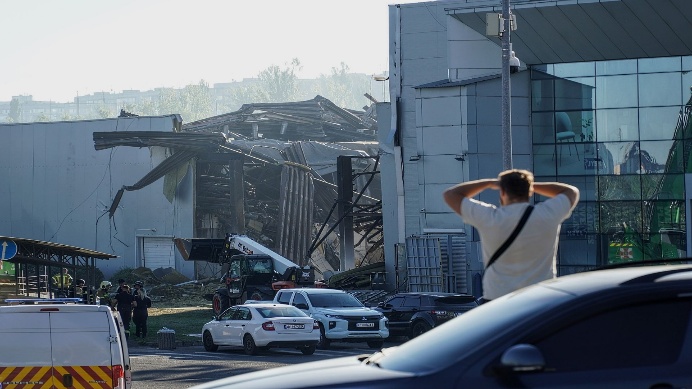
A man looks at a shopping center damaged by a Russian drone strike in Kryvyi Rih, Ukraine. (Ihor Kuznietsov / Global Images Ukraine / Getty Images)
UKRAINE OPENS 25,000 SCHOOLS UNDER FIRE
Ukraine’s new school year began today with 25,000 schools opening their doors nationwide, even as Prime Minister Serhii Koretskyi instructed local authorities to avoid mass assemblies in areas facing heightened risk of Russian attack. “Our task is to ensure that, despite the war, children have the opportunity to study safely and receive a quality education,” Koretskyi said, presenting a detailed safety report covering shelters, meal arrangements, and staff pay increases.
More than 82 percent of preschool children and 83 percent of school students nationwide now have access to shelters — up from 77 percent last year and just 10 percent in 2022 — covering over 9,000 preschools and 11,000 secondary schools, with 131 more state-funded shelters under construction. In Kharkiv Oblast, where security risks remain highest, hybrid learning is available only through underground schools and reaches just 30 percent of students, compared to roughly 80 percent in regions like Odesa, Chernihiv, and Sumy. Because Russia has deliberately targeted printing houses and textbook warehouses, Koretskyi said schools unable to print sufficient physical textbooks must shift students to electronic versions instead. Teachers will also see a 20 percent salary increase starting today, on top of a 30 percent raise earlier this year, with an additional stipend for those teaching in person in frontline areas.
A UKRAINIAN PRANKSTER HUMILIATES RUSSIA’S DRONE PROGRAM
A Ukrainian internet personality infiltrated a secure Russian government video conference discussing drone certification failures, publicly confronting officials from Russia’s Ministry of Industry and Trade and its state aviation agency before the meeting’s organizer cut the feed.
Evhen Volnov, using the handle “Major Chernobaev,” listened as Rosaviatsia’s deputy head compared Russia’s slow drone certification process unfavorably to China’s, then interrupted directly: “How is it that Ukrainian engineers assemble effective, combat-capable unmanned air vehicles in the space of three weeks, in primitive conditions, yet Russian aviation, with everyone here sitting at this meeting, billions of rubles spent, and all we have is a little packet of certification documents to show their bosses?” Attendees sat silently before one accused him of being a “provocateur”; Volnov falsely claimed to be an SBU operative before the call was terminated.
It’s Volnov’s second such intrusion this year — he previously infiltrated a Defense Ministry call on anti-drone jamming systems in early August, and a Russian military recruitment session in April, each time using the access to publicly embarrass officials in front of dozens of colleagues rather than gather intelligence covertly. In the recruitment call, he warned potential Russian recruits directly not to sign contracts, telling them their faces had already been noted. Under Russia’s wartime laws, simply listening to or repeating such comments can itself carry criminal liability — meaning every official present at today’s call now faces legal exposure simply for having stayed connected while Volnov spoke.
A SUSPICIOUS FIRE AT A POLISH DRONE FACTORY
A fire broke out overnight at a WB Electronics plant in Skarżysko-Kamienna, Poland, that manufactures pumps and composite components for drones used by both Polish and Ukrainian forces, with surveillance footage reportedly showing a masked individual entering the facility by climbing a fence shortly before the blaze. The fire was brought under control within two hours with no injuries reported, but a backpack and sweatshirt found near the site, along with a triggered intrusion alarm, has led Poland’s Internal Security Agency to investigate the incident as possible sabotage rather than accident.
WB Electronics is one of Poland’s largest privately owned defense manufacturers and a founding member of the EU-Ukraine Drone Alliance, whose stated purpose is jointly developing drone and counter-drone technology. The incident adds to a growing list of suspected sabotage targeting European defense manufacturers supporting Ukraine this year, including an August 13 explosion at an Italian ammunition plant and a foiled arson plot against a Ukrainian-owned drone factory in Slovakia on August 25 — a pattern Western officials increasingly attribute to a deliberate Russian campaign against the industrial base keeping Ukraine’s war effort supplied.
Polish authorities have urged caution against drawing premature conclusions about Russian involvement, noting the investigation remains ongoing and no suspect has yet been identified or formally linked to Moscow. Still, the timing and method — a masked intruder, an unexplained fire at a defense facility just weeks after similar incidents elsewhere in Europe — fits a pattern security officials across the continent have grown increasingly vocal about throughout the summer, treating each individual case as one data point in what looks, collectively, like a coordinated hybrid campaign rather than a series of unrelated coincidences.
UKRAINIAN INTELLIGENCE DEBUNKS RUSSIA’S “HYPERSONIC” ZIRCON MISSILE
Ukraine’s military intelligence agency published a detailed technical breakdown today revealing that Russia’s much-hyped Zircon missile falls well short of the Kremlin’s own claims — a quasi-ballistic weapon rather than the hypersonic cruise missile Moscow has marketed it as, with a real top speed of Mach 6.8 against Russia’s claimed Mach 9.
HUR said the missile, originally designed as an anti-ship weapon for Russia’s submarines and frigates, has been increasingly adapted to strike Kyiv and other Ukrainian cities from land-based Bastion-M coastal systems after Russia’s Black Sea Fleet proved unable to operate safely enough to use it as intended. Its 120-kilogram warhead is actually smaller than the one carried by Russia’s cheaper Banderol cruise missile. HUR identified 70 companies involved in supplying components for the Zircon’s production, including two American firms — TriQuint Semiconductor and Altera, formerly part of Intel — underscoring how deeply Western-made electronics remain embedded in Russia’s most advanced weapons despite years of sanctions.
Separately, HUR’s deputy chief said Russia has already met its full annual production target for Zircon missiles, manufacturing 33 units in the year’s first seven months alone. The disclosure lands as part of a broader Ukrainian effort to methodically demystify Russia’s most-hyped weapons systems, stripping away the propaganda value Moscow attaches to missiles like the Zircon by publishing hard technical specifications that consistently show real-world performance falling short of Kremlin marketing — a small but deliberate form of psychological counter-pressure aimed at both Ukrainian morale and international perceptions of Russia’s remaining technological edge.
PERSONNEL CHANGES AND A SKYSCRAPER FOR SALE
President Zelensky named Vadym Chenchyk as acting head of Ukraine’s State Border Guard Service, replacing Valerii Vavryniuk — the second such change this year without a permanent chief ever being appointed, following the dismissal of the previous chief amid a bribery investigation into diplomatic-plate smuggling that saw border guards accept nearly $237,000 to facilitate cigarette trafficking. Separately, Zelensky dismissed presidential strategic adviser Oleksandr Kamyshin, who said he’ll continue working in the defense industry on international partnerships rather than take another government post, thanking Zelensky for “the trust and the opportunity to be of service” during his tenure helping build Ukraine’s defense-industrial base into a sector increasingly integrated with European and American supply chains.
Meanwhile, Ukraine’s state banks put Kyiv’s Gulliver shopping and business center up for auction with a $207 million starting price, a year after courts seized the skyscraper from sanctioned oligarch Viktor Polischuk over $675 million in unpaid loans. If successful, it would be the largest wartime privatization in Ukraine’s history, though analysts questioned whether any buyer would take the risk given Russia’s escalating strikes on shopping centers elsewhere in the country. “I don’t think that businesses will take such a risk during these months,” one investment firm executive told the Kyiv Independent.
A DEADLY EXPLOSION IN RIVNE, A TANKER SEIZED, A SENATOR’S NUCLEAR THREAT
An explosion at a police station in Rivne killed one bomb-disposal team member and injured three others while the team worked on-site, prompting a negligence investigation into how the explosive materials were being handled. Separately, the EU’s Operation IRINI intercepted its sixth suspected shadow-fleet tanker, the MV Sun, in the Mediterranean, with EU foreign policy chief Kaja Kallas confirming the vessel was suspected of sailing under a false flag; the bloc has now sanctioned 673 shadow-fleet ships, with a new sanctions package targeting up to 1,500 more entities expected soon.
Meanwhile, Russian State Duma deputy Alexei Zhuravlev, leader of the nationalist Rodina party, publicly called for Russia to use tactical nuclear weapons against Ukraine if necessary, dismissing any debate on the question: “If we need to strike, we will strike. And that is not up for discussion.” Romania’s defense minister offered a more measured read on Russia’s intentions the same day, saying he sees no evidence Moscow intends to attack a NATO member and describing the war as having settled into “a stalemate along the entire front line” — a rare note of calm amid a day otherwise filled with nuclear rhetoric and quiet mobilization planning on Russia’s side of the war.
A SATELLITE FALLING, A SCHOOL BELL RINGING, A CALL FROM WASHINGTON
By nightfall, the day’s threads pulled toward the same uneasy conclusion: nothing about this war is close to resolving, and everyone involved seems to know it. A Russian satellite constellation keeps falling out of orbit. A Ukrainian warehouse a thousand miles from the border is burning because drones reached it anyway. Kyiv marked a fifth day of sirens with the same exhausted resolve it’s shown every day before this one.
Twenty-five thousand schools opened their doors regardless. A prankster made Russian officials sit in silence rather than answer an honest question. And in Washington, two envoys who still haven’t visited Kyiv talked, once more, about maybe finding a date. Nothing today ended. Everything today measured, in its own way, exactly how much longer everyone involved expects this to last.
A PRAYER FOR UKRAINE
1. For the Bomb Disposal Officer in Rivne
Lord, a man died today doing one of this war’s most dangerous, least visible jobs — clearing the explosives that keep threatening ordinary people even after the strikes themselves have stopped. We honor a life spent making things safer for others. Comfort his team, his family, and everyone who does this work daily without recognition. Protect those still doing it tonight, and grant swift healing to his injured colleagues.
2. For Every Family Facing a Quiet Draft Notice
Father, we lift up the men in Penza and across Russia being pressured into contracts they never chose to sign, and the families in Ukraine bracing for whatever Russia’s next wave of soldiers ultimately brings. Give clarity to those caught between coercion and conscience on one side of this war, and endurance to those defending against its consequences on the other. Let no one be forced into violence against their will.
3. For Children Starting School in a Country at War
Lord of the young, we thank you that twenty-five thousand schools opened today despite everything working against them. Protect every child walking to class in a frontline city, every teacher choosing to show up regardless of the risk. Let learning continue as an act of quiet defiance, and let this generation grow up believing normal life is still worth building toward, even now.
4. For Wisdom in Every Room Where This War Is Discussed
God of nations, we pray for the diplomats, envoys, and officials quietly working toward some version of peace, even when their progress is invisible and their timelines keep slipping. Give them patience with a process that resists urgency, and give Ukraine’s own negotiators strength to keep pressing for terms that actually protect its people. Let September bring more than another delay.
5. For an End to the Rhetoric That Makes War Feel Inevitable
God of peace, we pray against every voice, on any side, that treats catastrophic escalation as simply a matter of when, not whether. Give leaders the restraint to de-escalate rather than posture, and give ordinary people the reassurance that reckless words won’t become reckless actions. Let calmer voices be the ones the world ultimately listens to.
In Your mercy, in Your justice, in Your time — bring this war to its end, and let the ending be worthy of what Ukraine has endured.