
September 16, 2026
Prepared by Diana Bozhyk
Ukrainian Unmanned Systems Forces confirmed they killed Major General Anton Grunis, commander of the Russian brigade fighting in Kostyantynivka, in a targeted drone strike — the seventh senior Russian commander Ukraine’s drone units have killed since the war began. A hacking group announced it breached Russia’s Central Election Commission and the contractor building its “Elections 2.0” voting system just two days before Vladimir Putin’s tightly controlled State Duma vote, which Putin is openly framing as a referendum on the war. Kremlin aide Nikolai Patrushev warned Poland would “cease to exist within two or three days” if it entered military conflict with Russia, responding to Polish Foreign Minister Radoslaw Sikorski’s earlier claim that NATO could defeat Russia quickly. Ukraine’s military intelligence agency warned that falling water levels and repeated power losses are creating a genuinely dangerous safety situation at the occupied Zaporizhzhia Nuclear Power Plant, where all six reactors remain in cold shutdown.
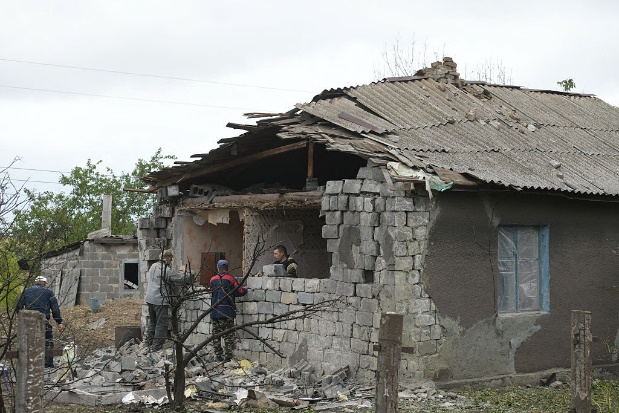
Residents work to repair damaged houses following what local Russian-installed officials called an overnight Ukrainian drone attack, in the settlement of Zolotaryovka in the Donetsk region, Russian-controlled Ukraine. (AFP via Getty Images)
THE DAY’S RECKONING
Somewhere in occupied Donetsk City twelve days ago, a Ukrainian drone found Major General Anton Grunis — the same general Putin personally met in a staged July photo op to celebrate a city Russia hadn’t actually captured. Today, Ukraine confirmed he’s dead. Seventh commander down. It’s the kind of quiet, cumulative attrition that doesn’t make headlines the way a missile strike does, but adds up to something Russia’s own generals can’t easily ignore anymore.
Everywhere else, the day moved between real danger and rhetorical theater. Hackers claim they broke into the system meant to run Russia’s supposedly unbreakable election, two days before Putin turns a predetermined vote into a loyalty test. A Kremlin aide threatened to erase an entire NATO country in 72 hours. Six reactors sat cold and increasingly thirsty at Europe’s largest nuclear plant, while the world’s attention drifted elsewhere. Six thousand people in occupied Oleshky have nowhere left to go but through minefields. A German entrepreneur is living out of hotel rooms because Moscow wants him dead for the crime of selling drones to the country defending itself. Nothing today resolved cleanly. Everything today measured how many different fronts this war is actually being fought on at once.
UKRAINE KILLS A SEVENTH RUSSIAN COMMANDER
Ukraine’s Unmanned Systems Forces confirmed today that a targeted drone strike killed Major General Anton Grunis, commander of Russia’s 4th Motorized Rifle Brigade, in occupied Donetsk City on September 12. USF Commander Robert “Magyar” Brovdi posted geolocated footage confirming the strike; Chechen Akhmat Spetsnaz commander Major General Apti Alaudinov separately confirmed Grunis’s death without specifying the cause. Grunis is the seventh Russian military commander at brigade, division, or army level that Ukraine’s drone forces have successfully killed since the war began.
The strike carries particular symbolic weight. Grunis’s 4th Motorized Rifle Brigade is the primary fighting force operating in Kostyantynivka itself, and Putin personally met with Grunis during a staged July 3 photo opportunity designed to showcase exaggerated claims of Russian advances in the city — claims that, more than two months later, still don’t match the actual, contested reality on the ground. Russian Defense Minister Andrey Belousov later awarded Grunis the Hero of Russia title specifically for his brigade’s supposed role in seizing Kostyantynivka, a city Ukrainian forces continue to actively contest. Grunis’s death adds one more entry to a growing list of Russian commanders killed after being publicly celebrated for victories that, on closer inspection, were never fully real.
RUSSIA’S DUMA ELECTIONS: A PREDETERMINED VOTE FRAMED AS WAR REFERENDUM
Vladimir Putin declared today that participating in Russia’s September 18-20 State Duma elections is a “responsibility” for all citizens, framing the vote as a “common contribution” to Russia’s war effort and highlighting that residents of the four illegally annexed Ukrainian oblasts will vote in Duma elections for the first time. The election’s outcome is effectively predetermined: Russia’s Supreme Court disqualified Yabloko, the only party offering a pro-ceasefire platform, from participating back on August 11, and Russian occupation authorities have staffed voting locations in occupied Ukraine with armed soldiers to ensure compliant results.
United Russia Chairman Dmitry Medvedev and other party officials have explicitly positioned the ruling party as Russia’s “party of victory” in Ukraine, a framing the Kremlin is using to manufacture the appearance of overwhelming domestic support for continuing the war — support it can then invoke to demand further societal sacrifice, including a mobilization wave Russian officials continue publicly denying is under consideration.
The election, in other words, isn’t a genuine democratic exercise so much as a controlled mechanism for the Kremlin to claim a mandate it needs regardless of what ordinary Russians actually think about a war that’s cost the country hundreds of thousands of casualties. Putin’s own framing makes the intent explicit: rather than presenting the vote as an ordinary domestic contest, he’s deliberately tying every ballot cast directly to the war effort, ensuring that whatever result emerges can be presented internationally as proof of national consensus, however manufactured.
HACKERS BREACH RUSSIA’S “INVULNERABLE” ELECTION SYSTEM
A hacking group announced today it had breached Russia’s Central Election Commission along with the contractor responsible for developing the country’s “GAS Elections 2.0” voting infrastructure, just two days before polls open for the State Duma vote. The announcement directly undermines Kremlin claims that Russia’s electronic voting systems are secure against outside interference, arriving at a moment when Putin is simultaneously accusing Western countries of attempting to interfere in the same elections — an allegation Lavrov repeated today without offering any supporting evidence.
The timing lands with particular irony given how tightly the Kremlin has already controlled the vote’s actual outcome through more conventional means: disqualifying the only antiwar party, staffing occupied territory polling stations with soldiers, and centering the entire campaign around loyalty to the war rather than genuine political competition. Whether the claimed breach produces any material effect on the vote itself remains unclear, but it adds a layer of genuine technical vulnerability to an election the Kremlin has spent months trying to present as both inevitable and unimpeachable.
Neither Russian election officials nor state media had publicly addressed the claimed breach as of this report, and independent verification of the hacking group’s specific claims remains limited. Still, the announcement fits a broader pattern of cyber operations targeting Russian state infrastructure throughout the war, adding one more source of uncertainty to a vote the Kremlin has otherwise worked exhaustively to insulate from any genuine element of surprise.
PATRUSHEV THREATENS POLAND WOULD “CEASE TO EXIST”
Kremlin aide Nikolai Patrushev claimed this week that Polish statehood would end within “two or three days” if Warsaw entered military conflict with Russia, saying Moscow would “use the entire arsenal of forces and means at its disposal” and that “Warsaw will cease to exist.” Patrushev didn’t explicitly invoke nuclear weapons, though Russia possesses one of the world’s largest nuclear arsenals. The comment came in direct response to Polish Foreign Minister Radoslaw Sikorski’s earlier remarks at the Yalta European Strategy conference, where he argued NATO holds overwhelming air-power superiority and could “defeat Russia quite quickly” if directly attacked — comments Patrushev dismissed as “amateurish.”
Lavrov echoed the escalatory rhetoric separately today, warning that any European attack on Russia would trigger “a completely different war” that would be “very short,” while insisting Moscow harbors no interest in military confrontation with the West. He also repeated Putin’s standing warning that deploying foreign troops to Ukraine as part of any postwar security arrangement would constitute a declaration of war against Russia — a direct challenge to the security-guarantee frameworks several European allies have discussed as part of ending the conflict.
The pairing of Patrushev’s specific, apocalyptic threat against Poland with Lavrov’s broader warning about European involvement illustrates a deliberate Kremlin messaging strategy: escalating rhetorical pressure against individual NATO members and the alliance as a whole simultaneously, aimed at discouraging exactly the kind of postwar troop deployments and defensive posturing Sikorski and other European officials have increasingly advocated in recent weeks.
ZAPORIZHZHIA NUCLEAR PLANT: ALL SIX REACTORS COLD, WATER LEVELS FALLING
Ukraine’s military intelligence agency HUR warned today that deteriorating conditions at the Russian-occupied Zaporizhzhia Nuclear Power Plant are creating an increasingly dangerous safety situation. None of the plant’s six reactors is currently generating electricity, with all remaining in cold shutdown maintained by a skeleton crew of roughly 1,150 workers. The facility’s cooling-pond water level has fallen from 12.86 meters in July to 12.55 meters by late August, continuing to decline even though normal operation requires at least 15 meters — a gap HUR described as worsening with no clear resolution in sight.
The plant lost external power three separate times in August alone due to problems with the Ferrosplavna-1 transmission line, bringing the total number of external power losses since the 2022 invasion to between 23 and 25. Backup diesel generators activated during each outage, but HUR warned a prolonged total blackout would require roughly 150 metric tons of diesel fuel daily — a supply increasingly strained by fuel shortages across occupied territory. HUR separately accused Russia of using IAEA representatives to help legitimize the occupation, alleging Russian deputy IAEA official Mikhail Chudakov secured changes to the agency’s reactor-information system that display occupied Crimea as Russian territory and render Ukrainian plant names in Russian.
ZELENSKY: NAME YOUR PROTECTED SITES FIRST
President Zelensky told CBS News today that Russia must present a specific list of energy facilities it wants spared from Ukrainian strikes if Moscow is serious about negotiating any reciprocal energy ceasefire. “If they say, ‘We are not attacking these facilities,’ then they must put on the table a list of their facilities — those they do not want us to attack,” Zelensky said, confirming that US envoys Witkoff and Kushner had raised the possibility of a mutual refinery-strike halt during their recent Kyiv visit. He drew a sharp distinction in what “energy” actually means to each side: “For Putin, energy means selling oil and gas. For us, energy means electricity and gas for our people.”
Zelensky estimated that restrictions on Russia’s ability to transport and sell oil are costing the Kremlin’s war budget more than $100 billion annually, potentially reaching $150 billion this year, framing Ukraine’s refinery campaign explicitly as retaliatory rather than unprovoked: “We never strike first. Our tactic is to respond where we can, because Putin does not respect the weak and will not even think about negotiating with them.” He said any genuine de-escalation must also address Ukraine’s roughly 30 million tons of needed grain exports, given Russia’s own 70-million-ton surplus and the global food-security stakes of continued Black Sea disruption.
ZELENSKY: “HE NEEDS UKRAINE” — REJECTS A TERRITORIAL “WIN-WIN”
In a separate interview with CBC News, Zelensky pushed back forcefully against the idea that Putin could be satisfied by securing a specific slice of Ukrainian territory, responding directly to Kushner’s earlier framing of territory as the war’s central sticking point. “The problem is that we have to change Putin’s mind,” Zelensky said, arguing it made little sense to suggest Putin wants only part of Ukraine when Russia already controls vast territory elsewhere. “He needs Ukraine. He needs Ukraine to be a part of Russia.”
Zelensky said he’d accept a ceasefire along the current line of contact if Russia agreed to halt fighting unconditionally, with negotiations continuing afterward through international mediation — but explicitly rejected any framing of the war’s outcome as a “win-win” for both sides. “There is no win-win in this war,” he said, arguing the conflict stopped being something either side could benefit from the moment it began. He confirmed he’d meet Putin directly if doing so could produce genuine progress toward peace, despite personal reluctance: “he is an enemy, of course,” but security guarantees ensuring Russia couldn’t simply resume its invasion after any agreement remain the non-negotiable precondition.
Zelensky acknowledged some daylight between his own position and Kushner’s on how to actually resolve the territorial question, but said he remained encouraged that both Kushner and Witkoff had finally traveled to Kyiv after months of exclusively visiting Moscow. He said Ukraine was preparing for a possible meeting with Trump in New York later in September, though he declined to detail specific proposals the envoys had asked Ukrainian officials to keep confidential while both sides continue examining them.
OLESHKY: 6,000 TRAPPED, WALKING THROUGH MINEFIELDS TO ESCAPE
Ukraine’s Parliamentary Human Rights Commissioner Dmytro Lubinets said today that Russian authorities have failed to uphold a previously agreed humanitarian evacuation arrangement for occupied Oleshky, a Kherson Oblast town where residents remain without reliable access to drinking water, food, or medicine. The International Committee of the Red Cross had been prepared to assist the evacuation, and Ukrainian forces had arranged a ceasefire specifically to enable it — an agreement Russian authorities simply never honored. “These people must be saved,” Lubinets said. “The city has been turned into a death trap.”
His office has verified at least 358 people urgently needing evacuation among 176 total appeals received, estimating more than 6,000 people, including 200 children, may remain trapped in Oleshky and the surrounding district — figures that can’t be independently verified given how tightly Russian occupation authorities restrict outside information access. Some residents, Lubinets said, have begun attempting to escape independently through mined fields rather than wait for a formal evacuation that never materializes. “They see no other way to escape this hell,” he said, describing residents who’d rather risk stepping on landmines or being struck by drones than remain in a town where regular shelling and near-daily drone attacks have made even routine survival a daily gamble.
A GERMAN DRONE CEO GOES INTO HIDING FROM A RUSSIAN ASSASSINATION PLOT
Stefan Thumann, CEO of German defense-tech firm Donaustahl, has spent months living in hiding, changing locations every few weeks and surrounded by bodyguards, after German authorities warned him of a suspected Russian assassination plot tied to his company’s drone supply to Ukraine. “Putin chose this path, and I have to accept that and respond accordingly,” Thumann told AFP from an undisclosed location, saying he believes the situation will only end when “the Russian regime is toppled” or Russia succeeds in killing him. Authorities first warned him of danger last December before explicitly confirming the threat originated from Russia; two low-level suspects have since been arrested in connection with the plot, though Thumann believes the danger persists.
Thumann isn’t an isolated case: the US reportedly foiled a Russian plot to assassinate the head of Rheinmetall, Germany’s largest defense company, in 2024, and firebombs were thrown at a defense-tech firm and drone maker in Munich just last week, resulting in the arrest of two Bulgarian nationals. “Every EU country is a target — and every defence company is a target — of Russian aggression,” Thumann said, arguing that his company’s focus on cheap, mass-producible drones specifically threatens Russia’s strategic calculus more than large-scale traditional defense manufacturing. “I’m more or less completely isolated from the outside world,” he said of the toll the threat has taken, describing contact with his own family as reduced to sporadic digital messages.
MEANWHILE, AT THE ACTUAL FRONT
Ukrainian military observer Kostyantyn Mashovets reported Ukrainian forces have pushed Russian 25th Combined Arms Army elements out of southeastern Lyman and Dibrova, back toward the Lyman-Zakitne road, while separately eliminating a Russian tactical bridgehead on the Nitrius River and clearing infiltrators from Novoselivka and Drobysheve northwest of the city. A source tracking Russia’s Western Grouping of Forces claimed Russia’s General Staff may have dismissed 20th Combined Arms Army Commander Lieutenant General Roman Yurchenko over the failure to repel these Ukrainian counterattacks — a personnel change, if confirmed, that would underscore just how seriously Moscow is treating the collapse of its northern encirclement effort.
Ukrainian forces also likely advanced southeast of Borova, liberating Hrekivka and pushing roughly 1.5 kilometers deeper into the area beyond it, according to Mashovets. Elsewhere, a source reporting on Russia’s Northern Grouping of Forces floated an unconfirmed and genuinely alarming possibility: that North Korean forces, already operating in Russia’s rear in Kursk Oblast since March 2025, might eventually replace Russian units currently deployed toward Sumy or Kharkiv — potentially bringing North Korean troops into direct combat inside Ukrainian territory for the first time. ISW said it has observed no confirming evidence of this claim, but noted any such deployment would represent a dramatic escalation requiring serious international reassessment, particularly from South Korea.
A PARTISAN SABOTAGE, A DEFENSE SPENDING TARGET, AND A JET DEPLOYMENT
A Ukrainian partisan group claimed today that sabotage it carried out has disrupted a Russian missile-components plant for weeks, delaying production of parts for Kh-101 cruise missiles, Iskander-K systems, and Pantsir-S1 air-defense units. Separately, Polish Foreign Minister Sikorski told a European conference that EU NATO members’ combined core defense spending could exceed €800 billion by 2035 if commitments made at the Hague summit are fully honored, framing Europe’s real challenge as capability rather than budget: “You cannot fight drones with sticks and stones.” He specifically named long-range strike systems, AI-enabled data analysis, mass drone deployment, and counter-drone technology as Europe’s priority investment areas.
Germany announced it will deploy four Eurofighter jets to Latvia’s Lielvarde Air Base for roughly a week spanning late September into early October, specifically to reinforce Latvian airspace ahead of the country’s October 3 parliamentary elections amid mounting drone-incursion concerns. The deployment joins NATO’s enhanced Air Policing North mission, following Latvia’s own request for additional alliance support and a string of confirmed foreign drone incursions into Latvian territory throughout 2026, including a Russian Gerbera-type drone NATO fighters shot down over the Latgale region in June.
Together, the three stories illustrate the same broad pattern playing out across the continent this month: Ukraine quietly degrading Russian missile production through irregular sabotage, Poland’s own foreign minister publicly arguing Europe needs to dramatically scale up its conventional deterrent capacity, and Germany reinforcing a Baltic neighbor’s skies specifically because an upcoming election has become, in itself, a moment of genuine security concern.
A COMMANDER KILLED, A VOTE HACKED, A CITY WITH NO WAY OUT
By nightfall, today’s threads pulled toward the same uneasy conclusion: this war keeps finding new fronts to open even as the old ones grind on unresolved. A seventh Russian commander is dead, killed by the same precision strikes that keep exposing the gap between Kremlin propaganda and battlefield reality. A vote meant to prove Russia’s unshakable unity may have been quietly compromised before it even opened.
Six thousand people in Oleshky have nothing left to lose by walking through a minefield. A German businessman hasn’t slept in the same place twice in months because he sells drones to people defending themselves. And somewhere in Zaporizhzhia, six nuclear reactors sit cold and thirsty, waiting for water levels that keep declining with no clear plan to reverse the trend. Nothing today ended. Everything today measured how many different, simultaneous emergencies this war has managed to create at once.
A PRAYER FOR UKRAINE
1. For Every Civilian Trapped in Oleshky
Lord, we lift up the thousands still trapped in a town that’s become, in the words of its own advocate, a death trap. We grieve that some would rather risk landmines than remain another day. Protect every person attempting that desperate crossing, and move whatever hearts still need moving to finally honor the evacuation Russia already promised and never delivered.
2. For Those Living Under the Shadow of Assassination
Father, we pray for Stefan Thumann and everyone else marked simply for helping Ukraine defend itself — living in hiding, separated from family, uncertain each day whether it will be their last as themselves. Give them courage to keep going, protection beyond what any bodyguard can guarantee, and eventually, a life they can return to without looking over their shoulder.
3. For Safety at a Nuclear Plant No One Fully Controls
Lord of creation, we pray for the workers keeping Zaporizhzhia’s reactors stable with dwindling water and unreliable power, doing careful, essential work under occupation and constant uncertainty day after day. Protect them from a catastrophe neither side can afford. And give the international community enough urgency to address a crisis that threatens far more than the two nations fighting over it.
4. For Truth in an Election Built on Silence
God of justice, we pray for the Russians denied any real choice in this week’s vote — the antiwar party barred, the soldiers watching polling stations, the loyalty demanded rather than genuinely earned. Let truth find its way through whatever cracks remain, however small, and give ordinary Russians eventually the genuine voice this election was designed specifically to deny them.
5. For an End That Doesn’t Require Another Commander’s Death
God of peace, we pray for a resolution to this war that doesn’t depend on how many more generals, on either side, must die before it ends. Give leaders the wisdom Zelensky described today — changing minds, not just borders. And let whatever peace eventually comes be strong enough that no ceasefire simply becomes a pause before the next invasion.
In Your mercy, in Your justice, in Your time — bring this war to its end, and let the ending be worthy of what Ukraine has endured.