
September 21, 2026
Prepared by Diana Bozhyk
Russia’s Central Election Commission reported that United Russia won 355 of 450 Duma seats — roughly 78 percent — in preliminary results from the country’s predetermined three-day vote, with 49 combat veterans among the party’s new lawmakers. President Zelensky confirmed he’ll meet President Trump on the sidelines of the UN General Assembly on Tuesday, after Trump wrote on Truth Social that Russia has “lost control” of its own diesel industry because of the war it started. The EU narrowly avoided letting all 3,000 of its Russia sanctions lapse entirely, striking a last-minute deal to delist Russian-Uzbek billionaire Alisher Usmanov and banker Mikhail Fridman in exchange for extending the remaining sanctions list for 36 months instead of the usual 12. Russian strikes killed at least two people and injured 11 more overnight, including at two gas stations along Ukraine’s main Kyiv-Lviv highway, while Politico reported Russia is building underground facilities at its Alabuga complex specifically to shield expanded drone production from Ukrainian strikes.
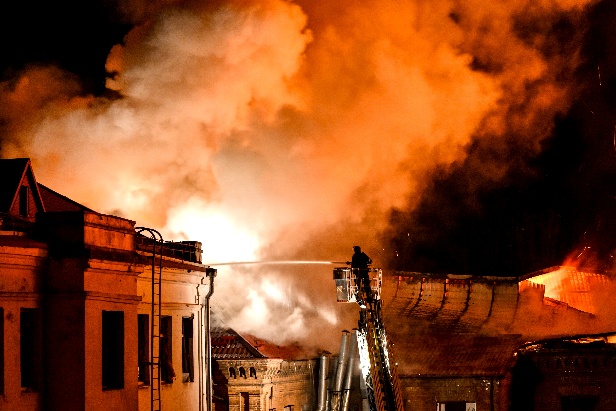
A rescuer uses an aerial work platform to extinguish a fire at Academic Building No. 3 of Zaporizhzhia National University in the Oleksandrivskyi district of Zaporizhzhia, Ukraine. (Dmytro Smolienko/Ukrinform/NurPhoto via Getty Images)
THE DAY’S RECKONING
Seventy-eight percent. That’s the share of Russia’s parliament Putin’s party now controls, after a vote nobody credible ever doubted the outcome of. Forty-nine of those new lawmakers are combat veterans, a deliberate bloc Putin is building to militarize not just the war but the government running it. The Kremlin will spend the next few years calling this a mandate. It’s really just the paperwork on a decision made long before anyone cast a ballot.
Everywhere else, the day carried its usual split between diplomacy and denial. Zelensky confirmed he’ll finally sit across from Trump on Tuesday, the same day Trump admitted, almost offhandedly, that Russia has lost its grip on its own fuel industry. Europe nearly let its entire Russia sanctions regime expire over a fight about two oligarchs, saving it only by trading their names for three more years of everything else. Two gas stations burned along Ukraine’s main highway west. A Romanian presidential candidate whose Russian-backed campaign got annulled last year turned up in handcuffs on fraud charges. Nothing today resolved cleanly. Everything today measured how much theater and how much substance this war still manages to produce in equal measure.
PUTIN’S PARTY WINS 78% OF THE DUMA IN A PREDICTABLE LANDSLIDE
Russia’s Central Election Commission reported preliminary results today showing United Russia winning 355 of 450 Duma seats — roughly 78 percent, an eight-point jump from the 315 seats the party currently holds — after a three-day vote widely documented for ballot stuffing, barred opposition candidates, and coercive recruitment tactics deployed at polling stations. Both the old and new totals sit well above the 226-seat threshold for an outright majority. United Russia General Council Secretary Vladimir Yakushev said 49 combat veterans won seats on the party’s ticket, roughly 11 percent of its total Duma presence, after retracting an earlier, higher claim of 86 veterans.
The veteran bloc represents a deliberate Kremlin strategy Ukrainian and Western analysts have tracked for months: embedding battlefield loyalists directly into Russia’s legislature to accelerate the militarization of both United Russia and the broader government. Russian officials wasted no time framing the results as a genuine mandate. Federation Council Chairperson Valentina Matviyenko said the vote showed Russians’ “understanding” of Putin’s war aims, while state outlet Moskovsky Komsomolets published a piece calling it a “new national referendum” on the invasion. Analysts assess Putin will use the results to justify further demands on Russian society — including some form of mobilization — while claiming societal approval for continued aggression against Ukraine and potential future confrontation with NATO.
ZELENSKY AND TRUMP TO MEET TUESDAY AS TRUMP ADMITS RUSSIA “LOST CONTROL” OF DIESEL
President Zelensky confirmed today he spoke with Trump by phone and the two agreed to meet Tuesday on the sidelines of the UN General Assembly in New York, with Foreign Intelligence Chief Rustem Umerov confirming the specific date. Trump wrote on Truth Social that Russia has “lost control of its diesel oil industry due to its war in Ukraine” — a rare, direct acknowledgment from the American president of exactly the damage Ukraine’s refinery campaign has inflicted, after weeks of publicly pressuring Zelensky to scale that same campaign back.
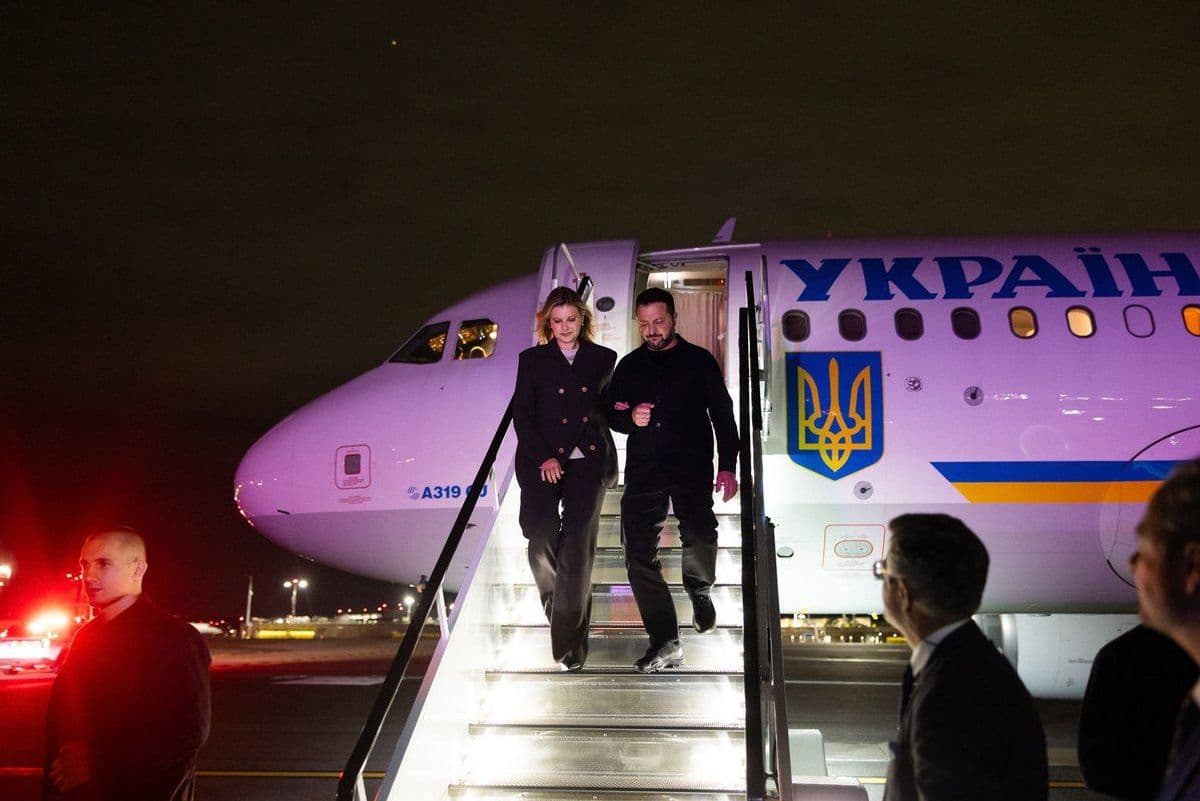
President Volodymyr Zelensky and his wife, First Lady Olena Zelenska, exit there plane after arriving in New York 21 to attend the 81st United Nations General Assembly. (Olena Zelenska)
Zelensky responded the same day, emphasizing Ukraine’s willingness to pursue a mutual ceasefire covering both energy and food infrastructure, and said Kyiv remains ready to work with partners on “strong diplomatic proposals.” Axios reported, citing sources familiar with the Trump-Zelensky call, that the two leaders specifically discussed Ukrainian strikes on Russian refineries — suggesting Trump’s public diesel comment may reflect a genuine, if belated, shift in how directly he now credits Ukraine’s strategy rather than simply blaming it for global fuel prices. Neither side has detailed what the Tuesday meeting is expected to produce, though Zelensky called the diplomatic momentum genuine. The meeting would mark the first in-person encounter between the two leaders since a contentious Oval Office exchange earlier this year, making Tuesday’s tone as consequential as its substance.
THE EU NEARLY LET ALL ITS RUSSIA SANCTIONS EXPIRE
EU ambassadors reached a last-minute deal today to prevent all 3,000 of the bloc’s individual Russia sanctions — asset freezes and travel bans requiring unanimous approval from all 27 members — from lapsing entirely at their September 22 deadline. The resolution came at a real cost: France and Slovakia succeeded in their weeks-long push to delist Usmanov and Fridman, two Russian oligarchs with documented Kremlin ties, in exchange for extending the remaining sanctions list for 36 months rather than the usual 12. Latvia remained the lone holdout late into the evening before the deal was finalized.
Ukrainian officials didn’t hide their frustration. “What has changed? Nothing. Delisting is unacceptable and would send the wrong signal to Moscow at a time when pressure needs to increase,” Foreign Minister Andrii Sybiha wrote. Sanctions envoy Vladyslav Vlasiuk was equally blunt: “Delisting without a fundamental change in conduct sends exactly the wrong signal: pressure is temporary, accountability is negotiable, and sanctions can simply be waited out.” Reuters reported France’s position followed pressure from Azerbaijan, which is holding at least two French nationals, though an Azerbaijani official rejected that characterization. Luxembourg separately pushed for Fridman’s removal specifically. Both men have long disputed the allegations underpinning their original sanctions listings.
RUSSIA BUILDS UNDERGROUND TO PROTECT DRONE PRODUCTION
Politico reported today that Russia is expanding carbon-fiber production capacity at its Alabuga-Volokno facility — a subsidiary of state nuclear agency Rosatom — by 500 tons annually by 2029, enough to potentially produce an additional 28,000 Geran-type strike drones a year, a 78 percent increase over current output. Satellite imagery from May through July shows active clearing operations for the expansion, and Russian government records confirm plans for a new production line at the site. A Chinese state-owned company supplied Alabuga-Volokno with 46 tons of the precursor material needed for carbon-fiber production earlier this year.
More strikingly, a Ukrainian open-source intelligence channel reported Russia has constructed roughly 42,000 square meters — more than 10 acres — of underground space for future production facilities at the same complex, part of a broader 500-hectare construction site Russia began developing in late April specifically adjacent to a passive air-defense perimeter of lattice towers built over the summer. The scale of the investment underscores how seriously Russia now treats the threat Ukraine’s deep-strike campaign poses to its drone manufacturing base — building not just new capacity, but new capacity specifically designed to be unreachable by the kind of strikes that have already disrupted similar facilities elsewhere in the country.
EUROPEAN INTELLIGENCE: RUSSIA MAY MOVE AGAINST NATO WITHIN MONTHS
Czech Security Information Service head Michal Koudelka told the Guardian that Russia may conduct a military operation against NATO within “months, not years,” potentially involving increased drone activity inside alliance territory, a limited incursion, or deliberately staged false-flag incidents designed to look accidental. Latvian State Security Service Director General Normunds Mezviets separately acknowledged Russia is preparing unspecified actions against Europe, while stressing his agency hasn’t observed concrete signs of an imminent attack — a distinction officials across the Baltic states have consistently drawn throughout the year, acknowledging genuine risk while avoiding language that might suggest a specific, dated threat.
The warnings arrive amid a documented pattern of Russian drone incursions, sabotage attempts, and near-miss incidents across NATO’s eastern flank throughout 2026, from Poland and Lithuania to Germany and the UK. Analysts continue to assess that Russia benefits from this ambiguity regardless of whether any single incident is intentional: each incursion tests NATO’s collective-defense response threshold, forces member states to spend real money on increased air-defense readiness, and gradually normalizes exactly the kind of border-testing behavior that would have been unthinkable before 2022. Koudelka’s specific timeline — months rather than years — represents one of the more urgent public warnings any senior European intelligence official has offered this year.
TWO KILLED, 11 INJURED AS KYIV’S HIGHWAY GAS STATIONS BURN AGAIN
Russian strikes killed at least two people and injured 11 more overnight, according to regional officials. Russia struck two gas stations along the M06 highway connecting Kyiv and Lviv, part of a continuing pattern of attacks specifically targeting Ukraine’s fuel retail network that’s spread from Kharkiv, Sumy, and Zaporizhzhia oblasts into central and western Ukraine over recent months. Separately, a Russian strike destroyed a pet retailer’s warehouse in Kyiv, adding another commercial casualty to a summer that’s already seen strikes on food processors, shopping centers, and logistics hubs nationwide.
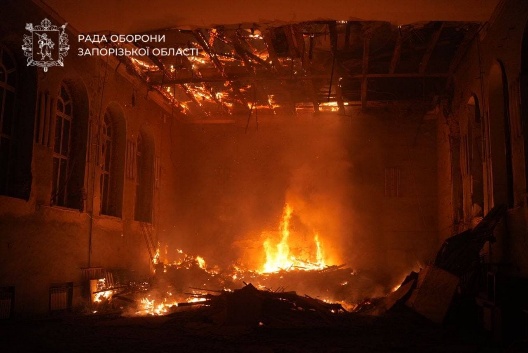
The aftermath of an overnight Russian strike on an education institution in the southeastern city of Zaporizhzhia, Ukraine. (Zaporizhzhia Oblast Governor Ivan Fedorov / Telegram)
Ukraine’s Air Force reported Russia launched 172 drones overnight, part of a barrage that continued the country’s now-routine pattern of near-daily strikes against both military and purely civilian infrastructure. The gas station strikes carry particular strategic weight given how central fuel access has become to ordinary Ukrainian mobility during a war that’s already strained the country’s energy supply chains from multiple directions — each station taken offline forces drivers toward fewer remaining options, compounding disruption well beyond the immediate site of any single strike. Station operators along the M06 corridor have increasingly adjusted operating hours around alert levels, a quiet adaptation that’s become routine even as it steadily erodes normal commercial life.
REGIONAL CASUALTIES ACROSS THE COUNTRY
Beyond the overnight barrage, Russian attacks killed and injured people across at least seven regions over the past day. Donetsk Oblast lost three people with 12 injured, Governor Vadym Filashkin said. Kharkiv Oblast lost one person with five injured; a separate morning drone strike near Lozova killed a woman and left a 13-year-old boy with severe burns. Sumy Oblast lost a 38-year-old woman and a 54-year-old man, with three more injured including a 14-year-old girl. Zaporizhzhia Oblast reported multiple wounded after an overnight strike forced evacuations from multi-story apartment buildings, including a 52-year-old man and an elderly woman, Governor Ivan Fedorov said.
Kherson Oblast reported nine injured. In Odesa, a strike hit a supermarket chain’s warehouses with no casualties reported. In Chernihiv Oblast, Russian forces struck an agricultural enterprise in the border village of Semenivka, destroying a hay storage hangar and damaging machinery and storage facilities, with livestock also affected, Governor Viacheslav Chaus said. Dnipropetrovsk Oblast reported a 20-year-old woman wounded in the latest attacks, while a 20-year-old man severely injured in a September 3 strike on Dnipro died in the hospital today — a reminder that the war’s daily casualty counts routinely understate its true toll, given how many injuries from earlier strikes prove fatal only weeks later.
UKRAINE INTRODUCES A TWO-LEVEL HOSPITAL ALERT SYSTEM
Ukrainian health officials announced new hospital protocols today tied to the country’s recently introduced two-level air-raid alert system, which distinguishes between yellow alerts for drone threats and red alerts for missile strikes. Under the new rules, hospitals will adjust their operational posture based on alert level rather than treating every warning identically, allowing certain non-critical services to continue during lower-threat yellow alerts while maintaining full protective protocols during red alerts specifically tied to missile danger.
The change reflects a broader adaptation across Ukrainian institutions to Russia’s shift toward near-continuous, lower-intensity drone harassment punctuated by occasional high-intensity missile strikes — a pattern that’s made blanket, undifferentiated alert responses increasingly impractical for hospitals trying to balance patient safety against the basic need to keep providing care throughout the day. Officials said the tiered approach should reduce unnecessary disruptions to non-urgent medical services while preserving maximum protective response for the genuinely higher-risk missile threats the red-alert designation is meant to capture. Hospital administrators welcomed the clarity, noting the previous single-tier system had forced repeated, often unnecessary halts to surgeries and outpatient care during lower-level drone alerts that posed minimal direct risk to their specific facilities. The Health Ministry said it would monitor implementation across regional hospitals over the coming weeks, adjusting protocols further if facilities in higher-risk frontline areas report the new system still leaves genuine safety gaps unaddressed.
RUSSIA’S “PARTIAL MOBILIZATION” TURNS FOUR
Four years after Putin’s only formal mobilization order triggered a mass exodus of hundreds of thousands of Russians in September 2022, Ukrainian and Western analysts continue debating whether Moscow can avoid a second such call-up given mounting battlefield losses. Russia’s recruitment rate has consistently fallen short of its casualty rate for months, with Ukrainian intelligence estimating Russian generals have privately requested Putin approve mobilizing up to 800,000 additional troops — a request Russia’s current administrative and training infrastructure likely can’t fully absorb even if approved.
Kremlin officials continue publicly denying any mobilization is planned, using language nearly identical to what Peskov and other officials said in the weeks before the 2022 call-up caught much of Russian society off guard. Bloomberg has separately reported that Russian recruitment and government officials themselves have quietly been moving personal assets abroad and encouraging relatives to leave the country — behavior that suggests even those closest to the recruitment apparatus don’t fully trust their own government’s reassurances. Analysts widely expect Putin to pursue some form of gradual, semi-covert call-up through regional quotas rather than a single dramatic announcement, specifically to avoid repeating 2022’s political embarrassment. Four years on, the anniversary itself has become a quiet marker Russian citizens and Western analysts alike watch closely, given how directly the original call-up’s political fallout continues shaping Kremlin caution around the subject today.
A RUSSIAN OIL HUB 1,600 KILOMETERS AWAY IS STRUCK
Ukrainian drones struck a major Russian oil hub roughly 1,600 kilometers from the border overnight, extending Ukraine’s deep-strike campaign deeper into Russian territory than most of its previous targets this year. The strike adds to a pattern of escalating range Ukraine has demonstrated throughout September, following earlier strikes that reached facilities in Siberia and the Arctic region — distances that would have seemed operationally implausible even a year ago, given the air-defense and logistical challenges involved in reaching targets that far from any Ukrainian-controlled launch point.
Separately, Ukraine’s General Staff confirmed strikes on bunkers and hangars at the Tsimbulova drone port in Oryol Oblast, roughly 175 kilometers from the front line, based on geolocated satellite imagery. Ukrainian forces also struck a Russian manpower concentration near Stary Khutor in Belgorod Oblast and confirmed an earlier strike destroyed the Seymskaya electrical substation east of Kursk City — part of the same sustained intermediate-range campaign against Russian logistics and infrastructure that’s continued regardless of the diplomatic conversations happening simultaneously in Washington and New York. Ukrainian officials describe the strikes as proof that battlefield pressure and diplomatic engagement aren’t mutually exclusive strategies, but two tracks Kyiv intends to keep running in parallel for as long as Russia refuses genuine concessions at the table.
ROMANIA’S PRO-RUSSIAN EX-CANDIDATE DETAINED ON FRAUD CHARGES
Romanian authorities detained Calin Georgescu, the ultranationalist, pro-Russian former presidential candidate whose 2024 election victory was annulled after intelligence agencies identified a Russian-backed social media campaign propping up his candidacy, on fraud charges today. Romania’s Directorate for Investigating Organized Crime and Terrorism said Georgescu led a criminal group that defrauded businesspeople by promising access to foreign financing, with one victim allegedly losing over $1.3 million after being promised a much larger loan that never materialized.
Georgescu already faces separate criminal charges for undermining Romania’s constitutional order and promoting extremist ideologies. Several dozen of his supporters gathered outside the investigating agency’s headquarters following his detention, and George Simion, leader of the far-right AUR party, condemned the arrest on social media: “Any of us can be next. Stop the abuse!” The case adds another chapter to Romania’s ongoing reckoning with the Russian-backed disinformation campaign that briefly propelled Georgescu to the frontrunner position in a presidential race widely seen as a test case for how vulnerable European democracies remain to exactly this kind of foreign interference. Romanian officials have not suggested any direct link between today’s fraud charges and the earlier election-interference investigation, treating the two matters as legally separate even as both continue shaping public perception of Georgescu’s broader credibility.
UMEROV DEFENDS WITKOFF AMID REPORTS OF MUTUAL FRUSTRATION
Ukraine’s Foreign Intelligence Chief Rustem Umerov pushed back today against reports that both Kyiv and Moscow have grown increasingly frustrated with US envoy Steve Witkoff’s role in peace negotiations, telling Axios that Witkoff “has done a great job” and that his work should be judged by those directly involved in the negotiating process. “I believe that the work of American negotiators should be assessed by people who are directly involved in the negotiation process and work closely with Steve Witkoff and Jared Kushner,” Umerov said.
The Kyiv Independent had previously reported that Ukrainian officials have privately questioned Witkoff’s grasp of the war’s complexities and raised concerns about his accommodating approach toward Putin, while Russian officials increasingly believe the real-estate-investor-turned-diplomat contributed to the failure of earlier negotiating rounds. Umerov’s public defense doesn’t fully resolve the tension the earlier reporting described, but it does signal that at least some senior Ukrainian officials remain committed to working through Witkoff’s channel rather than publicly undermining it ahead of Tuesday’s planned meeting between Zelensky and Trump. The competing accounts illustrate how carefully Ukrainian officials must now balance private frustration against public unity, given how directly the negotiating process still depends on maintaining workable relationships with every American envoy involved.
MEANWHILE, AT THE FRONT
Russian forces recently advanced in southern Vovchansk, Kharkiv Oblast, based on geolocated footage showing Ukrainian strikes on Russian positions there. Russian forces continued attempting to infiltrate northern Sumy Oblast from Sudzha, Kursk Oblast, using the Urengoy-Pomary-Uzhhorod gas pipeline connecting the two regions — a tactic Ukraine’s 8th Airborne Corps said Russian forces have attempted at least twice in the past week, part of a pattern ISW has tracked since September 13, including one platoon-sized infiltration attempt. Russian forces continued offensive operations in northern Sumy Oblast without confirmed advances otherwise.
Neither side made confirmed advances elsewhere along the front today. Ukrainian forces continued consolidating recent gains from Operation Vivaldi north of Lyman while Russian forces regrouped ahead of an expected renewed push toward Dobropillya. The relative quiet across most sectors reflects both armies absorbing the consequences of recent operations — Ukraine’s successful counteroffensive north of Lyman, and Russia’s own costly, largely unsuccessful attempts to advance in Sumy, Kharkiv, and Kupyansk over recent weeks.
A LANDSLIDE VOTE, A DIESEL ADMISSION, A DEAL THAT BARELY HELD
By nightfall, today’s threads pulled toward the same uneasy pattern this war keeps sustaining: Russia manufacturing consent at home while genuine cracks keep showing abroad. United Russia claimed 78 percent of a parliament nobody outside Russia believes reflects genuine choice. Trump admitted, almost in passing, that Russia’s own fuel industry is falling apart. Europe nearly let its entire sanctions regime lapse before saving it at the last possible hour.
Two people along a Ukrainian highway won’t see tomorrow. A drone reached 1,600 kilometers into Russia overnight. And in Bucharest, a man once positioned to become Romania’s president sat in custody on fraud charges, one more casualty of a disinformation campaign that very nearly worked. Nothing today ended. Everything today measured how much of this war is still fought in rooms far from any front line, with consequences that reach just as far as any missile.
A PRAYER FOR UKRAINE
1. For Every Life Lost Along a Country Highway
Lord, two people are gone tonight, killed at gas stations along a road that carries ordinary Ukrainians between two cities they call home. We grieve deaths this random, this disconnected from any purpose. Receive them, comfort the eleven injured and their families, and protect every driver still traveling that same stretch of highway tomorrow, not knowing which stop along the way might prove dangerous next.
2. For the Boy Burned and the Woman Lost Near Lozova
Father, a woman died and a thirteen-year-old boy was severely burned today in a strike that found them somewhere they should have been safe. We grieve a childhood interrupted by injuries no child should carry. Give this boy full healing, comfort his family through a grief layered with fear for his recovery, and protect every child still living where this war keeps reaching.
3. For Truth to Outlast a Landslide Built on Silence
Lord of justice, we pray for the Russians denied any genuine voice in this week’s election, watched at polling stations and counted by a system that decided the outcome before voting began. Let truth eventually reach a country whose government fears an honest count, and give courage to everyone who resisted this manipulation, however quietly, however alone, believing their vote still meant something even against odds this long.
4. For Wisdom as Diplomacy Tests Real Patience
God of peace, we pray for the negotiators and leaders navigating genuine frustration behind the scenes of this war’s diplomacy. Give them the humility to hear honest criticism and the resolve to keep working anyway. And give Tuesday’s meeting between Zelensky and Trump the substance this war desperately needs, not simply another symbolic gesture that leaves the actual fighting unchanged.
5. For Every Nation Choosing Accountability Over Convenience
God of justice, we pray for the countries still weighing sanctions, still deciding whether pressure on Russia matters more than diplomatic convenience. Give leaders the resolve Ukraine’s own officials called for today, and let accountability outlast every attempt to quietly wait it out. Let this war’s true cost never simply be negotiated away.
In Your mercy, in Your justice, in Your time — bring this war to its end, and let the ending be worthy of what Ukraine has endured.