
September 23, 2026
Prepared by Diana Bozhyk
Russian drones hammered Kyiv overnight, killing at least two people and injuring more than 43, setting a historic market ablaze near the Central Railway Station and striking data centers and a college building where students were present. Kremlin spokesperson Dmitry Peskov effectively rejected Trump’s proposed energy-infrastructure ceasefire, answering “absolutely” when asked if Western proposals were merely rhetorical, even as Secretary of State Marco Rubio met Foreign Minister Sergei Lavrov and said both sides had “expressed interest” in a limited grain-and-energy truce. The EU finally extended its Russia sanctions for three years after Latvia dropped its objection to delisting two oligarchs, and a Russian Mi-8 helicopter violated Polish airspace near Kaliningrad for 42 seconds in what Warsaw called a deliberate test of its air defenses. Fifty-one countries issued a joint UN statement accusing Russia of deliberately blocking Ukrainian grain exports and threatening global food security.
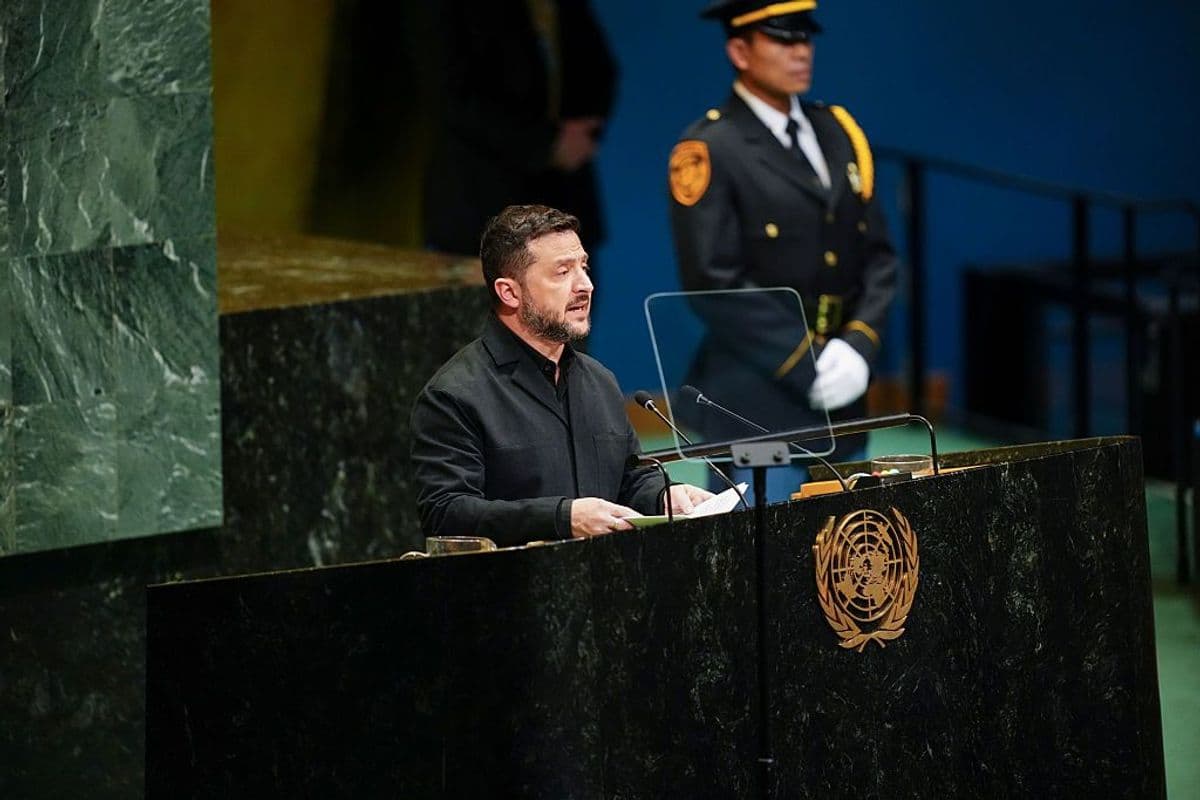
President Volodymyr Zelensky, during the United Nations General Assembly (UNGA) in New York, US. (Angelina Katsanis/Bloomberg via Getty Images)
THE DAY’S RECKONING
Kyiv woke today to a market that’s stood for generations burning near its central train station, five explosions in a single morning, two people dead before most of the city had finished breakfast. Foreign Minister Andrii Sybiha said it plainly: while the UN General Assembly spends its week on peace and diplomacy, Ukraine is once again under massive attack. Nobody in Moscow seemed to notice the contradiction.
Peskov made sure nobody had to guess where Russia actually stands. Asked directly whether Trump’s energy ceasefire proposal was just rhetoric, he said “absolutely” — as close to an outright rejection as diplomatic language gets. Rubio met Lavrov anyway, extracting a vague admission that both sides have “expressed interest” in something narrower. Europe barely saved its own sanctions regime, a Russian helicopter tested Poland’s patience for 42 seconds, and fifty-one countries told the UN plainly that Russia is starving the world’s grain supply on purpose. Nothing today resolved. Everything today measured how thoroughly Russia’s actual conduct keeps contradicting every word it says about wanting peace.
THE KREMLIN REJECTS AN ENERGY CEASEFIRE AS RUBIO MEETS LAVROV
Kremlin spokesperson Dmitry Peskov effectively rejected Trump’s proposed ceasefire on long-range energy-infrastructure strikes today, answering “absolutely” when asked whether Western ceasefire proposals amount to nothing more than a rhetorical exercise. Peskov said Putin remains willing to meet Trump bilaterally, but insisted any high-level negotiations require extensive prior preparation at the “expert level,” and reiterated there are currently no preconditions in place to actually begin peace talks with Ukraine. He repeated Putin’s standing position that any meeting with Zelensky can only happen in Moscow.
Secretary of State Marco Rubio met Lavrov in New York today and said afterward that both Russia and Ukraine have “expressed interest” in a limited ceasefire covering grain and energy infrastructure specifically, though he cautioned the arrangement “would not solve the war” and could serve, at best, as a baseline for broader talks later. Rubio separately said the war will ultimately have to end through a “negotiated settlement” rather than a “military victory” for either side. Putin himself expressed confidence today that Russian forces can still achieve all of Russia’s war goals on the battlefield — goals that amount to Ukraine’s complete capitulation — underscoring the Kremlin’s continued unwillingness to adjust its negotiating position despite years of failing to achieve those same goals by force.
THE EU FINALLY EXTENDS RUSSIA SANCTIONS AFTER LATVIA DROPS ITS OBJECTION
The EU formally extended its Russia sanctions for three years yesterday, narrowly avoiding a lapse of all 3,000 individual sanctions listings after Latvia dropped its objection to a compromise deal delisting Russian-Uzbek billionaire Alisher Usmanov and banker Mikhail Fridman. The reversal ends a chaotic 48 hours in which the deal appeared finalized, then blocked by Latvia, before Riga ultimately gave in to pressure from France and Slovakia to secure the broader three-year extension rather than risk the entire sanctions regime lapsing.
Ukrainian officials didn’t hide their continued frustration even after the deal closed. The resolution came the same day EU officials met Ukrainian counterparts in what Bloomberg described as a “tense” session, with Ukrainian representatives expressing open outrage over the oligarch delistings even as EU officials pressed Kyiv to accelerate rule-of-law reforms tied to continued financial support. The EU’s €90 billion funding loan, already approved, is designed to cover only about two-thirds of Ukraine’s total financial needs through the end of 2027, leaving disbursements directly conditioned on reforms Brussels says remain incomplete — a dynamic that’s kept Kyiv and its largest financial backer in a state of persistent, low-grade tension even as both sides publicly affirm their commitment to continued support.
RUSSIAN DRONES HAMMER KYIV: 2 DEAD, 43+ INJURED, HISTORIC MARKET ABLAZE
Russian drones struck Kyiv overnight and into this morning, with at least five explosions reported near the Central Railway Station, killing at least two people and injuring more than 43. A historic market near the station burned in the attack, alongside strikes on major Ukrainian data centers and a college building where students were present at the time. Foreign Minister Andrii Sybiha condemned the timing directly: “While the 81st session of the UN General Assembly is focused on peace efforts and diplomacy to end the war, Ukraine is once again under a massive Russian attack,” he said, calling for stronger sanctions and more missile interceptors. “These attacks must absolutely not become the new normal.”
The strike fits a broader pattern Ukrainian officials have documented throughout 2026: Russia intensifying attacks specifically during moments of heightened international diplomatic attention, whether UN sessions, ceasefire negotiations, or high-profile summits, seemingly calculated to demonstrate that no amount of diplomatic engagement will alter Moscow’s battlefield conduct. Kyiv’s gas stations and warehouses have absorbed repeated strikes throughout September, and today’s attack on a landmark market adds a symbolically significant target to a list that’s already included railway infrastructure, energy facilities, and civilian commercial sites across the capital.
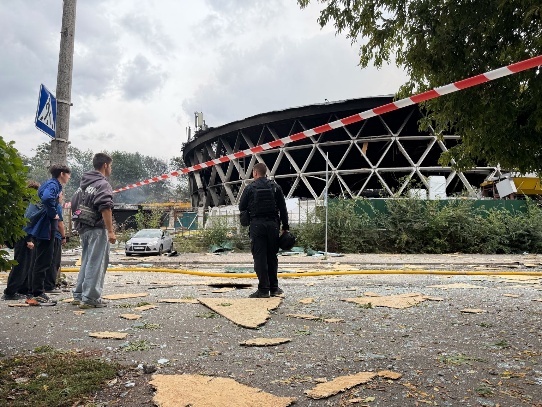
Damage at the historic railway market “Shayba” near Kyiv’s Central Station after Russia’s attack on Kyiv. (Anastasiia Kasinchuk/The Kyiv Independent)
A RUSSIAN HELICOPTER VIOLATES POLISH AIRSPACE
A Russian Mi-8 helicopter entered Polish airspace near Braniewo, close to Kaliningrad, for 42 seconds this morning, penetrating roughly 300 meters into Polish territory before returning to Russian-controlled airspace. Poland’s Armed Forces Operational Command said the incident’s nature indicates Russia is deliberately “testing” the readiness of Polish air defenses, marking the first confirmed manned Russian aircraft incursion into Polish airspace since a Su-24MR reconnaissance jet violated it over the Gulf of Gdansk in February 2025.
The incident lands just over a year after Russia’s mass drone incursion into Poland in September 2025, and fits what researchers describe as Russia’s deliberate “Phase Zero” campaign — a sustained pattern of airspace violations and hybrid provocations designed to set informational and psychological conditions for potential future aggression against NATO members, without ever crossing a line clear enough to trigger a formal alliance response. Polish authorities separately raised the readiness level at six border crossing points with Ukraine, and Prime Minister Donald Tusk warned that the coming months will likely see “very intensive actions” from Russia across the region. Analysts assess Russia’s escalating pattern of airspace violations against NATO states functions as a deliberate “Phase Zero” campaign, setting informational and psychological conditions for potential future aggression without ever crossing a threshold clear enough to trigger a formal alliance response.
51 COUNTRIES DEMAND RUSSIA STOP BLOCKING UKRAINIAN GRAIN
Fifty-one countries issued a joint statement at the UN today accusing Russia of deliberately impeding Ukrainian grain exports and warning that continued disruption in the Black Sea threatens global food security. The signatories endorsed efforts to safeguard freedom of navigation and protect commercial shipping routes, framing Russia’s continued blockade-style pressure on Ukrainian ports as a threat extending well beyond the two warring countries themselves, given how many nations depend on Ukrainian grain for their own food security.
The statement lands amid mounting evidence of the blockade’s real economic toll: Ukraine’s own agriculture ministry has warned that continued export disruption could shrink next season’s planted acreage by millions of hectares, as farmers lose confidence they’ll be able to actually sell what they grow. Russia has rejected reinstating the 2022-2023 Black Sea Grain Initiative that once kept exports flowing safely, opting instead to continue striking port infrastructure and civilian grain vessels — a choice today’s joint statement frames explicitly as a deliberate weaponization of global food supply rather than a legitimate military necessity. The signatories specifically called on Russia to guarantee unimpeded passage for commercial vessels and to cease attacks on maritime infrastructure that has no military purpose beyond disrupting the flow of food to countries with no direct stake in the war itself.
SUPREME COURT FAILS TO FIRE A JUDGE WITH RUSSIAN CITIZENSHIP
Ukraine’s Supreme Court failed today to dismiss a senior judge confirmed to hold Russian citizenship, highlighting persistent institutional resistance to accountability even in cases involving documented dual loyalty to the aggressor state. The case adds to a broader pattern of controversy surrounding Ukraine’s Supreme Court this year, following the recent sentencing of its former chief justice to five years in prison as part of a plea deal, and an expanding bribery probe tied to oligarch Kostiantyn Zhevago that’s implicated additional court officials.
The judge’s continued position on the bench despite confirmed Russian citizenship underscores exactly the kind of institutional weakness EU officials have cited in pressing Ukraine to accelerate rule-of-law reforms as a condition for continued financial support. Anti-corruption advocates argue cases like this one illustrate why Ukraine’s judicial reform process remains incomplete even years into the war, with entrenched interests within the court system still capable of blocking straightforward accountability measures that would seem, on their face, to require no genuine debate at all. Critics note the outcome lands particularly awkwardly given the timing, arriving the same week EU officials explicitly pressed Kyiv on rule-of-law progress as a precondition for continued financial support. Reform advocates say the case will likely resurface in future EU accession discussions as a concrete example of the institutional resistance Brussels continues citing as grounds for caution.
TSIKHANOUSKAYA: BELARUS READY TO HOST A NEW RUSSIAN OFFENSIVE
Exiled Belarusian opposition leader Sviatlana Tsikhanouskaya said today that the threat of Russia using Belarusian territory to launch new attacks against Ukraine is “a real possibility,” speaking on the sidelines of the UN General Assembly. “If Russia at some point again wants to attack Ukraine in any way from the northern border, then Lukashenko will be very happy to provide territory, logistics, and Belarusian infrastructure to help Putin achieve his goals,” she said. Zelensky has increasingly warned in recent months that Russia might open a new front against northern Ukraine specifically by drawing Belarus deeper into direct involvement in the war.
Tsikhanouskaya said Belarusian infrastructure is already actively supporting Russian drone operations, including logistics and equipment used to direct strikes — a claim that echoes Ukrainian officials’ own September 14 disclosure that Russia is using Belarusian LTE networks and repeater stations to maintain stable signal connections for Shahed-type drones during attacks on Ukraine. She said additional repeaters are being installed along Belarus’s borders with both Ukraine and EU member states, extending the infrastructure’s reach well beyond what’s needed for operations against Ukraine alone. Lukashenko, who allowed Russian forces to stage the failed 2022 assault on Kyiv from Belarusian territory, has denied any current plans for renewed involvement and proposed a meeting with Zelensky, though he hasn’t followed through on the offer.
CONFIRMED RUSSIAN WAR DEAD TOP A QUARTER MILLION
Independent Russian outlet Mediazona’s latest tally of verified Russian military deaths has surpassed a quarter million confirmed names since the invasion began in February 2022, based on public obituaries, family postings, and local media reports rather than official Russian disclosure. The outlet stresses the true total likely runs considerably higher, since its verification methodology depends entirely on identifiable public records that inevitably miss deaths Russian authorities and families choose not to publicize.
The milestone arrives the same week Russia’s predetermined State Duma elections handed United Russia a fresh mandate to continue the war, and as Ukrainian intelligence continues warning that Russian generals have privately requested Putin approve mobilizing up to 800,000 additional troops to sustain current offensive operations. The scale of confirmed losses — now exceeding a quarter million dead alone, before counting wounded, captured, or missing personnel — offers a stark counterpoint to the Kremlin’s continued public confidence that Russian forces remain capable of achieving all of Moscow’s original war aims through continued fighting. The Kremlin has responded to this kind of independent tracking not by disputing the figures directly, but by repeatedly designating Mediazona and similar outlets as “foreign agents,” a label meant to discourage ordinary Russians from trusting or even engaging with their reporting.
UKRAINE RESUMES WILDBERRIES STRIKES, HITS A MOSCOW OBLAST OIL DEPOT
Ukrainian forces resumed strikes against Russian e-commerce retailer Wildberries today, reportedly hitting a facility in Tambov Oblast, part of a renewed campaign against Russia’s logistics and retail networks that had continued intermittently throughout the summer. Separately, Ukrainian drones reportedly struck an oil depot in Moscow Oblast, adding to the string of strikes reaching ever closer to the Russian capital that’s defined Ukraine’s deep-strike campaign in recent weeks, following last week’s unprecedented attack on the Gazpromneft-Moscow refinery.
Ukraine’s General Staff separately confirmed strikes on Russian drone command posts and a depot belonging to the elite Rubicon unmanned-systems unit, continuing the pressure campaign that forced Rubicon’s withdrawal from the Vivaldi counteroffensive zone earlier this month after suffering heavy losses there. The combined strikes — retail logistics, oil infrastructure, and specialized military drone units — illustrate how methodically Ukraine continues working through multiple layers of Russia’s war-supporting economy and military infrastructure simultaneously, rather than concentrating its limited long-range strike capacity on any single category of target. Russian officials have not commented specifically on either the Tambov or Moscow Oblast strikes, consistent with Moscow’s general pattern of downplaying or ignoring deep-strike damage rather than acknowledging its cumulative scale publicly. Wildberries itself has not issued a public statement on today’s reported strike, mirroring its typical response to previous attacks on its warehouse network throughout the summer.
MEANWHILE, AT THE FRONT
Russian forces launched 161 drones against Ukraine overnight, with Ukrainian forces recently advancing in the Kupyansk direction, the Chasiv Yar tactical area, and the Novopavlivka and Oleksandrivka directions, while Russian forces recently advanced near Kostyantynivka and south of Dobropillya. In northern Sumy Oblast, the deputy commander of a Ukrainian battalion said Russian forces continue relying exclusively on infiltration tactics rather than frontal assaults, suffering increasingly heavy casualties while repeatedly using the same infiltration routes even through areas where previous attempts already failed badly. A Russian milblogger acknowledged that the density of Ukrainian drones is making any Russian advance north of Sumy City “virtually impossible.”
Russian forces conducted glide-bomb strikes against Sumy City itself, injuring seven people, according to the city’s military administration. Ukraine’s 1st Azov Corps confirmed it prevented Russian attempts to physically cut Ukrainian logistics routes near Druzhkivka as part of Moscow’s ongoing effort to operationally encircle the town and threaten Dobropillya, while a Ukrainian brigade spokesperson in the Vovchansk direction noted Russian forces are shelling settlements they’ve publicly claimed to have already seized — clear evidence, Ukrainian officials say, that Russian forces don’t actually hold ground its own ministry of defense insists has fallen. The pattern has repeated across multiple sectors this month, with Russian claims of encirclement and territorial control consistently outpacing what geolocated footage and Ukrainian frontline reporting can actually confirm on the ground.
ZELENSKY CALLS PUTIN “PATIENT ZERO” AT THE UN
President Zelensky told the UN General Assembly’s high-level debate today that Russia has lost nearly 249,000 military personnel in the first eight months of 2026 while capturing just over 1,000 square kilometers of Ukrainian territory — a toll he calculated at roughly 284 Russian lives spent for every square kilometer seized. “And we have already liberated a significant part of it,” he added. Zelensky repeatedly referred to Putin as “patient zero” throughout his address, the source from whom the war’s violence continues spreading outward: “The more freedom Putin has to act, the more dangerous the word becomes for everyone else,” he said.
Zelensky also disclosed that Putin told US envoys Steve Witkoff and Jared Kushner during their early-September visits to both Moscow and Kyiv that Russia intends to seize the remainder of Donetsk Oblast within a few months. He confirmed the Kremlin’s current negotiating position seeks all of Donetsk while retaining occupied portions of Sumy and Kharkiv oblasts as permanent buffer zones — a shift from earlier informal signals that Russia might trade those northeastern territories back in exchange for the rest of Donetsk and Luhansk. If accurate, the position would mean Moscow has abandoned even the pretense of a negotiated land swap, insisting instead on keeping every piece of Ukrainian territory it currently occupies while still demanding more.
ODESA’S PORT STRUCK, A ZAPORIZHZHIA MALL HIT: THE FULL NATIONAL TOLL
Beyond the Kyiv market attack, Russian strikes killed at least ten people and injured 53 more nationwide over the past day, with a diesel locomotive also struck near the Polish border in western Ukraine. In southern Odesa Oblast, Russia attacked port and civilian infrastructure directly, Governor Oleh Kiper said. A Russian strike hit a commercial cargo ship flying the flag of Antigua and Barbuda, sparking a fire that killed the vessel’s Ukrainian captain; the rest of the crew was evacuated safely. Separately, warehouses storing medicine, household goods, and food in Odesa Oblast were struck twice in succession, taking rescue crews several hours to bring the resulting fire under control.
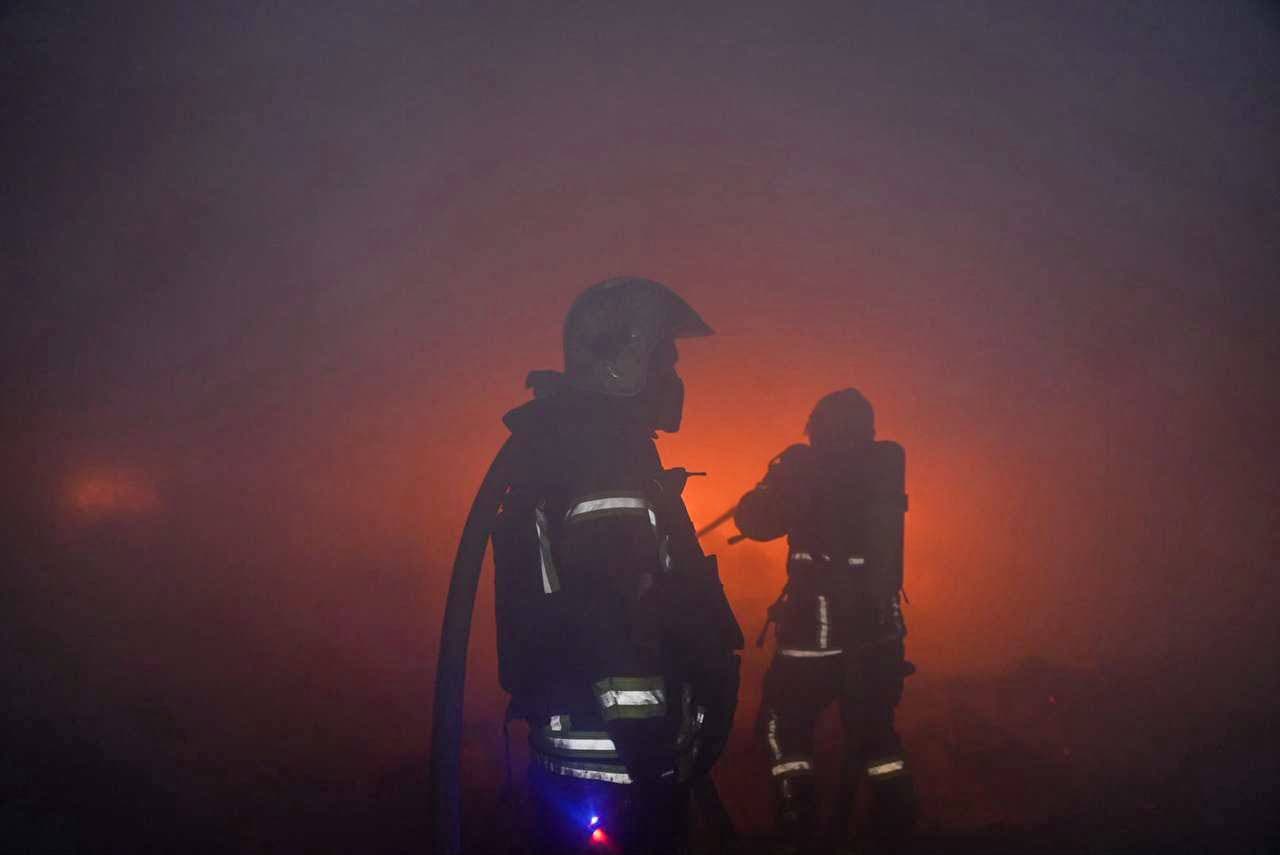
Emergency responders working at the site of a Russian attack in Odesa Oblast. (Oleh Kiper / Telegram)
In southeastern Zaporizhzhia Oblast, two people were injured when Russian forces struck a shopping mall in Zaporizhzhia City, while a separate attack killed one person when it damaged a home in the rural settlement of Kushuhum. Donetsk Oblast lost four people with 10 injured; Kherson Oblast lost two with eight injured; Kharkiv Oblast lost one person with 13 injured across the city and surrounding region. Dnipropetrovsk Oblast reported seven injured, Zhytomyr Oblast reported two injured, and Kyiv Oblast reported three injured, including a 76-year-old man, with 18 facilities damaged. Russia launched 161 Shahed-type, Gerbera, Parodiya, and Banderol drones overnight, with Ukrainian forces intercepting or suppressing 119 of them; strikes hit 18 locations, with debris falling at eight more.
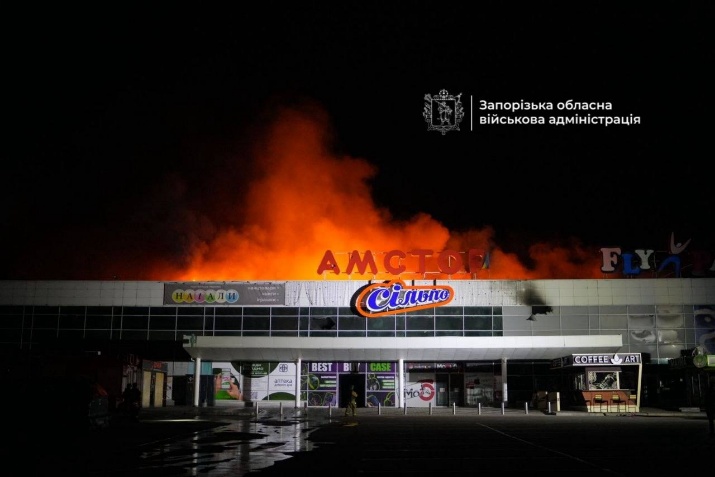
A mall in Zaporizhzhia which was attacked by Russian forces. (Telegram)
A MARKET BURNING, A SANCTIONS DEAL SAVED, A REJECTION MADE PLAIN
By nightfall, today’s threads pulled toward the same uneasy pattern this war keeps sustaining: real diplomatic effort running headlong into Russia’s continued, undisguised refusal to actually stop fighting. Rubio extracted a vague admission from Lavrov about grain and energy. Peskov answered the only question that actually mattered — is this all just rhetoric — with a single word: absolutely.
Two people in Kyiv won’t see tomorrow, killed while the world’s diplomats debated how to eventually end exactly the war that killed them. A quarter million confirmed Russian dead is now a matter of public record, verified name by name. And in Warsaw, a helicopter’s 42-second incursion became one more data point in a pattern nobody believes is accidental anymore. Nothing today resolved. Everything today confirmed how far apart diplomatic language and Russia’s actual conduct still remain.
A PRAYER FOR UKRAINE
1. For the Two Lost Near Kyiv’s Historic Market
Lord, two people are gone tonight, killed in an attack that reached a market that’s stood in Kyiv for generations. We grieve history and daily life burning together in the same strike. Receive them, comfort the more than forty injured and their families, and protect every vendor and shopper still returning tomorrow to markets this war keeps proving are never truly safe.
2. For Students Caught in a College Building Under Attack
Father, we lift up the students present today when a Russian strike hit their college building, an ordinary morning turned into genuine danger. Comfort them and their families, and protect every young person still attending classes in a country where even education has become a target. Let learning remain possible despite everything working against it, and let no classroom become the place where a childhood interrupted turns into something worse.
3. For Truth to Outlast Every Word That Isn’t Meant
Lord of truth, we pray for clarity between diplomatic language and actual intention, especially when a single honest word — “absolutely” — reveals more than months of careful phrasing before it. Give negotiators discernment to recognize genuine openness from performance, and give Ukraine’s own representatives strength to keep pressing for substance regardless of how convincing the rhetoric sounds on any given day.
4. For a Country Still Waiting on Its Own Institutions
God of justice, we pray for Ukraine’s judicial system as it struggles to hold even the clearest cases of divided loyalty accountable. Give reformers the persistence to keep pressing where resistance remains entrenched, and give Ukraine’s people patience with institutions still working, however slowly, to earn the trust this war demands they finally deserve.
5. For Every Family Grieving a Quarter Million Names
God of mercy, we hold in prayer the families on every side of this war now counted among a quarter million confirmed dead — sons, husbands, fathers, whatever cause sent them to a battlefield that took everything. Let this staggering number finally weigh on the leaders still choosing to keep adding to it, and let it hasten, rather than simply document, this war’s eventual end.
In Your mercy, in Your justice, in Your time — bring this war to its end, and let the ending be worthy of what Ukraine has endured.