
September 27, 2026
Prepared by Diana Bozhyk
German Foreign Minister Johann Wadephul met Russian Foreign Minister Sergey Lavrov for 22 minutes in New York — the first meeting between the two countries’ top diplomats since the full-scale invasion — and urged Moscow to “reject the dangerous path of escalation” against Germany, Europe, and NATO. Russian drones struck a Kyiv data center twice on Sunday and hit the Stolychniy food market outside the capital that evening, killing two people, as overnight Russian strikes across Ukraine killed at least 14 people and injured dozens, including 28 in a single glide-bomb strike on Sumy. Zelensky said Russia launched more than 2,200 drones, 1,650 guided bombs, and 38 missiles this week, while South Korea demanded an official apology from Kyiv for disclosing the transfer of two captured North Korean soldiers.
THE DAY’S RECKONING
Twenty-two minutes. That’s how long Germany’s foreign minister sat across from Sergey Lavrov behind closed doors in New York, the first such meeting since Annalena Baerbock saw him a month before the full-scale invasion. Wadephul asked Moscow to stop escalating against Germany, Europe, and NATO. Lavrov’s answer arrived hours later at his final press conference: Europe, he said, is the one preparing for war.
Back in Ukraine, the war answered both of them without diplomacy. A Kyiv data center took two hits in one morning, wounding two teenagers and a woman. By evening, a wholesale food market at the capital’s edge was burning, two people dead beneath a nine-hour air-raid alert. Zaporizhzhia buried four. Sumy’s glide-bomb toll reached twenty-eight wounded. Ukraine’s prime minister told television viewers the country enters this winter better prepared than last year, then listed everything that still isn’t fixed. Nothing today resolved cleanly. Everything today measured how far Moscow’s words about peace and Europe’s fears about war still sit from each other.
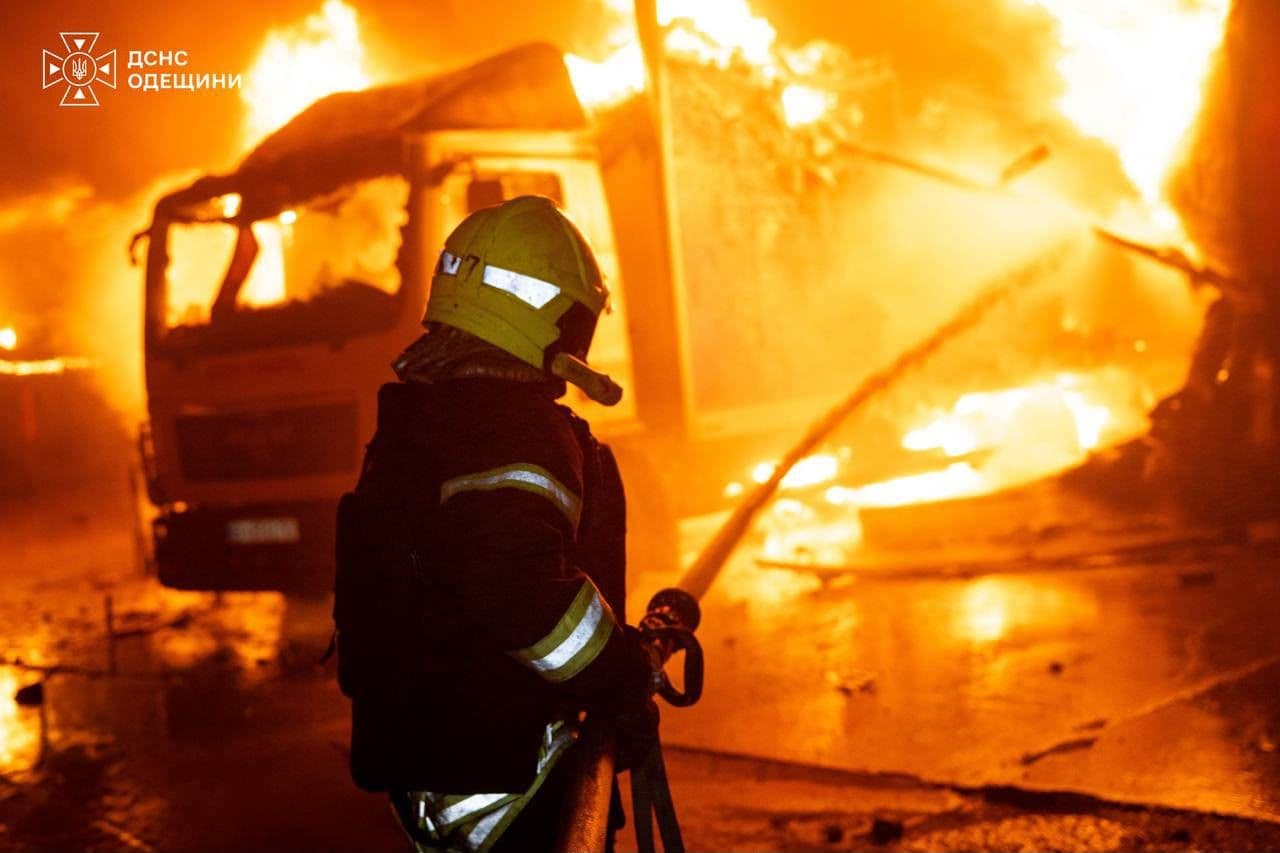
A firefighter putting out a fire at the site of a Russian strike in the Odesa Oblast. (Ukraine’s State Emergency Service / Telegram)
GERMANY AND RUSSIA’S TOP DIPLOMATS MEET FOR THE FIRST TIME SINCE 2022
German Foreign Minister Johann Wadephul met Russian counterpart Sergey Lavrov behind closed doors on the sidelines of the UN General Assembly in New York on Saturday, a meeting that lasted roughly 22 minutes and was reported Sunday. It’s the first encounter between the two countries’ top diplomats since Russia launched its full-scale invasion in February 2022; the previous meeting was in January 2022, when former Foreign Minister Annalena Baerbock met Lavrov less than a month before the invasion began. Russian Foreign Ministry spokesperson Maria Zakharova said Germany requested the talks and asked for restricted media access.
A German Foreign Ministry spokesperson said Wadephul urged Moscow to “reject the dangerous path of escalation” and told Lavrov that incidents like the attempted drone attack at Leipzig/Halle Airport — which Berlin has blamed on Russia — and other hybrid attacks won’t weaken Germany’s resolve to support Ukraine. The German side also condemned Russian attacks on Ukrainian civilians. Foreign Minister Andrii Sybiha thanked Wadephul for conveying “our firm shared positions” and warning against further hostile actions against Europe. The meeting followed weeks of tit-for-tat: Germany closed Russia’s Bonn consulate and reportedly ordered more than 150 Russian mission staff and family members out, while Moscow shut Germany’s St. Petersburg consulate and Goethe-Institut branches. Wadephul, representing Germany in place of Chancellor Friedrich Merz — who stayed home after his CDU performed poorly in three state elections — also discussed next steps toward a ceasefire and strengthening Ukraine’s winter resilience.
LAVROV: EUROPE IS THE ONE PREPARING FOR WAR
Speaking at his final press conference at the UN General Assembly, Lavrov warned that European calls to prepare for a possible war with Russia could become a “self-fulfilling prophecy,” while dismissing warnings of a Russian attack on Europe as “nonsense and absurd.” “We are not going to fight Europe… But it is Europe that is preparing for war with us,” he said, complaining that European governments are “investing enormous amounts of money in arms production.” He added that if Europe attacked, Russia would “not hesitate to respond,” repeating Putin’s earlier claim that such a war would end quickly.
The denials echo statements Moscow made before earlier aggression: Putin and Russian diplomats repeatedly denied plans to attack Ukraine before 2014 and in the days before February 2022. Putin himself said days earlier that Russia was “not preparing for any military action against Europe,” while accusing the Baltic states of violating Russian speakers’ rights — the same justification Moscow used in Ukraine — and mocking Estonian security concerns as “political clowning.” Two weeks ago, Medvedev threatened to wipe Lithuania “off the map.” Europe’s defense build-up follows a sharp rise in Russian hybrid attacks — drone incursions, sabotage, and cyberattacks — that several EU states now describe as direct attacks. Lavrov’s remarks also came as the Kremlin continued rebuffing every proposal for direct talks, including Zelensky’s June letter to Putin proposing a face-to-face meeting and full ceasefire.
RUSSIA HITS KYIV’S DATA CENTER TWICE, THEN A FOOD MARKET
Russian forces struck a data center in Kyiv’s Shevchenkivskyi district twice on Sunday morning, Zelensky said. Mayor Vitali Klitschko reported the first strike around 9:00 a.m., injuring three people — a woman and two 16-year-olds, all hospitalized. Later, an educational facility in the Solomianskyi district was hit, though nobody was hurt. In Vyshneve, in Kyiv Oblast, a Russian drone crashed onto a road as cars passed, killing one person and injuring three others and damaging five vehicles. Rescuers had earlier found a man’s body while extinguishing a fire in a non-residential building hit overnight.
By evening the attacks intensified. A drone struck a 16-story apartment building in the Podilskyi district at the seventh-floor level, a nine-story building in Darnytskyi, and an administrative building in Holosiivskyi, while a strike on the Stolychniy wholesale food market just outside the capital killed two people and injured four, according to Klitschko, sparking a large fire among parked vehicles. Kyiv endured a nine-hour air-raid alert. “Everywhere in the world, such a choice of targets would be called one word: terrorism,” Zelensky said, listing kindergartens, two schools, a residential building, warehouses, and communication facilities among the damaged sites. Kyiv’s City Prosecutor’s Office opened a war-crimes investigation. The strikes extend an almost three-week campaign against Ukraine’s data centers, which has repeatedly knocked out internet service for hundreds of thousands of subscribers.
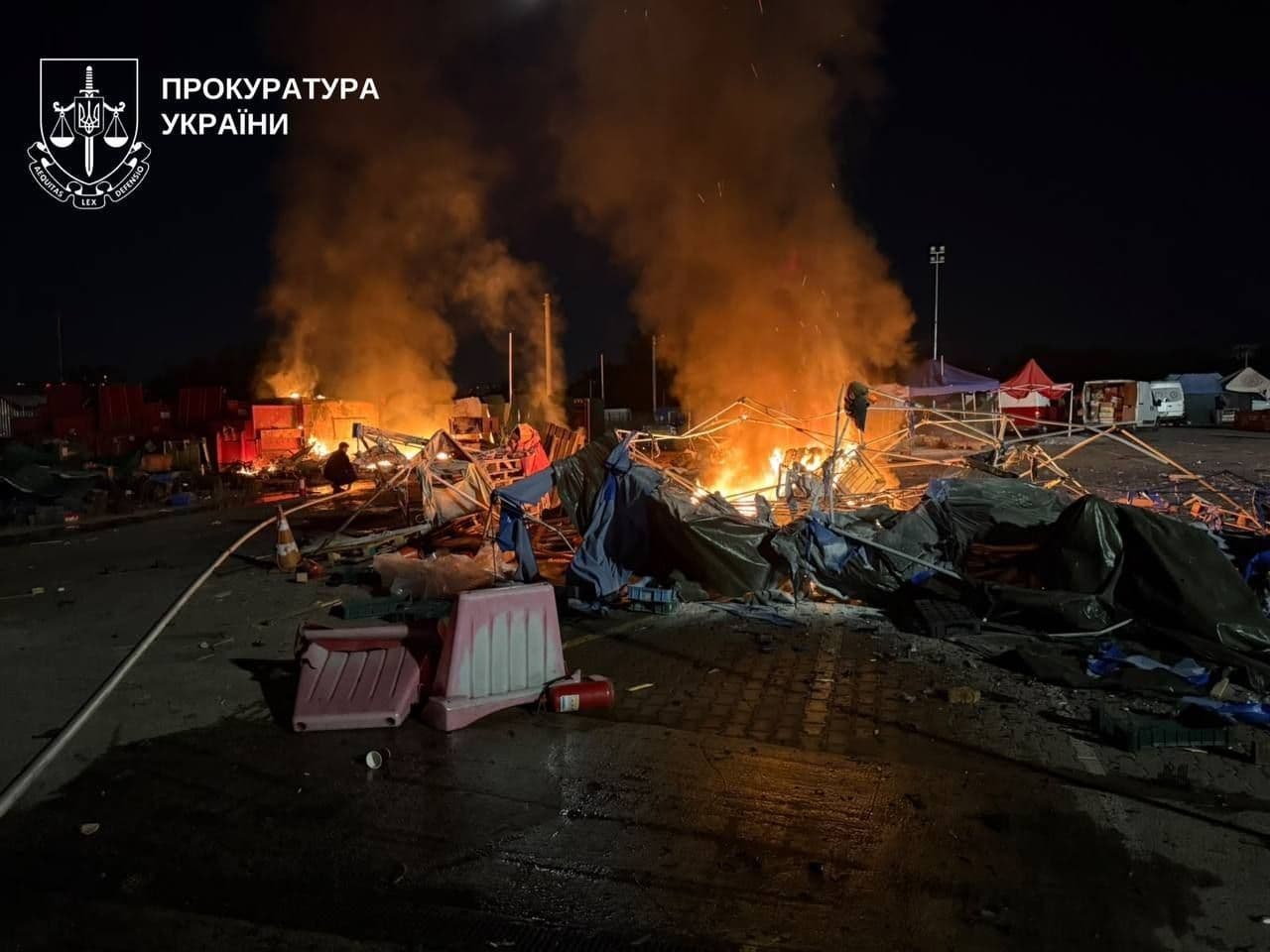
Aftermath of a Russian strike on the Stolichny market outside of Kyiv. (Office of the Prosecutor General of Ukraine)
ZELENSKY PRESSES CHINA, INDIA, BRAZIL, AND SOUTH AFRICA
President Zelensky called on China, India, Brazil, South Africa, and other major non-Western powers to take a stronger stance on Russia, saying Moscow launched more than 2,200 attack drones, about 1,650 guided aerial bombs, and 38 missiles — a significant share of them ballistic — against Ukraine in the past week alone. “Unfortunately, there is a lack of a consistently strong position from China and India, Brazil and South Africa, the G20 countries and the Global South,” he said, adding that “each of these countries has influence over Russia and can help make peace a reality.”
The appeal targets exactly the countries whose economic ties keep Moscow’s war funded: China and India are the world’s two largest buyers of Russian crude, Beijing supplies weapons-making components, and India remains a major buyer of Russian arms. All four countries belong to the BRICS bloc with Russia, which is why they’ve largely avoided taking sides publicly. Zelensky noted Ukraine continues working with the US, EU, Canada, Japan, and Australia to strengthen its defenses and diplomacy. Trump gained authority to impose tariffs of up to 100 percent on Russia’s largest energy buyers when he signed the Graham sanctions act on September 18, yet it remains unclear whether he’ll use it against China, where such tariffs could undermine trade stability Washington wants to preserve. Zelensky has repeatedly urged Trump to use the new powers as Russia escalates strikes on civilian infrastructure.
NATIONWIDE CASUALTIES: ZAPORIZHZHIA, DONETSK, SUMY, ODESA AND MORE
Russian forces killed at least 14 Ukrainians during the overnight strikes across the country, by one tally. Russia launched 170 Shahed-type drones, 76 of them jet-powered, plus Gerbera and Parodiya decoys; Ukraine’s Air Force shot down or suppressed 147, with strikes recorded at 18 locations and debris falling at eight more. Zelensky said residential buildings, energy, and civilian infrastructure were hit in Odesa, Kharkiv, Sumy, Mykolaiv, Kherson, Poltava, Zhytomyr, and Kyiv oblasts. In Zaporizhzhia Oblast, four people were killed and five injured as Russia carried out 989 attacks on 59 settlements. Donetsk Oblast lost three people with five injured. Dnipropetrovsk Oblast lost two with six injured, and Kharkiv Oblast lost two with three injured.
In Odesa Oblast, a strike damaged a residential building, medical facility, hotel, shop, and grain storage facility, killing one person and injuring two, Governor Oleh Kiper said. Kherson Oblast reported one injured, with a high-rise apartment building, nine houses, a shop, and vehicles damaged. Kyiv Oblast recorded 23 damaged facilities and two injured; Kyiv itself reported five injured. In Poltava Oblast, a crashed drone damaged power lines, temporarily cutting electricity to around 500 customers. Taken together with the Sumy glide-bomb strike described below, the day’s scattered violence touched at least ten regions. The pattern — dozens of small, dispersed strikes rather than one dominant attack — has become the defining rhythm of Russia’s air campaign, spreading emergency crews, hospitals, and air defenses thin across a country where almost no region can assume a quiet night.
KHARKIV’S CHILDREN AND A GLIDE BOMB ON SUMY
Two men, both 50 years old, were killed and at least seven people injured — including four children — as Russian forces struck Kharkiv city and 21 settlements across the region over Saturday, Governor Oleh Synehubov said Sunday. Russia used a missile, three multiple-launch rocket systems, and 41 drones against the region; one was a Geran-2, two were Molniya drones, 15 were FPV drones, and the type of the remaining 23 was still being determined. The village of Lebiazhe in the Prolisne community was among the hardest hit: a 13-year-old boy was injured there, while a 56-year-old man, a 32-year-old woman, and two boys aged 12 and 5 suffered acute stress reactions.
Damage spread across six districts, including an ambulance in Prosianka, a residential care facility in Shevchenkove, an apartment building and 15 private vehicles in Lebiazhe, and a residential building and hangar in Izium. The transit evacuation center in Lozova received 185 people over the past day and has now registered 62,012 since opening. In northeastern Sumy, a Russian glide bomb hit a residential area, killing two people and injuring 28, including four children, regional authorities said. Sumy has now absorbed repeated guided-bomb strikes this month, part of Russia’s effort to make the city’s frontline suburbs uninhabitable rather than capture them.
OPERATION VIVALDI: 10,660 RUSSIAN CASUALTIES IN A WEEK
Zelensky said Ukrainian forces killed or wounded about 10,660 Russian personnel across the front this week, crediting Operation Vivaldi in the Lyman axis, after receiving a report from Commander-in-Chief Mykhailo Drapatyi. He singled out soldiers of the 3rd Army Corps and the 68th Separate Airmobile Brigade of the Air Assault Forces. “The destruction of the occupier continues, and the set objectives are being achieved,” he said, adding that every Russian loss was backed by video confirmation, though the figures couldn’t be independently verified.
Brigadier General Andrii Biletsky announced the operation on September 15 after weeks of information silence and has hinted at more: “Vivaldi, as everyone knows, has four seasons. This is the first of them.” Across the first two phases, the corps said it recovered 125 square kilometers, including 50 formally de-occupied, and that Russia lost more than 3,000 soldiers. The gains come as Kyiv warns Moscow is preparing a new mobilization; Ukrainian intelligence says Russian generals drew up plans to mobilize 600,000 people, while Russia lost about 240,000 personnel between January and July and only 232,000 signed contracts. The General Staff logged 221 combat clashes, with the heaviest fighting on the Pokrovsk, Kostiantynivka, and Lyman axes, where Russian forces launched 26 attacks in the first two sectors and 12 in the third, trying to advance toward Novoselivka, Drobysheve, Lyman, Dibrova, Stavky, and Chernechshyna. Ukrainian units also repelled four assaults in the Southern Slobozhanskyi axis near Ternova, Kozacha Lopan, and Lyman, and three attempts to improve positions toward Kupiansk, Radkivka, and Kupiansk-Vuzlovyi.
BUDANOV: A MAJOR PRISONER EXCHANGE COULD COME WITHIN A WEEK
Presidential Office head Kyrylo Budanov said Ukraine and Russia are preparing another major prisoner-of-war exchange, telling Novyny.LIVE at the “Golden Hands” award ceremony it “should happen very quickly, in the near future. I think, within the next week.” He gave no date or scale. Prisoner swaps remain one of the few areas where Kyiv and Moscow still cooperate; the last known return took place on August 24, when Ukraine brought home 10 servicemen via Belarus, all previously listed as missing in the Donetsk sector.
The announcement arrives as new data highlights how many foreign nationals Russia’s war has drawn in. Under Ukraine’s “I Want to Live” project, one in 10 POWs held in Ukraine is a foreign citizen, with Russian POWs now including citizens of 55 countries; nearly 29,000 foreign nationals have signed contracts with Russia’s army since 2022, recruited largely from economically vulnerable populations. Ukrainian military intelligence estimates about 25,000 North Korean troops have served in Russia, and Zelensky warned in July that another 30,000 could arrive. Budanov previously said the war will most certainly continue through winter, dismissing hopes of a near-term ceasefire and calling an immediate freeze “unrealistic” given Russia’s refusal to stop fighting. Ukrainian officials have treated the exchange channel as one of the few dependable lines of contact, precisely because it survives even when broader diplomacy stalls, and they typically announce swaps only after the returning soldiers are already across the border.
SOUTH KOREA DEMANDS AN APOLOGY FROM KYIV OVER NORTH KOREAN POWS
South Korea’s presidential office demanded an official explanation and apology from Ukraine on Sunday over Kyiv’s public disclosure that two captured North Korean soldiers had been transferred to South Korea. Presidential spokesman Seong Ghi-hong said Seoul “expresses strong regret over Ukraine’s unilateral disclosure and its subsequent false announcement that there had not been a non-disclosure agreement,” adding that Seoul is reviewing additional measures. President Lee Jae-myung first criticized Zelensky for revealing the transfer during his UN General Assembly address, calling it “an extremely sensitive issue with serious implications for diplomacy, national security and the situation on the Korean Peninsula.”
Kyiv disputes the characterization. A Ukrainian presidential official said Seoul had been informed in advance that Zelensky might mention the transfer at the UN, and that Ukraine disclosed only the fact of the transfer, not how or when it occurred. A senior South Korean official confirmed Seoul knew Zelensky might mention the prisoners but said it asked that their destination not be disclosed. The two soldiers, captured in Russia’s Kursk region in January 2025, were the first North Korean troops known to be taken alive; they later said they wanted to go to South Korea rather than return home. The dispute now centers on what exactly the two governments agreed to keep confidential.
OLESHKY: FOUR TONS OF FOOD BY DRONE, 2,000 PEOPLE HELD
Ukrainian forces delivered around four tons of food to residents of occupied Oleshky in Kherson Oblast, distributing supplies to 100 locations across the town by drone, Governor Oleksandr Prokudin said. Since March, Ukrainian units have carried out such airdrops, the latest on Saturday night. Prokudin said Russian forces hold roughly 2,000 people in Oleshky, including nearly 50 children, who are forced to survive without food, electricity, or water — “Most horrifyingly, the Russians have effectively deprived them of the opportunity to leave this hell.” He said Russian forces detained and brutally beat several people who went to collect the delivered food.
The account tracks Ukraine’s earlier warnings about the town’s collapse, though the estimate of remaining residents differs from earlier figures of several thousand, which can’t be independently verified given how tightly occupation authorities restrict access. Residents report critical food shortages, with only a few able to leave through mined fields under drone threat. Council of Europe Human Rights Commissioner Michael O’Flaherty warned days earlier that civilians, including children, struggle to access food, medicine, clean water, and electricity, saying occupying authorities are legally required to ensure supplies and facilitate aid delivery: “the hardship and suffering of people caught along the frontlines of the war and in occupied territories demand international attention and action” — an appeal that so far hasn’t produced the evacuation corridor Ukraine has sought.
KORETSKYI: A BETTER-PREPARED WINTER, AND A WORST-CASE PLAN FOR THE INTERNET
Prime Minister Serhii Koretskyi struck an optimistic note on the national telethon, saying Ukraine enters this winter better prepared than last year: more critical facilities have backup power, key infrastructure has greater protection, and the country has accumulated more spare parts and repair crews. He warned Russia has also strengthened itself by stockpiling jet-powered drones and missiles. Major vulnerabilities remain — unrepaired energy infrastructure from last winter, pressure on air-defense stocks, budget constraints, and faster Russian drones — and Ukraine has struggled to fully finance its €5.4 billion energy resilience plan, seeking significant international support.
In a separate TSN interview, Koretskyi said Ukraine is preparing for a worst-case scenario in which Russian strikes disrupt internet and mobile communications, noting the threat “existed, exists, and will continue to exist until the end of the war.” Data-center protection was discussed at a meeting of the Supreme Commander-in-Chief’s Staff. Meanwhile Poland’s deputy defense minister proposed that Ukraine manufacture Patriot systems on Polish land once it secures US production licenses, following Zelensky’s announcement two days earlier that Trump granted Kyiv permission to produce its own Patriot missiles — “We’ll see if that happens,” she told Polish media. Defense Minister Yevhen Khmara said earlier this month Ukraine is working to secure about 1,000 Patriot missiles with allied support and an EU loan, though most would arrive over several years. Britain has separately pledged a 100 million pound air-defense package of interceptors and drones for the winter.
VUCIC RESIGNS AS POLAND PUSHES FOR A NEW US BASE
Serbian President Aleksandar Vucic announced his resignation on Sunday, telling hundreds of flag-waving supporters outside the Presidency building in Belgrade, “This is the last evening for me in this building.” The move clears the way for him to run as the Serbian Progressive Party’s candidate for prime minister in the October 25 parliamentary elections. Vucic has been Serbia’s prime minister or president since 2014, and his current presidential term was due to end in May 2027; he first signaled early retirement in June and dissolved parliament on September 9 to trigger the snap vote.
Vucic, a right-wing populist with authoritarian tendencies and warm ties to Russia, has faced sustained anti-government protests since November 2025, triggered by the collapse of a railway station roof in Novi Sad that killed 15 people and was blamed on government corruption. Separately, Polish Deputy Defense Minister Magdalena Sobkowiak-Czarnecka said Polish lawmakers want to accelerate construction of a new US military base in western Poland meant to house at least 5,000 American troops and their families, noting that “building the base is in fact building a small town.” She said she expects US officials to decide the location by December and that Poland needs a special act defining ministry responsibilities. The push comes amid heightened risks from Moscow, after Russian missiles and drones repeatedly violated Polish airspace, including a strike on a Kyiv–Warsaw passenger train locomotive two kilometers from the Polish border on September 13.
A MEETING IN NEW YORK, A MARKET IN FLAMES, A PRISONER SWAP PROMISED
By nightfall, the day’s threads pulled toward the same uneasy pattern this war keeps sustaining: diplomacy inching forward in quiet rooms while the violence keeps landing in loud places. Germany and Russia’s foreign ministers sat down for the first time in four years. Lavrov used the last word of the week to say Europe is the aggressor. Budanov promised a prisoner exchange within days.
A wholesale food market outside Kyiv burned under a nine-hour alert. A data center went down twice before lunch. Four people in Zaporizhzhia, two in Sumy, and one in Odesa won’t see tomorrow, while thousands in Oleshky wait on drone-delivered food. Nothing today ended. Everything today measured how much of this war is fought in the gap between what leaders say in New York and what lands on ordinary streets.
A PRAYER FOR UKRAINE
1. For the Two Lost at Kyiv’s Food Market
Lord, two people died tonight at a wholesale market on the edge of Kyiv, killed among the ordinary work of feeding a city. We grieve lives ended in a parking lot beneath a nine-hour siren. Receive them, comfort the injured and every family waiting for news, and protect the vendors and drivers who keep returning to places this war keeps proving unsafe.
2. For the Children Wounded in Kharkiv and Sumy
Father, children were hurt again in Kharkiv and Sumy — a thirteen-year-old boy, others left shaking from acute stress, four more wounded in a glide-bomb strike. We grieve childhoods interrupted by violence aimed at nothing they did. Heal their bodies and their fear, and hold every parent still waiting for a child to feel safe again, in a city that keeps teaching them otherwise.
3. For the Thousands Waiting in Oleshky
Lord of refuge, we lift up every person still trapped in Oleshky, surviving on food dropped by drone and beaten for retrieving it. Give them safety they can’t currently reach, and move whatever hearts still stand between them and a real evacuation. Protect the soldiers making those dangerous deliveries, and let no one, adult or child, be forgotten in that place.
4. For Every Prisoner Waiting to Come Home
God of mercy, we pray for the captives and their families as another exchange draws near. Bring them home safely, heal whatever captivity has broken in body and spirit, and comfort those still waiting for names that may never be read. Give negotiators on both sides the humility to finish what they’ve promised, and let this rare cooperation become a first step toward something larger.
5. For Wisdom Between Nations Learning to Talk Again
God of peace, we give thanks that two foreign ministers finally sat in the same room, however briefly. Give leaders in every capital the honesty to say what they truly fear and the courage to hear it. Let short conversations grow into real restraint, and let no lie about peace ever be mistaken for the peace itself.
In Your mercy, in Your justice, in Your time — bring this war to its end, and let the ending be worthy of what Ukraine has endured.