
September 30, 2026
Prepared by Diana Bozhyk
Russia launched its largest combined strike on Ukraine’s energy infrastructure since the end of last heating season overnight, hitting the Trypillya Thermal Power Plant with nearly 190 drones and nine missiles before returning with 285 more drones by day, killing at least four people nationwide, including a child pulled from a destroyed home in Vyshhorod. Presidential adviser Serhii Beskrestnov said Russia used a jet-powered drone fitted with a specialized warhead for the first time, built specifically to sever high-voltage power pylons, while Moscow’s Foreign Ministry warned European weapons factories supplying Ukraine could become “potential military targets.” Kremlin spokesperson Dmitry Peskov denied a Trump-backed proposal to trade Russian political prisoners for sanctions relief, and Ukraine’s 3rd Army Corps said it’s preparing a fourth phase of Operation Vivaldi after capturing roughly 250 Russian soldiers near Lyman.
THE DAY’S RECKONING
Russia picked its moment with care. Ukraine’s prime minister said it plainly: this was the first truly massive, combined strike on the energy grid since the heating season ended back in April, arriving precisely as the next one begins. A thermal power plant outside Kyiv took the hit. A child in Vyshhorod didn’t survive what came down on their own home. And somewhere in a Russian weapons lab, someone had already built a warhead shaped specifically to cut through steel pylons, tested today for the first time against the grid that keeps millions of Ukrainians warm.
Everywhere else, the war’s other fronts kept moving in their own directions. Moscow’s foreign ministry floated the idea that weapons factories in Germany or Poland could be fair game. The Kremlin denied, a little too specifically, a prisoner-release scheme nobody in Washington had officially confirmed existed. Ukrainian soldiers near Lyman took their 250th Russian prisoner this month and started planning a fourth push. In occupied Oleshky, Russian officials were reportedly scripting “grateful” testimonials for residents they won’t let leave. Nothing today resolved. Everything today measured how precisely this war can still calibrate its own cruelty to the calendar.
RUSSIA LAUNCHES ITS WINTER ENERGY CAMPAIGN AGAINST KYIV
Russia struck Ukraine’s energy infrastructure overnight with the largest combined attack since the last heating season ended in early April, Prime Minister Serhii Koretskyi said. “Russia has switched to massive strikes on energy infrastructure,” he wrote, confirming missiles and drones hit facilities in Kyiv, the surrounding region, and elsewhere nationwide. “Since the summer, there has effectively not been a single day when the enemy did not attack energy infrastructure. But such a massive and combined attack took place for the first time since the end of the previous heating season.” State energy company Centrenergo confirmed the Trypillya Thermal Power Plant in Kyiv Oblast sustained damage to its generating equipment; CEO Serhii Isachenko said repairs would begin once security conditions allow but declined to disclose further detail for security reasons.
Ukraine’s Air Force said Russia launched Zircon and Onyx anti-ship missiles, Iskander-M and S-400 ballistic missiles, and 188 drones overnight, 86 of them jet-powered, striking 18 locations; Ukrainian forces intercepted 160 targets, including five missiles and 155 drones. Russia returned during the day with 285 more drones, 174 of them jet-powered; Ukrainian forces downed 254 overall, including 146 jet-powered variants, though 10 remained airborne as of 6:30 p.m. Emergency power outages hit Kyiv City, Kyiv Oblast, Chernihiv, and Zhytomyr by evening. Economy Minister Oleksandr Kravchenko warned Winter 2026-2027 could become “the hardest and the harshest winter” of the war so far.
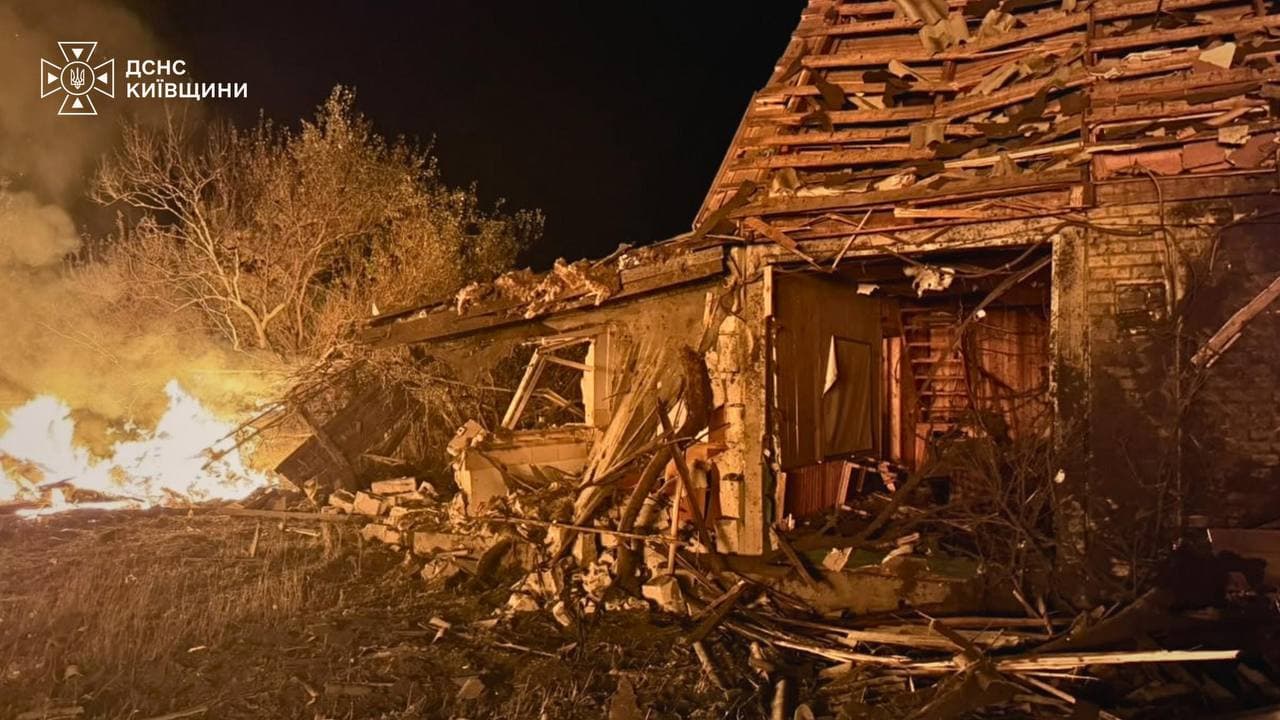
A house burns after a Russian missile and drone attack on Kyiv Oblast overnight. (State Emergency Service of Ukraine/Telegram)
FOUR KILLED, 30 INJURED NATIONWIDE AS A CHILD DIES IN VYSHHOROD
Russian attacks killed at least four people and injured 30 across Ukraine over the past day, local authorities said. In Kyiv, two women were killed and five people injured in an earlier ballistic missile strike, Mayor Vitali Klitschko said; a Kyivteploenergo utility driver was later killed and another worker injured when a strike hit a warehouse in the Solomianskyi district, and debris from the attack was found on the grounds of a Western embassy in Shevchenkivskyi district. Just outside the capital in Vyshhorod, Kyiv Oblast, a child’s body was pulled from the rubble of a destroyed private home, Kyiv Oblast Military Administration head Tymur Tkachenko said; a man and woman were also injured there, and three other people were separately pulled alive from the wreckage.
In northern Sumy Oblast, a 74-year-old man and 70-year-old woman were killed and at least 15 others injured after guided aerial bombs struck the city, local authorities said. Donetsk Oblast reported six injured; Kherson Oblast reported five injured as Russian forces struck critical infrastructure and residential areas, damaging two houses. Dnipropetrovsk Oblast reported one 67-year-old man injured after Russian forces struck three districts more than 20 times with aerial bombs, drones, and artillery, also sparking a fire. Fires and damage were recorded across the Sviatoshynskyi, Holosiivskyi, Obolonskyi, Podilskyi, and Solomianskyi districts of Kyiv alone.
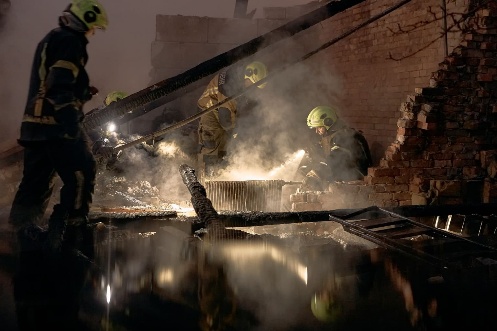
Emergency workers search the rubble of a house for the bodies of two women after a Geran-5 jet-powered drone struck the building at around 3 a.m. local time and sparked a fire in Kyiv’s Sviatoshynskyi district. (Kostiantyn Liberov/Libkos/Getty Images)
RUSSIA WEAPONIZES A NEW WARHEAD TO CUT POWER PYLONS
Russia used a jet-powered strike drone fitted with a specialized shaped-charge cutting warhead for the first time today, presidential defense technology adviser Serhii “Flash” Beskrestnov said, a weapon designed specifically to sever high-voltage power pylons and steel bridge structures. “Bad news. Today, the enemy for the first time used a special shaped-charge cutting warhead on a jet-powered unmanned aerial vehicle,” Beskrestnov wrote, describing a 40-kilogram main charge paired with four additional destructive modules. “I think the enemy plans to attack important high-voltage power transmission lines,” he said.
The development lands directly inside Russia’s renewed campaign against Ukraine’s grid, giving Moscow a tool engineered to inflict exactly the kind of cascading, hard-to-repair damage that regular explosive warheads struggle to achieve against steel infrastructure. Pylon and transmission-line damage takes considerably longer to fix than equipment inside a single facility, since replacement towers must often be fabricated and transported before power can be rerouted — meaning a single successful strike with this warhead could knock out service to an entire region for days or weeks rather than hours, precisely the kind of sustained disruption Russia’s winter strategy appears built around. Ukrainian engineers have spent months reinforcing substations and diversifying generation specifically to blunt this kind of targeted infrastructure attack, but a purpose-built cutting warhead represents a genuine escalation their existing countermeasures weren’t necessarily designed to fully address.
ZAKHAROVA THREATENS EUROPEAN WEAPONS FACTORIES
Russian Foreign Ministry spokesperson Maria Zakharova warned today that weapons factories in European countries producing arms for Ukraine are “potential military targets for Russia.” “One should not assume that military factories outside Ukraine that produce weapons for Kyiv will be safe. Anyone who thinks so is mistaken,” she said, adding that “European countries are directly involved in the conflict in Ukraine.” The warning came hours after Russia separately threatened NATO with nuclear weapons if alliance members attempt to isolate Kaliningrad Oblast, the Russian exclave bordering Lithuania and Poland.
The threat follows Estonia’s September 29 statement attributing an August arson attack on a Tallinn defense contractor’s building directly to Russian intelligence, and fits a documented pattern of Russian hybrid pressure against NATO’s eastern members and Ukraine’s defense-industrial suppliers throughout the year — including Germany’s own accusation that Moscow orchestrated an attempted drone attack on Leipzig Airport. Polish Prime Minister Donald Tusk has separately warned Russia could stage an “accidental” drone strike on NATO territory specifically to test the alliance’s collective-defense resolve, a concern Zakharova’s explicit targeting threat does little to ease. European defense manufacturers have so far shown no public sign of scaling back production in response, though the threat adds fresh urgency to security reviews several companies had already begun following earlier sabotage incidents.
PESKOV DENIES A TRUMP-BACKED PRISONERS-FOR-SANCTIONS DEAL
Kremlin spokesperson Dmitry Peskov denied today that Russia is negotiating with the United States to trade political prisoners for sanctions relief, after the Atlantic reported the Trump administration was weighing exactly that proposal, which people familiar with the matter confirmed to the Kyiv Independent. “This issue was not discussed, and could not have been discussed, because we categorically deny the existence of any political prisoners, and we believe that such a framing of the issue is absolutely inappropriate,” Peskov said, adding that Russian and American security services maintain “regular contacts” on prisoner exchanges specifically.
The proposal reportedly originated with John Coale, Trump’s special envoy for Belarus, who suggested a similar approach had already worked in negotiations with Minsk, where “hundreds” of political prisoners were released in exchange for easing restrictions on Belarusian potash exports. Peskov’s blanket denial that Russia holds any political prisoners conflicts directly with extensive human-rights documentation, including the case of opposition leader Alexei Navalny, who died in a Russian prison in 2024. The Wall Street Journal separately reported that October’s Miami negotiations between US and Russian officials centered partly on reviving Russian business access to roughly $300 billion in frozen central bank funds currently held in Europe — an arrangement Kyiv, its European partners, and some American lawmakers would find unacceptable.
UKRAINE PLANS A FOURTH PHASE OF OPERATION VIVALDI
President Zelensky said Ukraine’s 3rd Army Corps is preparing a fourth phase of Operation Vivaldi, its counteroffensive in the Lyman area of Donetsk Oblast, discussing the plan directly with military personnel at the corps’ command post. Over the operation’s first three phases, Russia has suffered more than 5,000 casualties while roughly 250 Russian soldiers have been captured, and Ukrainian forces have retaken 176 square kilometers of territory — gains the Atlantic Council assessed have reversed more than a year of prior Russian advances in the sector. “Ukraine’s Defense Forces have thwarted Russia’s plans to break through the rear of the Sloviansk-Kramatorsk” region, Zelensky said, calling the situation there now stabilized.
Zelensky singled out ground robotic systems as a key lesson from the operation: “Replacing our soldiers with ground robotic systems whenever possible is a highly promising area at present… during Operation Vivaldi, this element made it possible to accomplish a great deal.” He met commanders of the 21st Kraken Unmanned Systems Regiment, the 125th Separate Heavy Mechanized Brigade, and the 25th Separate Antitank Battalion, presenting awards and discussing drone funding, troop compensation, and foreign-volunteer recruitment. Separately, Ukrainian soldiers from the Lyman Military Administration and the 20th K-2 Unmanned Systems Brigade delivered humanitarian aid to elderly residents still living in the frontline community along a route Donetsk Oblast administration head Vadym Filashkin said remains “under constant fire from the occupiers.”
OLESHKY: RUSSIA PLANS TO FAKE “HAPPY” TESTIMONIALS AS RESIDENTS VANISH
Foreign Minister Andrii Sybiha said Ukrainian intelligence has learned Russia is preparing to stage dozens of propaganda videos in occupied Oleshky, forcing local residents to claim they are “happy, well-fed, and grateful to Russian forces” as part of a weeks-long campaign to deny the town’s worsening humanitarian crisis. Ukraine has called an urgent OSCE meeting for October 1 to brief member states on conditions inside the town, where roughly 2,000 people, including nearly 50 children, remain cut off from regular food, water, electricity, and medicine. “The Russian occupation authorities are effectively holding civilians, including children, hostage,” Sybiha said. “This is nothing other than a man-made humanitarian catastrophe.”
Kherson Oblast Governor Oleksandr Prokudin said Russian forces have actively disrupted Ukrainian drone food deliveries, including by shooting some down, while confiscating or reselling humanitarian supplies and detaining residents who receive aid. “The occupiers are detaining residents of Oleshky for receiving humanitarian aid parcels, throwing them ‘into the cellar,’ beating them brutally and resorting to violence,” he said. Local activist Hasanenko described entire families vanishing after Russian detention: “We have a family that disappeared without a trace. We don’t know where they are. They were taken to a basement, and that was it. Whether they are alive or not is unknown.” Council of Europe Human Rights Commissioner Michael O’Flaherty warned days earlier that some residents could face a serious risk to their lives.
MOLDOVA HIT BY A DRONE AGAIN AS THE KREMLIN THREATENS HOSTAGE DIPLOMACY
A Russian drone crashed and exploded near Hirbovat in Moldova’s Anenii Noi district early today, roughly 18 kilometers from the Ukrainian border, after witnesses first spotted it flying low near Bender around 5:40 a.m.; Moldova’s defense ministry confirmed its monitoring system detected the drone crossing national airspace during Russia’s overnight assault on Ukraine. It’s the latest in a string of similar incursions into Moldovan and Romanian airspace that researchers continue assessing are part of a deliberate Kremlin effort to normalize border violations by simply increasing their frequency.
Separately, a senior Kremlin official told Reuters Russia is taking “asymmetric measures” to pressure European states into reconsidering sanctions policy, declining to rule out seizing the Russian assets of Italian bank UniCredit and Austrian bank Raiffeisen. Putin signed decrees on September 17 and 28 already placing French companies Auchan and Lemana PRO, Swiss company Nestlé, and German company Metro AG under indefinite “temporary management” by Russian firms. Analysts assess the Kremlin is treating these companies’ remaining Russian assets as corporate hostages, betting European governments will eventually judge the business risk of continued operation unsustainable enough to pressure their own governments toward sanctions relief. Both UniCredit and Raiffeisen have maintained a Russian presence longer than most Western banks, making them obvious next targets if Moscow decides to escalate the pressure campaign beyond the retail and consumer-goods firms already seized.

Screenshot from a video showing the drone exploding uploaded by the Police of the Republic of Moldova. (Via facebook)
LITHUANIA MOVES TO BAN RUSSIAN ARTISTS WHO BACKED THE WAR
Lithuania’s Foreign Ministry proposed legislation requiring Russian and Belarusian artists seeking to perform in the country to sign a public declaration condemning Russia’s invasion and supporting Ukraine’s territorial integrity; those who refuse would be barred from working in Lithuania entirely. The move follows similar restrictions already adopted by Finland and Latvia on property purchases by Russian and Belarusian citizens, with Estonia reportedly drafting comparable legislation of its own.
Rights advocates note the proposal carries genuine risk for any Russian artist who actually signs: Moscow has prosecuted numerous civilians for antiwar statements, banned Yabloko, Russia’s only registered liberal opposition party, and sentenced figures like exiled novelist Boris Akunin to 14 years in prison in absentia for backing Ukraine. In July, Turkey deported 24-year-old antiwar activist Ariadna Litvinova back to Russia, where she now faces up to seven years in prison for writing “Peace to Ukraine” on banners at a pro-war exhibition — a case rights groups cited as part of a broader pattern of transnational repression against Russian exiles that any artist signing Lithuania’s declaration would risk joining. Lithuanian officials framed the measure as both a security precaution and a values statement, arguing the country shouldn’t provide a stage for performers unwilling to publicly distance themselves from a war their government continues waging.
UKRAINE’S $155 BILLION WAR BILL AND A SCRAMBLE FOR $29.5 BILLION
Ukraine’s total war costs will reach $155 billion this year, Koretskyi told Reuters — the first time Kyiv has published an annual estimate, with officials citing both countries’ growing reliance on missiles and drones as the primary driver. The government has entered “maximum austerity” mode, Koretskyi said, having already adopted a decision prioritizing defense, pensions, social payments, and public-sector salaries over nonessential spending, while covering roughly $7 billion of the country’s $27 billion defense shortfall through cuts and reallocation and expecting the remaining $20 billion entirely from Western partners.
Ukraine has completed just 17 of 42 reforms required to unlock $29.5 billion in aid, with the cabinet asking parliament for an additional plenary session on October 12 specifically to push remaining decisions through within two weeks; among the funds at stake is roughly €3.7 billion from the EU. Zelensky has told lawmakers that if the government meets its own commitments by October 15, parliament must follow an equally clear schedule for approval. The EU has already mobilized nearly €15 billion to Ukraine in 2026 alone, including a €6.1 billion defense package enabling PAC-3 Patriot purchases and a separate €3.3 billion disbursement for missiles and drones, with a further €100 billion package for 2027-2034 reportedly facing little dispute in the bloc’s ongoing budget negotiations.
JAPAN DEEPENS SECURITY TIES AS THE PENTAGON RUSHES LAST-MINUTE AID
Foreign Minister Andrii Sybiha met a delegation of Japanese lawmakers in Kyiv today, led by former Defense Minister Itsunori Onodera, agreeing to step up pressure on Moscow through tighter sanctions enforcement and fuller use of immobilized Russian assets. “What is happening in Europe has direct consequences for Asia, and vice versa,” Sybiha said, with the talks also covering North Korea’s deepening military role in Russia’s invasion and the need to restore safe Black Sea navigation for global food security. Japan has provided more than $20 billion in financial and humanitarian support since 2022, including a $1.3 billion grant funded through frozen Russian asset profits delivered in April.
Separately, the Pentagon obligated 99.8 percent of a $400 million Ukraine Security Assistance Initiative fund just one day before the money was set to expire, Senator Chris Coons said, after Congress approved the funding late last year and months of bipartisan pressure to actually spend it. “The fact that they are finally doing it, like on the last possible day, tells you everything you need to know about that relationship,” Coons said. “They don’t brief us on time. They don’t follow the law, and the partnership is struggling.” The defense department had obligated just $307 million as of late last week, with the remaining $93 million locked in only in the funding’s final hours.
DARNYTSIA STRUCK A THIRD TIME IN A WEEK AS COMMERCIAL TARGETS KEEP BURNING
Russian forces struck Ukraine’s largest pharmaceutical manufacturer, Darnytsia, for the third time in six days on September 28, following earlier strikes on September 23 and 26; the same day’s attacks also hit two ATB-Market warehouses in Brovary, a refrigerated warehouse belonging to ice-cream maker Rud in Zhytomyr, and an OKKO gas station in Kyiv. Darnytsia produces roughly one in six medicine packages sold in Ukrainian pharmacies; chairwoman Kateryna Zahorii said automated air-raid protocols protected staff and resulted in zero casualties, but declined to disclose damage details for security reasons, asking the public not to share photos or descriptions of the aftermath either.
The repeated targeting fits what’s become, for a second consecutive month, a systematic Russian campaign against major Ukrainian civilian commercial enterprises spanning retail, food processing, pharmaceuticals, logistics, and energy — treating ordinary economic activity as a legitimate military target regardless of any actual strategic value. Separately, satellite imagery revealed Russia has expanded its Oryol drone base with new shelters, launch sites, and underground structures specifically to support the jet-powered drone campaign now striking Kyiv nightly, part of the same infrastructure buildout that’s made Russia’s winter energy offensive logistically possible in the first place. Ukrainian officials say the pattern increasingly resembles a deliberate attempt to erode ordinary civilian confidence in the stability of daily commerce, not merely incidental damage from strikes aimed at adjacent military or energy targets.
MCDONALD’S CUTS ITS MENU AFTER A WAREHOUSE STRIKE
McDonald’s Ukraine announced today it’s temporarily operating a reduced menu at all restaurants nationwide after a Russian drone attack damaged a warehouse belonging to its logistics partner, without specifying which products were affected or when the full menu would return. “Due to damage to our logistics partner’s warehouse as a result of a recent drone attack, we are temporarily switching to a reduced menu at all McDonald’s restaurants in Ukraine,” the company said, directing customers to check availability through its app or delivery partners.
The warehouse was hit during a September 25 barrage on Kyiv that killed five people and injured 27 across the capital, including four killed when a drone struck an office building in Solomianskyi district and a 14-year-old boy killed in a separate strike on a residential building in Pecherskyi. Zelensky called the warehouse strike “an attack drone against ordinary food,” framing it as part of Russia’s expanding campaign against civilian infrastructure and foreign companies operating in Ukraine. McDonald’s has continued operating throughout the war despite repeated damage to its Kyiv locations, including a January 2025 missile strike near a Lukianivska-area restaurant that staff survived by reaching shelter in time, and facade damage from a separate attack in May 2026.
MEANWHILE, AT THE FRONT
Ukrainian forces recently advanced north of Korchakivka, north of Sumy City, based on geolocated footage. Russian sources continued making unconfirmed claims of advances elsewhere in northern Sumy Oblast, including the Russian Defense Ministry’s claim that forces seized Tovstodubove, credited to elements of the Chechen 349th Akhmat-Russia Motorized Rifle Regiment — a claim Ukrainian sources haven’t verified. A Russian milblogger separately described Kindrativka as a contested “gray zone” despite earlier Russian claims the settlement had already fallen, continuing a now-familiar pattern of Russian battlefield claims consistently outrunning confirmed reality.
Updated satellite imagery confirmed a Ukrainian strike on Russian military assets in Pochep, Bryansk Oblast, roughly 64 kilometers from the front, damaged a hangar belonging to the 856th Guards Self-Propelled Artillery Regiment along with a pumping station and outbuilding tied to a separate logistics battalion. Russian forces continued offensive operations in northern Kharkiv Oblast without confirmed advances, maintaining the broader pattern of a largely static front that’s persisted since Operation Vivaldi disrupted Russia’s original encirclement plan near Lyman. Ukrainian intermediate-range strikes against Russian logistics continued regardless, part of the sustained pressure campaign that’s run in parallel with the ground war’s slower, more contested rhythm throughout the autumn. Officials on both sides continued trading claims that diverged sharply from what independent battlefield tracking could actually confirm, a pattern that’s defined the war’s public narrative almost as consistently as the fighting itself.
AN ENERGY GRID TARGETED, A CHILD LOST, A WINTER JUST BEGUN
By nightfall, today’s threads pulled toward the same uneasy pattern this war keeps sustaining: a season’s first major blow landed with calculated precision, answered by diplomacy and defiance running on their own separate tracks. Russia picked the exact moment winter begins to launch its heaviest energy strike in months. A child in Vyshhorod didn’t survive what came down on an ordinary home nearby.
A new warhead debuted today, built specifically to cut the steel that carries power to millions. Ukrainian soldiers near Lyman kept adding to a count of 250 prisoners and started planning a fourth push regardless. And in occupied Oleshky, residents are reportedly being prepared to lie on camera about being happy, while the world outside debates whether sanctions relief is worth trading for prisoners Moscow insists don’t exist. Nothing today ended. Everything today measured how precisely this war can still time its own cruelty to exactly the moment it will hurt the most.
A PRAYER FOR UKRAINE
1. For the Child Lost in Vyshhorod
Lord, a child died today beneath the rubble of a home that should have kept them safe. We cannot make peace with a loss this small, this complete. Receive this child gently, comfort every family member left behind, and hold the man and woman also injured there as they carry forward a grief no season should demand of anyone, least of all at winter’s start.
2. For Every Ukrainian Facing a Winter Without Power
Father, we pray for the millions now bracing for a season Russia has deliberately aimed its worst weapons at. Protect the grid that keeps homes warm, give repair crews speed and safety in their dangerous, essential work, and give every family facing darkness and cold the resilience this long war keeps demanding of them, winter after winter after relentless winter.
3. For the Families Vanishing in Oleshky
Lord of the hidden, we lift up every resident of Oleshky forced into silence, into basements, into staged testimonials they never truly chose to give of their own free will. Find the families who’ve disappeared without a trace, and give them, wherever they are, whatever comfort and protection still remains possible for them under this kind of relentless pressure. Let the world refuse to accept Russia’s staged version of their suffering as the plain truth it so clearly isn’t, however convincingly performed.
4. For Wisdom in Every Negotiation Touching This War
God of justice, we pray for discernment in every proposal now being weighed in rooms far from Ukraine — prisoners for sanctions, frozen assets for access, business for silence about the war itself. Give negotiators the integrity to refuse deals that fund further violence, and give Ukraine’s own voice the weight it deserves in every decision made about its own future.
5. For Every Soldier Pressing Forward Near Lyman
God of courage, we give thanks for real ground reclaimed and prisoners taken near Lyman, and we pray for every soldier preparing for whatever comes next in this long and costly operation. Protect them as Operation Vivaldi continues, give their commanders wisdom in planning what follows, and let every hard-won kilometer of ground hold firm through the harder season that’s now arriving across the whole front.
In Your mercy, in Your justice, in Your time — bring this war to its end, and let the ending be worthy of what Ukraine has endured.