
October 1, 2026
Prepared by Diana Bozhyk
A Russian Geran-4 drone slammed into School No. 12 in Kyiv’s Solomianskyi district while 104 children and 60 staff sheltered underground, its 50-kilogram warhead piercing the stairwell floor without detonating, the same day Russian drones struck Kyiv’s Southern Bridge over the Dnipro three separate times, forcing authorities to suspend transit entirely. EU Defense Commissioner Andrius Kubilius said a Russian strike on a European arms factory would trigger NATO’s Article 5 clause, a day after Putin told the Valdai Discussion Club that Russia is “monitoring” European weapons plants supplying Ukraine. Zelensky announced the first combat use of Ukraine’s domestically built FP-7 ballistic missile, as Ukraine’s General Staff reported Russia suffered 46,320 casualties in September — its highest monthly toll of the year — for a net loss of territory across the front.
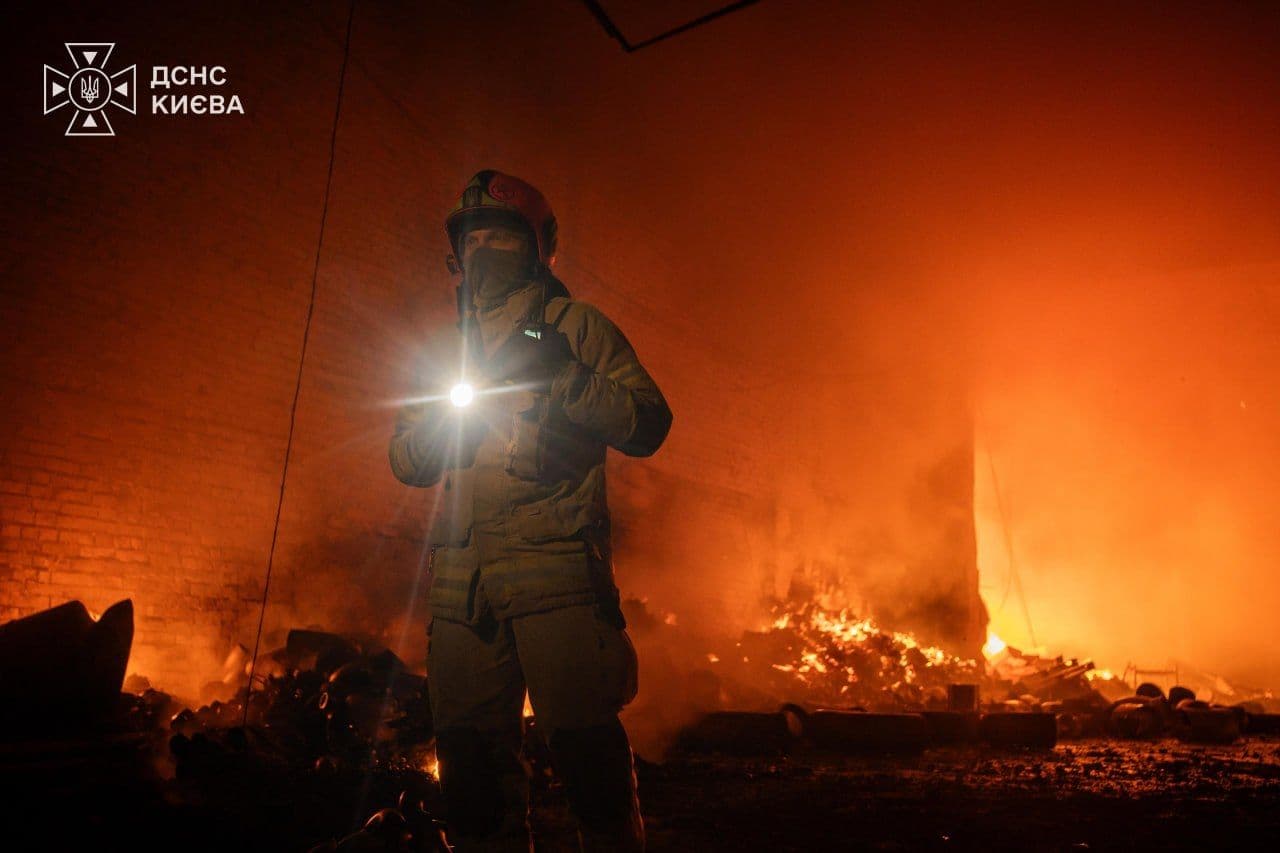
Fire erupts at a site in Kyiv, Ukraine, damaged in a Russian attack. (State Emergency Service/Telegram)
THE DAY’S RECKONING
A headteacher named Valentyna Chorna stood in the wreckage of her own school today and said the only thing left to say: “They spare no one.” A Russian drone had found Solomianskyi’s School No. 12 at nine in the morning, 104 children and 60 staff already moved into the shelter after an air-raid siren. The warhead came through the stairwell wall anyway, fifty kilograms of explosive that, by sheer failure to detonate, didn’t become a mass-casualty catastrophe. Hours later, a different drone found Kyiv’s Southern Bridge while a metro train was physically crossing it. Then it came back. Then it came back again.
Diplomacy and defense moved on their own separate track today, measuring the same war in entirely different units. Ukraine fired its first domestically built ballistic missile in actual combat. Russia’s own General Staff numbers, relayed through Kyiv, showed Moscow lost more soldiers in September than in any month this year while gaining no net ground at all. An EU commissioner said plainly that bombing a European weapons factory would mean war with the whole alliance. Putin, the same week, said he was watching those factories closely. Nothing today resolved. Everything today measured how close this war keeps coming to catastrophes that, so far, have failed to fully detonate.
A DRONE HITS A KYIV SCHOOL WITH 104 CHILDREN INSIDE
A Russian Geran-4 attack drone struck School No. 12 in Kyiv’s Solomianskyi district around 9 a.m. today, smashing through a stairwell wall between the second and third floors while 104 children and 60 staff sheltered in the building’s underground shelter after an air-raid alert had already sounded. The impact partially destroyed the wall and staircase, shattered windows, and sparked a fire, but the drone’s 50-kilogram warhead pierced the floor structure and fell onto the stairs without detonating. Bomb-disposal specialists later removed the unexploded munition and transported it for destruction. No one was injured.
“They spare no one,” headteacher Valentyna Chorna said as she surveyed the damage. A 21-second CCTV recording captured the moment of impact, followed by debris and smoke engulfing part of the building. Investigators said the only reasons the strike didn’t become a mass-casualty event were the school’s decision to send everyone underground and the warhead’s failure to function as designed. Since Russia’s full-scale invasion began, 334 educational institutions in Kyiv have been damaged, including 165 schools and 134 kindergartens, according to the Ukrainian presidency — a toll that keeps climbing as Russian strikes increasingly reach buildings explicitly meant to be safe. Zelensky called the strike a deliberate tactic rather than a stray hit, arguing Russia increasingly times attacks to land precisely where civilians, and children especially, are known to gather.
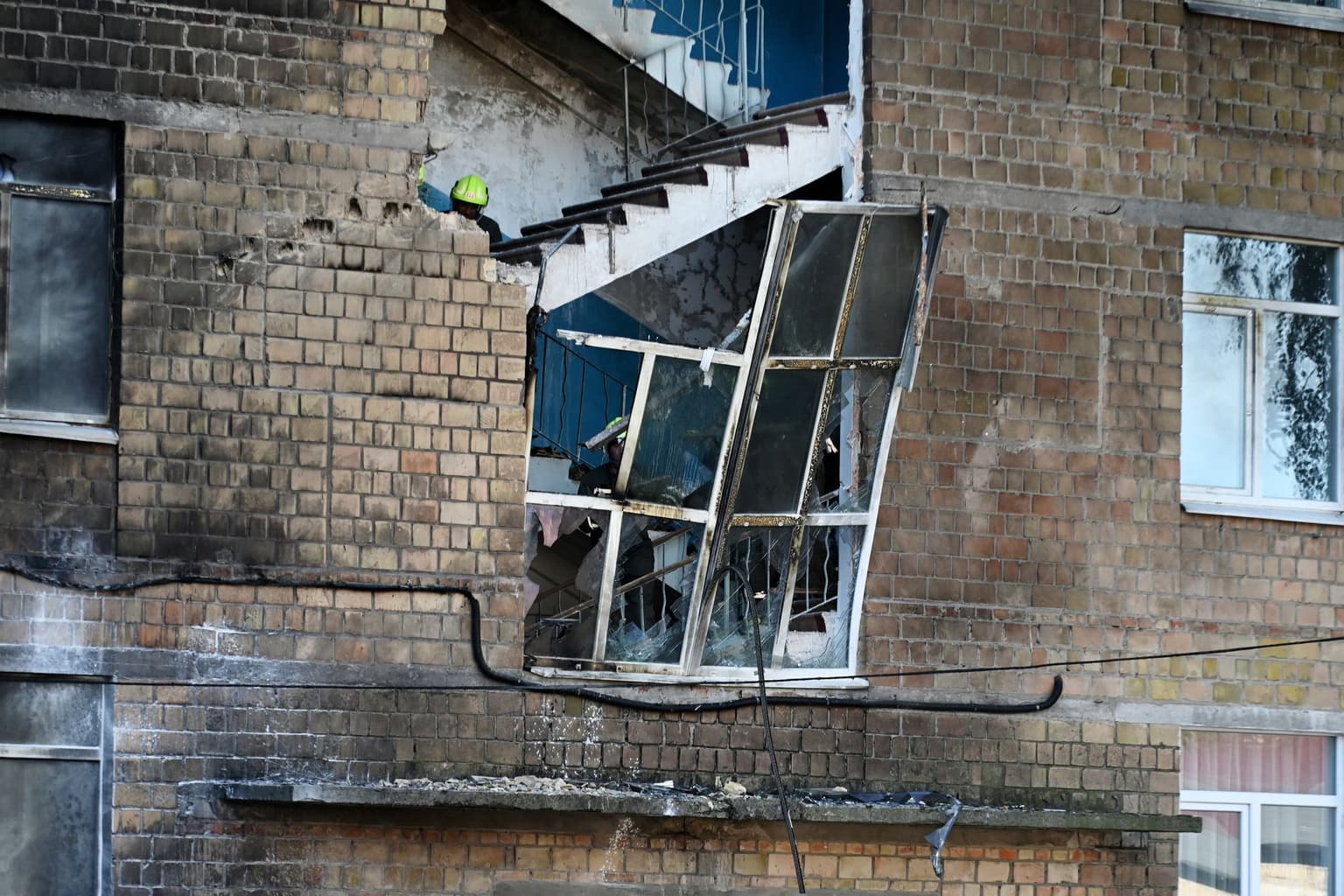
Rescuers work at a damaged school hit by a Russian jet-drone strike in Kyiv. (Oleksandr Gusev/NurPhoto via Getty Images)
RUSSIA STRIKES KYIV’S SOUTHERN BRIDGE THREE TIMES IN ONE DAY
Russian drones struck Kyiv’s Southern (Pivdennyi) Bridge over the Dnipro River three separate times today, forcing authorities to suspend metro and surface transport across one of the capital’s principal crossings. Mayor Vitali Klitschko first reported two drone strikes near the bridge’s support structure in the morning; engineers found no critical structural damage, and limited service resumed. A third strike that evening, reported at 9:50 p.m., damaged a bridge support, a crash barrier, the roadway, and the metro’s protective concrete barrier, sending emergency crews back to the scene.
The morning strike landed while a metro train was physically crossing the bridge; the blast wave forced dust through the ventilation system into a carriage, though the train stayed intact and no passengers were injured. Russian milbloggers said the repeated targeting aims to disrupt traffic and cause compounding structural damage through sustained precision strikes rather than a single decisive blow. Presidential defense adviser Serhii Beskrestnov’s September 30 disclosure of a new shaped-charge warhead specifically designed to cut steel pylons and bridge structures raised questions about whether that same technology was used against the Southern Bridge today, though the exact warhead type struck remains unconfirmed. Zelensky said Ukraine has “adjusted the response system” to what he called Russia’s “terrorist operation” against Kyiv’s critical infrastructure, ordering an urgent review of air-defense and F-16 ammunition supplies.
KUBILIUS: A STRIKE ON AN EU ARMS FACTORY WOULD TRIGGER ARTICLE 5
EU Defense Commissioner Andrius Kubilius said today that a Russian strike on a European weapons factory supplying Ukraine would trigger NATO’s Article 5 mutual-defense clause. “I would say if Russia will hit our factories in European territory, that would be Article 5,” Kubilius told TVP World on the sidelines of a European Parliament security committee meeting in Brussels. An aide later clarified he meant specifically an aerial bombardment or missile strike. The comment came a day after Russian Foreign Ministry spokesperson Maria Zakharova warned that European arms factories producing weapons for Ukraine are “potential military targets for Russia.”
The statement drew immediate unease within NATO itself, given how sensitive and legally consequential any public commentary on what actually triggers Article 5 tends to be; one NATO diplomat told Politico pointedly that Kubilius “might be able to claim what triggers or doesn’t trigger Article 5” only if he one day became the alliance’s own secretary general. The exchange lands amid a documented rise in suspected Russian sabotage at European arms facilities, including Estonia’s September 29 attribution of an August arson attack on Tallinn-based Milrem Robotics directly to Russian intelligence, with Poland, Slovakia, and other countries investigating similar incidents of their own.
PUTIN THREATENS EUROPEAN FACTORIES AT VALDAI
Vladimir Putin told the Valdai Discussion Club forum today that Russia is monitoring European factories supplying weapons to Ukraine, repeating the Kremlin’s warning from a day earlier in more personal terms. “I am not saying that we are going to strike enterprises in the countries supplying weapons to Ukraine, but this is a threat,” Putin said, while separately claiming Russia has no intention of attacking anyone in “2029, 2030 or 2050” unless attacked first. NATO Secretary General Mark Rutte responded the same week that the alliance’s combined strength exceeds Russia’s and that he doesn’t take the nuclear threats seriously.
The remarks follow weeks of escalating Kremlin rhetoric: Russia’s embassy in Belgium warned September 28 that Moscow was ready to deploy its “entire arsenal” if NATO tried to isolate Kaliningrad, and Dmitry Medvedev threatened on September 11 that Lithuania would “disappear from the map” if it lifted its nuclear-weapons ban. Bulgarian Prime Minister Rumen Radev called for more diplomatic engagement to reduce escalation risk at the same Brussels summit where Kubilius spoke; Kubilius rejected that approach outright, arguing past diplomacy with Moscow has already failed and calling instead for a tougher European response to Russia’s hybrid pressure campaign. Several NATO member states have already stopped describing these incidents as merely “hybrid,” opting instead to call them direct attacks — a rhetorical shift that itself signals how seriously European capitals now treat Moscow’s escalating pattern of sabotage and intimidation.
UKRAINE’S FP-7 BALLISTIC MISSILE DEBUTS IN COMBAT
President Zelensky announced today the first combat use of Ukraine’s domestically developed FP-7 tactical ballistic missile. “Ukrainian tactical ballistic missile. FP-7. First combat use. Thank you for the result. Next — production,” he wrote, without disclosing where the missile struck or what target it hit. Developer Fire Point said the FP-7 carries a payload of up to 200 kilograms with a range of roughly 250 kilometers, and is also being developed as an interceptor for Ukraine’s Freyja anti-ballistic missile program, serving as a surface-to-surface weapon until full integration into that system.
The milestone marks a genuine step in Ukraine’s effort to build an indigenous ballistic-strike capability after years of relying heavily on Western-supplied long-range weapons. Fire Point has become one of Ukraine’s most strategically significant private defense manufacturers, with Ukraine’s General Staff crediting the company with producing more than half the country’s deep-strike drones used in August and September 2025, alongside the FP-1 and FP-2 strike drones and the FP-5 Flamingo cruise missile already in service. The FP-7’s debut landed on the same day Russian drones struck a school and a bridge in Kyiv, placing Ukraine’s expanding domestic strike capability directly alongside the violence it’s meant to eventually help deter.
RUSSIA’S SEPTEMBER LOSSES HIT 46,320 FOR NO NET GROUND
Ukraine’s General Staff reported Russian forces suffered 46,320 casualties in September 2026 — the third consecutive month above 40,000 and Russia’s highest monthly toll so far this year, a 45.8 percent surge from earlier in the year. Independent analysis from the Institute for the Study of War found Russian forces seized 175.54 square kilometers but lost 256.35 square kilometers of Ukrainian territory in September, a net loss of 80.81 square kilometers, or negative 2.69 square kilometers a day on average. Even counting Russian infiltrations into areas it doesn’t fully control, Russia’s net position still declined by 175.18 square kilometers for the month.
Much of the net loss traces to Operation Vivaldi, Ukraine’s counteroffensive near Lyman, which liberated at least 147 square kilometers once details began emerging in September despite the operation having run over several preceding months. Looking across the full period since March 2026, Russian forces have lost control of roughly 293.59 square kilometers net territory, even when accounting for infiltrated areas. Russian forces are, in effect, currently spending record casualties for territorial outcomes that are at best flat and quite possibly negative — a trade Russian military bloggers themselves have begun describing with open unease, warning that Ukraine’s continued pressure near Lyman will likely hamper Russian offensive plans toward Slovyansk as well.
A DRONE STRIKES KYIV’S NUCLEAR RESEARCH INSTITUTE
A Russian drone struck the grounds of Kyiv’s Institute for Nuclear Research on Wednesday evening, where a shut-down research reactor is located, Ukraine’s State Nuclear Regulatory Inspectorate said. The strike hit at 6:18 p.m.; a resulting fire was quickly extinguished, and no casualties were reported. The VVR-M research reactor and its safety-critical systems sustained no damage, the regulator confirmed, and radiation monitoring recorded no change, with levels remaining within the normal natural background range of 0.16 to 0.20 microsieverts per hour.
The reactor has been shut down and fully defueled since February 2022 as a wartime precaution, with operations limited since then to scheduled safety-system maintenance rather than any active research use. The regulator called the strike “an attack on a peaceful nuclear facility that performs exclusively scientific and research functions,” describing it as a violation of internationally recognized nuclear and radiation safety principles and characterizing the incident outright as a war crime — language consistent with growing international concern about Russian strikes landing near or on nuclear-adjacent infrastructure throughout the war, even when the immediate safety consequences remain limited. The strike landed the same day Russia hit Kyiv’s school and bridge, adding one more entry to a single day’s remarkably broad list of civilian and scientific sites touched by Russian drones.
REPORTED ASSASSINATION ATTEMPT ON FIRE POINT CO-OWNER
An unnamed source told reporters that Denys Shtilierman, co-founder and chief designer at Fire Point — the defense manufacturer behind Ukraine’s FP-series strike drones and the Flamingo cruise missile — was slightly wounded in an assassination attempt that killed one of his security guards. Shtilierman himself called the report “somewhat exaggerated” when asked directly, and Ukrainian authorities haven’t officially confirmed any attack occurred; Fire Point has issued no statement describing an incident or casualties among its executive security team.
Whatever the precise facts, the report’s circulation alone reflects how strategically significant and personally exposed Fire Point’s leadership has become. Shtilierman has publicly discussed Ukraine’s development of ballistic missiles potentially capable of reaching Moscow, and the company’s weapons have been directly linked to Ukraine’s long-range strike campaign against Russian oil refineries and military-industrial facilities throughout the year. That profile places him alongside a growing list of Ukrainian defense-industry figures — including Unmanned Systems Forces commander Robert Brovdi, subject of a reported $20 million Russian bounty — whose public visibility has made them individually attractive targets for exactly the kind of deniable, intermediary-run operations Russian intelligence has increasingly favored. Neither Fire Point nor Ukrainian security services have offered any further confirmation or denial beyond Shtilierman’s own brief comment, leaving the incident’s actual scale and seriousness genuinely unresolved for now.
A UKRAINIAN PILOT IS KILLED WHEN HIS MIG-29 IS SHOT DOWN
Ukraine’s Air Force said a Russian missile shot down a Ukrainian MiG-29 fighter jet over eastern Ukraine today while the pilot was flying a combat mission, killing 25-year-old Captain Marat Redvanovych Mambetov. Mambetov ejected from the aircraft but did not survive. “We express our sincere condolences to Marat’s family and friends, he defended Ukraine until his last breath,” the Air Force said in a statement. Mambetov served as a flight commander in the “Ghost of Kyiv” 40th Tactical Aviation Brigade, based at Vasylkiv Air Base in Kyiv Oblast.
The brigade flies part of Ukraine’s aging fleet of Soviet-era Mikoyan MiG-29 jets, aircraft that have formed the backbone of Ukraine’s air defense since long before the full-scale invasion and remain in active combat use even as Western F-16s and Mirage 2000s gradually expand the country’s overall fighter capacity. Ukraine has lost a steady trickle of pilots and aircraft to Russian air defenses and missile strikes throughout the war, each loss representing not just a human cost but the depletion of a fighter corps that takes years to train and cannot be quickly replaced, particularly as Russia’s own jet-powered drone and missile threats continue evolving faster than Ukraine’s available pilots and airframes can be expanded to meet them.
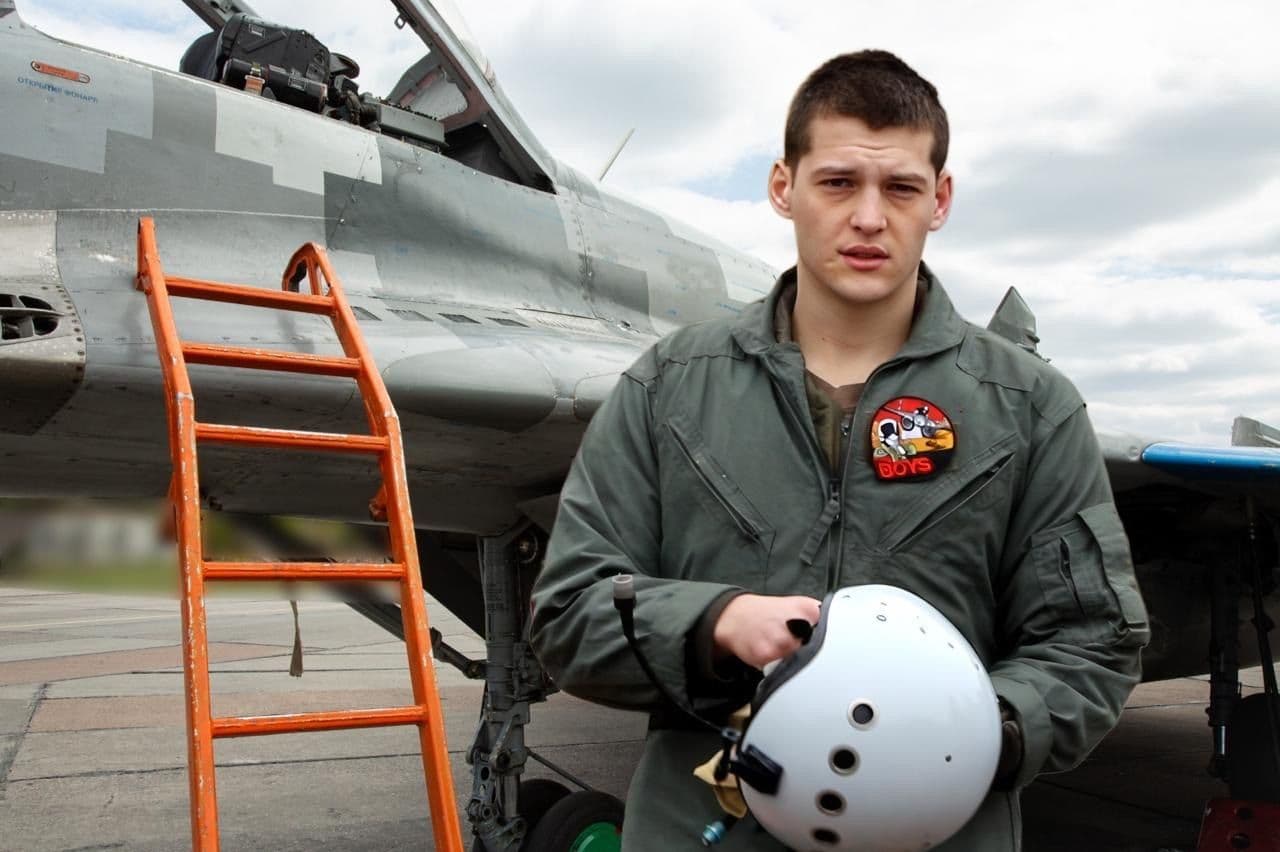
Ukrainian pilot Captain Marat Redvanovych Mambetov who was killed in action. (Ukraine’s Air Force)
REGIONAL CASUALTIES: AT LEAST 6 KILLED, 38 INJURED NATIONWIDE
Russia attacked Ukraine overnight with 107 drones, including Shahed-type and Gerbera models, 63 of them jet-powered; Ukrainian forces intercepted or suppressed 87 as of 8 a.m., with strikes recorded at 11 locations and debris falling at four more. Sumy Oblast lost two people — men aged 40 and 64, killed in a mortar attack — with at least 17 more injured. Dnipropetrovsk Oblast lost two people, a 33-year-old man killed in Dnipro and a 44-year-old man killed in repeated drone strikes on Nikopol district, which was hit more than 10 times; a 60-year-old man was separately injured there.
Mykolaiv Oblast lost a 50-year-old man in a drone attack on the Vesnianske community. Kherson Oblast lost one person with four injured. Kharkiv Oblast reported eight injured; Donetsk Oblast reported five injured, split between Sloviansk and Kramatorsk. Odesa Oblast reported one injured after a strike hit a business center, damaging roofs, facades, and a fifth-floor wall across two buildings. Kyiv reported one man injured as fires broke out in Solomianskyi and Obolonskyi districts. Rivne Oblast reported one woman injured, hospitalized with facial and shoulder injuries after her home was damaged. Consumers in Kirovohrad, Rivne, Sumy, Kharkiv, and Chernihiv oblasts remained without electricity as of today following Tuesday night’s energy-infrastructure strikes.
PACE DECLARES RUSSIA’S DUMA ELECTIONS ILLEGITIMATE
Russia’s State Duma election, held September 18-20 and resulting in United Russia winning 355 of 450 seats with 57.83 percent of the vote, drew formal condemnation from both Kyiv and European institutions this week. Foreign Minister Andrii Sybiha said Zelensky sanctioned 44 individuals involved in organizing the vote across occupied Ukrainian territory on September 26, while EU foreign policy chief Kaja Kallas confirmed the bloc “will never recognize” results from occupied Crimea, Sevastopol, and parts of Luhansk, Zaporizhzhia, and Kherson oblasts, warning organizers and candidates there would face sanctions. The Council of the EU separately sanctioned 10 individuals, including three Supreme Court judges, over the earlier exclusion of Yabloko, Russia’s only registered liberal party, from the ballot entirely.
Voting in occupied territory proceeded under heavy armed guard, with members of Russia’s Central Election Commission accompanied by soldiers and police and no independent OSCE observers present. The Council of Europe’s Parliamentary Assembly formally declared the vote illegitimate, a verdict Ukrainian presidential adviser Kravchuk underscored directly: “No Russian ‘elections’ can change Ukraine’s internationally recognized borders.” The condemnations add to a pattern of international non-recognition that’s accompanied every Russian electoral exercise held in occupied Ukraine since 2014, without yet producing any change in Moscow’s continued administration of those territories.
UK AND US ANNOUNCE NEW SANCTIONS PACKAGES
The UK unveiled 31 new sanctions against Russia today, targeting 22 individuals involved in unlawful detention and torture of Ukrainian civilians in occupied-territory detention centers, several Georgian politicians accused of legitimizing Russian propaganda about Donetsk Oblast, energy firm Novatek Gas and Power Asia, and eight vessels identified as part of Russia’s shadow fleet. Britain simultaneously extended LNG import licenses allowing Japan and South Korea to keep purchasing Russian gas, a carve-out officials didn’t explain alongside the broader sanctions push. Ukraine’s sanctions chief Vladyslav Vlasiuk welcomed the package, singling out two newly listed Arctic LNG tankers: “Russia’s Arctic gas is one of the Kremlin’s key future revenue streams, and it must stay frozen.”
Separately, the US Treasury announced restrictions today against the A7 Network, a Russian shadow banking system led by sanctioned fraudster Ilan Shor and state-owned Promsvyazbank that’s helped Russian and Iranian entities evade sanctions since 2024 by falsifying trade documents and disguising illicit payments as ordinary commerce. The network reportedly processed more than 2,000 transactions daily as of January, totaling $91.5 billion — roughly 13 percent of Russia’s entire 2025 foreign trade. “Treasury is dismantling the financial infrastructure that allows Iran and other adversaries to evade sanctions,” Secretary Scott Bessent said, following similar September 29 sanctions against 13 entities tied to Iranian weapons procurement.
ZINCHENKO SENTENCED TO LIFE FOR MURDERING IRYNA FARION
Lviv’s Shevchenko District Court sentenced Vyacheslav Zinchenko to life in prison today for the July 2024 murder of Iryna Farion, a prominent linguist and former lawmaker known for her uncompromising advocacy of Ukrainian language and culture. Farion, 60, was shot near her home on July 19, 2024, and died hours later despite medical efforts to save her; Zinchenko, then 18, was detained six days later in Dnipro, nearly 1,000 kilometers from the crime scene. Prosecutors said Zinchenko targeted Farion specifically for her public stances, believing she promoted discrimination against Russian-speaking Ukrainians; he refused to testify throughout the trial, which the judge described as an “abuse of procedural rights.”
The pretrial investigation involved more than 60 expert examinations and over 1,500 witnesses questioned. Farion’s daughter, Sofia Osoba, called the verdict “a historic day,” writing on Facebook: “Mom, your ideas are eternal. Your words live on. Your struggle continues.” Former President Viktor Yushchenko praised Farion’s legacy days before the verdict, writing that she “spoke the truth when it was more convenient for many to remain silent,” and warning that “silence today means enabling the enemy tomorrow” — a case that, while legally separate from the war itself, unfolded entirely within the climate of linguistic and cultural tension the invasion has sharpened across Ukrainian society.
UKRAINE REJECTS AUSTRALIA’S AGING TIGER HELICOPTERS
Ukraine formally withdrew its request for Australia’s retiring Eurocopter Tiger attack helicopters, Ambassador to Australia Vasyl Myroshnychenko confirmed, after military specialists concluded the aircraft’s maintenance and logistical demands would outweigh any battlefield benefit. “We have withdrawn our interest in the Tiger helicopters. So we are no longer pursuing them,” Myroshnychenko said. Though Australia had offered the 22 retiring Tigers free of charge, Ukraine would still have needed to finance pilot and ground-crew training, spare parts, and ongoing maintenance for an aircraft type entirely new to its existing fleet, which already juggles several Soviet-designed helicopter models under wartime strain.
Australia is replacing its Tiger fleet with 29 US-made AH-64E Apache Guardian helicopters, six of which had already been delivered as of May, with full delivery expected by 2029. Ukraine has separately expressed interest in acquiring Apaches directly from the United States rather than Australia’s newly purchased fleet, though their battlefield survivability would depend heavily on first suppressing Russia’s extensive air-defense network. Ukraine’s Ground Force Aviation has instead identified the multipurpose UH-60 Black Hawk as a more promising foundation for its future helicopter fleet as it works to replace aging Soviet-era aircraft. The decision echoes an earlier, similar outcome involving Australia’s retired MRH-90 Taipan transport helicopters, which Canberra ultimately dismantled rather than transfer after concluding restoration to operational condition wasn’t practical despite Ukrainian interest.
MEANWHILE, AT THE FRONT: VIVALDI’S RIPPLE EFFECT TOWARD SLOVYANSK
A Kremlin-affiliated military blogger assessed today that Russia’s position is deteriorating not just near Lyman but in the Slovyansk direction as well, claiming Ukrainian forces have gained a foothold near Dibrova and Ozerne and are attempting to cross the Siverskyi Donets River to strike Russian positions near Pyskunivka and Kryva Luka from the north. The same blogger said Ukrainian counterattacks near Yurkivka, Malynivka, and Tykhonivka east of Kramatorsk are complicating Russian efforts to strengthen positions beyond the Siverskyi Donets-Donbas Canal, forcing Russian forces to reorganize logistics and reduce their tempo of attacks toward both Slovyansk and Kramatorsk.
The chief of staff of a Ukrainian unmanned systems battalion operating in the Slovyansk direction said Ukrainian forces are in the final stages of establishing a position that could become the basis for larger future operations, suggesting Operation Vivaldi may soon generate more visible changes in that sector specifically. Military observer Kostyantyn Mashovets similarly assessed that eliminating the Russian salient near Lyman will likely continue hampering Russian offensive efforts toward Slovyansk from the east — one more sign that a counteroffensive originally confined to a single sector has begun generating consequences across a considerably wider stretch of the eastern front. Whether Ukrainian forces have actually crossed the Siverskyi Donets River remains genuinely unclear, with the waterway continuing to function as a substantial natural obstacle regardless of how much pressure Ukrainian counterattacks keep applying from its northern bank.
A SCHOOL SPARED, A BRIDGE STRUCK THREE TIMES, A MISSILE’S FIRST FLIGHT
By nightfall, today’s threads pulled toward the same uneasy pattern this war keeps sustaining: catastrophe narrowly avoided in one place, deliberate escalation pursued in another, and a quiet accounting of exactly what all of it is actually costing both sides. A school full of children survived only because a shelter and a failed detonator both happened to work today. A bridge took three separate hits before the day was done.
Ukraine fired a missile it built entirely itself for the first time in actual combat. Russia’s own numbers, relayed through Kyiv, showed a September that cost Moscow more soldiers than any month this year for ground it mostly failed to hold. And in Lviv, a young man who killed a woman for her words finally heard a judge call it what it was. Nothing today ended. Everything today measured how much this war still risks, and how much of that risk, today at least, somehow failed to fully go off.
A PRAYER FOR UKRAINE
1. For Every Child at School No. 12
Lord, a hundred and four children sat in a shelter today while a warhead fell through their own school’s floor and, by some mercy, never exploded. We give thanks they’re safe tonight, and we grieve that safety had to depend on a failure rather than any real certainty. Protect every child still walking into classrooms this war keeps proving are never fully beyond its reach, wherever in this country they happen to be learning.
2. For the Six Lost Across Sumy, Dnipropetrovsk, and Mykolaiv
Father, six people died today in places far from any front line, caught by mortars and drones aimed at nothing but their own ordinary lives. We grieve losses this scattered, this disconnected from anything resembling a real battle. Comfort the thirty-eight injured and their families, and hold every community still absorbing this kind of violence without any real warning at all.
3. For a Daughter Who Finally Heard Justice Named
Lord of justice, we give thanks today for Sofia Osoba and every family member who waited years for a verdict to finally arrive. We pray for peace for her, and for the strength to carry her mother’s legacy forward without bitterness consuming what love first built it on. Let justice, however delayed, still matter deeply to those who waited faithfully for it.
4. For Wisdom Among Nations Weighing How Far to Go
God of peace, we pray for the leaders now navigating threats against the very factories that arm Ukraine’s defense from afar. Give them resolve matched to genuine danger, not panic, and give Russia’s own leadership a conscience that arrives well before any threat becomes reality on the ground. Let deterrence hold firm, never actually needing to be fully tested in practice.
5. For Engineers, Pilots, and Builders of What Comes Next
God of ingenuity, we give thanks for every Ukrainian engineer and soldier building the tools this defense still requires — missiles, interceptors, the quiet work of keeping a country able to protect itself. Give them continued success, and give this war an ending before too much more of that ingenuity has to be spent on survival rather than something better.
In Your mercy, in Your justice, in Your time — bring this war to its end, and let the ending be worthy of what Ukraine has endured.