
The Ukraine Daily Briefing
Wednesday, October 14, 2026
Overnight, without a word of warning, the satellite link that keeps Ukraine’s fastest drones in the air was throttled to highway speed — and Russia answered with 39 missiles that slammed into every heating plant in Kyiv. Ukraine’s president admitted he feels betrayed by Washington, even as his soldiers in the east finished a summer offensive that won back 16 towns and villages.
The Day’s Reckoning
It’s late at night in Kyiv, and the warning is late too. The first ballistic missiles arrive before anyone tells the city they’re coming. In the Desnianskyi district, a nine-story apartment building takes a direct hit. Three women die. A 7-year-old girl is among the wounded. By morning, all three of the plants that heat and power the capital have been struck, and in parts of the city the taps run dry.
Now hold that picture next to another one. In the east, a Ukrainian general is announcing the best news of the season: a summer offensive named after Vivaldi has pushed the Russian army back across 106 square miles. It worked because of speed — fast drones, steered live by satellite, hunting Russian supply trucks before the infantry moved in.
And overnight, without warning, those satellites were slowed down. The company that runs them says the decision belongs to Washington. Washington isn’t saying.
That’s the plot of the day. Ukraine proved again that it can fight and win. Russia proved again that it will aim at apartment blocks and radiators. And the friend Ukraine counted on most loosened its grip at the worst possible moment.
Seventy Miles an Hour: The Night Ukraine’s Drones Lost Their Voice
You’re a drone pilot near Huliaipole, in Ukraine’s south. Your drone is fast, and it has to be: its job is to catch Russian supply trucks behind the front before they deliver the shells that will be fired at your friends. You push the throttle. The video feed — your only eyes — freezes. Ten seconds. Twenty. The drone is still flying. Nobody is steering it. You cancel the mission.
That happened across the front after SpaceX quietly changed one setting.
Quick explainer: Starlink is Elon Musk’s network of satellites that beams internet to small dish-shaped terminals almost anywhere on Earth. Starshield is the military version — tougher, harder to jam. Ukraine mounts these terminals on drones so pilots can fly them by live video far beyond the reach of ordinary radio.
Overnight, SpaceX capped Starshield so that any terminal moving faster than 100 miles per hour (160 km/h) would lose its link. In practice it was worse. The 7th Rapid Reaction Corps said connections dropped for 10 to 20 seconds at just 68 to 75 mph, and that one drone unit in the Huliaipole sector had to cancel missions. Kyiv got no notice at all, said presidential adviser Serhii “Flash” Beskrestnov.
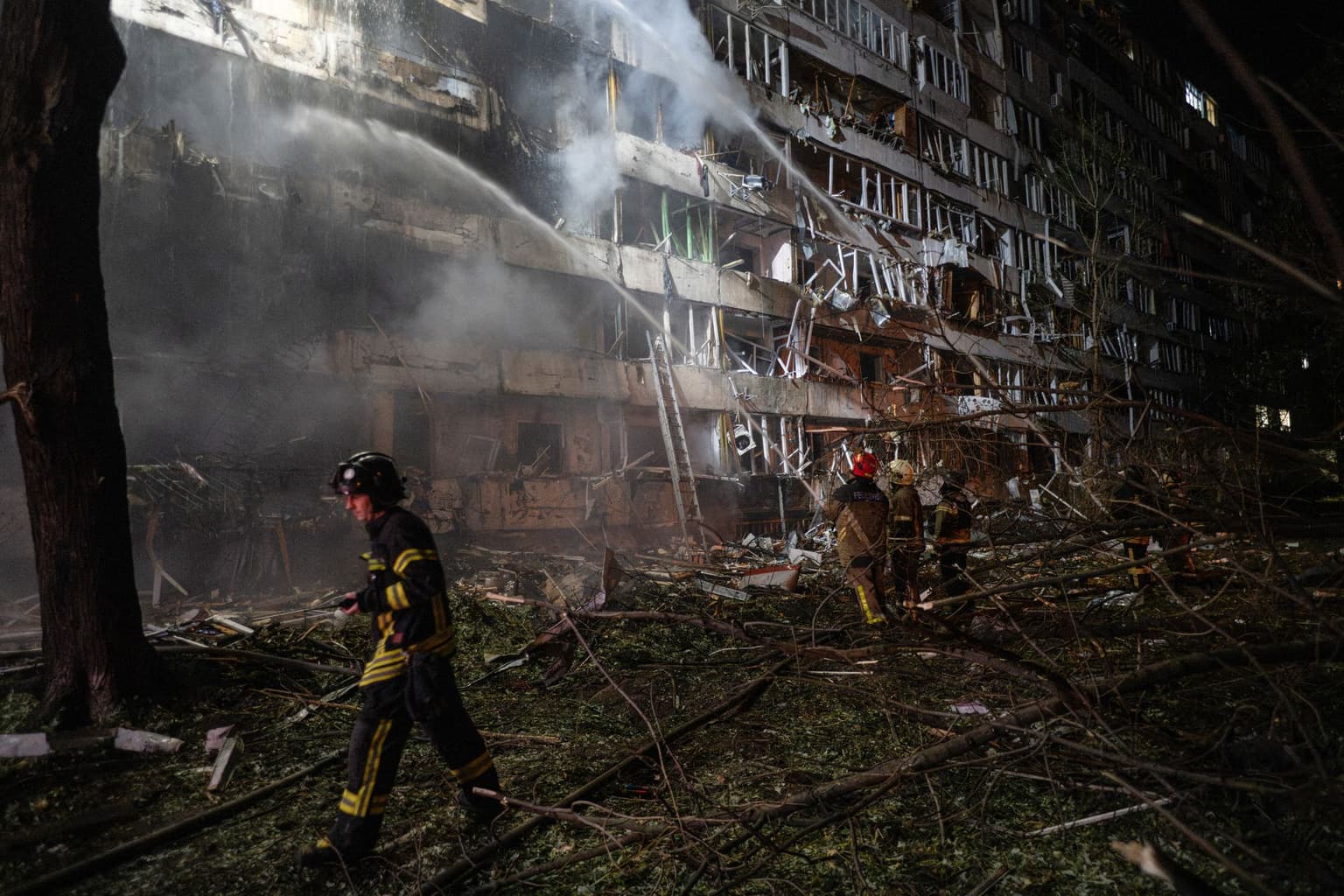
A home, now a target. Ukrainian firefighters work through the smoke at a Kyiv apartment block struck by a Russian missile. (Genya Savilov / AFP via Getty Images)
Here’s why speed is everything. Ukraine’s “middle strike” campaign uses fast drones — including American-made Hornets, which fly faster than the new cap — to choke Russian supply lines. Ukrainian drone-force data showed strikes on Russian vehicles fell off sharply. And the interceptor drones Ukraine sends up to chase Russia’s new jet-powered attack drones — the same drones hitting Kyiv — have to be fast by definition. A pro-Kremlin Russian blogger openly called the cap a “window of opportunity.”
So, who made the call? Musk pointed straight at the White House. “Any limits on speed or usage are decided by the U.S. military and ultimately (the president),” he wrote, adding that Starlink “cannot be used for offensive military action.” Read that line again. Hunting the trucks that carry Russia’s ammunition is offense. Keeping your own country alive requires it.
The White House said nothing. Poland, which has said it pays about $50 million a year for Ukraine’s Starlink service, said plenty. “Hey, @elonmusk, big man, are you playing politics with your products again?” Foreign Minister Radosław Sikorski posted. “As your European customers, we are watching you.”
By evening, service had stabilized — but the cap stayed. One mercy: Starlink doesn’t work over Russia at all, so Ukraine’s long-range strikes deep into Russian territory use other systems and are untouched. The fight that got harder is the one closest to the soldiers.
Cold Radiators and a Burning Warehouse: Russia’s Answer to the “Ceasefire”
Three days earlier, Donald Trump had announced that Russia and Ukraine agreed to stop bombing each other’s energy plants. Ukraine stopped. Here is what Russia sent: 39 missiles and 128 drones in a single night.
Most of those missiles were ballistic — they climb high and fall at tremendous speed, which gives people on the ground a few minutes at most to reach a shelter. For the second night in a row, Ukraine received no early warning from its Western partners for the first wave. The missiles came before the sirens.
They hit all three of Kyiv’s combined heat-and-power plants — the stations that produce both electricity and the hot water that runs through apartment radiators all winter. Across the country, at least 600,000 people lost power. In the capital, four people died and 25 were hurt. By morning, water pumps had failed: the upper half of the Pecherskyi district had no water at all, and the city posted a map of hand pumps where people could go fill bottles. When reporters asked Kyivans what worries them most about this winter, most named the same thing: water.
Russia’s Defense Ministry called the power plants military targets. They heat people’s homes.
Then the morning brought the war to the far west, a long way from any front line. In Lutsk, wreckage from a Russian drone fell on a food warehouse and set it ablaze. Five people died there. A sixth died later in the hospital. In nearby Rivne, a drone set an apartment house on fire, and rescuers lifted a woman out of the rubble alive. Among the wounded was a child born in 2012.
“This is exactly why Moscow must not be persuaded but forced to stop,” Zelensky said. “As long as Russia does not feel enough pressure, it continues to bring death.”
In Moscow, the Kremlin’s spokesman, Dmitry Peskov, had a lawyer’s answer ready. “The energy truce proposed by Trump was not specified,” he said, “so it cannot be said that Russia is not complying with it.”
“Really, Yes, Between Us”: The Day Zelensky Said It Out Loud
Asked in a television interview whether he felt betrayed by Donald Trump, Volodymyr Zelensky could have given a diplomat’s answer. He didn’t. “Really, yes, between us,” he said.
To understand why, you need about a week of backstory. On Oct. 9, after a phone call with Vladimir Putin, Trump announced a deal to buy Russian diesel. The next day he said it was time for Ukraine to get “a new president.” The day after that, he announced the energy ceasefire that neither Ukraine nor Russia had agreed to. “They agreed,” he told reporters. “You know why? Because I said, ‘You agree’ — that’s why.”
Meanwhile, according to Ukrainian reports, Trump’s envoys warned Kyiv’s negotiators that intelligence sharing could be cut off if Ukraine kept hitting Russian oil refineries — and that Washington might freeze the program through which Europe buys American Patriot missiles for Ukraine, the main defense against ballistic missiles. U.S. officials deny any change. But two nights of missing warnings landed hard.
And the ceasefire itself? A White House official said it may cover only oil refineries. Think about who that protects. Russia runs a huge network of refineries — they are its paycheck. Ukraine has exactly one. What Ukraine needs protected is its power grid. A refinery-only truce guards Russia’s wallet and leaves Ukraine’s radiators open to attack.
“It’s a pity that we are losing a strong partner,” Zelensky said, “but not because of us. We can’t be weak.” He said he would not step down. Of Washington’s course, he said: “This is not the right side of history.”
Not every American agrees with the White House. Twelve senators — six Republicans and six Democrats — called the diesel deal “a betrayal” of Ukraine and urged Trump to use the sanctions law he signed just three weeks earlier.
The same day, London offered a very different welcome. King Charles III received Zelensky at Buckingham Palace. Prime Minister Andy Burnham welcomed him to Downing Street with a military ceremonial guard — the first such honor ever granted to a foreign leader, according to the BBC — and announced Britain would rush its Lightweight Multirole Missiles, built to knock down exactly the jet drones now hitting Kyiv, to Ukraine before winter. Burnham said he would try to “repair bridges” between Kyiv and Washington.
On the same day, Ukraine learned both how lonely it can be and how many friends it still has.
Four Seasons in the Donbas: The Underdog Offensive That Worked
Every sports fan knows this story: the team nobody expects to win, playing fast because it can’t afford to play slow.
First, the map. Ukraine still holds a chain of cities in the eastern Donetsk region — Sloviansk, Kramatorsk, Druzhkivka and Kostiantynivka — that analysts call the “fortress belt.” Putin has named Sloviansk and Kramatorsk among his top objectives. Just north of them sits the town of Lyman, and that’s where, since July, Ukraine’s 3rd Army Corps has been running a counteroffensive named Operation Vivaldi, in four phases, like the composer’s Four Seasons.
The final phase is complete. Ukrainian troops liberated the villages of Zelena Dolyna, Lypove and Kolodiazi. Over the whole operation, they took back 16 towns and villages and 106 square miles, and the corps says Russia lost at least 8,000 troops. “Four seasons of ‘Vivaldi’ are over,” the corps announced, “but the music continues.”
The real prize was a road. Russia had been trying to swing around the fortress belt and cut the highway that keeps it supplied. It failed — and to plug the hole, it had to pull tank units away from the city of Kupiansk, easing the pressure there too.
How does an outnumbered army do this? “The key to the operation was speed,” said the corps commander, Brig. Gen. Andrii Biletskyi. “We did not give the enemy time to replace his losses or to construct a viable defense.” First came months of drone strikes on Russian supply lines and fuel. Then infantry slipped forward under a swarm of drones, cut Russian positions off, and cleared them one by one.
Even Russia’s own war bloggers admitted it. “The enemy has numerical superiority and a significant advantage in drones,” wrote Mikhail Zvinchuk, who has more than 450,000 followers. Moscow’s Defense Ministry, meanwhile, kept insisting its lines were holding.
Look at who did the fighting. The 3rd Assault Brigade began on the first day of the full-scale invasion as untrained volunteers in Kyiv. The K-2 drone unit started in 2017 as a group of hobbyists with consumer drones. Together with Ukraine’s push east of Sloviansk, their work meant Ukraine gained slightly more ground than Russia in September — the first time since June 2025.
And notice the connection to everything above. The drone campaign that made Vivaldi possible is exactly what the Starshield speed cap now threatens. Ukraine just showed the world what it can do with the right tools — on the same day someone made those tools slower.
Biletskyi isn’t done. Hinting at what comes next, he spoke like a composer: “At the very least there is still Wagner and Bach.”
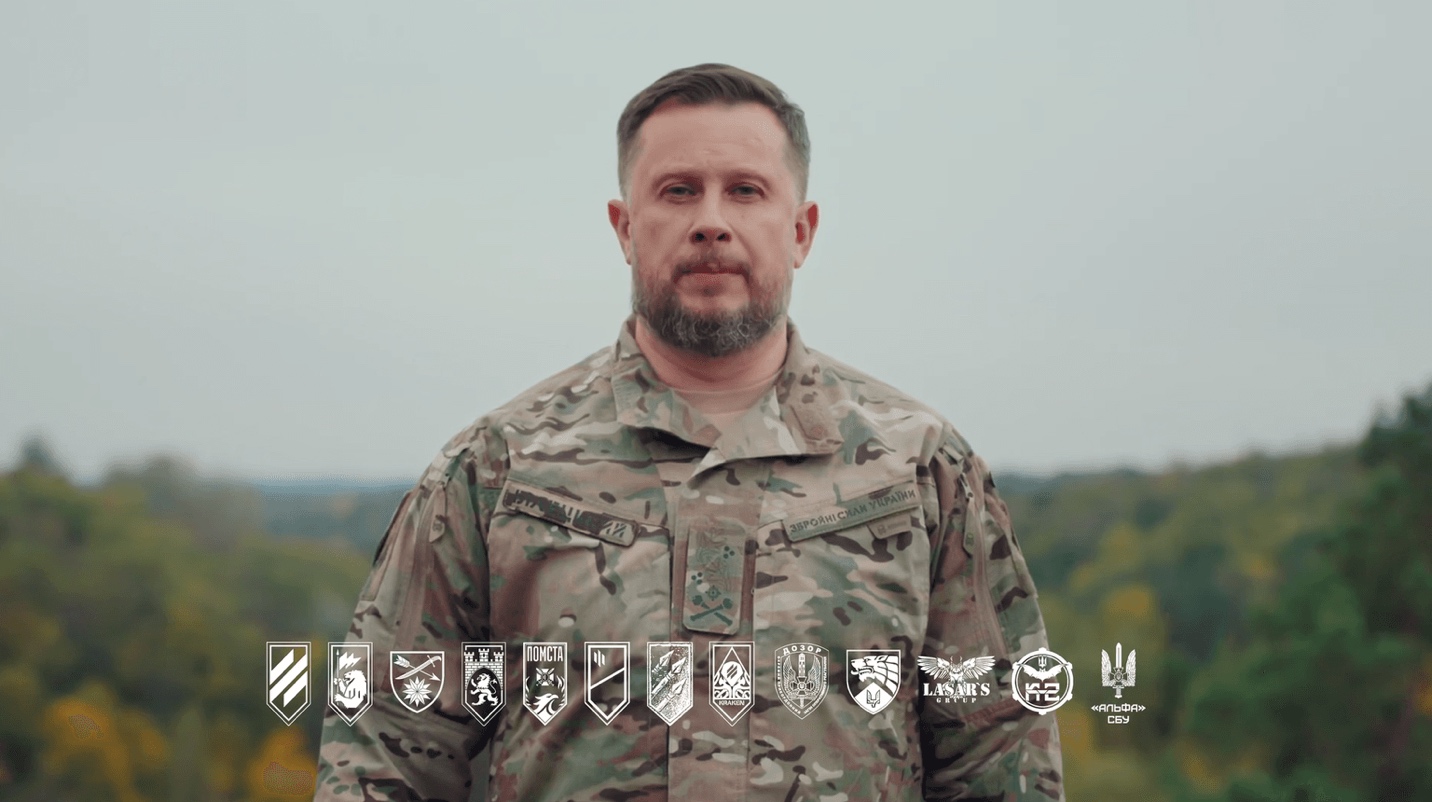
Ukraine’s Third Army Corps commander Brig. Gen. Andrii Biletskyi announces hard-won ground near Lyman, the latest gains of Operation Vivaldi. (Third Army Corps/Telegram)
Twenty-One Thousand Feet, on Prosthetic Legs
Picture fresh snow up to ten feet deep, avalanches sliding nearby, air so thin every step costs you. Now picture climbing it on an artificial leg.
Christopher Park-Greenwood, a British soldier who joined Ukraine’s naval special forces after the invasion, and Roman Havryliak, call sign “Hava,” a drone operator from the Lviv region, each lost a lower leg in combat. They have now stood together on top of Mera Peak in Nepal, 21,247 feet high — higher than any mountain in North America.
They trained for more than a year in climbing gyms and in Ukraine’s Carpathian Mountains, with a Ukrainian foundation called Second Wind that helps amputee veterans rebuild their lives through the mountains. After more than a year of treatment and multiple surgeries, Havryliak had set himself one goal: go back up. Their expedition began on Oct. 1, Ukraine’s Defenders Day, and they dedicated the summit to everyone still fighting and to everyone who has died.
On a day when so much was taken from Ukraine, two of its defenders climbed higher than almost anyone ever will.
Also Today
Ukraine hits back — just not at refineries. Keeping its word on the truce, Ukraine went after Russia’s digital economy instead. Drones struck a Sberbank data center under construction in Balakovo, about 456 miles inside Russia, and Russians reported outages on the state bank’s apps. It follows three strikes in four days on data centers of Yandex, Russia’s version of Google.
More dead in central Ukraine. A Russian drone attack on Kropyvnytskyi killed three people and injured six.
A killer behind the lines. A gunman in civilian clothes killed five soldiers of the 72nd Mechanized Brigade in a house near Kharkiv, and investigators believe he also shot a man who was fishing nearby. Prosecutors say the suspect, now arrested, is a Russian soldier.
Teenagers for hire. Ukraine’s security service arrested an 18-year-old in Kyiv who allegedly answered a “quick money” ad on Telegram and ended up trying to register 148 Starlink terminals for Russian troops. He faces life in prison.
Ukraine’s Home Depot loses its last warehouse. Russia struck the Khmelnytskyi distribution center of Epicentr K, Ukraine’s biggest home-improvement chain, ten times, destroying about 85% of its goods. “Honestly we are running out of strength,” the company’s spokeswoman wrote.
Europe pays up. The EU sent Ukraine another €2.86 billion ($3.1 billion) for air defense, drones and ammunition, and Poland’s defense minister warned that Europe must switch its arms factories into “war mode” to keep pace with Russia.
The rest of the front. Fighting was heavy around Pokrovsk and Kostiantynivka, and a Ukrainian spokesman warned that Russia is massing troops near Huliaipole, where it now outnumbers defenders five to one. Analysts saw no advances by either side, even as Russia’s Defense Ministry claimed fighting far beyond where its troops actually are.
A strike from the sky. Just across the border in Russia’s Belgorod region, a small Ukrainian FPV drone — the kind a pilot steers by camera — damaged a Russian Mi-28NM attack helicopter.
A trial in Germany. A Ukrainian former soldier, Serhii Kuznetsov, went on trial in Hamburg over the 2022 sabotage of the Nord Stream gas pipelines. He and Kyiv deny any involvement.
Kyiv’s mayor on the hot seat. Vitali Klitschko was summoned to parliament to answer for the capital’s winter readiness after Zelensky said Kyiv lags behind other regions.
A hard winter for business. The World Bank expects Ukraine’s economy to grow just 1.2% this year if the war continues.
The Closing
Tonight, in Kyiv, people are carrying water bottles to hand pumps beneath apartment blocks whose radiators have gone cold. Near Huliaipole, a pilot is flying slower than he wants to, watching a signal that may hold or may not. In three villages north of Lyman, Ukrainian soldiers are standing on ground they took back. They are not asking anyone to fight for them. They are asking not to be slowed down while they do it.
A Prayer for Ukraine
1. For the Six in the Lutsk Warehouse
Lord, five people died when fire swept a food warehouse in Lutsk, and a sixth in the hospital after. The morning began like any other, and they did not come home. Receive them, and hold close the families now waiting for bodies instead of footsteps. Comfort the woman pulled from the rubble in Rivne, and the child born in 2012 who learned too young what the sky can send. Let no grief here go unseen by You.
2. For the Seven-Year-Old in Desnianskyi
Father, a little girl in Kyiv was hurt when a missile struck her apartment building in the night. She will remember the sound. Heal her body, and in time quiet the fear that will follow her into every siren. Be with the children of Kyiv in their dark, cold rooms this winter. Give them parents steady enough to carry them and give their parents strength they do not have. Let these children grow up to know a quiet sky.
3. For the Men Who Must Decide
God of wisdom, the weight of this day fell on a few shoulders: a president who admitted he feels betrayed, allies weighing what to send, and the powerful who hold a switch over satellites in the sky. Give Volodymyr Zelensky clarity and endurance. Turn the hearts of those in Washington toward justice rather than convenience. Strengthen the friends who stood up today in London and Brussels. Where promises have been broken, raise up people who keep their word.
4. For the Five of the 72nd Brigade
Lord of hosts, five soldiers were shot in a house behind the lines, and a man fishing nearby was killed for being seen. Receive them. Cover the soldiers of the 3rd Corps who took back Zelena Dolyna, Lypove and Kolodiazi, and the pilots flying blind behind a slowed signal. Guard the defenders of Huliaipole who stand outnumbered five to one. Make them brave, keep them alert, and bring them home.
5. For the Long Road to Justice
Righteous God, Moscow says its promise was never defined and strikes heating plants as winter comes. Let lies be named, and let those who order the bombing of warehouses, universities and homes answer for it. Sustain the wounded veterans who climbed toward heaven on borrowed legs, and every Ukrainian still climbing.
In Your mercy, in Your justice, in Your time — bring this war to its end and let the ending be worthy of what Ukraine has endured.