
The Ukraine Daily Briefing · Tuesday, October 20, 2026
Prepared by Diana Bozhyk
Russian drones struck commuters on the Kyiv-Odesa highway, a warehouse in Obukhiv and the operating room of Kyiv’s leading heart institute, killing at least seven people in and around the capital. In Oslo, Zelensky, Norway and Finland handed U.S. envoy Steve Witkoff a draft of security guarantees to carry to Russia, and Zelensky said American missile warnings were working again. In Washington, Trump said that in this war “mostly soldiers die.”
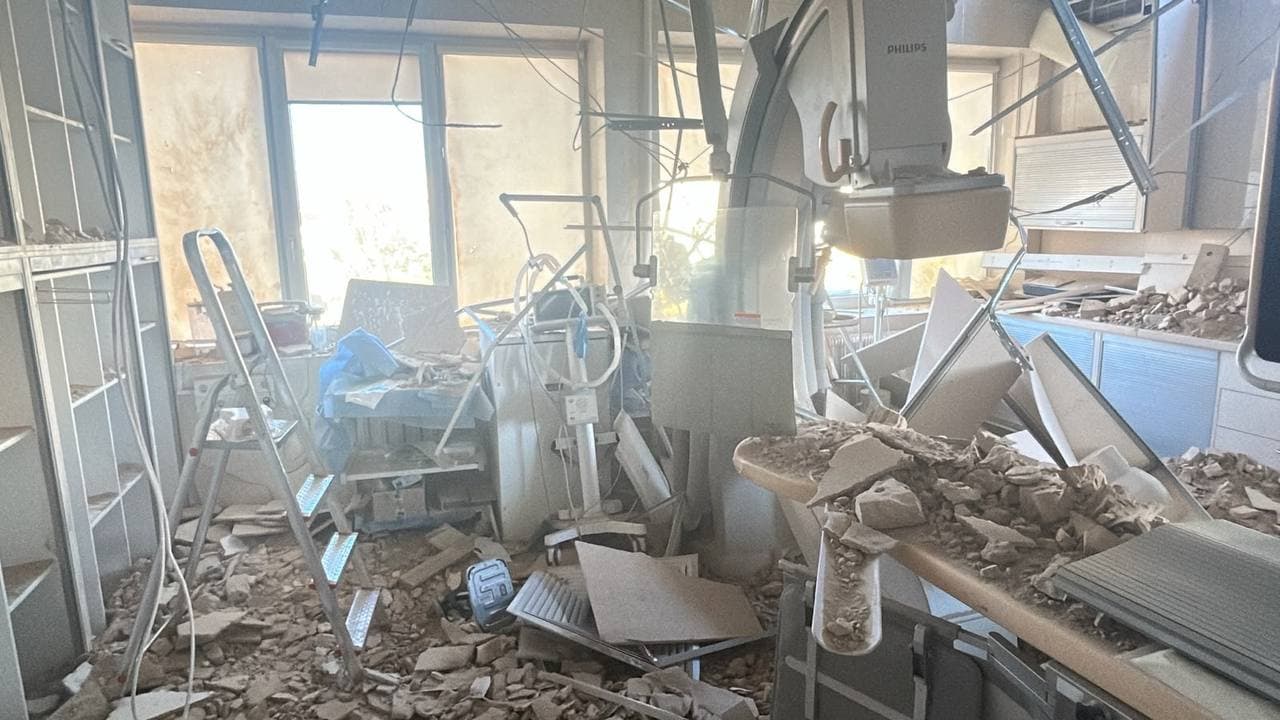
The damaged operating room of the Strazheska Institute of the National Academy of Medical Sciences after a Russian drone strike in Kyiv, Ukraine. (Serhii Koretskyi/Telegram)
The Day’s Reckoning
The drone came down during the morning rush. On the Kyiv-Odesa highway just south of the capital, near a shopping center, cars caught fire with people inside them on their way to work. Three were killed. A few kilometers away in Obukhiv, three more died in a warehouse. By afternoon, a drone had torn into the sixth-floor operating room of the institute that treats Ukraine’s heart patients.
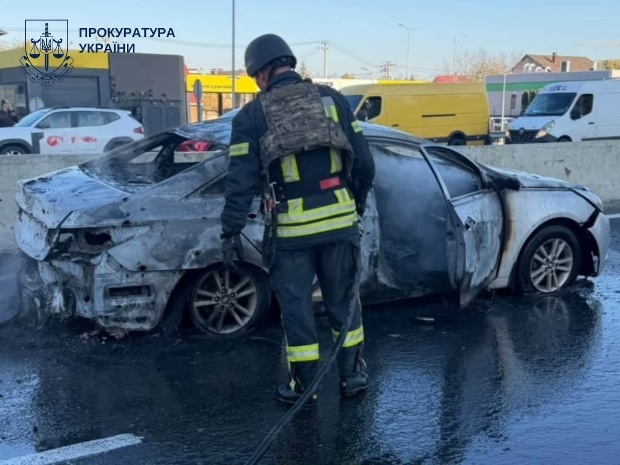
Remains of a car after a Russian drone attack on morning commuter traffic in the Holosiivskyi District of Kyiv, Ukraine. (Kyiv Oblast Prosecutor’s Office/Telegram)
That is the plot of this Tuesday: a country trying to get to work, and to the negotiating table, under fire. Zelensky flew to Oslo, where Norway and Finland had arranged a meeting with Trump’s envoy at his request, and said the missile warnings that failed three times had been restored. Witkoff left with proposals for Moscow.
Moscow had already answered. “If they propose something that benefits us economically and financially then why not?” Russia’s foreign minister said. “But it should not involve any political concessions on our part.”
The Morning Commute
You drive the Kyiv-Odesa highway every morning, past Chabany and the shopping center, into the city. On Tuesday, a Russian drone came down beside the road.
Cars caught fire near the shopping center, prosecutors said. Three people were killed and four injured. “They were simply on their way to work, going about their business,” said Kyiv region governor Tymur Tkachenko. Traffic was closed as investigators worked the scene. Inside the city’s Holosiivskyi district, near the same boundary, Mayor Vitali Klitschko reported a drone falling near a gas station and killing one person.
South of the capital in Obukhiv, a strike on a production and warehouse building killed two women and a man and injured six. In the Bucha district, two people were burned when a truck caught fire at a logistics complex.
Then the drones came in daylight. Russia hit the operating room on the sixth floor of the M.D. Strazhesko Institute of Cardiology, wounding a patient. It was the second strike on the institute; last year a Russian attack hit its fourth floor and killed two people. “The institute saves people with heart disease from all over Ukraine,” Prime Minister Serhii Koretskyi said. “Here, they perform surgeries, nurse patients back to health after heart attacks, and give people their lives back.” Debris struck another medical building in Holosiivskyi, fell on railway tracks and on a market, and started a fire at a garage cooperative near the Northern Bridge. The city said the bridge itself was not hit. Rescuers carried four people from the upper floors of a burning office building, and an energy facility in the Shevchenkivskyi district was struck in the afternoon.
By evening, Klitschko put Kyiv’s toll for the day at one killed and 21 injured, 12 of them in hospital, three seriously.
The night before, Russia launched 165 drones, 105 of them jet-powered, and Ukraine downed 115. They struck energy sites in the Kirovohrad, Zhytomyr, Lviv, Odesa, Rivne, Ternopil and Khmelnytskyi regions. In the Lviv region, drones hit the same energy facility twice. In the Khmelnytskyi region, a drone damaged the facade and bell tower of a church in the Shepetivka district. Ukrenergo reported new outages in 12 regions and imposed power limits on industry across the whole country. In the Zhytomyr region, the governor said Russia had attacked energy and railway infrastructure for a third day running, and in Volyn, Kovel and Lutsk took the worst of the strikes.
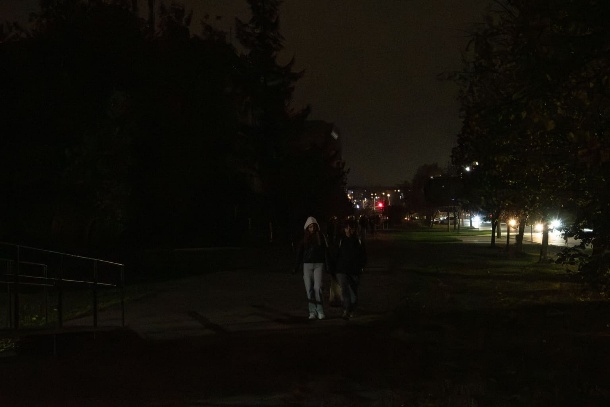
People walk along dark streets during a power outage and dropping temperatures in Lviv, Ukraine. (Olena Znak/Anadolu/Getty Images)
Over the past day, attacks killed one person and wounded five in the Zaporizhzhia region, wounded 18 in the Kherson region, including a child, and killed one and wounded eight in the Donetsk region, where a church in Starovarvarivka was damaged. In the Dnipropetrovsk region, Russia struck four districts nearly 70 times. Near Dnipro, a strike set warehouses on fire, and firefighters found two bodies once the flames were out; two men were hospitalized with severe burns, and men aged 65, 41 and 66 were wounded in the Synelnykove, Nikopol and Kryvyi Rih districts. In the Kharkiv region, one person was injured in Chuhuiv. In the evening, a drone hit an Epicentr home-goods store in Pervomaisk, in the Mykolaiv region, injuring eight. In Chernihiv, a drone set fire to a transport facility in the evening; no one was hurt. Late at night, a drone struck a university building in Kremenchuk where students had attended classes that day, injuring a 16-year-old.
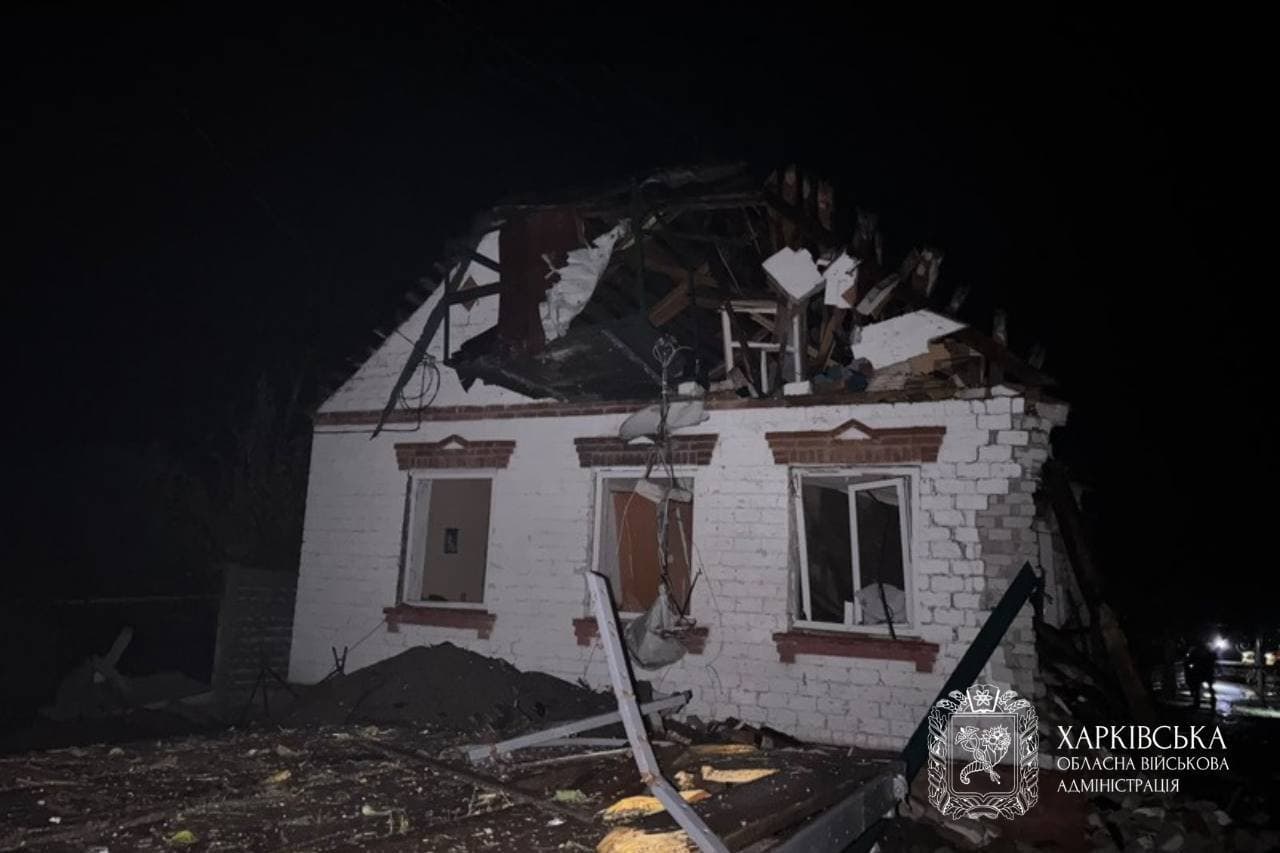
A residential building damaged in a Russian drone attack on Korotych, Kharkiv Oblast, overnight. (Kharkiv Oblast Military Administration/Telegram)
Forty-Eight Hours
Before landing in Norway, Zelensky spent 45 minutes on the phone with Secretary of State Marco Rubio. He called it “substantive” and listed the three subjects in order: “First, we discussed interceptors for ballistic missiles, which are essential for protecting lives. Second, we addressed early warning systems for Russian ballistic missile attacks – a matter of vital importance. Third, we talked about the situation regarding Starlink/Starshield, which needs to be restored.”
By midday he had good news. “This morning began with positive signals from the American side,” he said in Oslo. “We are thankful that intelligence works now.” On Patriots and Starlink, he said results could come within 48 hours.
Rubio, traveling in India, acknowledged that a shipment of interceptors may have been delayed but denied any plan to hurt Ukraine. “Every country in the world would like interceptors… It’s probably the most in-demand product right now in the defense field,” he said. “So when a country doesn’t get interceptors from the United States, it’s not because we’re denying. We have our own needs, too.” There has not been, he said, “some deliberate political directive to go out and harm Ukraine.”
Presidential adviser Serhiy “Flash” Beskrestnov told the BBC that U.S. intelligence had kept flowing; the problem was the timing of the warning. “Sometimes we receive this information before the attack, another time we do not. And for example, last night we received it, but … one minute before the attack.” People, he said, had already died. The Starlink speed cap of 160 kilometers an hour remains, he said, and Ukraine is now looking for alternatives “because we’re not sure what will be the next step.”
A Kyiv Post review counted at least six civilians killed and 21 injured in Russian missile strikes after the warnings stopped arriving, and estimated that ballistic and possibly ballistic missiles killed around 20 people from October 12 to 19.
Help from neighbors has limits. Polish Foreign Minister Radoslaw Sikorski said on Monday that Poland cannot give Ukraine Patriot missiles. “This is a genuine problem,” he said.
Oslo
Zelensky arrived in Norway saying, “We are not cutting off any contacts that could help peace.” Norway’s Prime Minister Jonas Gahr Støre and Finland’s President Alexander Stubb sat down with him and Witkoff, joined by officials from Britain, France, Germany, Poland, the European Commission and NATO. Jared Kushner took part by video, ill with the flu.
The talks covered Ukraine’s security, its recovery, territory and sanctions. Zelensky said the sides discussed several kinds of security guarantees laid out in a draft document, including ones modeled on NATO’s Article 5, the alliance’s pledge that an attack on one is an attack on all. Witkoff will take those ideas to St. Petersburg on Wednesday, where he is also expected to seek the release of Stephen Hubbard, an American detained by Russia in 2022. “We have some clear ideas on how to get to peace. And we are united with our European partners in this effort, and we want the Americans to take these ideas to the Russians,” Zelensky said. “One of the important ideas is to move to a trilateral meeting of the leaders.”
Støre said the visit could “possibly pave the way for a meeting at leaders’ level.” “We discussed and found key elements on security, and we discussed and found key elements on the economy,” Stubb said, adding that despite “a lot of noise in the public space,” the work was advancing “on the technical level.” Zelensky’s program also included an audience with Norway’s king and meetings with leaders of the Norwegian parliament. All three leaders said no decision about Ukraine should be made without Ukraine.
Zelensky also described what Ukraine had already offered. “We are ready not to hit sensitive parts of Russia’s energy sector if Russia stops hitting ours. Putin said no. But we’re working to find a solution.” Asked about Iran, he said Ukraine has evidence that Russian drone components and satellite intelligence are going to Tehran.
Foreign Minister Sergei Lavrov answered from Moscow before Witkoff arrived: economic offers are welcome, political concessions are not. He also accused Zelensky, without evidence, of sabotaging past rounds of talks. On Monday, beside Iran’s foreign minister, Lavrov had condemned what he called U.S. “unprovoked aggression” against Iran and said Russia “does not intend to abandon” its deals with Tehran.
In the Oval Office, Trump said Ukraine “has to want to make a deal.” “We have given tremendous amounts to Ukraine. We’ve got nothing back other than high diesel,” he said, adding that Europe, too, was tired of the war. Asked about Russian strikes on civilians, a day after a drone killed a baby in a park, he said: “Some people die in a town that got hit or whatever, but mostly soldiers die.”
The River Line
You are a soldier of Ukraine’s 3rd Army Corps, dug in on the bank of the Zherebets River, northeast of Lyman. A month ago, Russian troops held this side of the water.
Brig. Gen. Andrii Biletskyi said Ukrainian forces have reached the Zherebets, shortening the front and giving them a line they can hold with denser infantry and better positions for drones and artillery. Russia will have to cross the river again to attack Lyman, he said. He reported that Operation Vivaldi had so badly mauled Russia’s 144th Motorized Rifle Division that it effectively ceased to exist as an organized force.
ISW, which tracks the front daily, said Russian forces suffered a net loss of 122 square kilometers between September 1 and October 16, and have taken only about 100 square kilometers since the start of 2026. The 3rd Army Corps clarified that Maj. Dmytro Rohoziuk is its acting commander while Biletskyi leads the Center group of forces in the Fortress Belt, the chain of cities Russia has spent years trying to reach.
The pressure is spreading. A source close to Russia’s Western Group of Forces said troops near Kupyansk struggle to bring up reinforcements because Ukrainian drones catch them on known routes, and that commanders are not helping men stuck near Kupyansk-Vuzlovyi to pull back. In the Sumy region, Ukraine’s military intelligence said its special forces killed 108 Russian soldiers, captured 29 and cleared more than 600 hectares of forest in a seven-week operation, a claim that could not be independently verified. Ukrainian troops advanced east of Sumy near Velyki Prykil. North of Kupyansk, Ukrainian forces counterattacked, and northeast of Kharkiv they struck a Russian infiltration team near Zemlyanyi Yar. Around Slovyansk, Kostiantynivka and Borova, Russian assaults gained no ground, ISW reported.
Russia is still pushing elsewhere. It advanced in southern Novodanylivka, south of Orikhiv, and moved a reconnaissance battalion of its 104th Airborne Division to western Zaporizhzhia. Near Hulyaipole, a Ukrainian battalion commander said Russian troops attacked over the past week on motorcycles, all-terrain vehicles and armored vehicles. Russia’s Defense Ministry claimed to have captured Tymoshivka, at least 12 kilometers beyond any confirmed Russian position. West of Pokrovsk, a Ukrainian brigade said Russia has reinforced its reserves and is pushing toward Serhiivka, sending infiltrators forward in fog and rain. In Dobropillia, Russian troops raised a flag at the Almazna coal mine.
NATO’s Edge
NATO said it will send more maritime patrol aircraft, radar systems, drones, explosive ordnance teams and intelligence staff to the Black Sea after a run of attacks on merchant ships near Romania and Bulgaria. “Allies have or will send additional maritime patrol aircraft, radar systems, explosive exploitation teams, intelligence personnel, drones, and more,” spokesman Col. Martin O’Donnell said after the North Atlantic Council met.
The toll at sea has been heavy. On October 13, the Guinea-Bissau-flagged HS Dignity sank off Krapets, Bulgaria, and 11 crew members are still missing. Two days later, seven sailors went missing after the tanker Wine Trader caught fire near Sulina, Romania. Bulgaria is examining suspected drone fragments recovered from the Chelsea 3, The Maritime Executive reported. NATO has not named a culprit.
On the northern flank, Polish Prime Minister Donald Tusk said Poland will seek an explanation from Kyiv about the drone that exploded in Lithuania on Sunday, which Lithuania says came through Polish airspace. “Without emotion, without ill intentions,” he said, adding that Poland allows no operations over its territory without its consent. Lithuania has accepted Kyiv’s explanation that Russian jamming diverted a Ukrainian drone. The European Union also unveiled an Arctic strategy aimed at Russia, with more icebreakers, protection for undersea cables and tracking of the shadow fleet.
Also Today
Seoul pulls staff. South Korea will withdraw some diplomats from Kyiv, deepening the dispute over Zelensky’s disclosure of two North Korean prisoners sent to Seoul. A chargé d’affaires stays.
Hungary blocks again. Hungary blocked a procedural step toward Ukraine’s and Moldova’s final two EU accession clusters, even after Kyiv passed the minority-education law Budapest demanded, diplomats told the Kyiv Independent. Officials expect the clusters to open in December.
Japan opens its market. Japan lifted five years of restrictions on Ukrainian poultry and eggs.
A pipeline station burns. A fire broke out at the Nikolskoye oil pumping station of the Druzhba pipeline in Russia’s Tambov region after a reported drone attack. Ukraine did not confirm it.
A data center in Donetsk. An overnight strike destroyed the data center of the main telecom operator in occupied Donetsk, a Ukrainian occupation monitor said.
Russian retailers ask for help. Russia’s online-retail association asked the government for emergency rules to keep selling during data-center outages caused by Ukraine’s strikes.
St. Petersburg’s first death. The man killed in Sunday’s attack on St. Petersburg was a 36-year-old taxi driver named Yuri, hit by a falling drone in his car, Russian outlet Astra reported. Russian state TV barely covered the attack, BBC Russian found.
Charged in absentia. The Security Service of Ukraine named Russian occupation official Artem Sharlai a war crimes suspect for allegedly helping persecute churches and clergy in occupied Melitopol.
Polish jets on alert. Poland scrambled military aircraft twice on Sunday during Russian attacks on western Ukraine, issuing alerts for residents of the Lublin and Subcarpathian regions. No violation of Polish airspace was reported.
A Kyiv mother’s day. AFP followed Anastasiia Zhmutska, a hospital worker and mother of three, through a day of alerts, blackouts and a two-hour, 15-kilometer commute. “It feels like it can’t get any harder than it is right now but I know it will,” she said.
A train to Chelm. A Kyiv Post reporter documented a train to Poland that left more than eight hours late and arrived about 12 hours behind schedule, as Russian strikes on rail and power ripple across timetables.
The Closing
Tonight, three families on the road south of Kyiv are counting their dead, and a heart institute in Kyiv is counting the damage to its operating room. In Oslo, Ukraine and its friends wrote down what peace could look like. In St. Petersburg tomorrow, Russia will read it. Ukraine has asked only that it not be decided without Ukraine, and that the warnings keep coming in time.
A Prayer for Ukraine
1. For Those Who Defend
Lord of hosts, cover the soldiers on the Zherebets River and the men who hold the line at Kupyansk, Hulyaipole, Pokrovsk and Dobropillia. Guard the special forces in the forests of Sumy region and every drone crew watching over the front. Steady the air defenders who face drones by day and missiles by night, and let the warnings they depend on arrive in time.
2. For the Wounded and the Grieving
God of all comfort, receive the three killed on the Kyiv-Odesa highway on their way to work, the three lost in Obukhiv, the two found in the warehouse near Dnipro, and all who died across Ukraine today. Heal the patient wounded in the heart institute, the burned men in Dnipro, the shoppers in Pervomaisk and the sixteen-year-old in Kremenchuk. Hold close every family waiting by a hospital bed.
3. For Those Who Lead
King of kings, give President Zelensky wisdom in Oslo and strength in every conversation where his nation’s future is weighed. Grant Prime Minister Støre and President Stubb faithfulness as friends, and give President Trump, Secretary Rubio and Envoy Witkoff the clarity to see who attacks and who defends. Let no table be set without Ukraine, and let no peace reward the aggressor.
4. For the Grid, the Hospitals and the Towns
Faithful God, protect the doctors of the Strazhesko Institute who keep operating under fire, and every hospital where generators hum through the blackouts. Strengthen the power crews in Lviv, Zhytomyr, Rivne, Ternopil, Khmelnytskyi and across twelve darkened regions. Comfort the parish whose church was damaged in Shepetivka district, and the faithful of Starovarvarivka, and let their bells ring again over towns that refuse to go dark.
5. For a People Who Keep Standing
Father, Ukraine wakes each morning not knowing whether the road to work is safe, and still it goes to work. Sustain the mothers who plan every journey around the sirens, the children who study in shelters, and the travelers who wait through the night for trains. Give them rest and hope. In Your mercy, in Your justice, in Your time — bring this war to its end, and let the ending be worthy of what Ukraine has endured.