
The Ukraine Daily Briefing · Tuesday, November 3, 2026
Prepared by Diana Bozhyk
As Americans voted in the midterm elections, Russia launched 17 ballistic missiles, 59 cruise missiles and 289 drones at Ukraine’s power grid, knocking three thermal plants offline, sending drones at a substation serving a nuclear plant and cutting water to much of Kyiv. Strikes wounded or traumatized 73 people at a Kharkiv hospital and destroyed a hospice for the dying in Dnipro, as the toll from Monday’s bombing in Komyshuvakha rose to 33. In Berlin, Germany promised a winter package, and the Kremlin named Vladimir Medinsky to lead its delegation to next week’s talks.
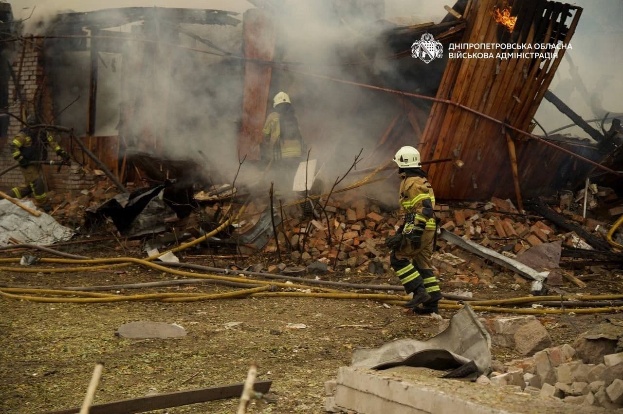
The aftermath of a Russian missile strike on the central-eastern city of Dnipro, where two people were killed and 20 others were injured. (Dnipropetrovsk Oblast Governor Oleksandr Hanzha / Telegram)
The Day’s Reckoning
The bombers took off the night before. By 2 a.m., four Tu-160s and nine Tu-95MS strategic bombers were in the air, monitoring channels reported. At about 3 a.m., the ballistic missiles came, toward Dnipro, Vinnytsia, Kharkiv, Zmiiv and Kaniv. Then the cruise missiles. By morning, Ukraine’s energy system had taken what its grid operator called one of the most extensive attacks against it.
That is the plot of this Tuesday, the day Zelensky had warned about. “The assumption is basically that tomorrow the world will be watching the American midterms,” he had said on Monday. It came as forecast. Three power plants stopped. Kyiv’s taps ran dry, and its trams went still. In Kharkiv, a ballistic missile hit the passageway between two hospital wings. In Dnipro, a missile destroyed a hospice where elderly and terminally ill people spent their last days.
And the dead of Monday were still being counted in Komyshuvakha. “There were ordinary people there,” Zelensky said of them. “They had come to get help.”
The Night of 17 Ballistic Missiles
You are a repair crew chief for Ukrenergo. Since midnight, your phone has not stopped. More than 20 Russian strikes have hit the grid’s facilities in 24 hours.
Russia launched 17 ballistic missiles, including Iskander-M, North Korean KN-23 and Zircon types, 59 Kh-101 and Kh-55SM cruise missiles fired from Tu-160 and Tu-95MS bombers, and 289 drones, 120 of them jet-powered, Energy Minister Denys Shmyhal said. The Air Force reported shooting down only three ballistic missiles; the Institute for the Study of War calculated that Ukraine intercepted about 18 percent of the ballistic and anti-ship missiles. During the day, Russia sent 81 more drones, 74 of them jet-powered.
Zelensky said strikes hit power plants and substations in nine regions, from Odesa and Cherkasy to Kharkiv, Chernihiv and Rivne. “Emergency and rolling blackouts continue in many cities and communities,” he said. DTEK said three of its thermal power plants were knocked fully offline and its grid in the Odesa region damaged, calling it one of the “most serious attacks ever” on its facilities. “It is clear Russia is dangerously escalating its efforts to deny Ukrainians critical services like energy this winter. We will not let them succeed,” CEO Maxim Timchenko said.
Three drones flew at a substation vital to the Khmelnytskyi Nuclear Power Plant, which runs two reactors with a combined capacity of about 2,000 megawatts. “Such actions pose a threat not only to Ukraine but to the nuclear safety of all of Europe. This is a serious step of escalation,” Shmyhal told G7 and EU ambassadors, saying Kyiv had informed the International Atomic Energy Agency. When substations near nuclear plants are damaged, the reactors must cut output for safety.
In Kyiv, the main facilities of the water utility, Kyivvodokanal, lost power, and taps went dry in the Pecherskyi, Podilskyi and Holosiivskyi districts; residents were told to fill containers at pump rooms. “The situation regarding the electricity supply in Kyiv is extremely difficult… The enemy continues to destroy Ukraine’s unified power system,” Mayor Vitali Klitschko said. From the evening, trams and trolleybuses stopped, and the city opened warming centers where people could charge phones and “have a cup of hot tea.” In the Zhytomyr region, the regional capital lost power and water; in the Vinnytsia region, most settlements went dark. In the Khmelnytskyi region, a strike damaged the roof of an apartment building in the Shepetivka district, and in Cherkasy debris damaged houses. Two drones were shot down over the Lviv region.
Across the past day, Russian attacks killed at least 38 people and wounded 167, counting Komyshuvakha. In the Donetsk region, four were killed and six wounded. In the Sumy region, a 63-year-old man was killed and a 61-year-old woman wounded. Seven were wounded in the Kherson region, and in Zaporizhzhia a 71-year-old woman was hurt when a strike set her house on fire.
A Hospital in Kharkiv, a Hospice in Dnipro
You are a patient in a cardiology ward in Kharkiv’s Nemyshlianskyi district. At about 3 a.m., Mayor Ihor Terekhov posts a warning: “Kharkiv is under a combined strike of ballistic missiles and KABs – be careful!” Minutes later, the hospital is hit.
The strike landed on the passageway joining two buildings of a city clinical hospital, damaging one department and blowing out more than 1,000 windows in the hospital and four nearby apartment blocks. Prosecutors said 73 people suffered, among them patients, medical staff and neighbors, including those treated for acute stress; Zelensky said the cardiology department was damaged. About 200 patients were moved to other hospitals. Across the Kharkiv region, Governor Oleh Syniehubov said, 50 people were injured.
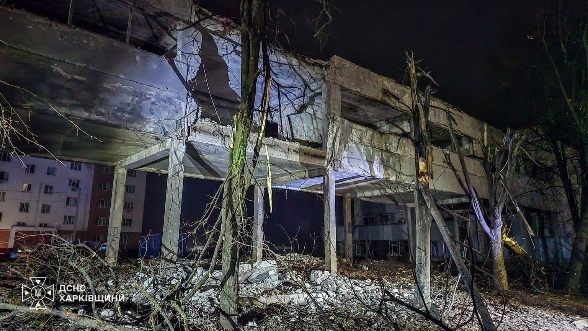
Aftermath of a Russian attack on a medical facility in Kharkiv, Ukraine. (Ukraine’s Emergency Service)
In Dnipro, a morning missile attack killed two people and injured 20, Governor Oleksandr Hanzha said. It hit a thermal power plant, a police station and homes in the Samarskyi district, and damaged a medical center and a hospital where nearly 100 patients were treated; none were hurt. It also destroyed a hospice. Mayor Borys Filatov said about 50 terminally ill patients, the oldest of them 90, were moved to another hospital from wards the city had only recently renovated. “Now all of this has been destroyed by a Russian missile,” he wrote. “I want as many people as possible to see these photos. Especially politicians and diplomats. The whole world must see this.” Twenty residential buildings were damaged or partly destroyed, and strikes also hit infrastructure in the Kryvyi Rih district.
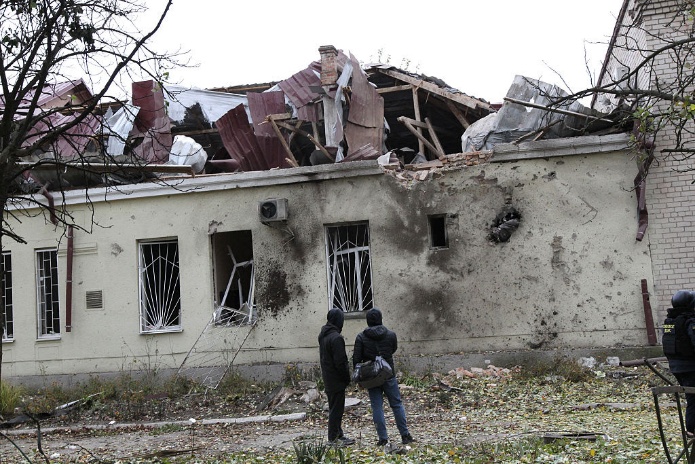
Two men look at a building damaged by an overnight Russian strike in Dnipro, Ukraine. (Mykola Miakshykov/Ukrinform/NurPhoto via Getty Images)
Komyshuvakha: The Count Goes On
In Komyshuvakha, rescuers kept digging through the shelter that a three-ton FAB-3000 bomb had collapsed. The bomb carries nearly one and a half tons of explosives. “After a direct hit, the concrete structure of the underground center collapsed,” regional head Mykhailo Semikin said of the village, about 30 kilometers southeast of Zaporizhzhia. By Tuesday evening, he put the dead at 31, 20 of them still unidentified, with five wounded and 58 missing; in Berlin, Zelensky said at least 33 had been killed and more than 50 might still be under the rubble. Semikin called it the deadliest Russian strike on the Zaporizhzhia region of the war, declared three days of mourning and said the region would pay every family’s funeral costs. “We will not leave a single family alone with its grief,” he said. Russian drones kept forcing rescuers to stop the search.
Ukraine’s military intelligence said Russia struck the village nine times and deliberately targeted the aid site. Latvia, which holds the UN Security Council presidency in November for the first time, called an extraordinary session. “Latvia has called for an extraordinary meeting of the UN Security Council after horrific Russian attacks on civilians in Ukraine, including on an aid distribution center in Komyshuvakha,” Foreign Minister Baiba Braze wrote.
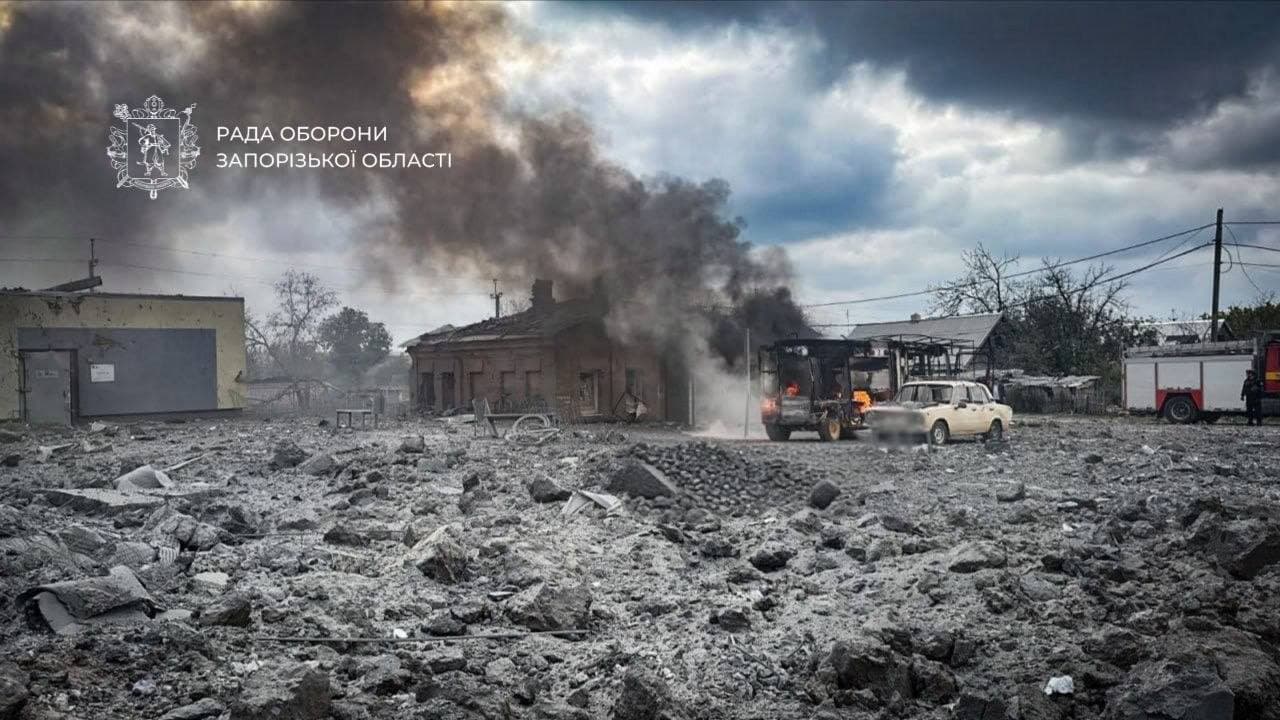
The aftermath of a Russian aerial bomb attack on Komyshuvakha, Zaporizhzhia Oblast. (Local authorities/Telegram)
What Happened in Borshchahivka
A day after the clash outside a National Guard building near Kyiv, officials gave their account. Interior Minister Ivan Vyhivskyi called claims of “torture chambers” false. Two of the men inside had left their units without permission, he said, and the rest were due to start basic training on November 9. He said a woman involved had tried to get a man out by fraud while hiding her own absent-without-leave husband at home. “This is a sort of scheme to extract draft dodgers,” he said.
Kyrylo Budanov, head of the Presidential Office, said police had detained the woman who arrived in the ambulance, Valentyna Moloda, and that she and her driver had scouted the house at least three days earlier. The actual owner of the ambulance firm she claimed to run, Mykhailo Furman, said it stopped operating in 2023. Journalists also identified a man in a medic’s uniform beside her, Viktor Yena, who faces charges of desertion and fraud, and a pro-Kremlin blogger, Olha Zubko, at the scene. “Her phone contains correspondence with certain Telegram channels that began widely distributing this information,” he said. The incident was “not without outside influence,” he said, but it also exposed real social tensions. The Security Service of Ukraine said it identified about 100 people who took an active part and that the organizers’ aim was to “abduct one of the military personnel.” The State Bureau of Investigation opened a case into possible abuse of authority by a military official.
National Guard commander Oleksandr Pivnenko said he saw no critical violations after speaking to 17 soldiers, said 16 guardsmen were lightly injured in the clashes, and said the site would be moved because its location was now public and exposed to Russian strikes. A boy who said he was 14 was found in the basement; how he got in was unclear. Military ombudswoman Olha Reshetylova said all servicemen were safe and receiving medical care. Ombudsman Dmytro Lubinets asked investigators to examine every aspect, including the legal basis for holding servicemen there. Azov commander Brig. Gen. Denys Prokopenko accused those who stormed the house of creating a picture favorable to Russia. “Citizens have an unquestionable right to demand that the law be upheld. However, this does not give anyone the right to take the law into their own hands,” the General Staff said. Russian officials called the house a “torture chamber,” and ISW said Moscow was exploiting the confusion to stoke anger over mobilization.
Berlin and the Road to Abu Dhabi
Zelensky spent the day in Berlin. Chancellor Friedrich Merz promised a dedicated winter package, naming air defense and energy as Ukraine’s two most urgent needs. “In this difficult time, Ukraine can count on Germany. We will continue to support it in full,” he said; they discussed PAC-2, PAC-3 and IRIS-T missiles and help with F-16s. Zelensky asked Bundestag President Julia Klöckner to approve the €11.6 billion for Ukraine in Germany’s 2027 draft budget, a little above this year’s record, and briefed President Frank-Walter Steinmeier, who personally sponsors aid for the Chernihiv region. “We are preparing to meet in Abu Dhabi and work constructively. We need the same constructiveness from Russia,” Zelensky said.
The road there now has stops. The European Commission will host Ukrainian, American, French, German, British, NATO and World Bank officials in Brussels on November 4 to build on the Miami talks, including a reported “prosperity plan” for Ukraine. Kremlin spokesman Dmitry Peskov said Putin aide Vladimir Medinsky, who led Russia’s team in Istanbul in 2025, will head its delegation in Abu Dhabi; Reuters reported Witkoff and Jared Kushner will lead the American one. Earlier rounds in Abu Dhabi in January and February and in Geneva in February produced prisoner exchanges but no settlement. Russian Foreign Minister Sergei Lavrov rejected the truces Kyiv proposes. “Ukraine is calling for an immediate ceasefire, for agreements on an energy, food, air and maritime truce. None of this is for peace,” he said. “We insist not on a temporary ceasefire… but on reliably eliminating the root causes of the crisis.”
The White House said Melania Trump will host representatives of Ukraine and Russia on Thursday to speak about the Oleshky ceasefire, calling it “an extraordinary moment in American history.” A Ukrainian official said Lubinets and his Russian counterpart, Yana Lantratova, are expected, though Lantratova has been under U.S. sanctions since 2022. Lubinets said Russia acknowledged that about 80 percent of evacuees chose Ukraine, and Kyiv Post sources said fewer than 10 people went to Russia. Several hundred, possibly up to 1,000, remain in Oleshky.
The Line
You are a Ukrainian soldier near Dobropillia. For months, the Russians attacked here more than anywhere else, 55 times on Sunday alone. On Monday and Tuesday combined, they came only 13 times, Ukraine’s General Staff said.
It was the fewest assaults toward Dobropillia since at least August 1, after an October average of about 28 a day, ISW said. Neither side advanced anywhere on Tuesday, ISW reported. Ukrainian forces counterattacked north of Kupyansk, northeast of Borova, northeast and southeast of Lyman and south of Orikhiv, and ISW found evidence of earlier Ukrainian advances in Pyskunivka and Rai-Oleksandrivka near Sloviansk and north of Sumy near Andriivka. Russian attacks near Kostiantynivka and Druzhkivka along the Kazennyi Torets River, and toward Oleksandrivka and Hulyaipole, gained nothing, and Russian bloggers’ claims of advances west of Hirke and south of Omelnyk went unconfirmed. Elements of Russia’s 1431st Motorized Rifle Regiment were reported near Petropavlivka, east of Kupyansk; the Novopavlivka direction was quiet. A source close to Russia’s Western Group of Forces claimed Russian attacks toward Borova continued, but ISW saw no Russian advance there. Russian troops infiltrated near Khrypuny northeast of Kharkiv and appeared in Rohozianka, at least 12 kilometers behind Ukrainian lines near Velykyi Burluk; ISW could not verify how they got there. In the Dnipro delta, Ukrainian forces struck Russian infiltrators on Kruhlyk Island, south of Kherson, and a brigade spokesperson said Russian troops try crossings in rubber boats in bad weather, and a Ukrainian spokesperson said they used the Oleshky truce to bring in men, equipment and supplies.
Ukraine struck back, as ISW noted the overnight barrage was part of Russia’s effort to make Ukrainians capitulate over the winter. Footage showed fires at the Slavneft-YANOS refinery in Yaroslavl, one of Russia’s largest, processing about 15 million tons a year, and the governor acknowledged damage. New footage showed three workshops damaged at the Kamensky rocket-fuel plant. A strike set fire to an ammunition depot and camp of a unit guarding the Kerch Strait bridge in occupied Crimea, about 250 kilometers from the front, and Sevastopol’s occupation governor reported widespread outages. Around Kyiv, presidential adviser Serhiy “Flash” Beskrestnov said Ukraine has built an electronic-warfare dome to jam the mesh radio networks Russian operators use to steer drones live. In Moscow, Putin signed a decree setting new rules for military-technical cooperation with Belarus, including the protection of state secrets in arms contracts and exchanges of military products, which ISW said reflects a combined Russian-Belarusian defense industry.
Also Today
A provocation stopped. Polish Prime Minister Donald Tusk said authorities prevented a Russian provocation near Sepopol overnight after border guards saw people with flashlights along the Kaliningrad border. Lavrov called Poland and the Baltic states the “most active promoters” of aggression against Russia.
Russia trims its bonuses. St. Petersburg cut its one-time enlistment bonus to 400,000 rubles from 3.5 million before October, Fontanka reported.
A former spokeswoman charged. The SBU charged Zelensky’s former press secretary, Iuliia Mendel, who lives in the U.S., with treason in absentia; she said the case was about “freedom of speech.” In May, she called Zelensky a “dictator” on Tucker Carlson’s podcast, and in September she spoke at an event hosted by Germany’s far-right AfD.
New head of Ukroboronprom. Lt. Gen. Ivan Havryliuk, a former first deputy defense minister, was appointed to lead the state defense conglomerate.
Lukoil’s foreign assets. A consortium led by U.S. investor Todd Boehly, including Emirati firms and the U.S. Development Finance Corp., and beating more than a dozen suitors including Exxon Mobil and Chevron, is close to buying Lukoil’s international assets, once valued at about $22 billion, Reuters reported. It would keep the shares it exchanges in escrow so Lukoil gains nothing immediately; Washington allows sale talks only until November 21.
Diesel at the docks. New Jersey Governor Mikie Sherrill warned the state’s ports in a letter that accepting Russian diesel would be illegal. “I urge you to turn away any tanker,” she wrote.
No hockey with Russia. Germany, which hosts the 2027 world championship, Finland, Sweden, Norway, Denmark and Czechia said they would not play Russia, and Canadian Prime Minister Mark Carney said Russians “will not be there” at the world juniors in Alberta, citing Canada’s immigration law. “We are currently gathering as many countries as possible to form a common front,” said Finland’s hockey chief, Heikki Hietanen.
Norway watches its border. Norway is sending NASAMS sensors and 30 troops to Kirkenes, 7.5 kilometers from the Russian border. “We have seen in other countries that drones go astray,” Defense Minister Tore Sandvik said.
Spartz loses. Ukrainian-born Representative Victoria Spartz, a critic of aid to Kyiv, lost her Indiana seat to Democrat J.D. Ford.
The Closing
Tonight, parts of Kyiv are without running water, and patients in Kharkiv and Dnipro are sleeping in strangers’ wards. In Komyshuvakha, the digging continues. In Berlin and Brussels, the talking is about to begin. Ukraine will go to Abu Dhabi. It asks the world to remember what was falling on its cities the night America voted.
A Prayer for Ukraine
1. For Those Who Defend
Lord of hosts, steady the air defenders who faced seventeen ballistic missiles in a single night, and the soldiers near Dobropillia, Lyman and Kupyansk who hold their ground. Guard those who watch the river near Kherson in the rain. Give them strength through the long nights, keep them safe from harm, and bring them home to the families who pray for them.
2. For the Wounded and the Grieving
God of all comfort, receive the dead of Komyshuvakha, of Dnipro, Donetsk and Sumy regions. Comfort the twenty families who cannot yet name their loved ones, and those still waiting. Heal the wounded of Kharkiv’s hospital, and give peace to the dying who were carried from the hospice in Dnipro. Strengthen the rescuers who dig while drones fly overhead, and bless their hands.
3. For Those Who Lead
King of kings, give President Zelensky wisdom in Berlin and Brussels, and courage as talks draw near. Let Chancellor Merz and every friend of Ukraine keep their word, and keep it soon. Soften hearts in Moscow that call peace a trick, and let no agreement be made that forgets the dead or abandons the living. Grant every negotiator patience, courage and truth.
4. For the Grid and the Cities
Faithful God, sustain the repair crews of Ukrenergo and DTEK who work through the cold and the strikes. Keep the reactors of Khmelnytskyi and every nuclear plant safe. Bring water back to Kyiv’s taps and light back to Zhytomyr and Vinnytsia, and warmth to every home before the frost. Protect the doctors and nurses who moved their patients in the dark of night.
5. For a People Who Keep Standing
Father, when rumors divide and fear rises, keep Ukraine united and truthful. Sustain the families waiting for news, the soldiers’ families, and all who carry water up dark stairwells tonight. Give them hope. In Your mercy, in Your justice, in Your time — bring this war to its end, and let the ending be worthy of what Ukraine has endured.