
The Ukraine Daily Briefing · Thursday, November 5, 2026
Prepared by Diana Bozhyk
At the White House, Kremlin envoy Kirill Dmitriev handed Melania Trump a child’s drawing reading “I love Melania” as Ukrainian and Russian officials marked the Oleshky ceasefire, while Zelensky said the operation proved that “when Putin wants the fighting to stop, it stops.” Rescuers in Komyshuvakha had recovered 43 bodies, with 33 people still missing, and Kyiv lost water again as voltage dropped across a battered grid. In Madrid, Spain promised a €437 million military package, and Zelensky said a Democratic Congress gives Ukraine “increased chances” of new American aid.
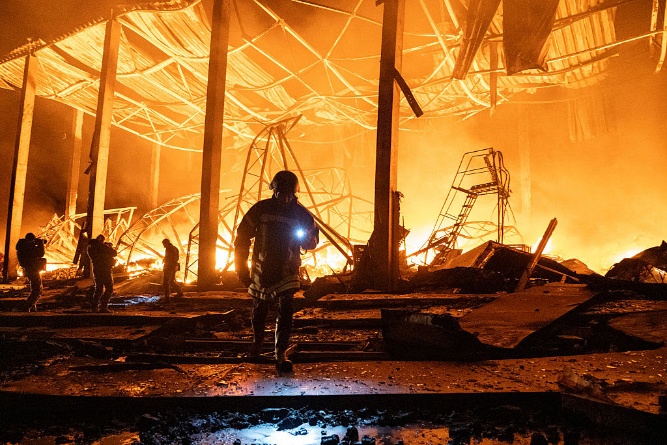
Firefighters work to extinguish a fire at a logistics center following a drone attack in Kyiv Oblast. Drones struck logistics infrastructure in the Bucha district, triggering a large fire. One person was injured in the attack. (Danylo Antoniuk/Ukrinform/NurPhoto via Getty Images)
The Day’s Reckoning
At the White House, the first lady spoke of a spark. “Let Oleshky be the modest spark that grows into a flame of lasting peace,” Melania Trump said, handing Ukrainian and Russian officials personal letters she had written for Zelensky and Putin. Beside her stood a Russian official under U.S. sanctions and a Kremlin envoy who called the war “the Ukrainian crisis.”
That is the plot of this Thursday: a ceremony in Washington and a count in Komyshuvakha. Three days after Russian bombs fell on a school where villagers collected food, rescuers had pulled out 43 bodies. One missing woman, Olha, 56, was found alive. A military medic who had run toward the wounded was found among the dead.
In Madrid, Zelensky said what the ceremony meant to him. “This operation has proven a very simple thing: when Putin wants the fighting to stop, it stops,” he said. “There was complete silence. No attacks. And we saved lives.”
Oleshky at the White House
You are Davyd Arakhamia, head of Zelensky’s party in parliament, standing in the White House next to Kirill Dmitriev, the Kremlin’s envoy. You are there to thank the woman who brokered a truce.
The first lady said she learned of Oleshky’s crisis in September and “acted immediately,” reviewing operational plans, road conditions, evacuation routes and medical resources. “Together, we can achieve something more enduring than a temporary ceasefire,” she said, thanking Russia’s human rights commissioner, Yana Lantratova, who has been under U.S. sanctions since 2022 and is accused of involvement in deporting Ukrainian children. “For a brief period, Oleshky residents enjoyed relief” from the war, she said. Lantratova did not speak. Dmitriev, speaking for Putin, gave the first lady a drawing by a girl whose family left Oleshky for Russia, inscribed “I love Melania,” honored a Russian deminer killed preparing the operation, and said 34 children had been reunited with their families in Ukraine and Russia, a figure that matches the total her office reported in August. Trump confirmed he met Dmitriev at the White House; he did not meet the Ukrainian delegation.
Arakhamia called the truce the biggest de-escalation since 2022, thanked her adviser Marc Beckman and the Americans who donated to evacuated families, and noted that many pets were rescued too. “We would like you to keep going and find new missions and de-escalate as much as possible,” he told her. “Your mission is above politics.” Ombudsman Dmytro Lubinets presented her with the Order of Princess Olga. Only Kyiv’s delegation called for more such operations; the Kremlin has ruled them out for now.
The picture from Oleshky was harder. Tetiana Hasanenko, head of the town’s administration in exile, said residents reported the aid was not reaching them, and those who got some received too little food to last a week. Many never learned of the evacuation because they were sheltering in basements without communications; people with limited mobility were not taken to the assembly point; some feared Russian “filtration”; and women waiting on the highway walked away before the buses came, thinking they had missed them. Those who left feared it could be “a one-way trip,” she said. “But they could not stay there at all, because death awaited them in either case.”
Inside Russia, the evacuation numbers became dangerous. Vladimir Romanov, a pro-war blogger whose “Romanov Lite” channel had reported that 17 buses went to Ukraine and four to Russia, has posted nothing since October 31, and Russian channels said he could face charges for “fake” reporting. ISW assessed the reported arrest as part of the Kremlin’s long-running effort to silence critical voices. Romanov’s figures roughly matched those of Newsmax reporter Alex Salvi. Meanwhile, Yaroslav Mantyar, commander of a Ukrainian drone unit near Oleshky, said Russia used the truce to bring in “a very large number of personnel,” ammunition and weapons, and a Russian blogger boasted that “our gangsters used the ceasefire.”
Komyshuvakha: Forty-Three
By Thursday, rescuers had recovered 43 bodies from the school and shelter in Komyshuvakha, Zelensky said, and 33 people were still missing. Most of the missing are expected to be dead. One, 56-year-old Olha, was found alive and well, regional police chief Artem Kysko said.
Among the dead was Oleksandr Zaryashchuk, 53, a military medic from Zhytomyr, who ran to help the wounded after the first bombs. His daughter Oleksandra Vaskivska said he stopped answering her messages; his body was identified in a morgue on Wednesday. “And then I saw a video where my father was in the shelter in the last minutes before the second strike. You could see him going down there with other people,” she said.
Council of Europe human rights commissioner Michael O’Flaherty condemned the attack. “Civilians must be protected, and the suffering caused by this war must never be normalised,” he said. The strike, which included a three-ton FAB-3000, is already among the deadliest single Russian attacks of the full-scale war.
The Water Goes Out Again
You live in Kyiv. On Wednesday, your water came back after a day and a half. On Thursday at 1:30 p.m., it stops again.
Kyivvodokanal said voltage swings at its facilities disrupted water in all districts. The metro line that crosses the Dnipro halted at noon and restarted at 1:05 p.m., running every nine minutes. “The problem is that the energy grid is not stable and is being repaired at the moment,” said energy expert Oleksandr Kharchenko. DTEK said Russia has struck power plants and transmission sites 78 times since about November 2, compared with 11 such strikes in all of 2022.
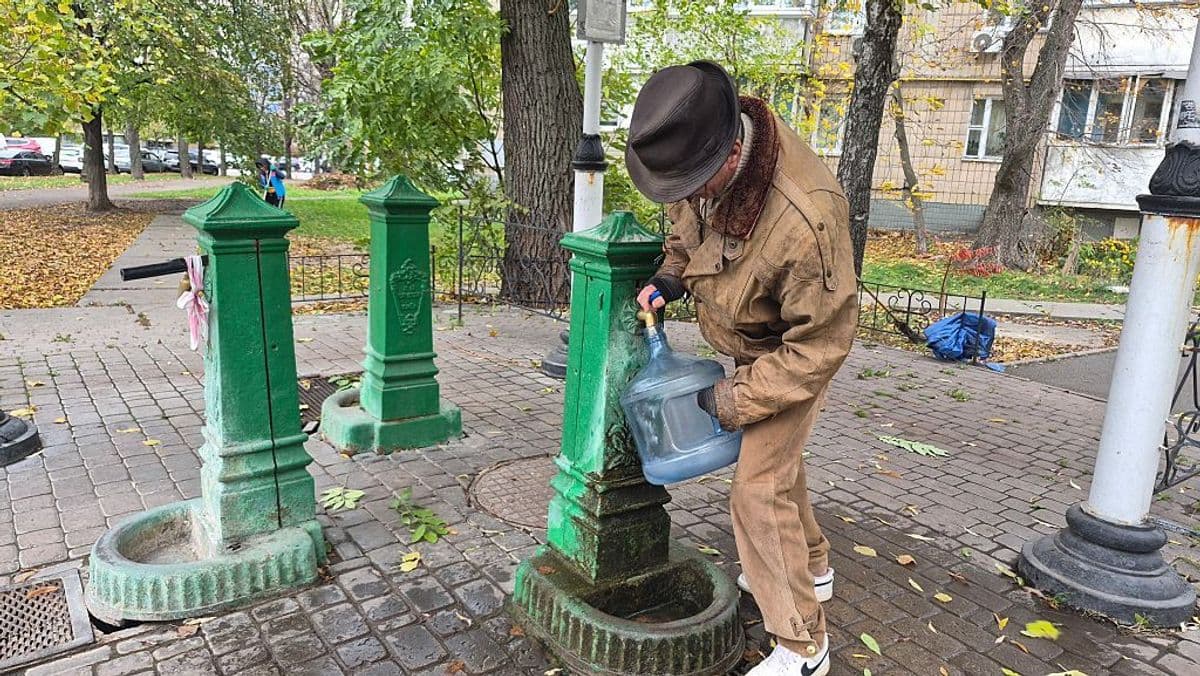
A man collects water from a public drinking fountain due to the lack of a centralized water supply in Kyiv, Ukraine. (BrightBird/Global Images Ukraine via Getty Images)
The city and state scrambled. Kyiv is building 13 backup heating plants by the end of 2026 and has finished 16 megawatts of dedicated power for its water and sewage system; heating reached almost 45 percent of homes, with full supply expected by November 12. The government sent 10 more generators to the water utility and 21 to 12 other communities. Last January, after a major attack, more than 1,670 Kyiv buildings lost heat as temperatures fell to minus 30 Celsius, and some residents are already leaving the capital. “People should not be left without water every time Russia attacks the energy system,” Prime Minister Serhii Koretskyi said. Interior Minister Ivan Vyhivskyi said mobile aid points with generators and heaters will open wherever more than 30,000 families lose power for more than a day.
Overnight, Russia fired two Kh-35 missiles from the Black Sea and 128 drones, 65 of them jet-powered; Ukraine downed 105. In the Kharkiv region, a drone hit a postal terminal in Pisochyn and then struck again while firefighters worked; they had taken cover. In Bezliudivka, a drone set a private warehouse ablaze. In the southern Odesa region, a strike destroyed part of a delivery warehouse and damaged a medical-products company, a college and a dormitory, without casualties. In the Dnipropetrovsk region, Russia attacked six districts 20 times overnight, wounding three people in Dnipro and hitting infrastructure in the Novooleksandrivka community and the city of Samara. Over the past day, Russian attacks killed nine people and wounded 19. In the Kherson region, where Russia shelled Kherson and 31 other settlements, one person was killed, the first civilian death there since the truce ended; 10 others had been hurt in the days before. Four died in the Donetsk region, Governor Vadym Filashkin said, and three in the Zaporizhzhia region. In the Sumy region, a strike collapsed a house in Putyvl, killing a 69-year-old woman and injuring two; mortar fire wounded two men in Seredyna-Buda. In the Kharkiv region, three people were hurt. Shelling wounded four women in Marhanets, and a man was hurt in a fire at a logistics site near Bucha. Ukraine’s General Staff said Russia launched 7,947 Molniya and Lancet attack drones at front-line areas in a week, and that 91 percent were stopped; Russia now fires more than 1,100 Molniyas a day.
Madrid, Taurus and a New Congress
At the Ibero-American summit, the first ever attended by Ukraine, Zelensky met Spanish Prime Minister Pedro Sanchez, who promised a €437 million military package. “This year, Russia has damaged more of our locomotives than in all the previous years of this war,” Zelensky told him, and offered condolences for the train crash in Spain that killed 69 people on October 28. “We need the diplomatic support of these countries,” he said of Latin America. “We will need the support of all continents, because it will also depend on how just a peace Ukraine receives.”
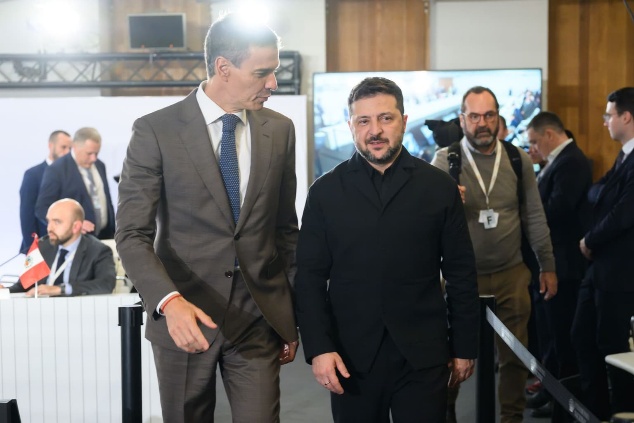
President Volodymyr Zelensky meets with Spanish Prime Minister Pedro Sanchez at the 30th Ibero-American Summit in Madrid, Spain. (The Presidential Office of Ukraine)
He spoke openly about Washington’s election. “Currently, we may have increased chances of receiving additional assistance from the United States,” he told TSN, saying Kyiv will press for $16 billion agreed under President Biden but never delivered. “If we don’t solve the Patriot problem, it will get very tough for us.” He said Democrats have spoken clearly about aid and about rebuilding ties with Europe. “Without this connection, without these relationships, it is very difficult to impose unity on Putin.” In an interview with Germany’s ZDF, he renewed his request for Taurus cruise missiles to hit the launch sites Russia uses against Ukraine: “They have built entire launch sites and are killing us, while we have no way to defend ourselves.” Combat in Ukraine, he argued, made Germany’s IRIS-T “the world’s number one system after the Patriot.” On security guarantees discussed in Brussels with the EU, NATO and the U.S., he said: “It’s crucial that everything is clearly defined in writing,” recalling the 1994 Budapest Memorandum, under which Ukraine gave up its nuclear weapons for assurances Russia later broke. Kyiv first asked for Taurus in 2023; Berlin has refused, and Defense Minister Boris Pistorius said in July that Ukraine’s own drones can already strike deep.
“We are needed by the United States, because our security is inextricably linked” to America’s, Foreign Minister Andrii Sybiha said in Bucharest. He said Ukraine’s Abu Dhabi delegation will focus on security, confidence-building measures and a possible agenda for a Zelensky-Putin meeting. “We see no signs of Russia’s willingness to engage in serious negotiations, neither on the ground nor on the battlefield,” he said. Italian Prime Minister Giorgia Meloni urged the EU to name a dedicated envoy for the talks, warning that competing initiatives risk “condemning Europe to irrelevance,” and asked that it be raised at an informal EU summit in Dublin on November 13.
In Lviv, Slovak Prime Minister Robert Fico, long a critic of military aid, signed a cooperation declaration with Koretskyi, pledging three electric locomotives, €500,000 for 54 generators, €300,000 for shelters and €200,000 for hospital equipment, plus bilingual schools in both countries and more than €100 million in energy projects under the EU’s SAFE and investment frameworks. Fico said Slovakia was ready to host technical talks but “too small a player,” and his government plans to resume economic talks with Russia on November 25. The EU disbursed another €4.36 billion from its Ukraine Support Loan, €3.7 billion of it tied to IMF reforms. Ukraine still faces a €70 billion gap for 2027; Norway has pledged $9 billion, Britain about $13 billion and Canada €500 million.
The Line
You are a Ukrainian soldier south of Orikhiv. This week your unit cleared most of Mala Tokmachka of Russian troops.
Military observer Kostyantyn Mashovets reported the gain and said Ukrainian forces firmly hold Novoandriivka and Novopavlivka west of Orikhiv, even as Russian infiltrators slipped into Lukyanivske and near Mali Shcherbaky; units of Chechnya’s Akhmat regiments may now be fighting in the Orikhiv direction. A Russian blogger admitted Ukrainian forces still hold positions south of Yunakivka, north of Sumy. Across the front, Russia attacked about 184 times on Thursday, below its weekly average of 206, and only 10 times toward Kostiantynivka and Druzhkivka after two days of heavy assaults. Russian bloggers claimed limited attacks near Kupyansk without confirmed gains, and Ukrainian forces counterattacked near Lyman, Borova and east of Kramatorsk; Russian bloggers claimed small gains near Novohryshyne, southwest of Dobropillia, and said Russian strikes damaged a bridge over the Kazennyi Torets in Kramatorsk. Russia has also hit Izium at least seven times in a week, including the largest strike on the city of the war, to choke the logistics hub behind Borova and Lyman; local officials say the heavy strikes began in late June.
Ukraine kept up its long-range campaign. Imagery showed drone wreckage on a Sheremetyevo runway from Ukraine’s October 23 strike on Moscow. Footage showed smoke over the Ryazan refinery, about 461 kilometers from the border, and fires at a Wildberries warehouse and an OpenYard server factory in Ryazan. The General Staff said Ukrainian forces hit a drone storage and launch site in occupied Crimea’s Hvardiiske district, about 198 kilometers from the front, and occupation head Sergei Aksyonov said Ukrainian strikes caused repeated outages across the peninsula for a third day. Neither side reported fighting toward Novopavlivka or Oleksandrivka. Ukrainian military intelligence said strikes have knocked 15 of Russia’s 38 major refineries offline and cut production at 12 more, reducing output at the affected plants by 55 percent and causing more than $23.2 billion in damage. The Financial Times reported that two tankers sailing for the U.S. under the Trump-Putin diesel deal turned away, one toward Brazil and one into the Mediterranean; two others are still heading for the U.S. coast without confirmed buyers. Ukrainian intelligence said refineries far from the front, such as Omsk and Achinsk, are working harder to make up the shortfall but cannot fully cover it. In Russia, a blogger said the 6th Motorized Rifle Brigade is becoming a division, and the Saratov region cut its payment to families of fallen soldiers tenfold, the fifth region since autumn to cut or cancel such payments after Belgorod, Smolensk, Stavropol and Samara. Russia’s regions together ran a deficit above 134 billion rubles by September, and St. Petersburg, Krasnoyarsk, Irkutsk and Khanty-Mansi are cutting social spending and preparing public-sector layoffs.
Also Today
A scam network and its protectors. Anti-corruption investigators charged five people, including senior SBU and police officials, in a case over protection of scam call centers, drug trafficking and torture-for-hire, and said a senior SBU official threatened to use a firearm during searches; a deputy head of the police strategic investigations department was jailed with bail of 15 million hryvnias. Separately, the anti-corruption court ordered the acting prosecutor general to open a case into alleged vote-buying involving Arakhamia, who said he “hadn’t had time to look into the matter.”
Spies on both sides. Poland detained six people suspected of supplying Russia with materials for weapons and ammunition. A Canadian military intelligence officer charged with passing information to Ukraine faces a court-martial on December 9; Canadian media reported he met a Ukrainian representative in Lithuania in 2024.
Death in detention. Oleksandra Kazarovytska, 44, a Kharkiv language-school director detained in occupied Crimea over messages with a volunteer, died in Russian custody; occupation authorities called it suicide. Ukraine estimates Russia holds about 16,000 Ukrainian civilians, many in two FSB-controlled detention centers in Crimea, where Russia plans another 1,500-place jail by 2030.
A partner in Baku. Energy Minister Denys Shmyhal hosted Azerbaijan’s energy minister in Uzhhorod to discuss joint production and gas routes.
Iran’s helicopters. The Financial Times reported that Iran bought at least six Russian Mi-28 helicopters and 90 missile launchers in 2023 and 2024.
Borshchahivka probe widens. Police and the SBU said they identified 130 people in the November 2 clash near Kyiv, 27 of them active participants, and a third suspect, Viktor Yena, was remanded in custody; a 22-year-old woman who urged the crowd to overturn a National Guard bus was charged.
A pro-Russian Latvian at the front. Sergei Mulivanov, a Latvian activist who moved to Russia to support its war, was sent to the front after signing a contract in pretrial detention, The Insider reported.
Banks recover. Ukraine’s bad-loan ratio held at 11.5 percent, its lowest in 17 years.
The Closing
Tonight, a girl’s drawing is in the White House, and 33 families in Komyshuvakha are still waiting for news. In Kyiv, the taps ran dry twice in three days. The ceremony in Washington proved a point Zelensky made in Madrid: Russia can stop shooting when it chooses. Ukraine asks the world to remember that it chooses not to.
A Prayer for Ukraine
1. For Those Who Defend
Lord of hosts, strengthen the soldiers who cleared Mala Tokmachka and hold the line at Orikhiv, Lyman, Borova and Kramatorsk. Guard the drone crews who stop thousands of enemy drones each week, and those who strike the factories of war far beyond the border. Give them rest and courage, and bring them home safely to those who wait and pray.
2. For the Wounded and the Grieving
God of all comfort, receive the forty-three of Komyshuvakha, and the medic Oleksandr, who ran toward the wounded and went down into the shelter with them. Comfort his daughter and every family still waiting by the ruins. Thank You for Olha, found alive. Receive the woman of Putyvl and the dead of Kherson, Donetsk and Zaporizhzhia regions, and heal the wounded.
3. For Those Who Lead
King of kings, give President Zelensky wisdom in Madrid and every capital where he pleads for his people. Let the new Congress hear Ukraine’s cry, and let leaders in Europe speak with one voice, bravely and soon. Grant honesty and courage to every table where peace is discussed, and let no ceremony ever hide the truth of what Ukraine endures.
4. For Oleshky and the Captives
Faithful God, look on those still in Oleshky who never heard the buses were coming, the sick who could not reach them, and the women who walked away too soon. Let aid reach them truly, and let help not stop. Remember the sixteen thousand civilians held in Russian prisons, and Oleksandra, who died alone. Bring the captives home, and comfort their families.
5. For a People Who Keep Standing
Father, Ukraine fills its buckets, repairs its lines and keeps faith. Sustain the water and power crews, the doctors, the mothers and the elderly through another cold night, and let warmth reach every home. In Your mercy, in Your justice, in Your time — bring this war to its end, and let the ending be worthy of what Ukraine has endured.