
The Ukraine Daily Briefing · Tuesday, November 17, 2026 · Day 1,728 of the Full-Scale War
Prepared by Diana Bozhyk
The Day’s Reckoning
Ukraine explained on Tuesday how it brought down part of the Crimean Bridge, and the explanation caused a public split among its allies. President Volodymyr Zelensky said the strike was the last of seven phases planned over several weeks, and Russian military bloggers questioned whether Moscow can protect the crossing at all. At the Ramstein meeting in Brussels, a senior Pentagon official said Ukraine’s deep strikes are not helping to end the war, and Germany and Britain rejected that view while announcing new air defense money. Russia’s overnight barrage of ballistic missiles and 306 drones closed both of Kyiv’s Dnipro bridges, left 700,000 households in Dnipropetrovsk Oblast without power and killed at least 14 people across Ukraine; drones also strayed into Moldova and near Hungary’s rail link. The latest front-line reporting showed Ukrainian gains near Sumy, Kharkiv and Orikhiv as Russian armor struggled on open ground. Kyiv prepared for talks in Berlin and a prisoner exchange, and offered new humanitarian corridors.
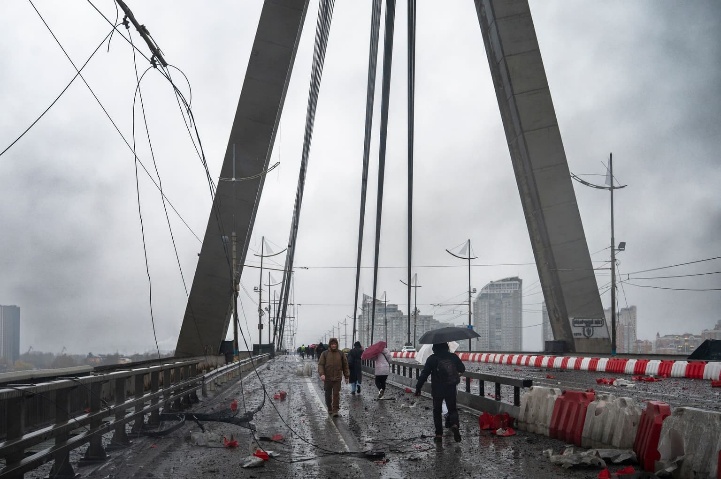
Kyiv’s Northern Bridge over the Dnipro River was struck in a Russian missile attack in Kyiv, Ukraine. (Christopher Occhicone / The Kyiv Independent)
Seven Phases to the Arch
“Our forces systematically destroyed air defense systems, radars, electronic warfare assets, and other designated targets along the path to the final objective,” Zelensky wrote on Tuesday, describing the operation against the Kerch Strait Bridge as the “seventh phase of an operation that has been underway for several weeks.” In the final stage, he said, Palianytsia drones struck the road section, Neptune missiles and Ruta and FP-5 drones hit the railway section, and the Flamingo missile struck with “the communication link functioning perfectly right up to the final seconds.”
The Security Service (SBU) confirmed that “one of the metal arches and the automobile span under it were completely destroyed.” “For years, the Russians have convinced the whole world that the Crimean Bridge is one of the most protected objects on the planet,” it said. “Today, parts of it lie on the seabed.” Defense Minister Yevhen Khmara called it a reply to Russia’s campaign against Ukrainian crossings in Zaporizhzhia, Dnipro, Kyiv and Odesa Oblast: “Today, we responded in kind.” The Navy’s spokesman, Dmytro Pletenchuk, said strikes in Crimea and the Black Sea are possible largely because Ukraine has spent months hunting Russian air defenses on the peninsula.
Kremlin spokesman Dmitry Peskov said there was “no doubt that the bridge will be restored,” and that it “will be even better than before.” Russian investigators opened a terrorism case. Ukrainian aviation expert Andrii Kharuk doubted a quick repair: the fallen section weighs around 6,000 tonnes and was assembled on shore over months, he said, so restoring it could take “a year or even longer.” Former Air Force officer Anatolii Khrapchynskyi said the occupying forces are “losing full operational connectivity with Crimea,” since the ferry was already out of service and the rail span will need load limits and long inspections. Cars are crossing by ferry, and rail operator Grand Service Express said trains were running again over the damaged rail bridge with delays of up to eight hours. Widespread power outages were reported across Crimea, though it was unclear whether they were linked to the strike.
The reaction among Russia’s pro-war commentators was bleak. “The Crimean Bridge is suspending operations until the end of the war,” wrote the blogger Art Jockey, who urged residents to consider leaving the peninsula by the R-280 highway through occupied Ukraine. “The bridge was struck every four to five minutes. The timing was simply unbelievable,” wrote another, Alexey Vasilyev, who speculated that Ukraine had found a way around the Starshield limits. Presidential adviser Serhii Beskrestnov noted the “coincidence” that Starshield had been restricted on the eve of the strike. “The entire Russian technical community is wondering how we managed to establish a stable connection in Crimea,” he wrote. “Let that remain our little secret.” Several bloggers demanded retaliatory strikes on Ukraine’s political leadership, ISW reported. War correspondent Andrey Filatov blamed the army: “Almost five years in, the ground forces… have been unable to destroy the enemy’s armed forces or reach the borders of Donbas.”
Russia’s Defense Ministry claimed it downed 1,441 Ukrainian drones overnight into Tuesday, which would be the largest attack yet. Monitoring channels reported fires at the Gazprom Neftekhim Salavat refinery and petrochemical complex in Bashkortostan, about 1,750 kilometers from Ukraine, which processes up to 10 million tonnes a year; Ukraine has not confirmed the strike. In its latest assessment, the Institute for the Study of War (ISW), a Washington think tank, noted Russia’s earlier claim of 2,049 drones and four Flamingo missiles downed in a single night, and wrote that the bridge strike “showcases Russia’s inability to defend strategic objects.”
Ramstein Splits
“While the public conversation focuses on the spectacle of deep strikes designed to inflict pain on the Russian population, our assessment is that such strikes have not been effective in driving an end to the war,” US Undersecretary of Defense for Policy Elbridge Colby told the Ukraine Defense Contact Group at NATO headquarters on Tuesday. Strikes on commercial targets such as warehouses of the retailer Wildberries, he said, have “probably hardened the Russian public’s resolve and the Kremlin’s own willingness to escalate.” Western aid, he argued, should prioritize front-line defense and medium-range strikes on Russian logistics, though “this is not to say that Ukraine should be forced to fight with its hands tied behind its back.”
German Defense Minister Boris Pistorius called the criticism “quite a stupid thing.” “Instead of criticizing that, we should rather criticize and talk about the terroristic strikes every night and every day on… energy, water, and heating infrastructure in Ukraine,” he said. British Defense Secretary Wes Streeting, who co-chaired the meeting, said the strikes had weakened Russia’s military, bought time and saved lives. Putin “uses winter as a weapon,” he said.
The money followed. Britain announced a £240 million air defense package with more than 1,000 short-range missiles, built by Thales in Belfast and due from mid-December, plus launchers and more than a dozen radars, part of a £500 million winter air defense effort. Germany and Norway each pledged $300 million to PURL, the NATO mechanism that buys American weapons for Ukraine, and Sweden gave 720 million kronor, including money for PURL and the Czech ammunition initiative. Britain, Sweden and Ukraine signed a letter of intent on supplying Swedish Gripen fighters. The United States no longer funds new weapons for Ukraine directly, and Patriot interceptors, the only reliable defense against ballistic missiles, are in short supply worldwide.
Zelensky, speaking online, proposed a swap rather than a donation: allies would hand over interceptor missiles now and receive “newer and better” missiles that Kyiv has on order. “This is not a donation. It’s an exchange,” he said. He asked for 40 more F-16s, since many current jets “spend a lot of time in maintenance rather than flying,” and for Mirage jets: “Mirage aircraft can be put into operation right now. Europe can help us with this. Please, make this decision.”
Both Bridges Closed
During the morning rush hour, metro stations in Kyiv were packed and long traffic jams formed as both crossings over the Dnipro stayed shut after the night’s ballistic missile strikes. Zelensky said four ballistic missiles had targeted the Southern Bridge and three the Northern Bridge. By 4 p.m., Mayor Vitali Klitschko partially reopened the Southern Bridge for lighter vehicles heading from the east bank toward the center; traffic from the west stayed closed while engineers calculated the load the damaged structures can bear. The State Emergency Service said two people were killed in the Obolonskyi district.
The Air Force said Russia fired Iskander-M, Zircon and S-400 ballistic missiles, Iskander-K and Kh-59/Kh-69 cruise and guided missiles, and 306 long-range drones, 92 of them jet-powered, plus Gerbera, Dan-T and Parodiya drones. Authorities counted at least 14 people killed and 78 injured. In Zaporizhzhia, strikes on industrial sites killed two people and injured 31. In Chernihiv Oblast, a strike on a house killed three people. In Mykolaiv, attacks on port and industrial facilities killed two, and 76 settlements in Pervomaisk district lost power. In Dnipropetrovsk Oblast, nearly 20 attacks killed two and injured 20, and DTEK said 700,000 households were without electricity. Donetsk Oblast reported one dead and nine injured, Kherson Oblast one dead as Russia shelled Kherson and 33 settlements, Sumy Oblast one injured in 40 attacks, Kharkiv Oblast 14 injured, and Cherkasy Oblast six injured and an education facility damaged. A blackout spread across 300 settlements in Rivne Oblast, and energy sites were hit in Chernivtsi and Odesa oblasts, where a warehouse was also damaged and two towns lost power.
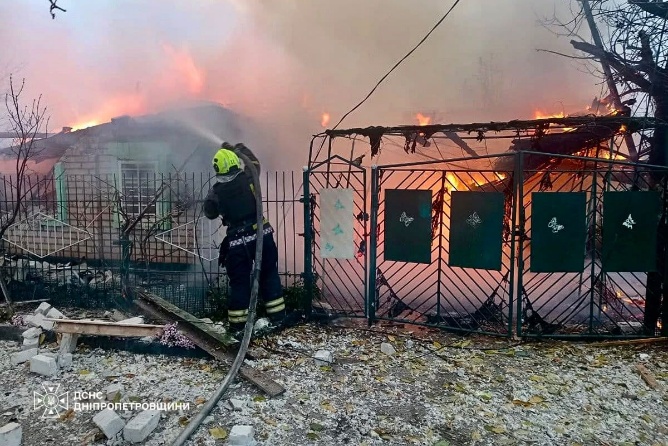
Emergency workers at the scene of a Russian attack on Dnipropetrovsk Oblast, Ukraine, overnight. (DSNS/Telegram)
In Kirovohrad Oblast, the fire at the food maker Korolivskyi Smak burned through the night after Monday’s strike. “Over the course of the night, the fire grew to a scale that resulted in the destruction of products, production capacity, and the production premises,” the company’s spokesman, Hennadiy Tertychniy, wrote. One employee was killed, and the company, which shipped sunflower oil, pasta and sauces to more than 85 countries, said it must halt production completely. Military intelligence had warned on November 7 that Russia would target Ukraine’s food industry.
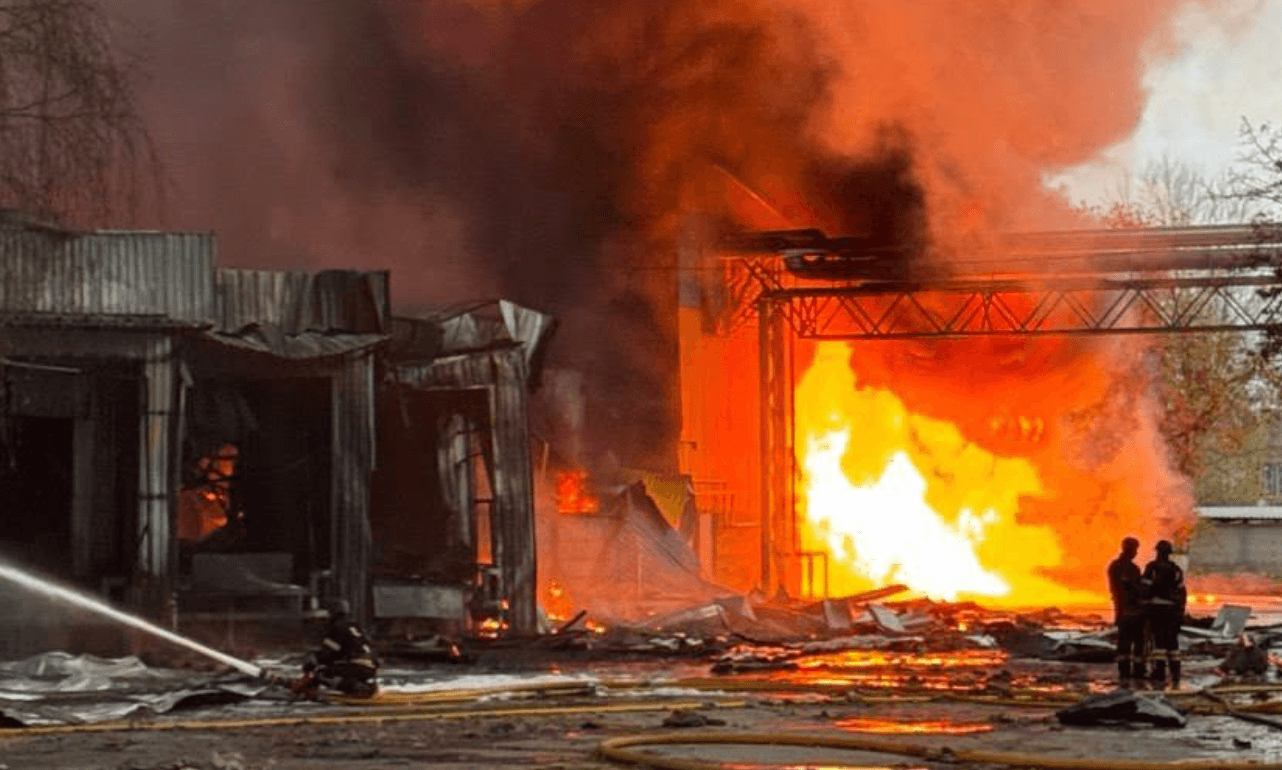
Firefighters tackle a blaze at the Korolivskyi Smak enterprise following a Russian strike in Kirovohrad Oblast, Ukraine. (Hennadiy Tertychniy / Facebook)
The attack spilled across borders. Seven drones entered Moldovan airspace; one Shahed was seen over Chișinău, and five crashed in villages, one about 11 kilometers from the capital. “We still do not have the necessary defense capabilities to protect ourselves from drones,” President Maia Sandu said. In Zakarpattia, a drone fell about 300 meters from Mukachevo station as a train from Hungary arrived, and Prime Minister Péter Magyar halted rail traffic with Ukraine for two days.
The Line
The Russian armor has to stop 10 kilometers short. A Ukrainian brigade commander in the Hulyaipole direction said on Monday that flat, open ground and local Ukrainian drone superiority force Russian vehicles to drop their infantry 10 kilometers or more from the front, which leaves soldiers to walk the rest of the way under drones. ISW noted that Russia usually tries more mechanized assaults in autumn and winter, when weather helps vehicles and bare trees offer infantry little cover.
ISW’s latest assessment, covering November 15 and 16, recorded Ukrainian advances in three areas. A Russian blogger acknowledged that Ukrainian forces fully control Yunakivka, northeast of Sumy; another published a map showing Ukrainian gains in northwestern Vilcha, northeast of Kharkiv; and a Ukrainian military observer said Ukrainian forces hold Novoandriivka, west of Orikhiv, even as Ukrainian strikes in Orikhiv itself pointed to a Russian infiltration. By ISW’s count, Russian forces gained about 140 square kilometers in October but lost about 167, the second straight month of net losses. Ukrainian troops counterattacked southeast of Lyman, west of Kostyantynivka across the Kazennyi Torets River, south of Dobropillia and southeast of Novopavlivka. The General Staff said the most intense fighting from roughly November 9 to 16 took place in and around Kostyantynivka.
Russian claims went largely unconfirmed. Bloggers said Russian forces had crossed the Oskil River south of Kupyansk and were advancing north of Velykyi Burluk, but ISW saw no evidence of either. A source close to Russia’s Western Group of Forces said the pace of Russian attacks near Lyman has slowed, and Russian drones are targeting Ukrainian vehicles, ground robots and control stations in Raihorodok to cut supply lines between Lyman and Slovyansk. An open-source analyst found that footage purporting to show Russian troops striking Ukrainian soldiers inside Druzhkivka had been altered with AI; ISW said Russia regularly circulates such footage to suggest sweeping advances. Near Vozdvyzhivka, northwest of Hulyaipole, Ukrainian forces struck another infiltrated position, and Russian forces kept up attacks in the Oleksandrivka and Borova directions without gains.
Behind the line, Russia kept hitting the crossings that supply it. Geolocated footage showed a strike on the Preobrazhenskyi Bridge in Zaporizhzhia on Monday; ISW assessed that the campaign aims to disrupt Ukrainian logistics toward Orikhiv and southern Donetsk Oblast. Ukrainian officials told ISW that the Starshield speed cap over occupied territory had entered a seventh straight day; chargé d’affaires Denys Sienik said SpaceX has given no explanation beyond calling it a technical issue.
Toward Berlin
“We identified the framework for our joint work with partners on key issues related to ending this war, guaranteeing Ukraine’s security and lasting peace,” Zelensky said after meeting Ukraine’s negotiators and security chiefs. US envoys, Ukrainian officials and European allies will meet in Berlin this week, likely on November 19, when Chancellor Friedrich Merz hosts the Coalition of the Willing. Kyiv is preparing the prisoner exchange agreed in Abu Dhabi. “We are already communicating through intelligence channels. Ukraine is ready to deliver results in the coming weeks,” Zelensky said, adding that the timing depends on Moscow and on the American team’s contacts with it. He also said Ukraine had proposed humanitarian operations like the Oleshky evacuation for 10 more occupied settlements in southern Kherson and Zaporizhzhia oblasts.
Speaking in the Philippines, President Donald Trump said he would meet Vladimir Putin separately in China “if it’s available.” Foreign Minister Andrii Sybiha warned that a Russia–China–US summit “would do only the opposite” of ending the war: “encourage Putin to continue this war.”
Ukraine’s Foreign Ministry protested a plan by International Atomic Energy Agency chief Rafael Grossi to appoint Alexey Ferapontov, deputy head of Russia’s nuclear regulator, Rostekhnadzor, as a deputy director general. Kyiv sanctioned Ferapontov in 2023 for helping legitimize Russia’s seizure of the Zaporizhzhia nuclear plant; the appointment, it said, would amount to “blatant acquiescence” to the occupation. Greenpeace also urged Grossi, a candidate for UN Secretary-General, to drop the plan.
Also Today
An-12 crash in Siberia. A Russian An-12 military transport flying from Novosibirsk to Kansk crashed near Yagunovo in Kemerovo Oblast, killing all 17 people on board; the cause was not disclosed.
Lithuania holds the line on Belarus. Foreign Minister Kęstutis Budrys said Vilnius will not ease pressure on Minsk despite a US push to reopen Lithuanian ports to Belarusian potash, calling Belarus “absolutely complicit,” and said Lithuania is tightening checks on grain transiting Klaipėda so that it is “not stolen from the occupied territories of Ukraine.”
Sport and propaganda. EU Sports Commissioner Glenn Micallef said sports bodies that spread Russian propaganda will lose eligibility for Erasmus+ funding, and an EU official said a Commission proposal on visa restrictions for Russian athletes is days away. The International Ice Hockey Federation said its website was hit by a cyberattack that posted a pro-Russian message; Russia’s federation denied involvement.
Prague train collision. Fifteen Ukrainians were among 46 people injured when two passenger trains collided near Prague’s main station.
Sikorski’s reply. Polish Foreign Minister Radosław Sikorski marked the bridge strike with a post on X referencing last year’s Oval Office confrontation between Zelensky and Trump.
The Closing
In Kyiv, engineers spent the afternoon calculating how much weight the Southern Bridge could still carry before letting the first lighter cars across from the east bank. Across the Kerch Strait, cars left Crimea by ferry, and trains crossed the damaged rail span up to eight hours late.
A Prayer for Ukraine
1. For Those Who Defend
Lord, keep watch over the soldiers on the open fields near Hulyaipole, and over those who hold Yunakivka, Vilcha and Novoandriivka. Bless the crews who planned for weeks and struck at the right moment, and the pilots whose aircraft wait in hangars for parts. Give the defenders strength for the cold months, healing for the wounded, and a swift homecoming for every prisoner of war.
2. For the Wounded and the Grieving
Merciful God, receive the two killed in Obolon, the three in their home in Chernihiv Oblast, the dead of Mykolaiv, Zaporizhzhia and Dnipropetrovsk, and the worker who died as the factory burned. Heal the seventy-eight wounded across the land, and comfort the families who wait outside hospital doors tonight. Hold the injured travelers in Prague and every Ukrainian far from home.
3. For Those Who Lead and Negotiate
Lord of wisdom, guide those who will meet in Berlin, and give Ukraine’s allies one mind when they argue about how this war must be fought. Let truth guide those who speak in distant capitals, and let no seat at any summit be used to trade away a free people. Grant patience to those who arrange the exchange of prisoners and courage to those who sign.
4. For Bridges, Grids and Bread
God of light, hold up the bridges of Kyiv and Zaporizhzhia, and the people who cross them to work and to school. Return power to the 700,000 homes of Dnipropetrovsk and the villages of Pervomaisk and Rivne. Protect the farms, factories and warehouses that feed the nation, and sustain the workers who lost their jobs when the fire took their factory.
5. For a People Who Keep Standing
Faithful Lord, on the one thousand seven hundred twenty-eighth day, sustain a people who find another route when the bridge is closed and keep moving. Strengthen neighbors in Moldova and Hungary who feel the war at their borders, and keep hope alive in occupied towns that wait for rescue. Let Ukraine see the day when every crossing is open and safe.
In Your mercy, in Your justice, in Your time — bring this war to its end, and let the ending be worthy of what Ukraine has endured.