
As Russia closed 2025 advancing through drone warfare and infiltration tactics, Ukraine answered by burning oil refineries deep inside Russia and destroying Shahed launch infrastructure before the drones could fly.
The Day’s Reckoning
Morning broke over Pokrovsk with Russian troops holding just over two-thirds of the city, their positions stitched together block by block through months of pressure. At the same time—far from the rubble—Ukrainian drone operators guided their aircraft 124 kilometers into occupied territory, lighting an oil depot in Rovenky on fire. Two realities moved in parallel: territory taken at the front, infrastructure burning far behind it.
The numbers told the story with brutal clarity. Over twelve months, Russian forces pushed forward an average of 13.24 square kilometers per day, accelerating beyond last year’s pace. The cost was staggering—more than 416,000 casualties for gains amounting to less than one percent of Ukraine’s land. Advances came, but they arrived soaked in blood and constrained by logistics, weather, and resistance that never fully broke.
Technology reshaped how the fighting unfolded. Russian fiber-optic drones stretched their reach from a few kilometers to fifty and beyond, bypassing electronic warfare and tightening pressure on Ukrainian supply lines. Ukraine answered not by retreating, but by widening the battlefield—striking power substations, ammunition depots, and the operators who made Russia’s drone advantage possible. The war’s geometry expanded outward, deeper, and higher into the air.
Elsewhere, contradictions defined the day. A one-day ceasefire held around the Zaporizhzhia Nuclear Power Plant so engineers could restore power. In the Baltic, a cargo ship sat detained for tearing at undersea cables. In Europe, new money flowed toward American weapons for Ukraine. And in Moscow, unity was proclaimed even as the war demanded ever greater sacrifice.
Day 1,403 closed without resolution. Russia moved forward. Ukraine struck back. The war ended the year not with answers, but with sharper tools, higher costs, and no clear edge for either side.
Seventy-Eight Bodies per Kilometer: The Price Russia Paid for 2025
The accountants of war finished their work quietly. When the Institute for the Study of War totaled 2025, the figures did not look like victory. They looked like arithmetic.
Russia took ground—4,831 square kilometers inside Ukraine, plus another 473 reclaimed in Kursk Oblast. On a map, the gains appeared steady, even impressive. On a ledger, they were devastating. Ukrainian General Staff figures put the cost at 416,570 Russian casualties. Seventy-eight bodies for every square kilometer seized.
The tempo quickened, but never stabilized. Russian forces advanced faster than in 2024, averaging 13.24 square kilometers a day instead of 9.87. November spiked to nearly 21 square kilometers daily, then collapsed into December’s slower grind. Surge. Pause. Regroup. Surge again. It was rhythm, not momentum—an army lunging forward, stopping to breathe, then bleeding its way onward once more.
Despite new drones, infiltration tactics, and technological fixes, the battlefield refused to open. Maneuver warfare never arrived. Tanks did not break through into open country. Infantry still walked forward, meter by meter, and kept dying there. The advances remained measured in footsteps.
And the gains stayed small. The land Russia seized inside Ukraine amounted to just 0.8 percent of the country. The Kremlin’s declared goals—taking all of Donetsk and Luhansk, establishing buffer zones—remained unmet. Pokrovsk was still partly Ukrainian. Slovyansk lay fifteen kilometers beyond Russian reach. The Fortress Belt did not fall.
Ukrainian defenders exacted costs that would have shattered older armies. Russia endured anyway, feeding the front with mobilized men, North Korean reinforcements, and factory output that replaced bodies faster than Ukraine could exhaust them.
That was 2025 in numbers. No collapse. No breakthrough. Just land changing hands one expensive meter at a time.
The Glass Thread That Changed the Front
The drone doesn’t buzz. It doesn’t blink on a screen. It glides forward trailing a hair-thin strand of glass, unspooling quietly as it slips fifty, then sixty kilometers beyond the front. There is nothing to jam. Nothing to blind. Ukrainian electronic warfare listens—and hears nothing.
This is how Russia moved faster in 2025.
The shift began in early spring. Russian operators started cutting Ukrainian supply routes not with artillery, but with drones that stayed tethered by fiber-optic cable. By April, the Rubikon Center—Russia’s elite unmanned warfare unit—spread its crews along the line, turning roads, forest paths, and rear staging areas into killing zones.
The reach grew month by month. Seven kilometers became twenty. By late year, fifty to sixty. Commander-in-Chief Oleksandr Syrskyi would later say bluntly that this concentration of extended-range fiber-optic drones helped Russia take Siversk. The math wasn’t subtle: deeper reach meant tighter pressure, fewer safe routes, slower Ukrainian movement.
The technology broke old limits. In places like the Serebryanske forest, radio-controlled drones once failed under dense cover. Fiber-optic drones did not. They slipped through trees and ravines where Ukrainian logistics once hid, making electronic warfare suddenly irrelevant. The glass cable carried commands immune to interference.
Then came the “motherships”—larger drones ferrying FPV units forward before releasing them into the near-rear. Layered interdiction followed. Ukrainian trucks had to move farther back. Supply lines stretched and thinned.
By fall, the pattern hardened: prolonged interdiction, infiltration under cover of bad weather, small-group assaults. Fog and snow grounded Ukrainian drones. Russian units moved when the sky worked for them.
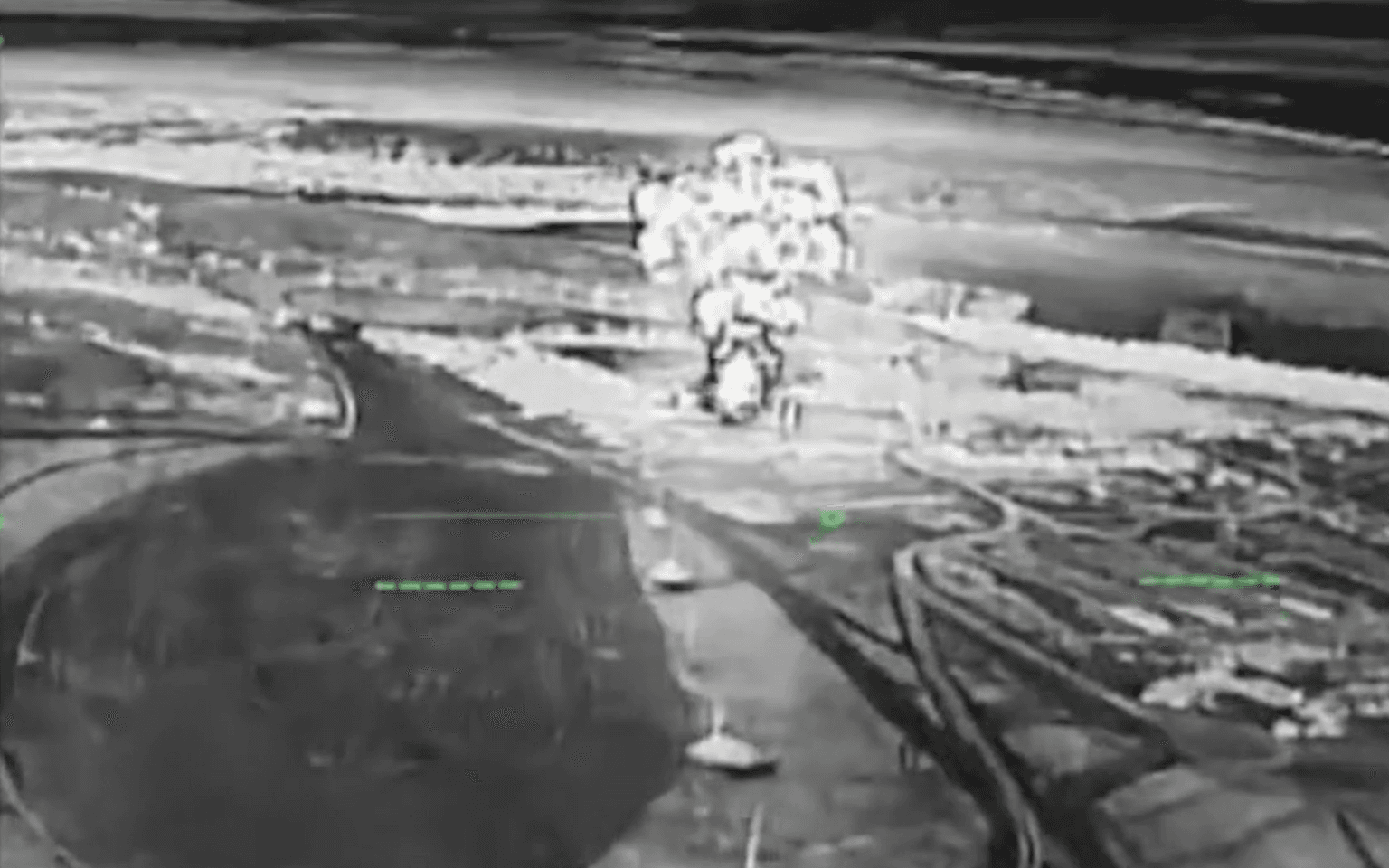
The moment before impact: Ukrainian drones converge on a Russian ammunition warehouse that will never launch another strike against Ukrainian homes. (Screenshot/Special Operations Forces/Telegram)
But the edge was never permanent. Ukrainian strikes began hunting Rubikon operators themselves. On December 31, drones slammed into Shahed launch sites at Donetsk airport—cutting the system at its nodes.
The fiber changed the war. It also created targets. Every cable led back to someone holding the other end.
Flags Without Breakthroughs: How Russia Slipped Forward Instead of Charging
The assaults no longer came as waves.
By early summer, Ukrainian defenders noticed the change. Fewer massed infantry charges. Fewer bodies rushing headlong into prepared fire. Instead, small Russian groups appeared where they weren’t expected—at tree lines, along drainage ditches, behind thinly held positions. Sometimes they raised a flag. Sometimes they waited.
This was Russia’s tactical turn in 2025.
Rather than forcing breakthroughs, infiltration teams searched for seams. A squad would slip through, occupy ground, and hold on long enough for reinforcements that often never arrived. In some cases, flags went up in places Russian forces couldn’t actually control, producing footage that suggested advances larger than reality on the ground.
The method worked when Ukrainian lines were stretched thin or when fog, rain, or snow blinded reconnaissance. It collapsed when those infiltrations were spotted early. In August, Russian sabotage groups reached toward Dobropillya—only to stall. Command couldn’t reinforce the penetration. Ukrainian counterattacks followed, reclaiming roughly seventy square kilometers.
Terrain decided everything. Open fields and scattered villages near Velyka Novosilka and Hulyaipole favored infiltration, especially once Russian forces stopped attacking from the south and instead slipped in from the northeast and east, bypassing Ukraine’s south-facing defenses. The shift exposed gaps—but only locally.
Where defenses were built deep, the tactic failed. Around Pokrovsk and Myrnohrad, eighteen months of fortification turned infiltration into a dead end. Russian units could slip in, but they couldn’t move through.
By winter, the adaptations sharpened. Snow suits masked bodies. “Sleeper” FPV drones waited along supply routes, dormant until targets appeared. Ukrainian forces answered with thermal imaging, pattern analysis, and rapid counterstrikes that killed infiltrations before they hardened.
Russia learned. Ukraine learned faster.
The attacks looked different by year’s end. The cost did not. Ground still changed hands slowly, painfully, and at a price no tactic could make cheap.
Hitting the Rear Instead of the Front: Ukraine Takes the War Deep
The strikes didn’t land at the trenches. They landed where Russia thought it was safe.
Late in December, Ukrainian drones began reaching twenty, fifty, even a hundred kilometers behind the front—quietly rewriting the geometry of the war. According to Unmanned Systems Forces commander Major Robert “Magyar” Brovdi, Ukrainian operators were no longer just defending against Russian battlefield air interdiction. They were running one of their own.
The targets formed a pattern. An oil depot in occupied Rovenky, 124 kilometers from the line, erupted in flames. Near Selydove, positions of the Rubikon-D Spetsnaz unit—the specialists behind Russia’s drone interdiction success—were struck directly. Power substations in Melitopol and Molochansk went dark. Ammunition depots seventy to ninety kilometers behind Russian positions detonated. In Crimea, drones reached the base of Russia’s 92nd River Boat Brigade near Olenivka.
These were not symbolic hits. They were systemic ones.
The December 30–31 strikes cut at the heart of Russia’s technological edge. Rubikon’s operators made fiber-optic drones effective; removing them weakened the entire system. Knocking out substations didn’t just black out towns—it disrupted communications, drone control, and logistics coordination. Destroyed ammunition depots forced Russia to haul shells farther, slower, and under threat.
Footage confirmed the fires in Rovenky. Occupation officials acknowledged power losses in Melitopol and Molochansk. Ukrainian headquarters confirmed the Olenivka strike. The effects at the front were not immediate—but the pressure was real.
This was Ukraine studying Russia’s playbook and returning it altered. Make logistics expensive. Stretch supply lines. Turn depth into vulnerability.
The campaign was young. Its outcome uncertain. But the intent was clear: if Russian drones made 2025 possible, Ukrainian drones would decide how hard 2026 would be.
Fuel on Fire: Ukraine Reaches for Russia’s Lifeblood
The night lit up far from the front.
Ukrainian drones slipped through Russian airspace and found what they were sent to find—oil. At Tuapse, flames climbed from one of Russia’s largest refineries after strikes damaged its primary processing unit. At the Tamannefttegaz terminal near the Crimean Bridge, berths went dark and loading racks twisted. And far to the north, near Rybinsk—160 miles from Moscow—a plume of smoke rose from a strategic fuel depot meant to feed Russia’s reserves.
These were not isolated hits. They were coordinated.
The Tuapse refinery processes twelve million tons of petroleum a year—fuel that moves tanks, powers generators, and fills export contracts. It had already been struck before. This time, the fire was confirmed again by geolocated footage, while regional officials quietly admitted damage at the port. At Tamannefttegaz, Ukrainian special operations drones reached their targets for the second time in nine days, knocking out infrastructure that serves both exports and military supply routes into southern Russia and occupied Crimea.
The third strike carried a different message. The Temp oil depot near Rybinsk isn’t a refinery or a port. It’s storage—run by Rosreserv, Russia’s strategic stockpile agency. Hitting it signaled intent: not just to slow fuel today, but to strain supply tomorrow.
Together, the three sites formed a system—refining, transport, reserve. Ukraine hit all three at once. Russian air defenses stopped none of them.
For the Kremlin, the meaning was immediate. Burning refineries meant lost revenue. Damaged terminals meant disrupted logistics. Every successful deep strike reinforced an uncomfortable truth: Russia’s rear was still exposed, no matter how much ground its forces held in Donetsk Oblast.
By morning, the fires were still burning. And Ukraine’s oil campaign was already carrying over into 2026.
Maps, Silence, and a Story That Didn’t Add Up
The briefing was meant to settle the matter. It did the opposite.
On December 31, Major General Alexander Romanenko stood before cameras and repeated an extraordinary claim: Ukrainian drones had tried to strike Vladimir Putin’s residence in Novgorod Oblast. Ninety-one drones, he said, were shot down across three regions. The numbers were large. The implications larger still.
The evidence was thin.
Russia’s Defense Ministry released a map tracing alleged drone flight paths, some skirting Smolensk City—a major urban center with sensitive military infrastructure. If air defenses had actually engaged drones there, residents would have heard it. They did not. No local footage surfaced. No emergency statements followed. The silence was immediate and telling.
Then came the video. A single servicemember stood beside a drone said to have been intercepted near Valdai. No landmarks. No timestamps. No way to confirm where—or when—it was filmed. Viewers were asked to accept the claim on authority alone.
The story unraveled further under scrutiny. How did drones over Bryansk suddenly become proof of an attack aimed at Novgorod? Why were there no corroborating reports from the very regions where interceptions supposedly occurred? Independent analysts found nothing to support the narrative.
Kyiv dismissed it outright. Foreign Ministry spokesman Heorhii Tykhyi called the evidence “laughable.” Ukrainian intelligence had warned the day before that Russia was preparing an information operation—complete with manufactured proof—to disrupt peace talks.
The timing was no accident. As Zelensky met with Trump in Florida, Moscow raised the specter of assassination. Lavrov threatened to “revise” Russia’s negotiating stance. Trump reacted publicly—then shared an article noting that Russia, not Ukraine, was blocking peace.
Real Ukrainian strikes leave trails—video, debris, eyewitnesses. This one left only slides, silence, and contradictions.
By the end of the day, the Valdai episode said less about Ukrainian drones than about how far Russia was willing to stretch credibility when the battlefield wasn’t enough.
One Nation, Two Stories: Putin’s Unity Speech and the War Beneath It
As fireworks rose over Moscow, Vladimir Putin offered a name for the year ahead.
2026, he declared, would be the Year of the Unity of the Peoples of Russia.
The words were warm. Russia, he said, was one large family—bound by tradition, faith, memory, and devotion to the state. It was a vision rooted in civic nationalism, closer to Soviet-era language than the ethno-religious fervor surging through Russia’s wartime base. In the calm cadence of a holiday address, Putin spoke of unity without hierarchy, sacrifice without division.
The contradiction was deliberate.
Outside the Kremlin’s walls, Russia’s ultranationalists demanded something else entirely: a state defined by ethnic Russianness, Orthodox identity, and exclusion. They were among the loudest supporters of the war—and among the most impatient with talk of multicultural harmony. Putin did not confront them. He simply spoke past them.
The message was calibrated for multiple audiences at once. Ethnic minorities from Russia’s republics—who have borne a disproportionate share of battlefield losses—heard reassurance that their blood counted. Ultranationalists heard no rebuke, only silence. Foreign listeners heard a Russia claiming moral cohesion rather than ethnic chauvinism.
Putin could not afford to choose. Volunteer formations and ideological fervor came from the nationalist fringe. Manpower came from the periphery—from regions where civic unity was not a slogan but a demand backed by conscription orders. The speech held both together by refusing to resolve the tension.
This was not philosophy. It was wartime management.
As 2026 began, Russia entered its fourth calendar year of war with a slogan that promised unity while masking fracture. Whether civic loyalty or ethnic identity would ultimately shape Russia’s war aims remained unanswered.
The speech did not resolve the contradiction. It preserved it.
Sixty-Seven Percent Isn’t Victory: Pokrovsk Refuses to Fall
By the last days of 2025, Russian maps shaded most of Pokrovsk in their colors—67.63 percent, by their count. But on the ground, the city refused to behave like conquered territory.
Russian units pushed from multiple directions, probing block by block. Geolocated footage showed advances north of Udachne. Milbloggers claimed movement toward Bilytske and north of the city itself. Attacks rippled outward—Hryshyne to the northwest, Rodynske and Bilytske to the north, Myrnohrad and Rivne to the east, Kotlyne and Molodetske to the southwest. The pressure never stopped.
Neither did the resistance.
Ukraine’s 7th Rapid Reaction Corps reported its forces still operating inside Pokrovsk, Myrnohrad, and Hryshyne. When Russian channels announced Rodynske taken, Ukrainian soldiers answered with video—raising a flag in the town they were supposedly pushed out of. Russian defense officials credited elite motorized rifle units with seizing Myrnohrad. Ukrainian units contested it, again.
This rhythm defined the pocket. Claims. Counters. Maps updated. Then erased.
Pokrovsk held because Ukraine kept its arteries open. Supply routes survived. Counterattacks reclaimed ground that Russian maps marked as secured. Defensive positions anchored key terrain that prevented Russian forces from turning tactical gains into operational freedom.
The stakes made every block matter. For Moscow, taking Pokrovsk would collapse a logistics hub and open routes deeper into Donetsk Oblast. For Kyiv, holding even a third of the city denied Russia a victory it badly wanted.
Russian forces brought elite brigades, fiber-optic drones, and weather-assisted infiltration. Ukrainian forces brought prepared defenses, rapid counterstrikes, and endurance.
The percentages barely moved because neither side could afford to let them.
Day 1,403 ended with Pokrovsk still fighting back—a city not liberated, not lost, but locked in the brutal math of urban war, where defenders decide the price of every step forward.
When the Front Collapsed from the Inside: Hulyaipole’s Lost Headquarters
The line didn’t break under artillery.
It broke when the headquarters emptied.
In Hulyaipole, during the night of December 24–25, Russian troops advanced into the town and found something they weren’t expecting—abandoned Ukrainian positions. A checkpoint and a battalion headquarters, manned by territorial defense forces, had been left behind in haste. Commander-in-Chief Oleksandr Syrskyi would later order an investigation into the failure, describing it as the kind that unravels defenses faster than any assault.
The evidence was stark. Video released by Russian forces showed laptops still open, documents scattered, maps left on tables, even an unlocked phone—signs not of an orderly withdrawal, but of panic. Whatever the confusion on the battlefield, the intelligence loss was unmistakable.
According to Syrskyi, Russian troops moved to within two blocks of Ukrainian positions before being detected. The local commander, he said, ignored direct orders to hold ground. The unit had endured long-range fire and stayed in place. But when Russian infantry appeared, the defenders fled without engaging. The retreat opened a path straight into Hulyaipole’s center.
Reserves were rushed in. Ukrainian sources said Russian units were gradually being pushed back. Russian channels claimed the opposite—that Hulyaipole was nearly theirs and Ukrainian morale had collapsed. On December 31, Ukraine’s Southern Operational Command publicly rejected those claims.
The episode exposed deeper fractures. The territorial defense brigades involved—lightly armed, depleted, and fighting far from their western Ukrainian home regions—were holding lines they were never designed to hold alone. Critics pointed to a broader pattern: thin units strung together without coordination, reinforcements arriving too late, command loyalty outweighing battlefield competence.
Syrskyi’s investigation may assign blame. But the damage was already done. The documents were gone. The approach went unnoticed. And a town learned how quickly a defense can fail—not from firepower, but from leadership.
Silence for the Reactors: The Day the War Paused at Europe’s Nuclear Edge
For one day, the guns went quiet where they mattered most.
On December 31, artillery stopped firing around the Zaporizhzhia Nuclear Power Plant, and drones stayed away from its power lines. Under an IAEA-brokered ceasefire measured in hours, repair crews moved quickly—because this was not about territory or prestige. It was about keeping nuclear fuel from overheating.
The plant’s six reactors have been shut down for years, but the danger never disappeared. Fuel rods still require constant cooling. When shelling and possible drone strikes severed the high-voltage lines linking the station to the Zaporizhzhia Thermal Power Plant in mid-December, ZNPP fell back on diesel generators—reliable, but finite. If cooling pumps failed for weeks, the physics could turn unforgiving. Europe has lived that nightmare before.
The IAEA carved out a narrow “window of silence.” Workers repaired transmission lines under international supervision. By evening, outside power flowed again. Generators shut down. Cooling systems stabilized. The plant reported continuous external electricity for the first time in days.
This was not reconciliation. It was necessity.
The same war that produced maximalist speeches and mutual accusations also produced this moment of coordination. Russia and Ukraine both understood what a radiological accident would mean—for their own people, for international support, for escalation no one could control. So they cooperated without acknowledging cooperation.
The ownership dispute remained unresolved. Kyiv accused Moscow of militarizing the site and replacing experienced Ukrainian staff. Rosatom’s chief insisted the plant was Russian, civilian, and compliant. Licensing was granted. Power production remained theoretical—no one agreed who would receive it or under what rules.
Yet for one day, claims gave way to cables and circuits. The ceasefire held exactly as long as required. The lights stayed on. The pumps kept running.
Then the war resumed—everywhere except the narrow strip of land where nuclear physics overruled politics.
Dragging Anchors, Cutting Lines: The Baltic’s Quiet Front Heats Up Again
The cable failed before dawn.
On December 31, engineers at Finland’s Elisa network saw the signal drop on a communications line running beneath the Baltic Sea toward Estonia. Almost immediately, Finnish border guards traced a cargo ship moving through the same waters—its anchor chain hanging where it had no reason to be. The vessel was the Fitburg, outbound from St. Petersburg.
By midday, Finnish authorities had taken the ship into custody.
The detention unfolded quickly and deliberately. Border Guard units and Helsinki Police escorted the Fitburg to a secure location, opening an investigation into aggravated criminal damage and interference with telecommunications. Fourteen crew members—from Russia, Georgia, Kazakhstan, and Azerbaijan—waited as investigators began examining the anchor chain that appeared to have scraped the seabed where the cable lay.
The scene felt familiar. Almost exactly one year earlier, Finland had seized the Eagle S, a Russian tanker suspected of dragging its anchor across the Estlink 2 power cable. That case collapsed in court over jurisdiction. No charges stuck. No precedent was set. And the lesson traveled fast.
Since then, the pattern has sharpened. Ships depart Russian ports. They transit waters dense with undersea cables linking NATO states. Anchors drop where no anchoring is required. Cables fail. Vessels fly flags of convenience. Crews claim accidents. Legal gray zones swallow accountability.
This is the Baltic’s shadow war—hybrid operations conducted just below the threshold of armed response. Cutting cables disrupts civilian communications and military coordination alike, forcing NATO members to divert resources inward. Russia doesn’t need to sever every line. It only needs to prove they’re vulnerable.
Denmark has tightened tanker controls. Sweden recently detained a sanctioned Russian vessel. Finland now holds the Fitburg. Evidence will be gathered. Patterns will be logged. Repairs will begin.
But unless jurisdiction changes, the outcome is predictable. The cable will be fixed. Another ship will sail. Another anchor will drag.
The seabed remains crowded. And Moscow keeps testing how much can be cut without starting a war.
Before the Sirens: Ukraine Hits the Shaheds on the Ground
The drones never reached the sky.
Late Monday night, Ukrainian operators sent their own aircraft hunting—not Ukrainian cities, but the crews preparing to attack them. At the abandoned Donetsk airport, Russian teams were setting up Shahed and Geran launch operations when FP-2 kamikaze drones slammed into the site. Buildings burned. Equipment vanished in fire. The launch cycle ended before it began.
The strike unfolded in waves. Ukrainian-made drones hit flight crews, training spaces, maintenance areas, and storage garages scattered across the airport complex. A separate strike ignited a munitions site near Manhush, where warheads for Russian strike drones were kept. Supporting flights from the 414th Unmanned Systems Forces Brigade widened the impact.
Footage released afterward told the story in fragments: crosshairs locking onto structures, a drone diving through a doorway, repeated hits on the same targets. Later reconnaissance showed flames still burning across terminal buildings and parking areas. In one sequence, figures identified by Ukraine as drone operators ran from a burning structure. No Russian air defense fire appeared in the video.
Russian officials said nothing.
Local occupation media acknowledged explosions across Donetsk and Mariupol but offered no details. Independent analysts from CyberBoroshno later confirmed nearly every strike location—assembly points, repair facilities, storage bunkers, and the warhead depot itself. Some targets were hit multiple times, including a repair crew that appeared to arrive mid-fire.
This was different. For years, Shahed launch sites—15 to 25 of them across Russia and occupied Crimea—had largely escaped retaliation. Since 2022, tens of thousands of Shaheds had crossed Ukrainian skies, killing civilians and destroying homes. Ukraine usually met them with interceptors after launch.
This time, Ukraine acted first.
Destroying maintenance sites meant fewer drones ready tomorrow. Killing operators meant no launches tonight. Burning warheads meant empty rails.
The shift forced a new dilemma on Moscow: defend launch sites or use them. Either choice carried cost.
The sirens stayed silent because the drones never flew.
Fifty-Four Thousand Drones Later: The Year Russia Tried to Break Ukraine from the Sky
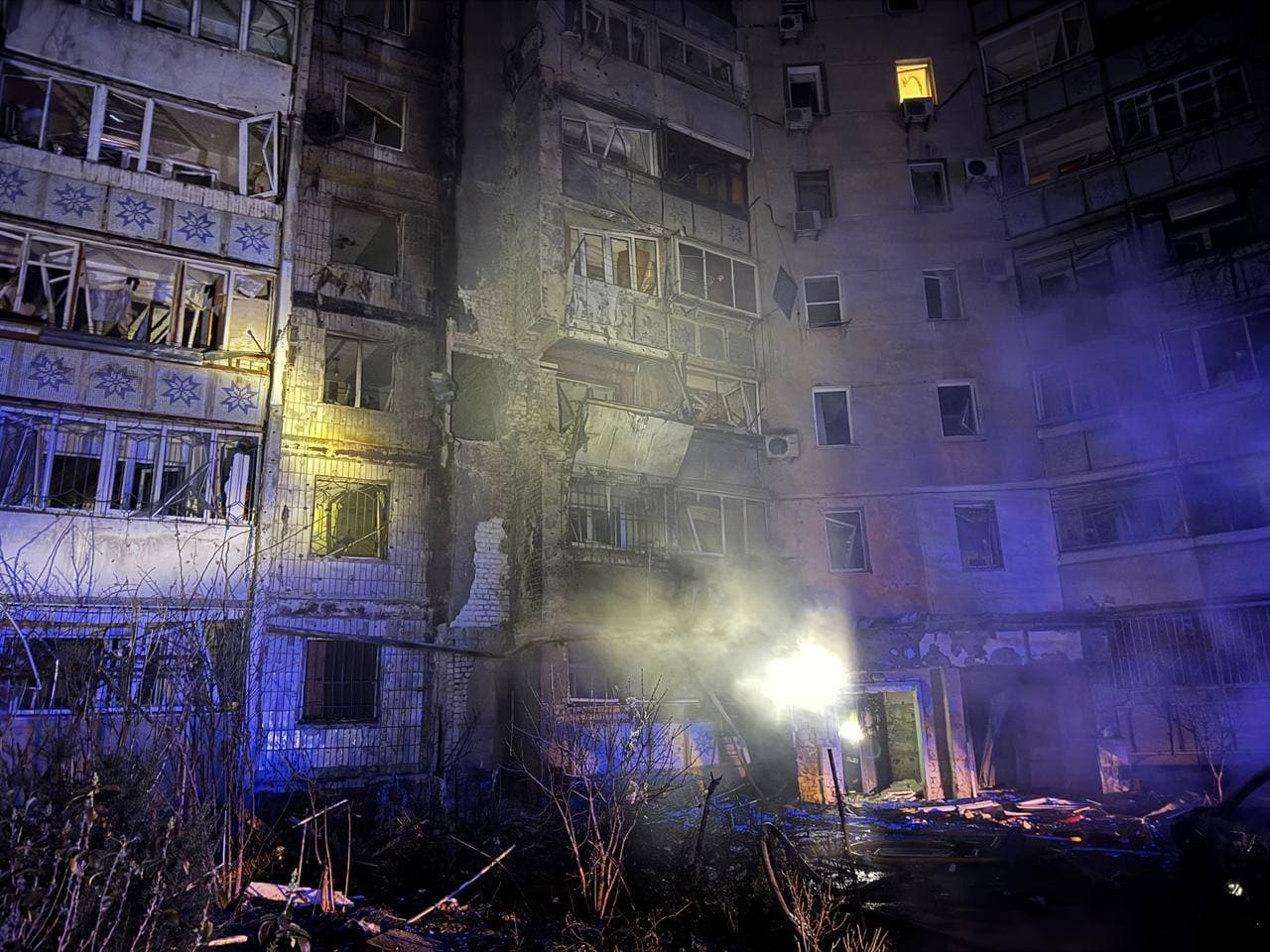
Russian drones struck bedrooms, not battlefields—six injured in Odesa, including a seven-month-old infant. (Oleh Kiper/Telegram)
The numbers stopped sounding abstract long ago.
By the end of 2025, Russia had launched more than 54,000 long-range drones and 1,900 missiles at Ukraine—a year spent testing whether sheer volume could succeed where precision and maneuver had failed.
The escalation was relentless. Before 2025, Russia’s largest strike package topped out at 210 drones and missiles. This year, it crossed that threshold 52 times. Eighteen attacks exceeded 500 projectiles. One night in September sent 810 drones into Ukrainian airspace at once. The sky itself became crowded.
Factories made it possible. Russia’s defense industry expanded production, drawing on Chinese components, North Korean missiles, and foreign labor to keep Shahed lines running in Tatarstan. By fall, the campaign shifted toward Ukraine’s power grid and railways—darkening cities, slowing trains, and stretching repair crews thin.
The last night of the year captured the pattern. Russian forces launched 127 drones from four directions. Ukrainian air defenses shot down 101—nearly eighty percent. It was a tactical success that still felt like failure. Twenty drones struck eleven locations. Homes burned in Odesa Oblast. Power went out for 170,000 people. Six civilians were injured, including children. Elsewhere, bread deliveries drew FPV fire. Villages absorbed shelling. An infant was wounded before the year could turn.
This was the logic of the campaign: even perfect defense leaks. And every leak hurts.
Yet the strategy never delivered its promise. Ukraine’s grid bent but did not collapse. Morale cracked but did not shatter. Reconstruction kept pace. Each massive strike proved something Moscow did not intend to prove—that volume alone could not force surrender.
The drones kept coming because Russia committed to the idea. The interceptors kept rising because Ukraine committed to survival.
Fifty-four thousand drones later, neither side had yielded. Only the cost kept climbing.
The Trains No One Saw: How Belarus Kept Russia’s War Supplied
The movements didn’t happen at the front.
They happened quietly, on rail lines few were watching.
Between April and August 2025, Belarus sent 31 flatcars of military equipment east—not west—away from the fighting and deep into Russia. The shipments moved from Belarus’s 814th Technical Support Center to Russia’s 1311th Central Tank Reserve Base near Yekaterinburg, far beyond the Urals. The transfers only became public months later, when opposition members of the Belarusian Railway Workers’ Community revealed what Minsk never announced.
This was logistics designed to disappear.
Belarus avoided the optics of combat while feeding Russia’s reserve system, sending equipment to depots far from Ukrainian missiles and foreign journalists. From there, matériel could be refurbished, redistributed, and quietly fed forward to units at the front. No headlines. No declarations. Just steel rolling east.
For the Lukashenko regime, it was the safest form of participation—support without fingerprints. For Russia, it was a gift: Belarusian stockpiles helping refill reserves while Russian factories focused on drones, missiles, and the innovations that reshaped the battlefield later in the year.
The choice of destinations mattered. The 1311th base is not a frontline hub. It is where Russia stores, repairs, and reconstitutes armor and equipment for long wars. Feeding it meant sustaining the future, not just the present.
Ukrainian planners were unsurprised. Intelligence had long treated Belarus as a logistics extension of the Russian military—territory, rails, and now matériel. What the railway workers’ evidence provided was confirmation.
As Russia refined fiber-optic drones and infiltration tactics through the summer, Belarusian equipment was already moving to keep the system alive. The trains didn’t fire shots. They didn’t raise flags.
But without them, the offensives that followed would have been harder to sustain.
Buying Time, Buying Defense: Two More Countries Fund Ukraine’s Shield
The announcement didn’t sound dramatic.
But it mattered.
As 2025 closed, Romania and Croatia quietly added their names—and their money—to a growing coalition funding Ukraine’s defense. Together, they pledged $77 million through the Prioritized Ukraine Requirements List, a program designed to buy American weapons Ukraine cannot replace on its own.
President Zelensky acknowledged the move with a brief message of thanks. Behind it lay calculation. Romania committed €50 million. Croatia added €15 million. The sums were modest compared to the scale of the war—but they flowed into a system already moving billions.
PURL, launched in August, had raised $4.3 billion by year’s end. Its logic was practical. Instead of scattered donations or incompatible European systems, partner nations pooled funds to buy U.S. equipment—Patriot interceptors, precision munitions, sensors—that Ukraine already knew how to use and Russia still struggled to defeat.
For Bucharest and Zagreb, the language mattered as much as the hardware. Officials framed the contributions as defensive, stabilizing, peace-oriented—phrasing aimed at domestic audiences uneasy about escalation. But the effect was clear. More interceptors meant more missiles stopped. More precision meant fewer civilians caught under inaccurate fire.
The program also revealed something larger. While Washington argued internally over aid packages, 24 nations committed their own money to buying American weapons for Ukraine. Canada, Germany, Australia—and now Romania and Croatia—kept the pipeline moving even when politics slowed elsewhere.
Seventy-seven million dollars won’t decide the war. But in a conflict measured in nights survived and cities kept lit, it buys something precious.
Time. Protection. And proof that Ukraine’s defense remains a shared responsibility—not a solitary one.
The Line That Wouldn’t Break: Pressure Everywhere, Breakthrough Nowhere
By December 31, the front did not look dramatic.
It looked tired.
Russian pressure pressed along nearly every sector, just as it had all year—probing, striking, claiming movement—but nowhere did it turn into the kind of breakthrough that changes wars. The pattern of 2025 repeated itself one last time.
In Sumy Oblast, Russian units attacked repeatedly, testing villages north and east of Sumy City. Milbloggers announced advances. None were confirmed. Ukrainian forces counterattacked where the line thinned, and the ground held. Even as General Gerasimov toured command posts and spoke of “security zones,” the frontline showed no sign of collapse.
Kharkiv Oblast followed the same rhythm. Russian assaults came near Vovchansk and its surrounding settlements. Claims of movement circulated online. Ukrainian counterattacks followed. The map barely changed.
Around Kupyansk, the war blurred. Positions intermingled. Infiltration teams slipped forward, filmed, then slipped back. Weather slowed logistics so severely that some Russian units relied on drones to drop supplies. There was motion everywhere—and control nowhere.
Near Siversk, Russian attacks pushed from multiple directions. Ukrainian forces answered, even advancing in areas Russian sources had already declared taken. Snow suits appeared on Russian infiltrators. Thermal optics erased the advantage.
Southward, attacks flared near Oleksandrivka and Hulyaipole without result. Ukrainian counterattacks cut into exposed Russian positions. West of Orikhiv, Ukrainian forces moved inside Stepnohirsk, reclaiming ground that Russian maps had colored red.
Even near the Dnipro, where Russian assaults edged toward Kherson’s approaches, nothing gave way.
Day 1,403 closed as it began: attacks launched, defenses absorbing them, counterpressure restoring balance. The line bent. It shifted by meters. But it did not break.
2025 ended the way it was fought—through pressure without decision.
The Year Written in Fire and Glass
The last day of 2025 did not feel like an ending.
It felt like a ledger closing—numbers tallied, costs exposed, nothing resolved.
Russia’s gains could be measured precisely: 4,831 square kilometers, taken at 78 casualties per square kilometer. Fiber-optic drones stretched sixty kilometers into Ukrainian rear areas. Infiltration teams slipped forward where infantry waves once died. The map moved. But the price—over 416,000 casualties—hung over every advance, raising the same question that refused to go away: how long could this pace be sustained?
Ukraine answered in depth rather than distance. Drones burned oil refineries far north of Moscow. Shahed launch sites at Donetsk airport were destroyed before the drones could fly. Substations went dark. Ammunition depots detonated. Russia advanced at the front while scrambling to defend its rear.
The contradictions piled up. Moscow spoke of unity while ultranationalist realities pressed beneath the surface. Officials produced evidence of an attack that left no traces where it supposedly occurred. At Zaporizhzhia Nuclear Power Plant, the war paused for one day—just long enough to keep catastrophe at bay—then resumed as if silence had never happened.
Along the line itself, pressure replaced decision. Russian attacks came everywhere. Breakthroughs came nowhere. Ukrainian defenses bent, counterattacked, and held. Pokrovsk remained contested. Sumy, Kharkiv, Kupyansk, Hulyaipole—each sector told the same story in different terrain.
Internationally, the machinery kept turning. Romanian and Croatian funds flowed into American weapons. Finnish authorities detained another vessel dragging anchors across Baltic cables. Support continued even as diplomacy stalled.
Day 1,403 closed without triumph or collapse. Technology accelerated the war. Costs multiplied. Control remained expensive to gain and harder to keep.
The refineries burned. The cables extended. The questions followed the war into 2026 unanswered.