
September 9, 2026
Prepared by Diana Bozhyk
A Russian drone entered Moldovan airspace at the exact moment President Zelensky’s plane was departing the country for Norway, prompting Norwegian Prime Minister Jonas Gahr Store to say the aircraft “was nearly hit” and raising fears of a targeted attack. Russian strikes killed at least 12 people and injured 72 more nationwide, including two 21-year-olds killed when a drone hit a shopping mall in Sumy and a woman killed in a second wave of daytime strikes on Kyiv, just one day after a separate overnight barrage on the capital killed five. Ukrainian forces struck a Russian naval base at Novorossiysk with a Neptune cruise missile, hitting a Kalibr-equipped frigate directly, while new data showed Russia’s federal budget deficit has already blown past its entire annual target with four months still left in the year.
THE DAY’S RECKONING
A drone crossed into Moldovan airspace at 4:20 p.m. today. At almost exactly that moment, President Zelensky’s plane was taking off from the same country, bound for Norway. Norway’s own prime minister said afterward that the aircraft was nearly hit. Nobody has proven it wasn’t an accident. Nobody can prove it was, either — and that ambiguity is precisely the kind of shadow this war now casts over even a head of state’s travel plans.
Everything else about today moved with the same relentless, grinding violence that’s defined this war for years. Two 21-year-olds died in a Sumy shopping mall. A woman died in Kyiv’s second wave of daytime strikes in as many days. Russia’s own finance ministry admitted its budget deficit has already exceeded its full-year target with a third of the year still to go. Ukraine answered with a missile straight into a Russian warship’s hull. Nothing today offered anyone real relief. Everything today measured exactly how close this war keeps coming to the people meant to end it, and how far it still is from actually doing so.
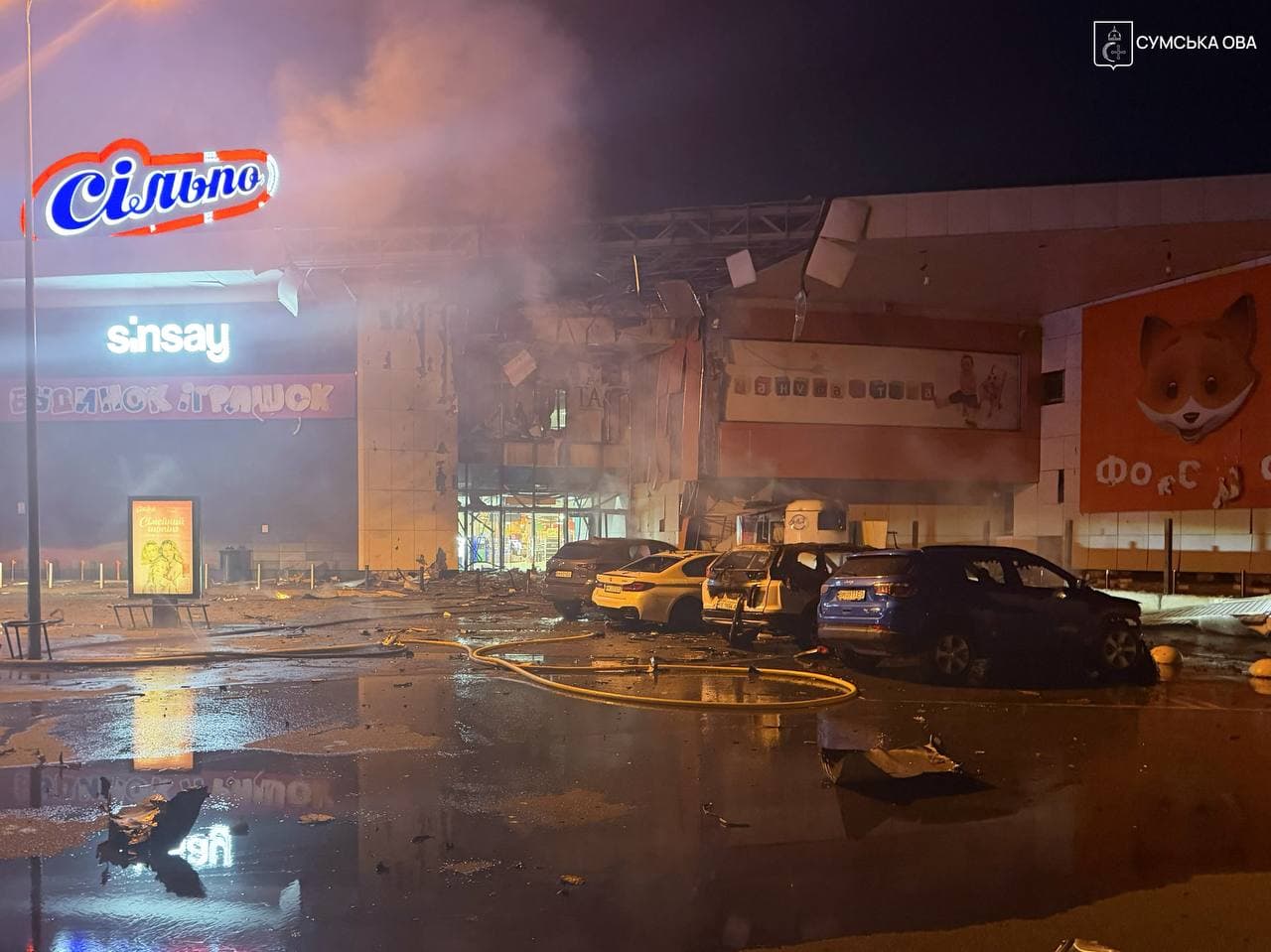
The aftermath of a Russian drone attack at a shopping center in Sumy, Ukraine. (Oleh Hryhorov / Telegram)
A DRONE NEARLY HIT ZELENSKY’S PLANE LEAVING MOLDOVA
A Russian Shahed-type drone crossed into Moldovan airspace at approximately 4:20 p.m. today, at nearly the exact moment President Zelensky’s aircraft was departing the country en route to Norway, a source told the Kyiv Independent. Norwegian Prime Minister Jonas Gahr Store confirmed the near miss directly to Norwegian broadcaster NRK: “His plane was nearly hit by a drone as it was taking off from Moldova. This is the reality he faces.” Moldova’s Defense Ministry tracked the drone until it crossed into Romanian airspace roughly 17 minutes later, triggering NATO fighter jet scrambles and airspace closures, but its official statements made no mention of Zelensky’s flight.
The timing has raised fears among Ukrainian officials of a deliberate attempt on the president’s life rather than a coincidental incursion. Russian drones and missiles have routinely violated Moldovan and Romanian airspace in recent months, but the precise overlap with Zelensky’s departure window is difficult to dismiss as pure chance. The concern isn’t hypothetical: Putin has long been suspected of orchestrating assassinations against political rivals using engineered aircraft incidents, most notably the 2023 downing of Wagner commander Yevgeny Prigozhin’s private jet. Neither Ukrainian nor Moldovan officials have formally accused Russia of a targeted attempt, but neither have they ruled it out.
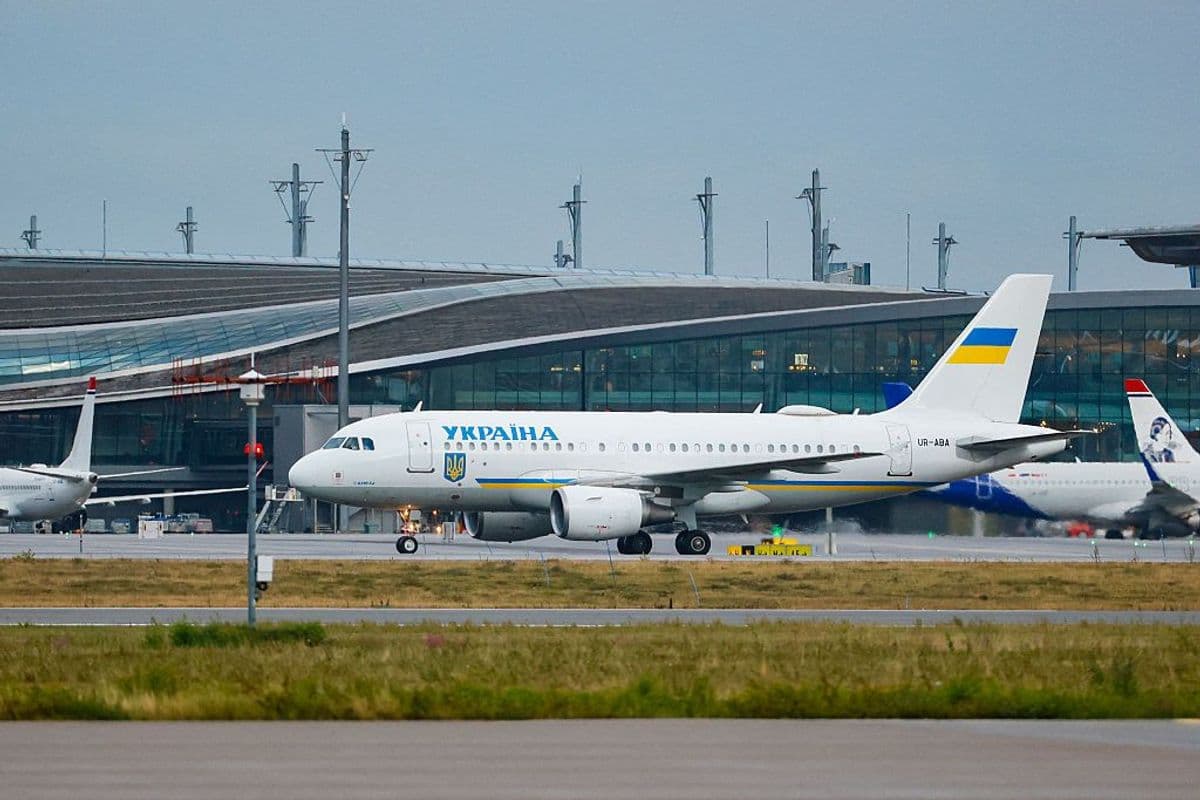
Ukrainian plane UR-AB, believed to carry President Volodymyr Zelensky and his wife Olena Zelenska, lands at Gardermoen airport near Oslo before Norway’s Harald V’s funeral in Oslo. (Frederik Ringnes / NTB / AFP via Getty Images)
TWELVE KILLED, 72 WOUNDED NATIONWIDE
Russian attacks killed at least 12 people and injured 72 more across Ukraine over the past day, President Zelensky said, condemning what he called the world’s insufficient response: “There has been too little response from the international community to these strikes, which are taking people’s lives practically every day. Moscow must not go into the winter believing that it can get away with missile and drone terror without consequences.” Overnight, Russia launched 196 Shahed-type drones alongside Iskander-M ballistic missiles and S8000 Banderol cruise munitions; Ukrainian forces intercepted 165 drones, with strikes hitting 23 locations and debris falling at four more.
Kherson Oblast lost two people with 15 injured; Dnipropetrovsk Oblast lost two with 12 injured; Kharkiv Oblast lost one with four injured, plus eight more hurt when a Shahed struck a railway station serving a Kharkiv-Izium train. Zaporizhzhia Oblast lost one person with seven injured amid 945 individual strikes on 46 settlements in a single day. Mykolaiv Oblast lost one woman with four injured, including a child, as strikes damaged a shopping mall, a postal terminal, and a cafe. Chernihiv Oblast lost one person with three injured after a Banderol cruise missile struck a hypermarket in Pryluky. Kyiv Oblast lost two people with seven injured, damaging 31 separate sites.
TWO KILLED IN A SUMY SHOPPING MALL
A Russian drone struck the Manufactura shopping and entertainment center in central Sumy today, killing two 21-year-olds and injuring 20 more, including three teenage girls, according to Governor Oleh Hryhorov. Footage released by Ukraine’s State Emergency Service showed firefighters battling flames engulfing parked cars while debris and blood covered the asphalt outside the mall. Fourteen people were hospitalized, with two men and one woman in serious condition and a fourth woman listed as extremely critical.
“Now, it is crucial for all partners to focus and work on the necessary steps to de-escalate the situation and stop the killings,” Zelensky said afterward. “Terrorism is always a threat to many, and we must counter it together.” The strike fits an escalating pattern Russia has pursued throughout the summer: daytime attacks on retail spaces crowded with civilians, following an August strike on a Kryvyi Rih shopping center that killed 16 people and injured 130, including 23 children.
It comes just days after a US-brokered diplomatic push in Kyiv and Moscow that revived stalled talks but produced no actual reduction in the violence that followed. The UN’s own human rights monitoring mission recorded July 2026 as the deadliest month for Ukrainian civilians since March 2022, with 437 people killed and 2,610 injured nationwide — figures that make today’s Sumy strike less an aberration than one more data point in a trend line that’s shown no sign of reversing regardless of how much diplomatic activity surrounds it.
KYIV STRUCK AGAIN BY DAY
Kyiv absorbed a full day of renewed drone strikes today, a day after Russia’s massive overnight barrage killed five people in the capital. A Russian drone hit a 24-story residential building in the Darnytskyi district around 8 a.m., sparking a fire on the 12th floor and injuring nine people through the morning. Hours later, a separate drone struck a nine-story building in the Dniprovskyi district, killing a 67-year-old woman standing nearby and injuring three more people, including two teenagers aged 15 and 16. By evening, the citywide toll reached one dead and 16 injured, with the capital under an active air-raid alert for more than six hours straight.
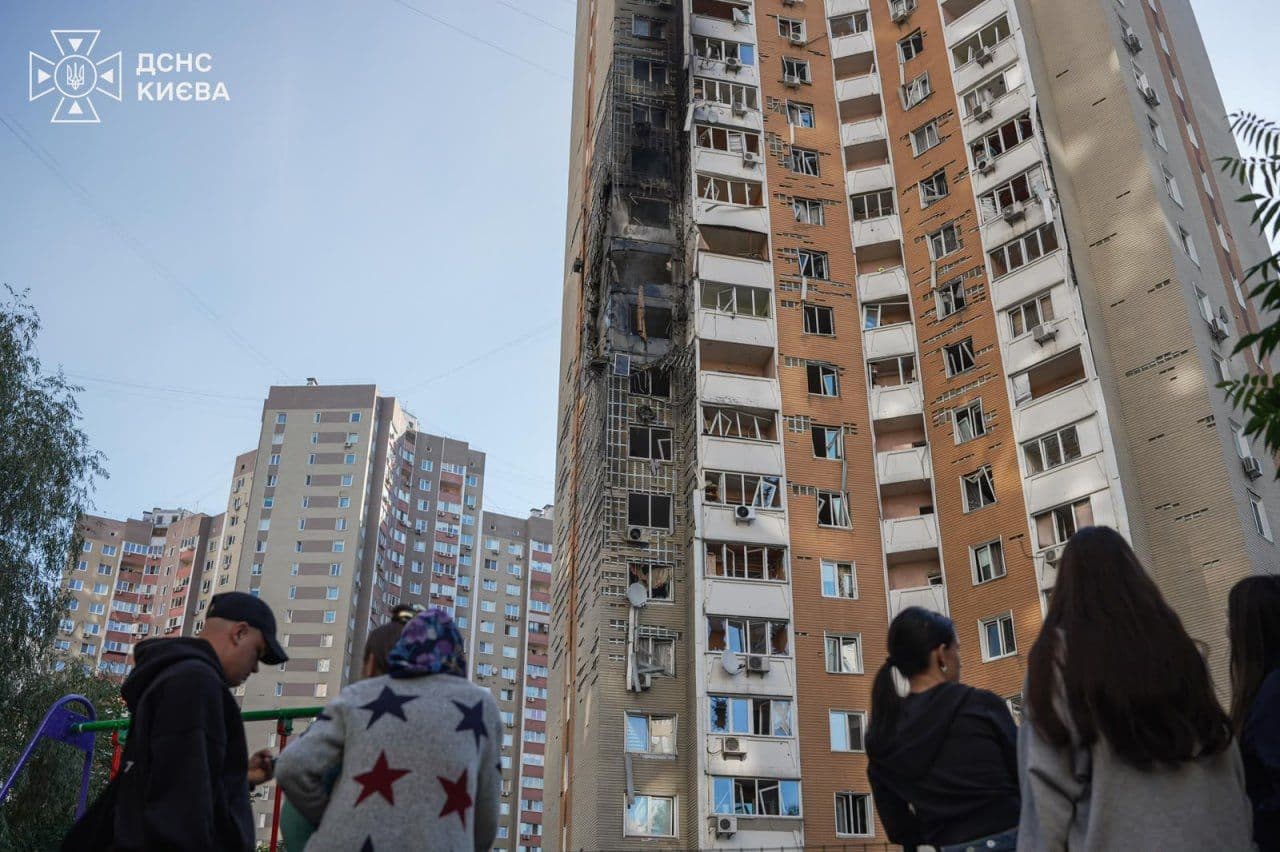
A residential building damaged in a Russian drone attack on Kyiv, Ukraine. (State Emergency Service / Telegram)
Kyiv’s City Prosecutor’s Office opened a war-crimes investigation into the woman’s death under Ukraine’s criminal code. Regional head Tymur Tkachenko said Kyiv Oblast separately lost two people with seven more injured, damaging 31 sites including 11 houses, two apartment buildings, and five production facilities. “Behind every number is someone’s life, someone’s home, someone’s property. And this is once again the reality that Russia brings to our land,” he said. The strikes mark Russia’s return to near-daily pressure on the capital almost immediately after the brief pause tied to last weekend’s US envoy visit expired.
UKRAINE STRIKES A RUSSIAN NAVAL BASE AND A WARSHIP
Ukrainian forces struck multiple military targets along Krasnodar Krai’s Black Sea coast overnight, President Zelensky confirmed, hitting an oil-loading terminal, military port facilities, and warships carrying Kalibr cruise missiles at Novorossiysk. Ukraine’s Navy said it used a domestically built Neptune cruise missile to strike the Admiral Essen frigate directly — a Kalibr-equipped Project 11356 vessel — while Unmanned Systems Forces commander Robert Brovdi said Ukrainian drones separately hit a Su-33 fighter jet and Mi-8 helicopter near Anapa, plus two S-300/S-400 air-defense radars near Gelendzhik. Fires broke out at Novorossiysk’s oil terminal, and Russian officials confirmed strikes across all three named locations.
Separately, satellite imagery released today confirmed Ukraine’s earlier September 6 strike on the Ryazan oil refinery caused lasting damage, with repairs to two of its crude-processing units still ongoing. The Novorossiysk strike adds to a monthslong campaign that’s left Russia’s Black Sea Fleet increasingly unable to safely operate from its own ports, forcing ships toward land-based missile launches instead and confining much of the fleet’s remaining capability to the port where today’s strike specifically found it.
Ukrainian officials framed the strike as part of a deliberate strategy to degrade Russia’s ability to threaten Ukrainian shipping and coastal cities alike, since a Kalibr-equipped frigate taken out of action represents one less platform capable of launching the exact type of cruise missile that’s struck Ukrainian civilian infrastructure repeatedly throughout the war. Naval officials say Russia has already been forced to rely on far fewer sea-launched strikes over recent months as a direct consequence of exactly this kind of sustained pressure on its Black Sea assets.
RUSSIA’S DEFICIT BALLOONS AS ELECTIONS APPROACH
Russia’s Ministry of Finance disclosed today that the federal budget deficit reached 5.8 trillion rubles — roughly $67.9 billion — between January and August, already 1.5 times higher than the same period last year and well past the government’s own full-year forecast of 3.8 trillion rubles. Federal spending grew 14.7 percent to $371 billion over the period, outpacing a 9.2 percent rise in revenue, driven largely by advance payments on defense contracts. Kremlin spokesperson Dmitry Peskov dismissed any concern, insisting the government isn’t considering tax hikes and that the economy “remains stable.”
Separately, Russia’s Central Bank published forecasts projecting persistently weak growth and elevated inflation through 2029, with GDP growth expected to stay between one and two percent next year even under its most optimistic scenario. Analysts say the combination reflects a deliberate but costly trade-off: Putin has prioritized controlling inflation over economic growth specifically to soften the visible impact of war spending on ordinary Russians ahead of this month’s State Duma elections, even as the fiscal strain increasingly forces cuts to everything the war itself doesn’t directly fund.
The numbers matter because they contradict Peskov’s reassurances in a very specific way: a deficit already 1.5 times larger than the same point last year, with four months still remaining in the fiscal year, suggests the gap will likely widen further before it narrows — leaving Russian officials with an uncomfortable choice between raising taxes, cutting non-military spending even more sharply, or simply absorbing a deficit considerably larger than anything the government has publicly prepared its own citizens to expect.
LAVROV: LET UKRAINE BE THE BUFFER ZONE
Russian Foreign Minister Sergei Lavrov said on state television that Ukraine itself should become the “buffer zone” Moscow claims it needs to prevent future threats from the west. “Everyone argues that Russia needs a ‘buffer zone.’ Let Ukraine become this buffer,” he said, rejecting the idea that any postwar Ukrainian government could remain in power, which he described as violating “human rights, language rights, and the right to choose one’s religion.”
The comment lines up with reporting that the Kremlin has quietly abandoned earlier informal proposals to return occupied parts of Sumy and Kharkiv oblasts in exchange for the rest of Donetsk and Luhansk, opting instead to keep those regions as permanent buffer territory while still pursuing all of Donetsk outright. Lavrov separately dismissed the idea that Russia is engaged in meaningful negotiations at all, saying Moscow will keep fighting until the West makes concessions and telling Western officials not to “fuss” over their latest proposals.
Asked how Moscow could guarantee the war wouldn’t simply resume in another generation, Lavrov argued Ukraine could not be allowed to retain what he called a “Russophobic, aggressive, neo-Nazi regime” — rhetoric that underscores the widening gap between Washington’s renewed diplomatic push and Moscow’s continued insistence on terms Ukraine has called unacceptable, and that leaves little room for the kind of incremental compromise any realistic ceasefire would eventually require.
FT: CIA’S RATCLIFFE MAY REPLACE WITKOFF AND KUSHNER
The Financial Times reported today, citing five sources, that the Trump administration is considering giving CIA Director John Ratcliffe a more prominent role in US-led negotiations, potentially reducing the involvement of senior envoys Steve Witkoff and Jared Kushner. The White House flatly denied it: “This entire story is totally fake news… None of these supposed conversations are happening,” a spokesperson said, adding that Witkoff and Kushner “continue to work incredibly hard toward a peace agreement, and the President trusts them fully.”
According to the FT’s sources, Ukraine has privately felt Witkoff hasn’t pressured Putin firmly enough to shift his demands, while Russia reportedly views him as sharing blame for the lack of a breakthrough at last year’s Anchorage summit. No final decision has been made, and Witkoff could retain his broader Middle East portfolio while still remaining involved in Ukraine diplomacy alongside Ratcliffe, who made his own first visit to Moscow two weeks ago and reportedly warned Russian officials against testing NATO’s Baltic members.
The internal disagreement over how to divide negotiating responsibility reflects broader frustration inside the administration with the pace of diplomacy so far: multiple rounds of talks, several high-profile visits, and still no concrete movement on the substantive terms separating Kyiv and Moscow. Any shift toward Ratcliffe would also mark a subtle but significant change in tone, moving the process further into intelligence channels and away from the more overtly political framing Witkoff and Kushner have brought to it.
A DRONE REACHES 1,800 KILOMETERS INTO SIBERIA’S OIL HEARTLAND
Russian authorities suspended flights and imposed airport restrictions across six airports in the Khanty-Mansi Autonomous Okrug today over drone threats, a region more than 1,800 kilometers from Ukraine’s border and responsible for roughly 40 percent of Russia’s total crude production. Geolocated footage separately showed smoke rising from the Novy Urengoy Condensate Preparation Plant, nearly 3,000 kilometers from Ukraine, after regional officials confirmed a drone was shot down nearby.
The region has never previously faced a drone strike or even a drone warning, according to independent Russian outlet Verstka, which reported regional authorities are now seeking to reclassify drone threats as “extreme life situations” alongside fires and natural disasters — a designation that would let affected residents receive emergency food, clothing, and other assistance. If Ukraine is indeed extending its reach into Siberian crude production rather than just refining capacity, it would mark a meaningful escalation beyond the refinery campaign that’s already pushed Russia’s processing output to a two-decade low.
The psychological impact may matter as much as the physical one: a region that spent four and a half years of war considering itself entirely beyond Ukraine’s reach is now facing airport closures and emergency planning for a threat its own residents have never had to contemplate. That shift alone — regardless of how much actual damage any single strike causes — represents a genuine expansion of the war’s perceived reach into parts of Russia that had, until now, functioned as if the conflict were happening somewhere else entirely.
SIGNS OF A QUIET RUSSIAN MOBILIZATION
Despite Putin’s public insistence that mobilization rumors are “complete nonsense,” Russia’s own domestic evidence increasingly suggests otherwise. Deutsche Welle’s Russian service reported that tens of thousands of reservists are being summoned to enlistment offices to “update” their registration records, only to discover their military ID cards have been modified with formal mobilization orders directing them to specific collection points — the same administrative step taken before Russia’s 2022 invasion and its subsequent partial mobilization. Searches for “mobilization order” on Russia’s Yandex search engine have spiked 800 percent, DW reported.
Western estimates, including from independent researchers, suggest Russia is losing more than 40,000 personnel killed or wounded monthly against roughly 35,000 new volunteer recruits — a gap analysts say cannot be sustained indefinitely without some form of mobilization. Reports from June described men summoned to enlistment offices in Russia’s Penza region being pressured into signing military contracts on the spot, a pattern some observers see as a rehearsal for broader measures. More than 110,000 Russians crossed into Georgia through the Upper Lars checkpoint in a single week in August, according to Politico, a loophole authorities have since moved to close.
Notably, Russia’s own 2022 partial mobilization decree has technically never been formally revoked and remains legally in force, a detail that adds to unease among those eligible for call-up. Kremlin spokesperson Dmitry Peskov’s current denials echo, almost word for word, similar assurances he offered in May 2022, just four months before that year’s mobilization was actually announced — a precedent Russians tracking the current warning signs haven’t forgotten.
MEANWHILE, AT THE FRONT
Russian milbloggers themselves are increasingly acknowledging that the Lyman direction is deteriorating for Russian forces, with one blogger admitting Russian troops have had to withdraw from unspecified forward positions and warning that the military’s culture of “beautiful reports” — fabricated claims of success — needs to be “absolutely forbidden.” The admission follows Ukraine’s public demonstration, days earlier, that Ukrainian forces fully control Svyatohirsk despite Putin’s own claim to the contrary.
Near Kramatorsk, Russian forces conducted five guided glide-bomb strikes this morning alone, injuring at least nine people, part of a deliberate campaign to create rubble Russian infiltrators can later use for cover; a Ukrainian brigade spokesperson said Russian forces are now launching dozens of glide bombs against nearby Druzhkivka daily. The same spokesperson said Russian forces are using “human safari” tactics, deliberately hunting civilians and transport infrastructure in Druzhkivka with first-person-view drones.
Russia’s own soldiers near Kupyansk are reportedly complaining that their command keeps deploying reinforcements to “secure” positions Ukrainian forces have actually held all along — a pattern Ukrainian officials say reflects the same systemic dishonesty distorting Putin’s own understanding of the war. Ukrainian forces separately struck Russian ammunition and equipment depots in occupied Luhansk Oblast using HIMARS rocket systems, part of the sustained intermediate-range pressure campaign that’s continued regardless of what’s happening along the front’s more static, contested stretches.
RUSSIA STRIKES THE MOLDOVA BORDER CROSSING AGAIN
Russian forces struck the Starokozache border crossing between Odesa Oblast and Moldova today, killing two civilians and injuring three more, according to regional governor Oleh Kiper, who said rescuers evacuated 16 more people from a bus at the scene. The crossing was temporarily suspended following the attack — the fourth time Russia has struck border infrastructure along this specific stretch since August 20, according to Ukrainian officials.
The repeated targeting of a crossing with no direct military value underscores a broader pattern in Russia’s campaign against Ukraine’s remaining export and supply routes, following weeks of strikes on the Danube corridor that’s become Ukraine’s primary alternative to Black Sea shipping since Russia’s blockade intensified. Each strike forces temporary closures that ripple through both Ukraine’s export logistics and ordinary civilian movement between the two countries.
The attack adds one more layer of disruption to a border region already absorbing the drone incursions and near misses that have become a near-daily feature of the war’s spillover into Moldova specifically — the same border crossing area, notably, where a Russian drone entered airspace at almost the exact moment President Zelensky’s own plane was departing the country earlier today, a coincidence Ukrainian officials have not yet fully explained but which underscores just how routinely this particular stretch of border now absorbs Russian aerial activity.
EUROPE PUSHES AGAIN FOR FROZEN RUSSIAN ASSETS
A group of 122 members of the European Parliament sent EU leaders an open letter today urging the “urgent” use of roughly €200 billion in frozen Russian assets to fund Ukraine, arguing the money would send Moscow an unmistakable signal that “time is not on Russia’s side.” Lead signatory Karin Karlsbro, a Swedish MEP, said the push follows an earlier letter from four EU countries and that momentum is genuinely building for the European Commission and member states to act. The letter specifically endorses transferring the immobilized Russian funds to a new EU-controlled instrument that would shoulder legal risk collectively, rather than leaving Belgium — which hosts roughly €180 billion of the assets through the clearing house Euroclear — exposed alone to potential Russian retaliation.
Separately, the Council of Europe’s Parliamentary Assembly passed its own resolution today calling for the same frozen assets to be used specifically to compensate Ukraine for war damage. The renewed push comes after a nearly identical proposal collapsed in December 2025 over Belgian objections, and while France — which holds roughly €19 billion of the assets, second only to Belgium — has reportedly shared some of the same legal concerns that sank the earlier effort.
UKRAINE UNVEILS TWO NEW WEAPONS
Ukraine’s state defense industry showcased two new domestically developed systems at the MSPO defense exhibition in Poland today. The RK-19 missile, designed to replace the Soviet-era 9M33-series ammunition running low for Ukraine’s Osa-AKM air-defense systems, can intercept targets up to 10 kilometers away and reach speeds of 600 meters per second — a direct response to a steep decline in available air-defense missiles that Zelensky said has fallen threefold compared to last year.
Separately, Ukrainian Defense Industry unveiled Pegas, a 35-ton tracked infantry fighting vehicle that would become Ukraine’s first domestically designed vehicle of its kind to reach mass production if development is completed. Built by the same design bureau behind Ukraine’s T-84 tanks, Pegas is rated to NATO’s STANAG 4569 protection standards and carries a 30mm automatic cannon alongside anti-tank guided missiles, though no production timeline has been announced.
Both unveilings reflect Ukraine’s broader push toward domestic manufacturing as Western supply chains for critical munitions remain strained heading into another winter. Ukrainian officials have increasingly framed self-sufficiency in both munitions and platforms as a strategic necessity rather than a preference, given how repeatedly allied deliveries of everything from Patriot interceptors to artillery shells have arrived late, in reduced quantities, or diverted toward other conflicts competing for the same limited global supply.
GERMANY’S WADEPHUL WANTS UKRAINIAN MEN TO COME HOME
German Foreign Minister Johann Wadephul said Berlin could help Ukraine identify and contact military-age Ukrainian men living in Germany who may be subject to mobilization, backing a proposal from a Bavarian conservative leader that such men should return home. “We know who lives here, who receives social benefits, or who is registered here,” Wadephul said, adding any return should happen “without coercion” and that he wasn’t proposing to strip anyone’s legal status.
Germany hosted roughly 1.33 million Ukrainian refugees at the end of last year, one of the largest such populations in Europe. Wadephul separately pressed Ukraine to direct more of its procurement spending toward German defense manufacturers, arguing Berlin’s status as Ukraine’s largest financial and military backer entitles its industry to a larger share of Ukrainian contracts — a request he said he’d already raised directly with Zelensky.
The comments landed awkwardly alongside Germany’s own domestic debate over how much further support for Ukraine, and its refugee population, the country’s shifting politics can sustain. Wadephul stopped short of proposing any change to the legal residency status Ukrainians currently hold in Germany, but the mere suggestion that Kyiv should actively work to identify and contact draft-eligible men living abroad drew immediate scrutiny from refugee advocates, who noted the proposal arrives at a politically sensitive moment following the far-right AfD’s recent state election win.
ANTI-DRONE NETS RISE NEAR CHORNOBYL AS ITALY PUSHES FOR A BIGGER SEAT
Anti-drone nets have appeared along roads leading toward the Chornobyl Exclusion Zone, part of broader Ukrainian defensive preparations near the Belarusian border following intelligence that Russia’s political leadership has ordered contingency plans for a potential operation toward Kyiv and Chernihiv — plans officials stress remain theoretical, with no evidence Russia has assembled the force such an operation would require. The zone, occupied briefly during Russia’s failed 2022 advance on Kyiv, has also seen new checkpoints, trenches, and fortified positions constructed nearby.
Separately, Italian Deputy Prime Minister Antonio Tajani urged Zelensky to include Italy and Poland more directly in initiatives to end the war, arguing Ukraine should engage the EU as a whole rather than relying on Germany and France alone. “We will continue to help Ukraine defend itself without sending our troops,” Tajani said, reiterating Rome’s longstanding refusal to deploy Italian forces to Ukraine even as it continues providing other forms of support.
And the EU’s General Court rejected sanctioned Russian billionaire Roman Abramovich’s third legal challenge to his EU sanctions listing today, upholding the asset freeze tied to his ownership stake in Russian steel giant Evraz and his alleged ties to Putin — leaving roughly £2.5 billion in frozen Chelsea Football Club sale proceeds still locked in a British bank account amid an unresolved dispute over how the funds should ultimately benefit Ukraine, a case Abramovich has now lost at every stage since first filing his challenge in 2022.
A PLANE, A MALL, A WARSHIP HIT
By nightfall, today’s furthest edges were hard to reconcile in a single frame: a drone crossing paths with a president’s departing plane, a shopping mall in Sumy turned into a crime scene, a Russian frigate struck by a missile built entirely in Ukraine. None of it resolved into anything simple. All of it measured exactly how far this war still reaches into ordinary life, presidential travel included.
Two 21-year-olds in Sumy won’t see tomorrow. A woman in Kyiv died standing near a building that had nothing to do with any war. And somewhere over Moldova tonight, a drone’s flight path came close enough to a president’s plane that Norway’s own prime minister felt compelled to say so publicly. Nothing today ended. Everything today added its own weight to a war that keeps finding new ways to reach further than anyone expected it still could.
A PRAYER FOR UKRAINE
1. For the Two 21-Year-Olds Lost in Sumy
Lord, two young lives ended today in a shopping mall, cut short at the very beginning of adulthood. We grieve futures that will now never unfold — careers unstarted, families unbuilt, decades of life simply taken. Receive them both, comfort the 20 injured and their families, and let their names be remembered as more than casualties in a war they were only ever bystanders to.
2. For the Woman Killed Standing Near a Building in Kyiv
Father, a 67-year-old woman died today doing nothing more remarkable than standing near her own neighborhood. We grieve a life ended by pure proximity to violence that had no target worth naming, no purpose beyond harm. Comfort whoever mourns her, and hold the two teenagers injured alongside her as they carry forward whatever fear this day left behind, long after the headlines move on.
3. For a President Whose Safety Cannot Be Fully Guaranteed
Lord of protection, we pray for President Zelensky and every leader whose ordinary travel has become a calculated risk in this war. Give him continued safety in the skies and on the ground, and give Ukraine’s security services wisdom to anticipate threats that keep evolving. Let no leader’s life be lost to ambiguity we could have taken more seriously sooner.
4. For Every Russian Quietly Bracing for a Call-Up That’s Denied
God of truth, we pray for the ordinary Russians increasingly summoned to enlistment offices under vague pretenses, watching their own documents change without official acknowledgment of what’s actually happening to them. Give them clarity where their own government offers none, and give those fleeing coercion, on any side of this war, a genuine path toward safety rather than more uncertainty.
5. For Every Nation Still Weighing How Far to Go
God of courage, we pray for the lawmakers, diplomats, and officials pushing to unlock resources still sitting frozen while Ukraine’s needs keep growing. Give them the resolve to move past legal caution toward real action, and give Ukraine the patience to keep making its case even when the response arrives slower than the war’s own pace demands.
In Your mercy, in Your justice, in Your time — bring this war to its end, and let the ending be worthy of what Ukraine has endured.