
As diplomats discussed ending the war on Christmas Day, Russian strikes killed civilians in Ukraine while Kyiv answered with Storm Shadow attacks deep inside Russia.
The Day’s Reckoning
Christmas morning began with a phone ringing in Kyiv and explosions echoing across Ukraine.
President Volodymyr Zelensky spent nearly an hour on a holiday call with U.S. envoys, parsing language about security guarantees, economic frameworks, and what a negotiated end to the war might look like. At roughly the same time, Russian strikes tore through civilian spaces—places meant for food, sleep, and celebration—turning Christmas into another day of emergency sirens and body bags.
The war unfolded on parallel tracks that never touched. In Rome, Pope Leo XIV spoke of courage in dialogue to a crowd gathered in St. Peter’s Square. In northeastern Ukraine, isolated Russian soldiers surrendered without food or ammunition. Far from the front, Ukrainian missiles struck deep into Russia’s energy infrastructure, sending fire into the winter sky and signaling that diplomacy had not slowed the mechanics of war.
Across capitals, draft agreements circulated. Roadmaps were refined. Sensitive clauses were bracketed for later discussion. The language of peace advanced carefully, line by line.
On the ground, none of it mattered.
Christmas brought no truce, no pause, no restraint. Markets were hit. Apartments burned. Emergency crews worked through the holiday while families counted the dead and wounded instead of gifts and guests. The violence did not interrupt negotiations; negotiations did not interrupt the violence.
This was the day’s truth. After 1,401 days, the war had become something more complex and more dangerous—a conflict being fought and negotiated at the same time. Peace talks were no longer an alternative to war. They were another front entirely, operating alongside missiles, drones, and artillery, with outcomes just as consequential and just as uncertain.
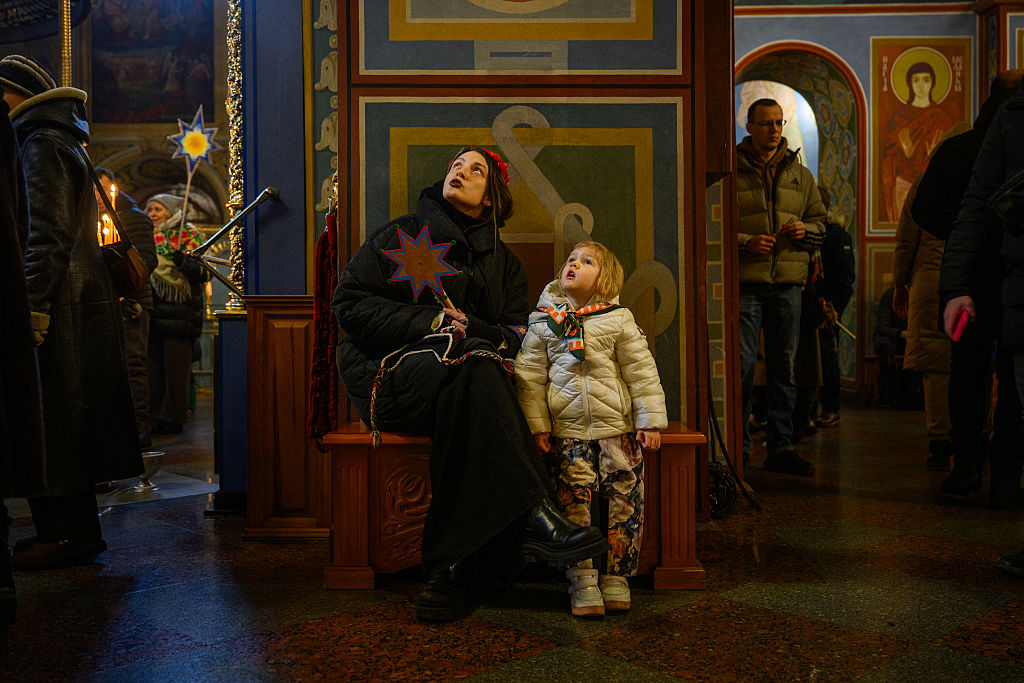
Christmas paused by sirens: A woman holds her daughter inside Kyiv’s St. Michael’s Golden-Domed Monastery after an air raid alarm halted a Christmas procession. Caroling Stars waited in silence as worshippers measured celebration against survival. (Elise Blanchard/Getty Images)
Phones Ring in Kyiv as Markets Burn
Christmas morning did not begin with silence in Kyiv. It began with a phone vibrating on a desk.
President Volodymyr Zelensky spent nearly an hour speaking with U.S. envoys Steve Witkoff and Jared Kushner, walking through draft language, security guarantees, and what he later called “substantive details” of a possible end to the war. It was diplomacy at its most careful—measured phrases, bracketed clauses, ideas tested and retested.
“We are truly working 24/7,” Zelensky wrote afterward, offering hope that Christmas might move the war closer to its end.
On paper, progress was real. A revised 20-point peace framework had replaced an earlier plan critics feared leaned toward capitulation. Three documents now circulated through diplomatic channels: a trilateral security guarantee with the U.S. and Europe, a bilateral U.S.–Ukraine security agreement, and an economic roadmap meant to anchor Ukraine’s future beyond the war. The Kremlin acknowledged receipt. Moscow said it was “analyzing” the material. Russian officials even spoke of “slow but steady progress.”
Then noon came.
In Kherson, Russian fire tore into the central market as vendors prepared for Christmas. Stalls collapsed. A 47-year-old worker was killed where he stood. Prosecutors opened a war-crimes case before the smoke had cleared.
In Chernihiv, a drone slammed into a five-story apartment building, punching through a third-floor home. An 80-year-old woman died. Nine others were wounded. Fire spread through shattered rooms while rescuers worked among still-smoldering debris.
This was no accident of timing. A proposed Christmas truce had been welcomed by Kyiv and rejected by Moscow. The rejection arrived not as words, but as policy—strikes that killed at least four people and injured dozens more across Ukraine in a single holiday.
For Ukrainians, the contradiction was impossible to escape. Peace advanced through phone calls and draft agreements while neighbors died in markets and bedrooms. Diplomacy and violence moved forward together, on parallel tracks, neither slowing the other.
Fire for Christmas: Ukraine Reaches Into Russia’s Fuel Lifeline
Smoke rose over Novoshakhtinsk on Christmas Day, thick and unmistakable against the winter sky.
Ukrainian Storm Shadow cruise missiles had slammed into the oil refinery in Russia’s Rostov Oblast, triggering explosions heard kilometers away. Around noon, air raid alerts rippled through the area as fire spread across the facility—a different kind of holiday signal, delivered at supersonic speed.
This was not a random strike. Novoshakhtinsk sat near the top of Ukraine’s target list. According to the General Staff, the refinery was one of southern Russia’s most important suppliers of diesel fuel and aviation gasoline for the Russian military. Its storage tanks—holding more than 210,000 cubic meters—represented weeks of operational endurance for armored units and aircraft fighting in Ukraine.
Geography made the message sharper. Just ten kilometers from the Ukrainian border and more than 200 kilometers from the front line, the plant embodied Russia’s assumption of rear-area safety. Hitting it demonstrated that assumption was false. Distance no longer guaranteed protection.
The weapon mattered, too. British-supplied Storm Shadow missiles, capable of precise strikes at ranges up to 250 kilometers, had become the backbone of Ukraine’s deep-strike campaign. Launching them on Christmas Day underscored a blunt reality: Moscow’s rejection of holiday ceasefires had consequences. Diplomatic calendars did not govern military operations.
The damage was immediate. Fires burned through the complex. One firefighter was injured battling the blaze and hospitalized. Authorities said no other casualties were reported, though assessments were still underway. It was the second time Novoshakhtinsk had been hit—Ukrainian drones had sparked another fire there in August—evidence of sustained pressure on Russia’s energy backbone.
For Ukrainian planners, the strike carried meaning beyond flames and fuel. It was a declaration that negotiations would not slow self-defense, that talks did not equal restraint, and that any facility powering Russia’s war remained a legitimate target—on Christmas, or any other day.
A Night Without Safe Distance: Ukraine Sets Russia’s Rear on Fire
The war did not stop at Novoshakhtinsk.
Overnight between December 24 and 25, Ukrainian forces launched a coordinated, multi-front strike that reached from the Sea of Azov deep into Russia’s interior—a sweep of fire that would have been unthinkable in the war’s early months. Geography offered no sanctuary. Distance offered no safety.
In Krasnodar Krai, drones from Ukraine’s Security Service “Alpha” unit struck the Temryuk Seaport, a vital node for oil exports and liquefied petroleum gas on the Sea of Azov. Flames raced through two storage tanks, burning across roughly 2,000 square meters. Seventy firefighters were pulled into the night to contain the blaze. The port was not just infrastructure—it was revenue, fuel, and logistics flowing directly into Russia’s war effort.
Farther east, nearly 800 kilometers from Ukraine, another strike hit a gas processing plant in Orenburg Oblast. The facility—one of the largest gas chemical complexes in the world—processed 37.5 billion cubic meters annually. A fire erupted in the 3U-70 pipeline unit, the system responsible for stripping raw gas of hydrogen sulfide and carbon dioxide. Operations were partially suspended, interrupting flows that fed both Russia’s economy and its military fuel chain.
Closer to the front, Ukrainian forces struck the Maykop military airfield in Adygea. Fires burned on the base that housed aircraft used to attack Ukrainian cities. The message was direct: launch sites would no longer be treated as untouchable.
The night included industry as well as airfields. In Tula Oblast, a synthetic rubber factory producing dual-use materials for military vehicles and armored platforms was also hit—another link in Russia’s defense supply chain cut under cover of darkness.
The strikes revealed a war transformed. Ukraine was no longer merely holding ground—it was shaping the battlefield far beyond it. Russia’s Defense Ministry claimed to have intercepted 141 Ukrainian drones nationwide, 62 over Bryansk Oblast alone. Whether accurate or inflated, the number told its own story: saturation, strain, and an air-defense network forced to guard everything, everywhere, all at once.
Claims in the Dark: Moscow Says the Drones Came, but Shows Nothing
Christmas Eve in Moscow unfolded online, not in the streets.
Just after 8 p.m., Mayor Sergei Sobyanin began posting alerts warning that Ukrainian drones were approaching the capital. Air defenses, he said, were responding. An attack had been repelled. Emergency services were dispatched.
Then the updates kept coming.
At 11:35 p.m., one drone destroyed. At 1:52 a.m., four more. Fourteen minutes later, two additional targets intercepted. Another at 2:08 a.m. And finally, at 2:20 a.m., a last drone “neutralized.” Nine in total, all stopped before reaching the city.
Each message ended the same way: “Emergency services are working at the crash site.” The phrase repeated like a refrain through the night.
But outside the mayor’s Telegram channel, Moscow was quiet.
No videos surfaced. No images of debris. No scorched courtyards or shattered rooftops. The Ministry of Emergency Situations—usually quick to document explosions, fires, and cleanups—posted nothing. For a city allegedly under repeated aerial attack, there was no visible disruption, no traffic stoppages, no airport closures, no crowds filming from balconies.
The absence was familiar. Russian authorities have often claimed to intercept large numbers of Ukrainian drones, yet visual confirmation frequently fails to appear. The effect is a carefully balanced narrative: reassure the public that defenses are working while avoiding proof that Ukraine can threaten the capital.
The contrast was stark compared to December 11, when dozens of drones approaching Moscow forced airports to shut down for hours—an attack that left an undeniable trail of cancelled flights and stranded passengers. Christmas Eve produced none of that.
For Ukrainian planners, the ambiguity was enough. Whether nine drones truly flew toward Moscow or not, Russian officials felt compelled to say they had. Air defenses were activated. Statements were issued. Attention shifted inward.
Sometimes the pressure matters more than the proof.
When the Lies Break: Kupyansk Falls and Moscow Admits It
The silence around Kupyansk told the story before the words did.
Viktor Trehubov, the communications chief for Ukraine’s Joint Forces grouping, did not dress it up. Only several dozen Russian soldiers remained inside the northeastern city, he said—cut off, undersupplied, and surrendering in growing numbers. Some were foreign mercenaries. None had a way out.
“They are surrendering,” Trehubov confirmed on television. “There are even foreigners giving themselves up.”
What made the moment extraordinary was not Kyiv’s assessment, but Moscow’s. After months of triumphant claims, Russian military bloggers and propaganda channels abruptly changed tone. The bravado vanished.
“Yesterday, an entire wave of messages appeared saying that Kupyansk is gone,” Trehubov said. “Even Russian propagandists now acknowledge the city is no longer under their control.”
That admission was rare. Russia’s information machine usually lagged far behind battlefield reality, sustaining fictional victories long after positions were lost. Kupyansk broke that pattern. The situation had deteriorated so completely that even loyal amplifiers could no longer pretend otherwise.
Russian units that had pushed into the city’s northern districts had been beaten back. No reserves arrived. No counterattack materialized. The remaining troops survived on air resupply alone—a fragile lifeline Trehubov described as unsustainable. Assault attempts continued daily, but they changed nothing.
Kupyansk mattered. The city sat astride key rail and road arteries in the Kharkiv region, a logistical hinge for Russian operations in the northeast. Losing it disrupted supply routes and exposed the fragility of Moscow’s recent advances.
Earlier in December, President Zelensky released video footage from inside the city to prove Ukrainian control. Moscow responded by claiming the images were generated by artificial intelligence—a line so implausible that even Russia’s own propagandists abandoned it.
In Kupyansk, the battlefield forced the truth. And for once, the messaging followed.
Meters, Not Miles: Hulyaipole Fights for the South
Hulyaipole is fighting for its life, one street at a time.
Over the past day, the southern Ukrainian city endured roughly two dozen combat clashes—some of the heaviest fighting anywhere along the front. Russian assault groups pressed forward under constant fire, probing for ways into the city center while trying to anchor themselves on the outskirts. For defenders, there was no pause, only pressure.
“The enemy is trying to infiltrate the city center,” Southern Defense Forces spokesman Vladyslav Voloshyn said. “They are trying to establish groups on the outskirts to consolidate.”
The stakes extended far beyond Hulyaipole’s battered neighborhoods. The city lies just 87 kilometers east of Zaporizhzhia. If it fell, Russian forces would gain a corridor toward the regional capital—an outcome that analysts warned could reshape the southern front.
Moscow’s approach was methodical and familiar. Attacks pushed in from the northeast and southeast while Russian units targeted the Pokrovske–Hulyaipole supply route, the lifeline keeping Ukrainian defenders in place. Open-source mapping from DeepState UA showed the cost of that pressure: roughly half the city now classified as gray zone, where control changed hands block by block.
Fighting spilled into nearby settlements—Dobropillya, Pryluky, Varvarivka—as Russian troops attempted to cut deeper into the supply network. The goal, Voloshyn said, was simple and brutal: take as many streets and houses as possible, regardless of cost. Progress was measured in meters, not kilometers.
Russia already controlled more than 73 percent of Zaporizhzhia Oblast, including the nuclear plant at Enerhodar. Zaporizhzhia city itself remained out of reach—for now.
For those defending Hulyaipole, the battle carried history as well as strategy. This was the birthplace of Nestor Makhno, a symbol of Ukrainian resistance against Russian domination. Holding the city meant holding more than terrain. It meant refusing to yield a place that had resisted before—and was resisting again.
A Call Above the Gunfire: The Pope’s First Christmas in a World at War
The square was full, the bells rang, and the words were chosen carefully.
Standing before roughly 26,000 people in St. Peter’s Square, Pope Leo XIV delivered his first Christmas message as pontiff—his first since being elected in May after the death of Pope Francis. The American pope did not speak in abstractions. He spoke about Ukraine.
“Let us pray in a particular way for the tormented people of Ukraine,” he said, asking that the parties involved find “the courage to engage in sincere, direct and respectful dialogue.”
Courage was the word he returned to. Not optimism. Not inevitability. Courage—the kind required to negotiate when compromise looks like weakness at home, when dialogue means facing an adversary responsible for destruction and death, when peace demands outcomes that fall short of victory.
His message landed amid quiet diplomatic motion. Russian and Ukrainian officials had separately engaged U.S. negotiators in recent weeks. President Volodymyr Zelensky had outlined elements of a plan to end the war. Vladimir Putin had not softened his demands. Nearly four years of fighting had left tens of thousands dead, eastern Ukraine shattered, and millions displaced.
The pope widened his lens. He spoke of Gaza, where families still lived in tents exposed to rain and cold after a fragile ceasefire. “They have nothing left,” he said. In Bethlehem, worshippers gathered for the first festive Christmas in more than two years, filling the Church of the Nativity and Manger Square beneath a towering tree.
But the contrast was unavoidable.
As the pope spoke of dialogue, Christmas Day in Ukraine brought fresh casualties and new strikes. His appeal did not ignore that reality—it acknowledged it. Peace, he suggested, would not come through momentum or goodwill alone. It would require risk.
And on a day when the war showed no restraint, even asking for that courage felt like an act of defiance.
No Truce in the Crosshairs: Ukrainian Drones Hunt Winter Armor
Christmas morning arrived quietly over the Slobozhanshchyna region—until the drones began to dive.
As diplomats traded language and leaders spoke by phone, crews from Ukraine’s “Hart” Border Guard Brigade were already at work. Footage released by the unit’s Furia (“Fury”) UAV strike team showed first-person views racing toward Russian positions near the northeastern border. Tanks sat exposed. Artillery pieces waited in place. Vehicles clustered where Moscow hoped to stage winter offensives.
Then the screens filled with fire.
The strikes were deliberate. Russian forces had been building “jump-off” points—forward staging areas meant to feed assaults once winter conditions hardened the ground. Ukrainian planners chose not to wait. Logistics, artillery, and armor were hit before columns could move, disrupting the offensive before it began.
The Fury unit specialized in this kind of work: reconnaissance that became attack within minutes. Their drones mapped Russian fire support and struck it directly, erasing guns and vehicles without exposing Ukrainian troops. The Christmas strike followed weeks of similar operations across the Kharkiv region, including earlier hits that destroyed a Russian Murom-M long-range surveillance system.
What the footage showed was the modern battlefield distilled. Drones costing thousands eliminated armor worth millions. Months of training vanished in seconds. Crews never saw the enemy—only coordinates, heat signatures, and impact flashes.
For Russian forces preparing winter operations, the message was unmistakable. Surveillance was constant. Assembly areas were known. Any buildup would be punished before it crossed the line.
And for Ukrainians, the timing carried its own weight. There was no holiday pause, no symbolic restraint. Christmas brought the same work it had brought for nearly four years—attrition, precision, and the steady dismantling of Russia’s ability to fight.
Christmas by the Numbers: Four Dead, Dozens Wounded, No Pause
The negotiations changed nothing on the ground.
Across Ukraine, Christmas Day unfolded as another full day of war. According to the General Staff, fighting surged through 151 combat engagements along the front. Missiles fell. Guided bombs dropped. Artillery and drones worked through the night, methodical and unrelenting.
Russia launched 131 drones toward Ukrainian cities and positions. Air defenses destroyed most—106 intercepted—but not all. At least 22 slipped through, striking 15 locations and knocking out power in parts of Chernihiv, Sumy, Dnipropetrovsk, Kharkiv, and Odesa oblasts. Darkness followed the explosions.
Kharkiv was hit hardest. A strike on the regional center killed a 51-year-old man and wounded 15 others. Separate attacks injured a 64-year-old man in Mytrofanivka and a 56-year-old man in Podoly. The city remained within range, and Russia continued to use that reach.
In Odesa Oblast, another strike killed one person and injured two more, tearing into port and industrial infrastructure already scarred by earlier attacks. Fires burned through the night, compounding damage that emergency crews were still struggling to repair.
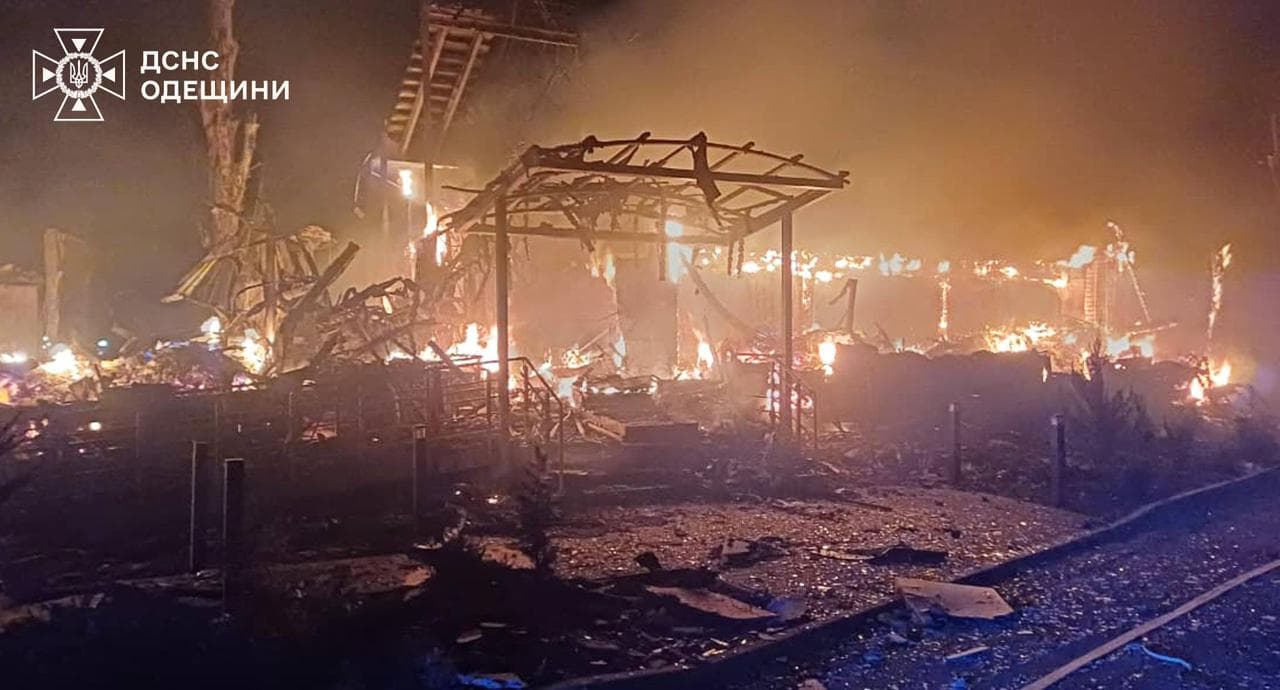
Ruins burn in Odesa Oblast after overnight Russian strikes, leaving only smoke, twisted metal, and the silence of a Christmas morning interrupted. (Ukraine’s Emergency Service)
The injuries spread outward. Zaporizhzhia reported five wounded. Sumy recorded four, including a 17-year-old girl. Kherson—under constant fire from across the Dnipro—added three more. In Donetsk Oblast, two people were injured in Kostiantynivka. Dnipropetrovsk reported one wounded in the Nikopol district.
Chernihiv carried the weight of repeated blows. Earlier attacks killed a 63-year-old driver when a drone struck his car in the Snovsk community. Another drone injured a 37-year-old woman. An FPV strike later killed a 39-year-old man in Novhorod-Siverskyi.
By nightfall, the count stood at four dead and 35 injured.
It was not an anomaly. It was routine.
Each number marked a Christmas interrupted—meals abandoned, homes shattered, hospital corridors filling with civilians instead of celebration. Residential buildings, markets, and energy sites burned alongside military targets, continuing a pattern international observers have repeatedly described as potential war crimes.
On December 25, peace was discussed. And the war did what it always does.
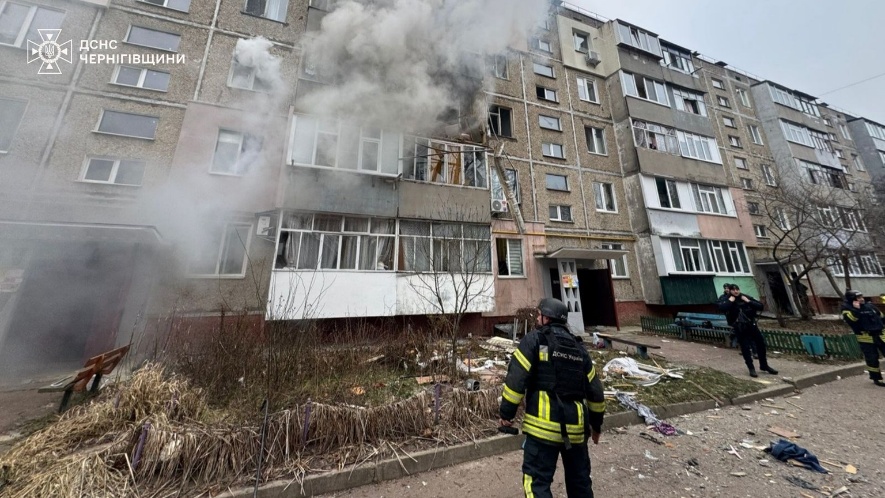
A home turned to wreckage: The remains of a residential building in Chernihiv’s regional center after a Russian drone strike, where shattered walls and scorched concrete mark a Christmas night that never ended. (Ukraine’s Emergency Service)
The Day’s Meaning: A War Fought in Two Languages at Once
December 25 did not resolve anything. It clarified everything.
After 1,401 days, the war revealed its mature form: a conflict conducted simultaneously in two languages that no longer translate into one another. One was written in draft agreements, phone calls, and carefully hedged frameworks. The other was written in fire, rubble, and casualty lists. Both advanced at the same time.
On Christmas Day, peace talks were not an alternative to violence. They ran beside it. Negotiation became a parallel front—no longer a pause in the fighting, but another arena where leverage was built, pressure applied, and outcomes contested. Moscow negotiated while killing. Kyiv negotiated while striking. Neither treated diplomacy as a reason to stop.
This was not hypocrisy. It was strategy.
For Russia, the day confirmed a familiar method: talk peace while maintaining maximum military pressure, reject ceasefires while demanding concessions, and use civilian suffering as background noise to diplomatic engagement. Violence was not a failure of negotiations; it was part of their logic.
For Ukraine, the dual track was unavoidable. Diplomats needed battlefield credibility. Soldiers needed diplomatic momentum. Infrastructure strikes, defensive battles, and surrenders on the front all fed into talks that could not succeed without proof that Ukraine was still shaping events.
The unresolved core of the war remained exposed. Territory versus guarantees. Occupation versus sovereignty. Zaporizhzhia and Donbas versus security commitments Russia had no incentive to honor. Creative language tried to bridge realities that weapons still defined.
The persistence of talks did not signal optimism. It signaled exhaustion. Neither side could win outright. Neither could afford to stop.
So Christmas passed without truce, without illusion. The war did not pause to negotiate, and negotiations did not soften the war. They became inseparable—two mechanisms grinding forward together, neither capable of ending the other.
That was the day’s meaning. Not that peace and war coexisted—but that, for now, they had fused.