
As saboteurs stalk a Ukrainian city and a radar burns in Crimea, Europe reaches for the valves feeding Russia’s war, Kyiv chases twenty-five shields against the sky, and Moscow rehearses a winter of pressure, propaganda, and denial.
The Day’s Reckoning
Morning arrived with a warning that tasted like metal. Ukraine’s military intelligence said Russia was preparing an active winter campaign—no ceasefire, no pause—only harder strikes, deeper infiltrations, and a long season of attrition. By midday, a Ukrainian drone’s camera shook and snowed to black as it rammed a high-end radar at Dzhankoi, blinding a piece of Crimea’s airwatch. In Pokrovsk, a small Russian team slipped past the front and shot civilians near the rail line, only to be hunted down inside the station where they hid. Far east, a single hit on the Orenburg gas complex rippled into Kazakhstan’s output and spooked the region’s energy math. Brussels sharpened sanctions—this time aimed at the “shadow fleet”—while Zelensky pressed for twenty-five Patriot systems and pitched an energy future that starves the Kremlin’s coffers. The day carried the sound of winter coming early: generators coughing to life, transformers thumping awake, and the distant buzz of wings in a cold, unsettled sky.
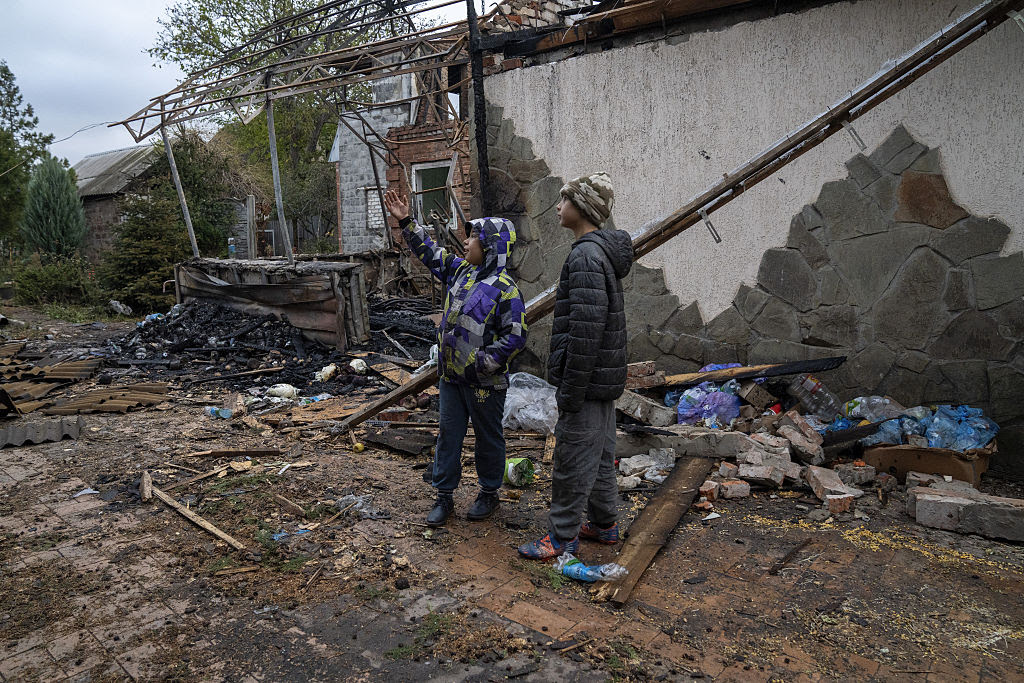
Children stand amid the wreckage of their neighborhood in Sloviansk after a Russian Geran-2 drone tore through Bohun Street during the night, shattering homes and igniting cars. The strike left the quiet residential block scarred with twisted metal and smoke. (Jose Colon / Anadolu / Getty Images)
“Prepare for an Active Winter”
The studio lights were too bright for a man who has spent so much time in rooms without windows. Vadym Skibitskyi, deputy to Kyrylo Budanov, folded his hands and chose plain words. Russia, he said, is building for an active winter campaign. The line landed like a door being bolted. The interviewer nudged for a timeline, a date to circle on a calendar. Skibitskyi refused to turn war into appointment-keeping. “We’ll be looking out for the results of our politicians,” he said—an officer’s way of acknowledging that battlefield tempo and diplomatic theater are now welded together.
Then came the part that quieted the room: Russia is also preparing for possible conflict with Europe, “particularly with NATO.” Not a prediction of tanks crossing borders, but a warning about posture—supply lines, propaganda budgets, the slow lay-up of missiles and glide bombs, power systems mapped as targets. The winter to come would be fought not only in trenches and cities, but across electrical grids, fuel stocks, and the contested air above both.
The Radar That Didn’t See Its Killer (Dzhankoi)
Somewhere over the flat darkness of northern Crimea, a small Ukrainian drone skimmed the horizon. Below, the Dzhankoi airfield sat in its geometry of concrete and light. The radar—a top-shelf anti-UAV system—turned and searched for a threat it has been marketed to defeat. The drone kept coming. In the last seconds, the video frame jittered, the image bloomed, and the world became static.
By morning HUR posted the clip with a line as cold as steel: “The demilitarization of Crimea continues.” No gloating, no specs—just the outcome. Russian crews moved through the wreckage, coughing in the smell of fused metal. The loss was more than equipment; it was confidence. Radar is a promise that someone is awake for you in the dark. On this day, that promise failed, and a hole opened in the air picture over the peninsula.
Railside Murders, Station-House Reckoning (Pokrovsk)
Pokrovsk’s morning began with the ordinary sounds of a frontline city: distant thunder, the rattle of shutters, dogs learning to sleep through sirens. A Russian sabotage group—small enough to fit in a single van—slipped past the first Ukrainian line and threaded alleys to the railway. There they shot civilians where they stood: two left prostrate beside the tracks, a third wounded and later carried away by neighbors who moved with that strange, careful hush of people working inside a catastrophe.
Word ran ahead of the uniforms: the killers were inside the station. Soldiers marked heat signatures through broken glass; drone pilots found angles between steel beams and ticket windows. Short bursts, a bloom of spark, more silence. When it ended, the airborne corps wrote the sentence that every city hopes will follow such a morning: “The group has been eliminated.” Outside, the rails gleamed with dust and spilled light. The front remained two kilometers away; the war was inside the city anyway.
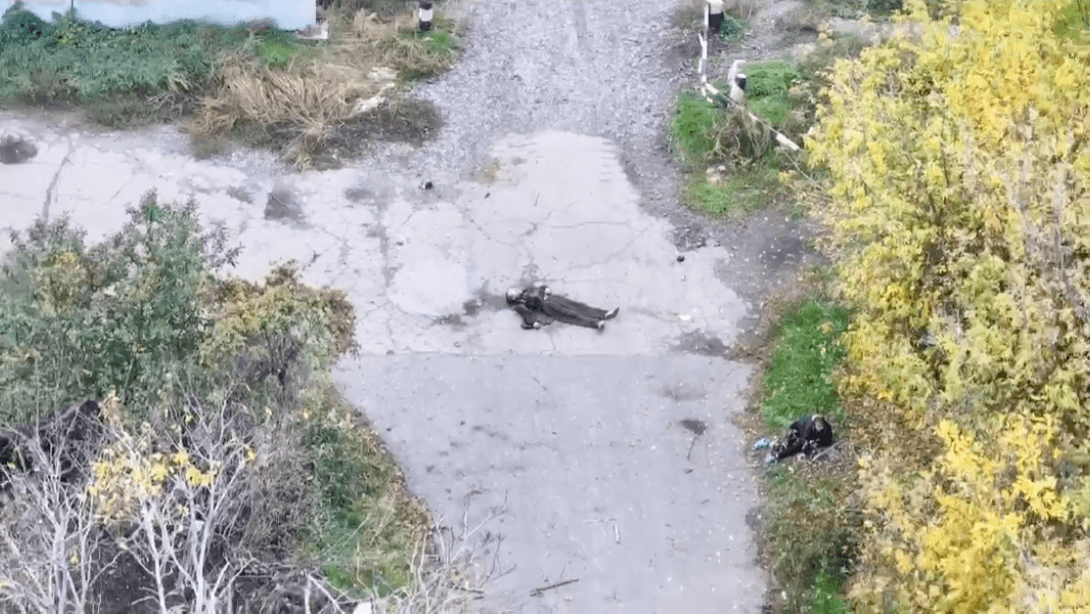
A screenshot from drone footage reportedly captured by a Ukrainian soldier shows civilians killed and injured in central Pokrovsk, Donetsk Oblast, after a Russian assault behind the front lines. (Denys Khrystov)
Coal and Fire: 192 Souls in the Dark (Western Donbas)
The missile struck when the miners were deep and the surface was still. Shock rolled through the seams; dust rained from the ceiling like sifted night. Above, DTEK’s coal infrastructure burned—Russia’s sixth wide-scale strike on the company’s mines in two months. Below, 192 people counted breaths and battery bars and the seconds it takes for courage to replace fear.
At dawn, the lifts started. First a pair of lights in the shaft, then faces rising into the blast-stained air. One by one they emerged—shaking, filthy, alive. All of them. Not a scratch. Rescue crews hugged with that awkward gratitude of men who have trained for hell and found only smoke. The pithead smoldered. Somewhere a siren faltered and died. The miners went home to rooms where the lamps flickered and the kettles took longer to boil than they did the week before.
Orenburg: When One Flame Bends a Market
Before sunrise on the steppe, a flare leapt off the Orenburg gas processing plant and turned night into magnesium daylight. The hit forced the facility to halt intake from Kazakhstan. Inside Almaty offices, production planners changed numbers as if they were moving stones across a river: take 25 to 30 percent off Karachaganak and watch how the flow downstream begins to whisper. In Orenburg, officials called it damage “in a workshop.” The satellite images said otherwise.
This was not just a fire; it was a message carried along pipelines and balance sheets. A single Ukrainian strike had touched Kazakhstan’s output and signaled to every trader from Rotterdam to Baku that Russia’s energy machine is long, vulnerable, and now inside range. No one knew when full operations would resume. Everyone knew what it meant.
The Arithmetic of Terror (Night Over Ukraine)
The night’s numbers arrived the way they always do: first in sirens, then in tallies. Three ballistic missiles. Sixty drones—about forty of them Shaheds—launched from airfields and coasts whose names Ukrainians have learned to hate: Oryol, Millerovo, Primorsko-Akhtarsk, Chauda. Thirty-eight fell to air defenses. Twenty found their marks, and all three ballistic missiles landed on a dozen locations.
In Kharkiv, a thud, a hiss, then glass answering with its own small storm. One dead, five injured, a child among them. In Chernihiv, a transformer moaned and the grid shed neighborhoods like leaves; tens of thousands in the dark. In Kherson, the night was a braid of artillery and the drone-low growl of engines crossing water. Engineers worked by headlamp, hands black with soot and graphite. “We are fighting for light,” one said, coiling cable in the cold. “Not just for territory.”
And something new in the sky: the UMPB-5 glide bomb, missile-shaped, fast, and thrown from high altitude to ranges that make old maps feel dishonest. Too quick for interceptor drones, too fresh for a confident electronic warfare counter—one more winter trick in the bag Moscow plans to empty over cities.
Patriot Math in a City of Sirens
Zelensky stepped up to the microphones in a city that has learned to keep one ear on the sky. He had come home from Washington with a plan: long-term contracts for twenty-five Patriot systems. It was not triumph; it was endurance written as procurement. Patriots are the one shield Ukraine can point at ballistic missiles with consistent results. But the interceptors—PAC-3s—are the kind of ammunition you count like gemstones.
He described a years-long pipeline: “a positive story… complex, but long-term.” A phrase that sounds like hope when you have no other choices. If even a fraction arrive in time, the winter calculus changes in Kyiv’s favor—fewer roofs peeled back at dawn, fewer power plants knocked off the grid, fewer prayers muttered beneath stairwells when the app says “Ballistic threat: take cover.”
Europe Reaches for the Valves (Sanctions No. 19 and the Shadow Fleet)
In Brussels the language grew sharper. The draft on the table did not just list banks or buyers; it named ships. Inspect, board, detain—the verbs of maritime pressure aimed at Russia’s “shadow fleet,” those re-flagged tankers that carry oil under false moons and borrowed names. A full LNG import ban from Russia by January 2027—moved forward—tightened the future. Crypto platforms and sanction-evading banks faced new penalties. Ninety-plus vessels, then a hundred-plus more, would find fewer ports willing to pretend not to know them.
Austria stepped out of the way. Slovakia lingered in the doorway, asking for considerations that reminded everyone this is a union of economies as well as consciences. Diplomats muttered dates: October 23 for leaders, drafts to be finalized, letters to be sent. Outside, rain, and the smell that cobblestones get in autumn. Inside, a quiet belief that this package would bite where the war feeds best.
The Theater of Ceasefires (Washington, Moscow, Budapest, London)
The diplomatic day unspooled like a play in too many acts. In Washington, reports swirled that Trump had met Zelensky, listened to Putin the night before, and exited with the notion to freeze the frontlines—occupation translated into “property,” as if artillery were a deed. The Kremlin responded with its favorite tautology: we have always said what we always say. Dmitry Peskov called it consistency; Maria Zakharova called it “root causes.” Both meant refusal.
A phone call followed between U.S. Secretary of State Marco Rubio and Sergey Lavrov. Budapest appeared as the proposed stage for a summit—the most Moscow-friendly room in the EU. In Paris, Macron pushed back on the very geometry of that table. Europe must be present, he said, or the conversation would fail the continent that has paid in sirens and taxes for the last 1,334 days.
And in London, a “Coalition of the Willing” meeting took shape for October 24, with Zelensky expected to attend. The agenda had the hard edges of winter: energy and weapons. The message between lines: diplomacy will talk as long as it must; the power plants and the Patriots cannot wait.
Energy as Strategy: Tanks, Cables, and Reactors
Kyiv’s counteroffensive in energy had its own maps. Projects were put on American desks: an LNG import terminal at Odesa (a dream complicated by the Bosphorus), deeper use of Ukraine’s vast underground gas storage (Europe’s largest), the Odesa–Brody oil pipeline as a corridor pointed west, and up to nine new nuclear reactors in partnership with Westinghouse. In another winter, such plans would read like technocratic ambition. In this one, they are supply lines for the will to endure.
If the strait stays closed, gas will come through Poland. If Russian fuel is finally choked off, Europe will rely more on American cargoes and Ukrainian storage. What used to be economics is now strategy; what used to be investment is now survival. “They see we have the network,” Zelensky said. “They are interested.” Translation: we are mapping the day after the war while we fight the night inside it.
Moscow’s Ledger Bleeds
Numbers in Moscow do not march; they limp. By Kyiv’s estimates, Russia’s deficit will near $100 billion next year. The state has already raised VAT, shortened workweeks, fiddled with fuel subsidies and discovered what happens when you twist that valve too fast: shortages, lines, and the muttered question that regimes dislike—why can’t we keep the pumps on?
Inflation rises; the central bank prints. Economists who once spoke of “temporary imbalances” now whisper about unsustainability. The clean fix—cut war spending—is the one lever no one will pull. Instead, propaganda gets a raise: state funding for mass media climbs by more than half in the 2026 plan. If shells can’t buy victory, stories must. The television victory parade is scheduled to arrive whether or not the infantry can.
Front Lines That Creep, Maps That Lie
If you stand with the soldiers on the northern arc—from Kharkiv through Kupiansk and Borova to Siversk—the war looks like hedgerows and culverts. Ukraine holds here, inches there, a rail embankment taken back, a treeline left gray with shattered bark. Russia pushes by infiltration: pairs and trios moving so slowly that grass springs back behind them. Claims of neighborhoods seized appear on channels before the men in those neighborhoods have finished their tea.
Farther south, the Pokrovsk axis feels like the palm of a hand pressed into a map. Russian teams probe inside the city, try to widen the gray zone between blocks, raise flags on roofs they cannot keep by day. West of Zaporizhzhia, a battalion-sized assault throws tanks and fighting vehicles at lines that hold, then buckle, then knit themselves tight again before night. Along the Dnipro’s right bank, small Russian groups test crossings and camera angles, and bloggers in distant rooms call it an offensive while the river shrugs and keeps its secrets.
The truth that holds across all of it: advances are measured in minutes of exposure and meters of mud. The casualties pay for headlines that do not match the ground.
Belarus on the Rim
In Tajikistan, CSTO drills began—Indestructible Brotherhood and Barrier—names that sound like someone trying too hard to convince an audience that has already started looking at the exits. Belarusian officers stood under foreign mountains taking notes on maneuvers intended to signal cohesion. Back in Minsk, the chief of the general staff shook hands with Vietnamese counterparts and talked of cooperation.
The images were tidy: flags, formations, the choreography of alliance. But the subtext was as plain as a chalk mark—Belarus remains a staging ground, an accomplice, and a reminder that Russia’s war is nested inside older structures that still creak when Moscow pulls the levers.
Airspace Jitters (Palma de Mallorca)
Even holiday islands feel the war now. Over Palma de Mallorca, a suspicious drone sighting grounded flights for half an hour. Eight planes diverted; police launched their own drone to find the first. Nothing conclusive, only a bruise on the airport’s schedule and another notch in a month that has seen Russian aircraft and drones teasing NATO’s airspace like pickpockets testing a crowd.
The tactic is cheap and effective: make Europeans feel that their sky is porous, that borders are only lines on someone else’s app. It doesn’t destroy infrastructure. It erodes patience—one delay, one suspicion, one evening missed.
A General Returns (Kharkiv’s Quiet Approval)
News moved along the trenches like a rumor that wants to be true: Major General Mykhaylo Drapatyi was back, appointed to lead a re-formed Joint Forces Formation after resigning in shame following missile strikes that killed recruits under his watch. In another army, that might end a career. In this one, where experience is earned in fire and paid back in steadier hands, the return felt like a bet on competence over optics.
No speeches, no blare—just a name on an order and a new set of eyes on maps that never stop changing. Officers nodded, then turned back to their work. Winter does not care who signs the document, only who is awake at four in the morning.
The Kremlin’s Mirror (Narratives of Inevitability)
As the battlefield moved by centimeters, Moscow’s messaging leapt by kilometers. The line from state TV to the public was clean: Russia advances relentlessly; victory is a matter of time; any deal will be on our terms. That requires two illusions to hold at once—that small infiltration teams are territorial shifts, and that Ukraine’s cities will crack under nightly pressure.
It is not nothing. A mind shaped by inevitability is slower to resist. But inside Russia, that same narrative binds the regime to outcomes it cannot deliver. When officials talk about “old regions” returning home, they erase the space for compromise. When they promise the map will swell, they leave themselves no language for a truce. The propaganda that buoys a war can drown the negotiator who comes later.
What It Means Next
October 20 did not reset the war; it rehearsed its winter. Russia is preparing to make electricity a weapon and exhaustion a strategy: coal mines set ablaze at dawn, transformers gutted at night, glide bombs thrown from farther and farther away. Ukraine is building a counter-season: Patriots on the skyline, engineers with spools of cable in the snow, drones that seek out eyes before they look up.
Europe is finally writing law to match rhetoric, reaching for the ships and banks that keep the Kremlin’s lifeblood moving. Washington and Moscow rehearse a summit in Budapest while Kyiv packs a bag for London, knowing that guarantees worth anything must be written in volts, barrels, and interceptors, not adjectives.
The story that carried through every scene—the miners rising, the station reclaimed, the radar going blind—was not triumph or despair. It was steadiness. Winter is the empire Russia thinks it knows how to rule. Ukraine plans to meet it with light.