
In Odesa, nurses sprinted through the night carrying newborns to underground shelters as Russian drones punched through a maternity hospital roof. In Samara, Ukraine’s Flamingo cruise missiles detonated inside the factory that makes the bombs Russia drops on Ukrainian cities. In Doha, Zelensky read from intelligence reports revealing that Russian satellites had been photographing American military bases for Iran — hours before Iranian missiles struck them. Day 1,398 of the war: the front lines held, the circles kept expanding, and the cost kept compounding.⸻
The Day’s Reckoning
Twenty-two women were in labor. Nineteen newborns lay in their wards. Then the drone hit the roof.
Nurses didn’t wait for orders. They sprinted for the bassinets, carried the infants to underground shelters, and kept running until every baby was below ground. Two people died in the strike. Twelve were injured. The babies lived because the nurses were faster than the war.
That was Odesa. At roughly the same hour, Ukrainian Flamingo cruise missiles were arcing nearly 900 kilometers into Russia’s interior — toward Chapayevsk, Samara Oblast, and the Promsintez explosives plant that produces the bombs Russia uses to hit Ukrainian cities. Secondary explosions tore through the production area. Geolocated footage confirmed the strike. Separately, an FP-1 drone found the Yaroslavl oil refinery — one of Russia’s five largest — and set it on fire.
Zelensky was in Qatar. He was signing the third Gulf defense agreement in three days and reading aloud from intelligence reports: Russian satellites had been systematically photographing American military bases across the Middle East on Iran’s behalf. The day after those satellites passed over Prince Sultan Air Base in Saudi Arabia, Iranian missiles struck it.
On the front lines, Russia attacked everywhere and broke through nowhere. The lines held.
But the front lines were almost a sideshow on March 28. The real war was elsewhere — in a Samara factory consumed by fire, in a Doha conference room where new alliances were being forged, in a Kyiv energy company burying its dead, in the shelters beneath Odesa where newborns breathed in the dark and waited for the all-clear.
It never fully came. It rarely does anymore.
⸻
Where Life Begins, Russia Aims
The sirens found them mid-labor.
In the Prymorskyi district of Odesa, twenty-two women were in the final hours of bringing children into the world when more than 60 Russian drones converged on the city — the sharpest single-city barrage in recent weeks. Nineteen newborns already lay in their wards. The nurses made a choice: move them now, or risk everything. They carried the infants underground before the full damage became clear.
Then the drone hit the roof.
Two people died in the wider Odesa strikes. Fourteen were injured, including a child. The attack gutted educational institutions, residential buildings, port infrastructure, and energy facilities. Governor Oleh Kiper confirmed over 100 drones struck Odesa Oblast alone.
It was part of something larger and uglier. Russia launched 273 drones overnight — Shaheds, Gerberas, Italmas-type — across Ukraine. Air defenses downed 252. Twenty-one got through, striking 18 locations. Fragments from downed drones damaged nine more.
The map of destruction spread in every direction. In Kryvyi Rih — Zelensky’s hometown — two men died at an industrial site, two others were wounded. Poltava Oblast: homes and a factory struck, one killed. Zaporizhzhia: 760 separate Russian attacks, one civilian dead, two wounded. Donetsk: one killed, six injured. Kherson: six wounded, five evacuated. In Sumy, an air alert ran for a full 20 hours without pause.
Foreign Minister Sybiha called the maternity strike “pure inhumanity.” Estonian Foreign Minister Margus Tsahkna said it “targets the most vulnerable — mothers, newborns, and those bringing life into the world.”
Russia has hit maternity hospitals before. Multiple times. Across multiple years.
This was not a mistake. It was a method.⸻
316 Names and Counting
Roman Chmykhun was 55 years old. He ran processes at a Naftogaz gas production site in Poltava Oblast. On the night of March 27, three Russian drones struck the facility. He was the third consecutive day’s casualty from attacks on Naftogaz infrastructure in the region.
Two days before Roman died, Russian shelling killed Olha Basenko — a worker at a cogeneration plant in Kherson Oblast.
Naftogaz CEO Serhii Koretskyi announced both deaths. Behind him stretched a ledger that keeps growing: more than 40 attacks on company facilities this year alone, concentrated overwhelmingly in gas-rich Poltava Oblast. In 2025, Naftogaz absorbed 1,399 Russian drone and missile strikes — more than the previous three years combined. Those strikes wiped out over half of Ukraine’s gas production before last winter. Since the full-scale invasion began, Russia has killed 316 Naftogaz employees.
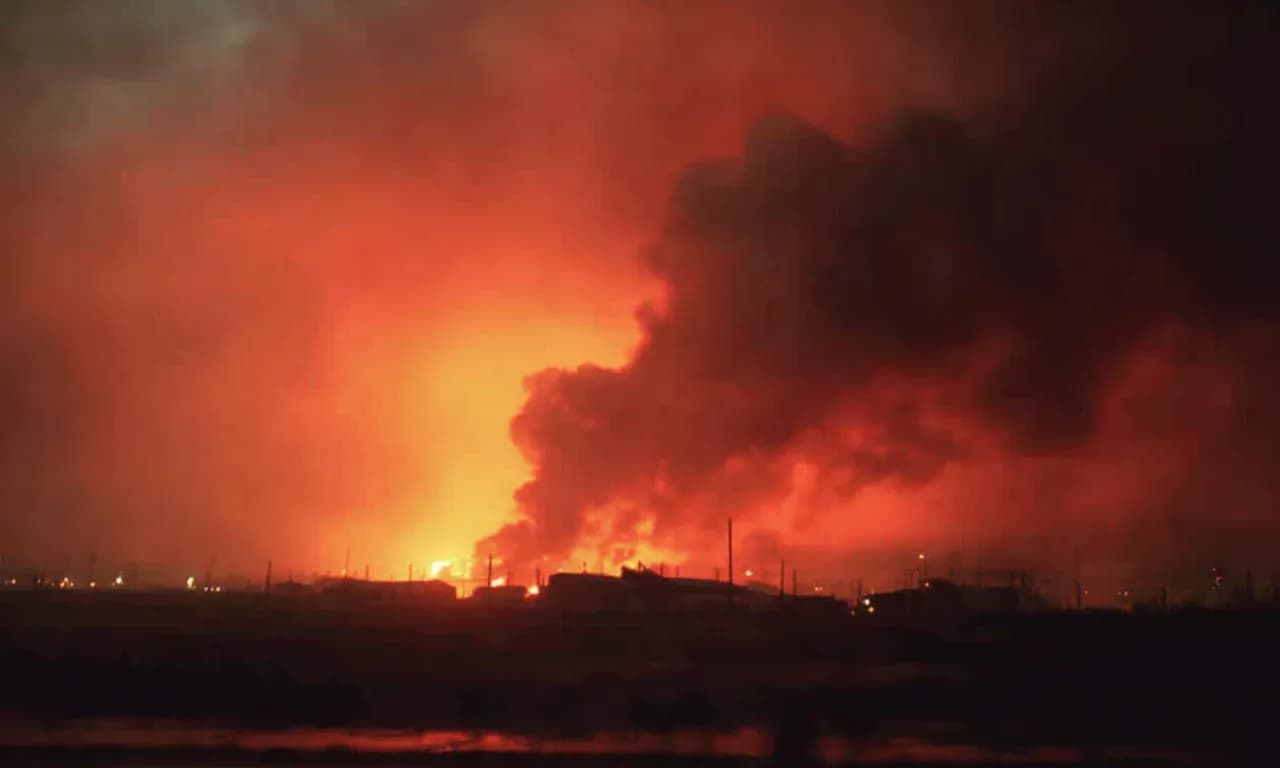
The company has adapted. Last month it secured U.S. liquefied natural gas deliveries routed through a German terminal. It keeps the heating infrastructure alive through ingenuity and improvisation.
But Roman Chmykhun won’t see any of it. Neither will Olha Basenko.
The war’s headline numbers — drones launched, missiles intercepted, kilometers gained or lost — have a way of absorbing the individuals inside them. This story exists to resist that. Two workers. Two names. Two more entries in a register that has reached 316, and is not finished.
The Factory That Made the Bombs Is Burning
At 6:30 a.m. in Chapayevsk, the sirens started.
Residents of this industrial city in Samara Oblast — nearly 900 kilometers from Ukraine’s border — heard the alerts, then heard the explosions. An FP-5 Flamingo cruise missile had found the Promsintez plant: the facility that produces over 30,000 tons of military explosives annually. The material packed into the aerial bombs Russia drops on maternity hospitals. Secondary explosions tore through the production area. Geolocated footage confirmed the strike. A photo circulated showing the Flamingo still in flight, seconds from impact.
The Samara Oblast governor said Ukrainian forces had been “unsuccessfully” repelled. Russian opposition outlet Astra reported that locals had witnessed the explosions themselves and heard the sirens. The governor’s statement and the residents’ accounts did not match.
The same night, FP-1 long-range drones hit the Yaroslavl Oil Refinery — one of Russia’s five largest, processing 15 million tons of petroleum products annually, including the jet fuel powering Russian military aircraft. The facility sits 230 kilometers northeast of Moscow. Geolocated footage showed fires across the production infrastructure and tank farms. Yaroslavl’s governor claimed air defenses downed over 30 Ukrainian drones — without addressing whether any reached their targets.
The Flamingo has been used sparingly since its debut last summer, deployment accelerating since November 2025. It carries a 1,000-kilogram warhead and a stated range of 3,000 kilometers. Zelensky calls it Ukraine’s “most successful missile.” Mass production launched in winter 2025-2026. In February, Flamingos hit the Votkinsk plant in Udmurtia — where Russia builds its Iskander-M ballistic missiles.
Ukraine’s war has arrived in Russia’s industrial heartland.
Not as a threat. As fire.
40% Gone: How Ukraine Is Strangling Russia’s Oil Machine
The Yaroslavl and Samara strikes didn’t happen in isolation. They were the latest beats in a campaign that has quietly achieved something extraordinary: combined with pipeline disruptions and tanker seizures, Ukrainian drone strikes have eliminated roughly 40% of Russia’s oil export capacity — approximately 2 million barrels per day.
The week before March 28 read like a strike log. March 25: an energy terminal at Ust-Luga on the Baltic Sea hit, a Russian military icebreaker damaged in Vyborg. March 26: the Kinef oil refinery in Kirishi, Leningrad Oblast. Overnight March 27: oil terminals at both Ust-Luga and Primorsk — the third consecutive night targeting Leningrad Oblast alone.
Moscow’s answer came not from its military but from its finance ministry. Deputy Prime Minister Alexander Novak instructed the Ministry of Energy to draft a resolution banning all gasoline exports from April 1 through July 31, 2026. Russia imposed a similar ban in September 2025, lifted it for large exporters in January, and is now reaching for it again.
That is an admission. Gasoline prices inside Russia have climbed sharply since autumn 2025. Inflation runs hot. Real incomes fall. Household goods cost more. Suspending export revenues — the stream that funds the war — means the Kremlin is choosing between financing its army and protecting its population from the consequences of that army’s existence.
It cannot fully do both. That tension is now policy.
The timing sharpens the irony. Global oil prices surged past $100 per barrel in early March as the U.S.-Israeli campaign against Iran escalated. Russia earned an additional 6 billion euros in the conflict’s first two weeks alone. Ukrainian strikes have systematically destroyed the infrastructure needed to cash in on those prices.
The Kremlin is being squeezed from both ends simultaneously.
5:10 PM
The Kremlin Turns to Pick Its Own Pockets
The easy money is gone. Now the Kremlin is coming for the rest.
Ukrainian intelligence revealed a systematic new campaign to extract funds from Russia’s domestic business sector — announced publicly as a crackdown on the shadow economy, understood internally as war financing by other means. The distinction matters less than the effect.
The measures arrive in a cluster: advance VAT payments, stricter verification for importers, new licensing requirements for tobacco, criminal liability for cryptocurrency mining, intensified monitoring of cash circulation, informal employment, and the gold market. Russia’s Finance Ministry projects the haul at $7.6 billion to $10 billion annually. Analysts consider that figure optimistic.
The sector being squeezed is already bleeding. Official Russian statistics — not Ukrainian, Russian — show loss-making companies rose to 27.1% of the total in 2025, up from 25.5% the year before, with aggregate losses climbing 7.5%. After a VAT increase to 22%, cashless payments stagnated as businesses shifted to cash to stay beneath official scrutiny. In Russia’s Far East, up to 36% of entrepreneurs are considering closing entirely.
Then came the closed-door meeting. Putin reportedly gathered the business elite and asked for “voluntary contributions” to the war effort. Several oligarchs agreed.
The word voluntary was doing considerable work.
Analysts note the structural trap the Kremlin has built for itself: squeezing businesses reduces profits, which reduces taxes, which shrinks the revenue base the war depends on. Each extraction accelerates the weakness it was meant to patch. Russia is consuming its own economic foundation to finance a war that is destroying it from the outside simultaneously.
The math does not improve with repetition.
Concrete Confessions: The War Comes Home to Chuvashia
They are installing bomb shelters in Cheboksary.
Not near the front. Not in a border region. In the capital of Chuvashia, a republic that sits more than 1,000 kilometers from Ukraine — eleven concrete structures going up around the VNIIR-Progress plant, which builds GNSS guidance modules for Russian drones, missiles, and aerial bombs. Ukraine has already struck the facility. The shelters are an acknowledgment of what comes next.
Locals are not impressed. “Why do we even need them? We do not live near the border,” read one comment on the Serditaya Chuvashia Telegram channel. Others called them “dog kennels,” “public toilets,” corruption schemes in concrete form. The mockery is reflexive — and understandable. Russia’s civil defense network is in wretched condition. As of 2025, only 16% of shelters nationwide were fit for use. The rest have become storage rooms, parking lots, saunas.
But beneath the jokes runs something darker. Chuvashia spent 10.7 billion rubles — nearly $130 million — on payments to soldiers and their families in 2025, a threefold increase from the year before. Recruitment bonuses have reached 2.1 million rubles per enlistee as the regional budget runs a deficit. In 2025, 1,527 Chuvashia residents were confirmed killed in Ukraine. Twice as many as in 2024. The actual number is almost certainly higher.
The people mocking the shelters know all of this. They have been living it — burying neighbors, watching bonuses rise as the bodies multiply, understanding that the distance between Cheboksary and the war has been shrinking for two years.
Now it is measured in eleven concrete boxes outside a guidance system factory.
The war didn’t announce its arrival. It poured itself into molds and hardened overnight.
Russia’s Satellites Are Watching. Iran’s Missiles Follow.
Zelensky stood before reporters in Qatar and read from what appeared to be intelligence reports. Not summaries. Not assessments. Schedules.
March 24: Russian satellites photographed Diego Garcia in the Indian Ocean, Kuwait International Airport, Saudi oil fields. March 25: Prince Sultan Air Base in Saudi Arabia. March 26: the Shaybah oil and gas field, Incirlik Air Base in Turkey, Al Udeid Air Base in Qatar — the facility Zelensky was standing near as he spoke.
Then he read what happened next.
The day after Russian satellites passed over Prince Sultan Air Base, Iran launched an attack that injured 12 U.S. troops and damaged multiple aircraft. Kuwait International Airport was struck by Iranian drones on March 28 itself — the same day Zelensky was disclosing the surveillance pattern that preceded it.
“When objects are being filmed in Ukraine, we always know that they need to be concealed, because an operation is being planned for their destruction,” he said.
The implication was not subtle. Russia — whose oil sanctions Washington has been quietly easing to stabilize energy prices disrupted by the Iran war — has been providing Iran with targeting intelligence used to strike American military personnel. “It’s strange,” Zelensky said. “Sanctions are lifted, and the aggressor provides information to target objects, particularly those of countries that are talking about lifting sanctions.”
President Trump, asked about the intelligence sharing, said it “makes no difference” to Iran’s strike capability.
Twelve injured American troops at Prince Sultan Air Base might assess that differently.
Zelensky’s New Map: Trading Expertise for Survival
He didn’t fly to Qatar to sign papers. He flew to rewire Ukraine’s strategic position.
On March 27, Zelensky signed a major defense cooperation agreement with Saudi Arabia. On March 28, a 10-year defense agreement with Qatar — covering air defenses, counter-drone measures, defense industry development, military training, cybersecurity, artificial intelligence, and control systems. Joint production factories will be built in both countries. A similar agreement with the UAE is days away. Some Ukrainian troops are already stationed there, helping bolster Gulf air defenses against the same Iranian drones and missiles that have been targeting American bases.

These are not acts of charity. They are transactions — and Ukraine is the seller.
Four years of surviving the world’s most intensive drone and missile assault campaign have produced something no classroom or think tank can replicate: operational knowledge. Ukraine’s air defense specialists have learned things under live fire that Gulf states facing Iranian attacks desperately need. “If you want a high-level relationship with Ukraine, it’s not just drones,” Zelensky told reporters. “It’s our specialists. And the specialists are our soldiers.”
The deals address Ukraine’s energy crisis from an unexpected angle too. Iran’s blockade of the Strait of Hormuz has driven fuel and fertilizer prices sharply higher inside Ukraine, squeezing businesses and farmers already stretched thin. Energy cooperation with Gulf producers offers a potential counterweight.
The strategic logic beneath all of it is cold and clear. Washington’s attention and resources are flowing toward Iran. Zelensky is ensuring that when American focus shifts, Ukraine doesn’t stand on a single pillar. The Gulf states signing these agreements now have a direct stake in Ukrainian survival.
That stake was the point of the trip.
Finland to Washington: We’re Watching the Weapons
The question inside NATO is simple and uncomfortable: when America needs missiles for Iran, does Ukraine get what was promised?
Finnish Defense Minister Antti Häkkänen decided to say out loud what others were only saying in private. Speaking to EuroNews on March 27, he announced that Finland intends to verify that American weapons procured through NATO’s Prioritised Ukraine Requirements List — PURL — actually reach Ukraine. “What has been promised to Ukraine must go to Ukraine. That is clear,” he said. He called for Europe to dramatically accelerate stockpiles and defense production, and stated plainly that the U.S.-Israeli war on Iran was not a NATO war. Not a European war. Not Finland’s war.
NATO Spokesperson Alison Hart offered reassurance: “everything that NATO allies and partners paid for through PURL has been delivered or continues to be delivered to Ukraine.” The statement was precise. It did not address what happens next.
The specific anxiety centers on air defense interceptor missiles — the same munitions being consumed at high rates in the Iran campaign. Ukraine needs them to survive Russian strikes. The U.S. military needs them to prosecute a separate war simultaneously. The stockpiles are not infinite.
Trump, asked about potential redirections at a cabinet meeting on March 26, was unbothered. “We do that all the time. We have tremendous amounts of ammunition… and sometimes we take from one and use it for another.”
He said it casually. In Kyiv, they heard it carefully.
Blood for Meters: The Front That Bent but Did Not Break
Russia attacked everywhere on March 28. It broke through nowhere.
The front absorbed the pressure sector by sector, each axis telling a variation of the same story: assault, destruction, retreat, repeat.
In Sumy Oblast, Russian forces pushed toward Tovstodubove, Ulanove, Shostka, Kindratkivka, and Nova Sich. They did not advance. Ukrainian forces struck back — hitting a fuel and lubricants depot near Unecha in Bryansk Oblast, 62 kilometers behind Russian lines.
In Kharkiv Oblast, attacks near Vovchansk and a dozen other settlements produced nothing. The Kupyansk direction revealed something more telling: Ukrainian forces reported Russian troops have largely exhausted their current resources and are now waiting — specifically for spring foliage to provide concealment before intensifying. Twenty Russian servicemembers remain inside Kupyansk itself. They probe with motorcycles, quad bikes, and ATVs. They are buying time, not taking ground.
Near Lyman, the calculus shifted in Ukraine’s favor. After a failed battalion-sized mechanized assault on March 19, Russian forces dramatically reduced tempo. Ukrainian forces advanced in eastern Lyman and counterattacked near the Serebryanske forest. Russia reverted to small-group infiltration — the tactical signature of an offensive that has lost its momentum.
Pokrovsk remained the most pressured axis. Russian forces attacked simultaneously toward Hryshyne, Rodynske, Myrnohrad, and Udachne, using smokescreens and poor weather to blind Ukrainian drone reconnaissance. In Dobropillya, they adopted a new tactic: hiding inside damaged buildings to evade surveillance. The rubble of the city they are destroying is now their cover.
In Oleksandrivka, the largest single Russian mechanized assault of 2026 in that sector arrived — a tank, quad bikes, motorcycles. Ukrainian forces destroyed every vehicle and killed 27 servicemembers.
Zaporizhzhia delivered the day’s starkest arithmetic. A company-sized assault: all 10 armored fighting vehicles destroyed, infantry retreating on foot. A second assault toward Mala Tokmachka — a tank, an IFV, two ATVs exploiting fog — all destroyed. Ten Russians killed, ten wounded.
Ukrainian counter-strike operations ran the length of the front. Drone operators hit the occupied Donetsk City Airport, where satellite imagery showed Russian forces building at least 11 new drone launch structures. Fuel and ammunition depots burned near Donetsk City, Manhush, Hlyboke, and Prokhorivka. An electronic warfare depot was struck in Luhanske. A Russian Tor-M1 air defense system was destroyed in occupied Zaporizhzhia Oblast. In Kherson Oblast, Ukrainian forces hit a drone control point near Nova Kakhovka, a command post near Lyubymivka, an equipment depot in Blahovishchenka. A materiel depot in occupied Crimea near Mizhhirya — 225 kilometers from the front — was also struck.
Russia sent men and machines. Ukraine sent them back as wreckage.
On a Manhattan Sidewalk, Pussy Riot Takes on a Wi-Fi Company
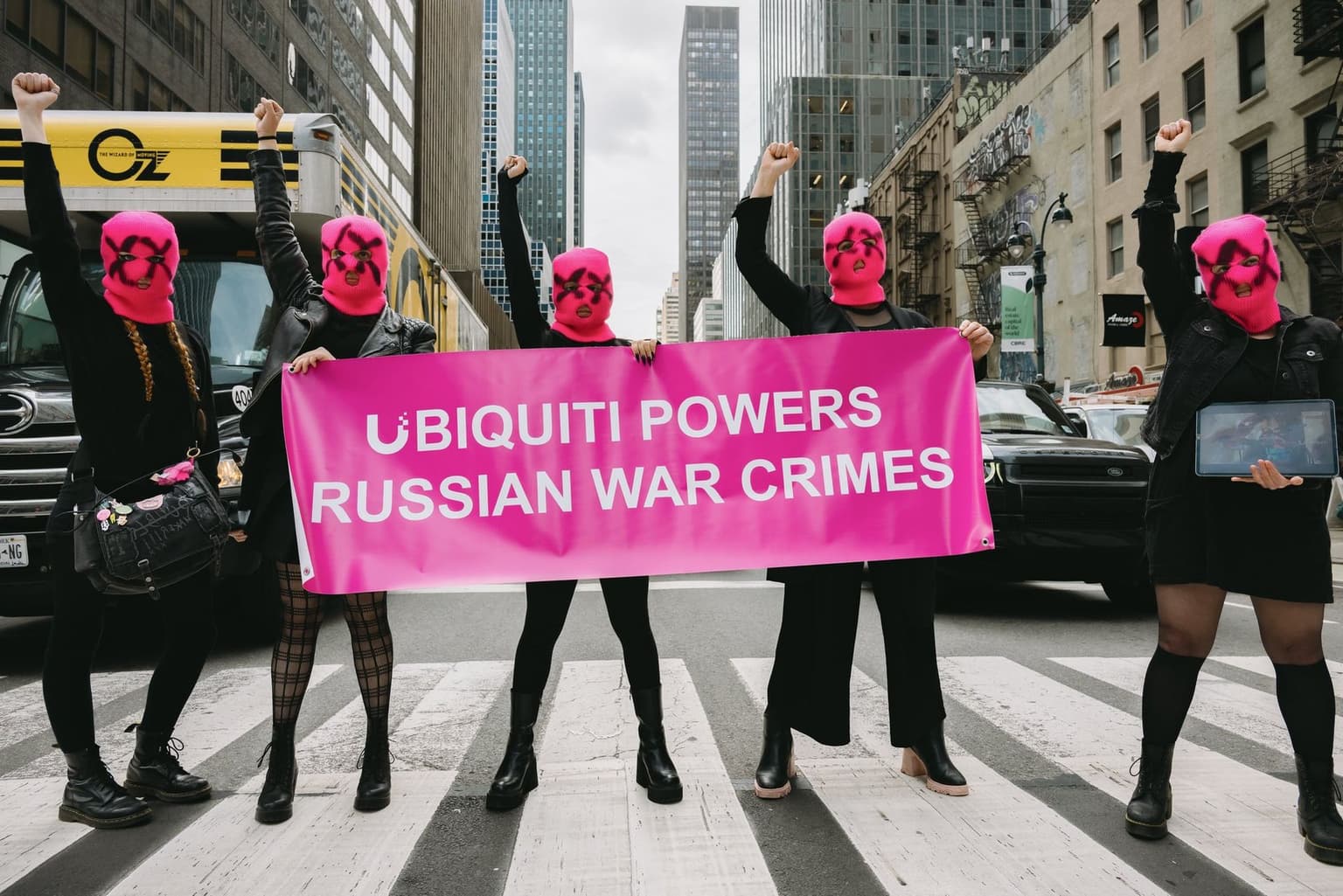
While Russian and Ukrainian forces traded fire across a thousand kilometers of front line, Nadya Tolokonnikova stood on a Manhattan sidewalk outside Ubiquiti’s headquarters and pressed play.
The footage she showed came from Russian military Telegram channels: soldiers in the field using Ubiquiti Wi-Fi bridges, step-by-step installation guides for forward positions, field manuals in Russian. After SpaceX cut Starlink access in early February — a move that gutted Russian frontline communications — Russian forces pivoted to Wi-Fi bridges to push connectivity toward the front. Ubiquiti equipment appeared prominently in that workaround. Not a perfect substitute for Starlink, but functional enough to matter.
Pussy Riot’s demand was specific: acknowledge that Russian forces are using your products, and work with Ukraine to stop it. The company had history here. In 2014, Ubiquiti paid more than $500,000 to settle U.S. allegations that it violated Iran sanctions through overseas intermediaries. The pattern of looking away from where its equipment ends up was not new.
Ubiquiti did not respond to press inquiries.
What did respond, hours after the protest, was Square — which deactivated the group’s merchandise sales account without explanation. Tolokonnikova’s reaction was dry: “Going after Russian feminist activists in exile, but not after Russian war criminals. Cringe.”
One tech company’s equipment helps Russian soldiers communicate on the front line. Another tech company’s payment platform moves against the women protesting it. Ubiquiti stays silent.
The war has a way of finding its way into every corner of the global economy — including the ones that would prefer not to notice.
What March 28 Revealed
The circles kept expanding.
A war that began on Ukraine’s eastern plains now shapes gasoline prices in Russian cities, defense agreements in Gulf capitals, alliance politics in Helsinki, and a protest on a Manhattan sidewalk. It shapes mortality rates in Chuvashia. It shapes the split-second calculation of a nurse in Odesa deciding whether she can carry one more infant to the shelter before the next drone arrives.
March 28 drew the lines clearly. Russia struck a maternity ward and achieved nothing strategically. Ukraine struck the factory making the bombs used against that maternity ward and degraded Moscow’s capacity to repeat it. Moscow responded by banning its own gasoline exports — an admission, written into policy, that Ukrainian strikes are working. Zelensky returned from Qatar with a decade-long defense partnership and an intelligence disclosure that reframed Russia’s role in the Iran war for anyone still uncertain about it. Finland announced it would verify that promised weapons actually reach Ukraine.
On the front lines, Russia attacked everywhere and broke through nowhere. The lines held.
One thread ran through all of it — from the maternity ward in Odesa to the burning factory in Samara to the concrete shelters in Cheboksary to the signed agreements in Doha. Russia launched this war believing Ukraine would bear its costs alone. Three years in, the costs are distributed across continents, currencies, satellite orbits, and the regional budgets of republics a thousand kilometers from the front.
Russia has not yet absorbed that lesson fully.
The babies born in Odesa’s underground shelters that night will outlive the calculus that targeted them. The question March 28 left open — the one every day of this war leaves open — is how many more must be born that way first.
Prayer For Ukraine
- Protection Over the Maternity Ward and Every Civilian Shelter
Lord, last night nurses carried newborns through darkness to underground shelters while drones struck the roof above them. Twenty-two mothers labored. Nineteen infants lay in their wards. All survived because Your grace moved faster than Russian steel. We ask You to continue that protection — over every hospital, every shelter, every civilian who has learned to measure safety in seconds. Guard the vulnerable whom this war targets deliberately. Let no more children enter the world beneath the sound of sirens.
- Comfort for the Families of Roman Chmykhun and Olha Basenko
Father, today we speak their names: Roman Chmykhun, 55, a process operator in Poltava Oblast, and Olha Basenko, a worker in Kherson. They kept Ukraine’s heat and light alive and were killed for it. They are two of 316 Naftogaz workers Russia has taken. We ask Your comfort for their families — for the grief that does not make the news, that accumulates quietly behind the statistics. Hold them. Remind them that their loved ones’ lives mattered beyond the ledger that records their loss.
- Wisdom for Zelensky and Ukraine’s Allies
Lord, grant wisdom to President Zelensky as he builds new alliances across Gulf capitals, navigates Washington’s shifting attention, and discloses intelligence that implicates Russia in attacks on American soldiers. Give him clarity of judgment and strength of purpose. Grant wisdom equally to the leaders of Finland, Qatar, Saudi Arabia, and every nation choosing where to stand. Let their commitments hold. Let what has been promised reach those it was promised to.
- Justice for the Patterns Russia Repeats
God of justice, Russia has struck maternity hospitals before. Multiple times. Across multiple years. We do not ask You to overlook this — we ask You to see it fully and respond. We ask restraint upon those who order these strikes and accountability for those who carry them out. We ask that the calculus that targets mothers and newborns be broken — not deferred, not managed, but broken. Let justice move as surely as those nurses moved through the dark.
- Endurance for a Nation That Has Not Broken
Lord, the front lines bent on March 28 and did not break. Ukrainian defenders held every axis — Sumy, Kharkiv, Lyman, Pokrovsk, Zaporizhzhia — absorbing assault after assault and returning fire. We ask You to sustain that endurance: in the soldiers concealing themselves from Russian drones, in the drone operators striking back across occupied territory, in the engineers keeping gas flowing through a network Russia has struck 1,399 times. Ukraine has not broken. Sustain what has not broken. Restore what has been damaged. And Lord — in Your mercy, in Your justice, in Your time — bring this war to its end.