
In Tehran, U.S. and Israeli missiles killed Iran’s supreme leader, igniting a regional firestorm. In Moscow, the Kremlin watched its most important drone supplier collapse in real time. In Ukraine, 105 Russian drones still crossed the night sky. The global chessboard flipped — and the war did not blink.
The Day’s Reckoning
Before dawn, Tehran was already burning.
U.S. and Israeli missiles tore through the Iranian capital. Ayatollah Ali Khamenei — Russia’s most important drone partner, the patron of the Shahed factories that fed Moscow’s air war — was killed when his compound collapsed into rubble. Senior Revolutionary Guard commanders and nuclear officials died with him. By sunrise, Iranian missiles were streaking toward U.S. bases across the Gulf. The Middle East was on fire.
Three thousand kilometers north, Russia’s war machine kept to schedule.
An Iskander-M ballistic missile lifted off from Voronezh Oblast. Then the swarm: 105 drones — Shaheds, Gerberas, Italmas — launched from six directions. In Sumy Oblast, four civilians were killed: two young men, 21 and 31, and two women, 67 and 72. In Kharkiv Oblast, a nine-year-old girl and a four-year-old boy were among seven wounded. A drone struck a locomotive at a train station in Dnipropetrovsk Oblast. In Odesa, a three-year-old was carried to hospital from a bombed port. By morning, the ledger showed at least 29 civilians hit in a single night.
Russia’s own territory was not quiet. A Ukrainian drone ignited a tank at the Albashneft refinery in Krasnodar Krai. Thirty-nine firefighters fought the blaze. In Belgorod Oblast, a Ukrainian Darts drone destroyed a Pantsir air defense system.
And in Kyiv, a quieter signal surfaced: Russia had privately indicated it would accept U.S.-backed security guarantees for Ukraine.
The supreme leader of Iran was dead. A regional crisis had erupted. Oil burned. Children bled. And the war in Ukraine did not pause.
February 28, 2026 — the day the chessboard flipped, and the front lines barely moved.
Tehran Before Dawn: The Strike That Killed a Supreme Leader
The missiles hit before sunrise.
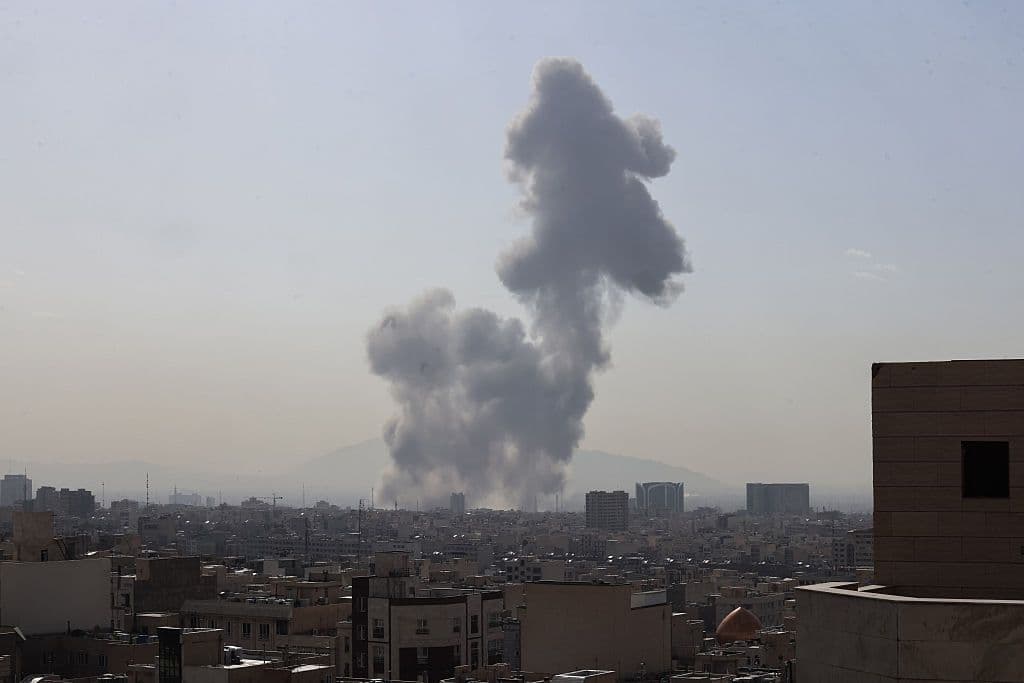
In the early hours of February 28, the United States and Israel launched coordinated strikes on Iran, calling them preemptive — a move to neutralize what Washington described as imminent nuclear and ballistic missile threats. Hours later, President Donald Trump confirmed U.S. involvement, declaring the mission aimed to eliminate threats to Americans, destroy Iran’s missiles, and annihilate its navy. He called it a “noble mission.”
Tehran denied everything. Officials dismissed Israeli claims as “mental warfare.” State media insisted Ayatollah Ali Khamenei was unharmed.
By March 1, those denials collapsed. Iranian state media confirmed Khamenei was dead. His daughter, granddaughter, daughter-in-law, and son-in-law were killed alongside him. Trump said “most” of Iran’s senior leadership was “gone” and later called the operation a “success” in an NBC News interview. Netanyahu declared senior Revolutionary Guard commanders and nuclear officials had been eliminated — and that operations would continue.
Iran’s retaliation was immediate. Missiles and drones targeted U.S.-linked bases and infrastructure across the Gulf — in the UAE, Qatar, Bahrain, and Kuwait. Air defenses intercepted many. Some struck. A luxury hotel in Dubai was hit. Residential towers in Bahrain were damaged by falling debris. It was one of the widest regional escalations in years.
The strikes followed weeks of U.S. military buildup and failed Geneva nuclear talks on February 26. U.S. officials had claimed Iran could assemble a nuclear weapon within days. Trump had vowed on February 25 never to allow it.
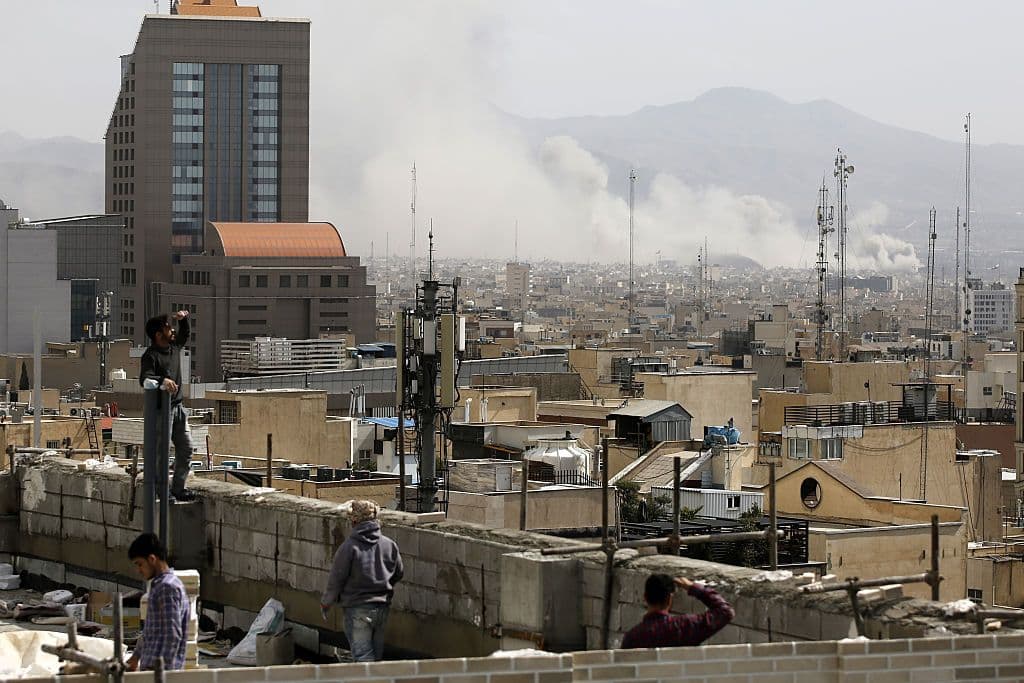
Inside Iran, protests already fueled by economic collapse now collided with leadership decapitation. As of February 23, the Iranian Human Rights Activist News Agency reported 7,007 deaths, 25,846 injuries, and 53,777 arrests.
Experts cautioned against assuming regime collapse. The security apparatus remains intact. No successor had been designated.
Tehran’s future is uncertain.
But the region woke up to a different map.
The Ally That Burned: Moscow Watches Its Drone Lifeline Collapse
The news from Tehran hit Moscow like a punch the Kremlin could neither block nor return.
Iran was never just a partner. It was the foundry of Russia’s air war. From the first months of the invasion, Shahed drones flowed from Tehran to Moscow, rebranded as Geran-1 and Geran-2, and launched in relentless waves at Ukrainian cities. President Volodymyr Zelensky says more than 57,000 Shahed-type drones have been fired at Ukraine since 2022. Even as Russia expanded domestic production and leaned on North Korea for munitions, the Iranian template remained the backbone of its terror campaign against civilian infrastructure.
Now that backbone is in chaos.
Foreign Minister Sergey Lavrov phoned Iranian counterpart Abbas Araghchi to condemn what Moscow called “an unprovoked act of armed aggression against a sovereign and independent state.” The phrase did not go unnoticed in Kyiv. The Foreign Ministry warned of global destabilization and accused Israel of misleading Russia about its intentions. Lavrov offered Moscow as mediator — a country waging its own invasion presenting itself as peacebroker.
Dmitry Medvedev posted that Trump the “peacekeeper” had “shown his true colors.” Leonid Slutsky and Alexei Chepa demanded UN Security Council action. Chepa openly hoped Washington would become so consumed by Iran that it would “forget” Ukraine — and delay any peace deal.
What they did not say: Russia cannot meaningfully help Iran. The war in Ukraine absorbs its strength. It can condemn. It cannot reverse events.
Iran may become the second major ally Moscow loses in 2026, after Venezuela’s Nicolas Maduro was removed by U.S. action in January. Ryhor Nizhnikau called Iran’s potential fall “a major blow” reputationally. Elena Davlikanova warned uncertainty alone damages Moscow’s standing.
The alliance network Putin spent years cultivating is fraying.
And the Kremlin can only watch it unravel.
Measured Applause: Kyiv Backs the Strike, Warns Against the Fire
Kyiv did not hesitate.
Within hours of the strikes on Tehran, Ukraine’s Foreign Ministry issued a statement that was both sharp and deliberate. The Iranian regime, it said, “had every opportunity to prevent a violent scenario.” Responsibility, in Kyiv’s view, lay squarely with Tehran. At the same time, the ministry separated the rulers from the ruled, expressing solidarity with the Iranian people and their “legitimate desire to live in security, freedom and prosperity.”
The grievance was personal.
Iran’s alliance with Moscow had not been abstract diplomacy. It had been drones — thousands of them. Shaheds adapted into Gerans. Night after night over Ukrainian hospitals, apartment blocks, and power plants. Kyiv called those supply chains “a gross violation of international law.”
President Volodymyr Zelensky had already signaled his position weeks earlier, meeting Reza Pahlavi at the Munich Security Conference on February 13 and condemning the Tehran-Moscow axis. On February 28, he pointed to the number: more than 57,000 Shahed-type drones launched at Ukraine since 2022. “It is fair,” he said, “to give the Iranian people a chance to rid themselves of a terrorist regime.”
But even in support, he set a boundary.
“It is important to preserve as many lives as possible,” Zelensky added, cautioning against escalation into a broader regional war. Ukraine, four years into its own fight for survival, was not celebrating destruction for its own sake.
The backing was clear.
The tone was controlled.
Ukraine understands what unchecked fire looks like.
The Swarm at 2 A.M.: 105 Drones and a Country Under Siege
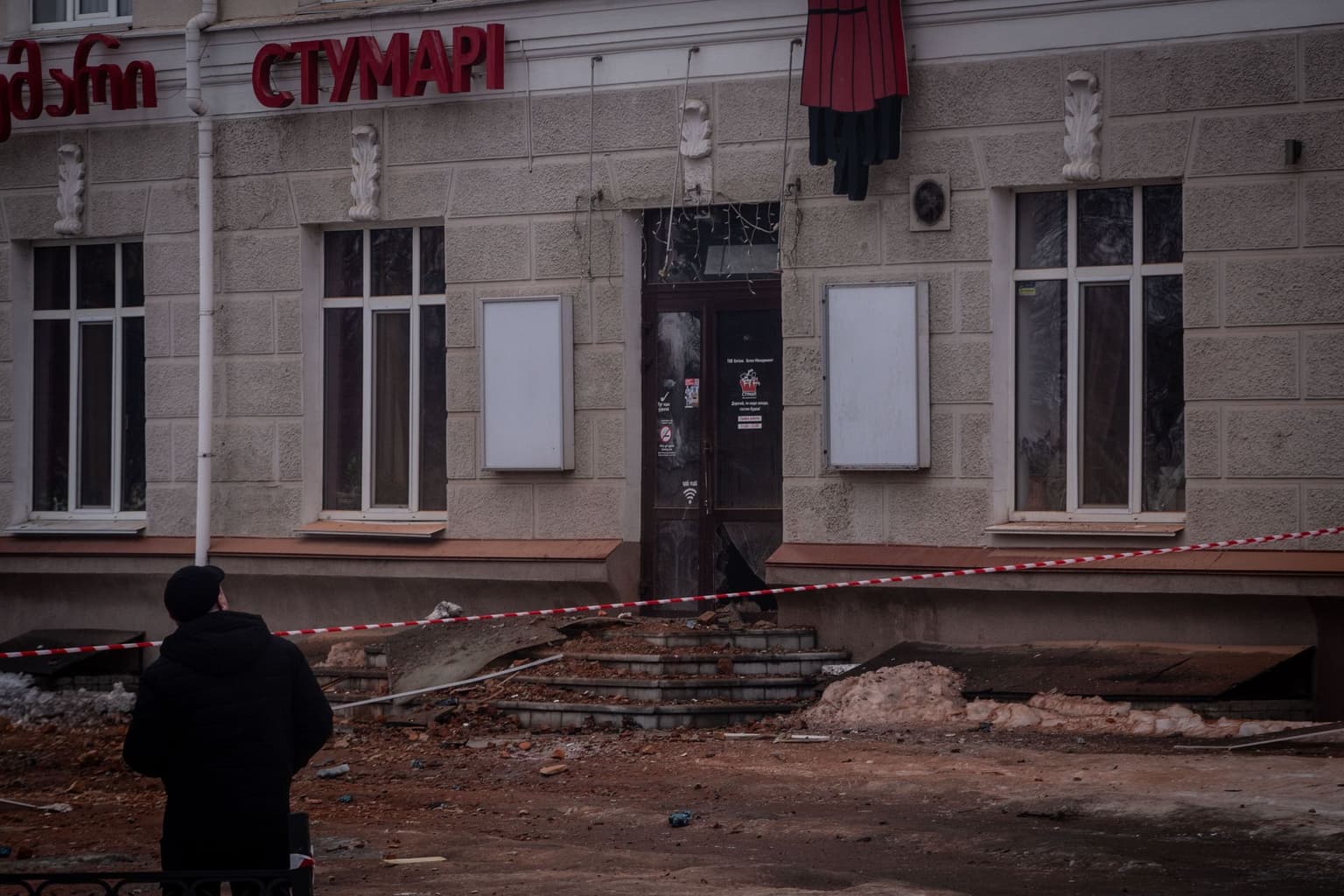
A restaurant suffers damage after a Russian drone attack on a hotel in the center of Sumy, Ukraine. (Photo by Francisco Richart/Anadolu via Getty Images)
The radar screens lit up before midnight.
An Iskander-M ballistic missile lifted off from Voronezh Oblast. Then the swarm followed — 105 drones, Shahed-type, Gerbera-type, Italmas-type — launched from six directions at once: Bryansk, Kursk, and Oryol; Shatalovo in Smolensk Oblast; Primorsko-Akhtarsk in Krasnodar Krai; Millerovo in Rostov Oblast; occupied Hvardiiske in Crimea; and Donetsk City.
Ukrainian air defense crews worked through the dark. By 8 a.m., 96 drones had been shot down.
Nine got through.
Six drones and falling debris struck seven locations.
In Sumy Oblast, four people were killed: two young men, 21 and 31, and two women, 67 and 72. In Kharkiv Oblast, seven were wounded, including a nine-year-old girl and a four-year-old boy. Three more were wounded in Donetsk Oblast. Eight in Kherson Oblast.
In Odesa, drones hit civilian port infrastructure. A three-year-old girl and a 44-year-old man were taken to hospital in stable condition. In Dnipropetrovsk Oblast, a drone struck a train station, destroying an electronic locomotive and injuring its driver. High-rise buildings and transport infrastructure in Dnipro were damaged. In Nikopol district, a car burned and a private house was hit. A power line was struck in Synelnykivskyi district.
Deputy Prime Minister Oleksii Kuleba called it what it was: a systematic attempt to disrupt civilian logistics — movement, evacuation, supply.
At least four dead. Twenty-five wounded. In one night.
Ninety-six interceptions. Nine penetrations.
The arithmetic of air defense is relentless — brave, precise, and never quite complete.
Oil Tanks in Flames: Ukraine Reaches 250 Kilometers Inside Russia
The fire in Novominskaya was visible before sunrise.
A Ukrainian drone reached the Albashneft mini-refinery in Krasnodar Krai — 250 kilometers from the front line, a facility Kyiv had already struck in February 2025. This time, falling debris ignited a tank. Flames spread across roughly 150 square meters. Thirty-nine firefighters rushed in. By 8 a.m., the blaze was extinguished. No casualties were reported.
Russia said it intercepted 97 Ukrainian drones overnight: 40 over occupied Crimea, 22 over Bryansk, 16 over Belgorod, 10 over the Black Sea, and at least four in Krasnodar Krai.
The refinery was not the only target.
Geolocated footage published February 28 showed a Ukrainian Darts drone striking a Russian Pantsir-S1 air defense system in Dubovoe, Belgorod Oblast — about 28 kilometers inside Russian territory. The Ukrainian General Staff also reported a strike on a Russian manpower concentration near Dronovka, just two kilometers from the international border.
Ukraine does not frame these attacks as symbolic. It calls them strategic. Oil profits finance the Kremlin’s war machine. Refineries supply military logistics. Fuel moves tanks. Fuel powers bombers.
Krasnodar Krai — across the Kerch Strait from occupied Crimea — has become a recurring target. Each hit forces Russian engineers to make a choice: repair what burned, or harden against the next drone.
The war no longer stops at the border.
And Russia’s rear areas are no longer rear.
The Sentence That Slipped Through: Moscow Signals on U.S. Guarantees
Amid the fire and noise, one sentence landed quietly.
Kyrylo Budanov, head of Ukraine’s President’s Office, told the national Yedyni Novyny telethon that during past negotiations, Russia had directly informed Ukrainian negotiators it would accept U.S.-backed security guarantees for Ukraine. Moscow, he added, understands it may be “forced” to accept them.
The remark came two days after U.S. and Ukrainian delegations met in Geneva — without Russia — to discuss postwar recovery and prepare for a subsequent round that would include Moscow. Budanov said he sees “progress” on the guarantees question, implying the Kremlin may be more flexible in private than in public.
The gap between those two arenas remains wide.
Russia has repeatedly rejected NATO membership for Ukraine and opposed the deployment of European peacekeepers — both seen as the strongest deterrents against renewed aggression. Moscow has demanded security guarantees of its own. And the escalating crisis with Iran now threatens to scramble diplomatic timelines entirely. Kremlin official Alexei Chepa openly predicted that the Middle East conflict would delay any Ukraine peace agreement.
But Budanov’s disclosure was not routine commentary. It was a senior Ukrainian official publicly describing a back-channel acknowledgment from Moscow: that American guarantees, specifically, are not off the table.
Four years into a war built on maximalist demands and public defiance, that admission matters.
The architecture of a possible settlement is faint, unfinished, and fragile.
But it is no longer invisible.
The Next Hammer Blow: Russia Masses for a Spring Assault on the Fortress Belt
While diplomats spoke of guarantees, Russian infantry moved.
A Ukrainian servicemember in the Slovyansk direction reported reinforcements arriving and assault tempo rising — infantry-led attacks, wave after wave, grinding forward at high cost. The soldier’s assessment was blunt: Russia is trying to encircle Slovyansk and Kramatorsk, the twin cities anchoring Ukrainian-held Donetsk Oblast.
ISW analysts see the same pattern from above. Reinforcements in the northeast. Increased pressure along a wide arc. A likely priority offensive against Ukraine’s “Fortress Belt” in a Spring-Summer 2026 campaign.
The Fortress Belt is not symbolic terrain. It is Ukraine’s most heavily fortified defensive line in Donetsk, built over years across dense urban ground designed to fracture attacking forces. Breaking it would mark Russia’s most consequential advance since Avdiivka fell.
The attacks now stretch across geography: near Lyman; northwest near Novoselivka, Svyatohirsk, Yarova, and Sosnove; north near Drobysheve and Stavky; northeast near Dronivka; east near Zarichne; south toward Staryi Karavan and Brusivka; northeast near Zakitne; east near Siversk, Kryva Luka, and Riznykivka; southeast near Fedorivka Druha.
Even Russian milbloggers are uncertain. One claimed a flag over Drobysheve but admitted fighting continues, comparing it to Kupyansk — a city Moscow has “taken” multiple times without securing it. Another rejected the seizure outright.
Reinforcements arriving. Assaults intensifying. Flags raised, then questioned.
The shape of the coming offensive is becoming clearer.
The question is whether the Fortress Belt will hold.
Eight Axes of Pressure: Pokrovsk and the Front That Never Sleeps
The Donetsk front did not go quiet.
Near Pokrovsk, Russian forces pressed along at least eight axes — toward the city itself, northwest to Hryshyne and Novooleksandrivka, north near Rodynske, Bilytske, and Shevchenko, east near Myrnohrad, and southwest near Udachne, Molodetske, and Novopidhorodne. Most of it failed.
The Ukrainian General Staff reported a strike on a Russian manpower concentration near Rodynske. Geolocated footage showed a Ukrainian drone destroying a BM-21 Grad in Novoekonomichne, eight kilometers from the line.
A Ukrainian drone officer in the sector described the pattern: when the ground freezes, Russian troops move in small groups with light armored vehicles. When the thaw turns fields to swamp, vehicles disappear and infantry absorbs the losses. Winter’s end will change the rhythm again.
Near Dobropillya, Russian probes toward Kucheriv Yar, Novyi Donbas, Toretske, and Nove Shakhove produced no confirmed gains. Around Kostyantynivka-Druzhkivka, both sides edged forward — Ukrainian advances in southeastern Kostyantynivka confirmed by geolocated footage, Russian marginal gains to the east. A FAB-3000 glide bomb slammed into southwestern Kostyantynivka, a weapon capable of leveling entire city blocks.
In the Novopavlivka direction, attacks were repulsed. Ukraine’s 9th Army Corps denied Moscow’s claim that Bilyakivka had fallen. In the Oleksandrivka direction, Russian forces attacked near Ternove and toward Orestopil. A Ukrainian brigade spokesperson described newly rotated Russian recruits — young, unfamiliar with the terrain. Command responds the same way each time: attritional infantry assaults. Melting ice is slowing them for now.
Ukraine struck back deep. The General Staff reported hits on a logistics depot near occupied Bahatyr (14 km out), a forward command post of the 127th Motorized Rifle Division near Orlynske (30 km), a fuel depot near Novoamvrosiivske (90 km), an ammunition depot near Amvrosiivka (95 km), and a manpower concentration near Berezove. National Guard Commander Oleksandr Pivnenko confirmed two Russian BM-21 Grad systems were struck in occupied Donetsk Oblast, both set ablaze.
The line bends. It does not break.
The Flag and the Fine Print: What Really Happened in Zaporizhzhia
A soldier climbs a rooftop. A flag goes up. Moscow declares victory.
The Russian Ministry of Defense announced that elements of the 60th Separate Motorized Rifle Brigade had seized Hirke, west of Hulyaipole in Zaporizhzhia Oblast. Geolocated footage showed a lone servicemember raising a Russian flag — proof, the ministry implied, of control.
ISW read the footage differently.
The video, analysts assessed, showed what appeared to be an infiltration mission — a reconnaissance-in-force that reached Hirke without shifting the forward edge of the battle area. One soldier. One flag. No confirmed change in terrain control.
ISW concluded that Russian forces had likely seized nearby settlements — Tsvitkove, Svyatopetrivka, Krynychne, Staroukrainka, and Zaliznychne — on an earlier date. The image from Hirke did not alter that assessment.
Ukraine, meanwhile, made a documented move of its own. Geolocated footage confirmed a Ukrainian advance in northern Dobropillya, northwest of Hulyaipole. Fighting rippled through more than a dozen settlements across the direction.
Russia responded with weight. A FAB-3000 guided aerial bomb struck the T-0803 bridge over the Kinska River between Orikhiv and Preobrazhenka — a logistics artery feeding Ukrainian positions. Drone operators from the Russian 37th Motorized Rifle Brigade were also seen interdicting supply traffic along the T-0401 Pokrovske-Hulyaipole highway.
The front here is not collapsing.
It is grinding.
Flags go up. Bombs fall. Supply lines burn. Gains are measured, disputed, sometimes reversed.
In Zaporizhzhia, the difference between symbolism and control is the difference between a photograph and a map.
A Nine-Year-Old and a Four-Year-Old: The War at the Border
The air war has statistics.
On this day, it had two small faces.
A nine-year-old girl. A four-year-old boy. Both among seven people wounded in Kharkiv Oblast as Russian drones and missiles struck again.
Across the northern Kharkiv front, Russian forces pressed near Vovchansk, Vovchanski Khutory, Zybyne, Symynivka, Zelene, Hrafske, Starytsya, Synelnykove, and toward Izbytske — a steady attempt to push Ukrainian defenders farther from the border and bring Kharkiv City, Ukraine’s second largest, back within tube artillery range.
The Russian Ministry of Defense claimed elements of the 9th Motorized Rifle Regiment had seized Neskuchne northeast of the city. The claim remained unconfirmed.
Further east and south, Russian forces attacked near Chuhunivka southeast of Velykyi Burluk without advancing. They probed along multiple axes in the Kupyansk and Borova directions — near Kupyansk-Vuzlovyi, Kurylivka, Novoplatonivka, Bohuslavka, Borivska Andriivka, Kruhlyakivka, Chervonyi Stav, Novoyehorivka, and Oleksandrivka. No confirmed gains.
In Sumy Oblast, attacks continued near Oleksiivka, Andriivka, Varachyne, and Kostyantynivka. Drone operators from Russia’s Rubikon Center for Advanced Unmanned Technologies and elements of the 1434th Akhmat-Chechnya Regiment were identified in the direction.
Ukraine answered in kind. Geolocated footage confirmed a Darts drone strike on a Pantsir-S1 air defense system in Belgorod Oblast. The General Staff reported a strike on a Russian manpower concentration near Dronovka.
But the ledger begins with children.
Border villages trade artillery for meters. Ministries trade claims for headlines. Drones trade targets across the line.
And in Kharkiv, two families wait beside hospital beds.
The Order and the Gas: Vovchansk’s Chemical Record
This accusation comes with a name.
Ukraine’s Security Service says Colonel Ruslan Nazarenko — commander of Russia’s 136th Motorized Rifle Brigade, 58th Combined Arms Army, Southern Military District — ordered subordinates to deploy K-51 and RG-Vo aerosol grenades loaded with CS and CN gas against Ukrainian positions in Vovchansk, Kharkiv Oblast.
The method: drone drops.
The period: at least 14 incidents between September 2024 and June 2025.
Eight specific soldiers were identified as having used the munitions.
CS and CN are riot control agents — chemicals intended for crowd dispersal. Under the Chemical Weapons Convention, which Russia has signed, their use in warfare is prohibited.
The SBU’s findings fit a broader pattern. ISW has observed a significant increase in Russia’s use of riot control agents against Ukrainian forces throughout 2024 and 2025, describing it as systematic and in violation of international law.
Russia has not acknowledged the charges.
It rarely does.
But this report is specific: commander, brigade, munitions, dates, personnel.
War crimes documentation is built this way — detail by detail.
The battlefield will not shift because of this disclosure.
But the record grows.
And records endure.
The Chips Behind the Missiles: Kyiv Targets Russia’s Smuggling Web
The decree did not mention rockets.
It targeted the parts inside them.
President Volodymyr Zelensky signed sanctions against ten Russian logistics companies, including Russian DPD service and Freightlink. Their alleged role: moving Western-sourced microelectronics into Russian-occupied territories and military supply chains, skirting export controls.
“It is not normal for a microchip to be sent by mail from Germany to Moscow,” said Vladislav Vlasiuk, the president’s representative on sanctions policy.
The network ran deeper than couriers. Russian postal services had established parallel import channels for dual-use goods — electronics and drone components declared civilian, assembled as weapons. Some entities repurposed captured Ukrposhta facilities in occupied areas, converting Ukrainian post offices into hubs for Russian passports and military summonses.
The scale is not theoretical. Russian missiles recovered after October strikes on Ukraine were found to contain more than 100,000 foreign-made components — parts traced to American, German, and British companies.
Moscow built an architecture to evade sanctions. It routes chips through shell firms, postal channels, shadow intermediaries. Ukraine is trying to dismantle that system piece by piece, decree by decree — while sharing intelligence with Western allies to seal the supply lines at their source.
Missiles fall from the sky.
Microchips arrive in padded envelopes.
Kyiv is now chasing the envelopes.
The Fleet That Slipped Back: Russia Hides in Sevastopol
The boats moved quietly.
According to the Atesh partisan group operating in occupied Crimea, Russian forces pulled several Hrachonok-class anti-sabotage vessels of the 102nd Separate Naval Spetsnaz Detachment out of Kostyantynivska Bay and back into Sevastopol’s territorial waters. The reason: protection from Ukrainian drone strikes.
The vessels are reportedly being concealed beneath infrastructure to shield them from aerial observation. The 102nd Detachment is tasked with guarding the Kerch Strait Bridge against underwater sabotage. Now the units meant to defend Russia’s most symbolic span are themselves seeking cover from Ukrainian drones.
Initiative in the Black Sea has shifted before. This is another signal of it.
Further west along the southern axis, Ukrainian forces struck a Russian logistics warehouse near Kalanchak and a fuel depot near Myrne in occupied Kherson Oblast. There were no confirmed ground clashes in the Kherson direction.
Russian drone operators from the 98th VDV Division continued targeting Ukrainian energy infrastructure in the region. In the broader Zaporizhzhia zone, Russian forces attacked northeast of Orikhiv near Myrne and Hulyaipilske, west near Stepnohirsk, and northwest near Mahdalynivka, Lukyanivske, and Zapasne.
They did not advance.
Ships withdraw. Warehouses burn. Drones hunt above both shores.
The Black Sea remains contested — and no harbor feels permanent.
What the Day Revealed
Two realities moved in opposite directions.
In Tehran, a regime pillar fell. Russia’s most important drone supplier — the source of the Shahed design that helped power Moscow’s air campaign — was decapitated in a strike the Kremlin could condemn but not prevent. Iran joins a growing list of shaken partners. Venezuela is already gone. The “resistance axis” Moscow spent years cultivating looks less like a bloc and more like a memory. The Kremlin can issue statements. It cannot project protection.
On the battlefield, momentum told a different story.
Russia launched another mass drone strike. It attacked across wide arcs in the east and south. It massed reinforcements near Slovyansk, signaling a coming push toward Ukraine’s Fortress Belt. Yet territorial gains remained marginal. Attritional assaults continue. Young recruits rotate in. The ground waits for spring to harden.
Ukraine answered methodically — striking air defenses, fuel depots, command posts, logistics hubs. Not dramatic breakthroughs. Systematic erosion.
Strategically, the day exposed a contradiction.
Russia’s global posture is weakening even as its war effort grinds on. Its alliances strain. Its rear areas burn. Yet its capacity to generate pressure along the front remains intact. The war machine absorbs geopolitical shock and continues firing.
And then there was the quiet disclosure: Moscow has privately signaled willingness to accept American-backed security guarantees. Not NATO membership. Not peacekeepers. But a line moved — however slightly — inside closed rooms.
Four years in, the war shows endurance, not resolution.
The balance of power shifts abroad. The front lines shift by meters.
The chessboard tilts.
The trenches hold.
Prayer For Ukraine
1. For Children Under Fire
Lord, we lift before You the nine-year-old girl and four-year-old boy wounded in Kharkiv, and the three-year-old in Odesa carried from a bombed port. Comfort their families. Heal small bodies shaken by war. Guard every child who sleeps tonight beneath the sound of drones.
2. For Protection Over Cities and Infrastructure
We pray for the defenders who faced 105 drones and a ballistic missile in a single night. Strengthen air defense crews. Protect power lines, train stations, bridges, and ports that keep life moving. Shield Ukraine’s cities from further terror.
3. For Wisdom in Diplomacy
As quiet signals emerge about possible U.S.-backed security guarantees, grant discernment to Ukrainian leaders. Expose deception. Clarify truth in negotiations. Let any path toward peace be just, secure, and lasting — not fragile or false.
4. For Resilience on the Front Lines
With reinforcements massing near Slovyansk and pressure building against the Fortress Belt, strengthen Ukrainian soldiers physically and mentally. Grant endurance in attritional battles. Protect them from chemical violations and every unlawful tactic.
5. For the Shaking of Violent Alliances
As global alliances shift and Iran’s leadership falls, we ask that every partnership fueling aggression against Ukraine unravel. Close the supply lines of drones, missiles, and microchips. Let systems built for destruction collapse under their own weight.
Father, sustain Ukraine through another day of war. Defend the innocent, steady the weary, guide the leaders, and bring a just end to this conflict.