
A deadly New Year’s strike in occupied Kherson became Moscow’s propaganda weapon just as Kyiv elevated its spymaster, warned of a looming false-flag atrocity, and proved the war is expanding far beyond the front lines.
The Day’s Reckoning
Just after midnight, the drones came to Khorly in waves. One strike. Then another. Then a third. Flames swallowed the hotel and café as five more drones circled overhead, keeping rescuers back. By the time the fires burned down, at least 28 people were dead and more than 50 injured in the occupied Kherson village.
Moscow moved fast to define the story. A war crime, Russian officials said. Deliberate civilian targeting. Kyiv called it disinformation. An anonymous Ukrainian defense source told AFP there was a strike—but not on civilians. The target, they said, was a military gathering closed to the public. Local reporting pointed to a New Year’s celebration attended by Russian soldiers, their families, and occupation officials. Among the confirmed dead were senior figures of the occupation apparatus: a former MVD chief in Kalanchak, an occupation IT director, an election commissioner who had collaborated since Crimea’s annexation.
By morning, the tragedy had been repurposed. The Khorly strike became Moscow’s pretext for escalation—justification for intensifying an infrastructure destruction campaign Russia claimed it had been restraining. The claim collapsed under its own numbers. Over 54,000 drones. More than 1,900 missiles. All launched in 2025 alone, across a war that had already stretched to day 1,409.
While Russia shaped outrage into propaganda, Ukraine reshuffled power. Kyrylo Budanov, the spymaster who turned HUR into one of the war’s most effective covert forces, accepted President Zelensky’s offer to lead the Presidential Office. Foreign Intelligence chief Oleh Ivashchenko would take his place. Security, defense coordination, and negotiations moved to the center of Ukrainian governance.
That same day, Ukrainian drones burned refineries in Samara. Russian glide bombs tore through a wildlife shelter in Kharkiv Oblast. Front lines held from Kupyansk to Zaporizhzhia. The war advanced on parallel tracks—fire, politics, disinformation—leaving unanswered whether any peace framework could survive the distance between Russian demands and Ukrainian survival.
The Night the Story Split in Two
The official Russian version hardened within hours. Vladimir Saldo, the Kremlin’s occupation chief in Kherson Oblast, briefed Vladimir Putin personally. Drone fragments were photographed and published. Geolocated footage showed the building engulfed in fire, flames punching through the roof into the winter dark. By dawn, Moscow’s numbers were set: 28 dead, at least 50 wounded.
The narrative was clean and absolute. About 100 civilians, Russian officials said, had gathered at a café and hotel to welcome the New Year. Three Ukrainian drones struck minutes apart just after midnight. One carried 10 to 20 kilograms of TNT. Another ignited an inferno with an incendiary warhead. Five more drones circled overhead, delaying rescue. No soldiers present. No military targets nearby. A deliberate strike on civilians.
Then Moscow’s own story began to fray.
Dmitry Rogozin—former Roscosmos chief, now an occupation senator in Zaporizhzhia—publicly claimed that soldiers and medics from the BARS-Sarmat Special Purpose Center were in Khorly and helped evacuate the wounded. His statement raised an unavoidable question: if troops were there to assist, were they there before the strike?
Kyiv responded with flat rejection. General Staff spokesperson Captain Dmytro Lykhovyi said Russia was spreading disinformation. Ukraine’s official list of overnight strikes from December 31 to January 1 did not include Khorly.
Then came the detail that cracked the frame. An anonymous Ukrainian defense source told AFP that Ukraine had conducted a strike—but against a military gathering closed to civilians.
Local reporting from a Crimea-based Telegram channel described the scene differently: Russian soldiers, their families, and occupation officials celebrating together. A mixed gathering. The kind that collapses clean legal categories when uniforms and families share the same room.
The dead told the rest of the story. Among those identified were a former MVD chief of occupied Kalanchak, an occupation IT director, an election commissioner who collaborated since Crimea’s annexation, and other figures embedded in Russia’s administrative grip on Ukrainian territory.
These were not random bystanders. They were the machinery of occupation.
The target remains disputed. The outcome does not. Occupation officials died—and Moscow seized their deaths to justify escalating a civilian infrastructure campaign it had never paused.
The Lie That Needed the Fire to Keep Burning
The talking points landed almost immediately. Russian officials said the Khorly strike proved Ukraine could never be trusted with a ceasefire. That Kyiv would only use any pause to plan more attacks. That Russia, reluctantly, now had no choice but to intensify strikes on Ukrainian infrastructure—claims delivered with straight faces and absolute certainty.
They insisted Russia had shown restraint. That civilian targets were off-limits. That power plants, heating systems, and water networks were not deliberate objectives.
The numbers shattered the performance.
Since February 24, 2022, Russia has waged a systematic campaign against Ukraine’s civilian and energy infrastructure. By 2025 alone, Russian forces had launched more than 54,000 long-range drones and over 1,900 missiles at Ukraine. Power stations. Substations. Apartment blocks. Hospitals. Water facilities. The weapons themselves had been modified—warheads adjusted, guidance simplified—to maximize blast and fire rather than precision. Civilian harm wasn’t incidental. It was engineered.
Khorly didn’t change Russian strategy. It refreshed the excuse.
The strikes that followed were not retaliation; they were continuation. The same winter calculus applied again: knock out electricity, strain heating systems, break transport, exhaust repair crews, and make civilian life unbearable. This was the campaign Russia had been running for nearly 1,410 days—only now repackaged as moral response.
The logic was brutally simple. Present the deaths of occupation officials as innocent civilians. Declare outrage. Then use that outrage to justify more missiles, more drones, more darkness.
Thousands of Ukrainian civilians had already paid the price long before Khorly. Their deaths required no justification at all.
The Warning Before the Bells
Ukraine’s Foreign Intelligence Service took the rare step of going public. Russia, it warned, was preparing a large-scale false flag operation designed to kill civilians—likely on or around Orthodox Christmas, January 6 or 7. The probable target: a church or symbolic site where blood would carry maximum political impact.
The scenario was precise. According to the SZRU, the Kremlin would stage the attack from a frontline position, then scatter fragments of Western-made drones as manufactured proof of Ukrainian responsibility. The goal was not military advantage but diplomatic sabotage—an atrocity shocking enough to derail U.S.-led peace efforts by shifting blame onto Kyiv.
The warning followed a familiar rehearsal. Days earlier, Russia claimed Ukraine had attempted to strike Vladimir Putin’s residence in Novgorod Oblast with more than 90 drones, all allegedly intercepted. The claim never aligned with known Ukrainian strike patterns. No debris. No corroborated damage. U.S. intelligence concluded the attack never happened.
The damage was still done.
President Trump publicly criticized Ukraine over the supposed incident, calling the timing inappropriate. Russia’s fabrication achieved its purpose—injecting friction into Ukraine’s most vital alliance.
Now, Ukrainian intelligence warned, the next act would be far deadlier. A church bombing. A mass-casualty event. Carefully staged evidence. Global outrage redirected at Ukraine instead of Russia.
The SZRU offered no proof—no documents, no intercepts. Intelligence services rarely do when exposing sources could cost lives. But the warning carried historical weight. Russia has used false flag violence before, from the 1999 apartment bombings that launched the Second Chechen War to the manufactured provocations preceding the 2022 invasion.
Whether the provocation would occur remained uncertain. That Ukraine felt compelled to warn the world revealed how dangerous the information war had become.
From Shadow Wars to Center Stage
For four and a half years, Kyrylo Budanov lived in the shadows. From there, he built Ukraine’s military intelligence directorate into one of the war’s most effective covert forces—striking deep inside Russia, coordinating the International Legion, directing drone attacks more than 1,000 kilometers away, and sending cross-border raids into Belgorod and Kursk.
At 39, the lieutenant general had become a familiar face to Ukrainians. His forecasts were bold, sometimes wrong. His methods aggressive. His results hard to dispute. He negotiated quietly with U.S. and Russian delegations in Abu Dhabi. He survived what The Economist described as an internal attempt to remove him in June 2025, allegedly pushed by then–Presidential Office head Andriy Yermak.
Now Budanov was stepping out of the shadows.
President Volodymyr Zelensky appointed him to lead the Presidential Office, replacing Yermak, who resigned in November amid Ukraine’s largest corruption scandal. Zelensky framed the move plainly: security first. Defense coordination. Diplomacy grounded in military reality.
Budanov accepted without flourish. It was, he said, an honor—and a responsibility—at a historic moment.
The appointment sent layered signals. The Presidential Office would shift away from political consolidation toward wartime coordination. Military expertise would outweigh political maneuvering at the highest level. And Budanov—long viewed as a future presidential contender—was either being elevated as a successor-in-waiting or neutralized as a rival by bringing him into the system.
A lawmaker from Zelensky’s party told Kyiv Independent the move reflected grim realism. Peace plans, he said, were unlikely to work given Russia’s position. Ukraine needed to prepare for a long war—and Budanov embodied that mindset.
Others were less certain. A spymaster excels at secrecy, not palace intrigue. Whether Budanov could navigate the politics of the Presidential Office remained an open question.
The reshuffle rippled outward. Foreign Intelligence chief Oleh Ivashchenko would take over HUR, preserving continuity. Border Guard head Serhii Deineko stepped aside after six years, his service stretching back to the invasion’s first hours.
It was Ukraine’s largest intelligence leadership shift since the war began—an experiment in whether wartime competence could survive exposure to power.
How the Death Was Staged: New Details of HUR’s $500,000 Ruse
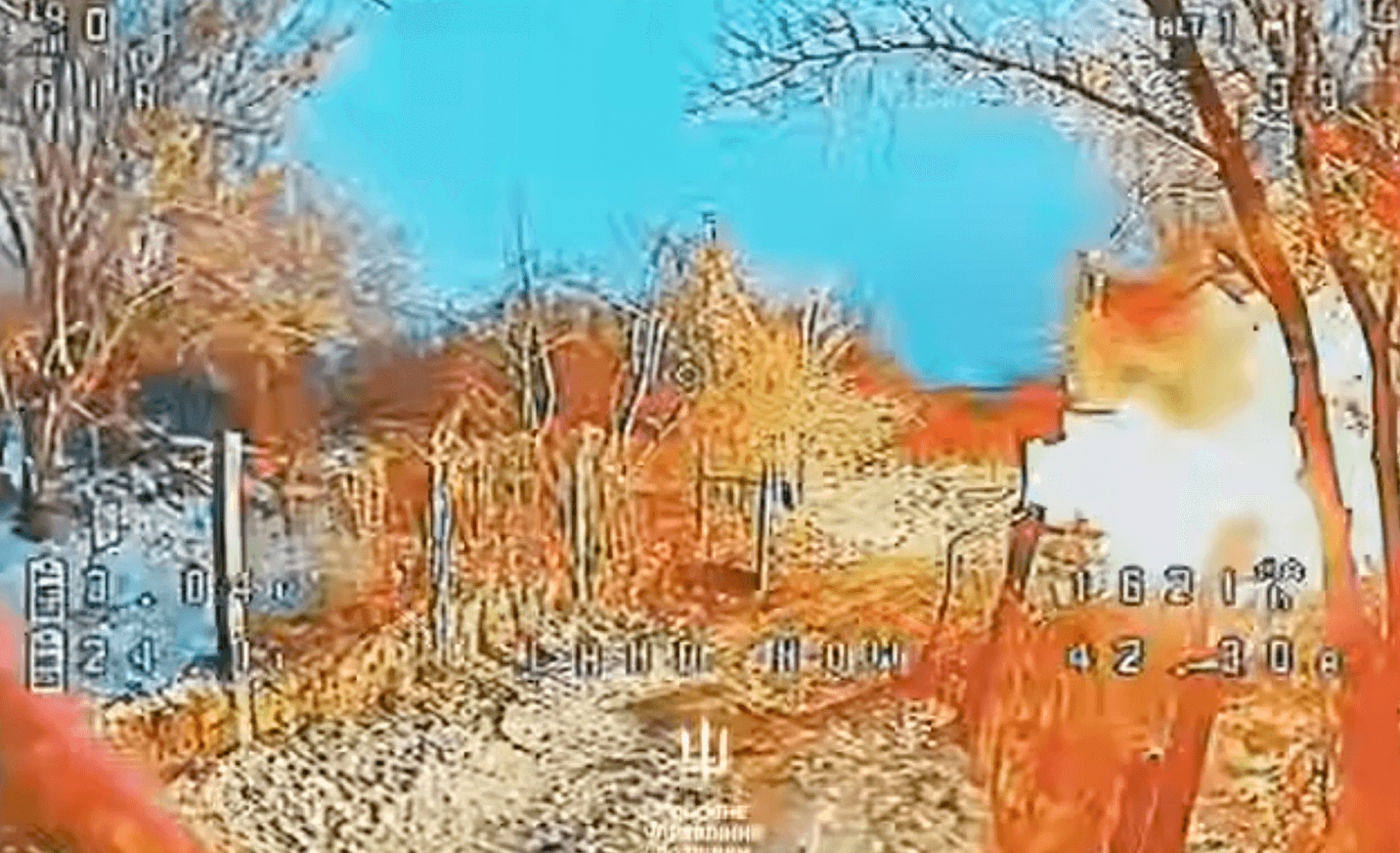
Screenshot from a video filmed by Ukraine’s military intelligence agency (HUR) showing a minibus engulfed in flames after a drone strike. The drone footage was used to convince Russian special services that Denis Kapustin, a Russian commander fighting for Ukraine, had been killed. (Screenshot/HUR/Telegram)
Days after Ukraine revealed that Denis Kapustin was alive, new details clarified how the deception was built—and why Russian intelligence fell for it.
Kapustin, known by the call sign “White Rex,” remains one of Moscow’s most wanted men. As leader of the Russian Volunteer Corps, he commanded anti-Kremlin fighters crossing into Belgorod and Kursk alongside other Russian units fighting for Ukraine. Russian intelligence put a $500,000 bounty on his head.
HUR chose not to hide him. It chose to sell him.
The update came with video. Carefully staged footage showed a drone strike hitting a minibus seconds after Kapustin appeared to enter it. Flames. Secondary explosions. A burning vehicle filmed from multiple angles. HUR later explained the mechanics plainly: two strike drones were used to create a believable kill sequence, complete with timing and visual confirmation calibrated for Russian analysts.
Russian intelligence accepted the package.
They verified the footage. They confirmed the death. And they paid the bounty—half a million dollars transferred for an assassination that never happened.
Only afterward did HUR reveal the truth. Reports on December 27 claiming Kapustin’s death in Zaporizhzhia Oblast were part of the operation from the start. The money, HUR said, would be redirected to strengthen its special forces—Russian funds converted directly into Ukrainian combat power.
What emerged was not just a clever trick, but disciplined tradecraft: plausible visuals, enemy validation, payment secured. The update showed how carefully the illusion had been constructed—and how completely Russian intelligence had been manipulated into funding the very war effort it sought to undermine.
Missiles in the Sky, Doubt on the Ground
The Patriots arrived quietly, then went to work. Two additional air defense systems—delivered after agreements with Germany—were deployed into Ukraine’s battered shield, extending the only protection the country has against Russian ballistic missiles. These are the interceptors that can reach what others cannot. The weapons that stand between cities and the missiles that have already killed thousands across nearly 1,410 days of war.
Their arrival strengthened Ukraine’s defenses. It did not strengthen belief in peace.
As the systems rolled into position, Ukrainians were weighing the negotiations unfolding far from the front. New polling from the Kyiv International Institute of Sociology showed how little appetite existed for compromise under fire. Seventy-four percent rejected any peace plan that required withdrawing from eastern Donbas or limiting Ukraine’s military without firm security guarantees. Sixty-nine percent said freezing the war was acceptable—but only if Ukraine was not forced to recognize occupied territories as Russian.
The gap between diplomacy and public sentiment was stark. President Trump’s initial peace framework had included territorial withdrawal, military caps, and suspended NATO ambitions. President Zelensky countered with a revised 20-point proposal on December 23. Few were convinced. Just ten percent of Ukrainians believed the war would end by early 2026.
Across the Atlantic, skepticism mirrored Kyiv’s mood. An Economist/YouGov poll showed nearly half of Americans disapproved of Trump’s handling of the war. Only 29 percent supported increasing military aid; 20 percent favored holding support where it is.
The numbers told the same story on both sides of the ocean. The war felt unfinished. The costs still rising. Patriots could stop missiles—but they could not manufacture faith in peace that hadn’t yet earned trust.
Eight Hundred Kilometers and Still Burning
The fires appeared far from the front, deep inside Russia’s rear. Ukrainian drones were still flying—and still finding their targets.
Geolocated footage released by Ukraine’s Unmanned Systems Forces showed strikes tearing into the Ilsky Oil Refinery in Krasnodar Krai, a facility capable of producing 6.6 million tons of fuel a year for Russia’s military machine. Another strike hit the Almetyevsk Oil Refinery in Tatarstan. Then came Samara. Footage showed flames at the Novokuybyshevsk Oil Refinery—nearly 800 kilometers from Ukrainian-controlled territory.
Closer to the border, the pressure continued. USF commander Major Robert “Magyar” Brovdi reported Ukrainian strikes on Russian concentration points, fuel stores, and ammunition depots belonging to the 69th Motorized Rifle Division and the 283rd Motorized Rifle Regiment near Valuyki in Belgorod Oblast. In occupied territory, Ukrainian forces hit a Shahed drone warehouse in Donetsk City, destroyed a TOR-M2 air defense system in Shevchenko, and struck a fuel depot and command post of Russia’s 51st Combined Arms Army in Ilyovaisk.
The campaign followed a clear logic. Target what keeps the war running. Force Russia to choose between defending refineries, depots, and command posts—or repairing what burns. Every refinery on fire was fuel not reaching the front. Every depot destroyed was ammunition not falling on Ukrainian cities.
After nearly 1,410 days of war, Ukraine was still carrying the fight deep into Russia. Moscow’s air defenses, stretched across a continent, could not shield everything at once.
After the Blast: What the Zoo Revealed About Russia’s Glide-Bomb War
Days after the strike, the damage at Feldman Ecopark had settled into grim clarity.
The KAB glide bomb that hit the wildlife sanctuary in Lisne, Kharkiv Oblast, on January 1 left a crater matching a 250-kilogram detonation. Shrapnel had torn outward nearly 100 meters. Three buildings were flattened. Five aviaries were shredded beyond use. What first looked like chaos now read as a precise inventory of destruction.
The human toll was unchanged but stark. A 40-year-old volunteer remained hospitalized with head injuries. Two lions were wounded. Tropical bird enclosures lay open to winter air—fatal exposure for species that depended on heat to survive. Two Bengal tigers, Abat and Alba, briefly escaped through a breached enclosure before caretakers tracked and returned them.
The zoo was never a military site. It sheltered more than 5,000 animals evacuated from cities across northern and eastern Ukraine—creatures already displaced by war. The sanctuary sat just 20 kilometers from the current front line, close enough to hear the war, never close enough to justify a bomb.
Feldman Ecopark had lived through occupation in February 2022 and liberation that September. Since then, thousands of Russian missiles and drones had passed overhead toward Kharkiv City. Workers had already died in strikes in July and September 2024. Now the glide bombs were landing directly on the refuge itself.
The update placed the strike inside a larger pattern. In 2025 alone, Russia dropped more than 60,000 glide bombs across Ukraine—most weighing 250 to 500 kilograms, some reaching three tons. Kharkiv’s outskirts absorbed 20 to 35 of them daily. These weapons, often guided by crude electronics vulnerable to jamming, behaved less like precision munitions and more like wide-area explosives.
Even Russia wasn’t immune. Independent outlet Astra reported at least 143 accidental bomb drops on Russian and occupied territory in 2025, largely blamed on faulty glider kits.
Two tigers alive but traumatized. Rare birds dead. A volunteer injured. And a sanctuary built to save the war’s victims added to the list of targets.
What Investigators Found After the Cable Went Dark
The new details came from the sea lane, not the seabed.
After reporting damage to an undersea communications cable between Finland and Estonia on December 31, Finnish Border Guards intercepted the vessel that had been in the area at the critical moment. The ship, Fitburg, was stopped while transiting from St. Petersburg to Haifa under a Saint Vincent and the Grenadines flag, operated by Turkish firm Albros Shipping & Trading.
At least two crew members were detained. Others were questioned.
Then came the discovery that sharpened suspicion: the Fitburg was carrying illegal Russian steel products. Cargo that should not have been moving through European waters at all.
Finnish and Estonian authorities formed a joint international investigation team as the picture narrowed. Officials stopped short of public attribution, but the update changed the case’s texture. This was no longer just a damaged cable on the Baltic seabed. It was a vessel with questionable cargo, detained crew, and timing that aligned too closely to ignore.
The investigation remains open. But the pattern feels familiar.
Undersea cables have been cut before. Power lines damaged. Pipelines sabotaged. Each incident forces European states to stretch naval patrols, inspect civilian shipping, and protect thousands of kilometers of vulnerable infrastructure with limited assets.
The detained sailors. The illegal steel. The cable lying silent on the seabed.
Even without formal accusations, the update underscored the same reality: Europe’s exposure does not end at Ukraine’s borders, and the war’s quieter front lines now run through the cold, crowded waters of the Baltic.
Neutral in Name Only: New Findings Complicate Olympic Eligibility
The update came not from Lausanne, but from Kyiv.
As preparations continue for the 2026 Winter Olympics in Milan and Cortina d’Ampezzo, Ukrainian researchers released new findings that sharpened scrutiny of the International Olympic Committee’s “neutral athlete” framework. The Molfar Intelligence Institute identified 56 Russian winter sports athletes who, despite documented political or institutional ties to Russia’s war effort, could still qualify to compete under neutral status.
Two names already approved brought the issue into focus. Figure skaters Adeliia Petrosian and Petr Gumennik had received invitations as neutral athletes. Molfar’s updated research showed Petrosian wearing “Russia”-branded clothing after the invasion, teaching master classes at Moscow events raising funds for the war, and competing in Channel One Figure Skating Cup events—run by a Kremlin-controlled broadcaster sanctioned for propaganda.
Gumennik’s profile raised different questions. Researchers documented photographs with musicians who publicly supported the invasion and visited occupied Mariupol. His brother followed Russian nationalist groups promoting the war. His father served as an Orthodox archpriest at a church that publicly backed Putin and provided aid to Russian troops.
The review extended beyond figure skating. Ski mountaineer Nikita Filippov followed official Rosgvardia accounts—the internal security force subordinated directly to Putin—and posted celebratory messages on Russia Day while wearing “I love the Russian Federation” shirts.
In response, Ukraine’s National Olympic Committee, Ministry of Youth and Sports, and Skating Federation jointly appealed to the IOC and the International Skating Union, arguing that these activities violated neutrality criteria.
The update reframed the debate. Flags and anthems can be removed. Public conduct, affiliations, and documented support cannot. For Ukraine, the concern is no longer abstract: neutrality risks becoming a legal fiction that masks allegiance while the war continues beyond the Olympic spotlight.
Kupyansk Update: The Assault Units That Never Broke Out
The situation around Kupyansk has hardened rather than shifted.
New reporting from Ukrainian military observer Kostyantyn Mashovets indicates that elements of Russia’s 121st and 122nd Motorized Rifle Regiments remain unable to relieve assault groups trapped in and around the city. Losses have been too heavy. Momentum never returned.
Inside Kupyansk, the picture has grown clearer. Observer Yuriy Butusov reported Ukrainian forces continuing a methodical, house-by-house clearing operation. Russian drones still complicate movement, but not enough to reverse the trend. One Russian milblogger went further, claiming Ukrainian units had fully surrounded Russian forward elements and severed their logistics lines.
Another Russian source confirmed what the battlefield conditions already suggested: snowfall has degraded Russian drone effectiveness, allowing Ukrainian forces to move reinforcements into the city with less exposure. Units that entered Kupyansk expecting to consolidate control instead found themselves isolated—short of supplies, short of exits.
Russian attacks have not stopped. Assaults continue north, northeast, east, and southeast of Kupyansk near Kutkivka, Petro-Ivanivka, Krasne Pershe, Fyholivka, Petropavlivka, Kurylivka, and Hlushkivka. Russian sources also reported Ukrainian counterattacks west of the city near Blahodativka and Nechvolodivka.
But the update points to a narrowing set of choices for Russian commanders. Either push additional forces forward to relieve surrounded units—accepting more casualties—or leave those elements to be slowly crushed or captured.
So far, neither option has produced a breakthrough.
Kupyansk remains contested, but the assault groups sent in first are still there—cut off, burning time, and waiting for relief that has yet to arrive.
Kostyantynivka Update: The Streets Russia Entered—and Couldn’t Hold
The map changed slightly in Kostyantynivka. The balance did not.
New geolocated footage confirmed Russian units pushing through parts of the city’s southern districts, advancing along Pravoberezhna Street and reaching southeastern blocks near Ostrovskoho Street. Additional footage showed movement northwest of Oleksandro-Kalynove, south of the city. These were gains measured in streets, not sectors.
Ukrainian military observer Kostyantyn Mashovets reported Russian forces consolidating on the southeastern outskirts while fighting to hold positions in Predtechyne and Oleksandro-Shultyne. Elements of the 72nd Motorized Rifle Brigade attacked from Bila Hora, while units of the 6th Motorized Rifle Division pushed up the T-0504 Bakhmut–Kostyantynivka highway. The effort was deliberate—and costly.
The update also revealed reinforcement of capability, not momentum. At least two groups of drone operators from Russia’s 16th Spetsnaz Brigade arrived in the area, signaling Moscow’s intent to sustain pressure despite losses. A Ukrainian drone battalion commander described the pattern that followed: small Russian infiltration teams probing forward, testing gaps, retreating under fire.
Winter worked against them. Snow reduced visibility of minefields for advancing Russian units while making movement easier to spot for Ukrainian defenders—even soldiers wearing anti-thermal cloaks stood out against the white ground.
Geolocated footage showed Ukrainian strikes on Russian troops north of Predtechyne. Separate footage captured Russian servicemembers raising flags in central Mayske—symbolic infiltrations that did not translate into lasting control.
Even Russian sources acknowledged the strain. A Kremlin-aligned milblogger complained that advances on Kostyantynivka’s northern flank had been exaggerated in official reporting, claiming areas taken that Ukrainian forces still held.
The most telling update came from the city itself. Municipal Military Administration head Serhiy Horbynov reported a Russian drone strike on a civilian evacuation vehicle inside Kostyantynivka, injuring three people.
Russia entered new streets. Civilians paid the price. And the line, for now, held.
Pokrovsk Update: Massive Forces, Measured Meters
The pressure around Pokrovsk has intensified—but the front has not broken.
New reporting from Ukraine’s 7th Rapid Reaction Corps confirmed Ukrainian control of Molodetske and continued holding of central and northern Myrnohrad, despite repeated Russian infiltration attempts from multiple directions. Russian forces, including elements of the 76th Airborne Division, tried to mass troops and more than 30 light vehicles along the T-0515 Shevchenko–Pokrovsk highway for an attack toward Hryshyne. The buildup was visible. The result was not decisive.
Ukrainian drone units operating in the sector now estimate the Russian grouping at roughly 150,000 personnel, including specialized drone operators—likely tied to the Rubikon Center for Advanced Unmanned Technologies. The scale is unmistakable. So is the outcome. Despite the manpower and equipment, Russian advances remain incremental, measured in small probes rather than breakthroughs.
A Ukrainian artillery reconnaissance battalion chief described the rhythm of fighting: small Russian infantry groups, sometimes single soldiers, occasionally supported by armor. A deputy commander outlined the reality on the ground—a “kill zone” stretching five to 20 kilometers wide on both sides, where movement almost guarantees drone detection and strike.
Weather has sharpened that danger. Frost and snow, combined with reduced fog, have improved Ukrainian drone visibility. Snow-covered terrain makes Russian movement easier to spot, complicating infiltration and favoring defenders—at least for now.
Russian milbloggers offered conflicting updates. Some claimed Ukrainian control of Sukhetske and western Zatyshok; others described Sukhetske as a contested gray zone. The contradictions reflected a fluid battlefield where gains are fragile and reversible.
Russian forces continue to apply pressure from nearly every direction—inside Pokrovsk, north near Bilytske and Rodynske, northeast near Chervonyi Lyman and Zatyshok, east near Myrnohrad, southwest near Udachne and Kotlyne, west toward Serhiivka, and northwest near Hryshyne.
The update is stark: Russia has committed enormous force. Ukraine has absorbed it. And the battle remains a grind, not a breakthrough.
Zaporizhia Update: The Bypass That Stopped Short
The maneuver became clearer with daylight.
New reporting confirmed Russian forces did not storm Stepnohirsk west of Orikhiv. Instead, they moved around it—pushing west along the road toward Hryhorivka and east toward Lukyanivske. Ukrainian military observer Kostyantyn Mashovets reported Russian units reaching the Ukrainian defensive line along the Konka River near Prymorske.
What they did not do mattered just as much. Neither Russian nor Ukrainian sources indicated that Stepnohirsk or Prymorske had been seized. The update showed adaptation rather than breakthrough: Russian forces testing flanks, trying to isolate defended settlements instead of paying the price of frontal assaults.
Mashovets identified the units involved. Elements of Russia’s 19th Motorized Rifle Division and the 108th and 247th Airborne Regiments attacked from Prymorske toward Richne and pressed both flanks of Stepnohirsk. Additional VDV elements from the 31st Separate Airborne Brigade operated near Lukyanivske. The intent was clear—stretch Ukrainian defenses and probe for collapse.
The danger lay in the geography. If Russian forces could fully isolate Stepnohirsk and push along the Konka River line, Ukrainian units would face hard choices: withdrawal under pressure or the risk of encirclement.
Ukraine answered the move from the air. Geolocated footage published January 2 showed a Ukrainian MiG-29 striking a Russian bridge over the Kinska River south of Bilohirya—an update that underscored Kyiv’s ability to disrupt Russian logistics even in contested airspace.
Further east, the situation around Hulyaipole remained unresolved. A Ukrainian assault regiment commander reported Russian forces consolidating on the town’s southern and northeastern outskirts, but Ukrainian units had blocked all infiltration routes. Both sides operated inside Hulyaipole. Neither controlled it.
An SBU source told CNN the balance remained tense. Russian forces still outnumbered Ukrainian defenders in manpower and equipment. The update showed that advantage producing pressure—but not decision.
After New Year’s Night: What the Drone Numbers Revealed
The scale of the attack became clearer with daylight—and then worse.
Updated assessments confirmed that on New Year’s Eve, Russian forces launched 205 Shahed-type and other drones from a web of launch sites stretching from Oryol, Bryansk, and Kursk to Krasnodar Krai, Rostov Oblast, occupied Crimea, and Donetsk Oblast. The drone waves were reinforced by heavier weapons: three Kinzhal aeroballistic missiles, four Iskander-M ballistic missiles, and five S-300/S-400 missiles repurposed for ground attack.
By 08:30 on January 1, Ukrainian air defenses had intercepted one Kinzhal and 115 drones. But the update underscored the cost of the remainder. Twenty drones broke through, striking 15 locations. Civilian, residential, and energy infrastructure was damaged in Dnipropetrovsk and Mykolaiv oblasts. Energy provider DTEK confirmed the destruction of two facilities supplying electricity to parts of Odesa, triggering cascading outages.
President Volodymyr Zelensky reported power disruptions in Volyn, Odesa, and Chernihiv oblasts. The pattern was familiar and deliberate—enough destruction to exhaust defenses and repair crews, calibrated to avoid provoking sharper Western escalation.
Then came the second night.
On January 2, Russian forces launched 116 more drones, this time from six directions, including a newly identified site in Shatalovo, Smolensk Oblast. Ukrainian defenses downed 86 drones by 08:30. Twenty-seven struck 23 locations, with debris falling on two additional sites.
This time, the update carried a heavier human toll. Russian strikes hit residential and civilian infrastructure in Chernihiv and Dnipropetrovsk. Two Iskander-M missiles struck Kharkiv, hitting medical and residential areas and injuring at least 30 civilians.
The numbers told the story. Ukrainian defenses intercepted more than 80 percent of incoming threats across both nights. It still wasn’t enough.
When hundreds of drones fill the sky, defense becomes a matter of arithmetic—and the few that get through still burn cities.
Odesa Update: What December’s Strikes Were Designed to Break
New reporting clarified the intent behind December’s heavy strikes on Odesa—and it wasn’t symbolic.
According to The Wall Street Journal, Russian attacks in December 2025 concentrated on the city’s port-adjacent infrastructure: storage reservoirs, power systems, and logistics nodes tied directly to maritime exports. President Volodymyr Zelensky summarized the objective bluntly—Russia was trying to cut Odesa off by infrastructure, not by ships.
The update sharpened the stakes. Roughly 90 percent of Ukraine’s agricultural exports move by sea, and six ports in Odesa Oblast handled about 76 million tons of cargo from January through November 2025. Odesa itself generates little electricity. Port operations depend on external power feeds. Damage the grid, and cranes stop. Loading halts. Ships wait—or leave.
This clarified why Russia shifted tactics. After withdrawing from the Black Sea Grain Initiative, Moscow initially sought a naval deterrence strategy. That collapsed once Ukrainian missiles and drones pushed the Black Sea Fleet out of the western Black Sea in mid-2023. With ships no longer decisive, long-range strikes became the substitute.
December’s attacks fit that logic. Missiles and drones replaced blockading vessels. Infrastructure became the choke point.
The update also underscored urgency. Without layered air defense over Odesa, each strike compounds damage—forcing Ukraine to reroute exports through slower, costlier land corridors and eroding confidence among global buyers.
The picture that emerged was not about a single city under fire, but a calculated economic campaign. Every damaged terminal reduced throughput. Every power outage delayed shipping. And every repair under threat reinforced Russia’s central aim: make Ukraine’s export lifeline unreliable without ever declaring a blockade.
Zaporizhzhia Update: The Drones That Slipped the Net
By morning, the scope of the New Year attack on Zaporizhzhia had come into focus.
Regional Military Administration head Ivan Fedorov confirmed that Russia launched one of its heaviest assaults on the city beginning late on New Year’s Day and stretching into the early hours of January 2. Two distinct waves arrived—one late Thursday evening, another around 02:00 Friday. Ukrainian air defenses intercepted most incoming threats, preventing casualties despite widespread strikes.
But not all were stopped.
Nine drones penetrated the defenses, hitting residential buildings, commercial sites, and infrastructure. A shopping center was set ablaze. Emergency crews worked through the night, extinguishing fires and clearing shrapnel from streets and courtyards.
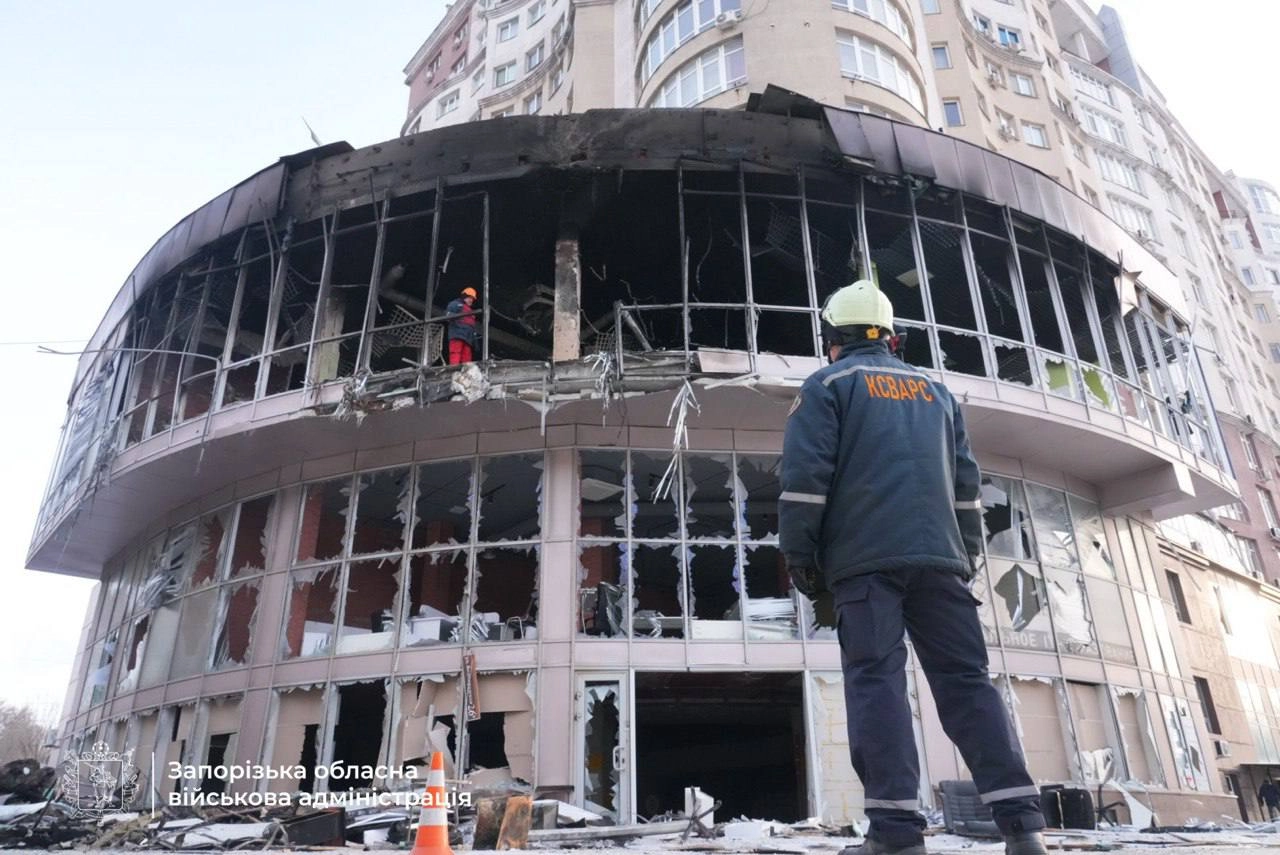
The update also placed the city attack within a broader regional pattern. On New Year’s Day alone, Russian forces launched 737 strikes across 27 settlements in Zaporizhzhia Oblast, injuring two people. One strike left more than 4,000 residents without electricity.
By Friday morning, there was cautious relief. Fedorov reported that Russia had attempted—again—to hit energy infrastructure overnight, but failed. Power had been restored to all subscribers in the region.
The timing mattered. The attack came just days after Russian and Ukrainian forces observed a rare, temporary ceasefire to allow repair crews to reconnect the Zaporizhzhia Nuclear Power Plant to external power supplies, averting what officials warned could have been a Chornobyl-scale disaster. Europe’s largest nuclear facility had been damaged in mid-December by artillery fire and suspected drone strikes.
The update clarified the pattern. Brief pauses when nuclear safety demands it. Relentless pressure everywhere else. Zaporizhzhia entered the new year with its lights on—but only because defenses held and repairs outran the next wave.
January 2: What the Day Laid Bare
By the end of January 2, the war’s contours felt sharper—less blurred by momentum, more defined by intent.
Russia seized on the Khorly tragedy almost instantly, using the deaths of occupation officials to justify escalating an infrastructure destruction campaign it had never paused. The claim of restraint rang hollow against the numbers: more than 54,000 drones and 1,900 missiles launched in 2025 alone, all part of one of the most sustained long-range strike efforts against civilian systems in modern warfare.
Ukraine moved in parallel, not in reaction. Kyrylo Budanov accepted appointment to lead the Presidential Office, marking the most significant intelligence leadership shift since the invasion began. Almost simultaneously, HUR released footage explaining how it staged a commander’s “death” to extract Russian bounty money—war funding turned back on its source. Whether Budanov’s move signaled succession planning or political containment remained unresolved.
The information war escalated alongside the kinetic one. Ukraine’s intelligence warning of a potential Orthodox Christmas false-flag attack—possibly a church or mass-casualty strike—reflected lessons already learned. Russia had successfully weaponized a fabricated attack on Putin’s residence to create friction between Kyiv and Washington. Ukraine was signaling it would not stay silent if the pattern repeated.
Public opinion hardened. Polls showed overwhelming Ukrainian rejection of peace frameworks requiring territorial withdrawal or military cuts without guarantees. Freezing the war was acceptable to many. Ending it soon was not expected. American opinion mirrored the doubt, with growing skepticism about leadership and outcomes.
On the battlefield, nothing broke—everything ground. Russian forces advanced street by street in Kostyantynivka and maneuvered around Stepnohirsk. Ukrainian troops surrounded Russian assault units near Kupyansk and held ground around Pokrovsk despite massive force concentrations. Pressure increased. Decisions did not.
Deep strikes told their own story. Ukrainian drones burned refineries as far as Samara. Russian forces answered with waves—205 drones on New Year’s, 116 the next night. Ukrainian air defenses stopped most. The rest still hit homes, hospitals, power lines.
January 2 offered no resolution—only alignment. Escalation justified by rhetoric. Resistance measured by endurance. Peace discussed, doubted, deferred.
Day 1,409 ended with the same truth intact: the war continued, and the space between Russian maximalism and Ukrainian survival remained unbridged.
Prayer Requests — January 2
- For civilians under sustained attack
Pray for protection, healing, and comfort for Ukrainian civilians facing relentless drone and missile strikes—especially those injured, displaced, or left without power, heat, or shelter during winter bombardments. - For wisdom and integrity in Ukrainian leadership
Pray for President Zelensky, Kyrylo Budanov, and Ukraine’s security leadership as they navigate intelligence transitions, wartime governance, and negotiations under immense pressure, asking God for clarity, unity, and moral strength. - For truth to overcome disinformation and false-flag plans
Pray that planned false-flag operations would be exposed or prevented, that lies would fail to take root internationally, and that truth would protect innocent lives—especially around religious holidays and symbolic sites. - For those defending Ukraine and those trapped at the front
Pray for Ukrainian soldiers holding difficult lines from Kupyansk to Zaporizhzhia—for endurance, protection, and discernment—and for an end to the grinding loss of life on both sides of the front. - For a just peace grounded in security, not exhaustion
Pray that any future peace framework would protect Ukraine’s sovereignty and people, resist pressure for unjust concessions, and move the international community toward sustained commitment rather than fatigue or false compromise.