
As Putin’s chosen proxy warns Russians to abandon hope for peace, Ukraine endures its largest drone swarm in weeks while Western unity fractures under mounting political and economic pressure.
The Day’s Reckoning
The first reports landed before dawn. Air-raid sirens wailed across multiple regions as waves of Russian drones cut through the winter dark, their engines buzzing low over sleeping neighborhoods. In Kharkiv, a private home took a direct hit. In Sumy, an entire residential block shuddered under the blast of an airstrike. In Odesa Oblast, emergency crews raced toward burning infrastructure as another night of war erased whatever quiet the cold had left behind.
Hours later, in Moscow, Viktor Medvedchuk sat for a Kremlin-approved interview and delivered his message to Russian audiences: there would be no peace in 2026. Not negotiations. Not compromise. Time, he said, belonged to the Kremlin. The war would continue until Russia achieved its original aims.
By midday in Brussels, European Union ambassadors convened emergency sessions to prepare retaliatory tariffs against Washington, responding to President Trump’s threats of economic punishment over Greenland. The alliance that had held firm through three years of war now faced internal strain just as Russian pressure intensified on Ukrainian cities.
These events unfolded in parallel. While Ukrainian air defenses hunted drones over frozen rooftops, Kremlin proxies prepared Russians for endless war. While utility crews patched shattered substations in subzero temperatures, European diplomats debated how to confront economic coercion from an ally. While families swept broken glass from bedrooms, Moscow calculated that winter, exhaustion, and division would succeed where tanks and missiles had not.
This was day 1,425 of Russia’s invasion. A day when diplomacy and destruction moved side by side. A day when peace was discussed in conference rooms while it was denied in the sky. And a day that showed the war for what it remains: not only a battle for territory, but a test of endurance, unity, and will under relentless pressure.
“No Peace, No Illusions”: The Kremlin’s Messenger Tells Russia to Prepare for Endless War
The interview landed like a verdict.
On January 18, Viktor Medvedchuk sat before Kremlin newswire TASS and delivered the line Moscow wanted its people to hear: there will be no peace in Ukraine in 2026. Not a prediction. A directive.
Medvedchuk is not just another talking head. He is Putin’s longtime confidant, a former Ukrainian lawmaker, and the man the Kremlin once hoped to install in Kyiv after the 2022 invasion. When he speaks, he does so as Russia’s invented stand-in for “legitimate” Ukrainian leadership — a government that exists only in Moscow’s imagination.
His words were blunt. Time, he said, belongs to the Kremlin. Negotiations are a distraction. Russia will achieve its original war aims without recognizing Ukraine’s elected government.
Translation: stop expecting an end.
The performance followed a familiar script. Medvedchuk framed the invasion as a war against the West. He declared Ukraine’s government illegitimate. He rejected Ukrainian elections — even as Moscow demanded elections as a condition for peace talks. The contradictions were deliberate. His role is to keep Russia’s options wide and its demands maximal.
Putin and his inner circle have repeated these lines for years, insisting their economy and army can outlast Ukraine and the West. Medvedchuk plays the extreme version — saying aloud what the Kremlin prefers to imply. He pushes the envelope, tests reactions, and gives Moscow room to retreat or escalate as needed.
The timing was no accident. His interview dropped amid U.S.–EU–Ukraine peace discussions and new rounds of Kyiv–Washington talks. It was a preemptive rejection of any proposal that didn’t deliver Russian control — including over territories Moscow still doesn’t hold.
The message to Russian viewers was unmistakable: don’t hope for peace, don’t question the war, and don’t expect compromise. Trust that exhaustion abroad will succeed where tanks have not.
This was not commentary. It was morale management — preparing a country for a war without an end date.
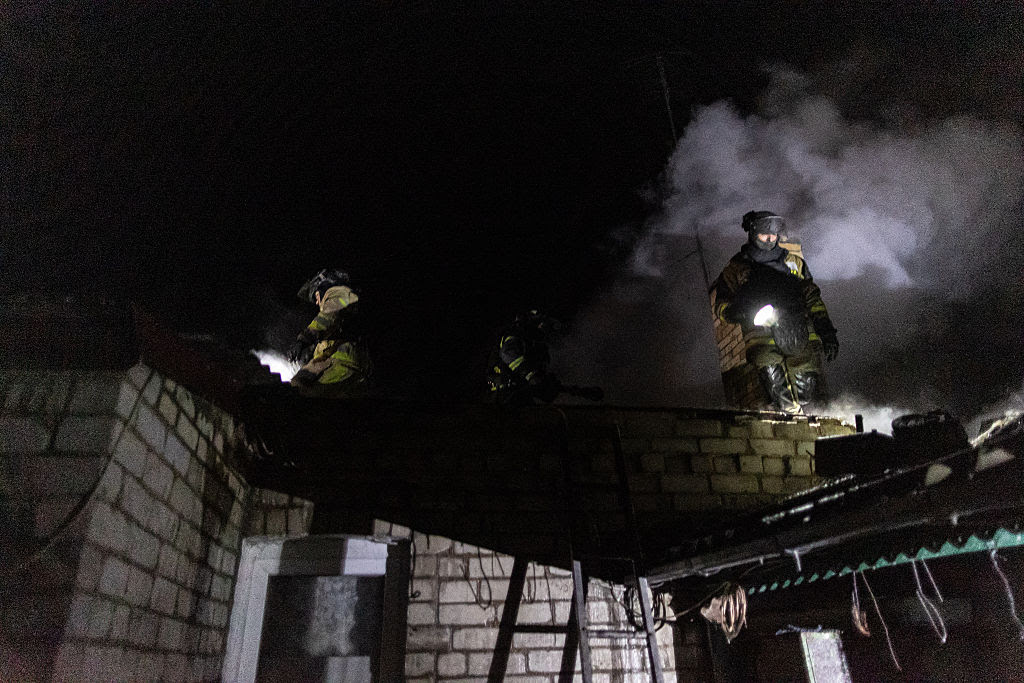
Firefighters extinguish a fire at a house damaged by the impact of a Russian FPV drone in Druzhkivka, Donetsk Oblast. (Diego Herrera Carcedo/Anadolu via Getty Images)
The Night the Sky Filled with Engines
The first drones crossed the border after midnight.
Then another wave. Then another. By the time Ukrainian radar screens filled, 201 attack drones were already fanning out across the country — black silhouettes threading through the winter dark, engines buzzing low over frozen fields and sleeping neighborhoods.
They came from everywhere. From Kursk and Oryol. From Millerovo in Rostov Oblast. From Primorsko-Akhtarsk on the Black Sea. From occupied Cape Chauda in Crimea. From occupied Donetsk City itself. Six launch zones. One coordinated swarm.
One plan.
Among them were 120 Shahed drones — Iranian-designed flying bombs built for long-range terror. They streamed toward Ukrainian cities in converging arcs, forcing air-defense crews into a brutal arithmetic: which targets to protect, which to risk, and how many missiles could be spared for the next wave.
Searchlights stabbed into the clouds. Anti-aircraft guns thundered. Interceptors raced into the dark.
But not all were stopped.
Thirty drones broke through. They struck fifteen locations. Critical infrastructure in Kharkiv. Energy facilities in Zaporizhzhia. Targets across Odesa Oblast. Each explosion landed on a grid already pushed to the brink by weeks of systematic strikes. Each fire deepened the strain on a power system fighting to keep lights on and heaters running in subzero temperatures.
This was attrition from the air.
Russia’s calculation is simple: keep breaking the machinery of daily life until exhaustion does what missiles cannot. Another blackout. Another frozen apartment. Another night without heat. Another morning without power.
Three winters of this strategy have failed to break Ukraine.
But the swarm in the sky made clear Moscow is not changing course.
For Ukrainian air defenders, every mass launch is an impossible equation — stop enough drones to save the grid, while saving enough missiles to survive tomorrow night.
And tomorrow night is always coming.
The House That Never Woke Up
The drone came out of the dark and into a bedroom.
In Kharkiv, a private home took a direct hit before sunrise. A 20-year-old woman was killed where she slept. Another woman was wounded as debris tore through the walls. A 41-year-old neighbor collapsed into shock, her body reacting to a blast her mind could barely process.
Mayor Ihor Terekhov confirmed the death. Regional governor Oleh Synehubov listed the wounded. Another line added to the war’s ledger. Another family changed forever.
The map of grief stretched north.
In Sumy region, an airstrike slammed into a residential neighborhood. Three women were pulled from the wreckage. A seven-year-old child was carried out bleeding. Emergency crews counted fifteen damaged homes — kitchens crushed into living rooms, roofs folded into bedrooms, winter coats buried under broken concrete.
Further south, in Odesa region’s Izmail district, Russian strikes hit critical infrastructure along the Danube corridor. No deaths were reported there. Not this time. But officials warned the pattern was familiar: logistics, power, and transport — the systems that keep civilian life running — were once again under attack.
These were not random explosions. They were part of a method.
Russia is not only fighting soldiers. It is dismantling daily life. Power stations, apartment blocks, heating systems. Each strike is a wager that fear will succeed where armies have failed — that survival itself will become too heavy to carry.
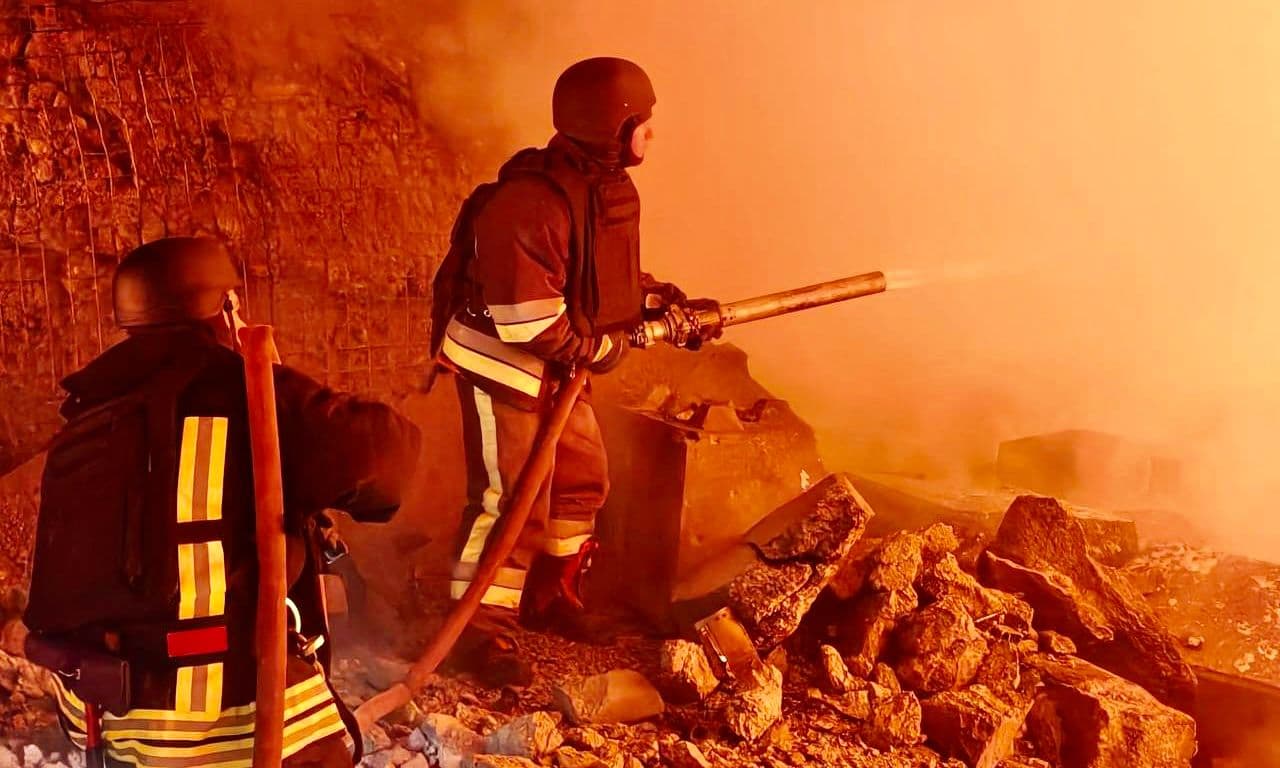
Firefighters extinguish fire following Russian attack in Odesa Oblast. (Oleh Kiper / Telegram)
Drawing the Line Before the Next War
Screens flickered on across Europe. Uniformed commanders filled the grid — Paris, London, Brussels, NATO headquarters — all logging into the same secure call. On one screen sat Ukraine’s Commander-in-Chief, Oleksandr Syrskyi. On the others, the generals who would help decide whether the next ceasefire would hold… or simply reset the battlefield.
The question before them was simple and brutal: how do you stop Russia from attacking again?
Syrskyi didn’t soften his words. Russian “terror” against civilians had not slowed. Energy infrastructure was still burning. Cities were still freezing. Moscow, he told them, had shown no readiness to end its war — only to pause when convenient.
Security guarantees, he warned, could not be paper promises.
They had to hurt.
Sanctions were not diplomacy, he argued. They were weapons. If the economic cost of war became unbearable, Russia’s ability to fight would collapse no matter how strong the political will. Sanctions, done properly, were deterrence.
So was firepower.
The commanders focused on sustaining military aid — the missiles, drones, artillery, and armor that keep Ukrainian units fighting and Russian losses mounting. Any peace that left Ukraine militarily exposed would simply invite the next invasion.
The Coalition of the Willing was built for endurance. A framework designed to survive elections, donor fatigue, and shifting headlines. One that could eventually place peacekeepers on Ukrainian soil — not as symbols, but as tripwires against treaty violations.
This was not diplomacy.
It was war planning for the day after the war.
Because every general on the call understood the lesson of the last three years: Russia does not respect agreements. It respects force.
And force has to be waiting when the guns fall silent.
The Long Walk to Davos: Ukraine Carries Its War into the World’s Boardroom
The plane touched down in the United States with a war still burning behind it.
Rustem Umerov stepped off carrying more than briefing folders. He carried satellite photos of burning substations, casualty lists from frozen cities, and a message Ukraine has learned to repeat in every capital: peace without enforcement is just an invitation for the next invasion.
Over two days of closed-door meetings, Umerov and his delegation moved from office to office — sitting across from Special Envoy Steve Witkoff, Jared Kushner, Army Secretary Dan Driscoll, and White House adviser Josh Gruenbaum. The agenda was not theoretical. It was survival.
At the table were Kyrylo Budanov, newly installed as head of the President’s Office, and parliamentary leader David Arakhamia. They spoke about rebuilding cities that no longer had roofs. About an economy running on generators. About prosperity plans that depended on one thing first: security.
Umerov pressed for mechanisms, not promises. Implementation. Enforcement. Penalties for violations. Ukraine has signed papers before. Russia has torn them up before. Any new framework, he warned, had to be built for betrayal.
The delegation showed what Russia had been doing to Ukraine’s energy system — substations cratered, transformers burning, entire regions plunged into darkness. This was not collateral damage. It was strategy. And it shaped every line of negotiation.
Both sides agreed to carry the talks forward to Davos. Teams would keep working. An economic deal would be signed. Reconstruction planning would move in parallel with security guarantees.
All of it unfolded beneath Washington’s political noise — including claims that Moscow was ready for peace and Kyiv was not.
Ukraine’s record told a different story. It had accepted proposals. Russia had accepted none.
And the war kept going.
One Line Between the Reactors and Disaster
The backup power line went dark earlier this month. Now engineers are racing to bring it back.
At the Russian-occupied Zaporizhzhia nuclear power plant, repair crews are working on the shattered 330-kilovolt line that once fed electricity from Ukraine’s grid into Europe’s largest nuclear facility. Without it, the plant has been running on a single remaining 750-kilovolt line — one cable standing between six reactors and a cooling failure no one wants to imagine.
The International Atomic Energy Agency calls the work “crucial.” That is not diplomatic language. It is physics.
Nuclear reactors need constant power even when shut down. Cooling systems cannot stop. Pumps cannot pause. Redundancy is the rule of nuclear safety — and Zaporizhzhia has been living without it.
So a ceasefire was arranged.
For the fourth time since Russia seized the plant, guns fell silent long enough for Ukrainian technicians to enter the compound. IAEA inspectors watched as crews worked under the shadow of armed occupation, restoring infrastructure damaged by the very war threatening to turn the facility into a radiological weapon.
This is what nuclear safety looks like in wartime: engineers repairing high-voltage lines while artillery waits on the horizon.
Before the invasion, Zaporizhzhia supplied about 20 percent of Ukraine’s electricity. Russia captured it in March 2022. By September, all six reactors were shut down. Since then, the plant has endured power outages, nearby strikes, staff shortages, and growing restrictions on international monitoring.
Now its control sits on the negotiating table.
A U.S.-backed proposal would place the facility under joint management by Ukraine, the United States, and Russia. Kyiv fears the arrangement would do something far more dangerous than stabilize the plant — it could legitimize Russian occupation and turn nuclear blackmail into diplomatic leverage.
For now, the repair crews work.
Because one broken line is all it takes.
Tariffs at Dawn: Europe Arms for an Economic War with Washington
In Brussels, the alarms went off in quiet offices and secure chat rooms.
Trade officials opened old files. Diplomats called counterparts in Paris and Berlin. A sanctions list once sealed away to avoid a trade war was pulled back onto desks — 93 billion euros’ worth of retaliatory measures aimed directly at American companies.
The European Union was preparing for battle.
The trigger was President Donald Trump’s threat to impose tariffs on NATO allies unless negotiations began over Greenland — an autonomous Danish territory that has hosted a U.S. military base since the 1940s. His plan: 10 percent tariffs on eight allied nations starting February 1, rising to 25 percent by June.
Denmark. Norway. Sweden. France. Germany. The United Kingdom. The Netherlands. Finland.
Allies, not adversaries.
The response had been drafted last year, after Trump’s first round of global tariffs. It was shelved to avoid escalation. Now it was back. And this time, EU leaders were openly discussing deploying the bloc’s anti-coercion instrument — a legal weapon that could restrict U.S. companies’ access to the European market and limit American investment and services, including major technology firms.
France coordinated with Germany. A united front was essential. Trump was expected at the World Economic Forum, where private meetings would try to contain a crisis that now threatened the foundations of the Western alliance.
European leaders heard something darker beneath Trump’s rhetoric about acquiring Greenland “one way or the other.” They heard echoes of territorial ultimatums. Of coercion. Of power politics Europe thought it had buried in the twentieth century.
Cyprus, holding the EU’s rotating presidency, called an emergency session of EU ambassadors. The speed of the response said everything.
This was no longer a trade dispute.
It was a test of whether alliances could be shaken by tariffs the same way borders are broken by tanks.
Applause in the Kremlin: When America Turns on Its Own Allies
In Moscow, the reaction was immediate — and gleeful.
Kirill Dmitriev, the Kremlin’s chief economic negotiator, went straight to social media and declared victory. The transatlantic alliance, he wrote, was finished. Europe, he mocked, should stop “provoking” President Trump. The message was not subtle: Washington’s tariff threats against NATO allies were doing Moscow’s work for it.
The celebration was not spontaneous. It was strategy.
For years, the Kremlin has tried to fracture Western unity with propaganda, cyberattacks, energy pressure, and political influence campaigns. None of it delivered what Trump’s threats achieved in a single announcement: open economic warfare against America’s own allies.
Former Russian president Dmitry Medvedev joined the chorus. The United States, he said, was now preparing to “attack Greenland,” choosing territory over Atlantic solidarity. European countries, he added, would be “punished with tariffs” for trusting Washington’s protection.
This was not trolling. It was messaging.
By amplifying Western discord, Moscow was speaking to its own public — telling Russians that sanctions were weakening, that NATO was cracking, and that patience would be rewarded. The longer Russia waited, the more the alliance would unravel from within.
Several EU countries rushed to back Denmark after Trump renewed his threats over Greenland. Alarm spread through European capitals. Leaders who had just watched NATO expand with Finland and Sweden now faced a reminder that alliance cohesion could be undone without firing a single missile.
The irony was sharp.
Putin failed to break NATO with tanks. Trump shook it with tariffs.
And in the Kremlin, they noticed.
The Ship That Tried to Disappear
The paperwork said one thing. The ship’s computers said another.
When Italian authorities stopped the cargo vessel at Brindisi port, they found more than 33,000 tons of Russian steel in its holds — and a trail of digital footprints that told a very different story from the documents on deck.
Investigators pulled data from the ship’s electronic chart and information system. The screen showed the vessel sitting at Novorossiysk port for three days in mid-November, loading cargo at a Russian terminal banned under EU sanctions. The paperwork insisted otherwise.
Then came the smoking gun.
Near Novorossiysk, the ship’s automatic identification system — the maritime equivalent of an aircraft transponder — had gone dark. No signal. No tracking. No questions. A deliberate blackout designed to hide its movements from European monitors.
The deception failed.
The Brindisi Court ordered the seizure of both the ship and its cargo. An importer, the shipowner, and two crew members now face investigation for breaching EU sanctions under Regulation 833/2014 — the legal framework blocking Russian iron and steel exports over Moscow’s war against Ukraine.
The vessel was not an outlier. It was part of a system.
European authorities call it the shadow fleet: ships that falsify documents, switch off tracking systems, and conduct ship-to-ship transfers in open water to launder Russian oil, steel, and raw materials past sanctions.
Each successful run keeps money flowing into Russia’s war economy. Each cargo funds missiles, drones, and artillery shells.
Europe has warned for months that enforcement was tightening.
At Brindisi, the warning became reality.
The ship tried to vanish.
Instead, it sailed straight into a courtroom.
Footprints in the Snow: The War That Will Not Pause
Along the frozen front, the war kept moving.
Not fast. Not clean. But relentless.
In northern Kharkiv Oblast, Russian units pushed forward again, probing Ukrainian lines through frost and fog. Milbloggers claimed gains in Hrafske and Symynivka, northeast of Kharkiv City. The maps said otherwise. No confirmed advances. Just another day of pressure without progress.
Above them, the battlefield kept changing shape. Russian sources claimed their forces were using Molniya fixed-wing “mothership” drones — airborne launch platforms carrying first-person-view strike drones nearly 50 kilometers beyond the front. A flying hive. A way to reach deeper without moving a single trench.
Near Kupyansk, the pattern repeated. Russian assaults. Ukrainian defense. Counterattacks near Kindrashivka and Radkivka. No breakthroughs. Just churn.
Toward Borova, more attacks. Same result.
Near Chasiv Yar, Russian channels announced they had taken Minkivka. Ukraine’s Eastern Group of Forces answered with a denial. Then came the footage: Ukrainian soldiers operating on the southeastern edge of Illinivka — exactly where Russian sources claimed control. The ground told a different story than Moscow’s maps.
South of there, outside Pokrovsk, assault teams moved in pairs and trios, advancing through snow that betrayed every step. Drone operators tracked footprints. Infantry tried to keep heat signatures low. Heavy armor stayed back. In some areas, Russian units used horses — silent, cold, invisible to thermal cameras. An old solution for a new battlefield.
In western Zaporizhzhia Oblast, geolocated video showed Russian troops edging east of Shcherbaky and probing Prymorske in what looked like an infiltration attempt. A Geran drone streaked toward Zaporizhzhia City, striking just 17 kilometers from the line.
In Kherson, Russian forces pushed again toward the Antonivskyi bridge. No gains. More bodies.
This is the war now. Pressure without pause. Movement without momentum. Kilometers measured in meters. Progress written in footprints that vanish with the next snowfall.
The Day’s Meaning: When Diplomacy Performs While the War Keeps Killing
Two wars unfolded at once.
In conference rooms in Florida and Switzerland, diplomats traded proposals and frameworks. On Ukrainian rooftops, air defenses hunted drones. In Brussels, officials drafted tariff responses. In Kharkiv and Sumy, families dug through shattered walls for survivors. The distance between those worlds was measured in burned substations, broken windows, and bodies pulled from bedrooms before dawn.
Peace talks conducted while one side is systematically dismantling the other’s ability to live are not negotiations. They are hostage situations. Moscow has no incentive to stop striking power grids, ports, and homes while those strikes advance its strategy. The Kremlin has learned that diplomacy continues regardless of battlefield behavior. In practice, aggression is met with process.
The contrast is the story. Ukrainian negotiators debate security guarantees while Russian drones sweep their cities. European leaders plan economic countermeasures while the next wave of infrastructure attacks is readied. Framework language and implementation timelines move forward even as the physical capacity to endure is eroded, night after night.
The danger is amplified by a fracture in Western unity at the moment solidarity matters most. Russia’s theory of victory has always depended on time and fatigue. Threats against NATO allies over Greenland did more to feed that theory than years of Russian information warfare. The Kremlin’s applause was not mockery; it was recognition that cohesion is weakening from within.
There are efforts to build guardrails that can survive politics: commanders sketching security architectures, engineers restoring a nuclear plant’s lifelines. But frameworks only matter if they are enforced, and enforcement requires unity that now looks brittle under pressure from multiple directions.
As long as peace talks and energy strikes are treated as separate tracks, the calendar favors Moscow. Every day of dialogue alongside bombardment is another day of destroyed infrastructure and accumulated loss. This war will not end on paper. It will end only when aggression costs more than it yields, or when deterrence changes the calculation. Neither has arrived. And the darkness keeps spreading—across power grids, across cities, and across any clear horizon for an end.
Prayer For Ukraine
- For those who faced the night sky full of drones
Lord, be near to every family who listened to engines overhead and waited for impact. Comfort those who lost homes, heat, and loved ones. Guard the children who woke to sirens and the elderly who sat in dark apartments, wrapped in blankets. Let Your presence be their shelter when walls are torn away. - For the wounded, the grieving, and the first responders
Hold the hands of the injured in Kharkiv and Sumy, and receive the life of the young woman killed in her home. Strengthen medics, firefighters, and rescue crews who run toward danger in freezing streets. Give them endurance, clarity, and protection as they carry the weight of this war. - For those defending the skies and the front lines
Shield the air-defense crews and drone operators who stand watch through the cold nights. Grant wisdom to commanders and courage to soldiers moving through snow and fire. Preserve life where possible, steady shaking hands, and bring safe return to those sent into harm’s way. - For leaders shaping security and peace
Guide Ukraine’s leaders and their partners as they design guarantees that truly deter renewed aggression. Give them unity of purpose, moral clarity, and the resolve to enforce what is promised. Expose deception, restrain coercion, and turn every plan toward lasting protection for the innocent. - For light in the darkness and hope for the weary
Restore power where it has been cut and warmth where winter bites. Renew the strength of a people asked to endure too much for too long. Let justice take root, let mercy flow, and let peace—real peace—come swiftly to Ukraine.