
As Marco Rubio rebuilt transatlantic ties in Munich, Moscow made clear its price for peace wasn’t territory—but Ukraine’s political surrender.
The Day’s Reckoning
Marco Rubio stepped to the podium in Munich and tried to steady a shaken alliance.
On February 14, before Europe’s security elite, the U.S. Secretary of State declared that America and Europe “belong together,” calling them heirs to “the same great and noble civilization.” The tone was deliberate. A corrective. A sharp departure from JD Vance’s confrontational 2025 appearance and months of strain after President Donald Trump’s threats toward Greenland and open derision of allies.
Fifteen hundred kilometers east, Moscow was speaking a different language.
Russian State Duma Defense Committee Deputy Chairman Alexei Zhuravlyov announced that Russia would not be satisfied with Luhansk, Donetsk, Zaporizhia, and Kherson alone. Peace required regime change in Kyiv—removal of any “Russophobic” government.
Translation: not just land. Political surrender.
Volodymyr Zelensky answered from the same Munich stage. He invoked 1938—the Munich Agreement that sacrificed Czechoslovakia—and warned that dividing Ukraine would not end war, only postpone it. Ukraine was ready for elections, he said, but only after a two-month ceasefire backed by American security guarantees. Washington had offered 15 years. Kyiv wanted 20 to 50.
On the battlefield, arithmetic replaced rhetoric. NATO Secretary General Mark Rutte reported 35,000 Russian dead in December and 30,000 in January—76 to 87 casualties per square kilometer gained. A “garden snail,” he called the advance.
In northern Kharkiv Oblast, Russian forces seized Lyman and pushed into Symynivka and Vilcha. Ukrainian forces counterattacked near Berezove. SpaceX’s blocking of Russian Starlink access disrupted Rubikon Center strikes. Overnight, Ukrainian drones hit an oil depot and shipping terminal in Volna, Krasnodar Krai—325 kilometers from Ukrainian-held territory.
Reassurance in Munich. Ultimatums in Moscow. Grinding advances. Strategic strikes.
Geneva loomed two days away, and the hardest questions still had no agreed answers.
The Man Trying to Hold the Alliance Together
Marco Rubio’s hands moved carefully in Munich — palms open, fingers extended, not slicing the air but stitching it.
He stood before Europe’s security establishment and chose each word like a man repairing porcelain. “We do not seek to separate,” he said, “but to revitalize an old friendship and renew the greatest civilization in human history.” America and Europe “belong together.” The message was deliberate. A course correction.
A year earlier, JD Vance had used this same stage to attack European immigration policy and free speech protections, stunning allies. The Trump administration’s National Security Strategy had accused Europe of “civilizational decline.” Trump himself had threatened to annex Greenland, forcing NATO member Denmark and its neighbors to push back publicly. German Chancellor Friedrich Merz had described the widening rift.
Now Rubio was offering reassurance instead of rebuke.
But even as he rebuilt tone, fault lines remained. He repeated the administration’s warning that “mass migration” was destabilizing Western societies — an issue many European leaders ranked far below Russian aggression.
On Ukraine, Rubio dropped the soothing language. Negotiations had “narrowed” to the “hardest questions to answer.” Russia demanded Ukrainian withdrawal from parts of Donbas. Moscow claimed the Zaporizhzhia Nuclear Power Plant. And then the admission: “We don’t know if the Russians are serious about ending the war.”
The United States didn’t know under what terms Moscow would accept peace. It didn’t know whether any formula could satisfy both Kyiv and the Kremlin.
Translation: Geneva, February 17–18, would reveal whether diplomacy was real — or theater.
Relief rippled through the hall. The Guardian’s Patrick Wintour noted delegates welcomed Rubio’s tone, though the alliance he described still reflected Trump’s framework. Emmanuel Macron called for “a strong Europe.” Keir Starmer spoke of a “sleeping giant.” Ursula von der Leyen insisted Europe must take responsibility for its own security.
Rubio’s reassurance landed.
But reassurance wasn’t strategy.
And strategy required answers he admitted he did not yet have.
The Ghost of 1938 Walks Back Into Munich
Volodymyr Zelensky did not raise his voice. He raised history.
“It would be an illusion,” he told the Munich Security Conference, “to believe that this war can now be reliably ended by dividing Ukraine — just as it was an illusion to believe that sacrificing Czechoslovakia would save Europe from a greater war.”
The room understood.
1938. Munich. Sudetenland. Appeasement called peace. War one year later.
Zelensky compared Vladimir Putin to “the previous Putin, who began dividing Europe.” He didn’t need to say Hitler. The echo carried.
As Geneva approached, Western officials were quietly debating territorial concessions. Could Ukraine give up land to stop the bloodshed? Zelensky answered before the question fully formed. Concessions, he said, are discussed only in the context of Ukraine surrendering territory — never Russia relinquishing what it occupies.
But he did not reject negotiation.
Ukraine was ready for elections “as quickly as possible” — after a sustained ceasefire. Two months of calm, backed by security guarantees. Elections under bombardment are fiction. A pause is prerequisite, not pretext.
Sequencing was everything. Security guarantees must precede any war termination agreement. Peace first and protection later would mean surrender without shield.
Washington has offered 15-year guarantees. Ukraine wants 20 to 50. The difference is not symbolic. It reflects competing judgments about how long Russia must be constrained before Ukraine can safely exist beside it.
Zelensky also called Europe’s absence from Geneva “a big mistake.” Europe’s interests must be at the table.
When pressed about Trump’s push to “get moving,” he answered carefully: “Not losing our dignity, we can move.”
He offered negotiation.
He refused capitulation.
And he said it in the city where Europe once chose wrongly.
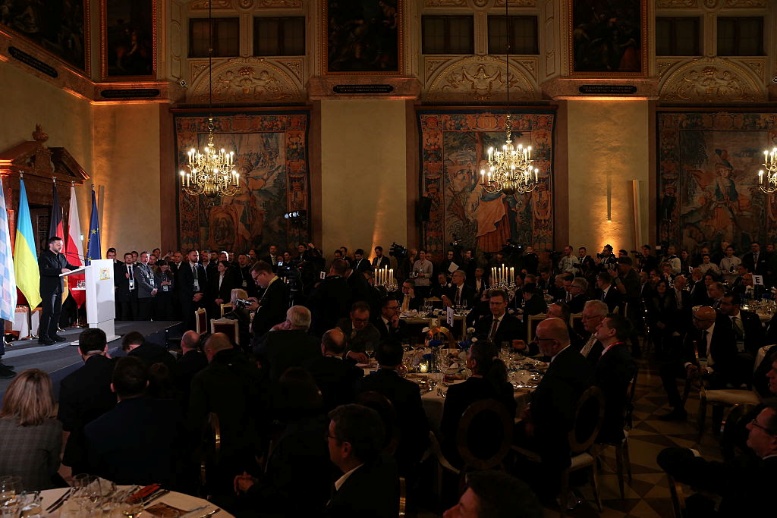
President Volodymyr Zelensky speaks during dinner at the 62nd Munich Security Conference (MSC) and Ewald-von-Kleist Award Ceremony, in Munich, Germany. While the award usually goes to a single person, MSC Chairman Wolfgang Ischinger said this year the recipients are the people of Ukraine for their courage and fortitude in enduring nearly four years of Russia’s war. (Gisela Schober/Getty Images)
Not Just Territory — Surrender
Alexei Zhuravlyov didn’t hedge.
Russia “will not be satisfied,” the State Duma Defense Committee deputy chairman declared, with Ukraine surrendering only Luhansk, Donetsk, Zaporizhia, and Kherson. That was baseline. Moscow also required regime change in Kyiv — removal of any “Russophobic” and neo-Nazi government.
The words cut through diplomatic fog.
Geneva wasn’t about borders alone. It was about political control.
For months, senior Kremlin officials had spoken vaguely about a postwar Ukraine that must be “friendly” to Russia. Zhuravlyov made the meaning explicit. “Friendly” meant a government aligned with Moscow. A Ukraine stripped of Western orientation, NATO aspirations, EU ambitions.
In other words: sovereignty removed.
The territorial demands widely discussed — Ukrainian withdrawal from parts of Donbas, surrender of the Zaporizhzhia Nuclear Power Plant — were merely the opening bid. Regime change was the real objective.
The timing mattered. With Geneva two days away, Moscow wanted clarity about its position. Or perhaps something else. By staking out maximalist demands that Kyiv could never accept, the Kremlin positioned itself to blame Ukraine and the West when talks collapsed — while continuing military operations designed to impose those terms by force.
Marco Rubio had admitted Washington did not know whether Russia was serious about peace. Pair that uncertainty with Zhuravlyov’s declaration and the shape of negotiations shifted. If regime change was non-negotiable, then territorial talks risked becoming theater.
NATO Secretary General Mark Rutte signaled skepticism. Russia had appointed Vladimir Medinsky — a controversial Putin aide with a record of uncompromising rhetoric — to its negotiating team.
“Russia does not seek a peace agreement,” Rutte said bluntly.
The pattern was familiar. Demand the impossible. Accuse the other side of intransigence. Keep advancing on the ground.
Whether Geneva would break that pattern — or confirm it — remained unanswered.
Blood for Meters
Mark Rutte did not raise his voice. He did the math.
Russian forces, he said, were advancing at the “stilted speed of a garden snail.” Yet in December 2025 they lost 35,000 soldiers. In January 2026, another 30,000. Ukrainian General Staff figures aligned closely: roughly 35,100 casualties in December, 31,680 in January.
Now measure the ground.
Open-source analysis from ISW showed Russian advances or infiltrations totaling about 462 square kilometers in December and 364 in January. The arithmetic turned grim. Roughly 76 casualties per square kilometer in December. Eighty-seven in January.
Volodymyr Zelensky added another ratio in an interview published February 13: 170 Russian casualties for every kilometer gained — possibly including infiltrated terrain not fully controlled, or reflecting losses higher than open sources captured.
The trend was unmistakable. The advance slowed. The dead did not.
At that rate, taking a city like Pokrovsk or Kurakhove would cost tens of thousands more lives. Pushing to the Dnipro River would demand hundreds of thousands. Securing all of Donetsk and Luhansk under current casualty exchanges would scar Russian military demographics for a generation.
A snail moves slowly but does not hemorrhage. Russian forces were doing both.
Ukrainian defenders made every meter expensive. Infantry assaults through fortified kill zones. Drones forcing dispersion. HIMARS strikes disrupting logistics. Gains measured in fields and tree lines, paid for in battalions.
These were not sustainable economics. But they continued.
Geneva loomed as negotiators prepared to debate territory and guarantees. On the ground, the exchange rate of blood to land told its own story.
The snail kept inching forward.
The bodies kept falling.
And no one yet knew which would run out first — territory, or men.
The Day the Sky Went Quiet
The Rubikon Center stopped showing its maps.
A Ukrainian unmanned systems brigade commander told BBC Ukrainian Service that Russian forces would need “about six months” to find a replacement for Starlink. SpaceX’s February 1 decision to block unregistered terminals in Ukraine had cut deeper than Moscow expected.
Before the cutoff, Rubikon drones struck 30 to 50 kilometers into Ukraine’s rear — logistics hubs, command posts, supply lines. The Telegram channel boasted of it, posting footage with precise geolocations. Then, after February 4, the posts continued — but the coordinates disappeared.
Translation: the signal had gone dark.
Rubikon’s mission had been singular — deep strikes, extended range, battlefield air interdiction. Ukrainian forces did not have that luxury. Their unmanned units split time between strategic strikes and helping infantry survive on the line.
Rubikon had focused only on the rear.
Until Starlink evaporated.
Satellite systems with comparable bandwidth and latency do not appear overnight. Russian domestic alternatives exist, but none match Starlink’s real-time drone control at extended range. The result was immediate. Drones that once reached deep into Ukrainian operational depth were pulled back to shorter ranges using Russian communications systems. The systematic degradation of Ukrainian logistics slowed.
In the Slovyansk direction, a Ukrainian commander noted that Starlink outages did not affect Russian infantry-heavy operations there. But in sectors where Rubikon had operated, the gap was visible.
Irony compounded it. Russian milbloggers complained that Moscow’s own blocking of Telegram worsened communications breakdowns. Units could access internet in places but could only coordinate horizontally through Telegram — which Russia itself had restricted.
American satellites guiding Ukrainian drones. Russian forces trying to use the same system. SpaceX cutting access. Russia blocking its own channels.
Six months is a long time in war.
Long enough to adapt.
Or long enough to lose momentum.
Technology, like terrain, was now contested ground.
Kharkiv’s Edge Under Pressure
The footage did not lie.
Geolocated video published February 13 showed Russian troops inside Lyman, northeast of Kharkiv City. Ukrainian defenders who had held those positions for months were pushed back. Russian forces also pressed into northern Symynivka and Vilcha — advances north of Symynivka occurring over prior days, the result of steady, grinding pressure finally breaking through.
These were not empty fields.
This was northern Kharkiv Oblast — terrain Russia has contested since its failed 2022 offensive. Every meter gained shortens the distance for tube artillery aimed at Ukraine’s second-largest city.
Russian assaults came from everywhere at once: near Lyman, Prylipka, Vovchansk, Vovchanski Khutory, Hrafske, Starytsya, Symynivka, Zybyne, Mala Vovcha, Vilcha. The breadth forced Ukrainian defenders to stretch thin rather than mass against a single breakthrough.
The units told their own story. Chechen Zapad-Akhmat Battalion. 116th Rosgvardia Special Purpose Brigade. 15th Separate Spetsnaz Company. 83rd Motorized Rifle Regiment. Chechen Akhmat Spetsnaz Vakha Battalion. FSB Special Purpose Center. Rosgvardia Griden Main Center.
When standard motorized rifle formations stalled, Russian command added Spetsnaz, Rosgvardia, Chechen elements — pulling from every pool to keep the pressure constant.
In the Velykyi Burluk direction, Ukrainian Joint Forces Task Force reported Russian troops and equipment accumulating again. The lull was not retreat. It was staging.
The pattern remained consistent. Russian forces absorbed enormous casualties yet kept attacking. Ukrainian defenders inflicted heavy losses yet could not stop every advance. The line crept westward at the garden snail’s pace.
But creeping was not breakthrough.
Lyman fell. Kharkiv City did not. Symynivka and Vilcha shifted. Operational momentum did not.
Pressure without collapse. Resistance without reversal.
The northern grind continued.
Cut Off in Kupyansk
They had rifles. They had positions.
They did not have batteries.
A Ukrainian battalion commander operating in the Kupyansk direction described Russian troops inside the city as isolated and deteriorating. Encircled elements lacked stable communications and supply lines. They contacted higher command only when absolutely necessary. Radios were useless without power. Leaving positions to coordinate fire support was impossible.
Translation: they were stranded.
The trapped personnel belonged to the 27th Motorized Rifle Brigade of the 1st Guards Tank Army, Moscow Military District. Three battalions of the brigade, along with support units and Spetsnaz elements, operated in the broader Kupyansk direction — but the troops actually inside the city were cut off from meaningful reinforcement.
Ukrainian forces did not need to storm every building. They could wait.
Meanwhile, a Russian milblogger affiliated with the Western Grouping of Forces admitted mapping control in Kupyansk was difficult because there was no traditional “gray zone.” Instead, Russian commanders sent small assault groups toward Kurylivka, Podoly, and Kupyansk-Vuzlovyi — generating footage that looked like large infantry waves.
The reality was thinner.
The milblogger conceded the tactic incurred heavy casualties. Russian troops had presence in these settlements but lacked sufficient mass to hold them. Small-group infiltrations produced dramatic video and territorial claims without sustainable control.
Commanders needed visible progress. So they ordered penetrations. The soldiers reached objectives. The footage went online. But without logistics, communications, or reinforcements, the positions could not be secured.
Ukrainian forces distinguished between infiltration and control. Isolated Russian groups could be contained and starved out. Only formations with intact supply lines demanded full engagement.
Kupyansk exposed the difference between territory claimed and territory held.
On the map, Russian units appeared present.
On the ground, they were waiting — to surrender or die.
Crossing on Thin Ice
For a few days, the river stopped being a barrier.
Ukrainian drone teams in the Slovyansk direction reported that Russian infantry used freezing weather to attempt small-group assaults toward the Siverskyi Donets River. Sections of the water had hardened enough to walk across. No boats. No noisy engines. No easy drone targets.
Russian troops crossed on foot and reached Zakitne before the ice gave way.
Then the thaw came.
A Ukrainian brigade spokesperson said the frozen sections had melted, forcing Russian forces back to boats if they wanted to keep infiltrating. And boats meant exposure — Ukrainian drones and artillery waiting at crossing points.
The river is not just geography. It is defense.
When it freezes, that defense weakens. But frozen crossings are brittle advantages. Units that slip across during cold snaps risk isolation once temperatures rise. The men who entered Zakitne now face sustainment challenges with boats the only link to supply and reinforcement.
Meanwhile, Ukrainian drone groups observed a surge in Russian reconnaissance and strike drone activity. They assessed that Russian forces might be preparing for intensified offensive operations in the Slovyansk direction — using these footholds as staging points.
A Ukrainian commander added that Starlink disruptions had not affected Russian infantry-heavy operations here. In this sector, boots mattered more than bandwidth.
Geolocated footage showed marginal Russian gains in central Nykyforivka, southeast of Slovyansk — meters, not kilometers.
Russian forces attacked toward Lyman, near Drobysheve and Svyatohirsk, toward Stavky, near Zarichne, and around Nykyforivka. Multi-axis pressure forced Ukrainian defenders to spread thin.
A Russian milblogger claimed reinforcements were sent near Lyman — acknowledgment that existing forces were insufficient.
The Siverskyi Donets will freeze again before spring fully arrives.
Each freeze offers a gamble.
Each thaw collects its price.
Streets That Refused to Change Hands
If Russian claims were true, Ukrainian soldiers would not be walking there in daylight.
Geolocated footage showed Ukrainian forces moving openly through eastern Kostyantynivka — an area Russian sources had described as under their presence. The Ukrainian 19th Army Corps reported control of the railway station in southern Kostyantynivka, directly contradicting those territorial claims.
The camera settled the argument.
Earlier assessments had marked parts of the eastern outskirts as sites of Russian infiltration. Footage from February 10 showed Ukrainian forces striking a Russian servicemember during what appeared to be a probing mission. But infiltration is not control. Reaching a street is not holding it.
Kostyantynivka exposed the distinction.
Russian units could slip forward in small groups. They could film themselves on contested blocks. But they could not sustain those positions against counterattack or maintain logistics and reinforcement. Ukrainian forces remained dominant in sectors Moscow portrayed as captured.
There were real gains elsewhere. Geolocated footage confirmed Russian advances north of Yablunivka, southwest of Kostyantynivka — a territorial shift distinct from temporary probes.
Across the wider sector, Russian forces attacked near Kostyantynivka itself; northeast near Novomarkove; east near Predtechyne; southeast near Pleshchiivka and Kleban-Byk; south toward Illinivka; southwest near Stepanivka; and south and southwest of Druzhkivka. Elements of the Russian 150th Motorized Rifle Division operated across the area, employing FPV drones to strike Ukrainian positions and intercept Ukrainian drones.
But even division-level commitment did not guarantee consolidation.
Urban war thickens the fog. Buildings obscure sightlines. Both sides claim blocks and intersections.
In eastern Kostyantynivka, the measure of control was simple.
Who could move in the open.
The footage answered that question more clearly than any communiqué.
When Ukraine Pushed Back
Not every arrow on the map pointed west.
Geolocated footage showed Ukrainian forces advancing north of Berezove, southeast of Oleksandrivka. The reclaimed terrain was limited. The message was not.
Even under pressure across multiple fronts, Ukrainian units were still capable of counterattack.
Russian milbloggers offered their own competing claims. One reported Ukrainian counterattacks near Hai. Another claimed Russian advances west of Ivanivka, northeast of Oleksandrivka. The sector remained fluid — gains and reversals measured in tree lines and trenches rather than cities.
Russian assaults pressed in several directions: toward Oleksandrivka itself; northeast toward Ivanivka and Havrylivka; east near Velykomykhailivka; southeast near Orestopil, Stepove, Berezove, and Ternove. The multi-axis pressure forced Ukrainian defenders to stretch across converging threats.
But strain was not one-sided.
A Russian milblogger complained that Moscow’s blocking of Telegram compounded communications breakdowns already worsened by Starlink outages. Units could access internet in places, but horizontal coordination between formations depended on Telegram — which Russia itself had restricted.
The irony was operational.
Ukrainian counterattacks exploited those gaps. When Russian elements struggled to coordinate laterally, they became vulnerable to isolation and destruction.
Order-of-battle reporting indicated elements of the Russian 14th Spetsnaz Brigade were operating in southern Kolomiitsi and north of Berezove — a sign Moscow was committing elite formations to stabilize the sector.
The pattern held. Russian forces attacked, gained ground, faced counterattacks, yielded ground, attacked again. The frontline oscillated within narrow bands.
Advancing north of Berezove would not reverse broader Russian pressure. But it demonstrated something essential.
Ukraine was not merely absorbing blows.
In some places, it was still throwing them.
The Gray Zones of Zaporizhia
The map here refuses to settle.
Russian milbloggers listed Ukrainian counterattacks near Staroukrainka, Zaliznychne, Rybne, Dobropillya, Ternuvate, Zahirne, Bratske, Andriivka, Nove Zaporizhzhia, and Vozdvyzhivka. The sweep was wide enough to reveal something unintended: sustained Ukrainian pressure across the Hulyaipole direction.
Then came the quiet admission. “Gray zones” in Ternuvate, Kosivtseve, Prydorozhnie, Tsvitkove — terrain neither side fully controlled. If Moscow had consolidated gains, gray zones would not exist.
Ukrainian military observer Kostyantyn Mashovets assessed the counterattacks were tactical, not large-scale offensives. The distinction mattered. Russian sources inflated the scope to explain stalled advances.
Russian forces attacked broadly: near Hulyaipole; northwest toward Ternuvate and Kosivtseve; north near Dobropillya and Nechaivka; northeast near Rybne and Zlahoda; south near Dorozhnyanka; southwest near Zahirne; west near Staroukrainka and Zaliznychne. Pressure came from every direction.
Breakthrough did not.
In western Zaporizhia Oblast, assaults continued south and southwest of Orikhiv, west near Prymorske, Plavni, Mali Shcherbaky, and northwest toward multiple settlements. A Russian milblogger claimed Ukrainian counterattacks in Stepnohirsk had created yet another gray zone.
“Gray zone” is clinical language. It means neither army can push the other out. It means positions change hands by trench, by tree line, by night.
Elements of Russia’s 7th Airborne Division — elite formations — remained committed to the sector. Commitment did not equal momentum.
Zaporizhia became a place of friction rather than breakthrough. Russian attacks denied Ukrainian rest. Ukrainian counterattacks denied Russian consolidation.
The line did not collapse.
It pulsed.
And in the gray spaces between claim and control, the stalemate endured.
Fire on the Black Sea
The flames were visible before dawn.
Ukrainian drones struck deep into Krasnodar Krai overnight February 14–15, igniting an oil depot in the coastal village of Volna along with a warehouse and shipping terminal. Two people were injured. More than 120 emergency personnel battled multiple fires as smoke rolled over the Black Sea coast. Volna lies just east of Crimea’s Kerch Peninsula — roughly 325 kilometers from Ukrainian-controlled territory near Nikopol.
In Sochi, falling debris damaged a house. Windows shattered after air raid sirens had sounded for hours.
Explosions echoed across the region as Russian air defenses intercepted some drones and missed others. The pattern repeated: Ukraine forcing Moscow to stretch finite air defense systems across vast geography.
The Volna oil terminal had been hit before — January 21 — a strike that killed three and injured eight. The repetition was deliberate. Identify critical infrastructure. Strike it. Strike it again. Make repair and defense equally costly.
Energy nodes are not symbolic targets. Oil depots fuel military vehicles. Shipping terminals move cargo. Warehouses sustain logistics chains. Kyiv treats them as military infrastructure because they underwrite the war itself.
The campaign carries cumulative intent. Each drone sortie triggers interceptor launches, draining missile stockpiles. Each blaze demands emergency response resources that cannot serve elsewhere. Each successful hit signals that distance and defenses do not guarantee safety.
The Security Service of Ukraine announced the same day that its Alpha unit had destroyed roughly half of Russia’s Pantsir air defense systems — assets valued at $15–20 million each — as part of a broader effort to weaken Russia’s ability to shield its rear.
By morning, Volna still burned.
The strikes were not isolated.
They were systemic.
Another Night Under the Swarm
The sirens began again.
Overnight February 13–14, Russian forces launched 112 drones and an Iskander-M ballistic missile at Ukraine. Ukrainian air defenses intercepted 91 drones — roughly 81 percent. At least 18 broke through, striking 11 locations. Debris fell at two more.
Interception is not immunity.
Energy, residential, and administrative infrastructure were damaged in Chernihiv, Zaporizhia, Odesa, and Dnipropetrovsk oblasts. The pattern remained deliberate: exhaust air defenses, erode infrastructure, make winter heavier than the cold itself.
In Kherson Oblast, two people were killed and four injured over the previous day. A 52-year-old man died when explosives were dropped from a drone. In Sumy Oblast, a 44-year-old woman was killed; a 16-year-old boy and 23-year-old man were wounded. In Zaporizhzhia Oblast, one person died and three were injured. In Odesa Oblast, a woman was killed in a drone strike. Russian forces carried out 655 strikes on 41 settlements in Zaporizhzhia Oblast alone.
The scale stretches beyond a single night. In January 2026, Russian forces launched roughly 6,000 drones — most Shaheds — more than 150 missiles, and over 5,000 guided glide bombs. Every Ukrainian power plant has been damaged.
Zelensky noted Ukrainian forces often intercept about 90 percent of Shaheds, but Russian engineers adapt constantly. Drones fly at varying altitudes, integrate Starlink terminals, act as “motherships” deploying FPV drones, and allow real-time control.
It is an arms race in the sky.
Ninety-one drones fell. Eighteen did not.
Air defense crews worked through the dark knowing success would never be total — only partial, only enough to save most.
And most would have to be enough.
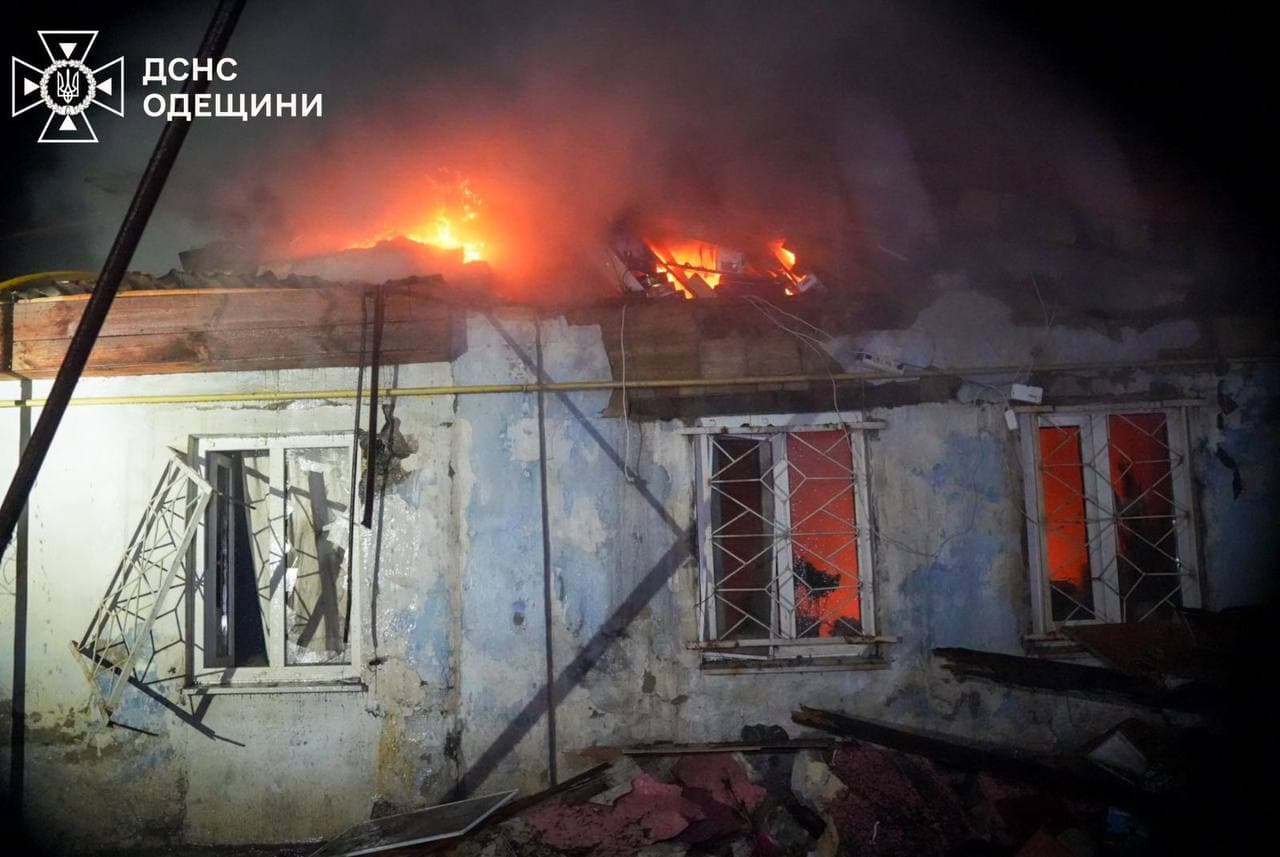
Aftermath of a Russian strike on Odesa, Ukraine, overnight. (Ukraine’s Emergency Service)
The Poison That Spoke Louder Than Diplomacy
While leaders debated borders in Munich, five European governments released a different kind of finding.
Laboratories in the United Kingdom, Sweden, France, Germany, and the Netherlands had analyzed Alexei Navalny’s biological samples. Their conclusion was unanimous: he had been poisoned with epibatidine — a toxin derived from poison dart frogs — before his February 16, 2024 death in an Arctic penal colony.
Epibatidine is not accidental. It is extraordinarily toxic. It has no legitimate medical use. Its presence does not suggest negligence. It suggests intent.
“Navalny died while held in prison, meaning Russia had the means, motive and opportunity to administer this poison,” the governments stated in a joint declaration.
The timing was not incidental. European leaders were gathered discussing Russia’s war against Ukraine and Moscow’s demands for territorial concessions and regime change in Kyiv. The announcement cut through abstraction. Negotiations were not theoretical. They involved a state accused of poisoning its most prominent opposition figure in custody.
The Kremlin denied responsibility. It had long claimed Navalny died of natural causes. But intensive-care physician Alexander Polupan told the Insider that Navalny’s publicly reported symptoms aligned with epibatidine exposure.
The revelation did not move the frontline. Russian forces continued attacking. Ukrainian forces continued defending. The attrition arithmetic remained unchanged.
But it sharpened the context.
A state willing to administer exotic toxins to a high-profile prisoner is a state whose commitments require verification and enforcement. For Kyiv, the finding reinforced why security guarantees must precede any territorial compromise.
Epibatidine is a scientific term.
In Munich, it became political language.
It defined the adversary at the table.
When Neutrality Wasn’t Enough
Ilham Aliyev did not sound surprised. He sounded finished with pretending.
At the Munich Security Conference, after meeting with Volodymyr Zelensky, the Azerbaijani president revealed that Russian forces had struck Azerbaijani assets in Ukraine three times — including the Azerbaijani Embassy in Kyiv.
“After the first attack, we could assume it was accidental,” he told Ukrainska Pravda. Azerbaijan provided Moscow with precise coordinates of its diplomatic missions, consular offices, and cultural centers. “Despite this, two more attacks took place. So it was a deliberate attack.”
The pattern stretched back months.
In November, Azerbaijan summoned the Russian ambassador after an Iskander-type missile damaged its embassy in Kyiv. In August 2025, the embassy was again hit during a Russian strike. That same month, a Russian drone damaged a SOCAR depot in Odesa Oblast, injuring four workers and striking a diesel pipeline. Another attack targeted a gas distribution station near Orlivka — part of the Trans-Balkan pipeline carrying Azerbaijani gas to Ukraine. Even Azerbaijan’s honorary consulate in Kharkiv was damaged in March 2022.
These were not battlefield accidents.
Azerbaijan had maintained a careful neutrality — balancing relations with Moscow while providing humanitarian and energy assistance to Kyiv. After Aliyev’s meeting with Zelensky, both sides discussed deepening cooperation in the energy sector.
Russia’s message appeared blunt.
Assets in Ukraine were targets — even those belonging to states maintaining diplomatic ties with Moscow.
Aliyev described the strikes as “an unfriendly step.”
For leaders debating negotiations, the implication was clear: Russia’s targeting calculus extended beyond Ukrainian military infrastructure.
Neutrality did not guarantee safety.
It simply postponed recognition.
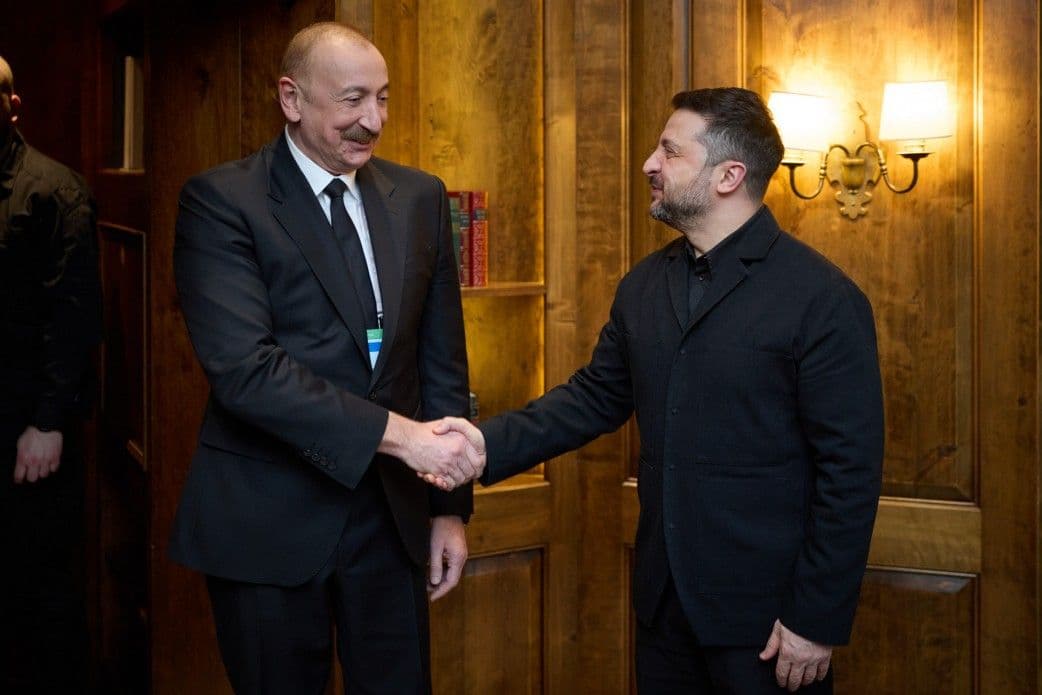
Azerbaijani President Ilham Aliyev meets with President Volodymyr Zelensky on the sidelines of the Munich Security Conference in Munich, Germany. (Presidential Office)
The Day’s Meaning
February 14 revealed not confusion — but clarity.
Marco Rubio reassured Europe that the transatlantic alliance still stood. Alexei Zhuravlyov made clear Moscow would settle for nothing less than regime change in Kyiv. Volodymyr Zelensky invoked Munich 1938 and warned that dividing Ukraine would not bring peace. European laboratories confirmed that Alexei Navalny had been poisoned with an exotic dart frog toxin while in Russian custody.
Diplomacy and brutality were not separate stories. They were the same story told in different rooms.
Russia’s demands are now explicit: not just land, but political control. No Ukrainian government aligned with the West would be acceptable. Ukraine’s position is equally explicit: negotiations are possible, but only with enforceable security guarantees and without surrender of sovereignty. The sequencing matters because trust does not exist.
On the battlefield, the arithmetic remained unforgiving. Russian forces advanced meters at enormous cost. Ukrainian counterattacks proved the line was not collapsing. Starlink disruptions exposed technological vulnerabilities. Frozen rivers opened brief tactical windows. Oil depots burned in Krasnodar while Ukrainian cities endured another night under drones.
Neither side can fully shield its rear. Neither side can force decisive breakthrough. Both can inflict pain.
Geneva approaches under these conditions — maximalist demands, hardened red lines, attritional warfare, and a documented willingness by Moscow to eliminate political opponents with state-level toxins.
The contradictions no longer hide beneath rhetoric. They sit in plain view.
Peace is being discussed by actors who do not trust each other, while armies continue to kill each other.
The question is no longer what each side wants.
It is whether the costs will compel either to accept less.
Pray For Ukraine
- Pray for Protection Under the Swarm
Ask God to shield Ukrainian cities from nightly drone and missile attacks. Pray for air defense crews who stand watch in the dark, making split-second decisions that save lives. Pray for families in Chernihiv, Odesa, Dnipropetrovsk, Zaporizhzhia, Sumy, and Kherson who go to sleep not knowing what the sirens will bring. - Pray for Those Living Along the Grinding Frontlines
Lift up the soldiers and civilians near Kharkiv, Kupyansk, Slovyansk, Kostyantynivka, Zaporizhia, and Oleksandrivka. Pray for endurance where the line shifts by meters and casualties mount daily. Ask for wisdom for commanders and courage for defenders holding under relentless pressure. - Pray for Truth and Justice in the Face of Evil
Pray that the truth surrounding Alexei Navalny’s poisoning would bring accountability and awaken conscience across Europe. Ask that leaders negotiating with Moscow would discern clearly the character of the regime they face and refuse any agreement built on illusion or appeasement. - Pray for Strategic Wisdom in Diplomacy
As Geneva approaches, pray for Ukrainian leaders to stand firm with dignity and clarity. Pray that security guarantees would be strong, enforceable, and just. Ask God to prevent any settlement that would sacrifice sovereignty or leave Ukraine vulnerable to renewed aggression. - Pray for Strength, Unity, and Hope
Pray that Ukraine would not grow weary. Ask for unity between America and Europe, courage among neutral nations pressured by Moscow, and resilience among civilians rebuilding after each strike. Pray that hope would outlast fear — and that peace, when it comes, would be righteous and secure.