
In Jerusalem, Netanyahu requested Ukrainian interceptor drones as Iran’s war spiraled. In Kyiv, 430 drones and 68 missiles tore through the night sky while four civilians died in the suburbs. In Washington, Trump eased Russian oil sanctions and blamed Zelensky for not making peace. Day 1,480—when the country the world tried to forget became the arsenal everyone needed.
The Day’s Reckoning
Every phone in Kyiv lit up at one in the morning. Four hundred and thirty drones and sixty-eight missiles—Zirkons, Iskanders, Kalibrs, Shaheds—screaming inbound from eight launch points simultaneously. The largest combined strike in weeks, aimed at the capital’s power grid while millions slept.
By dawn, four people were dead in the Kyiv suburbs. In Zaporizhzhia, rescue workers pulled a seventeen-year-old boy from collapsed rubble after guided bombs flattened a residential block. In Kharkiv, a suburban train sat shredded by drone shrapnel, its driver bandaging his own wounds. And off Novorossiysk, a Greek oil tanker chartered by Chevron drifted with drone damage in its hull—the geopolitics of oil, war, and sanctions colliding in a single strike.
But the day’s most consequential moment wasn’t an explosion. It was a phone call. Benjamin Netanyahu requested a meeting with Volodymyr Zelensky—not about peace, not about grain, but about Ukrainian interceptor drones. Tokyo weighed an arms deal to buy Ukrainian UAVs. More than ten countries had already asked Kyiv for help shooting down Iranian drones across the Middle East. Tehran responded by declaring all of Ukraine a legitimate target. And in Washington, Donald Trump eased Russian oil sanctions, blamed Zelensky for not making peace, and watched his own troops in Jordan being protected by the very Ukrainian drone technology he’d publicly dismissed twenty-four hours earlier.
Day 1,480. The war that was supposed to isolate Ukraine had turned Kyiv into the world’s most sought-after drone arsenal. The missiles kept falling, but the phone kept ringing—and not just from allies. From nations that had barely acknowledged Ukraine two years ago.
When the Sky Fell: 498 Munitions in a Single Night
The strike package came from everywhere at once. Zirkons screamed in from occupied Crimea at hypersonic speed. Thirteen Iskander-M ballistics launched from Bryansk Oblast. Twenty-five Kalibrs rose from warships in the Black and Caspian seas. Twenty-four Kh-101 cruise missiles streaked south from Vologda Oblast. Four Kh-59/69s from Kursk and occupied Donetsk. Then the swarm—430 drones, roughly 250 of them Shaheds, converging from eight directions: Bryansk, Kursk, Oryol, Millerovo, Shatalovo, Primorsko-Akhtarsk, and two sites in occupied Crimea.
Ukrainian air defense crews tracked them all simultaneously, firing through the darkness for hours. They downed 402 drones, one Zirkon, seven Iskanders, every single Kalibr, every Kh-101, and one Kh-59. Staggering efficiency under impossible conditions. But saturation math is unforgiving—six missiles and twenty-eight drones punched through, hitting eleven locations. Debris from intercepted drones struck seven more.
The lights went out across six oblasts. Kyiv City, Cherkasy, Kirovohrad, Kharkiv, Zaporizhzhia, Dnipropetrovsk—all dark. Ukrenergo imposed emergency electricity restrictions while repair crews worked under constant threat of follow-up strikes, racing to restore power before evening peak demand.
Zelensky posted the numbers on Telegram, then issued a warning aimed well beyond Ukraine’s borders: Russia could exploit the Middle East war to intensify these attacks. European partners needed to accelerate air defense deliveries. The message landed in capitals still debating whether this conflict could spill across borders.
One of Moscow’s drones had already answered that question—crossing into Moldovan airspace, passing over the villages of Ukrainka and Novosilka before vanishing from radar. Foreign Minister Mihai Popsoi called it a “serious breach of sovereignty.” Russian munitions don’t read maps.
Seven Dead, Forty-Six Wounded, and a Twelve-Year-Old with Shrapnel in Her Skull
Two died in Brovary district. One in Vyshhorod. Fifteen more lay in hospitals across Kyiv Oblast by morning, three critical, two in surgery. The damage reports cataloged ordinary life shattered—two private homes, a dormitory, office buildings, a restaurant, a garage complex, two schools, a kindergarten, a multi-story apartment building. Thirty structures across Obukhiv and Brovary districts. Thousands left without power or heat.
In Kharkiv Oblast, a drone found a suburban train. The driver and his assistant took shrapnel but kept breathing. The locomotive didn’t fare as well. One person died in the oblast, eleven were wounded, including two children. Railway services kept running—because in Ukraine, they always keep running.
Kherson’s agony arrived in waves. Morning shelling in the Dniprovskyi district hit three women aged 50, 47, and 78—concussions, blast injuries, the signature wounds of urban bombardment. Hours later, the city center. A twelve-year-old girl. Two boys, eleven and thirteen. The youngest took shrapnel to the head. Rescue teams pulled a woman from a destroyed house. One dead, seven wounded across the oblast by nightfall.
Then Zaporizhzhia, 4:30 in the afternoon. Four KAB guided glide bombs slammed into a residential neighborhood. One man killed instantly. Nineteen injured, including a seventeen-year-old boy in serious condition. Rescuers dug two people from collapsed rubble while emergency crews worked into darkness, clearing wreckage across several destroyed houses, twelve damaged homes, and twelve gutted apartment buildings. A city of 710,000 that has endured escalating strikes all winter absorbed another blow.
The day’s full toll across Ukraine: seven civilians killed, forty-six wounded. Three hurt in Sumy Oblast from eighty strikes on thirty-five settlements. Three more in Donetsk. Numbers compiled by governors who assemble these lists every single day.
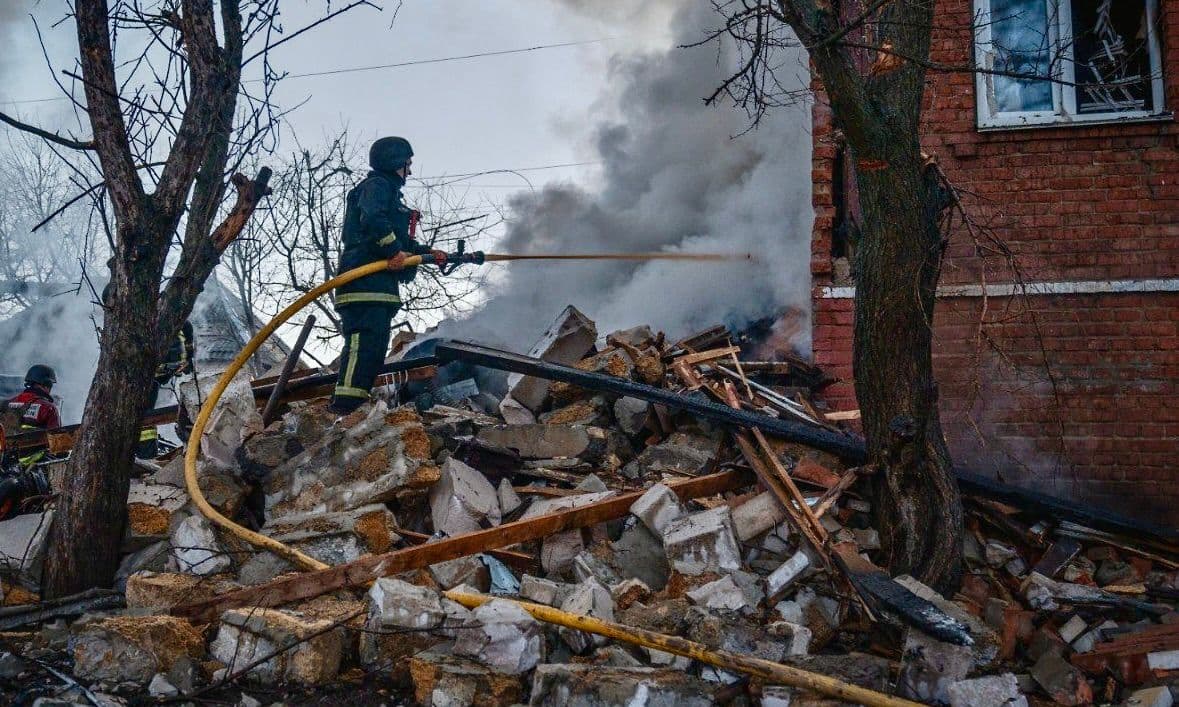
Firefighters extinguishing fire that broke out in the aftermath of a Russian attack on Sumy Oblast. (State Emergency Service / Telegram)
Flames Over Krasnodar: Ukraine Guts Russia’s Oil Lifeline
While Russian missiles rained on Kyiv, Ukrainian drones were already airborne heading the other direction.
Residents near the Afipsky Oil Refinery in Krasnodar Krai heard dozens of explosions starting around 1 a.m. Air defense systems activated, sirens wailed across the region, and then the fire took hold. One of southern Russia’s largest refineries—6.25 million tons of crude annually, two percent of national output—was burning. A Ukrainian open-source intelligence project assessed the strikes destroyed the main refining unit. Gasoline, diesel, gas condensate, heavy petroleum residues, sulfur—the fuels that keep Russia’s military logistics moving—stopped flowing.
Simultaneously, Ukrainian forces hit the Port of Kavkaz on the Chushka Spit, the gateway to Russia’s Kerch ferry crossing into occupied Crimea. Three people were injured, port infrastructure damaged. Ukraine’s military intelligence directorate reported it rendered the railway ferry Slavyanin inoperable and damaged the cargo vessel Avangard—both key to transporting ammunition and equipment across the Kerch Strait to Russian forces. That 35-kilometer waterway connecting the Black Sea to the Sea of Azov keeps losing its ferries, one strike at a time.
Ukrainian drones also found the Khanskaya Airfield at Maykop Airbase in Adygea, home to the 272nd Training Aviation Base. Geolocated footage captured an explosion near the KuybyshevAzot chemical plant in Tolyatti, Samara Oblast—the same facility hit just three days earlier. And by the following night, the Tikhoretsk oil pumping station in Krasnodar Krai was burning again. Second time in three days. Residents posted videos of massive flames consuming one of southern Russia’s largest oil logistics hubs.
The pattern was unmistakable. Ukraine wasn’t just striking targets. It was striking them again before repairs could finish.
Drones Over the Kremlin: Moscow’s Airports Go Dark
Sixty-five Ukrainian drones headed for Moscow. Mayor Sergey Sobyanin tracked the waves throughout the day, posting updates as air defenses engaged group after group converging on the capital. Russia’s Defense Ministry claimed 280 Ukrainian drones were destroyed across various regions during a ten-hour span.
Three of Moscow’s airports—Domodedovo, Vnukovo, and Zhukovsky—suspended all flights as the drone threat persisted. Emergency crews deployed to crash sites across Moscow Oblast, though Russian authorities reported no casualties or significant damage.
Ukrainian officials have described the airport closures as deliberate strategy—not trying to flatten Moscow, but making the capital feel the war. Every grounded flight, every diverted passenger, every delayed cargo shipment carried the same message: this war has no safe rear area. Not even the Kremlin’s backyard.
Killing the Spring Offensive Before It Starts
The headlines chased burning refineries. The more consequential campaign was quieter and closer to the front.
In occupied Crimea, Ukrainian forces found an Iskander-M ballistic missile launcher at Vyshneve—209 kilometers from the front line—preparing to fire at Ukrainian cities. They destroyed it. Near Kurotne, 217 kilometers out, they hit an Iskander storage warehouse. These weren’t strikes on static infrastructure. These were strikes on the weapons being aimed at civilians that very night. A Nebo-U radar station near Hvardiiske took a hit too, tearing a hole in the radar coverage Russia depends on to track incoming Ukrainian strikes.
Then the air defense hunt. A Ukrainian unmanned systems brigade destroyed five Pantsir-S1 systems in the Belgorod direction, geolocated footage confirming a strike on one in eastern Belgorod City, just thirty kilometers from the front. Five fewer systems standing between Ukrainian drones and their targets.
The target list stretched across the entire southern front—an S-300 missile depot near Sadove in Donetsk Oblast, a Russian Unmanned Systems Forces command post near Vulehirsk, command posts in Hrafske and Kermenchyk, a repair center near Andriivka in Zaporizhia Oblast, a force concentration near Novomykolaivka, a warehouse near Berdyansk, and two logistics trains disabled near Tokmak. Ukrainian forces were also intensifying strikes on Russian multiple launch rocket systems in the Slovyansk and Kostyantynivka directions.
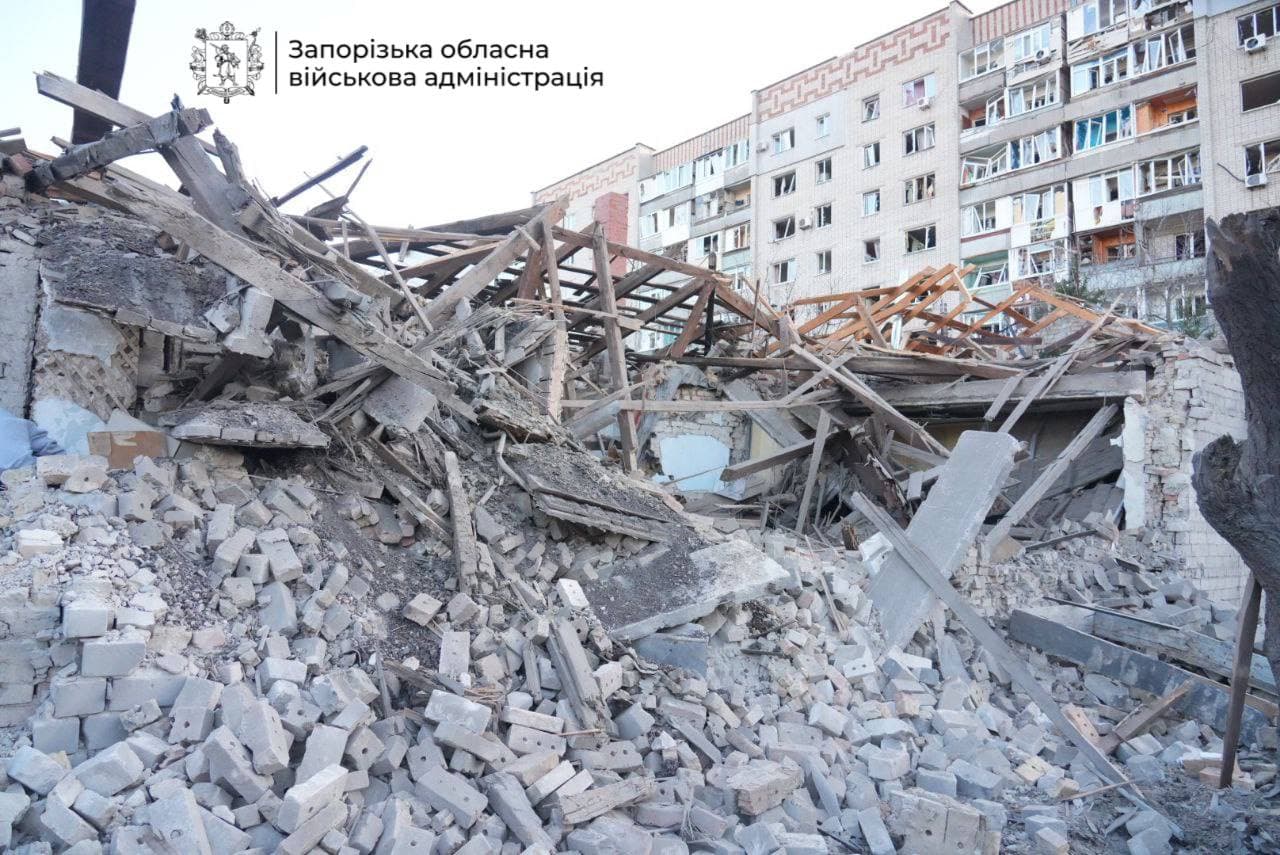
The aftermath of a Russian guided bomb attack on a residential neighborhood in Zaporizhzhia, Ukraine. (Ivan Fedorov / Telegram)
Every target fit a single strategic logic: degrade the launchers, radars, air defenses, logistics, and command posts Russia needs for its expected spring-summer 2026 offensive. Kill the offensive in its preparation phase. Every Iskander destroyed before launch was a Ukrainian city that wouldn’t burn. Every Pantsir eliminated was another gap Ukrainian drones could fly through.
The spring offensive was still being planned. Its infrastructure was already dying.
The Phone Call from Jerusalem: When the World Needed Ukraine’s Drones
Two years ago, this call doesn’t happen. On March 14, it did.
Benjamin Netanyahu requested a meeting with Volodymyr Zelensky. Not about peace talks or grain corridors—about Ukrainian interceptor drones. The U.S.-Israeli war against Iran was entering its third week, thousands of Iranian attack drones were hammering Israel and its allies, and Jerusalem was turning to the one country that had spent three years learning how to shoot Shaheds out of the sky. Ambassador Yevgen Korniychuk confirmed the request. Talks would likely happen the following week.
The irony cut deep. Iran had been supplying Russia with the very drones that struck Ukrainian cities by the hundreds—roughly 250 Shaheds flew in that same overnight barrage that killed four in Kyiv. Now Iran was launching those same drones at Israel, and Israel was calling Kyiv for help.
Netanyahu wasn’t alone in the queue. More than ten countries had already requested Ukrainian drone expertise. Kyiv had dispatched specialists to Saudi Arabia, Qatar, and the UAE. Ukrainian interceptor drones and operators were protecting U.S. military bases in Jordan—deployed at Washington’s own request on March 5.
From Tokyo, another signal. Japan was considering an arms transfer agreement for Ukrainian-made drones, according to Kyodo News—extraordinary for a country whose constitution restricts lethal military aid. Tokyo’s 2026 budget allocated 100 billion yen, roughly $629 million, for drone defense. Kyiv had initiated the approach. Ukraine’s drone industry—more than 200 companies producing cheap, adaptable systems—now had production capacity outpacing its financing, which was why Zelensky had ordered arms export internationalization in November 2025, with ten weapons export centers planned across Europe.
The sharpest contrast sat in Washington. Trump told Fox News the day before that America “does not need” Ukraine’s drone help. American troops in Jordan were being protected by Ukrainian interceptor drones at that very moment.
“Like a Serial Killer Citing Criminal Code”: Iran Threatens Ukraine
Iranian politician Ebrahim Azizi posted his threat on March 14 with the confidence of someone who hadn’t thought it through. Ukrainian territory, he declared, was now “a legitimate target for Iran.” His logic: by helping Middle Eastern countries shoot down Iranian drones, Ukraine had “effectively become involved in the war” and, under Article 51 of the UN Charter, made itself fair game.
Ukraine’s Foreign Ministry spokesperson Heorhii Tykhyi didn’t flinch. The Iranian regime, he noted, had been “supporting the murder of Ukrainians for years, by directly sharing drones and technology for Russian aggression against Ukraine.” Hearing Tehran invoke the right to self-defense was, Tykhyi said, “like hearing a serial killer justify his crimes by citing criminal code.”
Follow the circle and feel the absurdity tighten. Iran supplies drones to Russia. Russia launches them at Ukrainian cities. Ukraine, bleeding and burning, develops countermeasures to survive. The U.S. and Israel attack Iran. Iran launches those same drones at Israel and its allies. Ukraine deploys its hard-won countermeasures to protect countries under attack. Iran threatens Ukraine for providing the defense technology that Iran’s own weapons forced Ukraine to build in the first place.
Complete. And completely absurd.
Moscow’s role made it worse. Russia stood accused of helping Iran coordinate its drone attacks across the Middle East—the same Russia that had done almost nothing when American and Israeli bombs fell on Tehran, killing Iran’s Supreme Leader and dozens of senior officials. The Kremlin watched its ally burn, offered little, and quietly collected the financial windfall from the oil crisis the war created.
Every side played. Every angle covered. Every ally expendable.
“Tell Zelensky to Make a Deal”: Trump Eases Russia’s Oil Sanctions
“I want to have oil for the world. I want to have oil.” Donald Trump’s justification to NBC News was characteristically blunt. The oil sanctions temporarily lifted against Russia would “go back as soon as the crisis is over,” he said—the crisis being Iran’s blockade of tankers in the Strait of Hormuz, not Russia’s war on Ukraine.
The Treasury Department had already issued a temporary license days earlier, allowing countries to purchase Russian oil stranded at sea through April 11. A separate waiver let India buy Russian crude to offset Middle East supply disruptions. Moscow was cashing in fast—an additional six billion euros in fossil fuel revenue in just two weeks of fighting, according to the Center for Research on Energy and Clean Air.
When reporters pressed on international criticism, Trump pivoted to blame. “I’m surprised that Zelensky doesn’t want to make a deal. Tell Zelensky to make a deal because Putin’s willing to make a deal,” he told NBC.
Zelensky had already answered that logic four days earlier. “How can sanctions be lifted from Russia if it is an aggressor?” he asked during a March 10 briefing, calling the move a “serious blow” to Ukraine and a “reputational blow” for the world.
In Moscow, Kremlin economic negotiator Kirill Dmitriev celebrated on X: “Russian energy is indispensable to easing the world’s largest energy crisis.” EU officials, he predicted, would “soon be forced to recognize this reality, acknowledge their strategic blunders, and atone.” Dmitriev had met Trump administration officials in Florida just one day before the sanctions easing was announced.
Six billion euros in two weeks. The war on Iran was becoming the best thing that ever happened to Russia’s treasury.
A Chevron Tanker Takes a Hit: The Black Sea’s Impossible Contradictions
The Maran Homer was sailing through Russian territorial waters off Novorossiysk, flying a Greek flag, chartered by Chevron, headed to pick up Kazakh crude from the Caspian Pipeline Consortium terminal. Then a suspected drone struck. The tanker sustained damage but stayed seaworthy. All twenty-four crew members survived.
Greek Maritime Minister Vassilis Kikilias went on state broadcaster ERT and called the targeting of Greek-flagged vessels “unacceptable.” He said Greece would lodge a “strong complaint” with the country responsible—stopping short of naming Ukraine directly, but noting Kyiv had carried out repeated attacks in the Black Sea. Kikilias believed the strike was connected to Washington’s decision to ease Russian oil sanctions.
The impossible contradictions of the Black Sea converged in that single hit. Ukraine considers Russian oil infrastructure a legitimate military target because fossil fuel revenue funds the invasion. Western nations sanctioned Russian oil for exactly the same reason. But with the Iran war disrupting global energy markets, Washington was now easing those very sanctions—and a tanker chartered by an American oil giant took drone damage in the waters where Ukraine operates.
Washington had been here before. The State Department warned Kyiv after a reported strike on the Novorossiysk terminal in November 2025. Ukraine’s ambassador, Olha Stefanishyna, acknowledged the warning concerned “the very fact that American economic interests were violated there.”
Those interests were being violated again—at the precise moment Washington was trying to unlock Russian oil to stabilize global prices. The same oil. The same port. The same contradiction.
Orban’s Team Slept Through a Missile Attack—and Still Blamed Ukraine
The video call told the whole story. Hungarian State Secretary Gabor Czepek, reporting from Kyiv to Prime Minister Viktor Orban, admitted the delegation sent to “inspect” the Druzhba pipeline wasn’t allowed anywhere near it. They’d arrived March 12 without coordinating with Ukrainian authorities, held no official status, had no scheduled meetings. Ukraine’s Foreign Ministry had made that clear before they landed.
Orban declared success anyway. His team’s arrival had “set the machine in motion,” he claimed. “We forced the Ukrainians to take action.” He ordered Czepek home.
The briefing Orban took credit for was already underway. Naftogaz, partnered with Ukraine’s Foreign Ministry, presented technical evidence of the pipeline damage to ambassadors from thirty-one countries—Hungary included. Deputy Foreign Minister Yevhen Perebyinis and Naftogaz CEO Serhii Koretskyi detailed how Russia’s January 27 strike caused “significant damage” to the pipeline that had carried Russian crude to Hungary and Slovakia before going offline.
Koretskyi widened the lens: over 400 Russian attacks on Naftogaz facilities since the full-scale invasion. More than thirty in 2026 alone—including the massive overnight barrage that hit while the Hungarian delegation slept in Kyiv. Czepek admitted on camera it had been a “difficult” night, air defenses firing above them for hours.
The irony was brutal. Orban—the EU’s most Kremlin-friendly leader—had accused Kyiv of deliberately suspending the pipeline to “blackmail” Hungary. He’d blocked the EU’s twentieth sanctions package against Russia and a ninety-billion-euro loan to Ukraine in retaliation. His own team spent the night cowering under Russian missile fire in the city he accused of sabotage.
The pipeline wasn’t broken by Ukraine. The evidence was falling from the sky.
Logistics Men Sent to Die: Russia’s Exhaustion at Slovyansk
The ground war’s daily rhythm continued beneath the headlines—Russian forces pressing forward everywhere, breaking through nowhere.
Near Slovyansk, a Ukrainian brigade spokesperson delivered a damning assessment: Russian forces had almost fully exhausted available frontline troops. Logistics personnel were being thrown into assaults. Replacements arriving at the front were poorly trained, infiltrating at night in small groups, wearing anti-thermal cloaks, crossing the Bakhmutivka River on improvised bridges. Ukrainian forces had recently advanced positions in the area even as fighting continued around western Riznykivka.
The Atesh partisan group reported something more revealing. Russian forces were pulling vehicles deeper into rear areas across the Slovyansk and Siversk directions—withdrawing equipment from four kilometers behind the front to thirty-seven kilometers back. Ukrainian drones were reaching so far into the Russian rear that nowhere close felt safe anymore.
Around Kostyantynivka and Druzhkivka, combat was intense but inconclusive. Russian infiltration missions into central Holubivka and Kostyantynivka’s outskirts failed to change control of terrain. A Ukrainian company commander reported his forces were running their own infiltration missions into the Russian near-rear, seizing tactical initiative and potentially disrupting spring offensive planning. Improving weather had intensified Russian FPV drone operations, though glide bomb strikes hadn’t escalated.
In the Pokrovsk direction, Russian forces attacked from four axes simultaneously—northwest, north, northeast, southwest—without a single confirmed advance. Ukrainian forces struck a Russian artillery system near occupied Zelene and reported using unmanned ground vehicles en masse for logistics and casualty evacuation, though Russian FPV operators were hunting those UGVs.
Attacking everywhere. Advancing nowhere. Bleeding constantly.
Russia’s Own Bloggers Sound the Alarm
From Kupyansk to Zaporizhia, Russia’s own military bloggers were telling a story Moscow’s Defense Ministry wouldn’t.
In Kupyansk, one admitted Russian positions inside the city remained unstable. The logistics corridor feeding those positions had narrowed to 500 meters—too dangerous for foot soldiers or vehicles. Only drones could carry supplies in. Russian forces continued attacking near the city, east toward Kupyansk-Vuzlovyi, and southeast near Kurylivka and Novoosynove, while Ukrainian forces counterattacked in northern Kupyansk. But the 500-meter corridor told the real story.
In western Zaporizhia Oblast, another milblogger made a remarkable confession: Russian forces were submitting false position reports. Ukrainian forces were actually operating on the outskirts of Prymorske and Stepnohirsk—settlements Russia had previously claimed to control.
The drone warnings were loudest. A milblogger in occupied Donetsk City claimed Ukrainian FPV drones could now strike 100 kilometers behind the front line, using “advanced technology that Russian forces cannot copy.” Others described Ukrainian fiber-optic drones, mothership drones, shifting radio frequencies, and what they called AI drone swarms hitting the Russian rear.
Russian forces continued offensive operations across Sumy, Kharkiv, Borova, Dobropillya, Oleksandrivka, Hulyaipole, western Zaporizhia, and Kherson—without advances in any direction. The Ukrainian Joint Forces Task Force reported Russia accumulating forces to resume operations toward Velykyi Burluk.
The front line bent. It didn’t break. And Russia’s own voices were admitting why.
Five Names, Five Show Trials, Five Predetermined Verdicts
Oleksandr Harbuz is 53 years old. He served with the 129th Territorial Defense Brigade. A Russian court sentenced him to eighteen years for allegedly planting landmines in Sudzha district during Ukraine’s Kursk incursion. He was captured near the village of Gornal.
Volodymyr Koshmel of the 25th Assault Battalion—seventeen years. Serhii Mekhonoshyn of the 17th Mechanized Brigade—sixteen. Mykola Cheban of the 255th Assault Battalion—sixteen. Oleksandr Sychuhov, 47, of the 33rd Assault Regiment—fifteen.
Five men. Sentences totaling eighty-two years. Verdicts delivered with the procedural efficiency of a system that decided the outcome before the gavel fell.
Kyiv and international observers have consistently described Russia’s POW trials as politically motivated theater lacking due process. International human rights organizations have documented what happens before the courtrooms open—inhumane conditions, brutal torture, systematic abuse of Ukrainian prisoners during captivity. The trials don’t deliver justice. They perform it for cameras while the real punishment happens in cells no journalist will ever see.
What Day 1,480 Revealed
The war that was supposed to isolate Ukraine made it indispensable instead.
Netanyahu called Zelensky for drone technology. Tokyo weighed buying Ukrainian weapons. Ten countries lined up for help shooting down Iranian drones. Tehran threatened Ukraine for being too good at it. And Trump eased Russian oil sanctions, blamed Zelensky for refusing peace, and quietly relied on Ukrainian interceptor drones to protect American troops in Jordan.
The contradictions weren’t accidental. They were structural. The Iran war had redrawn the global map of who needed what from whom, and Ukraine—still absorbing 498 munitions in a single night—found itself holding cards nobody expected it to have.
On the ground, nothing moved. Russian forces attacked across every sector and advanced in none. Their own milbloggers admitted unstable positions in Kupyansk, fabricated reports in Zaporizhia, and Ukrainian drone technology they couldn’t replicate. The spring offensive Russia was planning was losing its infrastructure to Ukrainian mid-range strikes before the first order could be given.
The questions sharpened. Could Ukraine convert drone diplomacy into the air defense systems it desperately needed before the next 498-munition barrage? Could Russia sustain offensive operations when its own bloggers described logistics corridors too narrow for soldiers to walk through? Could Washington ease sanctions on Russian oil and maintain credibility as Ukraine’s ally?
Orban’s delegation slept through a missile attack on Kyiv and still blamed Ukraine for the broken pipeline. A Chevron tanker took a hit in waters Washington was trying to reopen. A Russian drone drifted across Moldova without consequence.
Day 1,480. The missiles kept falling. The phones kept ringing. And nobody could say which mattered more—the 498 munitions Russia launched at Kyiv, or the single call from Jerusalem.
Prayer For Ukraine
- Shield Over the Night Sky
Almighty God, we lift up the Ukrainian air defense crews who stood watch through the darkness of March 14, tracking 498 incoming missiles and drones from eight directions and shooting down 460 of them. We ask Your protection over every soldier who mans a radar screen, every crew that fires into the night not knowing what will get through. Strengthen their hands, sharpen their eyes, and sustain their courage through the long nights ahead. Guard the repair crews restoring power across six oblasts, working under the constant threat of follow-up strikes. Let their work be swift and their lives be preserved.
- Comfort for the Wounded and the Grieving
Lord, we bring before You the seven souls lost across Ukraine on this day—the four dead in the Kyiv suburbs, the man killed in Zaporizhzhia, the lives taken in Kharkiv and Kherson. We ask Your healing hand upon the forty-six wounded, especially the twelve-year-old girl in Kherson who took shrapnel to the head, the seventeen-year-old boy pulled from rubble in Zaporizhzhia, and the three children wounded in Kherson’s city center. Be near the families burying their dead tonight and the surgeons still operating by morning light. Comfort those who grieve. Heal those who bleed.
- Wisdom in a World of Contradictions
Father, we pray for wisdom among the leaders whose decisions shape this war’s trajectory. Guide President Zelensky as nations call upon Ukraine’s expertise while missiles still fall on his people. Grant discernment to leaders in Jerusalem, Tokyo, and across the Middle East as they seek Ukraine’s help. We ask that those in Washington understand that easing the aggressor’s sanctions while blaming the victim is not the path to peace. Turn the hearts of the powerful toward justice, and let no political calculation come before innocent lives.
- Justice for the Captive
God of justice, we remember Oleksandr Harbuz, Volodymyr Koshmel, Serhii Mekhonoshyn, Mykola Cheban, and Oleksandr Sychuhov—five Ukrainian prisoners of war sentenced in show trials to decades behind bars. You see what happens in cells where no cameras reach. We ask Your presence with every Ukrainian held in Russian captivity, enduring conditions that human rights organizations have documented as torture. Sustain them in body and spirit. Let the world not forget their names. And let the day of their return come swiftly.
- Endurance for the Arsenal of the Free World
Lord, we marvel at what Ukraine has become—a nation under fire that the world now turns to for protection. More than ten countries have asked for help. Specialists deploy to Jordan, Saudi Arabia, Qatar, and the Emirates. Even former skeptics reach for the phone. We pray for the endurance of a people who build while being bombed, who export expertise while importing grief. Sustain Ukraine’s defenders, its innovators, its ordinary citizens who go to work in buildings with shattered windows. Bring justice to this war. Bring restoration to this land. And bring it to an end. Amen.