
As the Kremlin tightens its digital grip at home, Ukrainian drones smash deep into Russia’s energy heartland—exposing the widening gap between Putin’s information control and battlefield reality.
The Day’s Reckoning
Phones across Russia went silent.
Messages stalled mid-sentence. Calls never connected. The last major Western messenger still working in the country—WhatsApp—simply stopped existing for roughly 100 million users. The Kremlin’s explanation arrived in careful bureaucratic language: Meta refused to obey Russian law. Translation — accept state censorship or disappear.
It wasn’t only WhatsApp. Russia’s internet registry quietly erased YouTube, Facebook, Instagram, Tor, independent media, and VPN pathways from the national routing system. The open web didn’t crash. It was unplugged.
But while Moscow sealed its digital borders, something else was breaking open hundreds of kilometers away.
Near Hulyaipole, Ukrainian units moved to reconnect isolated positions as Russian coordination faltered. Russian military bloggers complained of “new complicating factors” — Starlink restrictions and Telegram throttling. Ukrainian counterattacks appeared exactly where communication gaps widened.
Then the war jumped deep into Russia.
Ukrainian drones struck the Ukhta oil refinery 1,750 kilometers from the border, igniting processing units that fueled Russian forces. Cruise missiles hit a major ammunition arsenal near Kotluban. Another defense plant burned. The map of safe distance shrank overnight.
In Brussels, allies pledged nearly $38 billion in military support.
In Italy, an Olympic athlete was banned for honoring the war’s dead — and decorated by his president hours later.
The same day revealed a pattern: Moscow tightened control over information while losing control over events.
The digital curtain fell.
The battlefield widened.
When the Messages Died
The messages didn’t fail slowly.
They stopped.
On the evening Russian users reached for WhatsApp, screens froze mid-conversation. No spinning wheel. No error code explaining the silence. Just nothing. By morning, Meta confirmed what millions already knew: Russia had moved to block the platform outright, cutting off what the company called “over 100 million users from private and secure communication.”
Dmitry Peskov delivered the explanation with bureaucratic calm. Meta refused to comply with Russian law. There was still a “chance for reaching an agreement,” he said, if the company would “engage in dialogue.” Translation: accept state control over content, data, and private conversations — or disappear.
The mechanism was clinical. Russia’s National Domain Name System routed all internet traffic through the sovereign RuNet. Remove a service from the registry, and telecommunications providers simply could not connect users to it. The address existed. The road to reach it did not.
Independent outlet Vazhnye Istorii reported that users could sometimes bypass restrictions by manually changing DNS servers. Roskomnadzor appeared to have blocked only the web version for many users, while mobile applications still functioned in places. Reports of outages spiked but were not yet universal.
Yet.
The throttling had begun in December 2025. February 12 was escalation. The Kremlin was testing pressure points — infrastructure limits, public tolerance — before tightening further.
The objective was plain: eliminate Western platforms and herd users toward Max, the state-controlled messenger. Previous attempts to migrate Russians had failed. WhatsApp and Telegram endured.
So Moscow raised the stakes.
BBC. Radio Free Europe/Radio Liberty. Deutsche Welle. The Moscow Times. Tor. VPNs. One by one, pathways closed.
The walls of the digital Iron Curtain rose higher.
And 100 million voices felt the silence.
“With Carrier Pigeons?” — The Frontline Revolts
The complaints began as posts.
Then they turned into pleas.
On Russian Telegram channels, soldiers typed what commanders would not say publicly. “The front is in shock. Starlinks are gone, now they’re jamming Telegram too. How are we supposed to fight? With carrier pigeons?” one wrote, the message spreading across pro-war feeds within hours.
Three servicemen recorded video appeals directly to Roskomnadzor. One identified himself only by call sign: DJ. “I’m currently on combat duty. Telegram is our only channel of communication. Do not deprive us of it.” Another warned that without Telegram, Russian units would struggle to respond to Ukrainian drone strikes. “We need a tool like Telegram… It allows us to exchange information quickly in order to intercept drones.”
A fighter from the Albatros anti-drone unit said the same thing more bluntly: restrict Telegram, and Russian effectiveness drops — especially in newly occupied territories where UAV threats are constant.
The Kremlin had built a modern war machine that quietly depended on a civilian messaging app. Telegram handled tactical coordination, situational updates, ad hoc command-and-control — functions traditional military systems struggled to provide inside Ukraine’s electronic warfare environment. Now Moscow was degrading its own lifeline.
The backlash rippled through the Z-community. Fighterbomber mocked the move: “We can’t cut off Starlink for the Ukrainians. But we can cut off Telegram for Russians. And if we can, why not?” DShRG Rusich called it “another stupidity.” Belgorod Governor Vyacheslav Gladkov warned that slowing Telegram would disrupt urgent security alerts.
State TV host Boris Korchevnikov blamed Telegram founder Pavel Durov. Durov replied that restricting citizens’ freedoms was never the answer.
Roskomnadzor signaled it would continue.
The contradiction was stark: tighten control at home, weaken coordination at the front. And Ukrainian counterattacks near Hulyaipole moved into the gaps.
Moving Into the Static — Ukraine Strikes Where Signals Fade
East of the Haichur River, Russian drones filmed what they believed were exposed Ukrainian positions.
But the footage told a different story.
Geolocated videos published February 12 showed Russian strikes hitting static Ukrainian positions east of and in southern Dobropillya and north of Varvarivka, northwest of Hulyaipole. The positions had not collapsed. They had held. Ukrainian forces were still there — and moving.
Instead of launching a broad counteroffensive, Ukrainian units began stitching their lines back together. Small, localized counterattacks pushed to reconnect isolated positions Russian infiltration groups had bypassed, likely to exaggerate territorial gains. What Moscow presented as momentum looked more like gaps.
Even Kremlin-linked milbloggers admitted there were “new complicating factors.” Translation: communications were faltering. Starlink restrictions. Telegram throttling since February 9. Units struggling to coordinate.
Ukraine noticed.
Near the Dnipropetrovsk–Zaporizhia administrative border, clearing operations unfolded methodically. In southern Bohuslavka north of Borova, geolocated footage indicated Ukrainian forces made marginal advances where battlefield conditions briefly favored them.
Russian forces attacked across a wide arc — near Hulyaipole; northwest toward Tsvitkove, Staroukrainka, Kosivtseve, and Ternuvate; north near Dobropillya; northeast near Zlahoda and Rybne; south near Dorozhnyanka; west near Zaliznychne. Russian milbloggers claimed Ukrainian counterattacks near Ternuvate and Kosivtseve.
The fighting was incremental. Meter by meter. No sweeping breakthrough.
But that wasn’t the point.
These were opportunistic strikes — tactical repairs executed while Russian command-and-control lagged. Ukraine moved quickly before Moscow could adapt, exploiting temporary fractures in communication to regain cohesion along its defensive lines.
The void in Russian signals became Ukrainian maneuver space.
1,750 Kilometers — The Night Russia Felt the Distance Collapse
The smoke rose in Komi before dawn.
Seventeen hundred fifty kilometers from Ukraine’s border — farther than any confirmed strike before — Ukrainian long-range drones hit the Ukhta Oil Refinery overnight February 11–12. The Security Service of Ukraine’s Alpha special operations center confirmed the operation. Preliminary reports indicated impacts on the atmospheric-vacuum distillation unit and the visbreaking unit — the core systems that turn crude into fuel oil and gasoline.
Geolocated footage the next day showed plumes curling above the Lukoil facility. Ukhta processes roughly 4.2 million tons of oil annually. Ukrainian sources said it supplies fuel to Russian armed forces.
This was not just a record. It was a message.
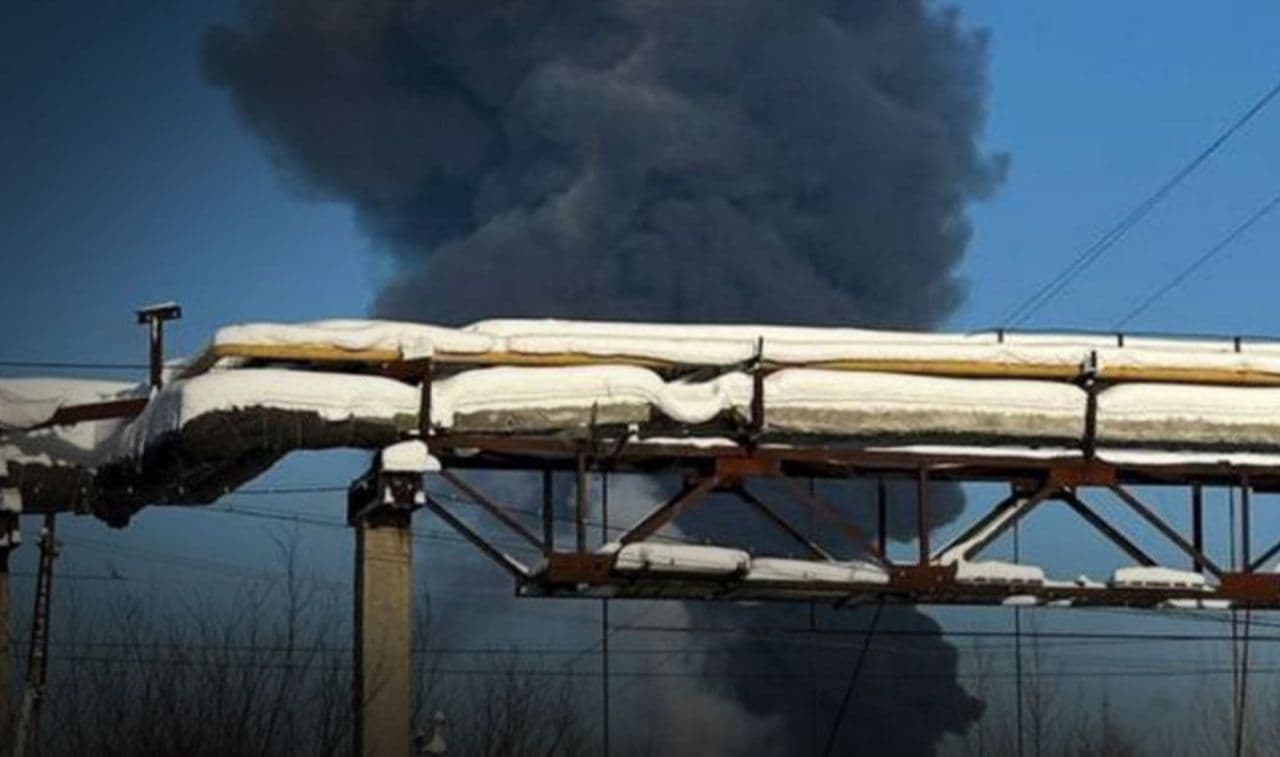
A fire burns at the Ukhta oil refinery in Russia’s Komi Republic following a Ukrainian strike. (Ukraine`s General Staff/Telegram)
Komi sits deep inside Russia’s industrial heartland, far beyond what should be comfortable reach. Russian air defenses, in theory, had time and space to react. The successful strike suggested something had failed — interception gaps, drone evasion improvements, or both.
The same night, Ukrainian forces launched FP-5 Flamingo cruise missiles at the Main Missile and Artillery Directorate arsenal near Kotluban in Volgograd Oblast, roughly 320 kilometers from the border. The Ukrainian General Staff described it as one of Russia’s largest ammunition and explosives storehouses. Geolocated footage showed fires and secondary detonations. Governor Andrei Bocharov acknowledged a blaze at a Defense Ministry facility.
In Tambov Oblast, drones struck the Michurinsk Progress Plant, which produces aviation and missile control systems. Governor Yevgeny Pervyshov confirmed fires and damage near the plant, including a Magnit store.
Additional assessments reported damage to primary and secondary processing units at the Volgograd Oil Refinery, halting parts of operations.
The pattern is deliberate: hit fuel, hit weapons, hit logistics. Stretch Russia’s defenses across thousands of kilometers. Make distance irrelevant.
And prove that nowhere is entirely rear anymore.
Thirty-Eight Billion Reasons to Keep Fighting
In a conference room in Brussels, the numbers changed the war.
Defense Minister Mykhailo Fedorov stepped out of the 33rd Ramstein meeting with a figure that reshaped Ukraine’s 2026 horizon: nearly $38 billion in new military aid pledged, about $35 billion already confirmed.
Most of it would harden the skies and multiply drones.
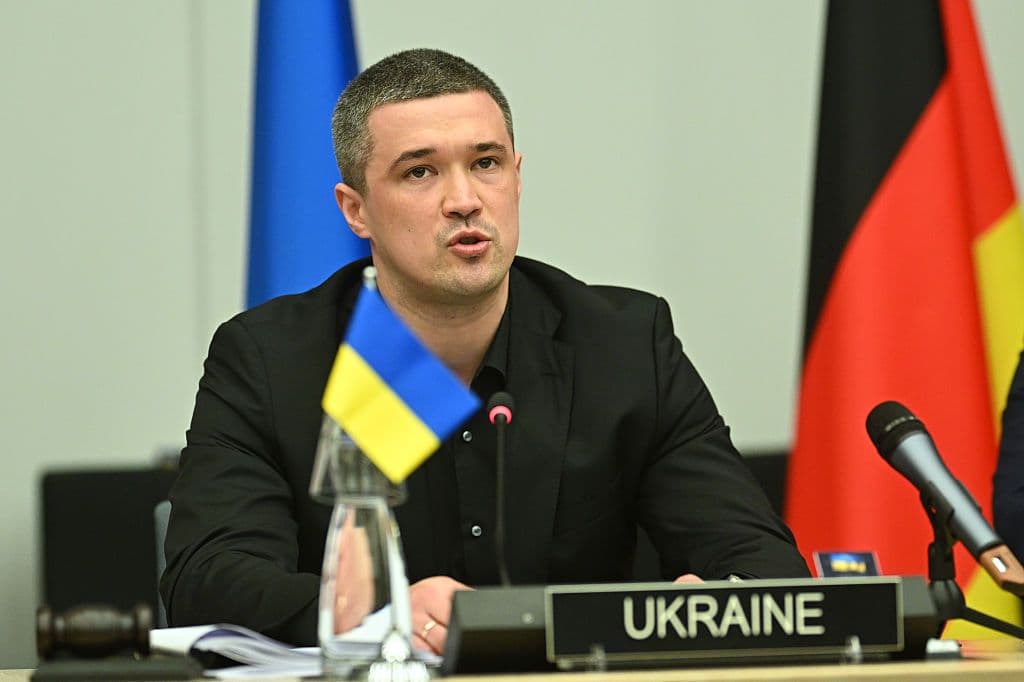
Ukrainian Defence Minister Mykhailo Fedorov attends the Defence Contact Group meeting at NATO headquarters in Brussels, Belgium. (Photo by Leon Neal/Getty Images)
Seventeen countries signed on — the United Kingdom, Germany, Norway, Sweden, Denmark, the Netherlands, Canada, Belgium, and others. More than $2.5 billion earmarked for Ukrainian drones. Over $500 million for the Prioritized Ukraine Requirements List to fund NATO purchases of American weapons. Two billion dollars directed toward air defense.
Partners also committed artillery ammunition, training programs, and naval capabilities. Several European allies agreed to urgently deliver Patriot missiles from existing stockpiles — critical as Russian strikes continue to target Ukrainian cities and energy infrastructure.
London added another £500 million ($681.4 million) specifically for air defense, on top of a £150 million PURL contribution. British Defense Secretary John Healey had already announced a package worth roughly £540 million, including £390 million to supply 1,000 UK-manufactured Lightweight Multirole Missiles designed to counter Russian drones and missiles.
The Netherlands committed F-16 flight simulators to accelerate pilot training. Defense Minister Ruben Brekelmans framed it as part of a layered air defense system — Patriots and fighter jets backed by lower-cost interceptor drones and missiles.
Fedorov outlined 2026 priorities: push Russian battlefield losses from 35,000 per month to at least 50,000; strengthen air defenses; increase economic pressure. Eighteen strategic defense projects were presented, including expanded domestic missile production and specialized drone assault units.
American aid may have collapsed in 2025.
Europe stepped forward.
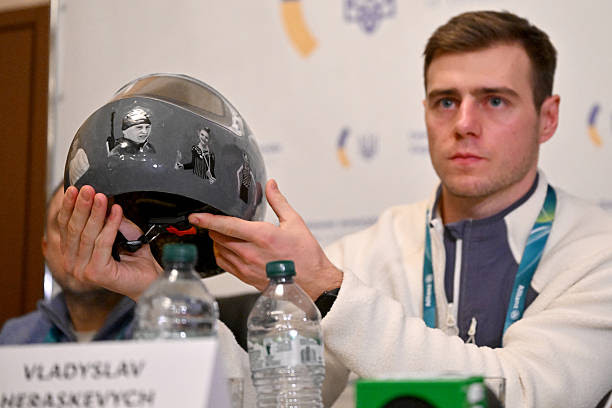
Ukrainian Olympic skeleton pilot Vladislav Heraskevych shows off his helmet at a press conference at the Ukrainian consulate in Milan, Italy. Heraskevych was banned from the competition because he insisted on wearing a helmet with photos of Ukrainian athletes who were killed by Russia amid the war. (Peter Kneffel/picture alliance via Getty Images)
He Wouldn’t Take Off the Names
They told him to change the helmet.
Vladyslav Heraskevych slid anyway.
On February 12, the International Olympic Committee disqualified the Ukrainian skeleton racer after he refused to remove a custom helmet bearing the faces of Ukrainian athletes killed during Russia’s war. Days earlier, the IOC had barred him from using it at the Games. He kept training in it.
“This is price of our dignity,” he wrote on X when the decision came down.
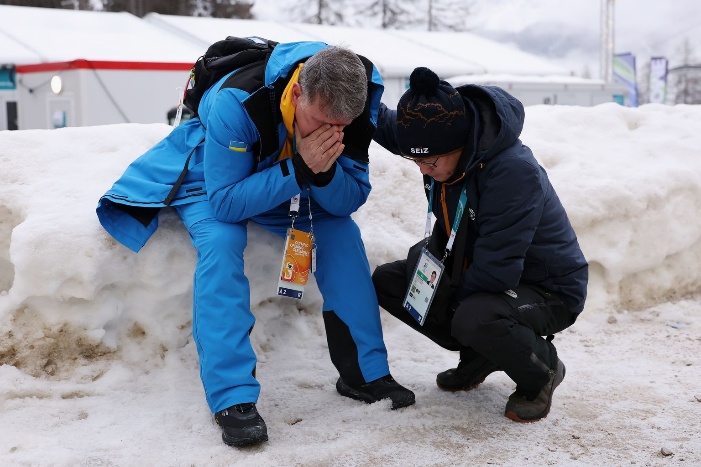
Mykhailo Heraskevych (L), father and coach of Ukrainian skeleton racer Vladyslav Heraskevych, after Heraskevych was disqualified from competition on day six of the Milano Cortina 2026 Winter Olympic games in Cortina d’Ampezzo, Italy. (Richard Heathcote/Getty Images)
The International Bobsleigh and Skeleton Federation jury ruled the helmet “was not in compliance with the rules.” The IOC said Heraskevych met with President Kirsty Coventry that day but “refused to consider any compromise.” The issue, they insisted, was not the message — only the location where he chose to express it. Spokesperson Mark Adams added that there were “130 conflicts in the world,” and the field of play could not feature them all.
Hours later, President Volodymyr Zelensky awarded Heraskevych the Order of Freedom. “Sport shouldn’t mean amnesia,” Zelensky said. “The Olympic movement should help stop wars, not play into the hands of aggressors.” Foreign Minister Andrii Sybiha called the decision a stain on the IOC’s reputation, saying future generations would remember it as a moment of shame and praising Heraskevych for honoring the 650 Ukrainian athletes and coaches killed by Russia.
Heraskevych pointed to what he called hypocrisy. Israeli skeleton racer Jared Firestone had been allowed to wear a kippah honoring victims of the 1972 Munich massacre. “I honestly don’t understand how these two cases are fundamentally different,” he had said.
Ukraine’s sports minister confirmed an appeal. Monobank CEO Oleh Horokhovskyi offered a Hr 1 million ($23,000) reward. Heraskevych told Suspilne Sport he hoped to compete in 2026 but had no regrets.
“There are things far more important than any medals.”

A detail view of the helmet worn by Ukrainian skeleton racer Vladyslav Heraskevych during men’s training heat 3 on day four of the 2026 Winter Olympic games in Cortina d’Ampezzo, Italy. (Richard Heathcote/Getty Images)
The Year the Drones Hunted Civilians
In 2025, the sky became the deadliest weapon.
Independent reporting and UN monitoring data now confirm what Ukrainians felt all year: it was the bloodiest year for civilians since the full-scale invasion began in 2022.
At least 2,919 civilians were killed.
17,775 were injured.
That marked a 12 percent increase in deaths and a 25 percent increase in injuries compared to 2024.
The numbers sharpen when broken down by weapon. Drone strikes alone killed at least 1,376 civilians and injured at least 10,089 — more casualties than all other weapons combined. Nearly three times higher than drone-related civilian casualties in 2024.
UN data found that Russian strikes against Ukrainian-controlled territory accounted for 97 percent of all civilian casualties in 2025.
Kherson Oblast absorbed the worst of it.
359 civilians killed.
2,903 injured.
That represented a 24 percent increase in deaths and a 35 percent increase in injuries from the previous year — despite the absence of major ground offensives in the region.
The method explains the pattern.
Russian forces increasingly used what Ukrainian officials described as “human safari” tactics: tactical drones, especially first-person-view systems, hunting civilians and striking homes, vehicles, and infrastructure. Civilian harm was not incidental to broader operations. It was integrated into them.
The data confirms what Kyiv has argued for months — that targeting patterns were designed to maximize civilian casualties as a strategic effect, not simply as collateral damage.
The war did not just grind forward at the front.
It descended from above.
Meters for Blood — The Frontline Barely Moves
The map changed again.
Not dramatically. Not decisively. Just enough to matter.
Russian forces edged north of Zybyne northeast of Kharkiv City, pressing near Vovchansk, Vovchanski Khutory, Hrafske, Starytsya, Symynivka, and toward Okhrimivka. In the Velykyi Burluk direction they pushed near Khatnie and toward Kolodyazne. Southeast of Slovyansk, Russian units moved into central Nykyforivka.
Fighting stretched across Lyman and its outskirts — Yarova, Serednie, Drobysheve, Stavky, Zakitne, Dronivka, Maslyakivka, Ozerne — and east of Slovyansk near Riznykivka, Platonivka, and Svyato-Pokrovske. Russian forces pressed toward Rai-Oleksandrivka and Fedorivka Druha.
In Kramatorsk and Slovyansk, glide bombs fell. Donetsk Oblast administration head Vadym Filashkin reported two FAB-250 strikes on Kramatorsk, injuring two civilians and damaging residential and commercial buildings. More FAB-250 bombs hit Slovyansk, striking homes, schools, churches, rail infrastructure.
A Ukrainian brigade spokesperson said Russian troops were infiltrating into Zakitne, using frozen sections of the Siverskyi Donets River to cross. In the Lyman direction, Russian forces amassed infantry and attacked with and without armored vehicles, suffering losses reportedly up to ten times higher than Ukrainian units.
South and west, Russian forces continued offensive efforts toward Kostyantynivka-Druzhkivka, Dobropillya, and Pokrovsk without confirmed gains. FAB-3000 glide bombs and Kh-38 missiles targeted bridges along the H-20 Pokrovsk-Kostyantynivka highway.
Near Dorozhnie north of Pokrovsk, Ukrainian forces struck Russian servicemembers after an infiltration attempt that changed nothing on the map. Colonel Viktor Trehubov said Ukrainian forces still physically controlled Kupyansk, with Russian troops trapped in high-rise buildings and resupplied only by drones.
No breakthrough. No collapse.
Just territory traded meter by contested meter.
Night of Fire and Falling Heat
The sirens began after dark.
Between February 11 and 12, Russian forces launched one of their largest combined barrages in weeks: 24 Iskander-M ballistic missiles and S-300 missiles from Bryansk, Voronezh, and Rostov oblasts; one Kh-59/69 cruise missile from occupied Donetsk airspace; and 219 drones — roughly 150 of them Shaheds — launched from Kursk, Oryol, Bryansk, Primorsko-Akhtarsk, Millerovo, Shatalovo, and occupied Hvardiiske in Crimea.
Air defense crews raced the sky.
Ukraine shot down 15 ballistic/S-300 missiles, the cruise missile, and 197 drones. But nine missiles and 19 drones reached 13 locations. Debris fell across 14 more. Residential districts and energy facilities were hit in Kyiv, Odesa, and Dnipro, and across Kharkiv, Donetsk, and Kyiv oblasts.
By morning, 10,000 homes in Dnipro had no heat.
In Kyiv, more than 3,700 apartment buildings went cold.
Another 2,600 buildings lost power.
DTEK reported outages affecting 107,000 residents in Kyiv Oblast.
In Odesa, four people were injured. Governor Oleh Kiper said direct hits and falling debris damaged residential, industrial, port, and energy infrastructure. Power, heat, and water were disrupted. Repairs began immediately.
The targeting pattern was clear: energy systems first. Make winter heavier. Make civilian endurance the battlefield.
Out of 243 airborne threats, Ukrainian defenses destroyed 213. Twenty-eight penetrated.
It was both a display of Russia’s capacity to launch mass strikes — and Ukraine’s capacity to blunt most of them.
The war now moves on two tracks: one in the sky, one in the power grid.
And when the lights go out, the cold does the rest.
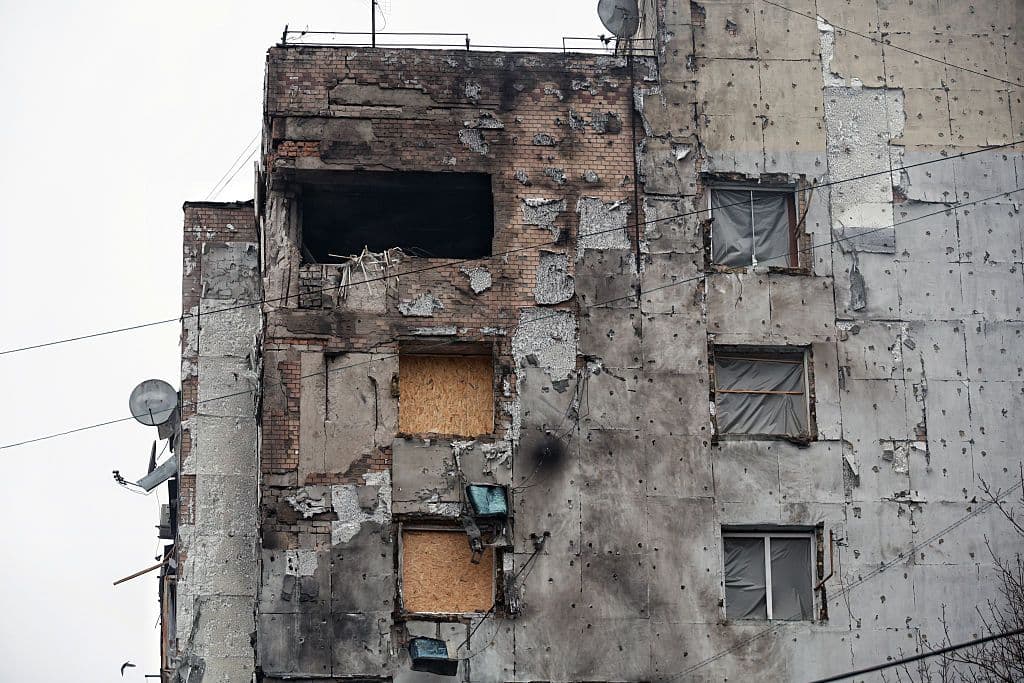
An apartment building was damaged in a Russian drone strike in Odesa, Ukraine. Energy infrastructure was also damaged, and fires broke out in market pavilions and a supermarket. (Photo by Nina Liashonok/Ukrinform/NurPhoto via Getty Images)
The Day’s Meaning
Two Russias moved in opposite directions.
Inside the country, the Kremlin tightened its grip — cutting off platforms, narrowing speech, forcing citizens toward state-controlled channels. At the front, Russian soldiers complained that the same restrictions were disrupting coordination. Control at home was eroding efficiency at war.
That contradiction sharpened.
The attempted WhatsApp blackout and Telegram throttling revealed a regime prioritizing information dominance over battlefield convenience. Yet the backlash from pro-war voices showed that even loyal constituencies feel the strain. Authoritarian consolidation carries operational costs. The question is how much friction the system can absorb before effectiveness suffers.
At the same time, Ukraine demonstrated range and agility. A 1,750-kilometer strike into Komi signaled that distance no longer guarantees safety for Russian infrastructure. Targeting refineries, arsenals, and defense plants forces Moscow to stretch air defenses across vast geography. Every successful deep strike complicates Russian resource allocation.
Brussels added another layer. Nearly $38 billion in pledged support — most already confirmed — suggested Europe is preparing for a long war even as American aid has collapsed. The commitments were not symbolic. Patriots, drones, missiles, simulators. Systems that shape next year’s battlefield.
Meanwhile, casualty data confirmed a grim reality: civilian targeting has intensified, particularly through drones. The war is no longer just about lines on a map. It is about endurance under constant aerial threat.
No breakthrough. No collapse.
Instead, the day revealed competing strategies hardening in parallel — Russia consolidating control while Ukraine extends reach, Europe deepening commitment, and civilians absorbing the cost.
The pressures are rising on every side.
And none of them are easing.
Prayer For Ukraine
- For Families Without Heat and Power
Pray for the thousands of households in Kyiv, Dnipro, Odesa, and surrounding regions left without heat, electricity, or water after the latest strikes. Ask the Lord to protect the elderly, children, and vulnerable through winter cold — and to strengthen repair crews working around the clock. - For Civilians Under Drone Threat
Lift up the communities, especially in Kherson Oblast, where drone attacks have taken so many lives. Pray for protection from aerial strikes, comfort for grieving families, and justice for those deliberately targeted. - For Soldiers on the Frontlines
Pray for Ukrainian defenders holding positions near Hulyaipole, Slovyansk, Kupyansk, and across contested sectors. Ask for clarity in command, strength in body and spirit, and protection as they endure grinding combat. - For Wisdom Among Leaders and Allies
Pray for Ukrainian leaders, NATO defense ministers, and European governments as they allocate billions in support. Ask for unity, strategic wisdom, and sustained commitment to defend freedom and protect lives. - For Courage to Stand for Truth
Pray for those who refuse silence — whether journalists, athletes, soldiers, or citizens. Ask that truth would not be suppressed, that dignity would not be compromised, and that the light would continue to shine even when systems attempt to darken it.