
Russia invented an assassination attempt on Putin, used it to justify maximalist demands and wider mobilization, and revealed how a war fought with drones and conscripts is now being negotiated with lies.
The Day’s Reckoning
The claim landed without warning: Ukraine had tried to assassinate Vladimir Putin. Ninety-one drones, the Kremlin said, sent toward the president’s residence in Novgorod Oblast. No explosions followed. No air defenses fired. No debris was shown. When reporters asked for proof, Dmitry Peskov waved the question away. There did not need to be evidence, he said. There simply needed to be the accusation.
From that absence, Moscow built an entire diplomatic structure. The phantom attack became justification to “harden” Russia’s negotiating position, to resurrect demands from before the invasion even began—Ukrainian neutrality, demilitarization, regime change—and to insist those ultimatums now form the starting point for peace. Sergey Lavrov reached further still, pulling NATO-shattering demands from December 2021 back onto the table. The message was unmistakable: negotiations would proceed only on terms Ukraine could never accept.
At the same time, the real war did not pause for theater. Ukrainian drones burned Russian oil infrastructure. Russian drones flew deeper into Ukraine than before, reaching targets 150 kilometers from the border. Moscow expanded conscription into a year-round system and prepared to deploy active reservists—steps that carry domestic risk the Kremlin avoids unless manpower shortages leave no alternative. On the ground, casualties continued to outpace territorial gains.
The simultaneity mattered. Fiction in Moscow. Fire on the battlefield. Diplomacy hardened by a story that left no physical trace.
This was not confusion or miscalculation. It was method. An invented provocation to justify escalation already planned. A narrative designed to shift blame, test which governments would accept claims without proof, and poison negotiations before compromise could take shape.
December 30 revealed the war exactly as it is now fought: not just with drones and conscripts, but with accusations detached from reality—used to demand surrender while the fighting grinds on.
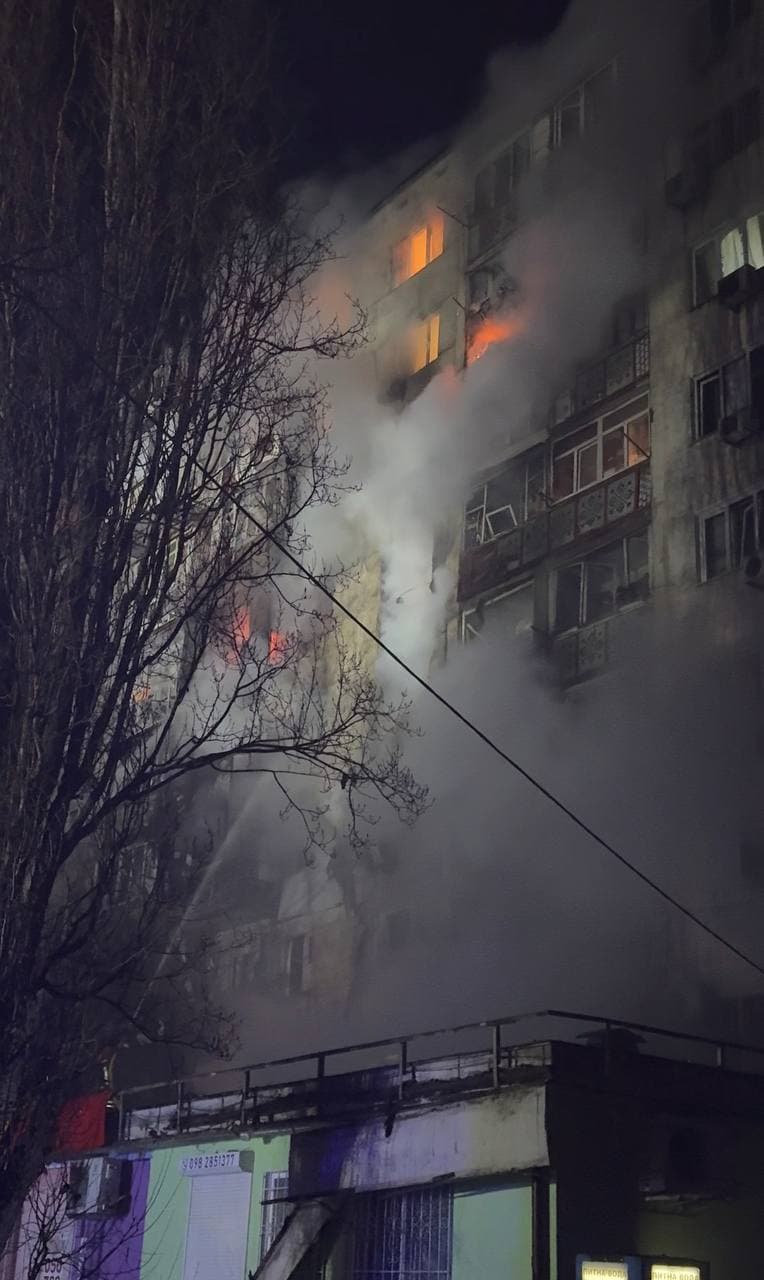
Fire and smoke are seen at a residential building in Odesa overnight following a Russian drone attack. (Odesa City Military Administration head Serhii Lysak/Telegram)
The Attack That Left No Sound, No Smoke, No Proof
The alert came from Moscow, not Valdai. Ukrainian drones, the Kremlin said, had surged toward Vladimir Putin’s residence—ninety-one of them, slicing through the night toward Novgorod Oblast. But in Valdai itself, the night stayed quiet. No explosions. No air-defense fire. No residents waking to the sound of engines overhead. In a town accustomed to hearing distant war, there was only silence.
Outside Russia, intelligence services searched for traces. Satellite imagery showed nothing. No debris appeared. French intelligence, cross-checking with partners, found “no solid evidence” the attack had ever happened. The assassination attempt existed only on paper.
Then the story began to bend. Russia’s Defense Ministry first claimed 41 drones were shot down over Novgorod Oblast. When that number conflicted with later statements from Sergey Lavrov, the ministry revised its account: actually 91 drones—some over Novgorod, others over Bryansk and Smolensk—somehow all heading toward the same target. The geography unraveled the claim. Valdai sat hundreds of kilometers away. Drones over Bryansk or Smolensk would have been far more likely aimed at real military targets Ukraine had struck before.
Pressed for evidence—wreckage, damage, anything—Dmitry Peskov ended the performance. He said there did not need to be proof.
Translation: the accusation was the point.
The timing was no accident. Putin spoke with Donald Trump before and after Trump met Volodymyr Zelensky. The phantom attack entered the diplomatic bloodstream at the precise moment narratives mattered. Zelensky named it plainly: Russia was manufacturing a pretext.
Some governments played along. India and the UAE condemned an attack that left no trace, while remaining silent as Russian missiles killed Ukrainian civilians. The fiction had already done its work—justifying hardened demands, shifting blame, and reminding Russians their president was “under threat.”
Nothing happened in Valdai. And that was exactly what Moscow needed.
Peace on Paper, Surrender in Reality
The phantom attack cleared the stage. What followed was the Kremlin’s real performance.
First came Dmitry Peskov, announcing that Russia would now “harden” its negotiating position. He did not explain how. He did not need to. Vagueness was the weapon—allowing Moscow to dismiss any proposal as insufficient without ever saying what would be enough.
Sergey Lavrov removed the mask days later. Speaking to state television, he returned to the war’s opening script from February 2022: Ukraine must be neutral, disarmed to the point of helplessness, and “denazified”—the Kremlin’s shorthand for regime change. Kyiv, Lavrov said, must also recognize Russia’s ownership of Crimea and four additional regions Russia still did not fully control.
Then he reached further back, beyond the invasion itself. Lavrov declared that Russia’s December 2021 ultimatums to the United States and Europe should serve as the starting point for peace. Those demands had nothing to do with Ukraine alone. They called for NATO to dismantle its eastern defenses, abandon member states, and grant Moscow veto power over Europe’s security order. The West had rejected them. Russia invaded anyway.
Now, after nearly four years of war, staggering casualties, and limited gains, Moscow insisted those same rejected demands were non-negotiable.
Russian lawmakers echoed the line. One argued Ukraine should be handed a U.S.–Russia agreement as a finished document. Another said Russia could only negotiate capitulation. The logic was blunt: demand victories Russia never achieved, ensure Kyiv refuses, then blame Ukraine for the failure of talks.
The position directly collided with the U.S.–Ukrainian–European peace framework, which explored ceasefires, security guarantees, and partial compromises. Moscow rejected it all. This was not bargaining. It was coercion by diplomatic means.
Peskov offered one final clue. Russia, he said, would continue talks “primarily with the United States.”
Translation: sideline Europe, pressure Kyiv, and seek in diplomacy what the battlefield has failed to deliver.
Nowhere Is Far Enough
The strike did not come from the front. It came from far behind it.
Russian drones reached out more than 150 kilometers into Ukrainian-controlled territory, striking helicopters and aircraft in areas once considered relatively safe. Bases that had lived in the margins of danger suddenly found themselves inside it. Distance no longer protected anything.
Ukrainian electronic warfare specialist Serhiy “Flash” Beskrestnov traced the change. These were not simple drones riding cellphone networks. They were Molniya drones guided through Starlink, launched either by sabotage teams closer to the target or carried forward by larger “mothership” drones before breaking away. Some were fitted with LTE modems, slipping through commercial networks instead of military frequencies.
Translation: they could not be easily jammed.
Ukraine could intercept ballistic missiles. It could challenge aircraft. What it lacked—badly—were enough short-range air-defense systems to protect a country this large from swarms arriving at unpredictable angles and distances. Electronic warfare helped, but Starlink-guided drones ignored many of the tricks Ukrainian defenders relied on.
Each Russian innovation widened the gap. Mothership drones pushed the range. LTE guidance complicated detection. Commercial satellite links made control resilient. Facilities once outside planning maps—training grounds, logistics hubs, command posts—suddenly required dispersion, camouflage, or protection that did not exist in sufficient quantity.
The choices became cruel. Shield cities and power plants and accept losses at forward bases. Spread defenses thin and leave everything partly exposed. Either way, something burned.
The pressure was not only physical. It was psychological. Every airfield, warehouse, and staging area had to assume the sky could open without warning. No rear area stayed quiet for long.
Ukrainian forces adapted—moving, hiding, hardening—but adaptation consumed time, energy, and resources already scarce. And with every successful strike, Russia learned too, refining its methods, extending its reach.
The front did not move that day. But the war did. It expanded sideways, backward, inward—until safe zones became a memory.
When the Volunteer Pool Runs Dry
The decree looked harmless on paper. Training camps. Critical facilities. Bureaucratic language signed on December 30. But inside the phrasing was a line the Kremlin had worked for years not to cross. Vladimir Putin had authorized the deployment of active reservists—men who believed their military service was behind them—toward the machinery of war.
This was not routine. It was necessity.
Ukraine’s commander-in-chief, Oleksandr Syrskyi, laid out the math Russia could no longer escape. Moscow recruited roughly 406,000 personnel in 2025. Its losses matched or exceeded that number. Russian forces advanced—on paper—across nearly 4,900 square kilometers, paying for every kilometer with at least 83 casualties. Territory gained in meters. Lives spent by the tens of thousands.
The incentive system that once kept the war distant from ordinary Russians was failing. Regional bonuses ballooned to the equivalent of years of salary. Recruiters promised cash, benefits, and safety. Fewer men answered. Either the money was running out, the volunteers were, or both.
So the Kremlin turned to systems instead of promises.
A day earlier, Putin had signed another law: conscription administration would now run year-round. No longer confined to spring and fall cycles, the machinery would stay warm, ready. Officially, conscripts would still serve outside combat zones. Politically, that line mattered. But the infrastructure told a different story—one built for speed, scale, and flexibility if conditions demanded more bodies.
The move reopened memories the Kremlin preferred buried. In September 2022, partial mobilization triggered protests, panic flights, and chaos as untrained men were rushed to the front. Moscow stabilized the backlash with money and silence.
Now even that buffer was thinning.
Calling up reservists was a signal—not of strength, but of strain. When the well of volunteers runs dry, states reach deeper. And when they do, the war stops being something fought “over there.”
It comes home.
Fire Where the Money Flows
The flames rose far from the trenches.
Overnight, Ukrainian drones reached into Russia’s economic bloodstream, striking oil facilities that help keep the war running. At Tuapse, on the Black Sea coast, fire tore through part of a refinery complex capable of processing roughly 12 million tons of crude a year. A dock was damaged. Equipment burned. Five nearby homes were hit. Two people were injured as emergency crews raced to contain blazes spreading across hundreds of square meters.
Seventy-five kilometers from Sochi, the message was unmistakable: distance no longer guaranteed safety.
Farther east, in Russian-occupied Rovenky, another oil depot ignited. Residents filmed towering flames licking into the night sky, a familiar sight in a place Ukraine had already struck before. The depot had been hit in October 2024. Ukraine returned anyway. The repetition mattered. It showed an ability not just to identify valuable targets, but to revisit them—forcing Russia to defend the same sites again and again across enormous territory.
These were not isolated acts of retaliation. They were part of a sustained campaign against the infrastructure that pays for the war. Earlier in December, Russian oil prices fell to their lowest point since the invasion began, pressured in part by repeated Ukrainian drone strikes disrupting production and exports.
The reach extended deeper still. Ukrainian forces also struck a drone base at Donetsk Airport, where Russian units trained and launched Shahed, Geran, and Gerbera drones. Warehouses burned. A logistics hub was hit. A preflight training center was damaged. The operation was planned by “Madyar’s Birds” of the 414th Brigade and executed by Ukraine’s unmanned systems forces—a clean strike against the machinery that sends drones toward Ukrainian cities.
Ukraine did not comment publicly. It did not need to.
Each strike forced Russia to stretch its air defenses thinner, guarding oil, ports, depots, and drone hubs instead of concentrating protection at the front. Under resource pressure, Ukraine was learning to hit what mattered most—not where the fighting was loudest, but where the war was paid for.
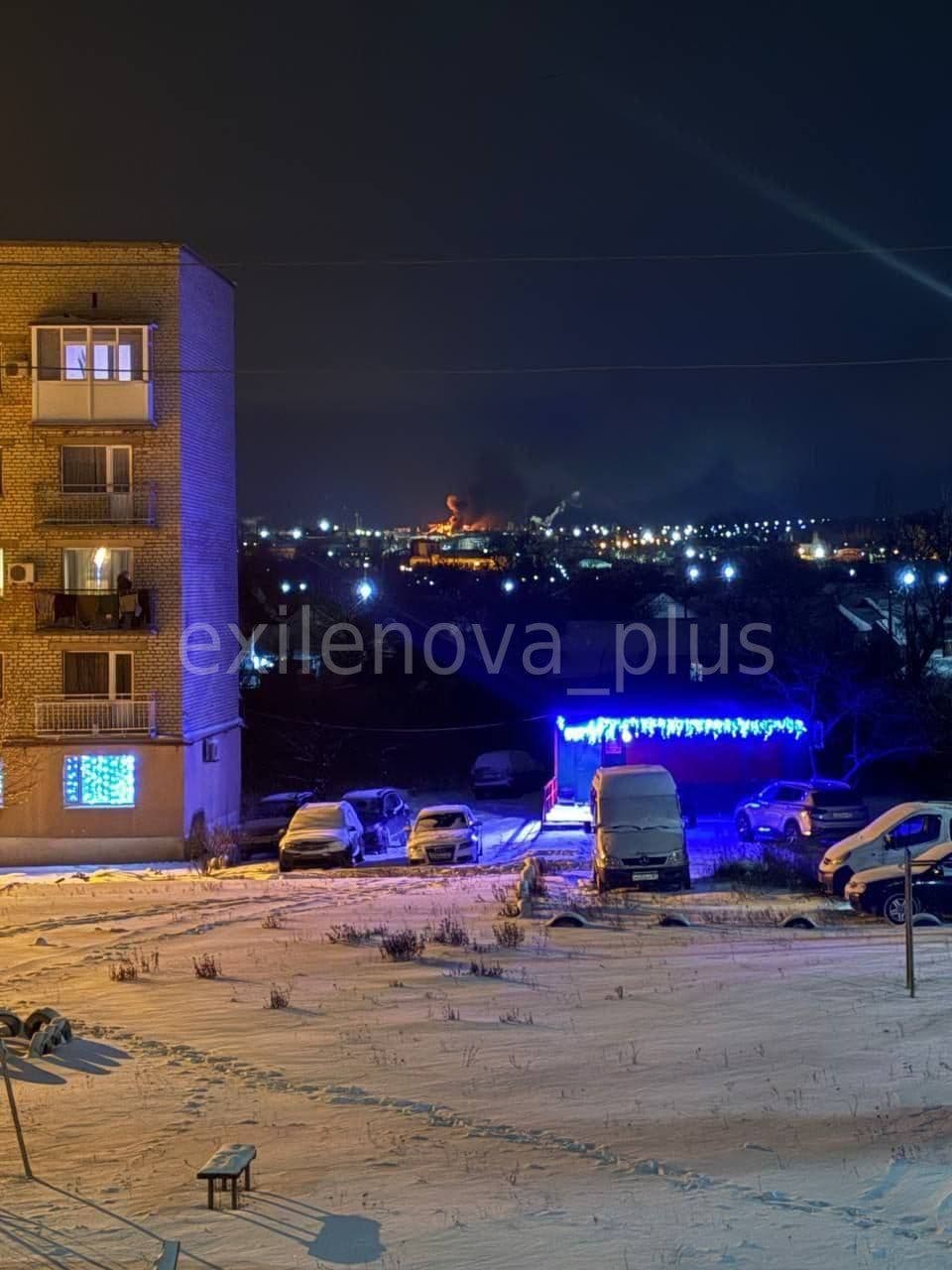
A purported photo of a fire after Ukraine’s military reportedly struck an oil depot in the Russian-occupied community of Rovenky in Luhansk Oblast. (Exilenova_plus/Telegram)
Peace Spoken Aloud While the War Continues
At 10:00 GMT, the language of urgency filled European conference rooms. Leaders gathered to talk about ending the war—prime ministers, presidents, NATO’s secretary general, Canada at the table—moving with a speed that suggested time itself had become a factor. This was not another routine summit. It felt closer than that.
Polish Prime Minister Donald Tusk said it plainly. Peace, he told his government, was “on the horizon.” Not months away. Not years. Weeks. The Berlin Format talks, he said, had created grounds for hope—fragile, uncertain, but real. The engine behind that hope was Washington. U.S. security guarantees, Tusk argued, could finally unlock an end to the fighting, even if Ukraine would be asked to accept painful compromises.
But not without consent. Any territorial decision, Tusk stressed, would have to be approved by Ukrainians themselves—and backed by guarantees strong enough to mean something after the guns fell silent.
In Warsaw, the tone sharpened. Tusk announced an urgent meeting with President Karol Nawrocki, warning that January could force decisions about Ukraine and Europe that demanded national unity. History, he implied, was accelerating.
Across the border to the east, Moscow was moving in the opposite direction. The Kremlin hardened its position after an assassination attempt that left no evidence and demanded terms that amounted to Ukrainian surrender. Russian officials spoke not of compromise but withdrawal—Ukraine leaving its own territory because force had not delivered what diplomacy now demanded.
Kyiv pressed forward anyway. President Volodymyr Zelensky announced new security talks would begin in early January, with advisers meeting in Ukraine and leaders gathering in France days later. “We are not losing a single day,” he said.
The contradiction hung in the air. Europe spoke of peace within weeks. Russia prepared for more war. Somewhere between optimism and reality, diplomacy raced the battlefield—hoping to outrun it.
The Front Never Slept
Peace was discussed in conference rooms. At the front, the war kept its own schedule.
Russian assaults rolled on across nearly every sector, probing, pressing, and grinding without pause. In Sumy Oblast, attacks came in clusters—north of the city, then northeast, then southeast—testing lines but gaining nothing. Ukrainian drones made even evacuation dangerous, trapping Russian units under constant surveillance.
Along the northern border, civilians paid the price. Fourteen villages in Chernihiv Oblast were ordered to empty. Most had already fled earlier in the year. Three hundred people remained, packing what they could while artillery and drones dictated the timeline.
Near Kharkiv, Russian units surged again toward Vovchansk and surrounding villages, only to stall. The pattern repeated across the north: attacks without breakthroughs, pressure without payoff.
At Kupyansk, the picture flipped. Ukrainian forces edged forward in the city’s north while Russian troops clung to basement positions inside town. Moscow claimed control. Kyiv answered with encirclement. The fight went vertical—streets above, soldiers below.
Farther south, Russian commanders announced gains near Borova and pressed toward Slovyansk and Lyman, sending small groups forward in bad weather, hoping fog and rain would blunt Ukrainian drones. In Siversk, the pressure intensified. Fiber-optic drones with long ranges forced Ukrainian units to pull back equipment, then personnel. Control held—but barely.
Huliaipole exposed the war’s other danger: failure behind the lines. A Ukrainian command post was abandoned too quickly, equipment and documents left behind. Commander-in-Chief Oleksandr Syrskyi acknowledged the mistake. Investigations began. Reinforcements arrived. The line held.
From Pokrovsk to Zaporizhzhia to Kherson, the story repeated—attacks, counterattacks, claims, denials, minimal movement at enormous cost.
Nothing decisive happened. And that was the point.
While diplomacy searched for shortcuts, the battlefield kept enforcing its own logic: progress measured in meters, mistakes paid for immediately, and pressure applied everywhere, all the time.
Winter Without Switches
The night attack came in waves.
Missiles first—two Iskander-Ms launched from Russia and occupied Crimea—followed by a swarm of drones slipping in from half a dozen directions. Air defenses caught most of them. Fifty-two drones were shot down. It wasn’t enough. One missile and eight drones broke through, striking five locations across Ukraine.
In Zaporizhzhia, an industrial facility burned. In Chernihiv Raion, an energy site went dark. By morning, 75,000 people across Chernihiv, Kharkiv, and Sumy oblasts were without power. The grid absorbed the blow—but only barely.
Deputy Energy Minister Olha Yukhimchuk delivered the blunt reality: the damage was now so severe that even rolling blackout schedules no longer worked. In parts of Kyiv, Kyiv Oblast, and Odesa Oblast, outages were no longer planned or predictable. Power disappeared when strikes landed—and returned only when emergency crews could piece systems back together.
In Odesa, the war moved from infrastructure to homes. Around 12:20 a.m., explosions rippled through the city as dozens of drones closed in. Residential buildings were hit. Fires climbed apartment facades. Heat, electricity, and water vanished together. Five people were injured, three of them children—including a seven-month-old infant. Nearby, a logistics warehouse burned. Falling debris ignited parked cars.
This was not collateral damage. It was design.
Russia has been hitting the same facilities again and again, timing strikes for winter cold, aiming not just to cut power but to exhaust repair crews and fracture daily life. When systems fail repeatedly, restoration becomes slower. Schedules collapse. Families wait in dark apartments without knowing when lights—or heat—will return.
The strategy has not broken Ukraine’s resolve. But it has created a rolling humanitarian emergency that never fully ends. Each blackout leaves scars that linger after electricity flickers back on.
The front lines shift by meters. The infrastructure war moves through kitchens, nurseries, and stairwells—turning winter itself into a weapon.
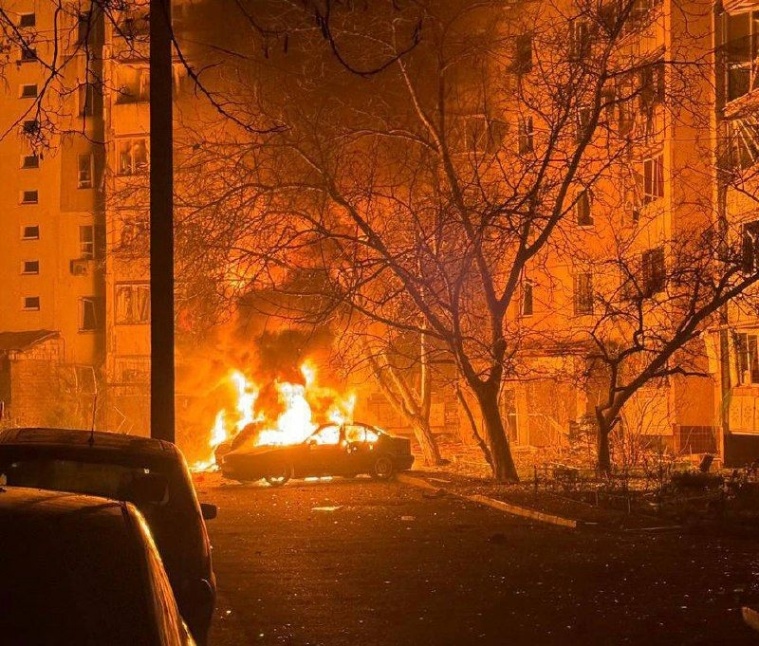
Odesa Oblast Governor Oleh Kiper/Telegram
A Launchpad Disguised as a Neighbor
The video looked ceremonial. A green command vehicle rolled forward. Two military trucks followed. Somewhere in Belarus, Russian state television said, a new missile system had taken its place on combat duty.
The name mattered: Oreshnik.
Russian officials announced the hypersonic, nuclear-capable ballistic missile was now deployed from a base inside Belarus, ready for launch. The Defense Ministry spoke of a formal ceremony, thanking Alexander Lukashenko for creating “all conditions” for Russian forces to live and serve. The language was polite. The meaning was blunt. Belarus was no longer hosting Russia’s military. It was becoming part of it.
The Oreshnik itself was still more concept than battlefield reality—an experimental follow-on to Soviet-era missiles, advertised at Mach 10 or 11, allegedly resistant to jamming, maneuverable, and nearly unstoppable. Whether it worked as promised mattered less than where it was placed. From Belarus, Russia gained forward basing, strategic depth, and a launch corridor pointed at Ukraine and NATO’s eastern flank.
Then the threats followed. On state television, military commentator Igor Korotchenko argued that Ukraine’s “attack” on Putin’s residence—an attack without evidence—justified Oreshnik strikes on Kyiv. Not nuclear, he said. Just decisive. Government buildings. Leadership targets. The escalation ladder was being climbed on air.
Alongside the missiles came the money. Belarusian officials boasted of $60 billion in trade with Russia, of joint aircraft production, electronics manufacturing, and deepening energy integration. Gazprom executives met with Belarusian ministers to coordinate gas flows. The economy was locking in alongside the military.
This was the trade Lukashenko had made. Russian protection in exchange for sovereignty. Survival in exchange for alignment.
Belarus had not declared war. It did not need to. Its roads, bases, and industries were already doing the work—turning a neighboring state into a launchpad, and a border into a threat.
The Day’s Meaning: When Proof Stops Mattering
The day revealed a war no longer constrained by evidence.
Russia invented an attack on Putin’s residence, produced nothing to support it, then announced that proof was unnecessary. From that void came hardened demands, escalatory threats, and diplomatic pressure already waiting to be deployed. The fabrication wasn’t a misstep. It was a test—of how much fiction the world would tolerate if accepting it made negotiations easier.
Some did. India and the UAE condemned an attack that left no trace, while Russian missiles and drones continued to tear through Ukrainian cities. In Europe and Washington, leaders spoke of peace within weeks even as Moscow demanded Ukraine’s surrender and NATO’s unraveling. The contrast exposed an uncomfortable reality: hope can become a liability when it overrides pattern recognition.
On the ground, the war answered differently. Russia expanded conscription and edged toward coercive mobilization as casualties outpaced recruitment. Ukrainian drones struck oil facilities that bankroll the invasion, while Ukrainian defenders scrambled to counter drones reaching deep into territory once considered safe. Assaults continued across the front, trading lives for meters. Nothing about the battlefield suggested compromise was near.
The phantom assassination attempt became a mirror of Russia’s broader method. Create a pretext. Escalate demands beyond acceptance. Blame others for the collapse of talks. Continue fighting while claiming to seek peace. Evidence is optional. Narrative is not.
After 1,406 days, the pattern is unmistakable. Russia’s objectives still require Ukraine’s defeat and Europe’s intimidation—outcomes the current battlefield cannot deliver. Diplomacy strains against that immovable fact, pulled forward by urgency and backward by reality.
The lie worked because it didn’t need to be believed by everyone—only by enough. That is the danger now facing the war’s endgame: not that falsehoods go unchallenged, but that they are quietly accommodated.
When evidence stops mattering, escalation becomes easier. And peace, harder.