
As Putin doubled down on total victory fantasies, Ukraine answered with battlefield resilience, long-range strikes, and diplomacy that exposed the widening gap between Kremlin claims and reality.
The Day’s Reckoning
The cameras were already rolling when Vladimir Putin leaned into the microphone, confident, rehearsed, unyielding. From a Moscow studio, he declared terms for ending the war that assumed a victory Russia had not achieved—demanding Ukraine abandon four regions his army still failed to control, surrender its sovereignty, and accept a future written in the Kremlin. It sounded decisive. It wasn’t.
Because elsewhere, the war told a different story.
Ukrainian units still held towns Putin claimed had fallen. Far from retreating, Kyiv’s reach expanded outward—Ukrainian drones struck a Russian oil tanker in the Mediterranean, more than 2,000 kilometers from home, turning a supposedly safe revenue artery into a burning liability. It was a quiet message delivered in fire: distance no longer guaranteed protection.
In Warsaw, Volodymyr Zelensky sat down with Poland’s newly inaugurated president, reinforcing alliances on NATO’s eastern edge. In Washington, Ukrainian officials pressed American and European counterparts for something Moscow explicitly refused to allow—real security guarantees, not paper promises. Diplomacy moved on parallel tracks, urgent and unresolved, while Putin spoke as if outcomes were already decided.
At the same time, a quieter exchange unfolded away from podiums and cameras. Along a road marked by grief, Red Cross workers accompanied the return of fallen Ukrainian soldiers—bodies coming home long after the speeches ended, reminders of the war’s true ledger.
The contrast was unmistakable. Putin projected certainty; Ukraine demonstrated capability. Moscow issued ultimatums; Kyiv acted. On this day, the war’s fourth year exposed its defining paradox: Russia’s president could say anything he wanted, but reality—measured in territory held, drones launched, alliances reinforced, and lives lost—refused to obey.
Everything or Nothing: Putin Demands a Ukraine That No Longer Exists
The demand came without hesitation, delivered as if it were reasonable. From a polished studio and beneath bright lights, Vladimir Putin outlined his version of “peace”—not as an end to war, but as a final accounting in which Ukraine would surrender everything Russia failed to seize by force.
Ukraine, he said, must withdraw entirely from Luhansk, Donetsk, Zaporizhia, and Kherson—even from areas Russian troops still cannot hold. NATO membership must be abandoned forever. Ukraine must accept “neutrality,” a word that in Kremlin language means defenselessness. Its military would be stripped down. Its government would be “denazified.” Regime change, spoken softly.
Then came the rest. International recognition of Russia’s annexations. Sanctions lifted. Treaties signed to bless conquest after the fact. It was not a proposal. It was a list of demands written as if the war had already been won.
None of it matched the peace frameworks circulating among Western capitals. The U.S.-backed 28-point plan—already controversial for suggesting a freeze along current front lines—was dismissed outright. Even partial concessions were unacceptable. Anything short of total capitulation, Putin made clear, was meaningless.
This was not new. Putin has always spoken of compromise while preparing for the next assault. He referenced temporary flexibility after the August 2025 Alaska summit, but the pattern remains unchanged: pause, rearm, return. Security guarantees for Ukraine—real ones—have been explicitly rejected by Moscow again and again.
What Putin revealed on December 19 was not a negotiating position but an objective. He is not fighting for borders or buffers. He is fighting to erase Ukraine’s independence altogether—to deny that the country has the right to exist on its own terms.
It was a reminder, spoken plainly at last: this war ends only when one side disappears.
Cities on Paper, Not on the Map: Putin Invents a Victorious Battlefield
The claims rolled out smoothly, confidently, as if they were beyond dispute. Sitting before cameras during his Direct Line broadcast, Vladimir Putin spoke of towns taken, cities half-captured, fronts collapsing—describing a battlefield that existed only in his words.
Siversk, he said, had fallen. So had Vovchansk. Russian forces controlled half of Lyman and Hulyaipole, more than half of Kostyantynivka. It sounded like momentum. It wasn’t.
On the ground, the numbers told a harsher story. Independent analysis showed Russian troops present in just 7.3 percent of Hulyaipole and 2.9 percent of Lyman. Even Russia’s own military bloggers—rarely inclined toward pessimism—placed Russian control at no more than seven percent of Lyman and 11 percent of Kostyantynivka. Ukrainian observer Kostyantyn Mashovets reported Russian units still struggling to dislodge Ukrainian defenders from southern Vovchansk, not celebrating victory parades.
Putin’s version of events overshot even his generals’ exaggerations. Defense Minister Andrei Belousov and Chief of the General Staff Valery Gerasimov had at least acknowledged ongoing fighting without firm claims. Putin went further, transforming contested ground into conquered cities with a sentence.
The fiction had a purpose. By inflating gains in towns with prewar populations of 12,000 to 20,000, Putin argued that larger prizes were inevitable. Siversk and Lyman, he claimed, opened the road to Slovyansk—a fortified city of 105,000 that has withstood assaults since 2014.
The math refused to cooperate. Russian forces have spent months and enormous casualties to seize villages. Slovyansk and Kramatorsk form Ukraine’s Fortress Belt—bigger, denser, hardened by years of war. At current rates, analysts estimate Russia would need years and catastrophic losses to take the rest of Donetsk Oblast.
These claims weren’t meant to persuade analysts. They were meant to exhaust audiences—Ukrainian, Western, even Russian—into believing resistance was pointless. But when a leader must invent victories his own soldiers haven’t won, the illusion cracks.
Lies can fill airtime. They cannot hold ground.
The Town That Wouldn’t Stay Conquered: How Kupyansk Shattered the Kremlin’s Story
Kupyansk was supposed to be settled. At least, that was the story Vladimir Putin repeated on television—calmly insisting that Russian forces had seized the city weeks ago and were now simply tidying up the battlefield.
The truth was moving in the opposite direction.
Putin echoed his generals’ claim of victory, then hurried to explain why Russian troops weren’t advancing west: they were, he said, methodically eliminating Ukrainian forces along the Oskil River and preparing to take Kupyansk-Vuzlovyi to the south. It sounded like strategy. In reality, Ukrainian counterattacks had pushed Russian units back, unraveling a narrative Moscow had already declared complete.
The fiction grew stranger. Putin dismissed video footage of Volodymyr Zelensky’s December 12 visit to Kupyansk’s southwestern outskirts as fake, arguing that drone activity made such a visit impossible. The footage was real. What wasn’t was the idea that Russia controlled the city.
On the ground, the situation was deteriorating for Moscow. Ukrainian forces had reclaimed significant portions of Kupyansk. Military observer Kostyantyn Mashovets reported that up to two understrength Russian companies were encircled in central and southern districts, trapped along both banks of the Oskil. To prevent collapse, Russia’s Western Grouping of Forces would likely have to siphon troops from other sectors already stretched thin.
Those strains were visible everywhere. The 6th Combined Arms Army was pulled apart between Vovchansk, Velykyi Burluk, and Kupyansk, unable to mass forces anywhere decisively.
Still, Putin insisted Ukrainian counterattacks had failed and suffered heavy losses. Ukraine, he claimed, had “practically” no forces left—and should therefore surrender.
It was cognitive warfare laid bare: turning a Russian setback into proof of Ukrainian exhaustion.
Kupyansk mattered because it exposed the lie too clearly to ignore. Moscow had declared the city fully captured in late November. Ukraine took it back anyway. And when a dictator must deny video evidence to preserve a myth, the myth is already dying.
Selling the Crown Jewels: Putin’s Economy Looks Strong—Until You Check the Vault
From the Kremlin podium, the numbers sounded reassuring. Inflation, Vladimir Putin said, was under control—hovering neatly between 5.6 and 5.8 percent. Interest rates were coming down. The budget was balanced. Unemployment sat at a record-low 2.2 percent. Russia, he insisted, was weathering the war just fine.
But away from the cameras, the math fell apart.
Western estimates told a different story. U.S. Treasury Secretary Scott Bessent put real Russian inflation above 20 percent by October—nearly four times what Putin claimed. The vanishing unemployment rate wasn’t a sign of strength but of scarcity: factories and military units scraping for workers, wages rising too fast, costs bleeding into everything from food to ammunition.
The clearest signal came not from speeches but from actions. In late November, Russia’s Central Bank quietly did something it hadn’t done before—it began selling physical gold reserves to cover government spending. The move spoke louder than any statistic. Russia had burned through the liquid portion of its sovereign wealth fund financing the war and was now melting down its last emergency assets to keep the budget afloat.
Putin boasted that international reserves had climbed to $741.5 billion. But reserves look impressive on paper when you ignore what’s being liquidated to sustain them. Gold sold. Taxes raised. Spending stretched thin.
This was the real economy behind the performance: an engine still running, but only because vital parts were being stripped away to keep it moving. The message Moscow wanted to send—to Kyiv and the West—was simple: Russia can outlast you. Capitulation is inevitable.
The indicators told another story. An economy forced to sell gold and hike taxes to fund a war isn’t demonstrating resilience. It’s signaling strain.
When a government celebrates prosperity while quietly pawning its crown jewels, belief becomes optional.
Unity on Cue: Putin’s Stage-Managed Multicultural Russia
The segment was carefully arranged. Smiles. Applause. A handpicked officer stepping forward at exactly the right moment. Vladimir Putin presented Russia as a nation bound together across faiths and ethnicities—a harmonious wartime family united by shared sacrifice.
He praised soldiers of many backgrounds fighting “shoulder to shoulder,” lingering on Senior Lieutenant Naran Ochir-Goryaev of Kalmykia, an assault company commander featured repeatedly in what felt like rehearsed exchanges. The message was clear: this was not just Russia at war, but Russia united.
The performance built toward an announcement meant to sound historic. Putin declared 2026 the “Year of the Unity of the Peoples of Russia,” arguing that war reveals a nation’s true cohesion. Under fire, he said, religion doesn’t matter. Everyone shares the same values. Everyone belongs.
Islam received special attention. Putin praised its alignment with “traditional values,” noted that more than ten percent of Russians are Muslim, and promised support for Islamic education in Bashkortostan. He pointed to Tatarstan as a model of coexistence admired by the Islamic world—a Russia at peace with its diversity.
What went unspoken was just as important.
This vision of civic nationalism directly clashes with Russia’s ultranationalists—some of Putin’s loudest war supporters—who insist that Russian identity should belong to ethnic Russians and the Orthodox Church. They rage against migrants, especially Muslims, portraying them as cultural threats even as the war drains manpower from Russia’s heartland.
Putin has been trapped between realities of his own making. The war has worsened labor shortages and demographic decline, forcing the Kremlin to rely heavily on ethnic minorities and Muslim regions for recruits. At the same time, ultranationalists demand ethnic purity and exclusion.
December 19 offered no solution—only theater. Carefully staged praise. Promises of unity. A vision that sounded reassuring on television.
But no amount of choreography can reconcile the contradiction at the center of Putin’s war: a regime that needs a multicultural army to survive while depending on supporters who resent its very existence.
Nowhere Is Safe: Ukraine Carries the War Into the Mediterranean
The blast didn’t echo across a battlefield. It rolled across open water.
More than 2,000 kilometers from Ukraine, in neutral Mediterranean shipping lanes crowded with global commerce, explosions tore through the Russian shadow fleet tanker QENDIL. For the first time, Ukrainian drones had reached deep into one of the world’s busiest seas, striking a maritime target far beyond any traditional frontline.
Footage released by Ukraine’s Security Service showed the sequence clearly—controlled detonations ripping into the vessel’s structure. The SBU called it an “unprecedented special operation,” confirming that long-range drones had inflicted critical damage, leaving the tanker unable to function.
The ship was empty, carrying no oil at the time. That detail mattered. The QENDIL’s real value wasn’t its cargo but its purpose. Ukrainian intelligence identified it as part of Russia’s shadow fleet—a floating workaround of shell companies, false flags, and opaque ownership designed to smuggle Russian oil past sanctions. Each successful voyage funneled money directly into Moscow’s war effort.
“From the perspective of international law,” an SBU source said, “this was a legitimate target.” Translation: war revenue is war material.
The Mediterranean strike wasn’t an isolated act. It followed earlier Ukrainian attacks on sanctioned tankers in the Black Sea, including the Kairos and Virat off Turkey’s coast, and a December 10 Sea Baby naval drone strike against another shadow fleet vessel. The map of the war was expanding outward.
This was strategy, not spectacle. Ukraine has been methodically hunting the machinery that finances Russia’s invasion—refineries far inside Russian territory, power infrastructure, chemical plants, and now oil tankers moving through international waters.
The location raised obvious questions. Neutral waters. Multiple nations. A confined sea ringed by allies and adversaries alike. But Ukrainian planners made a colder calculation: if Russia uses these ships to fund the war, distance does not confer immunity.
The SBU emphasized that the tanker was empty to avoid environmental damage—a signal that Ukraine understood the risks. But the message was unmistakable.
The war no longer respects geography. And Russia’s assets are no longer out of reach.
Meters, Not Cities: The Eastern Front Refuses to Obey the Kremlin Script
Out east, the war moved the way it actually moves—slowly, brutally, and measured in meters rather than headlines.
Russian forces did advance in places. Northeast of Kharkiv, observer Kostyantyn Mashovets confirmed the seizure of Synelnykove and Tsehelne. Farther south, geolocated footage showed Russian troops edging forward near Pleshchiivka, southeast of Kostyantynivka, and probing toward the northern outskirts of Zapovidne near Dobropillya. These were real gains, paid for in blood.
They were also small.
Beyond those narrow advances, the broader picture refused to align with Vladimir Putin’s triumphant claims. In the Vovchansk sector, Russian units hammered away at Ukrainian defenses along the T-2104 road and still failed to break through. Ukrainian brigades reported holding Stavky and Novoselivka—settlements Moscow had already declared captured weeks earlier.
The weather became a combatant of its own. Fog, rain, and snow muted drone visibility on both sides, briefly opening space for armored assaults. Russian commanders tried to exploit the gaps. Coordination collapsed anyway. Ukrainian officers reported Russian armor blundering forward in fog, unable to synchronize movements even when Ukrainian drones were grounded.
Near Kupyansk, Ukrainian forces tightened control. Fire dominance over the Kupyansk–Holubivka road cut a key Russian supply artery. Mashovets noted that habitual false reporting up the Russian chain of command distorted decisions on the ground, just as Ukrainian counterattacks gained momentum. Mud swallowed wheeled vehicles, turning movement into liability.
Around Lyman, Russian troops kept attacking—often without drone cover. The 425th Skelya Regiment’s spokesperson noted many Russian soldiers arrived at the front after barely a month of training. It showed.
Elsewhere, Ukrainian resilience was unmistakable. Near Oleksandrivka, defenders smashed a reinforced Russian mechanized assault—one tank destroyed, two armored vehicles burning, trucks wrecked, 35 attackers killed. Ukrainian drone teams near Pokrovsk extended strike ranges beyond 21 kilometers, pushing Russian units deeper into danger zones.
This was the eastern front as it actually existed: grinding assaults, fragile gains, weather-driven pauses, and stubborn Ukrainian defense.
No cities falling. No collapse coming.
Just a war that refused to match the story told on television.
Burning the Revenue Stream: Ukraine Takes the War Deep Inside Russia
While Vladimir Putin spoke confidently about economic stability, the fires told another story.
On December 18–19, Ukrainian drones struck at the machinery that keeps Russia’s war alive—far from the front lines, deep inside the systems that generate money, power, and explosives. This wasn’t symbolic. It was methodical.
Footage released by Ukraine’s Security Service showed a Lukoil oil rig burning in the Rakushechnoye field of the Caspian Sea—the third such facility Ukrainian forces have hit there in recent weeks. A gas turbine went dark, another node of Russia’s energy network quietly removed from service.
Farther west, flames rose at the Oryol Thermal Power Plant after a reported drone strike. Governor Andrey Klychkov confirmed outages in Sovetsky Raion. Hundreds of kilometers from Ukraine, power disappeared anyway. Distance no longer mattered.
Then came Tolyatti. Ukrainian forces likely struck the TogliattiAzot chemical plant in Samara Oblast—one of Russia’s largest producers of ammonia, capable of three million tons annually. Fertilizer feeds fields. It also feeds explosives. Dual-use infrastructure, Ukrainian planners calculated, sustains the war either way.
The pattern was unmistakable. These were not random hits or morale raids. Ukraine was carving away at revenue, energy, and industrial capacity—one refinery, turbine, and plant at a time. Each successful strike narrowed Russia’s ability to pay soldiers, fuel armor, and manufacture weapons.
The effects rippled outward. Air raid sirens in Russian cities. Evacuations at industrial sites. Blackouts in regions long told the war would never reach them. Civilians learned what Ukrainians have known for years: modern war ignores geography.
For Russian authorities, the problem became unmanageable. Thousands of facilities spread across eleven time zones cannot all be defended. Every unit pulled back to guard infrastructure weakens the front line. Every successful Ukrainian strike forces another impossible choice.
This was the deeper meaning of Ukraine’s long-range campaign. A country once begging for air defense had become a force projecting power across a continent—systematically dismantling the economy that finances its destruction.
The war was no longer just being fought at the front.
It was being fought in Russia’s balance sheets, power grids, and production lines.
Night Bus, No Shelter: Odesa Pays the Price of Putin’s War
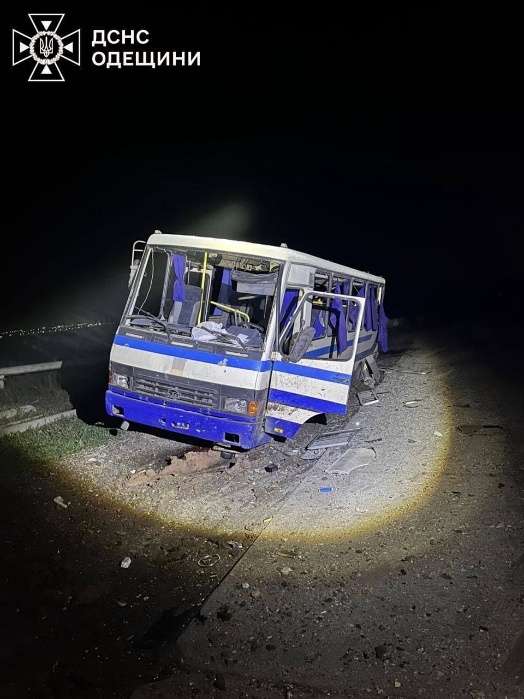
An ordinary ride turned fatal: A city bus sits ripped open after a Russian missile strike in Odesa Oblast, where eight civilians were killed and 27 wounded—people caught mid-journey, with nowhere to run. (State Emergency Service / Telegram)
The missile hit at night, when people were trying to get home.
On December 19, Russian ballistic missiles slammed into port infrastructure in Odesa Oblast, killing at least eight civilians and wounding 27 more. Some of them were on a city bus, caught at the epicenter—ordinary passengers mid-journey, with no warning and nowhere to run. What Moscow called a military strike unfolded as another civilian massacre.
Governor Oleh Kiper described a “massive” attack on the port area. Cargo trucks burned in the parking lots. Cars were shredded where they stood. Firefighters and rescue crews worked through smoke and twisted metal, pulling bodies and survivors from wreckage—tasks that have become routine in Odesa, even as the shock never does.
The strike was part of a rolling assault. The previous night, Russian drones damaged a bridge on the M15 Odesa–Reni highway near Mayaky, forcing neighboring Moldova to close nearby border checkpoints. Electronic warfare expert Serhiy Beskrestnov reported the bridge was targeted relentlessly: ten Shahed drones overnight, five more during the day, then a ballistic missile in the afternoon—all armed with cluster warheads.
The choice of weapon mattered. Cluster munitions couldn’t destroy the bridge itself, but they could kill the people trying to fix it. Military observer Yuriy Butusov later published footage showing a Russian drone striking a civilian car on an Odesa bridge—one person killed, three children injured. Observers called it what it was: a “human safari.”
Energy expert Oleksandr Kharchenko warned that Russian forces were shifting tactics, targeting small transformer stations instead of large power plants. The goal was simple—cripple repairs, hit crews, keep the lights off.
For Odesa residents enduring a fifth day without power, water, or heat in winter, the war was no abstraction. It was sirens in the dark, freezing apartments, and neighbors who never came home.
One Thousand Homecomings: The War Counted in Bodies, Not Claims
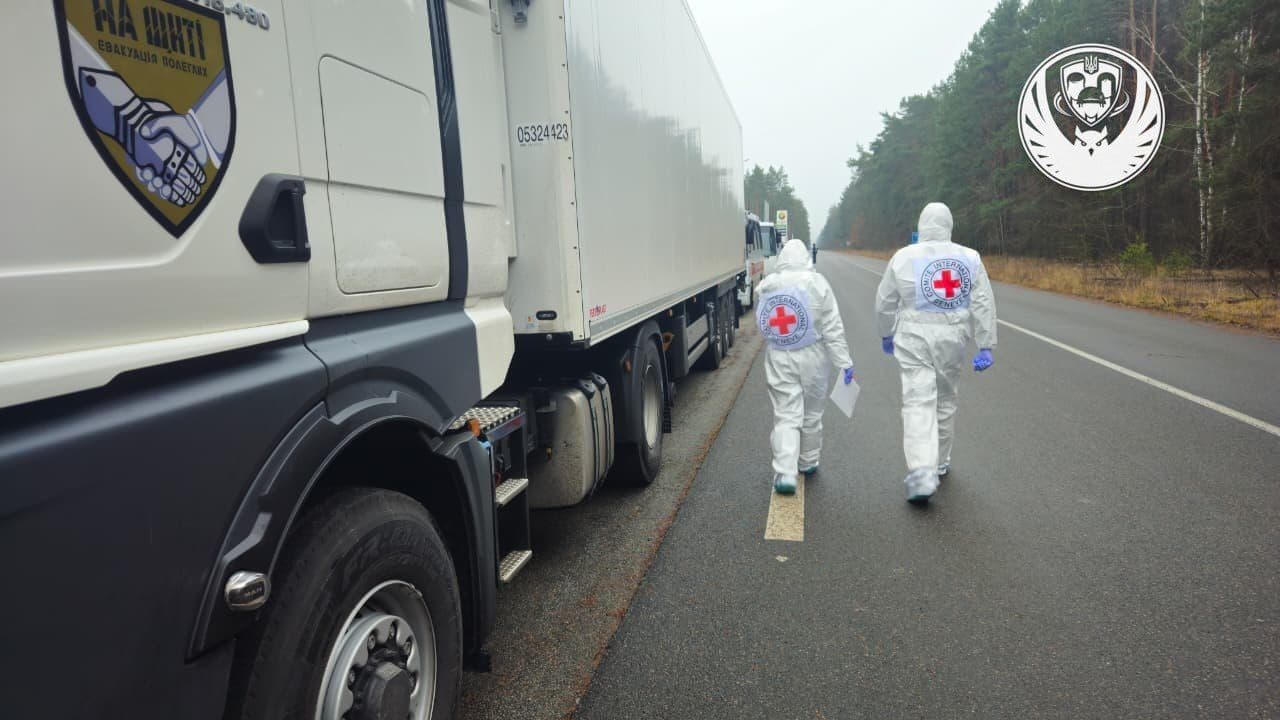
The road home, at last: Two International Committee of the Red Cross workers walk beside the repatriation of fallen Ukrainian soldiers—bodies returning after months in enemy hands, grief finally given a path back to their families. (Coordination Headquarters for the Treatment of Prisoners of War / Telegram)
They came back quietly, without speeches or cameras—1,003 Ukrainian soldiers returned to their country on December 19, not alive, but finally home. For each one, a family could begin what the war had long denied them: burial, mourning, an ending.
Moscow said the exchange happened under the Istanbul agreements. Vladimir Medinsky, Putin’s chief negotiator, confirmed that Russia returned the Ukrainian dead in exchange for 26 fallen Russian soldiers. The ratio—thirty-nine Ukrainian bodies for every Russian one—spoke volumes. Whether it reflected Russia’s battlefield losses, its negotiating priorities, or both, the arithmetic carried a grim clarity no press conference could soften.
The handover unfolded as peace talks dragged on under American pressure to end the war. Since negotiations resumed in early 2025, more Ukrainian bodies have been returned than in earlier periods—one of the few areas where diplomacy has produced something tangible. Not progress. Not peace. Just remains.
The Istanbul framework, agreed during Moscow-Kyiv talks in Turkey earlier this year, created procedures for repatriation. The first exchange took place in June. Thousands have followed since. Each transfer closes one chapter while exposing countless others still unresolved—soldiers lost in contested ground, families waiting without answers, names still missing.
Ukraine’s Coordination Headquarters for the Treatment of Prisoners of War thanked the International Committee of the Red Cross and state institutions that made the return possible. Law enforcement and Interior Ministry specialists now face another task: identification. Russia often returns remains commingled, documentation incomplete, forcing painstaking forensic work before families can be notified.
These exchanges reveal what casualty figures never do. They show the war measured in empty places at dinner tables, in children growing up without parents, in communities permanently altered.
For the families receiving their dead, Vladimir Putin’s claims of victory and prosperity meant nothing. Their truth lay in a coffin, a flag, and the knowledge that someone they loved died defending a country that still stands.
Across the Table from History: Warsaw Chooses Sides
The setting was formal, but the message was unmistakable. On December 19, Volodymyr Zelensky sat across from Poland’s newly inaugurated president, Karol Nawrocki, inside Warsaw’s Presidential Palace—and in choosing Ukraine for his first foreign meeting, Nawrocki made his priorities plain.
“This is bad news for Russia,” he said.
The words carried weight. Poland sits on the fault line of European security, and its leaders understand that Ukraine’s war is not a distant conflict but a forward defense. Nawrocki framed the meeting as proof that Poland, Ukraine, and the region stand together on strategic and security matters—at a moment when Moscow was demanding capitulation and Washington was pressing for deals.
The agenda was broad and unavoidably complicated. Security cooperation topped the list, including consultations on drone defense after repeated Russian drone incursions into Polish airspace. Nawrocki did not rule out transferring MiG-29 fighter jets to Ukraine and made clear that Poland expected something in return—shared drone production technologies that could strengthen both countries’ defenses.
History hovered over the room. Nawrocki acknowledged Polish frustration that years of military and humanitarian support had not always been fully recognized. Zelensky responded with gratitude but also with warning: without Ukrainian independence, Moscow would push west—toward Poland itself.
The past was addressed directly. Nawrocki has spoken openly about historical grievances, especially the Volyn massacres of 1943–44. On the same day, Ukraine’s and Poland’s National Memory Institutes met in Warsaw. Zelensky chose careful language: respect for Polish memory, and a request for equal respect for Ukraine’s.
Later, Zelensky met Prime Minister Donald Tusk, reinforcing the day’s purpose. This visit followed Brussels and came amid intense diplomatic pressure elsewhere to trade territory for peace.
Warsaw sent a different signal. While others debated compromises, Ukraine was strengthening ties with neighbors who know what Russian demands look like when they arrive at your border.
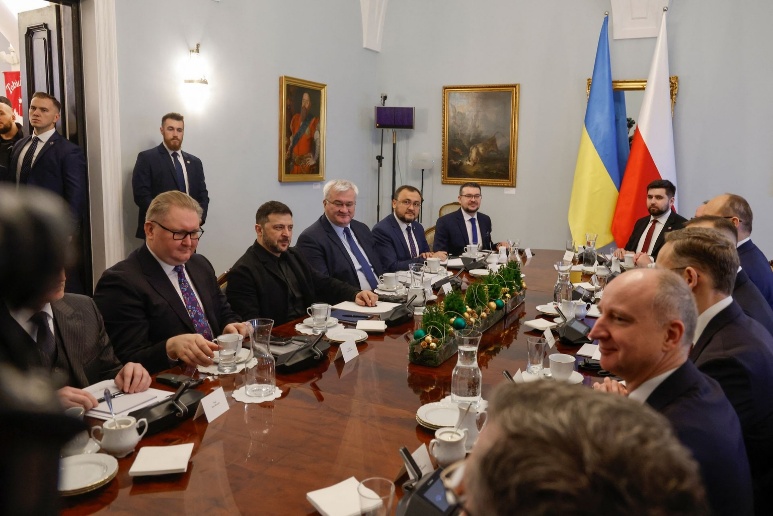
Warsaw, not Moscow: President Volodymyr Zelensky meets Polish President Karol Nawrocki at the Presidential Palace, a deliberate signal that Ukraine’s future is being discussed among allies, not dictated by the Kremlin. (Wojtek Radwanski / AFP via Getty Images)
The Line That Would Not Move: Ukraine Takes Its Case to Washington
While Volodymyr Zelensky pressed alliances in Warsaw, another front opened thousands of kilometers away. In Washington on December 19, a Ukrainian delegation arrived with a single, immovable demand: peace without protection is just a pause before the next war.
Rustem Umerov, secretary of Ukraine’s National Security and Defense Council, led the talks alongside General Andrii Hnatov, the chief of the General Staff. The message, Umerov said, reflected the president’s priorities—security guarantees that are real, enforceable, and built to last. Not language. Not assurances. Guarantees.
After the meetings, Umerov spoke carefully. Steps had been agreed. Work would continue. Zelensky had been briefed. Diplomacy moved forward, even as pressure mounted from the other side of the table.
The context was unmistakable. The Trump administration was pushing Kyiv to consider territorial concessions in the name of speed—ending the war quickly, regardless of what that ending might invite later. Days earlier in Berlin, U.S. envoy Steve Witkoff and Jared Kushner had discussed “Article 5–like” guarantees with Ukrainian and European officials, along with reconstruction funding meant to sweeten the bargain.
At the same time, American officials were preparing to meet Kirill Dmitriev, head of Russia’s sovereign wealth fund. Moscow’s position had not softened. It still demanded Ukraine surrender the entire Donbas—both occupied territory and land Ukrainian forces still held.
Zelensky had already drawn his line on December 15. Ukrainian troops would not withdraw from Donetsk Oblast. The Washington talks were about what comes next—how to ensure that any ceasefire doesn’t simply reset the clock for another Russian invasion.
The parallel tracks mattered. Zelensky in Warsaw. Umerov in Washington. Ukraine reinforcing alliances in Europe while reminding American officials of a hard truth learned through blood: land concessions without security guarantees do not end wars. They postpone them.
Umerov called the process “constructive.” Ukraine’s task was ensuring that word did not become a synonym for surrender.
Three Deaths, Instant Fire: America’s Fury in Syria
The response came fast—and loud.
On December 19, U.S. aircraft struck deep into Syria under the banner of Operation Hawkeye, a campaign Defense Secretary Pete Hegseth described not as escalation, but as retribution. Two American soldiers and a civilian interpreter had been killed six days earlier in a shooting Washington blamed on ISIS. The answer was immediate airpower.
“This is not the beginning of a war—it is a declaration of vengeance,” Hegseth wrote, promising that under President Trump, the United States would “never hesitate and never relent” when Americans are attacked. Central Command announced a large-scale strike against ISIS infrastructure and weapons sites. The objective was simple: destroy fighters, facilities, and capability.
The timing mattered. Just weeks earlier, Trump had welcomed Syrian President Ahmed al-Sharaa to the White House—the first Syrian leader to do so since 1946. Al-Sharaa, once labeled a terrorist by Washington, now led the coalition that ousted Bashar al-Assad in December 2024. Trump said the Syrian government was “fully in support” of the strikes, framing the operation as both punishment and partnership.
The name—Hawkeye—was pure theater. A nod to Iowa, home state of the fallen soldiers. Symbolism wrapped around missiles.
But the contrast was impossible to miss.
Three American deaths triggered immediate airstrikes and vows of vengeance. Tens of thousands of Ukrainian deaths have produced a very different response—pressure to compromise, warnings against escalation, calls to trade land for peace. American blood demanded force. Ukrainian blood, restraint.
The strikes also rippled outward. Assad remains in Russia, a reminder that Moscow’s shadow still stretches across Syria. Ukraine, which restored diplomatic ties with Damascus in September after al-Sharaa met Zelensky at the United Nations, watched closely as Washington reshaped the regional map.
For Ukrainian observers, the message was stark. When American lives are taken, retaliation is swift and unquestioned. When Ukraine bleeds, the conversation turns to concessions.
The bombs over Syria didn’t just signal vengeance.
They revealed how differently wars are weighed.
Different Rules for Different Wars: When Russia Can Be Ignored
Marco Rubio said it flatly, almost casually. Standing before reporters on December 19, the U.S. Secretary of State waved off concerns about Russia as Washington escalated military pressure in the Caribbean.
“We’re not concerned about an escalation with Russia,” he said, explaining that Moscow’s expected support for Venezuela’s Maduro regime wasn’t a factor. Russia, Rubio added, had its “hands full in Ukraine.”
The remark landed with a thud.
At that moment, the United States was already conducting deadly strikes on boats in the Caribbean Sea, alleging—without public evidence—links to drug trafficking. Thousands of U.S. troops were deploying to the region. A sanctioned oil tanker had been seized off Venezuela’s coast. The Trump administration declared a “total and complete blockade” of sanctioned oil vessels entering or leaving the country.
Russia objected. Its Foreign Ministry warned Trump not to make a “fatal mistake.” Rubio brushed it aside as predictable, irrelevant—then paused to wish Russian Foreign Minister Sergey Lavrov a “merry Christmas.”
The contrast was stark. Venezuela, a Russian-aligned state, faced force, blockades, and escalation. Ukraine, invaded by Russia, faced pressure to compromise.
Venezuela’s ties to Moscow are real. President Nicolas Maduro has denounced Western sanctions on Russia and, according to reporting, asked Putin for military assistance—radar repairs, aircraft support, even missile systems—as U.S. strikes intensified. Trump, for his part, announced plans to designate Maduro’s government a terrorist organization. Maduro accused Washington of coveting Venezuela’s oil, gas, and gold.
Yet Rubio’s logic revealed the deeper contradiction. Russia’s objections could be ignored in the Caribbean because Moscow was bogged down in Ukraine. But that same war—Russia’s “full hands”—was cited elsewhere as the reason Ukraine must avoid escalation, accept limits, and consider concessions.
American interests justified confrontation. Ukrainian survival did not.
For officials in Kyiv, the message was impossible to miss. When U.S. priorities are directly engaged, Russia can be dismissed, challenged, and sidelined. When Ukraine’s existence is on the line, caution suddenly becomes paramount.
It wasn’t just a comment about Venezuela.
It was a window into how wars are weighed—and whose lives carry leverage.
When the Mask Slipped: A Day the War Refused to Obey the Lie
December 19, 2025, exposed the fault line running through this war as it entered its fourth year—the widening distance between what Vladimir Putin said and what the world could see.
On television, Putin claimed cities he had not taken, prosperity he could not sustain, and inevitability he could no longer prove. He spoke of economic strength while his state quietly sold gold and raised taxes. He demanded Ukraine’s surrender while Russian units struggled to hold small towns and Ukrainian drones struck targets thousands of kilometers from home. He staged unity and diversity while relying on minority communities to feed a war that consumed bodies faster than loyalty.
Reality moved in the opposite direction.
Ukrainian forces pushed back in Kupyansk. Ukrainian drones detonated in the Mediterranean. Zelensky pressed alliances in Warsaw while Russian infrastructure burned far from the front. Moscow’s narrative of control fractured under the weight of events it could no longer contain.
The contradictions stretched beyond the battlefield. The United States launched massive airstrikes in Syria to avenge three American deaths, even as it pressed Ukraine toward concessions after hundreds of thousands of Ukrainian casualties. Russia could be ignored in Venezuela because it had its “hands full in Ukraine,” yet Ukraine itself was told to avoid escalation with the very power bleeding it dry. Putin boasted of reserves while pawning his last safeguards.
This was no longer a war Putin could choreograph with speeches. The army meant to collapse kept fighting. The economy meant to endure kept cracking. The alliances meant to fracture kept holding—unevenly, imperfectly, but still standing. And the country meant to vanish kept striking back.
That day, 1,003 fallen Ukrainian soldiers returned home. Their deaths measured the cost of survival—but also its meaning. They defended a nation that remained free, defiant, and very much alive.
Putin will keep lying. That was never in doubt.
What December 19 showed—through smoke, diplomacy, and grief—was that those lies still failed to shape reality.
And for now, reality was holding.