
While negotiators in Geneva compressed Trump’s peace plan and Belarusian balloons violated NATO airspace forty times, Ukrainian forces cleared Russian infiltrators from Pokrovsk’s center—the 1,370th day when diplomatic theater collided with battlefield reality.
The Day’s Reckoning
The Reuters alert from Geneva arrived mid-morning: negotiators had trimmed the American peace framework from twenty-eight points to nineteen. Officials called it progress. Three thousand kilometers east, Ukrainian assault teams were clearing Russian soldiers from Pokrovsk’s railway station, room by room, stairwell by stairwell.
The contrast defined November 24, 2025.
In Switzerland, diplomats compressed clauses about NATO membership and territorial concessions into language both sides might accept. In Zaporizhzhia Oblast, Russian forces seized Zatyshshya through morning fog, pressing closer to Hulyaipole. Above Lithuania, forty Belarusian balloons drifted across NATO borders—a provocation too absurd to ignore, too minor to answer with force.
By nightfall, the diplomatic statements spoke of “productive consultations” and “meaningful progress.” The battlefield told different stories. Ukrainian forces had retaken portions of Pokrovsk’s center but faced continued Russian fire control across the city. Russian troops consolidated control of Zatyshshya while infiltration groups probed Hulyaipole’s outskirts. Overnight, 162 Russian drones had struck residential buildings and energy infrastructure across six oblasts. Thirty-seven reached their targets. Seventy thousand Ukrainians lost power.
The Kremlin dismissed Europe’s counter-proposal as “completely unconstructive” while acknowledging portions of Trump’s plan remained “acceptable to Moscow”—a formulation revealing how far apart acceptable and just remained.
Day 1,370. Diplomats refined language in Geneva conference rooms. Soldiers fought for railway stations in ruined cities. And balloons violated NATO airspace while alliance members calculated appropriate responses to provocations designed to humiliate without quite justifying retaliation.
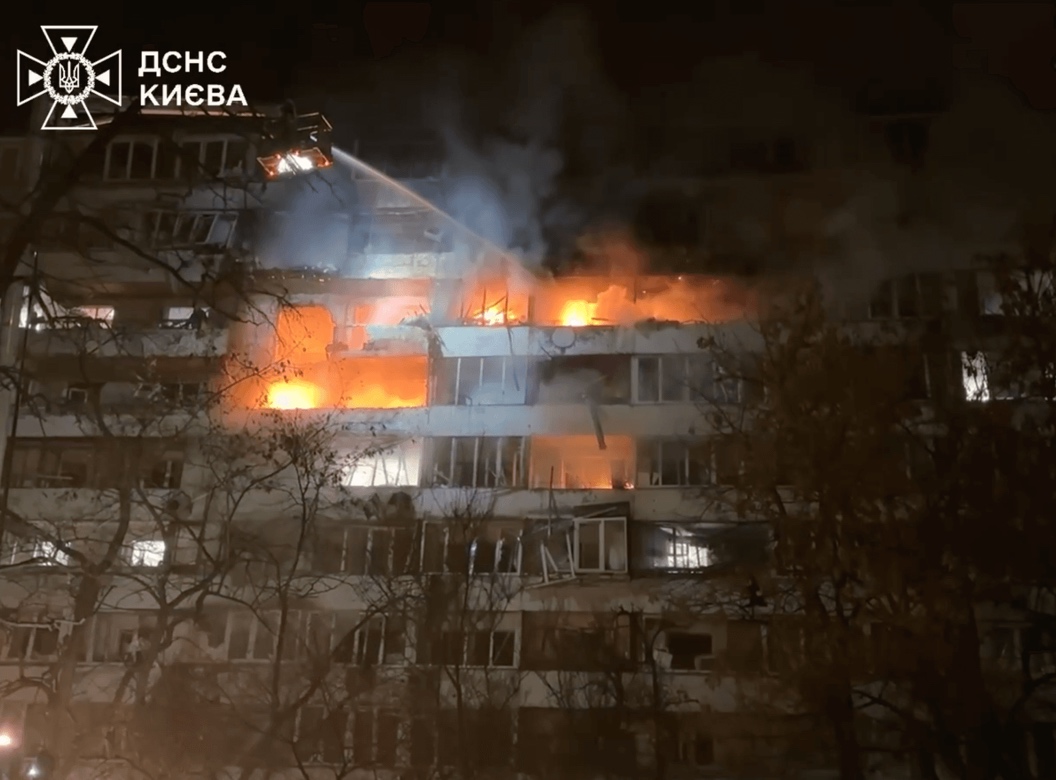
Night in Kyiv: Firefighters battle flames in a high-rise where families were sleeping hours before. Russian drones found their targets—162 launched, 37 struck home. Seventy thousand lost power. This is how Ukrainians wake up on day 1,370. (Ukraine’s State Emergency Service / Telegram)
The Illusion of Progress
Twenty-eight points became nineteen. Ukrainian and American negotiators in Geneva called it progress.
The original framework—leaked weeks earlier—had generated fury across European capitals and resistance in the U.S. Congress. Ukraine would cede all of Donbas. Reduce its military to six hundred thousand troops. Abandon NATO membership. Moscow would get everything it wanted, wrapped in diplomatic language about “realistic compromise.”
The revision removed the most blatant giveaways. Gone were provisions about bilateral U.S.-Russian engagement that excluded Ukrainian input. Gone were certain “European matters” deemed unrelated to Ukraine’s survival. What remained: disputes over territory, military force levels, and NATO membership that no amount of diplomatic wordsmithing could reconcile.
Oleksandr Bevz, advisor to Presidential Office Head Andriy Yermak, emphasized the adjustments. NATO accession would be decided by the alliance’s consensus mechanism—not Russian veto. Territorial discussions would begin from current frontlines—not from Russian demands for additional land swaps. The revised plan no longer included proposals for one hundred billion dollars in frozen Russian assets to fund American-led reconstruction, Bloomberg reported. Even the economic components had collapsed under scrutiny.
Sources told multiple outlets that Trump and Zelensky would need to personally resolve the most sensitive issues—territorial concessions, NATO membership—before any agreement could materialize. Translation: the hard decisions got postponed while creating the appearance of momentum.
The Kremlin’s response clarified everything. Yuri Ushakov dismissed Europe’s counter-proposal—which had raised Ukrainian force limits to eight hundred thousand and removed demands for additional territorial cessions—as “completely unconstructive.” But portions of the American plan remained “acceptable to Moscow.”
Acceptable to Moscow. The phrase revealed which proposal had started closer to Russian demands.
Russian officials continued their narrative: European involvement only prolonged the war. State Duma Chair Leonid Slutsky claimed Europe’s proposal would perpetuate conflict. His deputy Svetlana Zhurova warned that continued American revisions would “drag on” negotiations “endlessly.”
The subtext was clear: only bilateral U.S.-Russian talks—excluding Ukrainian and European voices—could produce “acceptable” results. Ukraine’s preferences mattered only insofar as they facilitated Russian objectives.
The diplomatic theater continued. The fundamental incompatibilities remained unchanged.
Fighting for the Railway Station
Ukrainian assault teams moved through Pokrovsk’s railway station at dawn, clearing Russian positions room by room. The 425th Assault Infantry Regiment—trained specifically for urban warfare—led the operation with support from air assault brigades and special operations units. By afternoon, Ukrainian forces controlled the station and Soborny Square in the city center.
Major Valentyn Manko, commander of Ukrainian assault infantry troops, reported his forces had “cleared the center of Pokrovsk.” Combat continued in southern districts where Russian troops retained positions and fire control.
The accounts varied depending on who was speaking. Some Ukrainian units emphasized successful clearing operations and described remaining Russian forces as isolated, cut off from resupply. Other sources offered more cautious assessments, noting that Russian troops still held portions of the city and that tactical improvements might not fundamentally alter the operational situation.
Geolocated footage showed Ukrainian forces patrolling along the E-50 Pokrovsk-Pavlohrad highway in the city’s northwest and moving through northern areas where Russian infiltrators had operated for weeks. The fog of urban warfare made definitive assessments difficult.
A Ukrainian military source provided tactical details: effective drone interdiction had reduced Russian logistics to approximately ten percent capacity. Over five hundred Russian troops operated inside Pokrovsk in relatively uncoordinated fashion, sometimes committing friendly fire incidents. But Russian forces maintained extensive fire control through drones and artillery, interdicting Ukrainian supply routes and complicating reinforcement efforts.
Both sides exploited poor weather. Movements that would prove suicidal in clear conditions became feasible under fog and low clouds. The result: ongoing back-and-forth fighting with neither side achieving decisive control.
The Russian Defense Ministry’s daily report claimed Russian forces had repelled attacks by Ukrainian assault and air assault units in the Pokrovsk area. No mention of combat within the city itself.
The absence of triumphant Russian announcements claiming control of central Pokrovsk suggested Ukrainian accounts had merit. The details remained contested. The fighting continued.
Three Wounded, One Captured
The Ukrainian Special Operations raid hit Russian positions in the Pokrovsk direction before dawn. Two Russian soldiers died in the brief firefight. A third was captured alive.
The real objective wasn’t the kills—it was the evacuation. A neighboring Ukrainian unit had three wounded soldiers trapped in a contested area where traditional medevac would draw immediate fire. The Special Operations team’s assault created enough confusion for unmanned ground vehicles to roll forward, load the wounded, and extract them to safety.
Ukrainian Special Operations Forces announced the mission’s success on November 24. The raid demonstrated capabilities that resource constraints and Russian advantages in artillery and aviation couldn’t eliminate: the ability to strike at times and places of Ukrainian choosing, even in sectors under sustained Russian pressure.
Special operations units across multiple sectors continued similar missions—disrupting Russian operations, gathering intelligence, demonstrating that Ukrainian forces retained offensive capabilities beyond purely defensive postures. The raids imposed psychological costs on Russian troops who learned that Ukrainian special operators could appear anywhere, anytime.
The tactical sophistication mattered. Coordinating assault teams, drone operators, and support elements while maintaining operational security required functional command and control systems despite months of grinding warfare. The use of unmanned ground vehicles for casualty evacuation highlighted Ukrainian adaptation to battlefield realities that made conventional medical evacuation prohibitively dangerous.
These weren’t capabilities Ukraine possessed when Russia invaded in February 2022. Nearly four years of high-intensity combat had forced innovation in tactics, techniques, and procedures that conventional military doctrines hadn’t fully anticipated.
The raid’s immediate territorial impact was negligible. The strategic message was clear: Ukrainian forces retained the initiative in ways that transcended holding or losing ground.
Three wounded soldiers extracted. One Russian captured. And proof that adaptation under pressure remained Ukraine’s asymmetric advantage.
Fog Over Hulyaipole
Russian forces took Zatyshshya through morning fog—2.6 kilometers closer to Hulyaipole. Elements of the Russian 114th Motorized Rifle Regiment conducted the assault while Ukrainian reconnaissance drones sat useless, grounded by weather that turned cameras blind.
Geolocated footage confirmed the seizure. So did the Russian Ministry of Defense. Another settlement fallen. Another incremental advance toward a city whose loss would threaten Ukrainian defensive positions across southern Zaporizhzhia Oblast.
Russian milbloggers claimed reconnaissance groups had been operating inside Hulyaipole itself for a week. Ukrainian sources disputed claims of Russian presence within the city proper but acknowledged the pressure building on all approaches.
Ukrainian military spokesman Vladyslav Voloshyn called the situation “quite difficult.” Russian forces were increasing combat engagements, employing artillery, drones, and aviation against Ukrainian positions near multiple settlements. Russian troops had attempted assaults and tried infiltrating Hulyaipole’s outskirts. Ukrainian forces contested each attempt.
A Ukrainian servicemember confirmed fighting had begun for Zatyshshya—meaning Ukrainian forces hadn’t simply withdrawn but were actively contesting control even as Russian troops consolidated their grip.
The weather mattered. Seasonal fog degraded Ukrainian drone defenses that had proven devastatingly effective in clearer conditions. Russian forces exploited these windows, conducting ground operations that would have been prohibitively dangerous when Ukrainian reconnaissance and strike drones could operate freely. Ukrainian forces had reportedly developed new drone technologies capable of functioning in fog, but the seasonal advantage still favored Russian tactics.
Hulyaipole’s significance extended beyond tactical considerations. The city served as a transport hub with logistical routes connecting north to Dnipropetrovsk Oblast and west to Zaporizhzhia city. Russian seizure or envelopment would create conditions for advances toward more significant objectives.
The city’s fortifications—built over years of frontline proximity—meant rapid capture remained unlikely. But the documented Russian advances in surrounding areas revealed sustained commitment to operations in this sector.
Fog. Infiltration. Incremental gains. And Ukrainian defenders adapting to fight an enemy who could see when they couldn’t.
Forty Balloons Over Lithuania
Forty balloons drifted across Lithuanian airspace overnight. Thirty more crossed into Latvia. Weather balloons, technically. Harmless, officially. Violations of NATO sovereignty, undeniably.
Vilnius International Airport suspended operations twice as Lithuanian air traffic controllers tracked the slow-moving objects. The balloons lacked propulsion, weapons, or any characteristics resembling traditional military platforms. They also lacked any plausible meteorological purpose for systematic launches toward NATO territory.
The provocation was too absurd to ignore, too minor to answer with force.
Belarus served as Russia’s proxy for actions Moscow preferred not to claim directly. Hosting Russian nuclear weapons. Launching attacks into NATO airspace. Testing alliance responses without assuming direct responsibility. Belarusian President Alexander Lukashenko’s complete dependence on Russian political and economic support meant Belarus functioned as a Russian client state maintaining the fiction of independent sovereignty.
The arrangement provided Moscow with operational advantages. Belarus’s nominal independence offered deniability. Actions attributed to Minsk rather than Moscow fell below thresholds that might trigger responses Russia wanted to avoid. The balloon incursions tested NATO air defense procedures, probed for weaknesses in alliance cohesion, and demonstrated that violations could occur with apparent impunity.
The balloons served multiple strategic purposes. They tested NATO responses to ambiguous threats that didn’t justify military countermeasures. They demonstrated Russia and Belarus could violate NATO airspace without consequences, potentially eroding confidence in alliance security guarantees among Baltic populations. They imposed costs by disrupting civilian aviation and requiring sustained air defense vigilance against numerous low-value targets.
Western responses reflected the challenges of hybrid warfare operating in gray zones between peace and armed conflict. NATO members couldn’t reasonably treat weather balloons as equivalent threats to military aircraft. Neither could they ignore systematic violations of their airspace.
Lithuania closed land border crossings with Belarus—one attempt to impose costs for enabling Russian provocations. The measure’s effectiveness remained questionable given Belarus’s isolation and dependence on Russia.
The assessment: these activities formed part of “Phase Zero” preparation for possible future NATO-Russia conflict. Russia was systematically testing NATO defenses, procedures, and political cohesion in ways that might inform planning for potential military operations.
Forty balloons. Individually trivial. Collectively revealing. And nobody quite sure how to respond to provocations designed to humiliate without justifying retaliation.
Performance Without Script
The performance continued because all parties found value in appearing to pursue peace, even when underlying positions remained fundamentally incompatible.
The United States demonstrated engagement with a conflict straining transatlantic relations and imposing humanitarian costs that troubled even callous observers. Ukraine showed willingness to negotiate while maintaining that any settlement must preserve Ukrainian sovereignty and territorial integrity. Russia participated in diplomatic processes while continuing military operations aimed at creating facts on the ground that would render Ukrainian negotiating positions irrelevant.
The substantive gaps remained enormous despite reported textual progress. Ukraine insisted on maintaining its right to pursue NATO membership and refused to formally recognize Russian occupation. Russia demanded Ukraine abandon NATO aspirations and accept permanent loss of occupied regions. The United States proposed frameworks attempting to bridge these incompatible positions through carefully crafted ambiguities and deferred decision-making.
No amount of diplomatic creativity could reconcile demands that contradicted each other at fundamental levels.
The peace plan’s contraction from twenty-eight points to nineteen reflected efforts to eliminate provisions generating obvious objections rather than resolving core disputes that would determine whether any settlement proved durable. Russian rejection of Europe’s counter-proposal—which had softened the American plan’s most egregious demands—revealed Moscow’s baseline expectations.
Raising limits on Ukrainian military force levels from six hundred thousand to eight hundred thousand troops proved unacceptable to Russia because it would leave Ukraine with capabilities potentially threatening Russian control of occupied territories. Removing demands for Ukrainian territorial cessions beyond current frontlines similarly contradicted Russian objectives of ratifying maximal territorial gains through diplomatic settlement.
Russia’s insistence that only bilateral U.S.-Russian negotiations excluding Ukrainian and European input could produce acceptable results reflected Moscow’s preference for arrangements where Ukraine would be presented with faits accomplis rather than participating as an equal party.
The diplomatic process thus continued not because it offered realistic prospects for sustainable peace, but because it served various parties’ shorter-term interests regardless of ultimate outcome. Ukrainian participation demonstrated Kyiv’s reasonableness, strengthening Ukraine’s position with Western supporters who valued diplomatic engagement. American involvement allowed the Trump administration to claim engagement while potentially deflecting criticism regarding insufficient support for Ukraine. Russian participation enabled Moscow to portray itself as willing to negotiate while maintaining maximalist demands and continuing military operations aimed at improving Russia’s bargaining position through territorial conquest.
Theater. All of it. And everyone knew their roles.
One Hundred Sixty-Two Drones
The waves came after midnight. Russian forces launched 162 Shahed-type drones from multiple sites across Russia, targeting port facilities, agricultural infrastructure, civilian neighborhoods, and energy systems in Kharkiv, Chernihiv, and Dnipropetrovsk oblasts.
Ukrainian air defenses intercepted 125. Thirty-seven struck their targets across fifteen locations. Debris from downed drones fell at one additional site. Seventy thousand customers lost power in Dnipropetrovsk and Kharkiv oblasts.
In the afternoon, Russian drones struck civilian infrastructure in Chernihiv City. Three civilians wounded. The attacks formed part of Russia’s sustained campaign to destroy Ukraine’s electrical generation and distribution systems ahead of winter—deliberate strategy to inflict maximum suffering on civilian populations and create conditions favoring Ukrainian acceptance of Russian terms.
The systematic targeting of heating and power systems revealed objectives extending beyond military necessity to encompass straightforward terrorism aimed at maximizing civilian hardship.
Russian forces struck infrastructure in six oblasts: Donetsk, Kharkiv, Chernihiv, Odesa, Sumy, and Dnipropetrovsk. The geographic scope demonstrated the breadth of Russian targeting. The attacks occurred even as diplomatic discussions in Geneva supposedly aimed at ending such strikes.
Either Russia’s diplomatic and military operations proceeded without coordination, or the attacks themselves formed calculated components of Russian negotiating strategy. Neither interpretation provided reassurance to Ukrainian civilians enduring another night of attacks on their homes and essential services.
Western responses remained inadequate despite rhetorical condemnations. Air defense system provision continued at rates insufficient to protect all Ukrainian population centers, forcing commanders to make grim calculations about which cities merited defense and which would remain vulnerable. Western restrictions on Ukrainian use of provided weapons to strike Russian launch sites within Russian territory compounded these challenges by allowing Russia to conduct strikes from sanctuaries Ukraine could not effectively target.
The resulting asymmetry: Russia able to systematically attack Ukrainian civilian infrastructure while Ukrainian responses remained constrained—creating conditions favoring Russian objectives of imposing maximum suffering at minimal cost.
One hundred sixty-two drones launched. Thirty-seven reached their targets. And seventy thousand Ukrainians woke to darkness and cold on the morning diplomats spoke of progress.
Names on the Record
Ukrainian authorities filed war crimes charges in absentia against four Russian military officers responsible for an April Iskander missile strike on a Kryvyi Rih playground. Twenty dead. Nine of them children.
The Security Service of Ukraine named the officers: Colonel-General Aleksei Kim, Vice Admiral Aleksandr Peshkov, Rear Admiral Aleksei Petrushin, and Colonel Aleksandr Kisiedobryev. These men ordered the strike, Ukrainian investigators concluded. Their names now entered official records as individuals responsible for murders committed under their command.
The charges represented continuation of Ukrainian efforts to document Russian war crimes since the invasion’s earliest days. Realistic prospects for bringing these officers to trial remained minimal absent fundamental changes in the war’s trajectory. Russian commanders operated from Russian territory under protection of a state that rejected International Criminal Court jurisdiction and showed no willingness to surrender its officers.
The practical challenges were enormous. But the symbolic importance exceeded immediate legal effect.
The methodology behind such charges—identifying specific commanders through signals intelligence, satellite imagery, and command structure analysis—reflected systematic Ukrainian efforts to build cases that might eventually support international prosecutions. Ukrainian investigators had been documenting Russian war crimes systematically: databases of attacks, casualties, evidence that might prove valuable should international mechanisms for accountability ever gain jurisdiction over Russian military leadership.
By naming specific Russian officers and detailing their roles in attacks killing Ukrainian civilians, Ukrainian authorities demonstrated that accountability would be pursued even when delayed. Individual Russians bore personal responsibility for crimes committed under their command. The charges served notice that Russian military officers could not hide behind claims of following orders or organizational anonymity.
Their actions were being documented for potential future reckoning.
Whether such future accountability would materialize remained uncertain. Russian forces operated from territory a court could not reach, under protection of a government that denied jurisdiction. But the systematic documentation ensured that evidence would exist should opportunities arise.
Twenty people dead. Nine children among them. And four names on the record for a crime Russia would never acknowledge and Ukraine could not yet punish.
Turkish Mediation and Internal Friction
Turkish President Recep Tayyip Erdogan announced he would speak with Russian President Vladimir Putin the following day, positioning Turkey as potential mediator following the unveiling of controversial American peace proposals. Turkey would “leave no stone unturned” to broker an end to the conflict, Erdogan stated, noting that “so many people have died” and expressing intention to discuss steps that might stop further casualties.
The Turkish president indicated he would subsequently discuss outcomes with European partners, U.S. President Donald Trump, and others, suggesting Turkey’s continued aspiration to play a central role in any diplomatic resolution.
Turkey’s mediation efforts faced the same fundamental challenges that had frustrated previous attempts at negotiated settlement: Russian demands remained incompatible with Ukrainian requirements for genuine sovereignty and security. Erdogan’s previous hosting of President Volodymyr Zelensky in Ankara had produced limited concrete results. American envoy Steve Witkoff had not attended those discussions.
Turkey’s position as NATO member maintaining relations with Russia provided potential advantages for facilitating dialogue, yet no amount of skilled mediation could bridge gaps between parties whose core objectives contradicted each other at fundamental levels. Erdogan’s mention of reviving the grain corridor arrangement that Russia had abandoned suggested focus on practical humanitarian measures that might prove more achievable than comprehensive peace settlements.
Meanwhile, Ukrainian law enforcement agencies denied preparing charges against Oleksandr Klymenko, Ukraine’s chief anti-corruption prosecutor, and David Arakhamia, head of President Zelensky’s party faction in parliament. The denials followed media reports suggesting such charges were being contemplated.
The Security Service of Ukraine stated that no “instructions, requests, or hints” regarding charges against these individuals had been received from the President’s Office or any other body. The Prosecutor General’s Office similarly denied that evidence existed supporting such charges.
The denials came amid tensions between anti-corruption agencies and the President’s Office regarding investigations into high-level corruption, particularly the Energoatom case involving allegations against individuals close to Zelensky. The reported consideration of charges against prominent figures involved in anti-corruption efforts raised concerns about potential retaliation against officials pursuing sensitive investigations.
Klymenko and Arakhamia had both taken positions on corruption cases that reportedly generated displeasure among presidential advisors, creating perceptions that charges against them might represent attempts to constrain anti-corruption activities rather than legitimate law enforcement actions.
The denials from law enforcement agencies suggested either that reported plans for such charges had been exaggerated or that pressure to pursue them had been resisted. The episode illustrated ongoing tensions between Ukrainian efforts to combat high-level corruption and political pressures that complicated such efforts.
What November 24 Revealed
Day 1,370 revealed the familiar pattern: diplomatic processes proceeding simultaneously with military operations that contradicted optimistic rhetoric about progress.
The reduction of the American peace framework from twenty-eight points to nineteen represented adjustments to superficial details rather than resolution of fundamental disputes. Russian demands for Ukrainian subordination and Ukrainian insistence on genuine sovereignty remained irreconcilable. Russian rejection of Europe’s counter-proposal while acknowledging acceptability of portions of the American plan demonstrated that Moscow’s baseline requirements for any settlement remained incompatible with Ukrainian survival as an independent state capable of defending itself against future Russian aggression.
The day’s military developments provided clearer indicators than diplomatic statements. Ukrainian forces’ maintenance of positions within Pokrovsk and successful counterattacks against Russian infiltrations demonstrated continued Ukrainian capacity to contest Russian advances even in sectors experiencing sustained pressure. Russian seizure of Zatyshshya near Hulyaipole and continued exploitation of weather conditions favoring Russian tactics showed that Russian forces retained capability and determination to pursue territorial gains regardless of diplomatic processes.
The overnight drone strikes—162 launched, 37 striking targets, seventy thousand losing power—illustrated Russia’s continued commitment to maximizing Ukrainian suffering as calculated strategy rather than unfortunate byproduct of military necessity.
The international context surrounding these events revealed persistent absence of Western strategies capable of compelling meaningful Russian compromise. American proposals reportedly favoring Russian demands generated European attempts at moderation that Russia promptly rejected as unacceptable. Turkish mediation offers faced the same fundamental obstacles that had frustrated all previous diplomatic initiatives: no amount of skilled facilitation could bridge gaps between parties whose core objectives contradicted each other.
Ukrainian efforts to document war crimes and pursue accountability proceeded despite minimal prospects for near-term justice, reflecting determination to preserve evidence for potential future reckoning even when immediate enforcement remained impossible.
Neither diplomatic activity nor military operations had fundamentally altered the war’s essential character. Russia remained committed to achieving maximal territorial control and Ukrainian subordination through combination of military pressure and diplomatic maneuvering designed to ratify gains achieved through force. Ukraine maintained determination to preserve sovereignty and resist permanent loss of territory, even as resource constraints and inadequate Western support complicated defensive operations.
The grinding attritional conflict continued consuming lives and resources at rates that should have generated greater international urgency, yet Western responses remained characterized by rhetorical support accompanied by insufficient material assistance and persistent restrictions on Ukrainian ability to strike Russian territory.
Those hoping for imminent resolution found little encouragement. The peace plan revisions could not overcome fundamental incompatibilities. The military situation remained characterized by Russian incremental advances in some sectors balanced by Ukrainian defensive successes in others. The civilian suffering imposed by systematic Russian attacks on infrastructure and population centers continued apparently immune from consequences, as Western air defense provision remained inadequate and restrictions on Ukrainian responses persisted.
Day 1,370 ended much as it began: diplomats crafting careful phrases attempting to reconcile the irreconcilable while military forces and civilian populations bore costs of decisions made by leaders whose own safety remained secure.