
As Moscow inflated its battlefield gains, Ukrainian forces pushed back in the south and hit a key Russian missile factory 1,300 kilometers inside Russia—exposing the widening gap between Kremlin narrative and war reality.
The Day’s Reckoning
Colonel General Sergei Rudskoy stood before cameras and claimed momentum. Nine hundred square kilometers seized. Forty-two settlements taken. “More than half” of Kostyantynivka under Russian control. Pokrovsk. Toretsk. Twelve kilometers from Zaporizhzhia City.
The numbers traveled fast.
But maps told a different story. Nineteen settlements confirmed. Five hundred seventy-two square kilometers verified. Russian forces present in roughly seven percent of Kostyantynivka. Twenty kilometers from Zaporizhzhia’s southern boundary—not twelve.
Three hundred twenty-eight square kilometers existed only in Moscow’s narrative.
While that narrative rolled outward, Volodymyr Zelensky told AFP that Ukrainian forces had liberated 300 square kilometers in a southern counteroffensive. “I won’t go into too many details,” he said, “but… 300 kilometers have been liberated.” No triumphalism. Just a quiet counterpoint.
Then came the strike deep inside Russia.
Late evening in Udmurt Republic. Explosions over Votkinsk. Black smoke rising above the Machine Building Plant that produces Iskander-M ballistic missiles and intercontinental systems. At least eleven injured. Workshops No. 22 and No. 36 reportedly damaged. The facility lies more than 1,300 kilometers from Ukraine’s border. The alleged weapon: a long-range “Flamingo” cruise missile with a 3,000-kilometer reach.
Elsewhere, ten suspects detained in a Russian-backed assassination plot targeting journalists, public figures, and GUR personnel including Andriy Yusov—bounties up to $100,000 per killing.
Leaked messages showed Major General Roman Demurchiev circulating images of mutilated Ukrainian POWs, discussing torture as routine.
Hungary blocked a 90-billion-euro EU loan. Slovakia and Hungary halted diesel exports. Putin expanded FSB authority to disconnect citizens from the internet.
Near Serednii Burluk, a Russian Lancet drone struck a White Angels evacuation vehicle. Yuliia Keleberda, 23. Yevhen Kalhan, 39.
Claims inflated. Territory contested. A missile plant burning.
Day 1,458 compressed the war into one stark contrast: projection versus proof.
The 328-Kilometer Lie
Colonel General Sergei Rudskoy stepped forward with maps and certainty. Nine hundred square kilometers seized in 2026. Forty-two settlements taken. More than 6,700 square kilometers and over 300 settlements captured in 2025.
The Northern Grouping, he said, carved out a “security zone” along the border—26 settlements in Sumy Oblast, 15 in northern Kharkiv including Vovchansk. The Western Grouping seized “over 50” settlements, including Kupyansk—a claim even Russian milbloggers have repeatedly challenged.
He went further. Forty-nine settlements taken in 2025. “More than half” of Kostyantynivka under Russian control. Eighty-six settlements seized by the Central Grouping—Pokrovsk, Toretsk, Myrnohrad. The Eastern Grouping capturing Hulyaipole and 160 square kilometers in eastern Zaporizhia and southern Dnipropetrovsk oblasts. The Dnepr Grouping pushing to within 12 kilometers of Zaporizhzhia City.
Then came the audit.
Verified assessments show 19 settlements and 572 square kilometers seized in 2026—a gap of 23 settlements and 328 square kilometers. In 2025, roughly 252 settlements taken, about 50 fewer than claimed. Nine in Sumy. Seven in northern Kharkiv.
Seventeen settlements in the Western Grouping’s area. Fifty in the Southern Grouping’s area—one of the few claims roughly aligned with reality. Seven percent of Kostyantynivka affected by advance or infiltration, not “more than half.” Thirty-eight settlements near Pokrovsk.
In eastern Zaporizhia in 2026, Russian forces seized 99 square kilometers and three settlements including Hulyaipole—while losing 18 settlements and 86 square kilometers to Ukrainian counterattacks. Two settlements taken in western Zaporizhia since November. And the advance toward Zaporizhzhia City? Twenty kilometers from the southern boundary—not twelve.
Small rural settlements along the border became symbols of triumph.
The cost: 13–15 square kilometers per day in 2025, paid in blood—83 casualties for every square kilometer gained.
Projection filled the missing 328. The battlefield did not.
Three Hundred Kilometers Back
Volodymyr Zelensky did not bring a map. He brought a number.
“Today I can congratulate our army first and foremost—all the defense forces—because as of today, 300 kilometers have been liberated,” he told AFP. He offered no timeframe. He offered restraint.
Three hundred square kilometers in the south. Ground retaken in a counteroffensive unfolding along a front line that refuses to freeze.
“You can’t say that we’re losing the war. Honestly, we’re definitely not losing it, definitely. The question is whether we will win.”
Ukrainian forces have advanced in eastern Novopavlivka. West of Zaliznychne, positions shifted again. In the Hulyaipole direction, counterattacks have forced elements of Russia’s 36th Combined Arms Army to defend their northern flank instead of reinforcing the 5th CAA. Pressure redirected.
Russia, meanwhile, has concentrated the bulk of its renewed ground offensive in eastern Donetsk Oblast. Operations intensified in southern Zaporizhzhia Oblast. Forces pushed into southern Dnipropetrovsk Oblast.
The scale of the struggle remains stark. In 2025 alone, Russian forces occupied 4,336 square kilometers of Ukrainian territory.
Three hundred kilometers does not erase that map.
But it redraws part of it.
And it interrupts the narrative that only one side advances.
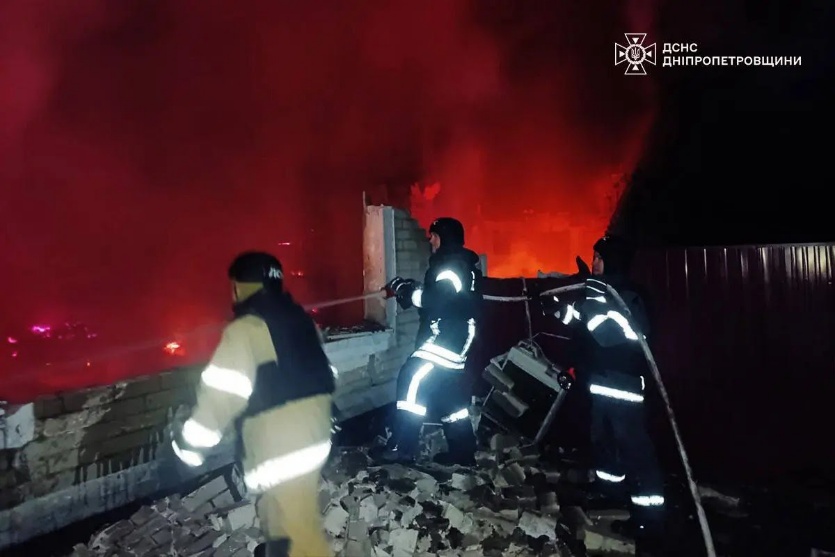
Firefighters extinguish a fire after a Russian overnight attack on Dnipropetrovsk Oblast. (State Emergency Service of Ukraine / Telegram)
Fire Over Votkinsk
Late evening in Udmurt Republic, explosions cracked across Votkinsk. Residents stepped into the dark with their phones raised. Black smoke climbed into the night sky above the Machine Building Plant. Windows shattered in nearby buildings.
The target was no ordinary factory.
Votkinsk is a strategic, state-owned defense enterprise—one of Russia’s most important missile production hubs. It produces the short-range Iskander-M ballistic missiles that routinely strike Ukrainian cities. It manufactures intercontinental ballistic missiles capable of carrying nuclear warheads. It is also suspected of producing Russia’s new Oreshnik ICBM.
At least 11 people were injured.
The strike was reportedly carried out using long-range “Flamingo” cruise missiles—Ukrainian-made systems with a range of up to 3,000 kilometers and a warhead of roughly 1,150 kilograms. Votkinsk lies more than 1,300 kilometers from Ukraine’s border. Distance offered no protection.
Aleksandr Brechalov, head of the Udmurt Republic, confirmed a facility was hit by a Ukrainian drone. He did not specify which one. “According to operational data, there are damages and casualties.”
Locals said workshops No. 22 and No. 36 were damaged.
Throughout the full-scale war, the plant expanded—hiring thousands, adding new buildings, importing advanced machinery through third-party channels to bypass sanctions. Supplies from China, Taiwan, and Belarus helped fuel the growth.
That expansion translated into firepower.
In 2024, Russia produced nearly three times more Iskander-M ballistic missiles than in 2023.
Now smoke rose from the source.
The $100,000 Kill List
They posed as delivery couriers. Knock. Photograph. Leave.
Behind the routine movements was a contract. Up to $100,000 per name.
Ukrainian and Moldovan authorities detained ten people connected to a Russian plot to assassinate prominent Ukrainians. Prosecutor General Ruslan Kravchenko said Russian intelligence promised payments of up to $100,000 to kill journalists, public figures, the head of a strategically important company, members of the Ukrainian Foreign Legion, and GUR personnel—including Coordination Headquarters for Treatment of POWs Deputy Head Andriy Yusov.
The alleged organizer: a 34-year-old Moldovan national who previously served a prison sentence in Russia, where he was recruited by Russian security services. After returning to Moldova, he built a hierarchical agent-combat group under Russian supervision. Recruits were drawn largely from men with military training or pro-Kremlin views.
The structure was methodical. Surveillance teams documented routines, residences, workplaces, security details. Execution teams prepared to act. Operatives marked geolocations on digital maps, procured weapons, prepared explosives, organized safe houses. Communication ran through encrypted channels. Funding moved via cryptocurrency wallets and foreign bank cards.
The objective was not only murder. It was spectacle. Killings designed to provoke public outrage, generate negative media coverage about Ukraine’s security environment, and incite further destabilization.
Moldovan investigators detained the alleged coordinator and two associates. Ukrainian authorities conducted searches in Kyiv and Odesa, seizing firearms, ammunition, grenades, communication equipment, and digital devices. Seven suspects were detained in Ukraine, three arrested in Moldova.
If convicted, they face life imprisonment with confiscation of property.
The plot was structured. Funded. Activated.
And stopped.
“Dispose of Him”: The Chats That Exposed Command-Level Brutality
The messages were not whispers from the shadows. They came from a major general.
Leaked chats from Russian Major General Roman Demurchiev, deputy commander of the 20th Combined Arms Army, show torture and killing of Ukrainian POWs discussed as routine. Not rogue behavior. Not isolated breakdown. Routine.
Demurchiev exchanged messages with senior officers: 49th CAA commander Lieutenant General Mikhail Kosobokov, 20th CAA commander Lieutenant General Oleg Mityayev, 36th CAA First Deputy Commander Major General Igor Timofeev, and counterintelligence officer Colonel Alexei Shvedov. The conversations reveal normalization at the top.
He shared images of cut-off human ears with soldiers—and with his wife. In one exchange, he bragged about making a garland from them. She replied, comparing them to “pig ears served with beer.”
The materials include photos of violence against animals, discussions of torture, and videos of abused prisoners circulated privately. In one chat, Demurchiev offered a POW as a “gift” to an FSB officer known as “Grek,” asking whether he should “dispose of him” or hand him over, noting his unit had not had time to “properly interrogate” the prisoner.
A photograph in the chat helped identify the POW: a 42-year-old volunteer from Zaporizhzhia. He later spent more than a year in Russian captivity before being exchanged in 2025.
The leaks also contain infrared drone footage showing Russian forces executing Ukrainian POWs near Makiivka. The far-right Rusich Sabotage Assault Reconnaissance Group publicly celebrated such imagery and offered cash rewards for footage of executions.
Circulated, amplified, monetized.
Violence did not hide. It was shared.
Oil, Elections, and a €90 Billion Standoff
The leverage was not artillery. It was oil.
Hungarian Foreign Minister Peter Szijjarto announced Budapest would block the European Union’s €90 billion loan to Ukraine until Russian oil resumes flowing through the Druzhba pipeline.
“We are blocking the €90 billion EU loan for Ukraine until oil transit to Hungary via the Druzhba pipeline resumes,” he said.
The Ukraine Support Loan had been preliminarily approved to cover two-thirds of Ukraine’s needs for 2026–2027: €30 billion for budget support, €60 billion for military needs. Without it, Kyiv risks running out of cash by mid-2026.
Szijjarto accused Kyiv of “blackmailing” Budapest and claimed cooperation between Ukraine, EU institutions, and Hungarian opposition parties aimed to destabilize Hungary ahead of parliamentary elections.
Polls show Prime Minister Viktor Orban and his Fidesz party trailing opposition leader Peter Magyar by roughly 10 points. Rhetoric has hardened. Orban has called Ukraine an “enemy.”
Hungary and Slovakia also announced plans to halt diesel exports to Ukraine in retaliation for the suspended oil transit. The Druzhba pipeline—one of the world’s largest, capable of carrying about two million barrels per day—remains Hungary and Slovakia’s last route for importing Russian crude. Transit stopped in late January after Russian strikes damaged Ukraine’s energy infrastructure.
In Moscow, Vladimir Putin signed a law granting the FSB broad authority to order individuals disconnected from mobile and home internet services, obliging telecommunications operators to comply and shielding them from liability.
Energy pressure. Election pressure. Information pressure.
The pipelines carry more than oil.
Pressure at Home, Judgment Abroad
In Moscow, even loyalists are learning the limits.
The Kremlin filed an administrative case against Pavel Gubarev, the former self-declared “People’s Governor of Donetsk Oblast,” for “discrediting the Russian Armed Forces.” The fine could reach 50,000 rubles. His offense: calling Chechen commander Apti Alaudinov a “TikTok general” over failures in Kursk Oblast and accusing Kremlin-backed DNR Head Denis Pushilin of profiteering during a water supply crisis.
Gubarev once stood at the front of the separatist cause. Now he stands in the crosshairs. He co-founded the Angry Patriots Club with imprisoned Igor Girkin. His case unfolds as Russian authorities tighten control over Telegram and move to silence even pro-war critics.
Ahead of September 2026 State Duma elections, the Presidential Administration instructed media outlets to amplify coverage of United Russia—highlight family support programs, housing legislation, medical benefits for veterans. Rising food and utility prices have cut into party popularity; polling dropped an average 10 percent in recent months, 13 to 15 percent in St. Petersburg.
In Kyiv, accountability moved in the opposite direction. A court sentenced Russian soldier Vladimir Ivanov of the 40th Separate Marine Brigade to life imprisonment for executing two unarmed Ukrainian POWs who had surrendered in Kursk Oblast. He must also pay 50 million hryvnias in moral damages to the victims’ family.
Allies signaled their own lines. Czechia joined Ukraine in boycotting the 2026 Winter Paralympic Games opening ceremony over the IPC decision to allow six Russian and four Belarusian athletes to compete under their own flags. EU Sports Commissioner Glenn Micallef will also stay away.
Former British MP Jack Lopresti joined Ukraine’s 12th Special Forces Brigade “Azov.”
France renewed a €71 million Ukraine Fund, signed in Kyiv by Ambassador Gael Vessier and Economy Minister Oleksiy Sobolev.
And in Brussels, the European Commission said it would welcome reactivation of the Druzhba pipeline—but the decision rests with Kyiv.
Inside Russia: tightening control. Outside: sharpening choices.
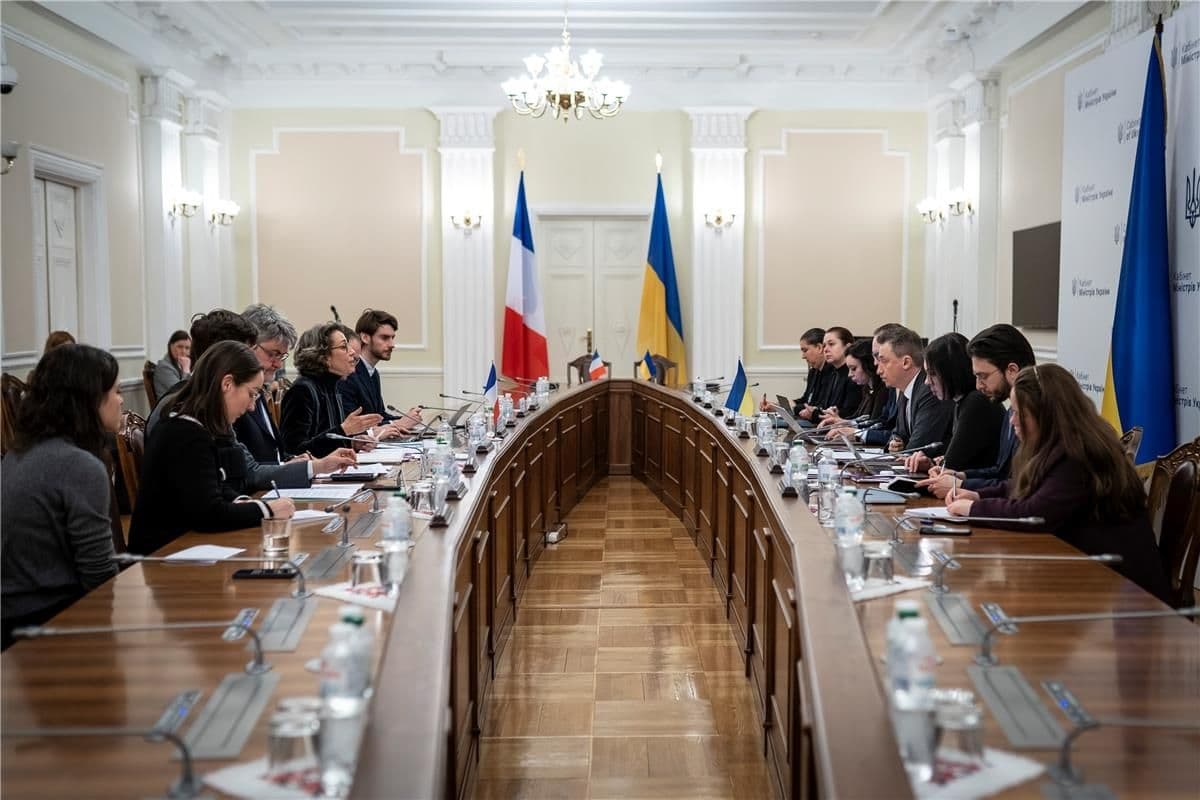
French and Ukrainian officials at a signing ceremony to renew a Ukraine investment fund in Kyiv, Ukraine. (Economy Ministry)
The Rescue Marked for Death
The armored vehicle carried no assault team. It carried hope.
Near the village of Serednii Burluk in Kharkiv Oblast’s Kupiansk district, the “White Angels” evacuation unit was moving civilians out of danger when a Russian Lancet loitering munition struck.
Two officers died at the scene. One was injured.
Yuliia Keleberda was 23.
Yevhen Kalhan was 39.
They had been part of the White Angels since the early months of the full-scale invasion, driving into frontline settlements to evacuate children, the elderly, and people with disabilities. They went where artillery fell and windows shattered, pulling families out before the next strike landed.
“They carried out numerous missions to the most dangerous settlements, evacuating dozens of families. They repeatedly risked their lives to save others. Sadly, this evacuation became their last.”
Keleberda is survived by her parents.
Kalhan leaves behind his wife, his mother, a 16-year-old son, and a 7-year-old daughter.
They went to save lives.
The drone found them first.
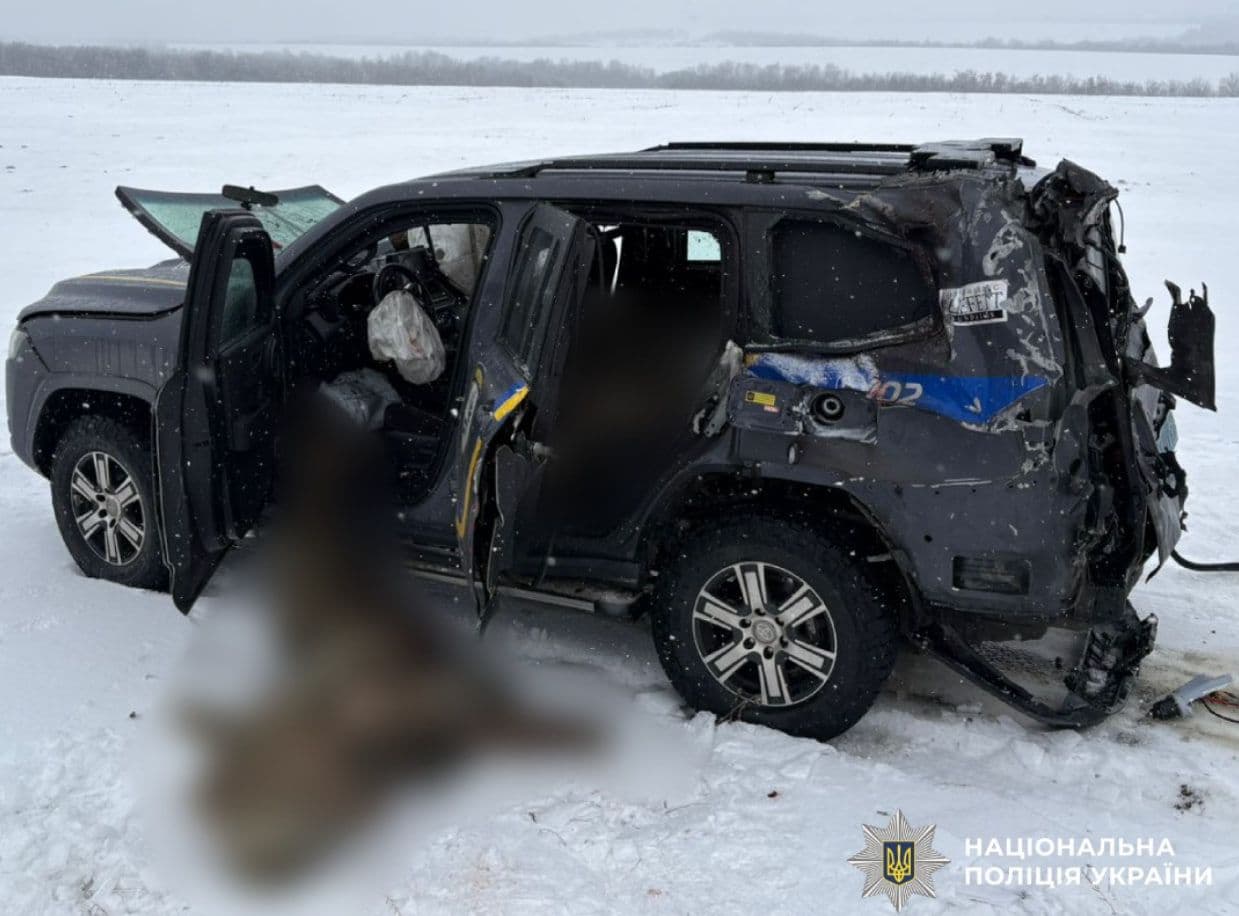
The site of a Russian drone strike that killed two Ukrainian police officers in Kharkiv Oblast. (The National Police / Facebook)
The Day’s Meaning
Two wars unfolded at once.
On one stage, numbers were projected with confidence—900 square kilometers seized, cities nearly taken, victory implied. On another, verified maps showed 572 square kilometers, seven percent of a city, lines still 20 kilometers from Zaporizhzhia. The gap was not minor. It was 328 square kilometers wide.
That gap is the story.
Moscow is fighting on the battlefield and in perception. Inflate gains. Signal inevitability. Convince Western capitals that resistance is futile. Cognitive warfare fills what artillery cannot.
But counterpressure answered. Three hundred square kilometers liberated in the south. Russian units in the Hulyaipole direction forced to defend rather than advance. And a missile plant more than 1,300 kilometers inside Russia struck, workshops damaged, production disrupted. Distance no longer guarantees sanctuary.
The war’s shadow operations surfaced too. A $100,000-per-kill assassination network dismantled before it could ignite outrage. Leaked messages revealing senior officers treating torture and execution as routine practice. Violence not hidden—normalized.
At the same time, pressure tightened inside Russia and across Europe. Hungary blocked €90 billion in EU support as elections loom. Diesel flows halted. The FSB empowered to disconnect citizens from the internet. Loyalists disciplined. Media instructed. Poll numbers slipping.
And on a road near Serednii Burluk, two evacuation officers were killed by a Lancet drone while trying to save civilians.
This day revealed contrast more than clarity. Projection versus proof. Expansion versus disruption. Control versus exposure.
The war is not static.
It stretches from frontline trenches to oil pipelines, from Telegram chats to missile factories deep in Russia.
And the space between narrative and reality remains measurable—down to the kilometer.
Prayer For Ukraine
- For Truth to Prevail Over Deception
Lord, expose false narratives and propaganda that distort reality. Strengthen leaders, journalists, and citizens who stand for truth. Let clarity break through manipulation, and prevent lies from weakening international resolve to support Ukraine. - For Protection of Defenders and Rescuers
Protect those on the front lines and those who run toward danger to save others—soldiers, medics, and evacuation teams like the White Angels. Comfort the families of Yuliia Keleberda and Yevhen Kalhan. Guard every life risking itself to shield civilians. - For Justice in the Face of Atrocities
Bring accountability for war crimes. Heal survivors of torture and captivity. Restrain cruelty at every level of command, and let justice—not revenge—shape the response to documented abuses. - For Stability Amid Political and Economic Pressure
Sustain Ukraine as economic pressure mounts and aid faces obstacles. Provide wisdom to European leaders navigating energy disputes and elections. Keep unity strong among allies supporting Ukraine’s defense and recovery. - For Courage and Endurance in the Days Ahead
Strengthen Ukraine’s leaders as they weigh difficult decisions about war and peace. Grant endurance to communities under constant threat. Preserve hope in the midst of loss, and bring this war to a just and lasting end.