
Seven European leaders signed their support for a revolutionary financial mechanism that could unlock €210 billion from frozen Russian assets to sustain Ukraine’s resistance, even as American diplomats pressed Kyiv to surrender Donbas and Putin performed economic confidence theater while admitting Russia’s birth rates were collapsing under war casualties.
The Day’s Reckoning
Seven European leaders put ink to paper on December 8, knowing their signatures could unlock 210 billion euros that might save Ukraine—or arrive too late to matter. The mechanism was elegant in its audacity: use frozen Russian assets as collateral for loans that Moscow would ultimately repay through war reparations. Translation: make Russia fund Ukraine’s resistance against Russian aggression.
While those signatures dried in seven capitals, Zelensky sat in a Downing Street meeting room with Britain’s Starmer, France’s Macron, and Germany’s Merz. The agenda was urgent: coordinate European positions before Washington’s patience expired. Trump had made his preference clear—territorial concessions, delivered quickly. Europe needed a unified response. They didn’t have one.
Three thousand kilometers east, the war’s third dimension ground forward. Russian mechanized columns traded lives for meters in Pokrovsk. Ukrainian drones hunted fuel depots in occupied Luhansk. And 149 Russian drones swarmed toward Ukrainian cities, sixteen penetrating air defenses to strike power stations and residential blocks.
Day 1,384. The war had evolved beyond tank columns into something far more complex—a contest where frozen assets mattered as much as artillery, where diplomatic coordination could determine survival, and where financial creativity competed with military attrition to decide Ukraine’s fate.
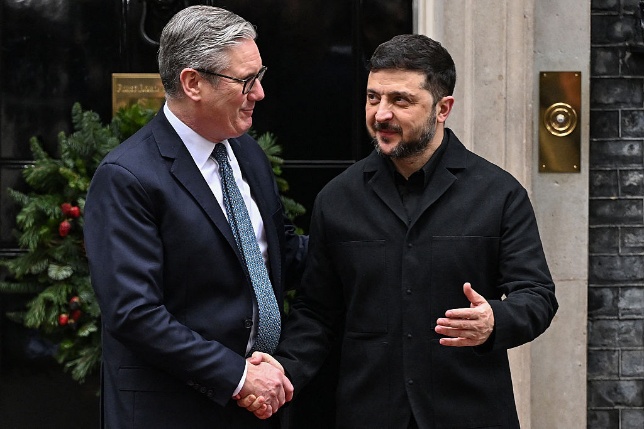
London, December 8: Keir Starmer welcomes Volodymyr Zelensky to Downing Street as Europe’s leaders attempt unified resistance to American pressure for territorial surrender. Behind closed doors, four nations scrambled to coordinate their response before Trump’s patience—and Ukraine’s ammunition—ran out. (Chris J Ratcliffe / AFP via Getty Images)
Seven Signatures Against the Clock
The letter arrived at seven capitals carrying 210 billion reasons for urgency. Estonia, Finland, Ireland, Latvia, Lithuania, Poland, and Sweden declared “strong support” for the reparations loan. The language was diplomatic. The subtext wasn’t: “Time is of the essence.”
The mechanics were elegant. Use frozen Russian Central Bank reserves as collateral for European loans to Ukraine. Repayment only required once Russia paid war reparations. Translation: make Moscow fund Kyiv’s resistance against Moscow’s aggression.
The arithmetic was brutal. Ukraine faced an 8-billion-euro budget shortfall and needed 135 billion euros over two years. Without external support, government coffers would empty by mid-2026. The reparations loan offered salvation without fresh parliamentary appropriations or politically toxic tax increases.
Belgium held the key. Roughly 200 billion dollars in Russian reserves sat frozen in Euroclear, the Brussels-based clearing house. Prime Minister Bart De Wever demanded other European nations share risk proportionally. He wasn’t being obstructionist—just Belgian, cautious when liability could fall on his voters.
The seven signatories weren’t Europe’s largest economies. France and Germany remained conspicuously absent. But the Baltic states, Finland, and Poland understood Russian aggression through lived historical memory. Their unified voice carried moral authority that German fiscal prudence and French diplomatic positioning couldn’t easily dismiss.
Iryna Mudra, Zelensky’s top legal advisor, called it “perfectly legal, economically sound, and politically necessary.” The war had transformed into financial combat where frozen assets became as consequential as artillery.
The Brussels summit on December 18-19 would decide everything. Seventy European politicians issued a separate letter demanding EU leadership act “without delay.”
The question: would European unity crystallize around bold action, or fracture under competing interests? Ukraine’s financial crisis was approaching. Diplomatic settlement efforts were intensifying. And time kept moving forward.
When Russia Admits It’s Running Out of Russians
Vladimir Putin spent December 8 performing economic confidence theater. One percent GDP growth. Inflation at six percent. The numbers sounded reassuring until you remembered Russia’s Central Bank had raised interest rates to economy-crippling levels just to prevent collapse.
Then Putin revealed what actually worried the Kremlin.
“Russia is working to overcome demographic issues and increase the birth rate,” he announced. Birth rates were declining partly due to “external challenges”—Kremlin euphemism for hundreds of thousands of casualties in Ukraine. Translation: the war was consuming the generation needed to produce the next generation.
Regional governors would now be evaluated on birth rate indicators. The policy admitted what Moscow couldn’t say directly: Russia was literally running out of Russians.
The most audacious claim involved occupied territories. Putin stated that “people’s readiness to have children” had “most significantly improved” in occupied Kherson and Zaporizhia. The subtext: Russia intended exploiting occupied Ukraine as demographic resource, replacing Ukrainian populations with Russian settlers to replenish Moscow’s depleting human capital.
Prime Minister Mishustin claimed 10 percent GDP growth over three years despite “unprecedented” sanctions. The narrative: Russia could withstand Western economic warfare indefinitely. The messaging aimed to convince Washington that sanctions wouldn’t push Putin toward compromise.
But propaganda contradicted reality. The ruble had weakened despite capital controls. Inflation consumed purchasing power faster than wages compensated. Putin’s cheerful GDP discussion served the same purpose as military inevitability claims—convincing the West that Ukrainian resistance was futile.
What Putin conspicuously avoided: any connection between battlefield losses and economic problems. The presentations never mentioned the war, creating rhetorical separation between Russia’s military quagmire and financial difficulties.
The demographic crisis exposed Russia’s deepest vulnerability. The war supposed to restore Russian power was consuming the human capital needed to sustain that power across generations.
Putin was admitting defeat in the only war that ultimately mattered—the one against Russia’s own demographic collapse.
Four Leaders, No Unity
The Downing Street meeting room held four leaders attempting coordination they didn’t have. Zelensky, Starmer, Macron, and Merz—gathered with minimal notice but maximum urgency to unify European positioning before confronting American pressure.
Starmer opened with carefully calibrated Trump praise. “What President Trump has achieved in the last few weeks has been the furthest we’ve got in four years.” The diplomatic language concealed deeper tensions. Trump controlled Ukraine’s military support and could make Kyiv’s situation untenable through simple inaction.
Macron declared Europe had “a lot of cards”—sustained financial support and security guarantees America seemed increasingly reluctant to provide. But his confidence masked reality. France, Germany, and Britain couldn’t replace American military aid even if coordinated.
Merz admitted skepticism of Washington’s proposals. Translation: serious disagreement about territorial concessions that would reward aggression and encourage future Russian attacks.
Zelensky faced contradictory pressures. Trump had criticized him one day earlier: “I’m a little disappointed Zelensky hasn’t yet read the proposal.” American impatience with Ukrainian resistance to terms resembling Russian demands was obvious.
“We don’t have a unified view on Donbas,” Zelensky told Bloomberg afterward. The admission mattered. Russia demanded Ukraine cede the entire region despite controlling only 70 percent after three years. Washington was pressuring Kyiv to surrender territory Putin couldn’t capture militarily.
“Under our laws, under international law—and under moral law—we have no right to give anything away,” Zelensky declared. The language was absolute. Yet he simultaneously emphasized willingness to negotiate—a diplomatic tightrope between principle and pragmatism.
A senior Ukrainian official captured the positioning: the peace plan was “closer to be doable for Ukraine, but not easy and not finished.” Movement toward agreement without commitment to unacceptable terms.
Europe had attempted unity. What they achieved was coordinated confusion.
When “Leverage” Means Abandonment
US Ambassador to NATO Matt Whitaker revealed Trump’s approach to Ukraine peace negotiations in a Fox News interview. Trump “understands how to put leverage” on both Russia and Ukraine to conclude a deal, Whitaker stated. The phrasing was telling. “Leverage” meant coercive pressure, not honest brokerage between parties seeking mutually acceptable terms.
Whitaker acknowledged Trump could “step away” if he saw “no deal to be had.” Translation: American mediation came with expiration dates and consequences for non-compliance. Ukrainian resistance to American-backed terms might result in reduced support—a threat carrying weight given Trump’s control over military assistance and demonstrated willingness to cut aid to allies who didn’t comply.
European officials speaking to Politico described American positioning with barely concealed frustration. “On the territory issue, Americans are simple: Russia demands Ukraine to give up territories, and Americans keep thinking how to make it happen,” one senior European official reported. Another added: “The Americans insist that Ukraine must leave the Donbas…one way or another.”
The pressure reflected Trump’s desire for rapid resolution regardless of Ukraine’s strategic vulnerabilities or precedents such settlement would establish. A Western diplomat told Kyiv Post: “Trump is signaling to Zelensky that the clock is ticking, and Washington wants movement. But he’s also broadcasting to Moscow that he’s willing to lean hard on Kyiv—and that’s raising eyebrows in European capitals.”
Washington wasn’t mediating between two parties. It was pressuring one side to accept the other’s demands. Europeans watched with growing alarm as their primary security guarantor actively worked to reward Russian aggression.
The message to Kyiv was clear: capitulate quickly or capitulate alone.
Moscow’s Definition of Peace: Ukrainian Surrender
Russian State Duma Defense Committee Deputy Chairperson Alexei Zhuravlev revealed the Kremlin’s actual negotiating position with remarkable candor. Russia doesn’t care who signs the “capitulation” to end the war, Zhuravlev stated, as long as terms “satisfy Russia.”
He didn’t say “peace agreement.” He didn’t say “settlement.” He said “capitulation.” That was how Russian leadership viewed any acceptable outcome.
Zhuravlev claimed Russia should sign any peace agreement only with the United States—not Ukraine. The statement demonstrated how the Kremlin treated Ukrainian sovereignty as secondary to great power negotiations. Moscow made demands of NATO, not just Kyiv. Ukraine was merely territory to be divided between powers that mattered.
Kremlin spokesperson Dmitry Peskov offered carefully calibrated remarks, stating negotiations must be “done in silence.” The demand for secrecy likely aimed to obfuscate Russia’s rejection of proposed peace plans while maintaining appearance of constructive engagement. Moscow was awaiting results of US-Ukraine talks while avoiding commitment to specific terms.
The dynamic placed Kyiv in an impossible bind.
Reject territorial concessions and risk losing American military support that remained essential despite growing European assistance. Accept concessions and create precedents encouraging Russian aggression while leaving Ukraine strategically vulnerable to renewed attack.
Zelensky was being asked to choose between immediate survival and long-term viability. Between maintaining American support and preserving Ukrainian sovereignty against an adversary that viewed any settlement as temporary pause before renewed offensive.
Russia’s position hadn’t changed since February 2022. Total Ukrainian capitulation to Russian territorial and political demands. The only question was whether Washington would help Moscow achieve what Russian military couldn’t—Ukraine’s surrender through diplomatic pressure rather than military victory.
Weaponizing Mothers’ Grief
Ukrainian Ombudsman Dmytro Lubinets revealed that Russian special services were planning to stage “peaceful protests” in large cities throughout southern and eastern Ukraine. The target recruitment pool: mothers of Ukrainian military personnel who were prisoners of war or missing in action.
The cynicism was breathtaking. These women had legitimate grievances about family separation and uncertainty about loved ones’ fates. Russian operatives intended exploiting real pain to create protests that would resonate with broader Ukrainian populations worried about casualties and war duration. The fact that Russian forces had captured or killed Ukrainian soldiers wouldn’t prevent Moscow from weaponizing families’ suffering against Ukraine’s government.
The protest strategy aligned with Russia’s broader approach. Moscow consistently treated the Ukrainian government as illegitimate negotiating partner that didn’t represent genuine Ukrainian interests. The Kremlin had long claimed Ukrainian presidential elections should have occurred despite martial law provisions postponing votes during active conflict. Staged protests showing “popular opposition” to Zelensky would provide propaganda support for claims that Ukrainian leadership lacked democratic mandate.
The strategic implications extended beyond immediate propaganda value. If Russia successfully established narrative that Zelensky’s government was illegitimate, Moscow could use that claim to renege on any peace agreement at a time of Russia’s choosing. Agreements signed with an “illegitimate” government weren’t binding—convenient pretext for renewed aggression whenever Russian military capabilities recovered.
Lubinets’s public revelation represented Ukrainian attempt to preempt Russian information operations through transparency. By announcing the plan before protests materialized, Ukrainian authorities could frame any demonstrations as Russian manipulation rather than genuine domestic discontent.
The approach revealed how completely information warfare had integrated into the conflict. Both sides maneuvered to control narrative space before physical events occurred, recognizing that perception often mattered as much as material reality.
Russia would exploit grieving mothers to undermine the government defending their sons. It was information warfare at its most brutal—and most effective.
Blood for Meters
While diplomats argued about which territories Ukraine should surrender, Russian forces attempted seizing those same territories through direct assault. The frontline reports revealed the war’s fundamental character—grinding advances measured in meters rather than kilometers, purchased at costs that would bankrupt any rational military operation conducted for achievable strategic objectives.
Near Borova, geolocated footage showed Russian forces advancing west of Novovodyane. A Russian milblogger claimed additional advances northwest, though Ukrainian officials hadn’t confirmed the extent. Elements of Russia’s 252nd Motorized Rifle Regiment operated in the area, conducting assaults against Ukrainian positions fortified over months. Russian forces attacked north of Borova near Bohuslavka, northeast near Borivska Andriivka, and southeast near Novovodyane, Druzhelyubivka, and Hrekivka.
In the Pokrovsk direction, multiple Russian advances compounded Ukrainian defensive challenges. Geolocated footage indicated Russian forces advanced in northwestern Rodynske, though the settlement remained contested with rapid terrain control changes. Additional footage showed advances along the T-0504 Pokrovsk-Myrnohrad highway in southwestern Rivne. Ukrainska Pravda reported Russian forces seized Lysivka and Sukhyi Yar after Ukrainian withdrawals.
The Russian Ministry of Defense claimed elements of the 1435th Motorized Rifle Regiment seized Rivne entirely. Russian milbloggers claimed additional advances southwest of Rodynske, in northeastern Myrnohrad, and in northern Svitle. Russian forces attacked near and within Pokrovsk itself, northwest near Hryshyne, north near Rodynske and Bilytske, northeast near Krasnyi Lyman, Fedorivka, Svitle, and Novoekonomichne, east near Myrnohrad, and southwest near Kotlyne, Udachne, Zvirove, and Molodetske.
Ukrainian military spokespersons acknowledged the difficult situation while noting adaptations to combat conditions. A brigade operating in the Pokrovsk direction reported Ukrainian forces continued rotating and delivering ammunition to forward units in Myrnohrad despite complicated logistics. Russian forces attempted infiltration through defensive lines using small groups, but Ukrainian drones with night vision and thermal imaging engaged these infiltrators. Winter’s lack of foliage actually helped Ukrainian observation, removing concealment Russian forces had exploited during warmer months.
A deputy regiment commander reported Ukrainian forces were still fighting in Pokrovsk itself. The situation had stabilized somewhat compared to mid-November, though remaining difficult. Russian forces used infiltration tactics with fire teams of two to three personnel moving on foot. The description matched patterns across the eastern front—Russian forces had largely abandoned massed mechanized assaults in favor of small-unit infiltration followed by consolidation.
Throughout eastern sectors, Russian forces maintained offensive pressure without achieving breakthrough. In Kupyansk, attacks hit west near Sobolivka, east near Petropavlivka and Kucherivka, and southeast near Pishchane. Russian milbloggers claimed forces seized Pishchane, though Ukrainian officials hadn’t confirmed major changes. A guided glide bomb strike against Podoly killed one civilian and injured another.
Near Kostyantynivka-Druzhkivka, the Russian Ministry of Defense claimed forces seized Chervone. Russian milbloggers reported advances in southern Kostyantynivka, near Virolyubivka and Mykolaivka, and in northern Sofiivka. A Ukrainian FPV drone strike wounded four civilians, including two children, in Kostyantynivka—demonstrating pervasive dangers where drones operated constantly.
In Siversk, geolocated footage showed Russian servicemembers operating in central areas during infiltration missions that didn’t change overall territorial control. A Ukrainian brigade servicemember reported Russian and Ukrainian drones had created a 10-15 kilometer “kill zone” where masses of tactical strike and reconnaissance drones posed elevated risks to any equipment or personnel. Foggy weather complicated Ukrainian logistics and facilitated Russian advances.
The pattern was consistent—constant attacks, marginal gains, and Ukrainian resistance that prevented rapid collapse but couldn’t prevent slow erosion.
Ukraine’s General Staff reported Russia had lost 1,181,680 troops since February 2022, including 810 casualties that day. At least 10 people were killed and 43 injured in Russian attacks across Ukraine. In Kharkiv Oblast, attacks killed five and injured 11. In Donetsk Oblast, strikes killed four. In Dnipropetrovsk Oblast, drones and FPV strikes injured multiple civilians including a 14-year-old boy and 13-year-old girl.
The grinding nature revealed war’s transformation into attritional struggle where neither side could achieve breakthrough but Russia’s larger manpower reserves allowed sustained pressure gradually shifting lines westward. The question: would Russian advances culminate before Ukrainian defenses collapsed or Western support evaporated?
Hunting Supply Lines
Ukrainian forces continued their campaign against Russian military infrastructure in occupied territories. The Ukrainian General Staff reported strikes on an ammunition depot near Chmyrivka village in Luhansk Oblast (approximately 65 kilometers from the frontline) and a fuel depot near Simeykine settlement (approximately 115 kilometers from the frontline). In occupied Donetsk Oblast, Ukrainian forces struck a drone depot near Donetsk City (roughly 53 kilometers from the frontline) and a mobile fire group equipped with Pantsir-S1 air defense system.
The strikes demonstrated Ukraine’s sustained capability to target Russian logistics deep in occupied territory despite Russian air defense systems and electronic warfare capabilities designed to prevent such attacks. Each successful strike against ammunition storage, fuel depots, or drone infrastructure forced Russian military planners to disperse resources, extend supply lines, or reduce operational tempo—cumulative effects degrading Russia’s ability to sustain offensive operations across the frontline.
The Ukrainian General Staff also reported Ukrainian drones had destroyed 70 percent of fuel tanks at Russia’s Temryuk Seaport in Krasnodar Krai in an earlier strike, with fires continuing to burn at the liquefied gas loading facility. The campaign against Russian logistics infrastructure was producing sustained effects that complicated Moscow’s ability to supply forces engaged in combat operations.
Every depot destroyed. Every fuel tank incinerated. Every supply convoy forced to take longer routes. The cumulative effect wasn’t dramatic—it was mathematical. Russian offensive tempo couldn’t be sustained when ammunition arrived late and fuel stocks burned before reaching frontline units.
149 Drones, Sixteen Hits
Russia launched 149 drones at Ukraine overnight—another massive wave in Moscow’s sustained air campaign against civilian infrastructure. The assault included approximately 90 Shahed-type drones plus Gerbera-type and other unmanned aircraft, launched from multiple directions including Bryansk, Oryol, and Kursk oblasts, Millerovo, Primorsko-Akhtarsk, occupied Donetsk City, and occupied Crimea.
Ukrainian air defenses intercepted 131 drones—an 88 percent interception rate that nonetheless left 16 reaching their targets. Those 16 struck 11 locations. The Ukrainian Ministry of Energy reported strikes caused power outages in Dnipropetrovsk, Donetsk, Zaporizhia, Sumy, and Chernihiv oblasts. Sumy was left entirely without power.
In Zaporizhzhia, three guided aerial bomb strikes injured 15 people. Four were in serious condition, six in moderate condition. The Sumy attack pattern was particularly intensive—over a dozen drones hit sites within half an hour. Water supply and healthcare facilities operated on backup power. The concentration of strikes in compressed timeframe overwhelmed defensive systems, revealing Russian tactical adaptation designed to saturate Ukrainian air defenses.
In Okhtyrka, Russian drones struck a nine-story residential building, injuring seven civilians including five women. In Chernihiv Oblast, attacks injured three in the regional center and struck Semenivka village injuring a woman.
The sustained drone campaign served multiple strategic purposes. It degraded electricity generation and distribution. It forced Ukrainian air defenses to expend expensive munitions intercepting cheap Iranian-designed drones, creating cost asymmetries favoring Russian attrition warfare. It inflicted psychological strain on civilians facing nightly air raid alerts and morning damage assessments. And it demonstrated Russian capability to reach any location in Ukraine.
Perfect defense was impossible against such volume. Some drones would always penetrate, meaning civilian casualties and infrastructure damage were inevitable consequences of Russia’s strategy deliberately targeting civilian infrastructure to break Ukrainian will to resist.
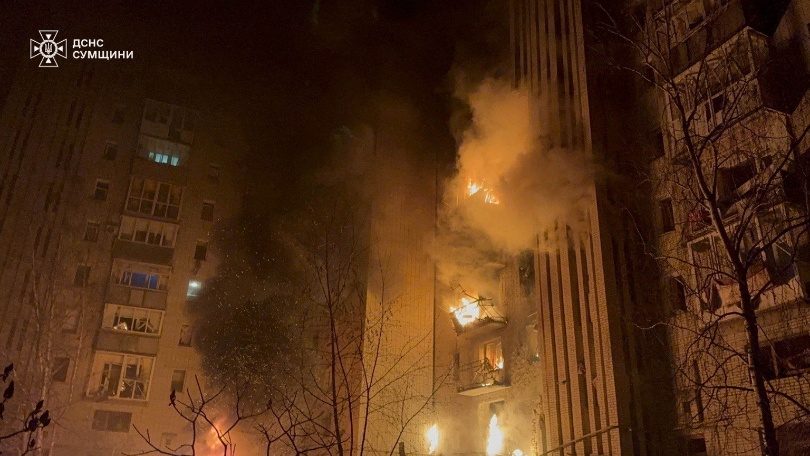
Morning after in Okhtyrka: A nine-story residential building gutted by Russian drones in Sumy Oblast. Seven injured, including five women. This is what 149 drones launched in a single night looks like when sixteen penetrate Ukraine’s air defenses—shattered glass, twisted metal, and families pulled from rubble at dawn. (Ukraine’s Emergency Service)
The Losses That Can’t Be Replaced
Lieutenant Colonel Yevhenii Ivanov died during a combat mission in the eastern sector. The Ukrainian Air Force announced the death of the senior navigator from the 39th Tactical Aviation Brigade but didn’t specify mission type or circumstances. Ivanov was flying an Su-27 fighter—a Soviet-era air superiority aircraft Ukraine had adapted for ground attack and reconnaissance escort.
The Air Force’s silence suggested operational security concerns. Ukrainian military aviation had suffered significant losses, with pilots conducting missions in contested airspace against Russian air defenses. Trained fast-jet pilots required years of development and represented irreplaceable expertise Ukraine could barely afford to lose.
A Russian military court in occupied Donetsk sentenced four Russian soldiers to prison in the murder of American pro-Kremlin propagandist Russell Bentley. Vitaly Vansyatsky, Vladislav Agaltsev, Vladimir Bazhin, and Andrei Iordan received sentences ranging from 1.5 to 12 years.
Vansyatsky, Agaltsev, and Iordanov attacked and tortured Bentley to death in April after wrongly assuming he was an American operative rather than a propagandist working for Russian state media outlet Sputnik. Vansyatsky and Agaltsev then blew up a car with Bentley’s body, while Bazhin helped hide the remains. All four pleaded guilty. Vansyatsky and Iordanov received 12 years, Agaltsev 11 years, Bazhin 1.5 years. The first three were stripped of military ranks.
Bentley, known as “Texas” or “Donbas Cowboy,” was a 64-year-old Texas native who arrived in Ukraine in 2014 to join Russian proxy forces. He received Russian citizenship and became an online voice championing Russia’s campaign.
The incident proved awkward for Moscow, which had promoted recruitment of sympathetic foreigners. Murdering a useful propagandist undermined recruitment efforts and demonstrated Russian military indiscipline even toward supporters who actively promoted Kremlin narratives.
Two deaths. One represented irreplaceable expertise Ukraine desperately needed. The other demonstrated the chaos consuming the force it had volunteered to join.
When Small Nations Lead
The Netherlands announced its outgoing government agreed to release an additional 700 million euros (almost $820 million) in support for Ukraine for next year. The move came in response to a parliament-backed request to allocate 2 billion euros in the 2026 budget. The initial 700 million comprised 500 million euros in unspent Defense Ministry funds and 200 million euros from the Foreign Ministry—money already appropriated, allowing reallocation without new budget battles.
The Dutch decision came after heated debate. Outgoing Prime Minister Dick Schoof had initially opposed the step, arguing other partners should step up. The Christian Democratic Appeal party derided Schoof as a “bookkeeper” for prioritizing fiscal conservatism over strategic necessity.
The contribution mattered beyond raw numbers. The Netherlands had provided approximately 1.1 percent of GDP in bilateral aid to Ukraine, significantly outpacing larger nations in proportional terms. The continued Dutch commitment signaled smaller European nations wouldn’t allow larger partners to hide behind budget constraints while expecting others to bear assistance burdens.
The European Union Council adopted the European Defense Industry Program (EDIP), clearing the way for program launch. The initiative allocated 1.5 billion euros for 2025-2027 to strengthen European defense industrial base, with 300 million euros specifically directed to modernizing Ukrainian defense industry and integrating it into EU defense manufacturing networks.
The EU Council stated EDIP was “the cornerstone of the EU’s renewed commitment to bolster its defense readiness.” The initiative arrived as Europe sought rebuilding defense production capacity after nearly four years supporting Ukraine, recognizing fragmented national defense industries couldn’t meet long-term security demands.
The 300 million euros for Ukraine represented acknowledgment that Ukrainian defense industry had become strategically important to continental security. Supporting Ukrainian defense industry wasn’t charity but investment in capabilities strengthening European defense architecture.
When Survival Requires More Than 51 Days
Commander-in-Chief Oleksandr Syrskyi announced Ukraine would strengthen its army through better mobilization, recruitment, and high-quality training. The announcement represented acknowledgment that current processes weren’t meeting standards needed for effective combat operations.
“The enemy continues its advance, so we have no choice but to strengthen our defense,” Syrskyi stated. Key changes included extending Basic General Military Training duration to 51 days, introducing specialized instruction, and creating adaptation periods within combat units.
Additional measures involved improving instructor selection, modernizing training center infrastructure, and providing psychological and tactical adaptation support to newly mobilized personnel. An audit identified top-performing facilities that would serve as benchmarks. To increase safety and ensure consistent training, the military was relocating programs away from front-line areas, assigning army corps to training grounds in central and western Ukraine.
Syrskyi called for urgent improvements to protective infrastructure, citing unsatisfactory conditions in some training centers. “We have no right to be careless with the safety of our servicemen.”
The reforms acknowledged reality that newly mobilized soldiers had been arriving at frontline units inadequately prepared. Previous training periods had been compressed due to personnel urgency, producing soldiers who couldn’t effectively operate equipment, coordinate with units, or survive contact with enemy forces. The extension to 51 days represented attempt to balance urgency with minimum competence requirements needed for survival.
The relocation away from front-line areas represented both practical necessity and admission of Russian capability to strike rear positions. Training centers near frontlines faced regular Russian artillery and missile strikes that killed trainees before they reached combat units. Moving training westward increased safety but complicated logistics and reduced experienced instructor availability.
Fifty-one days. Better than before. Whether it was enough to keep newly mobilized soldiers alive remained an open question that would be answered in blood.
What This Day Revealed
This day revealed a war operating on three simultaneous timelines. The military timeline showed Russian advances at catastrophic cost. The diplomatic timeline showed American pressure for territorial concessions while European partners attempted coordinating resistance. The financial timeline showed creative mechanisms that could provide hundreds of billions if political will held.
Which timeline would resolve first? Would Russian advances cumulate into Ukrainian collapse? Would American pressure force capitulation before European unity provided support? Or would financial innovation unlock resources allowing Ukraine to sustain resistance until Russia’s constraints forced genuine compromise?
The seven European leaders who signed support for the reparations loan were betting financial leverage could create negotiating space. The 210 billion euros in frozen Russian assets could sustain Ukrainian resistance for years. But the money meant nothing if Ukraine was pressured into concessions before funding materialized or if European unity fractured.
Putin’s remarks about demographics revealed Moscow’s timeline pressures. The Kremlin’s demographic crisis—declining birth rates compounded by wartime casualties—meant Russia was running out of Russians at a pace threatening long-term state viability.
Decisions made in coming weeks would shape European security architecture for decades. If Russia succeeded keeping conquered territory through military pressure and American diplomatic intercession, the precedent would encourage future aggression. If European unity and financial creativity sustained Ukrainian resistance until Russian realities forced genuine compromise, the outcome might establish that territorial conquest remained prohibitively expensive.
All three timelines accelerated toward intersection points none could precisely predict. The war’s outcome would be determined not by which side was stronger, but by which coalition maintained unity longer.
Multiple pathways remained available if courage and creativity could overcome fear and fatigue. But time was running out—Russia’s demographic and economic sustainability, Ukraine’s military endurance, European political unity, and American patience were all approaching limits forcing resolution.
Day 1,384. The future narrowed. And the decisions being made would echo across generations.