
In Pokrovsk, Russian and Ukrainian soldiers fight from adjacent buildings in chaotic three-dimensional warfare. In occupied Mariupol, construction crews rebuild a theater atop mass graves where 600 civilians died. In Volgograd, flames consume Russia’s third-largest refinery after Ukrainian drone strikes. The 1,352nd day of war—when front lines dissolve into interpenetrating chaos and occupation becomes permanent infrastructure.
THE DAY’S RECKONING
The commander’s assessment arrived without euphemism: Russian forces had infiltrated “practically all over Pokrovsk such that Russian and Ukrainian positions are interspersed house-to-house.” The word captured what maps couldn’t—opposing forces in adjacent buildings, front lines existing vertically and horizontally, basements and rooftops mattering as much as east and west.
In Volgograd, 450 kilometers inside Russia, flames consumed the oil refinery’s processing units. Ukrainian drones had struck before dawn, crippling 5.6 percent of Russia’s refining capacity in a single night. The facility wouldn’t restart quickly. The CDU-5 unit and hydrocracker—critical infrastructure—lay in ruins.
In occupied Mariupol, the Drama Theater reconstruction was “more than 80 percent complete.” December opening planned. Nobody mentioned the 600 civilians who died when Russian bombs fell in March 2022, or the word “CHILDREN” painted outside. The theater would open atop a mass grave and Russian media would call it progress.
In Kherson, artillery struck a civilian bus. A 14-year-old girl was among the wounded.
In Moscow, Crimean Tatars completed a multi-day journey to submit a petition. Russian police stopped them five times. Hours of detention. They had 6,500 signatures requesting release of four women arrested on “extremism” charges. The petition wouldn’t matter. The harassment was the point.
In a Zaporizhzhia courtroom, a judge sentenced Russian soldier Dmitry Kurashov to life imprisonment. He had ordered Ukrainian prisoner Vitalii Hodniuk to kneel, then opened fire with a Kalashnikov. Hodniuk had raised his hands. He had surrendered. The execution was one of 322 documented cases where Russian forces killed Ukrainian soldiers after they’d laid down their weapons.
In Dnipropetrovsk Oblast, power failed at eight coal mines. 2,595 miners were trapped underground in darkness, hundreds of meters below the surface. Russian strikes on energy infrastructure didn’t just damage facilities—they endangered thousands simultaneously.
In occupied Mariupol, a youth military training center neared completion: capacity for 300 children year-round. Tactical shelter. Drone training area. Shooting gallery. The Voin program had expanded tenfold in 2025, reaching 3,000 Ukrainian children. Russian veterans would teach them to shoot and operate drones. Some instructors were Ukrainian POWs—captured soldiers training occupied children for Russia’s military.
The day revealed war’s transformation beyond conventional combat. House-to-house infiltration where maps became obsolete. Railway closures. Billion-ruble investments in occupied infrastructure. Children militarized in camps staffed by captive enemy soldiers. Telecommunications restricted to force populations onto Kremlin platforms. Theaters rebuilt atop mass graves.
Not just combat. Transformation. The systematic conversion of occupied territory into permanent Russian space, of Ukrainian children into Russian soldiers, of war crimes into construction projects.
Day 1,352. The machinery ground forward.
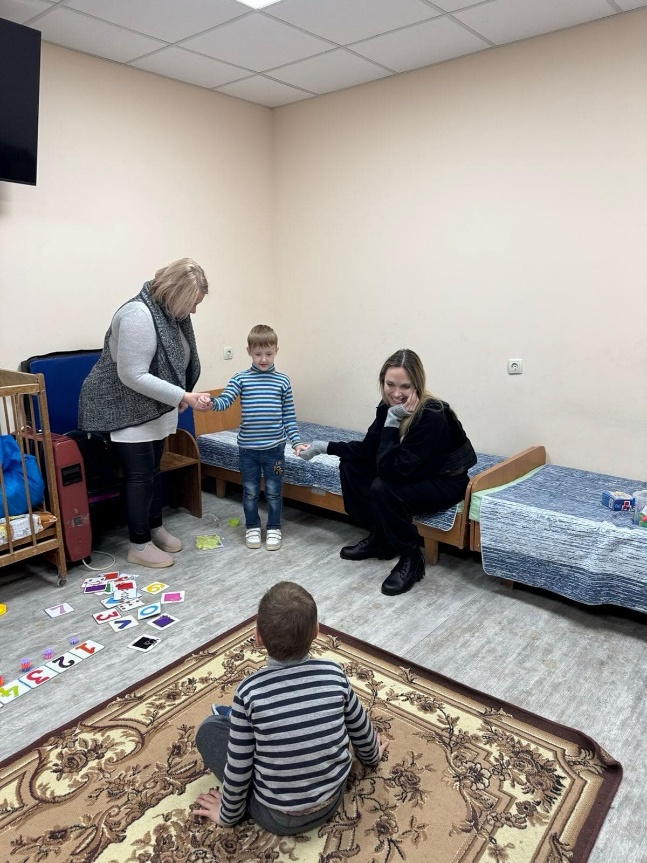
Hollywood underground: Angelina Jolie tours medical facilities relocated into reinforced bunkers in Kherson and Mykolaiv, where doctors operate beneath drone-netting streets and daily Russian strikes force life itself below ground. This is how southern Ukraine survives. (Legacy of War Foundation)
THE HOUSE-TO-HOUSE WAR
September: 13 Russian assaults per day. November 6: 30 in a single day. The Ukrainian 7th Rapid Reaction Corps tracked the acceleration as Russian forces exploited infiltration gains through sustained pressure.
The General Staff documented 276 combat engagements across the entire front. One hundred occurred in Pokrovsk—more than one-third of all fighting in Ukraine concentrated in this single devastated town.
Ukrainian drone operators watched Russian forces adapt to weather. Poor visibility meant drones couldn’t hunt effectively. Russian troops gathered in larger groups, mounted motorcycles and buggies, raced through rubble-strewn streets. When drones appeared, they dispersed. When weather closed in, they advanced—bringing provisions, pushing deeper into northern Pokrovsk, targeting Ukrainian rear positions where mortar crews and drone pilots operated.
The infiltration had succeeded so thoroughly that positions were now interspersed house-to-house. Not a traditional front line. Three-dimensional warfare where Russian troops might occupy ground floors while Ukrainians held upper floors, where adjacent buildings could be controlled by opposing forces, where “forward” and “rear” became meaningless.
Russian forces had rotated through three complete replacements after suffering catastrophic losses over four months. Moscow committed Spetsnaz and naval infantry—elite formations, not mobilized conscripts—to consolidate gains.
Russian milbloggers claimed advances to the T-0515 highway and seizure of part of the Pokrovska Mine complex. Ukrainian officials continued reporting Russian forces disguising themselves as civilians—perfidy prohibited under Geneva Conventions, a war crime so routine it barely registered.
The Institute for the Study of War introduced a new mapping category: “Assessed Russian Infiltration Areas.” Admission that conventional cartography couldn’t capture opposing forces occupying the same geographic space in different vertical dimensions.
Pokrovsk had become the place where traditional warfare died.

Alpha operators fight in Pokrovsk’s chaos, where Russian and Ukrainian positions interpenetrate house-to-house and front lines exist in three dimensions. Every building could hide enemy troops. Every corner could be contested. This is urban warfare without maps. (SBU / Facebook)
THE RAILWAY WAR
Ukrzaliznytsia announced the closures in bureaucratic language: multiple railway lines approaching the Donetsk fortress belt would “temporarily” shut down due to “security factors.” Translation: Russian strikes had made operating these railways suicidal.
The line from Husarivka to Slovyansk and Kramatorsk—45 and 29 kilometers from the front respectively. The line between Bantysheve and Kramatorsk. The line between Slovyansk and Raihorodok. Critical arteries that had sustained Ukrainian defenses for years were closing.
The announcement came hours after Russian drones struck a railway station in Kamyanske, Dnipropetrovsk Oblast—104 kilometers from the frontline. The station building was heavily damaged. Logistics flowing through the oblast disrupted.
This was battlefield air interdiction playing out across Ukrainian rear areas. A Ukrainian drone battalion commander operating near Velykomykhailivka had described the pattern recently: Russian forces struck bridges first to degrade logistics, then attacked when resupply became difficult. Destroy infrastructure, exploit the gaps.
The railway closures along the E-40 Izyum-Slovyansk highway and T-0514 Dobropillya-Lyman highway threatened supply lines to Ukraine’s fortress belt—the defensive positions in Donetsk Oblast that had anchored resistance for months. Russian military command might be setting conditions for future operations: seize Pokrovsk and Myrnohrad first, degrade logistics to the fortress cities simultaneously, then shift focus to the fortress belt when Ukrainian defenders couldn’t be adequately supplied.
The railways had been lifelines. Now they were targets Russia could hit with impunity, forcing Ukraine to choose between operating them under constant bombardment or closing them entirely and accepting the logistical consequences.
Ukraine chose to close them. The alternative was worse.
WHEN NATO SAYS IT OUT LOUD
NATO Secretary General Mark Rutte stated what careful observers had known for months: Russia was increasing cooperation with Iran, China, and North Korea to destabilize Europe and prepare for long-term confrontation. The significance wasn’t the information—it was that NATO’s highest official was saying it publicly.
Reading between the lines: the alliance was preparing European populations for a conflict that extended far beyond Ukraine’s borders, involved far more actors than just Moscow, and wouldn’t end with any near-term diplomatic settlement.
Drones had been appearing over Belgian airports and critical infrastructure with increasing frequency. Belgian Prime Minister Bart de Wever announced he would convene an emergency government security council meeting to address the incursions. The pattern suggested coordinated reconnaissance rather than isolated incidents—mapping critical infrastructure, testing response times, identifying gaps in air defenses.
Similar drone flights had occurred over multiple NATO members in recent weeks. Each incident could be dismissed individually as coincidence or malfunction. Collectively, they revealed systematic intelligence gathering across the alliance’s territory.
Russia wasn’t just fighting Ukraine. It was coordinating with authoritarian powers to probe NATO defenses, map vulnerabilities, and demonstrate that European airspace wasn’t as secure as governments claimed. The drones were messages as much as reconnaissance platforms: we can reach your critical infrastructure, we’re watching your response capabilities, and we’re doing it openly because the costs of escalation constrain your reactions.
Rutte’s statement acknowledged what the drone flights had already demonstrated. The question wasn’t whether Russia was coordinating with adversaries—it was what NATO would do about it.
STRIKING DEEP
The Reuters alert landed on trading floors at dawn. Volgograd Oil Refinery—halted. Three sources familiar with the matter confirmed Ukrainian strikes had damaged the CDU-5 primary processing unit and a hydrocracker. Critical infrastructure that couldn’t be quickly repaired.
The facility processed 15.7 million tons annually—5.6 percent of Russia’s total refining capacity. Operated by Lukoil. Located 450 kilometers from the front line. And now burning.
“Explosions and fire were recorded in the area of the target,” the Ukrainian General Staff reported. Volgograd Oblast Governor Andrey Bocharov confirmed one civilian dead—a 48-year-old man killed by shrapnel. The refinery supplied fuel to Russian military forces. Past tense.
Ukrainian drones also struck the Kostroma State District Thermal Power Plant in Volgorechensk—Russia’s third-largest thermal facility. Kostroma Oblast Governor Sergei Sitnikov claimed Russian forces had repelled the strikes. Geolocated footage showed fires burning. The governor was lying.
In occupied Crimea, Ukrainian forces hit an oil depot in Hvardiiske, damaging a storage tank and fuel cistern. Two oil depots in Simferopol sustained damage to storage tanks.
But the most significant strike occurred at occupied Donetsk Airport. Ukrainian forces conducted a combined drone and missile attack against a Russian logistics hub where Shahed-type drones were stored, equipped, and launched. A Russian milblogger stated that up to 1,000 Shahed drones and over 1,500 warheads were at the facility when Ukrainian strikes hit.
Ammunition warehouses destroyed. Fuel warehouses destroyed. Pre-launch preparation point destroyed. Electronic and communication nodes destroyed. Unmanned Systems Forces Commander Major Robert “Magyar” Brovdi called it the result of “painstaking months-long reconnaissance operation.”
One thousand drones. Gone in minutes. Months of Russian logistics effort erased by Ukrainian targeting.
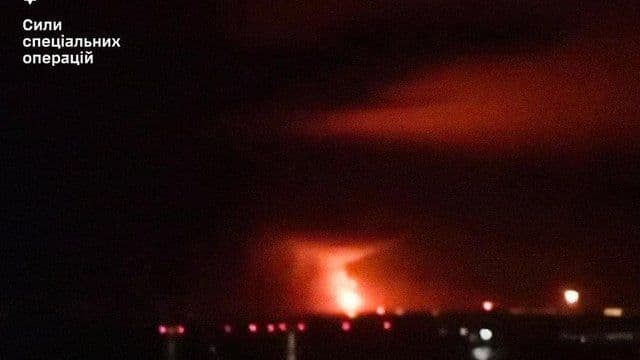
Flames consume Russia’s Volgograd refinery at dawn—450 kilometers from Ukraine’s border. Ukrainian drones struck the CDU-5 processing unit and hydrocracker, halting 5.6 percent of Russia’s refining capacity. The war reaches deeper into Russian territory with each passing month. (SSO/Facebook)
ONE CONVICTION, 322 EXECUTIONS
The Zaporizhzhia courtroom was packed when the judge sentenced Dmitry Kurashov to life imprisonment. First time in Ukrainian history a Russian soldier received such a sentence specifically for executing a prisoner of war on the battlefield.
January 6, 2024. Near Pryiutne village. Vitalii Hodniuk ran out of ammunition. He dropped his weapon, raised his hands, signaled surrender. Kurashov—a 27-year-old convicted thief who had joined a “Storm V” assault unit in exchange for early prison release—ordered him to kneel.
Then opened fire with a Kalashnikov rifle.
Ukrainian forces later recaptured the position and captured Kurashov along with four other Russian soldiers—the only survivors of the assault. Kurashov pleaded guilty during trial. Then he told journalists he was innocent and hoped to be released in a prisoner exchange.
The Security Service of Ukraine called the verdict historic. The Prosecutor General’s Office was investigating 322 similar cases—Ukrainian servicemen believed killed after surrendering to Russian forces. Most executions—263—occurred on battlefields just like Pryiutne.
One conviction. 322 documented executions. Over 2,500 Ukrainian soldiers remained imprisoned in Russia as of September, their fates often unknown, their treatment often brutal.
The math was stark. Kurashov received life imprisonment for one execution. Russian forces had committed at least 321 others documented by Ukrainian prosecutors. The precedent mattered. But precedent required enforcement, and enforcement required capturing the executioners alive—rare in a war where neither side took many prisoners in frontline combat.
Hodniuk had raised his hands. He had surrendered. The Geneva Conventions were supposed to protect him. They didn’t.
THE DAILY TOLL
Russian forces launched 135 Shahed-type, Gerbera-type, and other drones overnight from multiple directions. Ukrainian air defenses downed 108. Twenty-seven struck their targets across 13 locations—damaging civilian infrastructure, railways, and energy facilities in Sumy, Chernihiv, Kharkiv, Donetsk, Dnipropetrovsk, and Zaporizhia oblasts.
The most dramatic consequence: power failed at eight coal mines in Dnipropetrovsk Oblast. 2,595 miners trapped underground. Hundreds of meters below the surface. In darkness.
The number captured how Russian strikes on energy infrastructure endangered civilians far from combat zones. Destroy the power grid, trap thousands of workers underground simultaneously. The war’s reach extended everywhere—even into the earth.
Russian drones struck a civilian vehicle in Seredino-Budska Hromada, Sumy Oblast. Four passengers injured. A first-person view drone hit a car in Kostyantynivka, injuring one civilian. Russian forces conducted a drone strike against a bus in Dniprovskyi Raion, Kherson City. Three civilians injured including a 14-year-old girl.
Buses. Cars. Civilian vehicles on civilian roads. Drones hunting ordinary people going about their lives.
The Security Service of Ukraine reported October strikes against Russian military infrastructure in occupied Donetsk and Luhansk oblasts. A fuel depot in Starobilsk destroyed. An ammunition depot in Voevodivka destroyed. Command posts and equipment repair bases in Troitskyi Raion struck. Automated rail control equipment in Shchastynskyi Raion damaged. Russian drone control points in the Lysychansk-Bakhmut direction hit.
Two tallies running simultaneously. Russian drones hunting civilians. Ukrainian strikes targeting military infrastructure. The asymmetry was deliberate.
BUREAUCRATIC KIDNAPPING
The Kremlin’s announcement used administrative language: occupied parts of Donetsk, Luhansk, Zaporizhzhia, and Kherson regions were now officially incorporated into Russia’s Southern Military District. Translation: Moscow had created legal framework for systematizing forced conscription of Ukrainian men into Russian military service.
The Center for Countering Disinformation identified what the bureaucratic language concealed—basis for dramatically expanded mobilization in occupied territories. What had been ad hoc kidnapping would become bureaucratic process. What had been war crime would receive administrative cover.
Intelligence services estimated Russia had already mobilized approximately 300,000 men from occupied populations between 2022 and summer 2024. Forced conscription of residents from occupied territory constituted war crime under international law. Russia had demonstrated systematic disregard for such constraints.
The incorporation into Southern Military District provided infrastructure for scaling up what Russia had already proven willing to do. It transformed illegal abduction into official policy, gave military structure to what had been improvised violence, and set conditions for massive expansion of violations already documented.
The announcement didn’t create new violations. It industrialized existing ones.
Ukrainian men in occupied territories now faced formalized Russian military conscription backed by administrative machinery of a military district. Registration requirements. Draft notices. Official summons. The entire apparatus of state-organized mobilization that Russian citizens faced—now extended to occupied Ukrainian populations under legal fiction that these territories were Russian.
Moscow wasn’t hiding what it was doing. It was making it official.
TRAINING THE NEXT GENERATION
The Voin military training center under construction in occupied Mariupol would accommodate 300 children year-round after completion in 2026. Director Alexander Kamyshov detailed the specifications to Kremlin newswire TASS: tactical shelter, drone training area, indoor gym, shooting gallery, sports training facilities, helicopter training tower, onsite residences, dining hall.
A complete military training campus for Ukrainian children.
Kamyshov reported that Voin’s occupied Donetsk Oblast branch had increased its audience tenfold in 2025—reaching 3,000 participants. The expansion revealed the scale of Russian efforts to militarize Ukrainian youth. Three branches already operated in occupied Ukraine beyond the Mariupol facility: Henichesk, Berdyansk, and Luhansk City.
The curriculum was explicitly military. Small arms fire. Tactical first aid. Drone operation. Russian veterans and active military personnel served as instructors—teaching occupied Ukrainian children the skills necessary for future service in Russia’s armed forces.
This wasn’t youth summer camp with patriotic themes. It was systematic preparation of Ukrainian children for military service against their own country. The infrastructure investment—permanent facilities with residential capacity, specialized training equipment, military-grade shooting ranges—demonstrated long-term planning for occupation measured in generations rather than years.
Russia was building the institutions necessary to transform Ukrainian children into Russian soldiers. The Mariupol center’s 2026 completion date showed Moscow’s timeline. The tenfold expansion to 3,000 participants showed Moscow’s ambition.
Ukrainian children learning to operate drones, fire weapons, and provide battlefield first aid under instruction from the military occupying their homeland. The program’s name—Voin, “Warrior”—captured its purpose without euphemism.
PRISONERS AS INSTRUCTORS
The Donetsk News Agency correspondent visited the Rubikon training ground and observed a five-day youth course on firearm use, tactical medicine, and drone operation. Russian veterans from the Pyatnashka International Volunteer Brigade served as instructors alongside members of the Maksim Krivonos Battalion—many allegedly former Ukrainian soldiers.
The Mariupol Specialized Construction College had sent students to train alongside these instructors. Ukrainian outlet Suspilne published investigation in August finding that the Maksim Krivonos Battalion was predominantly staffed by Ukrainian prisoners of war captured between 2023-2024.
Ukrainian POWs training Ukrainian children in military skills for Russia’s armed forces.
The use of POWs to serve in the military of the aggressor state constituted war crime. Determining which servicemembers participated voluntarily was nearly impossible given the inherently coercive nature of captivity. A prisoner saying “yes” under Russian detention wasn’t consent—it was survival calculation made under duress.
Russia was likely using the Maksim Krivonos Battalion partly for propaganda—many prominent battalion members publicly advocated anti-Ukrainian and pro-Russian views. But the battalion also provided tangible military training. Former Ukrainian soldiers knew Ukrainian tactics, Ukrainian equipment, Ukrainian doctrine. They could train children in skills directly relevant to fighting against Ukraine.
The Rubikon training ground represented war crime layered atop war crime. Forcing POWs into military service: violation of Geneva Conventions. Using those POWs to train children from occupied territories: violation of laws protecting children in conflict zones. Preparing those children for future military service: violation of prohibitions against forcible transfer and assimilation.
Russia had found a use for captured Ukrainian soldiers: make them complicit in militarizing the next generation.
FIVE STOPS, FIVE HARASSMENTS
Sixteen Crimean Tatars traveled to Moscow by minibus after a multi-day journey to submit a petition with 6,500 signatures. The petition requested release of four Crimean Tatar women arrested October 15 by Federal Security Service near Sevastopol on unfounded “extremism” allegations.
Russian law enforcement stopped the delegation five times while en route to Moscow. Each stop: hours of detention. Russian police and Ministry of Internal Affairs harassed delegation members repeatedly. The pattern was systematic—not security checks but intimidation through bureaucratic abuse.
The treatment was consistent with Russian state policy of repressive brutality toward the Crimean Tatar community. It demonstrated restrictions on freedom of movement within both occupied Crimea and Russia proper. Crimean Tatars couldn’t even travel to Moscow to petition for prisoners’ release without facing state harassment at every checkpoint.
The petition had 6,500 signatures. The four women were arrested on charges of “extremism” without evidence. The delegation traveled days to reach Moscow. Russian authorities stopped them five times, detained them for hours, and sent clear message: even peaceful petition was criminal activity under occupation.
The delegation eventually reached Moscow. They submitted their petition. It wouldn’t matter. The four women would remain imprisoned. But the harassment along the route had already achieved its purpose—demonstrating that Crimean Tatars lived under surveillance state where even legal advocacy became grounds for detention.
The petition was right of citizens in any democracy. The five stops made clear that occupied Crimea wasn’t a democracy, and Crimean Tatars weren’t citizens—they were subjects.
PROFITING FROM OCCUPATION
Russian state-owned bank Promsvyazbank announced a 1.1-billion-ruble ($13.5 million) investment loan for modernization of the Bilorichenska coal mine in occupied Luhansk Oblast. The bank noted the mine was a leading coal producer supplying 40 percent of thermal coal for occupied Luhansk Oblast. The loan would be provided at preferential rate unique to investment in occupied areas.
Translation: Russian state bank would profit directly from occupation of Ukrainian territory.
Russian Prime Minister Mikhail Mishustin announced that the Russian government would allocate 1 billion rubles ($12 million) in preferential loans to residents of the free economic zone in occupied Crimea to “increase the attractiveness” of Crimea to investors.
Translation: Russia was offering financial incentives to make occupied Ukrainian territory profitable for Russian businesses.
Russia was investing heavily in industrial, economic, and financial assets in occupied Ukraine to generate tangible profit from occupation. The Bilorichenska mine loan wasn’t humanitarian aid or reconstruction assistance—it was business investment designed to produce returns. Russian officials, state-owned enterprises, and government entities all stood to benefit from this extractive investment strategy.
The preferential loan rates made the calculation explicit. Invest in occupied territories at favorable terms, extract resources or profits, normalize occupation through economic integration. The coal mine would produce thermal energy. The free economic zone would attract investors. The loans would be repaid with interest. And every transaction would further embed Russian economic interests in Ukrainian territory seized through violence.
Occupation wasn’t just military control. It was asset acquisition, profit generation, and economic colonization under legal cover of “investment.”
REHEARSAL FOR DIGITAL PRISON
Volna Mobile, the Russian telecommunications operator in occupied Crimea, announced it was restricting access to Telegram and WhatsApp messengers “in accordance with Roskomnadzor measures.” Users experienced connectivity issues. Then the operator backtracked—claiming the press release referred to “possible restrictions” that Roskomnadzor had announced in October, that Telegram experienced “temporary outage,” that nothing was actually blocked.
Roskomnadzor denied restricting access to Telegram and WhatsApp in occupied Crimea. Ukrainian outlet Suspilne reported the incident could have been a “rehearsal” for future restrictions.
The rehearsal interpretation made sense. Russian opposition outlet Meduza reported that Russian communications service providers would stop transmitting SMS and calls with authorization codes for registering new WhatsApp and Telegram users—making registration more difficult without technically blocking the apps. Volna Mobile’s press service recommended that residents download the Kremlin-controlled MAX messenger.
Russian authorities continued promoting MAX messenger. They had designed it for centralized user tracking. Russian intelligence services had access to user data. The restriction campaign was intended to force residents of occupied areas to switch to MAX, granting Russian authorities even greater control over the information space.
The pattern was clear: make Western messaging apps difficult to use, recommend Kremlin-controlled alternative, create infrastructure for comprehensive surveillance. Every message on MAX could be monitored. Every user could be tracked. The digital surveillance state was being constructed one app recommendation at a time.
Volna Mobile’s confused messaging—restriction announced, then denied, then explained as rehearsal—suggested the process was still being refined. But the direction was unmistakable.
ERASING THE EVIDENCE
Vasily Novokhatko, project manager of St. Petersburg-based Modul-Center construction company, reported to TASS that repair and restoration work at the Mariupol Drama Theater was “more than 80 percent complete.” The Mariupol occupation administration planned to open the theater as early as December.
March 16, 2022: Russian forces dropped two heavy bombs on the building as civilians including children sheltered inside. Those sheltering had clearly written the word “CHILDREN” in Russian outside the theater—attempt to safeguard themselves from attack. The strike may have killed up to 600 people. Amnesty International and other human rights organizations classified Russia’s attack as clear war crime.
Russian reporting on reconstruction completely ignored these facts. The narrative presented Mariupol as somehow better off under Russian occupation. Two newly renovated hotels added to the image. Construction projects multiplied across the city. The theater would reopen with fanfare. And nobody would mention the mass grave beneath the foundation.
This was how Russia covered up crimes—not through denial but through reconstruction. Build atop the evidence. Create new structures where old horrors occurred. Present the physical transformation as proof of progress. The theater’s December opening would become propaganda: look how we’ve improved Mariupol, look at the beautiful theater we built.
The word “CHILDREN” had been painted in letters large enough to be visible from aircraft. Russian forces bombed the building anyway. Now Russian construction crews were finishing renovation work. The contrast captured occupation’s essence—crimes committed, evidence buried, infrastructure rebuilt, progress declared.
Six hundred civilians dead. Theater 80 percent reconstructed. Moscow would call it improvement.
THE GEOMETRY OF GRINDING
In northern Kharkiv Oblast, Russian forces advanced marginally in southern Vovchansk. Ukraine’s Kharkiv Operational-Tactical Group reported they had quickly struck Russian troops who filmed a flag raising in the same area. The flag went up. The troops died. Russian milbloggers claimed seizure of Synelnykove.
South of Siversk, Russian forces advanced along the Donetska Railway. Russian milbloggers claimed progress east of and within Zvanivka. In eastern Ivanopillya and southern Kostyantynivka, geolocated footage showed Russian infiltration missions—Ukrainian forces subsequently struck them.
Joint Forces Task Force Spokesperson Colonel Viktor Trehubov reported that Russian forces continued attacking within Kupyansk where neither side could maintain reliable logistics in urban terrain. Russian forces were employing the same tactics as in Pokrovsk—occupying buildings that offered protection from drones to accumulate manpower for subsequent attacks.
A Ukrainian brigade operating in the Lyman direction reported Russian forces were conducting Molniya, Kub, and Lancet loitering munition strikes while attacking on motorcycles and electric scooters. Russian drone operators were well-trained. Russian forces evacuated pilots to other locations when they came under Ukrainian strikes to reduce pilot casualties.
In the Hulyaipole direction, Russian forces intensified glide bomb, artillery, multi-launch rocket system, and drone strikes. Ukraine’s Southern Operational Command reported areas near Pavlivka and Plavni were contested “gray zones.”
Across eight sectors, the pattern repeated. Russian forces advanced meters through rubble. Ukrainian forces struck infiltrators. Neither side held decisive advantage. The front line shifted in increments measured by buildings rather than kilometers.
This was war as attrition—methodical, grinding, measured in casualties per meter gained.
BULGARIA SEIZES LUKOIL
Bulgarian media outlet Capital reported that Bulgaria was preparing legislative amendments allowing authorities to seize the Lukoil-owned oil refinery in Burgas and sell it to a new owner. The move aimed to protect Bulgaria’s only refinery from impact of U.S. sanctions imposed on Russia’s Rosneft and Lukoil on October 22.
Under proposed legislation, an external administrator would oversee the refinery’s sale. Lukoil would lose voting rights and ability to contest the decision. The Burgas facility supplied more than two-thirds of Bulgaria’s domestic fuel. Sofia couldn’t afford to let sanctions shut it down.
Bulgaria had already temporarily suspended diesel and aviation fuel exports on October 31 to prevent future shortages. The country had fully stopped importing Russian crude oil in March 2024. Now it was preparing to take the final step—seizing the refinery itself from Russian ownership.
The sequence revealed how U.S. sanctions on Russian energy companies forced European states to choose between economic disruption and property seizure. Bulgaria chose seizure. The refinery was too critical to Bulgaria’s fuel supply to leave under sanctioned Russian ownership.
Lukoil would lose the asset. Bulgaria would maintain fuel supplies. And the refinery would change hands not through negotiation but through legislative compulsion backed by sanctions enforcement.
European states were finding ways to escape Russian economic entanglement—even when it required seizing assets on their territory.
LURED AND TRAPPED
South African President Cyril Ramaphosa ordered an investigation into how 17 South African men ended up trapped in the Donbas region. The men—aged 20 to 39, sixteen from KwaZulu-Natal and one from the Eastern Cape—had been “lured into joining mercenary forces engaged in the Russia-Ukraine war under the pretext of lucrative employment contracts,” the presidency stated.
Distress calls from the trapped men triggered the investigation. They thought they were accepting employment offers. They found themselves in a war zone instead.
South Africa’s 1998 Foreign Military Assistance Act prohibited citizens from offering military assistance to foreign governments unless authorized. The statement didn’t specify which side the men were fighting for—though Moscow had been actively recruiting foreign fighters from multiple countries since 2022, often using promises of employment or Russian citizenship as bait.
The pattern was familiar across multiple countries. Recruitment agents offered lucrative contracts for security work, construction jobs, or other non-combat roles. Men accepted, traveled to Russia, then found themselves conscripted into military service with no way out. Some ended up on frontlines. Some ended up dead. Some ended up making distress calls home from the Donbas.
Seventeen South African men. Promised employment. Trapped in combat. The investigation would determine how they were recruited. It wouldn’t bring them home quickly. Russia didn’t easily release foreign fighters who’d learned how its recruitment deception operated.
NEPOTISM UNSEEN SINCE THE TSARS
Russian investigative journalism project Proyekt reported that at least 24 relatives of Vladimir Putin had received jobs linked to government—a record for nepotism since the Romanov imperial dynasty a century ago.
The third generation of Putin’s family had now joined government ranks. Putin himself. The second generation. Now his grandnephews. Three generations of Putins embedded in Russian state apparatus.
The 24 relatives with state-linked jobs included family members of Putin’s former wife Lyudmila Putina and his three alleged lovers—Alina Kabayeva, Svetlana Krivonogikh, and Alisa Kharcheva. The positions ranged from minister and deputy minister to roles at state gas giant Gazprom, state hydropower monopoly Rusgidro, state propaganda outlet Dialog, state-controlled Sberbank, and state-owned Russian Railways.
This wasn’t subtle patronage. It was systematic placement of Putin’s extended family across critical Russian state institutions and state-owned enterprises. Energy. Banking. Transportation. Media. Government ministries. Every major sector of Russian state control had Putin relatives in positions of authority or profit.
The Romanov comparison was deliberate. Imperial Russia had been notorious for nepotistic appointments that placed family members in positions regardless of competence. Putin had exceeded even tsarist-era nepotism—24 documented relatives in government-linked positions.
The investigation revealed how thoroughly Putin had converted Russian state apparatus into family enterprise. Not just concentration of power in one man, but distribution of state positions and profit streams across an extended family network spanning three generations.
THE PARTNER’S EXPANDING EMPIRE
Ukrainian media outlet Ukrainska Pravda published investigation revealing that President Volodymyr Zelensky’s former business partner Timur Mindich had dramatically increased his clout in recent years. Mindich, co-owner of Zelensky’s Kvartal 95 production company, had allegedly expanded influence across multiple industries.
Law enforcement sources said investigation into Mindich was allegedly one factor that led to attempts to eliminate the National Anti-Corruption Bureau’s independence in July. Zelensky had celebrated his birthday in Mindich’s apartment in 2021. The former partner’s influence allegedly peaked in 2024-2025—wartime.
Mindich was investigated due to alleged connections to drone producer Firepoint, sources told the Kyiv Independent. After information on alleged links was published in August, a stake in Firepoint was sold to a Saudi company in effort to avoid allegations that Mindich was the real owner.
According to Ukrainska Pravda, Mindich also allegedly influenced the banking industry through nationalized Sense Bank. Another industry where Mindich allegedly had interests was energy. In June, NABU arrested his relative Leonid Mindich when he was trying to flee abroad, charging him with embezzling $16 million from Kharkivoblenergo.
Opposition lawmaker Yaroslav Zheleznyak claimed in April that NABU was investigating Mindich in a case into a Hr 2 billion ($48 million) embezzlement scheme at Odesa Portside Plant. In October, Zheleznyak published investigation about Mindich’s alleged diamond business, reporting that Mindich controlled Ukrainian diamond producer Alcor-D and owned stake in Russian diamond producer New Diamond Technology until 2024—well into Russia’s full-scale invasion.
The Security Service of Ukraine confirmed it was investigating Mindich on suspicion of aiding the aggressor state.
Drones. Banking. Energy. Diamonds. Russian business connections during wartime. The investigation revealed corruption persisting despite crisis.
FIVE OF ELEVEN
Deputy Prime Minister Taras Kachka stated that Ukraine had submitted a draft education law to Hungary that partly addressed Budapest’s demands related to language policy in schools. Hungary had previously formulated an 11-point request regarding rights of national minorities.
The draft considered 5 out of 11 Hungarian requests related to Hungarian minorities in Ukraine. If Budapest approved the current version, Kyiv was ready to bring the bill to parliament.
Kachka noted that in roughly two-thirds of 100 Hungarian schools in Ukraine, primary language of instruction was Hungarian with some subjects taught in Ukrainian. The statement clarified existing language distribution while negotiations continued on the remaining six demands.
Hungary had been blocking various forms of EU assistance to Ukraine while pressing education demands. The partial compliance represented Ukrainian willingness to accommodate minority language rights while maintaining Ukrainian language requirements. Five concessions granted. Six still contested.
The math captured wartime diplomacy’s frustrations—fighting Russia while negotiating with Hungary over school curriculum, making concessions to an EU member state that had repeatedly sided with Moscow on sanctions and aid.
Ukraine submitted the draft. Hungary would review it. And Kyiv would wait to see if partial compliance was sufficient to unlock Hungarian cooperation—or if Budapest would hold out for all eleven demands while Ukrainian soldiers fought in Pokrovsk.
HOLLYWOOD UNDERGROUND
The Legacy of War Foundation confirmed that American actress Angelina Jolie had visited medical staff, families, and volunteers in Kherson and Mykolaiv. During her visit, Jolie was shown how medical and educational institutions in southern front-line regions had been moved into reinforced underground spaces to continue operations despite daily Russian attacks.
Life in southern Ukraine had literally gone underground. Hospitals operated in bunkers. Schools taught in basements. Medical staff treated patients hundreds of meters below ground because Russian strikes made surface facilities death traps.
Jolie was shown netting placed above roads throughout the city to protect locals from Russian drone attacks. Anti-drone netting stretched across streets—urban camouflage attempting to shield civilians from aerial hunters. “The people of Mykolaiv and Kherson live with danger every day, but they refuse to give in,” Jolie said. “At a time when governments around the world are turning their backs on the protection of civilians, their strength and their support for each other is humbling.”
Local outlet MykVisti confirmed that Jolie had visited the regional military recruitment office in Mykolaiv. A man traveling with Jolie, being a reserve officer, lacked valid medical commission certificate and was redirected to resolve the issue.
The detail captured Ukraine’s wartime reality—even Hollywood visits involved conscription bureaucracy. Jolie toured underground hospitals and drone-netted streets. Her companion got caught in mobilization processing. Both were true.
SCRAPING THE BOTTOM OF STORAGE
A social media source tracking Russian military depots via satellite imagery assessed that Russia’s 103rd Armor Repair Plant near Chita would maintain annual refurbishment rate of 300 to 500 T-62 tanks by end of 2025 after experiencing activity spike this year.
Russia had pre-war total of 1,822 T-62 tanks in storage. It had pulled 1,000 for refurbishment or modernization in 2025—leaving no tanks in “decent” condition in storage. Translation: Russia was scraping the bottom of its Soviet inheritance. The vehicles remaining in storage bases were no longer in good enough condition to send to front without significant repair work.
The T-62 first entered service in 1961. These were Vietnam-era tanks being refurbished for use against modern anti-tank weapons. Russian forces had recently exploited worsening weather conditions to resume limited mechanized assaults—using the old tanks mainly to transport infantry or provide localized firepower in ways that didn’t require more modern vehicles.
The refurbishment rate told two stories simultaneously. First: Russia could still pull hundreds of tanks annually from storage and make them combat-capable. Second: Russia had exhausted its ready reserve and was now working through vehicles that required extensive repair before deployment.
Three hundred to five hundred tanks per year. Enough to sustain operations. Not enough to suggest infinite reserves. The Soviet stockpile was large but finite, and Russia was burning through it faster than anyone had expected.
WHAT NOVEMBER 6 REVEALED
Two wars operated simultaneously. In Pokrovsk, Russian and Ukrainian forces fought from adjacent buildings in three-dimensional chaos that defied mapping. In occupied Mariupol, Russian construction crews neared completion on a theater built atop 600 graves and a youth military training center designed to transform 300 Ukrainian children annually into Russian soldiers.
The contrast revealed war’s true nature. Combat generated headlines—house-to-house fighting, railway closures, refinery strikes, life sentences for war crimes. But occupation generated infrastructure. Children trained by captive Ukrainian soldiers. Billion-ruble loans for coal mines. Telecommunications restrictions forcing populations onto surveillance platforms. Theaters reconstructed to erase evidence.
November 6 demonstrated how Russia was converting temporary occupation into permanent control. Not through military victory but through systematic transformation—Ukrainian territory into Russian economic assets, Ukrainian children into Russian military trainees, Ukrainian infrastructure into Russian profit centers, war crimes into construction projects.
The day’s arithmetic was stark. One conviction for executing a prisoner. Three hundred twenty-two documented executions. Thirty Russian assaults in Pokrovsk versus thirteen in September. One thousand Shahed drones destroyed at Donetsk Airport versus 135 launched overnight. Twenty-four Putin relatives in government positions. Five of eleven Hungarian demands accepted. 2,595 miners trapped underground by power failures.
The questions going forward: Could Ukraine close railways to fortress cities and still defend them? Could Russian refurbishment of Vietnam-era tanks sustain offensives indefinitely? Could NATO counter coordination between Russia, Iran, China, and North Korea with statements alone? Could corruption investigations proceed during existential war?
Most critically: Could Ukraine prevent occupation from becoming permanent before maps no longer showed contested territories—only infrastructure, investment, and children learning to operate drones in training centers named “Warrior”?
Day 1,352. The machinery ground forward. And nobody knew when—or whether—it would stop.