
As Russia fabricated an assassination plot to derail peace talks, Ukrainian intelligence flipped the lie into profit—exposing Moscow’s deception, funding new drones, and revealing which side was actually losing control on the first day of 2026.
The Day’s Reckoning
Denis Kapustin walked into Ukrainian military intelligence headquarters alive—a man Russia had already buried, mourned, and paid to have killed. Kyrylo Budanov greeted him without ceremony. The deception had worked. Moscow’s money was gone. Its operatives were exposed. An assassination attempt had become Ukrainian drone funding.
While fireworks rose over Russian cities, the Ilsky oil refinery in Krasnodar Krai burned again. Ukrainian loitering munitions struck during the turn of the year, a reminder that distance and holidays no longer protected Russia’s rear. The same facility had burned before. It burned again as glasses clinked.
In Kyiv, snow fell—New Year’s snow, the first in years. President Volodymyr Zelensky stood beneath it and chose his words carefully. Peace, he said, was “90 percent ready.” The final ten percent, he warned, contained everything that mattered.
At the same moment, U.S. intelligence was dismantling a Russian fabrication. Moscow claimed Ukraine had launched 91 drones at Putin’s residence. Zelensky denied it immediately. The CIA confirmed he was right. There had been no assassination attempt. The crisis was invented—and exposed just as Washington and Kyiv were aligning their diplomatic track.
Germany’s support was taking physical form. Two additional Patriot systems were moving into position, expanding the shield over cities and infrastructure and forcing Russian planners to recalculate how many weapons it would take to break through.
They tried anyway. Two hundred five Russian drones flew toward New Year celebrations across Ukraine. Air defenses stopped most of them. Some still got through.
This was the first day of 2026. Deception turned into advantage. Lies collapsed under intelligence scrutiny. Defenses thickened. Peace hovered close—unfinished.
Day 1,407. The war did not pause. But the balance of what was working became harder to ignore.
He Was Already Buried — Then He Walked In Alive
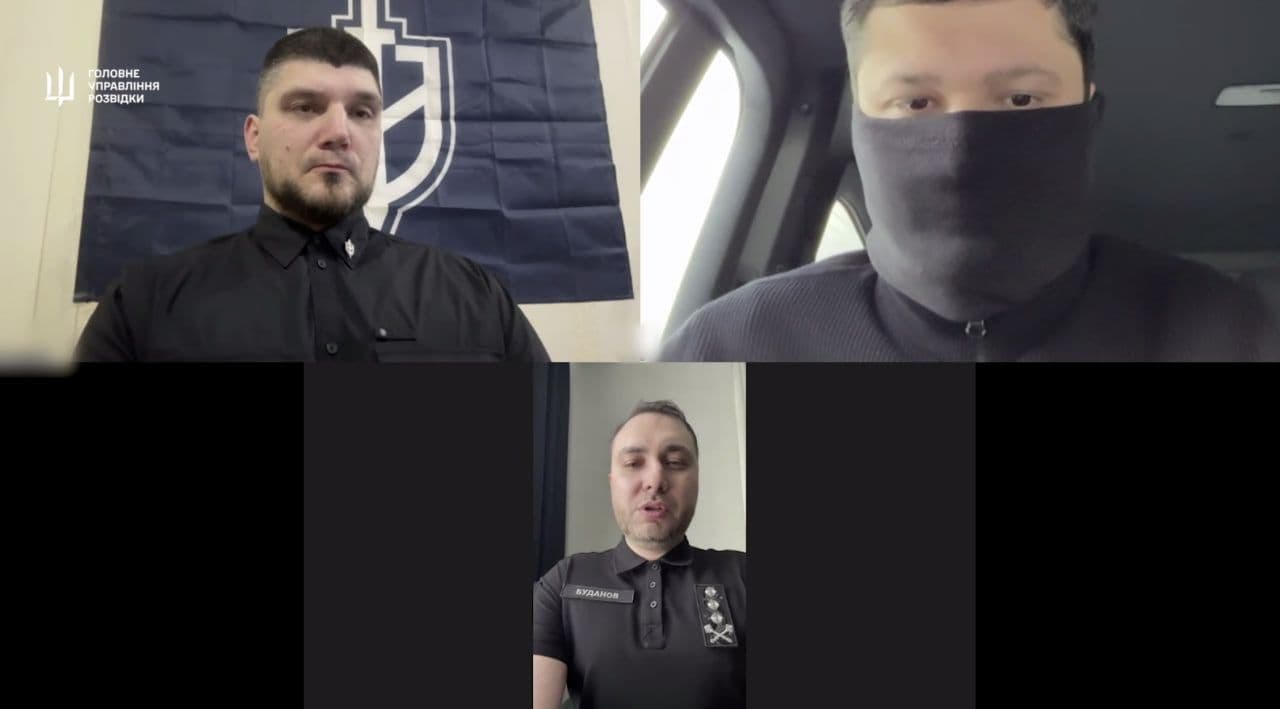
Proof of a lie undone: Separate images show RDK commander Denis Kapustin—whom Russia claimed was dead—and HUR chief Kyrylo Budanov on January 1, a visual confirmation that a Russian assassination narrative had collapsed into an intelligence failure. (HUR / Telegram)
Denis Kapustin did not haunt Russian intelligence with a video message or a leaked photo. He walked through the door.
One moment, Moscow’s operatives believed their work was finished. The target was dead. The announcement had gone out. The mourning had begun. Half a million dollars had been spent to erase one of Putin’s “personal enemies.”
Then Kapustin appeared in a briefing room with Kyrylo Budanov, very much alive.
The December 27 report of his death in Zaporizhzhia Oblast had been theater—sustained, disciplined, and convincing enough to deceive Russian special services for more than a month. While Moscow celebrated a successful liquidation, Ukrainian military intelligence was watching its adversary relax, talk, reveal networks, and spend money.
A lot of money.
Russian intelligence had allocated $500,000 for Kapustin’s assassination. The kind of bounty reserved for threats Moscow genuinely fears. That cash did not vanish into the shadows. It changed hands. It became Ukrainian funding. Drones would fly on it.
“Our side obtained the corresponding funds allocated for this crime,” the commander of HUR’s elite Tymur Special Operations Detachment reported.
Translation: Russia paid for weapons that would strike Russia.
But the real damage went deeper than the money. HUR mapped the operation from the inside—who ordered it, who facilitated it, who believed they had succeeded. The penetration was complete. Moscow’s intelligence services weren’t merely fooled. They were exposed.
Kapustin’s resurrection followed a grim Ukrainian tradition. In 2018, journalist Arkady Babchenko had reappeared alive after staging his death to uncover a real Russian assassination plot. The logic was the same: let the enemy believe the lie long enough to reveal the truth.
“My temporary absence did not affect combat tasks,” Kapustin said calmly. He was ready to return to the front.
The Russian Volunteer Corps he founded had already humiliated Moscow with cross-border raids into Belgorod and Kursk—armed Russians fighting Putin on Russian soil. Now its commander had done something worse.
He turned an execution order into a weapon.
The first day of 2026. A dead man walked back into the war. Russian intelligence learned the cost of believing its own success.
Ninety Percent Is a Mirage
Snow fell on Kyiv as President Volodymyr Zelensky measured every word, aware that hope could slide into surrender if phrased carelessly. “The peace agreement is 90 percent ready,” he said. Then he stopped. “Ten percent remains. And that is far more than just numbers.”
Those ten percent, he warned, would decide how Ukrainians—and Europeans—would live.
After nearly fifty hours of travel and seven meetings with Donald Trump in 2025, after sleepless coordination with European leaders, after watching Russian forces check documents in Pokrovsk while Ukrainian drones burned refineries 800 kilometers inside Russia, Zelensky understood the trap. Ninety percent agreement meant nothing if the last ten percent erased Ukraine itself.
“We want the end of the war—not the end of Ukraine.”
The speech dismantled the familiar bargain offered by Moscow and echoed by some abroad. Withdraw from Donbas, accept loss as peace, call it compromise. Zelensky translated it bluntly: deception. A pause designed to guarantee the next offensive.
“A Budapest-style piece of paper will not satisfy Ukraine,” he said, invoking the broken promises of 1994. “We do not need a Minsk-style trap.” Weak signatures, he warned, only fuel future war. His signature would go on something stronger—or not at all.
What he demanded was explicit: security guarantees ratified by the U.S. Congress and European parliaments. Not sympathy. Not language. Commitments that could not be waved away.
He acknowledged exhaustion without yielding ground. Ukrainians were tired—deeply so. But surrender, he said, was not confusion. It was fantasy. A nation holding through 1,407 days of full-scale war had already endured longer than many cities under Nazi occupation.
The sharpest lines were reserved for allies. Russia, Zelensky said, does not stop on its own. Only pressure works. Only coercion.
Seven meetings with Trump. Late-night calls with Macron. Air-defense promises from Berlin. Immediate post–New Year coordination with London. And Giorgia Meloni’s warning echoed over the speech: fragile peace would end in rage.
Snow continued to fall—gentle, undeserved. Peace, Zelensky said, would not arrive that way.
Ninety percent ready meant nothing. Everything depended on the last ten.
When the Lie Hit Washington—and Stopped There
The call landed like a detonation. Vladimir Putin told Donald Trump that Ukraine had launched 91 drones toward his residence—an assassination attempt, he said. Trump was furious. The accusation arrived at a precise moment, just as Washington and Kyiv were aligning updated peace frameworks. The timing was no accident.
It was theater.
Within hours, U.S. intelligence began dismantling the story. CIA Director John Ratcliffe delivered the assessment directly: Ukraine had not targeted Putin’s residence. No assassination attempt. No crisis. A fabrication, cleanly exposed.
The reversal was swift. Trump’s tone changed. The anger cooled into skepticism. Soon after, he circulated a blunt New York Post headline: Putin “attack” bluster shows Russia is the one standing in the way of peace. The narrative Moscow hoped to weaponize collapsed under scrutiny.
Zelensky had seen it instantly. “Another lie,” he called it. A familiar pattern: invent a provocation, force Ukraine onto the defensive, pressure Western partners to urge “restraint.” Translation: concede.
The GRU refused to let the moment pass quietly. Its chief, Igor Kostyukov, staged a presentation for a U.S. embassy military attaché—claiming to show decrypted routing data and a drone controller allegedly recovered en route to Putin’s residence. A video followed. Technical assertions. Confident tone. No independent verification. The performance was for Russian television, not Western intelligence.
The calculation was clear. Russia could not break Ukraine militarily. It could not exhaust Ukrainian resistance. So it tried something else: distort perception. Make Ukraine look reckless. Make Russia look threatened. Create sympathy where none was earned.
It didn’t work.
The CIA’s assessment mattered because it anchored policy to reality, not outrage. Decisions could proceed based on facts instead of fabricated emergencies.
That night, Russia launched real attacks. Drones hit Odesa and Volyn. Power went out. Two civilians were killed. Sixteen were wounded.
The contrast was brutal. Invent a crisis abroad. Inflict one at home.
Ukraine hadn’t targeted Putin. Russia had targeted the peace—and watched the lie fail.
The Fire That Won’t Go Out
The Ilsky oil refinery lit up the New Year the same way it has learned to—by burning.
As the calendar flipped from 2025 to 2026, Ukrainian loitering munitions found the facility again in Krasnodar Krai. No pause for holidays. No respect for Moscow’s declared “security zones.” Just fire, rolling upward as Russians raised glasses and tried not to look east. The General Staff confirmed the strike plainly: another blow meant to hollow out the military and economic machinery feeding the war.
Ilsky was not alone.
Elsewhere, Ukrainian strikes rippled across occupied and rear areas—Shahed drone storage near Donetsk, a Tor-M2 air defense system near Shevchenko, a fuel depot near Ilovaisk erupting into flame, a command post near Avdiivka silenced. The pattern was deliberate. Fuel. Air defense. Drones. Command. Take away what lets an army move, see, and strike.
Videos began circulating on Russian Telegram channels. In Liudinovo, Kaluga Oblast, residents filmed towering columns of fire from an oil storage facility, the glow reflected in frozen streets. Regional authorities said nothing, the usual silence that follows successful Ukrainian deep strikes and exposes how thin Russia’s defenses really are.
Even Moscow wasn’t spared. Mayor Sergei Sobyanin announced that nine drones had been shot down overnight. No damage reports. No details. Another familiar gap between claims and reality.
The significance went far beyond any single facility. Each strike 400 to 800 kilometers inside Russia forced Moscow to stretch air defenses across impossible distances. Every burning refinery proved geography no longer offered protection.
The psychological impact mattered too. New Year celebrations punctuated by explosions. Firelight replacing fireworks. A reminder that Ukraine could reach back—any night, any season.
Ilsky burned as 2026 began. The flames carried a message no communiqué could match: this war does not stop at Russia’s borders, and it does not take holidays.
More Steel in the Sky
The shield over Ukraine thickened quietly, without ceremony. Two more Patriot air defense systems began moving into position—hardware on the road, crews training, radar arcs expanding. No speeches. Just math changing.
The announcement followed Germany’s €1.2 billion defense package signed in mid-December, the kind of support that doesn’t just deliver launchers but keeps them alive: spare parts, sustainment, long-term readiness. Patriots don’t win wars by spectacle. They win by denial. Each battery can track up to 100 targets at once and engage eight simultaneously—numbers that matter when Russian planners are counting missiles.
Those planners know the specifications. Intercepts at up to 24 kilometers in altitude. Coverage stretching 160 kilometers. Not point defense, but umbrellas. Ukrainian officials credit Patriots with stopping Russia’s most prized weapons—Kinzhal and Zircon hypersonic missiles moving faster than sound can follow. Missiles meant to intimidate now meet radar locks and interceptors instead.
The Defense Ministry described it clinically: protection for cities, energy sites, civilians. Translation: fewer funerals. Fewer blackouts. Fewer nights spent waiting for impact.
Western capitals understand the equation. Ukraine will not dominate the air against a nuclear power. NATO won’t close the sky. So allies are doing the next best thing—making Ukrainian airspace ruinously expensive to attack. Patriots at the top. IRIS-T and NASAMS beneath them. SAMP/T for depth. Gepards and Skynex chewing through drone swarms.
It’s working. Russia still launches missiles, but mostly from afar—from its own airspace, from occupied territory—avoiding Ukrainian skies that now bite back.
The limits are real. The night before, Russia sent 205 drones. Ukrainian defenses destroyed 176. Twenty-four still got through. Two civilians died. Sixteen were wounded.
That is the arithmetic of survival.
Two more Patriots mean more arcs, more tracked targets, more interceptions in the same minute. Russian strike planners see it clearly: fewer hits, less damage, resilience intact.
The shield didn’t close. It grew thicker.
And the war moved forward under it.
Snow Fell. Drones Followed. Ukraine Kept Celebrating.
The celebrations began knowing they might be interrupted.
As midnight approached, Russian forces launched 205 drones—the kind of number meant to drown radar screens and exhaust interceptors. Ukrainian air defenses fought through the night, destroying 176 of them. Twenty-four still slipped through. Fifteen places were hit. By morning, at least two civilians were dead. Sixteen were wounded. Survival came down to arithmetic.
In Volyn Oblast, near the borders with Poland and Belarus, drones tore into critical infrastructure. Fires burned in Lutsk and the Kovel district. Daylight revealed darkened homes and silent streets. Mayor Ihor Polishchuk looked over the damage and said what everyone was thinking: “This is the fire we have this New Year instead of festive lights.”
In Odesa, the timing was deliberate. Minutes before midnight, drones struck energy facilities. One ignited. Governor Oleh Kiper called it what it was—an attempt to poison the moment itself. Power faltered. A drone punched into a 17th-floor apartment and failed to detonate, a malfunction that spared lives while proving civilian buildings were fair targets.

A holiday left behind: A Christmas tree stands amid shattered walls in a Zaporizhzhia living room after a Russian drone strike, a quiet reminder of celebrations interrupted and homes turned into targets. (Dmytro Smolienko / Ukrinform / NurPhoto / Getty Images)
Kherson lost one more person. Four others were wounded. Donetsk buried another dead. In Zaporizhzhia Oblast, Russian forces fired 612 times at 24 settlements, a volume meant to grind, not shock.
Near Kharkiv, a glide bomb hit the Feldman Eco-Park. Predators’ winter enclosures collapsed. Aviaries were destroyed. Lions were injured. Most birds were killed. “A shell hit the aviary,” said Oleksandr Feldman. Nothing more needed to be said.
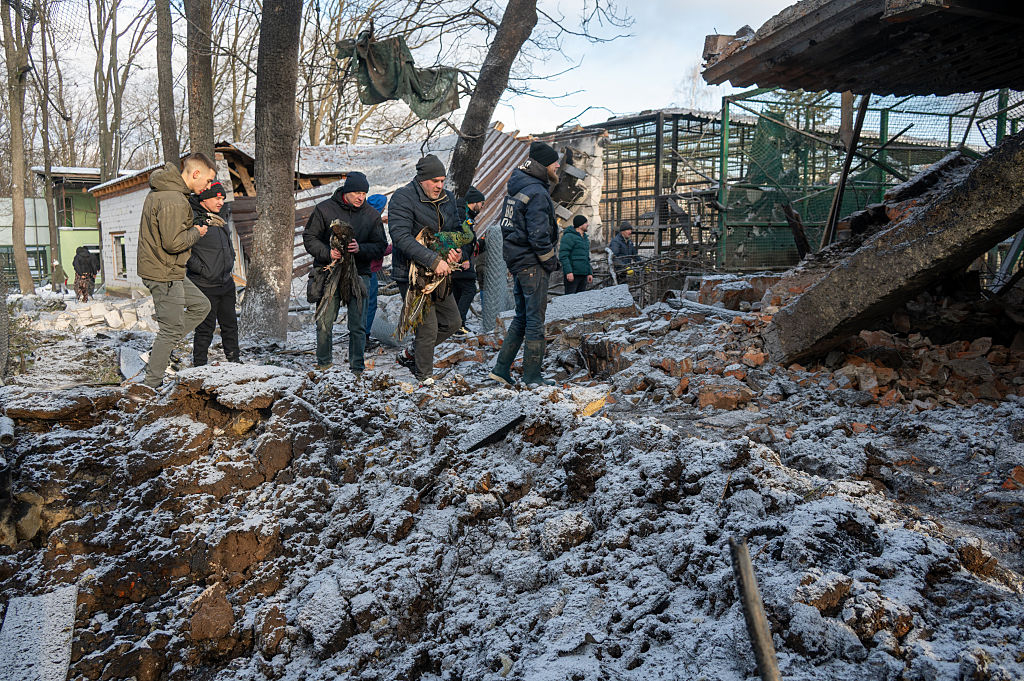
Feathers in the rubble: Rescuers carry peacocks from the shattered bird enclosure at Feldman Eco-Park outside Kharkiv after a Russian guided bomb struck on New Year’s Day, turning a place of care into a scene of quiet rescue. (Serhii Masin/Anadolu via Getty Images)
The pattern was unmistakable. Freeze the country. Break routines. Erase the idea of safe places.
And still, Ukrainians celebrated.
In shelters. By generator light. With children watching snow fall for the first New Year in years. Nature offered something gentle. War answered with fire.
Russia launched 205 drones. Ukraine stopped most of them. The rest caused pain—but not surrender.
The snow kept falling.
The fires kept burning.
And Ukraine welcomed another year unbroken.
Russians Crossing the Line—Against the Kremlin
They crossed the border knowing exactly what it meant.
The Russian Volunteer Corps exists because some Russians decided that stopping Putin mattered more than nationality. Denis Kapustin founded the unit at the start of Russia’s full-scale invasion, building what became the largest anti-Kremlin Russian formation fighting under Ukrainian military intelligence. Alongside the Freedom of Russia Legion and the Siberian Battalion, the RDK carried the war back into Belgorod and Kursk in 2023 and 2024.
The message landed harder than any Ukrainian raid could have. These were not foreign troops probing Russian defenses. They were Russians—armed, organized, and willing to fight their own state on its own soil. Moscow called it terrorism. The humiliation was deeper than that.
Kapustin himself carried contradictions that unsettled Western observers. A Russian who relocated to Germany in the early 2000s, he drifted through violent football scenes before emerging as a prominent figure in a neo-Nazi splinter group tied to mixed-martial-arts networks. German authorities monitored him closely. A Schengen ban followed in 2019, though investigative journalists later reported he continued operating across Europe.
That history complicated support. Opposition to Putin did not erase extremist baggage. But Ukrainian intelligence made a colder calculation. The RDK disrupted Russian rear areas, forced Moscow to defend borders it once treated as symbolic, and proved that armed resistance to the Kremlin existed inside Russia itself. Whatever Kapustin had been, the effect was undeniable.
Moscow’s response showed how seriously it took the threat. A $500,000 bounty was quietly authorized to eliminate Kapustin. Not rhetoric—money. When Ukrainian intelligence staged his death and let Russian services believe the job was done, operations continued uninterrupted. Deputies kept the tempo. Moscow relaxed.
Then Kapustin returned.
“My temporary absence did not affect combat tasks,” he said. He was ready to resume command.
Russian intelligence learned the truth too late. The assassination funds were gone. The operatives were exposed. And the war they thought was safely contained had crossed back over the line.
Ukraine’s asymmetric strategy does not stop at weapons. It uses people—sometimes uncomfortable ones—to fracture the illusion of unity inside Russia.
And that illusion has not survived contact.
When the War Didn’t Touch the Phone Bill
Not every victory shows up on a map. Some arrive quietly, in the fine print of a mobile contract.
Ukraine entered the European Union’s single roaming zone—something no non-EU country had ever done before. Moldova entered with it. For Ukrainians, the change was immediate and intimate: calls, texts, and mobile data now worked across 27 EU countries as if they were still at home. No roaming fees. No calculations before answering the phone. No silent dread at the end of the month.
For millions, it mattered more than symbolism.
More than 5.8 million Ukrainians fled after Russia’s full-scale invasion. Many kept Ukrainian numbers as lifelines—back to parents still under fire, children scattered across borders, news from home, plans for return. Now those numbers stayed alive without punishment. Connection no longer came with a cost.
The decision capped a bureaucratic process that ran in parallel with the war itself. Ukraine applied for EU membership days after the invasion began in February 2022. Candidate status followed. Formal negotiations opened in June 2024. The roaming agreement—approved by the Verkhovna Rada in May 2025 and signed by Zelensky a month later—fulfilled a concrete EU integration requirement in electronic communications.
This was not emergency charity. It was infrastructure.
The agreement runs through March 4, 2027, with extension options. Temporary free roaming introduced during the invasion became permanent regulation. Predictability replaced improvisation.
The timing mattered. While Russian forces pressed forward near Pokrovsk and Ukrainian drones struck refineries deep inside Russia, ministries in Kyiv were still aligning standards, passing legislation, and syncing systems with Europe. War did not suspend governance. Integration did not wait for peace.
For Brussels, the move signaled something else: commitment beyond weapons shipments. Roaming integration required coordination among regulators, telecom firms, and governments across the continent. Ukraine was treated not as a petitioner, but as a country on the inside track.
Phones working across borders won’t stop missiles. But they keep families intact, officials coordinated, refugees connected—and futures imaginable.
The war continued.
Europe moved closer.
Both things were true at once.
The Speech That Refused to End the War
Vladimir Putin spoke for three minutes and twenty seconds. He didn’t mention Ukraine. He didn’t mention peace. He didn’t mention how the war might end.
That silence did the work for him.
The New Year’s Eve address was brief—shorter, calmer, almost routine. Gone was the wartime staging of 2022, when Putin stood at military headquarters flanked by soldiers, delivering a nine-minute justification for invasion and sacrifice. This time, the tone was softer. Normalized. The war folded neatly into patriotism.
Putin praised the soldiers of the so-called “special military operation,” thanking them for defending the homeland, for fighting for “truth and justice,” assuring them that “millions” stood with them on New Year’s night. The framing was precise: guardians, not invaders; duty, not conquest; unity, not coercion.
What never surfaced were the facts pressing in from outside the studio.
No mention of conscription decrees quietly signed days earlier. No reference to reservists now guarding infrastructure. No acknowledgment of mounting casualties or economic strain. No word about Ukrainian drones reaching deep into Russia. No hint that negotiations—much discussed abroad—had any relevance at home.
The strategy was clear. In 2022, the war needed explanation. In 2026, it needed normalization.
“All that we envision—our hopes and plans—will certainly come true,” Putin said, speaking of personal dreams and national destiny as if they were inseparable. The message was not victory or peace, but endurance. This is simply how things are now.
The omissions carried intent. Putin showed no need to prepare Russians for compromise, no reason to soften expectations, no desire to imagine an endpoint. Objectives remained unstated, but familiar—territory held, borders redrawn, power asserted.
For Russian audiences, the address offered reassurance: the war is stable, managed, ongoing. For the rest of the world, it offered clarity.
While Russian administrators tightened control in Pokrovsk, Ukrainian drones burned refineries, and U.S. intelligence dismantled Moscow’s fabrications, Putin welcomed the New Year without a single word about stopping the war.
Sometimes what a leader refuses to say is the most honest signal of all.
What Went Down With the Ship—and What May Never Surface
The Ursa Major slipped beneath the Mediterranean on December 23, about sixty nautical miles from Cartagena. At first, it looked like another maritime incident—erratic movement, a calm reply to controllers (“Nothing, everything is fine”), then a mayday. Rescue crews arrived. Fourteen sailors were pulled off a listing deck. Two were missing. The lights went out. The ship was gone.
What followed is where the story darkens.
Spanish authorities completed an investigation and quietly passed the findings to Russia. No details released. Then La Verdad, a regional Spanish paper, published what it called an “official version” known to investigators—allegations impossible to independently verify, but too serious to ignore if true.
According to the report, inspectors identified two undeclared containers, each roughly 65 tons. Aerial imagery, the paper said, suggested components linked to two VM-4SG nuclear reactors—covers and hardware, not fuel. The presumed destination: Rason, North Korea. Spanish officials reportedly believed no nuclear material was aboard, but the cargo itself was never publicly confirmed.
If accurate, it would sketch the hidden supply lines of Putin’s war—nuclear technology flowing east in exchange for troops, weapons, and diplomatic cover. Moscow and Pyongyang had already signed a strategic partnership in 2024. This would add steel and circuitry to that alliance.
How the ship sank remains contested. La Verdad cited a document describing hull damage inconsistent with a conventional torpedo, pointing instead to a supercavitating weapon—fast, precise, leaving limited explosive signature. Spain’s seismographs reportedly detected blasts equivalent to 20–50 kilograms of TNT. No raw data was released.
Russia called it terrorism. Then moved to take control—invoking maritime law, demanding Spanish vessels withdraw, dispatching a military ship. Flares reportedly lit the night as the Ursa Major’s power died.
Now the wreck rests on the seabed. The evidence—whatever it is—went with it.
As Óscar Villar, the Cartagena maritime captain, put it: The ship was already sunk. The nightmare wasn’t over.
Day One of Year Four: What Still Holds—and What Still Breaks
The first twenty-four hours of 2026 did not bring answers. They brought clarity.
Ukrainian intelligence turned deception into leverage—convincing Russian services they had killed Denis Kapustin, collecting the assassination bounty, mapping the operatives involved, and converting Moscow’s money into Ukrainian drones. It was not a tactical trick. It was a statement about penetration, reach, and who was learning faster.
At the same time, Ukraine’s war did not pause for the calendar. Loitering munitions struck the Ilsky refinery as Russians toasted the New Year. Additional strikes degraded drone storage, air defense, fuel, and command nodes. Distance did not protect Russia. Holidays did not interrupt Ukraine.
Facts mattered. When Moscow manufactured a crisis—claiming an assassination attempt on Putin—the CIA cut through it. The assessment reached Washington in time. Emotion gave way to evidence. Policy stayed anchored to reality. The information war worked only until intelligence intervened.
Defense thickened. Two more Patriot systems began positioning. The previous night’s numbers told the truth: 176 drones intercepted, 24 still breaking through, civilians still killed. Air defense was not perfection. It was survival math—and it was improving.
Diplomacy hovered unfinished. Zelensky’s “90 percent ready” captured the paradox: agreement on process, stalemate on substance. Sovereignty, security guarantees, borders—the final ten percent remained immovable. Without them, peace would be pause, not conclusion.
Russia’s behavior filled the gap. Drones struck through midnight. Infrastructure burned. Animals died. And Putin, welcoming the New Year, said nothing about ending the war. Silence, as policy.
Yet another track moved forward. Ukraine entered the EU’s roaming zone. Millions stayed connected. Institutions advanced even as missiles flew. War and integration coexisted.
Day 1,407 rolled into Day 1,408 with no resolution. But the first day of year four revealed which strategies still worked—and which illusions no longer did.
Snow fell on Kyiv. Refineries burned in Russia. Patriots moved. Intelligence cut deeper. Peace stayed close—and unresolved.