
As 447 drones and 60 missiles terrorize Ukraine from Crimea to western borders, F-16 pilot dies heroically shooting down seven targets while Zelensky withdraws from landmine ban treaty
Summary of the Day – June 29, 2025
Russia conducted its largest combined strike of the war on June 29, launching 537 aerial weapons including 447 Shahed and decoy drones alongside 60 missiles against targets across Ukraine. The unprecedented bombardment killed a Ukrainian F-16 pilot who shot down seven Russian targets before his aircraft crashed, while civilian infrastructure suffered damage from Crimea to western regions far from front lines. As the assault unfolded, President Zelensky signed a decree withdrawing Ukraine from the Ottawa Convention banning anti-personnel landmines, following similar moves by Baltic states and Poland. Meanwhile, diplomatic developments included Senator Lindsey Graham’s announcement that Trump approved Senate voting on new Russian sanctions, while Hungarian officials claimed the U.S. lifted sanctions hindering Russian nuclear plant expansion, and Slovak Foreign Minister suggested “forgiving” Russian actions to resume dialogue.
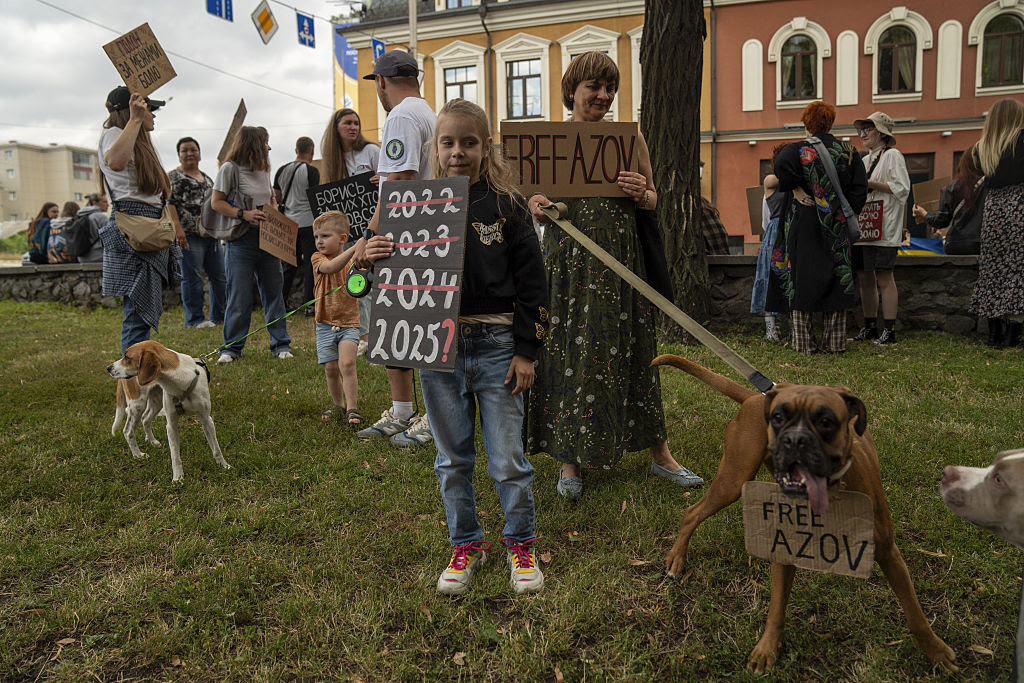
Ukrainians gathered in the Ukrainian capital with a convoy of vehicles touring part of the city to honour fallen soldiers and demand the release of prisoners of war still held in Russian captivity since 2022, in Kyiv. (Jose Colon / Anadolu via Getty Images)
Unprecedented Aerial Assault: 537 Weapons Target Ukraine in Single Night
Russian forces launched their largest combined strike series of the war on the night of June 28-29, deploying 537 strike vehicles including 447 Shahed and decoy drones from multiple directions. The Ukrainian Air Force reported Russian forces also launched four Kh-47M2 Kinzhal aeroballistic missiles from Tambov Oblast airspace, seven Iskander-M/KN-23 ballistic missiles from Voronezh Oblast, 41 Kh-101/Iskander-K cruise missiles from Saratov, Kursk, and Bryansk oblasts, five Kalibr cruise missiles from the Black Sea, and three S-300 air defense missiles from Kursk Oblast.
Ukrainian forces shot down 221 drones, one Iskander-M/KN-23 ballistic missile, 33 Kh-101/Iskander-K cruise missiles, and four Kalibr cruise missiles, while 225 drones and one cruise missile were suppressed by electronic warfare systems. The scale represented Russia’s continued efforts to overwhelm Ukrainian air defenses through massive drone swarms enabling subsequent missile strikes.
Hero of the Skies: F-16 Pilot Dies After Downing Seven Russian Targets
Lieutenant Colonel Maksym Ustymenko, born in 1993, was killed while flying a U.S.-made F-16 fighter jet during the overnight assault after shooting down seven aerial targets. The Air Force reported his aircraft was damaged while attempting to intercept the eighth target, losing altitude and crashing before he could eject.
“Maksym Ustymenko did his best to take the plane away from the settlement, but did not have time to eject,” the Air Force stated, honoring him as dying “like a hero.” President Zelensky posthumously awarded Ustymenko the Hero of Ukraine award, acknowledging the extreme danger F-16 pilots face while destroying dozens of Shahed-type drones during air defense operations.
Targeting Civilian Infrastructure: Changed Russian Strike Tactics Inflict Maximum Damage
Kyiv City Military Administration Head Timur Tkachenko reported that Russia has changed strike tactics to inflict maximum damage to civilian areas, with three heavy attacks on Kyiv in June 2025 involving 285 drones and 65 missiles. This represents a sharp increase from 35 drones and one ballistic missile launched against the capital in January 2025.
Russian strikes killed 42 civilians including one child in Kyiv since June began, with 234 people including 11 children sustaining injuries. Tkachenko revealed Russian forces conduct “double tap” strikes against emergency responders and use cluster munitions with delayed detonations threatening both civilians and rescue workers.

Kyiv residents shelter in subway amid a Russian drone-and-missile strike in Kyiv, Ukraine. Russia launched 537 aerial targets in its largest attack on Ukrainian cities since the start of the full-scale war. (Yan Dobronosov/Global Images Ukraine via Getty Images)
Widespread Regional Damage: From Western Borders to Industrial Centers
Russian forces struck civilian infrastructure including residences and educational facilities in Ternopil, Ivano-Frankivsk, Cherkasy, and Mykolaiv oblasts, along with railway and industrial infrastructure in Lviv and Poltava oblasts. The attacks forced Poland to scramble fighter jets and activate ground-based air defense units in response to threats near its border.
Civilian infrastructure damage occurred across Cherkasy Oblast with three people injured, while enterprises were hit in Kremenchuk, Poltava Oblast causing fires, and production facilities in Zaporizhzhia sustained damage. Despite attempted strikes on critical infrastructure in Lviv Oblast, Mayor Andrii Sadovyi reported no injuries or civilian building damage in the city itself.
Strategic Weapons Development: Russia Expands Aircraft Production Capabilities
Satellite imagery and Russian government announcements indicate significant expansion of aircraft production capabilities for medium-to-long-term strategic purposes. Finnish outlet Yle reported satellite imagery from mid-2024 to May 2025 shows Russia constructed or expanded at least five buildings at the Kazan Aviation Plant by 19,000 square meters.
The plant produces and modernizes strategic Tupolev aircraft including Tu-160M, Tu-160M2, and Tu-22M3 variants along with helicopters, with officials planning continued construction until 2026. The United Aircraft Corporation announced building new final assembly halls, upgraded manufacturing technology, and procured computer numerical control machine tools, welding robots, and measurement systems.
Production Targets and Constraints: Ambitious Plans Meet Reality
Russian officials plan for the Kazan plant to produce four Tu-214 aircraft by 2025, seven by 2026, 17 by 2027, and 28 annually by 2028, with modernization costs potentially reaching 90 billion rubles ($1.2 billion). However, the plant delivered only two Tu-160M2s and two Tu-160Ms in 2024, struggling with sanctions, labor shortages, and parts availability.
United Aircraft Corporation Head Vadim Badekha announced plans to increase Sukhoi aircraft production effectiveness by 30% by 2030, though Ukrainian military observers note Russia currently produces Sukhoi aircraft in one to two months. The expansion occurs despite previous plans to lay off 1,500 managerial staff in Moscow.
Constitutional Decision: Ukraine Withdraws from Anti-Personnel Landmine Ban
President Zelensky signed a decree initiating Ukraine’s withdrawal from the Ottawa Convention banning anti-personnel landmines, following National Security and Defense Council decisions. Lawmaker Roman Kostenko announced the move as “a step the reality of war has long demanded,” noting Russia’s extensive landmine use against Ukrainian military and civilians despite not being a convention party.
The 1997 treaty, signed by 164 countries, prohibits use, production, transfer, and stockpiling of anti-personnel landmines, requiring signatories to destroy existing stockpiles. Latvia, Lithuania, Poland, and Finland voted to leave the convention earlier in 2025, following defense ministry recommendations regarding rising security threats from Russia and Belarus.
Congressional Breakthrough: Trump Approves Senate Vote on Russian Sanctions
Senator Lindsey Graham announced that President Trump was ready for Senate voting on new Russian sanctions legislation following their June 28 golf discussion. Graham reported Trump saying “it’s time to move your bill” for the first time, with voting expected after the July congressional break ending July 9.
The bipartisan bill signed by 84 co-sponsors would impose 500% tariffs on products from countries buying Russian goods without helping Ukraine, specifically targeting India and China which purchase 70% of Putin’s oil. Graham expressed optimism Trump would sign the legislation while noting presidential waiver authority over implementation details.
Diplomatic Tensions: Hungarian Nuclear Claims and Slovak Reconciliation Proposals
Hungarian Foreign Minister Peter Szijjarto claimed the U.S. lifted sanctions hindering expansion of the Paks Nuclear Power Plant where Russian state-owned Rosatom will build two new reactors. Construction of major equipment proceeds in Russia and France, with on-site work accelerating toward projected 2032 completion despite Ukrainian sanctions commissioner disputing the claims.
Slovak Foreign Minister Juraj Blanar suggested the international community may need to “perhaps forgive” Russian actions and resume dialogue with Moscow to end the war in Ukraine. Blanar emphasized diplomatic solutions over battlefield resolution while requesting postponement of the 18th EU sanctions package pending RePowerEU consequence decisions.
Intelligence Cooperation: CIA-SVR Direct Communication Channels Established
Russian Foreign Intelligence Service Director Sergey Naryshkin announced agreement to maintain open contact with CIA Director John Ratcliffe following recent phone conversations. Naryshkin stated they “reserved for each other the possibility to call each other at any time and discuss issues of interest,” though neither specified conversation timing or details.
The intelligence cooperation represents broader Trump administration efforts to normalize U.S.-Russia relations following February 12 phone calls between Presidents Trump and Putin establishing dialogue on “topics of mutual interest” including potential Ukraine war resolution.
Military Advances and Ground Combat: Ukrainian Gains in Northern Sumy
Ukrainian forces achieved confirmed advances south of Oleksiivka in northern Sumy Oblast according to geolocated footage, while Russian forces attacked near Andriivka and Yablunivka with Ukrainian counterattacks between Yablunivka and Khrapivshchyne. Commander-in-Chief Syrskyi reported that Russian advances in the Sumy border zone have been stopped with the front line stabilized.
Ukrainian forces also recently advanced in central Chasiv Yar and southeast of Bila Hora according to geolocated evidence from June 28-29. Russian forces continued offensive operations near Chasiv Yar itself and south toward Stupochky and Bila Hora, with elements of the 217th and 331st VDV regiments operating in the area.
Eastern Front Operations: Comprehensive Tactical Developments
Russian forces continued assaults across multiple eastern directions without confirmed advances. Kharkiv Oblast saw operations near Hlyboke, Lyptsi, and Vovchansk with unconfirmed claims of westward advances. Kupyansk direction included attacks near Stroivka, Holubivka, Kutkivka, Petropavlivka, Stepova Novoselivka, and Pishchane.
Borova direction operations targeted Zelenyi Hai, Kopanky, Nadiya, Hrekivka, Tverdokhlibove, and Novoserhiivka, while Lyman direction attacks occurred near Ridkodub, Zelena Dolyna, Serednye, Shandryholove, Yampolivka, Myrne, Torske, and in the Serebryanske forest area.
Central Donetsk Combat: Siversk Pressure and Equipment Deployments
Russian forces conducted unsuccessful attacks with three infantry fighting vehicles and three motorcycles toward Serebyranka according to Ukraine’s Khortytsia Group of Forces. A Ukrainian battalion chief of staff reported Russian deployment of single infantrymen equipped with anti-tank mines to destroy Ukrainian shelters, taking advantage of poor weather when Ukrainian drones could not fly.
Elements of the Russian 7th Motorized Rifle Brigade operate near Serebryanka while the 6th Motorized Rifle Brigade operates near Verkhnokamyanske. Russian milbloggers claimed sabotage and reconnaissance groups approached Siversk outskirts, though Ukrainian forces repelled attacks near the settlement.
Southern Front Dynamics: Pokrovsk Pressure and Zaporizhzhia Operations
Russian forces continued operations in the Pokrovsk direction without confirmed advances, attacking near Malynivka, Koptieve, Myrne, Razine, Volodymyrivka, Promin, Myrolyubivka, Hrodivka, Yelyzavetivka, Sukhyi Yar, Lysivka, Zvirove, Udachne, and Kotlyne. Ukrainian drone crew commanders reported Russian forces recently increased drone usage in the sector.
Syrskyi reported Russian forces attacking in the “Dobropillya direction” with elements of the 68th Combined Arms Army and 20th and 150th motorized rifle divisions operating in three operational directions. The Russian military command may intend leveraging the salient between Pokrovsk and Toretsk to envelop Pokrovsk from northeast and north.
Air Defense Limitations: Ballistic Missile Interception Challenges
Ukrainian forces notably shot down only one of seven Iskander-M/KN-23 ballistic missiles and none of the four Kinzhal aeroballistic missiles during the massive attack, highlighting air defense limitations against Russia’s most advanced weapons. Zelensky called for strengthened air defenses and reiterated Ukraine’s readiness to purchase U.S. Patriot systems following recent Trump discussions.
Trump recently spoke with Zelensky about possible U.S. Patriot system sales on June 25, with these systems vital for defending against Russian ballistic missile strikes as Russia reportedly increases production capacity for larger and more frequent ballistic missile attacks.
Order of Battle Intelligence: Detailed Unit Identifications
Russian forces deployed specialized units across fronts including 217th VDV Regiment drone operators in Tetkino direction; 119th VDV Regiment and 11th Separate VDV Brigade elements in northern Sumy Oblast; 83rd Separate VDV Brigade drone operators near Yablunivka; 144th Motorized Rifle Division repelling Ukrainian counterattacks near Ridkodub.
Additional formations included 68th Separate Reconnaissance Battalion near Yablunivka and Rusyn Yar; 255th Motorized Rifle Regiment and “Vega” Spetsnaz Detachment in Pokrovsk direction; 57th and 60th motorized rifle brigades attacking toward Maliivka; 14th Spetsnaz Brigade and 16th Radiation, Chemical, and Biological Defense Regiment in Shakhtarske direction.
Summer Offensive Stalls: Russian Operations Lose Momentum Across Multiple Fronts
Russia’s summer offensive launched in May is losing steam just weeks after beginning, despite record numbers of attacks along several fronts. Experts report Russian forces failed to break through defenses in Sumy near Ukraine’s northern border, with Ukraine recapturing ground and halting Russian advances entirely. Commander-in-Chief Syrskyi established a special defense group for the region commanded by Brigadier General Oleh Apostol.
Russian struggles extend to Donetsk Oblast where attempts to seize key towns like Kostiantynivka have stalled despite having more soldiers and drones. Analysts note Russia risks overstretching its army by spreading forces thin across Ukraine, including new pushes in Sumy, Kharkiv, and Dnipropetrovsk oblasts, while celebrating minor victories over strategically insignificant small towns and villages.
Robotics Complex Approval: Defense Ministry Authorizes “Murakha” Ground System
The Defense Ministry approved the Ukrainian-made ground-based robotics complex “Murakha” (Ant) for combat operations on June 28. The tracked robotic platform supports front-line units under challenging conditions including enemy artillery and heavily mined terrain, carrying over half a ton across dozens of kilometers while crossing difficult terrain and shallow water.
The Murakha’s multiple control channels enable function despite Russian electronic warfare systems, performing offensive and defensive activities, wounded evacuation, logistical support, and mining and demining operations. Ukraine has scaled up robotics development since 2024 hoping mass production of unmanned ground vehicles will minimize human battlefield involvement.
Papal Support Continues: Vatican Welcomes Ukrainian Greek Catholic Pilgrims
Pope Leo XIV welcomed Ukrainian Greek Catholic pilgrims to the Vatican on Friday, describing Ukraine as “martyred” by Russia’s “senseless war” during the Catholic Jubilee themed “Pilgrims of Hope.” His Beatitude Sviatoslav Shevchuk, head of the Ukrainian Greek Catholic Church, joined bishops, priests, and lay pilgrims at St. Peter’s Basilica.
The Pope acknowledged spiritual anguish from Russia’s full-scale invasion, stating Ukrainian faith is being “sorely tested” and offering special blessings to mothers of soldiers killed on frontlines. President Zelensky expressed gratitude for continued prayers while requesting assistance returning Ukrainian children held in Russian captivity against their will.
Additional Southern Front Operations: Zaporizhzhia and Kherson Sectors
Russian forces continued offensive operations near Malynivka east of Hulyaipole and in western Zaporizhzhia Oblast near Kamyanske without advances. Ukrainian Southern Defense Forces Spokesperson Colonel Vladyslav Voloshyn reported Russian aims to seize Kamyanske for artillery strikes against Stepnohirsk and advances toward southern Zaporizhzhia City outskirts.
Voloshyn stated Russian forces concentrate infantry on the southern front for continued high-intensity assault operations, with the military command deploying an unspecified newly formed regiment to Southern Military District areas. The newly created unit lacks sufficient personnel for serious large-scale offensive operations.
Comprehensive Unit Deployments: Additional Order of Battle Details
Additional Russian formations included drone operators of the 61st Naval Infantry Brigade (Northern Fleet) in Kherson direction; “Omerzitelnaya Vosmerka” drone group (Russian Volunteer Corps) in occupied Crimea; 7th Airborne Division elements in Orikhiv direction; and various specialized reconnaissance and assault battalions across eastern fronts.
Ukrainian forces maintained defensive positions while conducting tactical counterattacks, with ground activity absent from Kherson direction on June 29 according to both Ukrainian and Russian sources, suggesting potential operational pause or redeployment of forces to more active sectors.
Novopavlivka and Velyka Novosilka Directions: Continued Russian Pressure
Russian forces continued offensive operations in the Novopavlivka direction on June 29 without confirmed advances, with unconfirmed claims of advances to Myrne south of Novopavlivka and by the 36th Motorized Rifle Brigade north and southeast of Zirka. Russian attacks targeted Horikhove, Troitske, Oleksiivka, Myrne, Zaporizhzhia, Komar, Yalta, Dniproenerhiya, and Vesele.
In the Velyka Novosilka direction, Russian forces attacked northwest of Velyka Novosilka near Shevchenko toward Maliivka, west near Novosilka, and southwest near Rivnopil without confirmed advances. Elements of the 57th and 60th motorized rifle brigades attacked toward Maliivka while the 11th Air Force and Air Defense Army struck Ukrainian forces in the area.
Toretsk Sector Operations: Multi-Directional Russian Attacks
Russian forces conducted offensive operations in the Toretsk direction on June 29 without advances, attacking near Toretsk itself, northeast near Dachne, northwest near Rusyn Yar, Popiv Yar, Poltavka, and Yablunivka, west near Shcherbynivka, and southwest near Leonidivka. Drone operators of the 68th Separate Reconnaissance Battalion continued operations near Yablunivka and Rusyn Yar.
The Russian military command may intend to leverage the salient between Pokrovsk and Toretsk to envelop Pokrovsk from the northeast and north or bypass Ukrainian defenses in Kostyantynivka from southwest and west. Russian forces would need to cross the Kazennyi Torets River to advance toward Dobropillya, potentially presenting obstacles depending on water levels.
Extended Ground Combat Details: Kursk Oblast and Northern Operations
Fighting continued in Kursk Oblast on June 29 with Russian forces attacking in unspecified parts while drone operators of the 217th VDV Regiment struck Ukrainian forces in the Tetkino direction southwest of Glushkovo. Elements of the 119th VDV Regiment and 11th Separate VDV Brigade operated in northern Sumy Oblast alongside 83rd Separate VDV Brigade drone operators near Yablunivka.
Ukrainian forces achieved confirmed advances south of Oleksiivka in northern Sumy Oblast according to geolocated footage, while Russian forces attacked in Sumy direction near Andriivka and Yablunivka with Ukrainian counterattacks between Yablunivka and Khrapivshchyne and near Andriivka.
Air Defense System Effectiveness: Detailed Interception Statistics
The massive Russian attack demonstrated both Ukrainian air defense capabilities and limitations, with forces shooting down 221 of 447 drones (49% interception rate) while suppressing an additional 225 drones through electronic warfare. However, Ukrainian forces intercepted only one of seven Iskander-M/KN-23 ballistic missiles (14% rate) and zero of four Kinzhal aeroballistic missiles (0% rate).
Ukrainian forces achieved better success against cruise missiles, downing 33 of 41 Kh-101/Iskander-K cruise missiles (80% rate) and four of five Kalibr cruise missiles (80% rate), while intercepting all three S-300 air defense missiles. The statistics highlight Russian strategic focus on overwhelming Ukrainian defenses through drone swarms while deploying advanced ballistic missiles against high-value targets.
Regional Defense Preparations: Special Command Structure Establishment
Commander-in-Chief Syrskyi announced establishment of a special defense group for Sumy region commanded by Brigadier General Oleh Apostol following stabilization of the front line. Priority tasks include strengthening fortifications, expanding engineering barriers, and preparing local communities for potential attacks as Russian summer offensive momentum decreases.
The defensive preparations reflect Ukrainian adaptation to Russian multi-front pressure while maintaining territorial gains achieved through recent counterattacks. Syrskyi’s assessment that Russian advances have been stopped represents significant tactical success in preventing Russian breakthrough attempts toward Sumy City.
Looking Forward: Escalation Dynamics and International Response
The events of June 29 marked a significant escalation in Russian aerial warfare capabilities, with the 537-weapon attack representing the largest single-night bombardment since the war began. The combination of massive drone swarms with precision missile strikes demonstrates Russia’s evolving strategy to overwhelm Ukrainian defenses while targeting civilian infrastructure for maximum psychological impact.
Ukraine’s withdrawal from the landmine convention and continued deep-strike operations against Russian territory suggest both sides are preparing for prolonged conflict despite ongoing diplomatic initiatives. The death of an F-16 pilot while defending Ukrainian airspace underscores the human cost of Russia’s escalating aerial campaign and the critical importance of enhanced air defense capabilities for protecting both military assets and civilian populations.