
The Ukraine Daily Briefing · Saturday, October 17, 2026
The ambulance came to help, and the bombs came back for it. Overnight, Russia went for the switch that keeps Ukraine warm, and within hours of the barrage the American law built to pressure Moscow was set aside. Today, stand where Ukrainians stood.
The Day’s Reckoning
Your power has just come back on. It’s Saturday morning in the Vinnytsia region, the generators are still running the water pumps, and before you reach for the kettle, your governor has a request. Switch your appliances on one at a time, she asks. The grid was stitched back together overnight, and it can’t take everyone at once.
So you wait. You turn on one thing, then another. That small patience is how a whole region keeps the lights on after one of Russia’s largest attacks on Ukraine’s power system.
That is the plot of this Saturday. Russia is trying to break Ukraine before winter, and it is aiming at everything that keeps people alive: the power lines, the factories, even the ambulances. And on the night the drones flew, the help Ukraine counts on came loose in three places. Washington waived its own sanctions on Moscow. Ukraine’s satellite link stayed throttled. Its Patriot missiles are nearly gone.
Today you’ll stand in four places: a street in Kherson, a repair crew’s dispatch room, a drone pilot’s screen, and a town Moscow says no longer belongs to Ukraine. In every one, Ukrainians are still standing.
The Medics Came Back
You drive an ambulance in Kherson.
On Saturday morning, the call comes from the Korabelnyi district. Russian planes have dropped guided bombs on apartment buildings. People are hurt. Some may be under the rubble. You do what you have always done. You go.
You pull up. The medic with you jumps out to reach the wounded. And then the planes come back.
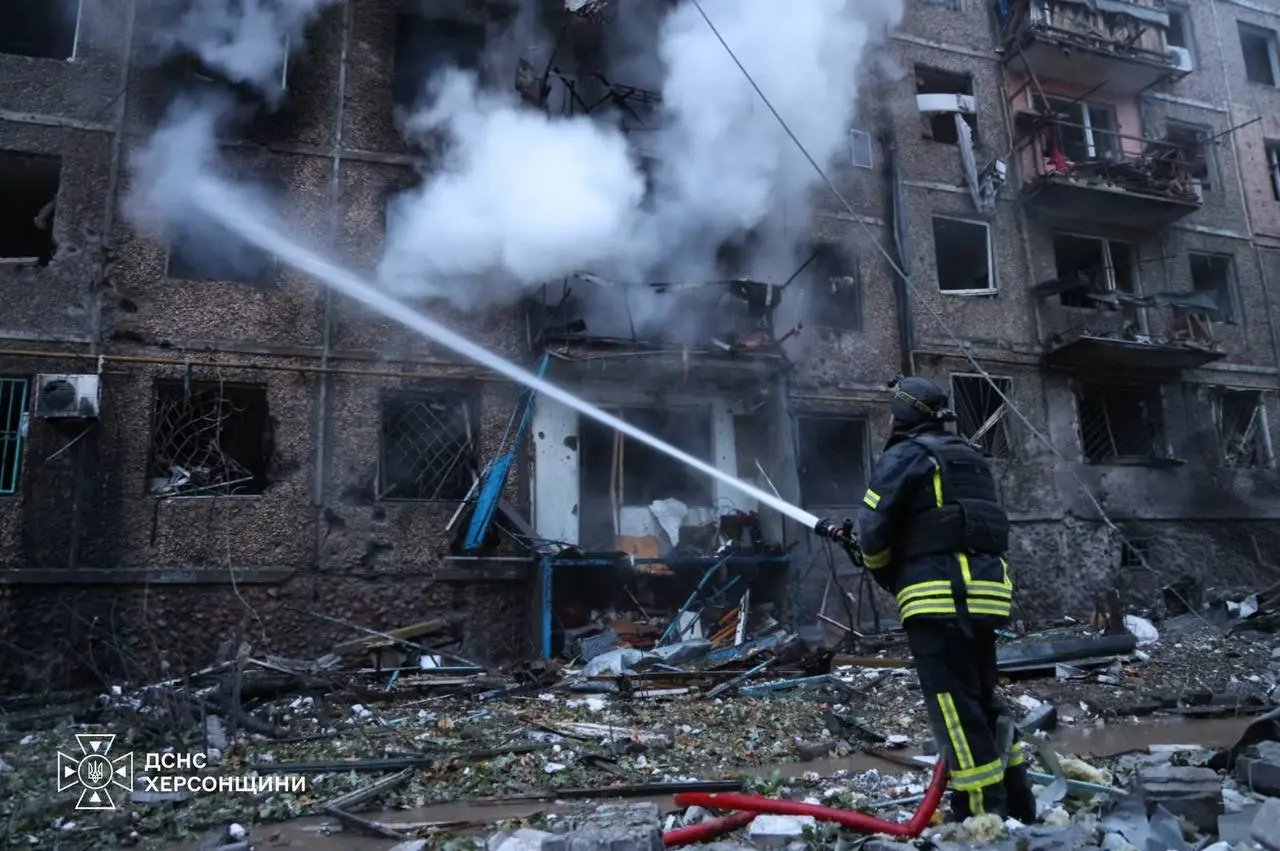
Still running toward the fire. A firefighter puts out a blaze after Russian attacks on Kherson Oblast, Ukraine, on Oct. 17, 2026. (State Emergency Service/Telegram)
Less than an hour after the first wave, Russian aircraft drop more bombs on the same streets. Eight guided bombs in all, said Yaroslav Shanko, who runs the city’s military administration. “The repeat strike was delivered after the arrival of medics,” he said. “An ambulance driver was killed, and another female medic was injured.”
The driver was real, doing exactly what you would hope someone would do for you. Russia waited for that.
Strike once. Wait for the people who run toward danger. Strike again.
Ten apartment buildings were damaged and fires broke out. Rescuers pulled seven people from beneath the rubble. All day the number of wounded climbed, 22, then 27, and finally 33. One of them is 11 years old. One of them is a baby, one month old. Later, three women aged 64, 55 and 54 came forward with concussions, blast injuries and head wounds.
Kherson was not the first city bombed that day. At 3:40 a.m. in Sloviansk, in the Donetsk region, Russian planes dropped FAB-250 high-explosive bombs on a residential neighborhood. Two apartment buildings partly collapsed. “Direct hits were recorded on two multi-story buildings, under whose rubble people may be trapped,” said Vadym Lyakh, the head of the city’s military administration. One person was killed. Ten were wounded.
In Kharkiv, missiles struck the Nemyshlianskyi district late Friday and wounded 15 people, three of them children. Across the Kharkiv region, Russian attacks killed a man of 58 and a woman of 71. Near Nikopol, a 74-year-old woman died. In Dnipro, a man was killed when Russia struck an industrial site. Two people died in Kramatorsk. By the count of regional officials, Russia killed at least seven people and wounded about 90 across Ukraine in a single day.
Every one of those numbers had a name, a home and a Saturday that was supposed to be ordinary.
The Night Russia Went for the Switch
Now you run a repair crew.
Your phone starts lighting up around 7 p.m. on Friday. By morning, Russia has thrown 332 drones at Ukraine, along with ballistic missiles from Russia and occupied Crimea, cruise missiles from Crimean skies, and four Kalibr missiles fired from the sea. Ukraine’s defenders, from fighter pilots to mobile gun crews, bring down 293 of them, every Kalibr included.
But the rest get through, and they are aimed at you. More than 15 power plants and transmission sites are hit, in what President Volodymyr Zelensky calls one of the largest strikes on Ukraine’s energy system. The damage reports pour in from ten regions. Lutsk is dark. So are Rivne, Zhytomyr, Vinnytsia, Shepetivka, Slavuta and Netishyn.
You can’t be everywhere. That is the point.
“The Russians scaled up their anti-energy operation and are trying to disperse our reserves and recovery capacity to the maximum,” Zelensky said. Russia isn’t trying to win one fight with your crew. It’s trying to stretch every crew in Ukraine so thin that the frost arrives before the repairs do.
In Vinnytsia, where air defenders shot down 24 drones, six people were still wounded, one now in intensive care.
Russia also went after the places where Ukrainians earn their living. If you work at the Kromberg & Schubert plant in Lutsk, you make wiring for BMW, Audi, Mercedes-Benz, Porsche and Skoda cars, and on Saturday you got a message instead of a shift. Russian drones had hit the plant. “The business has stopped!” the company posted, saying the safety of every worker came first. The plant employed 5,500 people as of last year. They will be told when they can come back. Nobody can say when.
In Zaporizhzhia, six ballistic missiles slammed into the Zaporizhstal steel plant on Saturday morning, said its owner, Metinvest. It hadn’t recovered from the last strike yet. Nearby, missiles landed beside apartment blocks, wounding two people and setting parked cars on fire. Russia’s Defense Ministry bragged about both factories, and claimed a third in Kryvyi Rih.
Zelensky thanked the crews “working virtually non-stop to restore power.” That means you.
Forty-Eight Hours
The clock started on September 18, when President Donald Trump signed the Lindsey O. Graham Sanctioning Russia and Iran Act into law. This weekend it was supposed to hit Moscow where it hurts. Russian imports would face a 500 percent tariff, a tax charged at the border; a $10 Russian product would cost $60 to bring in. Any country buying Russian petroleum would face 100 percent duties.
With 48 hours to go, on Friday night, Trump signed an executive order waiving the law’s key sanctions, restrictions and tariffs, certifying to Congress that the waiver serves America’s national interest.
Moscow celebrated. Kirill Dmitriev, head of the Russian Direct Investment Fund and a key Kremlin negotiator, called it “significant and truly historic.”
Now go back to the repair crew, still on the phone that same night, and to the ambulance driver in Kherson the next morning. That is the moment Zelensky wants the world to see side by side.
“It is important that everyone in America also sees what is actually happening,” he said. “At a time when the Russians delivered such a massive strike against our energy, a decision was unfortunately made in America to completely ignore the Lindsey Graham law, which was supposed to introduce truly effective pressure on Russia to end this war.”
The waiver closed out a week of easing. On October 9, Trump announced a deal with Vladimir Putin lifting sanctions on Russian diesel. Two days later, he announced an “energy ceasefire” between Kyiv and Moscow that Kyiv had not agreed to. Ukraine paused its strikes on Russian refineries for three days anyway, while Russia kept pounding Ukraine’s grid. On Thursday, Zelensky ended the pause with two words: “We’re done.” Trump blames Ukraine’s refinery strikes for rising fuel prices, a claim energy experts dispute.
Zelensky has not given up on the law. “This law could — and still can! — help greatly,” he said. “But the law needs to actually work, and every vote for this matters.” Easing the pressure, he warned, “only encourages him to strike further.”
The Institute for the Study of War, which tracks the war daily, judged that the order will help Russia keep paying for the war while removing its reasons to negotiate. French President Emmanuel Macron said of the diesel deal: “It sends a negative signal. It is an element of division and doubt.”
Speed Limit: 161
You fly interceptor drones. On your screen is a Russian jet-powered Geran, a drone that can cross the sky at 600 kilometers an hour toward a power plant like the ones that went dark last night. Your interceptor is built to chase it down.
You push the throttle. At 161 kilometers an hour, your Starlink connection drops. The screen goes dead. The Geran flies on.
That is the problem Zelensky described on Saturday. The speed cap first noticed on October 14 is still there, despite reports that service had come back. It applies to Starlink, SpaceX’s satellite internet, and to Starshield, its more secure military version. With it in place, he said, Ukraine’s Starlink-guided interceptors cannot bring down Russia’s jet drones at all. The cap also slows the drones that ferry food and water to soldiers in front-line positions.
No one warned Kyiv. When it asked, it got silence from American channels or the words “technical issues.” Zelensky isn’t buying it. He called the cap a “planned operation” and pointed to a test: Ukraine drove vehicles carrying its Starlink terminals into the European Union, and there they blew past the limit. European partners are already working on an alternative.
You can see the cost in September’s numbers. Russia launched 3,520 jet-powered Gerans that month, and Ukraine stopped only 54 percent of them, said Air Force spokesman Col. Yuriy Ihnat. Against the older propeller drones, defenders stop about nine in ten.
So the fight moves to the pilots in the cockpit. Ukraine’s warplanes now bring down 55 to 60 percent of Russia’s jet drones, Zelensky said. More cannon rounds are coming for F-16s that have been running short of missiles. New, cheaper missiles are arriving, some homemade, and Ukraine is building dozens of anti-drone gun turrets.
The hardest gap is still defense against ballistic missiles. In Brussels, Zelensky asked Europe for a winter package of 300 Patriot interceptors. “Ukraine can’t get by on just two or four missiles from a country every few months,” he said. Greece and Spain, pressed to part with aging interceptors, have hesitated. “There will be news, there will be results,” Zelensky promised on Saturday.
The Town That Fell on Paper
You’re holding a position in Dobropillia, in the Donetsk region. On Friday, in a report to Vladimir Putin, Russia’s top general announced that your town had been captured.
You are still there.
On Saturday, Ukraine’s General Staff answered Valery Gerasimov town by town. His report, said spokesman Maj. Andrii Kovalov, “is built on outright falsehoods, manipulations, and exaggerations.” Gerasimov claimed more than 1,800 square kilometers and 92 settlements taken since September 1. Ukraine, Kovalov said, has freed more ground since autumn began than Russia has seized.
A brigade fighting near you said its troops hold three villages northeast of town, so there is no encirclement. What Russia sends instead are “infiltration and flag-raising” missions: a few soldiers slip in, raise a flag, and Moscow calls it a capture. Even a Kremlin-friendly Russian blogger admitted there is no confirmation of Russian gains in central Dobropillia. He described Russia’s real plan: drones to cut your supply roads, small teams creeping in to hunt Ukrainian drone pilots. It is how Russia took Pokrovsk in February. So far, it hasn’t worked here.
Across the front, the same pattern. In Kostiantynivka, which Gerasimov also claimed, Ukrainians still hold the north and center of the city, according to military observer Kostyantyn Mashovets, though Russian troops have pushed into its northwest and slipped small groups into villages to the north. Ukraine still holds Rozkishne, west of the city. Russia claimed half of Mykolaivka, near Sloviansk; Kovalov said one small Russian scouting team had crept onto its southern edge and was being hunted. Russia said it had reached within five kilometers of Zaporizhzhia; Kovalov put the front about 22 kilometers away. Velykomykhailivka, Orikhiv, Novopavlivka and Novoandriivka are all in Ukrainian hands. Near Sumy, the 8th Airborne Assault Corps put the front about 20 kilometers from the city and called a Russian commander’s claim of 14 captured villages false. Russia’s Defense Ministry repeated Gerasimov’s claims anyway, Kupyansk-area villages included.
Kovalov reminded everyone that on September 1, Putin announced the capture of Sviatohirsk. It never left Ukrainian hands.
Why would generals lie to their own president? The Institute for the Study of War, which found Ukraine’s account consistent with the open-source evidence, points to a culture of lying in the Russian army, where officers pass “beautiful reports” up the chain until the men at the top may believe them too.
Moscow’s map says you’re gone. The ground says otherwise.
Also Today
Executions on the Huliaipole front. Ukrainian forces intercepted Russian radio traffic as soldiers received orders to kill wounded Ukrainians and “take them out immediately,” said Southern Forces spokesman Maksym Kravchuk; Ukraine believes two unarmed prisoners were killed. Kravchuk blamed the commander of Russia’s 38th Separate Motorized Rifle Brigade, Col. Valery Kazak, and said the evidence has gone to investigators. Killing prisoners is a war crime, and Ukraine’s human rights ombudsman counted at least 345 surrendered Ukrainians executed as of August.
Romania shoots back. Two Romanian F-16s shot down two jet-powered Geran drones over Romanian waters, after the drones spent five minutes in the country’s airspace. Romania’s Defense Ministry did not say whose drones they were.
Moscow grounded again. For the sixth night running, flights were restricted over Moscow: three of its four major airports suspended operations, and Sheremetyevo followed at about 2 a.m. Moscow’s mayor, Sergey Sobyanin, said nearly 30 drones bound for the capital were shot down.
Ryazan’s damaged heart. Russia’s Ryazan refinery, about 485 kilometers from the border, shut one of its four main crude-processing units after an October 15 drone strike, industry sources told Reuters. Kyiv has not confirmed any new refinery strikes since lifting its pause.
A drone factory hit. Ukraine struck a production and storage building of Roboavia, which makes Sarych surveillance drones and Klin strike drones for Russia’s army, near Lenina in the Rostov region. The General Staff also confirmed an October 12 hit on a Russian missile brigade’s supply warehouse near Latyshi in the Bryansk region.
A bridge in Bryansk. Ukrainian forces struck a railway bridge over the Unecha River near Sloboda-Seletskaya, about 55 kilometers inside Russia, cutting at a supply line.
Helicopters versus cheap drones. Footage shows Ukrainian forces hitting two Russian Mi-28 attack helicopters in the Belgorod region with fixed-wing first-person-view drones, which a pilot steers through an onboard camera and which cost a tiny fraction of a helicopter.
Through the pipes. Unable to advance above ground in the Sumy region, Russian troops keep trying to crawl through a pipeline; Ukrainian forces detonated explosives at its exit.
Vivaldi’s longer reach. Gains in Operation Vivaldi let Ukraine’s drone teams move forward and hit Russian armor in the Luhansk region that had been out of reach. One drone regiment struck a TOS-3 “Drakon,” Russia’s newest launcher for thermobaric rockets that produce a huge fuel-air blast, more than 12 kilometers behind the front.
Pushback near Kramatorsk. Ukrainian forces cleared Russian infiltrators from Tykhonivka, east of Kramatorsk, Mashovets reported.
Bombing the crossings. A Ukrainian GBU-62 glide bomb hit a Russian river crossing over the Mokri Yaly near Velyka Novosilka, about six kilometers from the front, to choke Russian supplies.
Holding elsewhere. Russian attacks near Kharkiv and Velykyi Burluk, around Kupyansk, near Novopavlivka, around Huliaipole and in western Zaporizhzhia gained no confirmed ground, and Ukrainian troops counterattacked northeast of Kharkiv. A Russian blogger claimed troops entered Myrove near Kupyansk; no fighting was reported near Borova or Kherson.
Poland braces. Prime Minister Donald Tusk said allied intelligence points to “some escalation” before Christmas Eve, with Russia set to target gas, oil and food shipments to Ukraine and the railways on the Polish-Ukrainian border. A former head of Poland’s National Security Bureau warned of more drone attacks on infrastructure this winter; Russian-linked saboteurs targeted rail tracks near the Dorohusk crossing in November 2025.
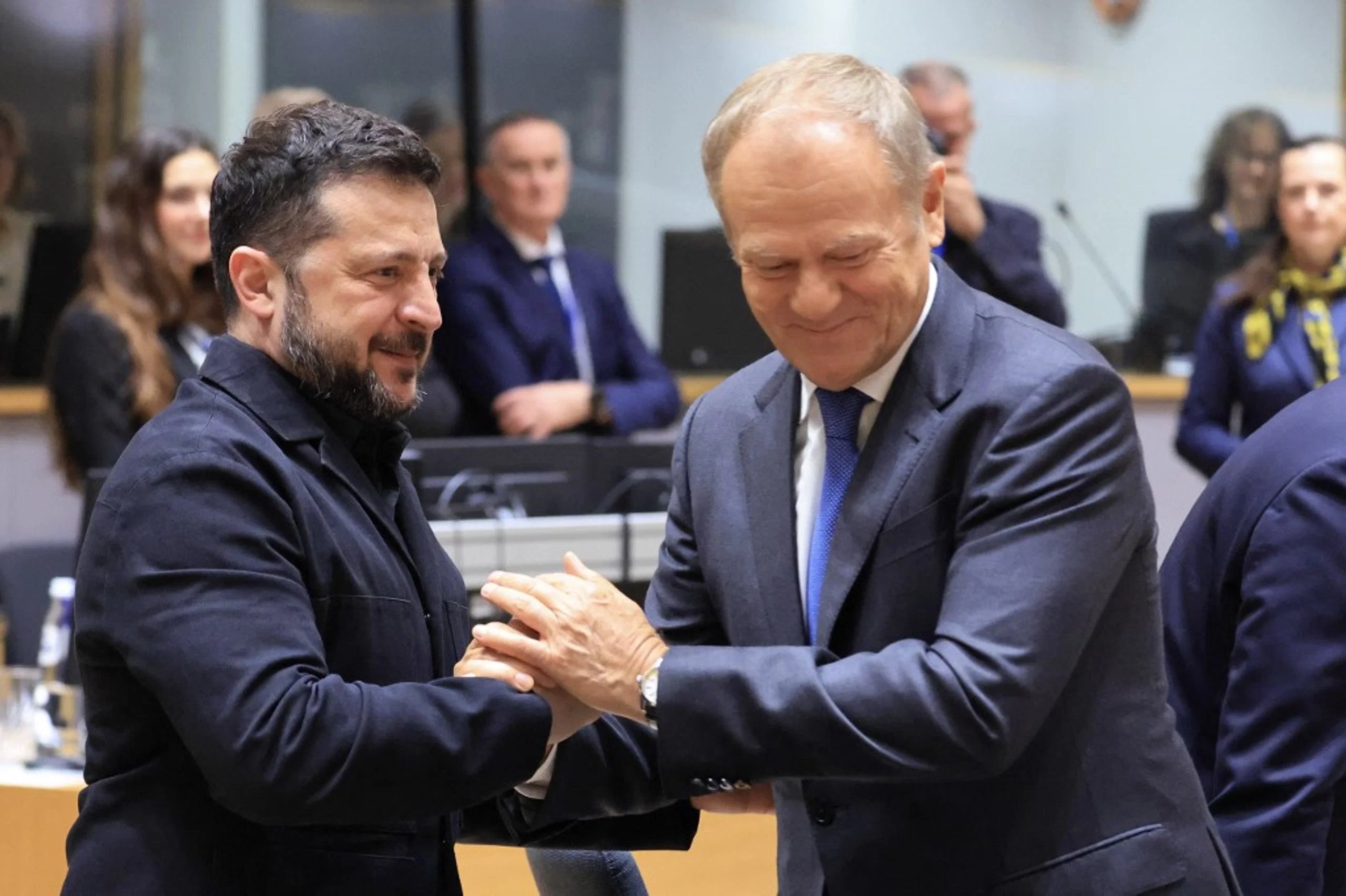
Two neighbors, one enemy. President Volodymyr Zelensky and Poland’s Prime Minister Donald Tusk (R) speak before a round table at the EU summit at EU headquarters in Brussels on Oct. 16, 2026. (Photo by Ludovic MARIN / AFP)
Old neighbors, new warmth. Zelensky said relations with Poland have “genuinely improved” and thanked Tusk and the Polish people. “The enemy is one — Russia,” he said.
A €70 billion hole. EU leaders asked the European Commission for a concrete plan to cover Ukraine’s projected 2027 budget gap, which Commission President Ursula von der Leyen put at €70 billion. Money keeps flowing under the existing €90 billion loan, and an EU official said it is undecided whether frozen Russian assets will be used.
Europe’s own eyes. Macron said the G7 and European partners will review Ukraine’s funding request, and that Europe is speeding up satellite imagery and early-warning systems for Ukraine, after friction with Washington exposed how much Kyiv relies on American technology.
Missiles for Belarus. Zelensky said Putin intends to place ballistic missiles in Belarus, though he would need Alexander Lukashenko’s consent and nothing suggests a move is imminent. Meanwhile, Russian signal relays in Belarus stretch the range of Russian drones deep into western Ukraine’s Rivne, Volyn and Lviv regions.
The Closing
You can’t drive the ambulance in Kherson or fly the drone over Dobropillia. But you can do what Zelensky asked of everyone watching: see what is actually happening, and refuse to look away. Russia is betting that Ukrainians will stop running toward the fire, and that the rest of the world will stop caring. Ukraine has proved the first bet wrong every day of this war. The second is up to us.
A Prayer for Ukraine
1. For Those Who Defend
Lord of hosts, cover the soldiers holding Kostiantynivka and Dobropillia, who stand where Russia’s generals say they are gone. Steady the hands of the drone pilots flying under a limit they did not choose, and the F-16 pilots chasing jet drones through the night. Remember the prisoners near Huliaipole who were wounded and helpless when they were killed. Shield every captive soldier, and bring those who gave such orders to account before You.
2. For the Wounded and the Grieving
God of all comfort, receive the ambulance driver killed in Kherson as he came to help others, and heal the medic hurt beside him. Hold the month-old baby and the 11-year-old who were wounded, and the families of Sloviansk who waited for word from under the rubble. Comfort those who mourn the man of 58 and the woman of 71 in Kharkiv, and the woman of 74 near Nikopol. Let justice not sleep.
3. For Those Who Lead
King of kings, give President Zelensky wisdom and endurance as he pleads for his people. Grant President Trump and the Congress clear sight to see what is happening in Ukraine, and courage to act on what they see. Give Europe’s leaders, Costa, von der Leyen, Macron and Tusk, unity and resolve as they weigh Ukraine’s needs for the year ahead. Let no leader trade a nation’s life for a bargain.
4. For the Grid and the Towns
Faithful God, strengthen the repair crews working without rest in Lutsk, Rivne, Zhytomyr, Vinnytsia, Shepetivka, Slavuta and Netishyn. Restore power, heat and water before the cold comes. Protect the steelworkers of Zaporizhstal and give the 5,500 workers of the Lutsk wiring plant their jobs back soon. Guard the apartment blocks of Kherson and Sloviansk, and let homes be rebuilt where walls have fallen.
5. For a People Who Keep Standing
Father, a whole region was asked to switch its lights on one by one, and it did. Medics went back into danger, and soldiers held towns that liars had already given away. Sustain this people, whose courage is real though their strength is not endless, and let the truth of what they suffer be seen by all. In Your mercy, in Your justice, in Your time — bring this war to its end, and let the ending be worthy of what Ukraine has endured.