
While seven died in Kyiv’s rubble and Russian drones crossed into NATO territory, Trump’s peace negotiators met in Abu Dhabi to discuss Ukraine’s future—but Moscow’s missiles made clear that Russia negotiates with weapons, not words.
The Day’s Reckoning
The first Kinzhal missile hit Kyiv at 6:47 a.m., punching through the predawn darkness with hypersonic precision. Then another. Then Iskanders rising from ground launchers. Then Kalibrs spinning off naval platforms. Then the drones—250 of them humming through the night sky with their distinctive whine.
Seven people died before breakfast.
In Abu Dhabi’s climate-controlled conference rooms, U.S. Army Secretary Dan Driscoll sat across from Ukraine’s intelligence chief and Russian negotiators, discussing the mathematical reduction of Ukraine’s future. The peace plan that had started at twenty-eight points was down to nineteen. Each deletion presumably represented compromise. Each missile that struck Kyiv’s apartment buildings suggested otherwise.
The Ukrainian Air Force intercepted 438 drones, one Kinzhal, five Iskander-Ks, three Iskander-Ms, five Kalibrs. An extraordinary defensive performance that still left twenty-six weapons on target and debris raining across twelve locations. In the Dniprovskyi district, firefighters pulled an 86-year-old woman from rubble as flames consumed five floors of her apartment building. In Sviatoshynskyi, a follow-on strike killed four more while rescue workers were still searching for survivors from the overnight assault.
Russia’s negotiating technique: discuss concessions while tightening the noose.
The timing wasn’t coincidental. While Vadym Tupchii—stage designer, prop maker, contributor to Ukrainian comedy television—died in the rubble, diplomats argued over whether Ukraine’s post-war army should number 600,000 or 800,000 soldiers. While the Novus supermarket chain’s only logistics hub burned and four truck drivers died during routine unloading operations, Steve Witkoff prepared for his Moscow trip to meet Putin, having already told Russian officials in October: “I know what it’s going to take to get a peace deal done: Donetsk and maybe a land swap somewhere.”
Over 102,000 Ukrainians woke without power. Rolling blackouts would begin the next day.
Day 1,371. Violence and diplomacy happening simultaneously, in parallel universes that occasionally collided when missiles interrupted the mathematics of peace plans.
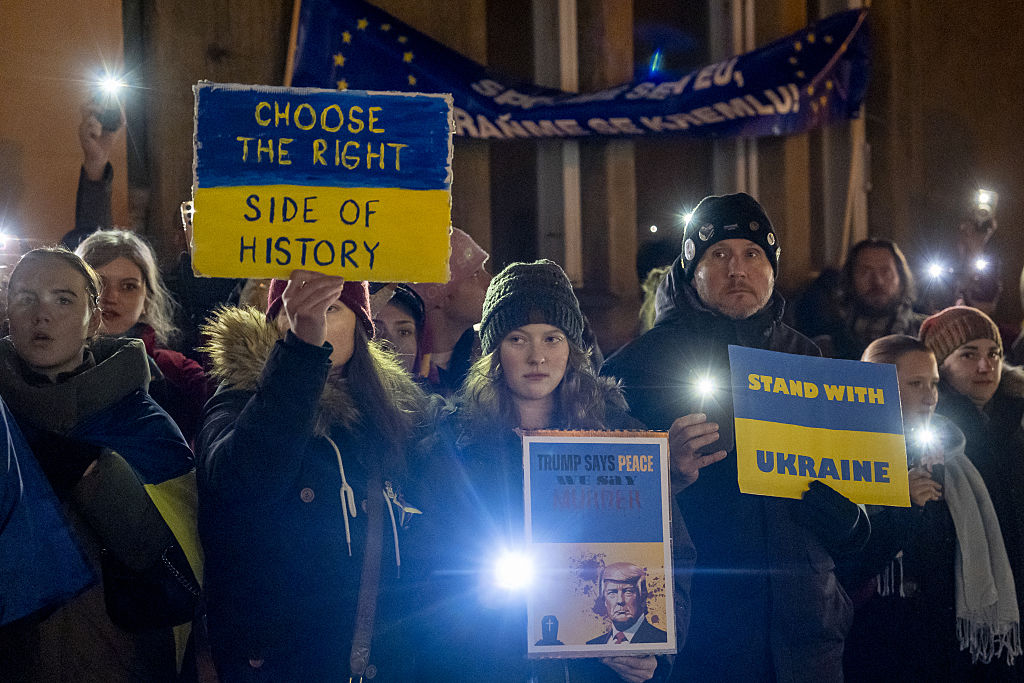
Prague, evening of day 1,371: Protesters hold signs reading “Choose the Right Side of History” outside the U.S. Embassy as Trump’s peace plan takes shape in distant conference rooms. They’ve watched this movie before—1938, when great powers decided Czechoslovakia’s fate without Czechoslovakia in the room. (Stringer / Anadolu via Getty Images)
Dawn’s Catalog of Destruction
Four Kh-47M2 Kinzhal missiles launched from MiG-31K fighters. Three Iskander-M ballistics rising from ground launchers. Eight Kalibr cruise missiles spinning off naval platforms. Seven Iskander-K missiles tracing programmed paths. And approximately 250 Shahed drones humming through predawn darkness with their distinctive engine whine.
The Ukrainian Air Force intercepted one Kinzhal—hypersonic missiles aren’t supposed to be interceptable. They stopped three Iskander-Ms, five Iskander-Ks, five Kalibrs, and 438 drones. An extraordinary defensive performance that would have seemed miraculous in any previous war.
It wasn’t enough.
In Kyiv’s Dniprovskyi district, a nine-story residential building erupted in flames at 6:47 a.m. Firefighters pulled an 86-year-old woman from the rubble, her body joining another victim as the fire consumed five floors with the voracity that only modern building materials achieve when ignited by military-grade explosives. In Pecherskyi, multiple apartment buildings absorbed blast patterns and ignited, morning light revealing the characteristic signatures of high-explosive warheads against structures built for living, not surviving.
Then came the follow-on strike.
The Sviatoshynskyi district absorbed the second wave at midmorning—Russian forces demonstrating their willingness to attack even as rescue operations continued from the overnight assault. Four more dead. A non-residential building collapsed, potentially trapping victims beneath rubble as emergency services navigated the familiar calculus: save lives while expecting the next missile.
This was Russia’s “double tap” technique, refined across 1,371 days of war.
Among the dead: Vadym Tupchii, stage designer and prop maker whose work on Ukrainian comedy television now ended beneath concrete and twisted rebar. Kirylo Chyrkov described waking to “a whistle for a split second and then a huge blast just three meters from our balcony”—doors blown from frames as he and his girlfriend and cat fled through the burning sixth floor with the instinct of those who’ve learned that hesitation equals death.
The Novus supermarket chain lost its only Kyiv logistics hub—50,000 square meters built during the invasion with European Bank financing. Four truck drivers died during routine unloading operations. The textile business TK Group watched its warehouse and production buildings in Darnytskyi district reduced to ruins, the owner’s Facebook post promising “we are working, even without windows or walls.”
Over 102,000 Ukrainians woke without power. The Energy Ministry reported damage across Kyiv, Odesa, Chernihiv, Dnipropetrovsk, and Kharkiv oblasts. Rolling blackouts would begin the following day.
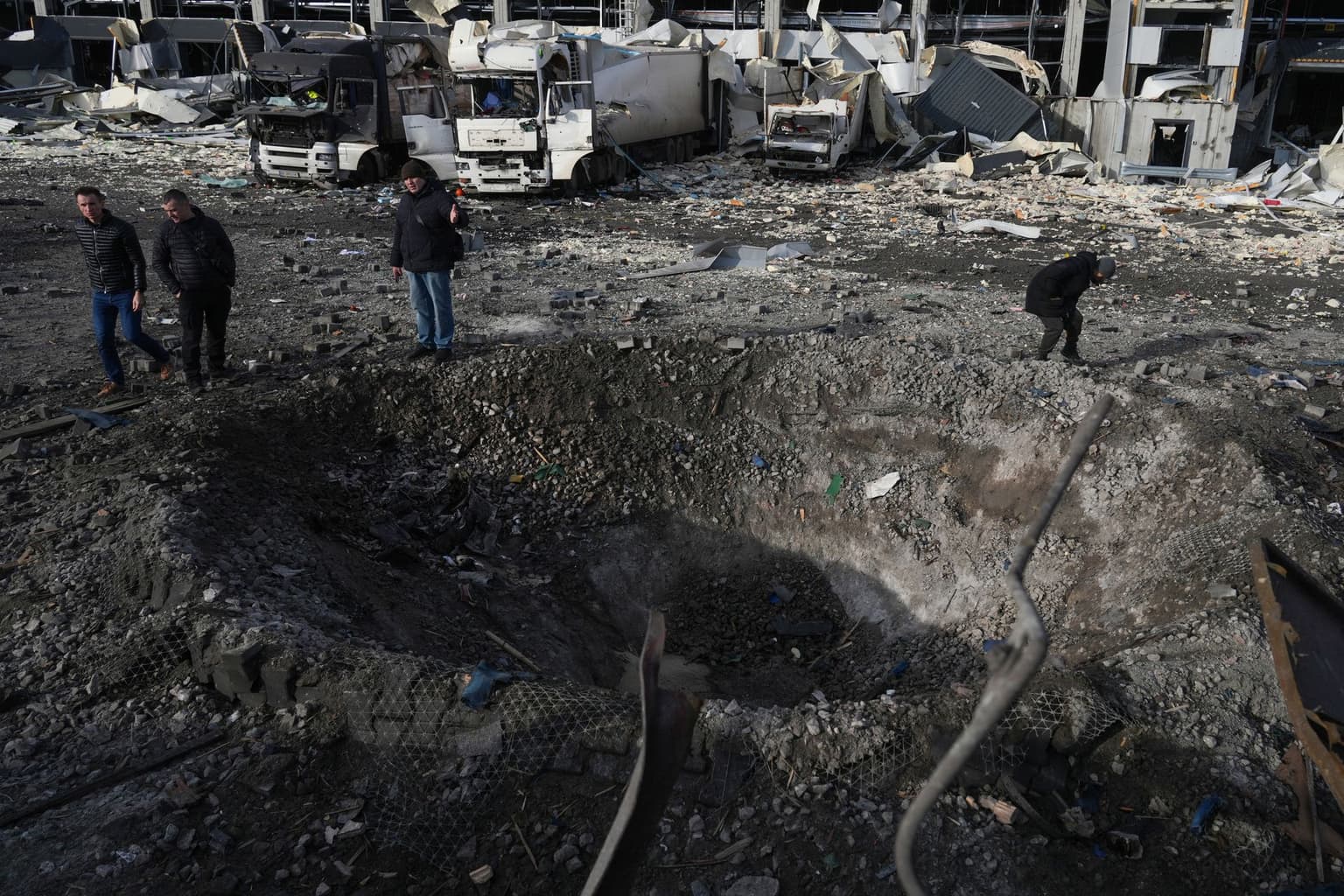
Morning in Kyiv: Law enforcement officers stand at the edge of a crater beside the Novus logistics hub—50,000 square meters built during the war with European financing, destroyed in seconds. Four truck drivers died here during routine deliveries while diplomats in Abu Dhabi discussed peace. (Oleksii Filippov / AFP via Getty Images)
Three Cities, One Delusion
In Abu Dhabi’s conference rooms, Dan Driscoll sat with Ukraine’s intelligence chief Kyrylo Budanov and Russian representatives, discussing terms. The talks had reportedly been planned for “a different topic” before Driscoll’s unexpected arrival shifted the agenda—revealing the improvised quality of Trump administration diplomacy as it scrambled to produce the peace deal the president had promised would arrive swiftly and painlessly.
In Washington, Trump announced that Special Envoy Steve Witkoff would travel to Moscow the following week to meet Putin personally.
In Kyiv, rescue workers pulled bodies from rubble.
The architecture remained deliberately opaque. Was Ukraine negotiating directly with Russia, or were American intermediaries shuttling proposals between delegations separated by geography and diplomatic fiction? The opacity suggested Washington’s preference for managing rather than facilitating genuine Ukrainian-Russian dialogue.
Witkoff had already shown his hand. In an October phone call with Russian officials: “I know what it’s going to take to get a peace deal done: Donetsk and maybe a land swap somewhere.”
Translation: Ukrainian territorial integrity had become a variable in Washington’s calculations.
Trump’s characterization of the original twenty-eight-point plan revealed either genuine confusion or calculated retreat: “just a map,” he said, “not a plan” but merely “a concept.” The proposal had been whittled from twenty-eight points to nineteen through Geneva consultations, each deletion presumably representing compromise extracted from Moscow’s maximalist positions.
The missiles striking Kyiv’s apartment blocks suggested otherwise.
Sergei Lavrov demonstrated Moscow’s playbook perfectly. Russia’s stance would “fundamentally” change, he claimed, if the updated plan “erased” alleged agreements from the August Alaska summit. The Alaska summit that had produced no public documentation. No joint statement. Nothing but Putin’s post-conference reiteration of maximalist demands and Lavrov’s clarification that Russia’s war aims remained unchanged.
The Kremlin was exploiting deliberate ambiguity to position Moscow as the reasonable party honoring commitments while characterizing Ukrainian and Western proposals as violations of agreements that had never actually been reached.
A former senior Kremlin official told the Washington Post the initial plan was “pro-Russian” but still insufficient. Why? Because it failed to address the Kremlin’s actual demands: removing Ukraine’s democratically elected government and crippling its military capacity.
The goals that had motivated the February 2022 invasion hadn’t changed. Only the diplomatic language had gotten more sophisticated.
The Noose Tightens Around Pokrovsk
Russian forces now controlled Pokrovsk south of the Donetska Railway. The formalization of what Ukrainian and Russian sources had been documenting for days—the railway line becoming the new demarcation between control and contest.
The frontline ran along Pokrovsk’s northern outskirts. Russian forces had established sufficient presence to deploy tanks and mortars inside the city since November 19—heavy equipment that Ukrainian interdiction had previously kept at bay.
Translation: Pokrovsk was transitioning from threatened to lost.
Ukrainska Pravda reported that Ukrainian counterattacks in Rodynske north of Pokrovsk initially succeeded. Then Russian forces retook the settlement. The pattern revealed the operational reality: Ukraine could still mount localized pushes, but lacked the resources to hold gains against Russian reinforcement.
The Russian advance toward Myrnohrad demonstrated the template’s mechanical logic. Geolocated footage showed Ukrainian servicemembers taking Russian prisoners along Tsentralna Street in central Myrnohrad—indicating infiltration missions had penetrated deep into the settlement. But “deep penetration” didn’t mean comfortable control. The presence of Ukrainian forces sufficient to capture enemy personnel suggested the urban battle retained its fluid, contested character.
For now.
The Ukrainian 7th Rapid Reaction Corps assessed that Russian forces would attempt to sever ground lines of communication between Pokrovsk and Myrnohrad in the near future. The tactical geography made such an operation the logical next step.
A Ukrainian officer told Ukrainska Pravda that the ground lines of communication to Myrnohrad lay entirely within contested “gray zone.” Neither Ukrainian nor Russian forces exerted firm control. Ukrainian servicemembers reported that Russian FPV drone operators were within range to interdict the Pokrovsk-Myrnohrad connection.
The operational interdiction campaign that had preceded Russian advances into Pokrovsk was now being applied to Myrnohrad. Degrade logistics. Isolate defenders. Then advance.
Russian military planners had learned from three years of grinding urban combat that seizing Ukrainian cities required first starving them of sustainment. The lesson was now being applied with increasing sophistication across multiple axes.
Around Kostyantynivka, the pattern repeated. A Ukrainian drone platoon commander told Ukrainska Pravda that Russian forces had been entering Kostyantynivka for over a month, regularly engaging with small arms. The infiltration phase was well advanced. Russian milbloggers claimed fighting continued on the city’s eastern outskirts while months of heavy strikes suggested an operational-level air interdiction campaign ahead of a dedicated ground effort.
The template: interdict, infiltrate, advance. Repeat.
When Drones Cross NATO Borders
Romanian air defense detected two drones over Tulcea and Galați counties in southeastern Romania overnight. NATO scrambled German Eurofighter Typhoons and F-16s. The fighters tracked the first drone until it reentered Ukrainian airspace. They prepared to engage the second as it pushed deeper into Romanian territory.
Romanian Defense Minister Ionut Mosteanu’s statement revealed the operational dilemma: fighters nearly shot down the second drone but held off due to concerns about debris damage.
Translation: Russian weapons regularly violate NATO borders with impunity because shooting them down creates its own problems.
Then came the discovery in Vaslui County—250 to 300 kilometers from Ukraine. Potentially the deepest violation of Romanian airspace since February 2022. A Russian drone without an explosive device, suggesting either catastrophic navigation failures or deliberate testing of how far into NATO territory Moscow could push without consequences.
Mosteanu called it “a new Russian provocation.” Romanian officials understood these weren’t accidents but boundary-testing designed to establish precedents and normalize transgressions that would have been unthinkable in previous eras.
Moldova experienced six separate airspace violations. A Gerbera drone crashed into a house in Cuhurestii de Jos in northern Moldova. The Foreign Affairs Ministry summoned Russia’s ambassador in a gesture whose diplomatic futility underscored how thoroughly international law had become optional for a state engaged in existential conflict.
While Russian drones crossed NATO borders, Ukraine struck back deep into Russian territory.
The Caspian Pipeline Consortium resumed loadings at its Black Sea terminal near Novorossiysk after Ukrainian strikes forced a temporary halt. Ukrainian drones hit the Sheskharis Oil Terminal and Tuapse Oil Refinery in Krasnodar Krai—targeting oil infrastructure to create economic costs for continued aggression.
In Taganrog, Ukrainian strikes on the Beriev Aircraft Repair Plant destroyed an A-60 experimental aircraft and an A-100 long-range radar detection aircraft. The successful engagement of targets hundreds of kilometers from Ukrainian launch sites demonstrated that Kyiv’s drone and missile programs had achieved operational maturity.
Ukraine couldn’t stop every Russian missile striking Kyiv.
But it could make Russia pay for launching them.
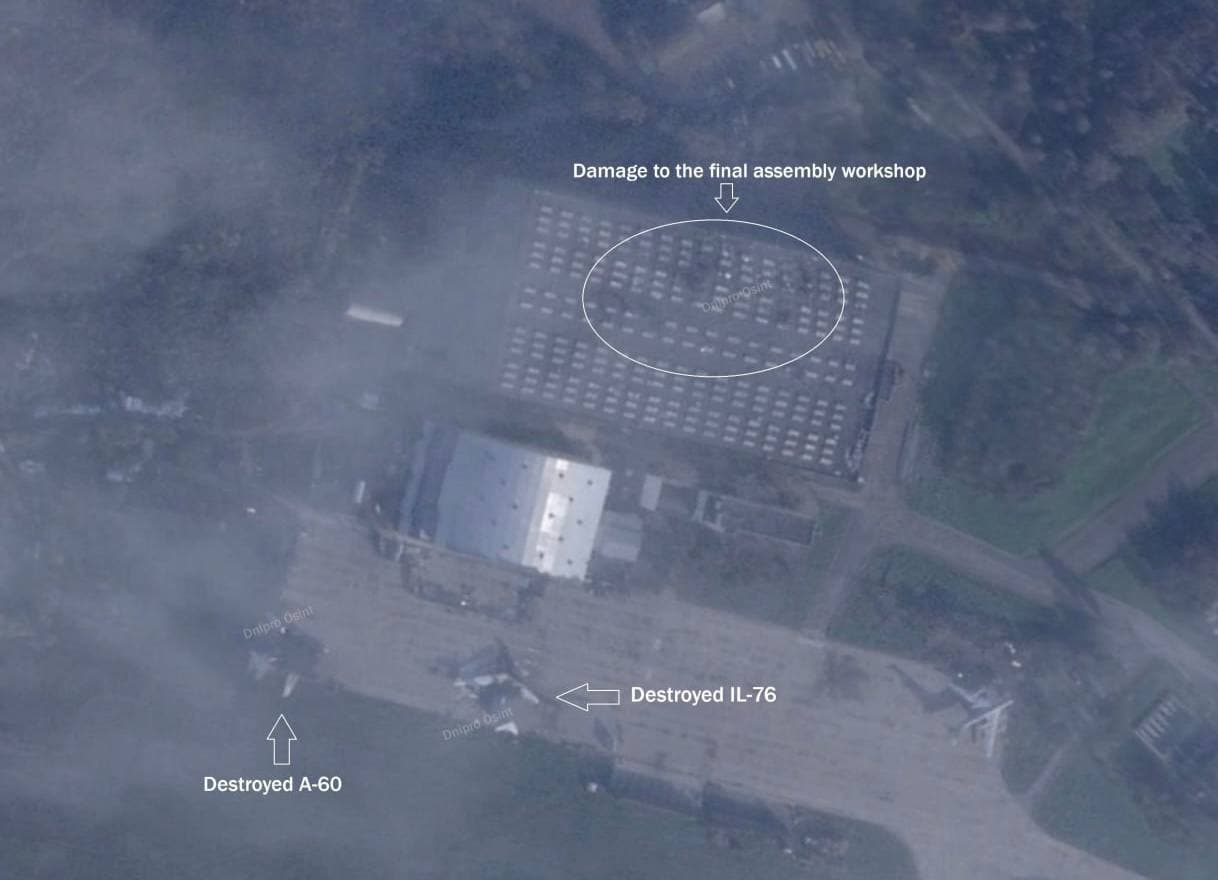
Taganrog, Russia—the morning after: Ukrainian drones reached deep into Rostov Oblast, destroying an A-60 experimental aircraft and an A-100 long-range radar detection plane at the Beriev repair facility. Ukraine can’t stop every Russian missile, but it can make Russia pay for launching them. (Dnipro OSINT)
Europe Plans for the Next War
Macron announced that French, British, or Turkish troops could deploy to Ukraine as part of a “reassurance force” the day a peace deal was signed. Not as NATO forces—Moscow would never accept that. But as an “intergovernmental coalition” operating in rear locations like Kyiv or Odesa to provide security and training.
The distinction was designed to avoid triggering Russian objections to formal alliance presence while achieving the practical effect of European security guarantees for Ukrainian sovereignty.
Roughly twenty countries had already indicated what they were prepared to contribute—either in the air, on land, or at sea. The Coalition of the Willing had progressed beyond theoretical discussions to operational planning. Ground forces. Air support potentially based outside Ukraine but working with Ukrainian forces. Maritime elements to secure access and demonstrate commitment to Ukrainian territorial waters.
The emphasis on establishing an air reassurance force acknowledged the degree to which Russian air superiority and the threat of strikes against Ukrainian infrastructure had shaped the conflict. Any post-war security architecture would need to address this threat.
Whether such arrangements would prove sufficient to deter renewed Russian aggression remained unclear. Particularly given Moscow’s repeated statements rejecting any NATO or Western military presence on Ukrainian territory.
The security guarantees discussion occurred alongside intensifying European conversations about frozen Russian assets. Macron’s statement that France and European allies would work in coming days toward using the assets represented a potential breakthrough in the longstanding debate about immobilized Russian reserves could be leveraged without undermining trust in European financial institutions.
The proposal: a reparations loan backed by Russian assets to address Ukraine’s massive funding requirements for 2026-2027. The estimates were staggering—83.4 billion euros for military support, 52.3 billion euros for macro-financial needs. Sums that exceeded European budgets’ capacity for direct transfers but might be manageable through creative financing mechanisms tied to assets that Russia itself had forfeited through its aggression.
The European approach reflected more sophisticated understanding than Washington’s: any settlement would require concrete mechanisms to deter renewed Russian aggression, not paper commitments that Moscow had violated repeatedly throughout its history.
But the scale of resources required—both for deterrence and reconstruction—confronted uncomfortable realities about European capacity and political will.
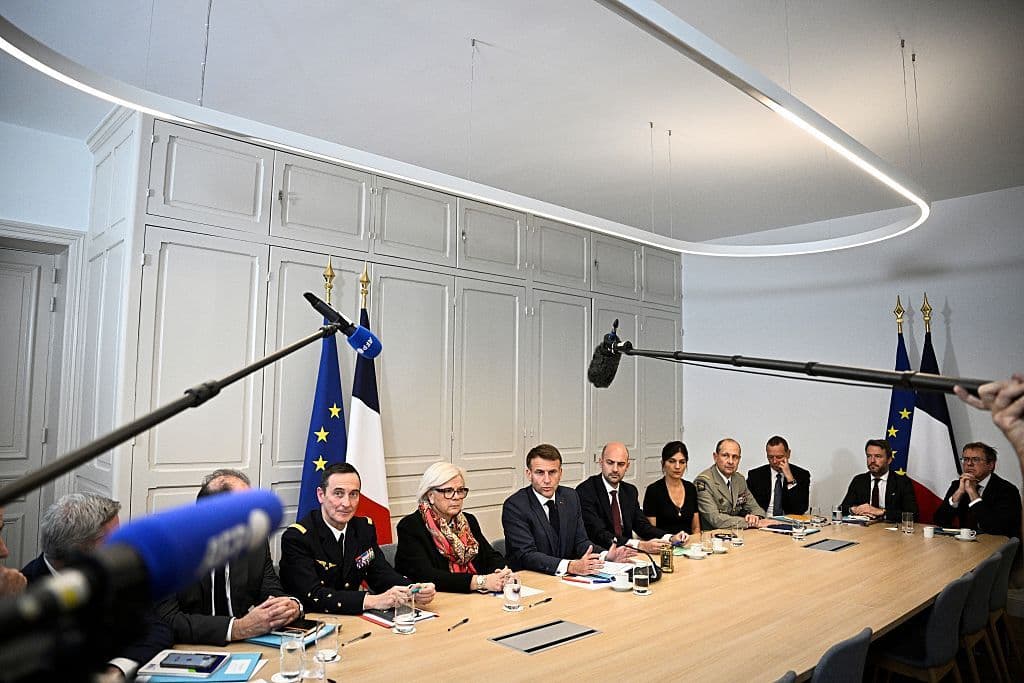
Paris, Elysee Palace: Macron announces that French, British, or Turkish troops could deploy to Ukraine the day a peace deal is signed—not as NATO forces, but as an “intergovernmental coalition” to deter the next Russian invasion. Twenty countries have already indicated what they’re prepared to contribute. (Julien De Rosa / POOL / AFP via Getty Images)
When the Watchdogs Are Watched
NABU detective Oleksandr Abakumov discovered 527 reports containing personal data at a money laundering office used by Energoatom corruption suspects. The targets: sixteen lawmakers, eighteen ministers and deputy ministers, ten journalists, nine SBU employees, and fifteen NABU detectives investigating corruption in the energy sector.
The form and content of the documents suggested preparation by law enforcement agencies.
Translation: The institutions tasked with fighting corruption had become participants in protecting corrupt networks.
The timing revealed the coordination. Reports on several NABU detectives were created on July 17—just days before the Prosecutor General’s Office, SBU, and State Investigation Bureau conducted at least seventy searches at the anti-corruption bureau and arrested detective Ruslan Mahamedrasulov.
The SBU’s accusation: Mahamedrasulov and his father had planned to serve as intermediaries in cannabis sales to Dagestan. The evidence: poor audio quality recordings. When a key witness refuted the claims, prosecutors charged him with perjury—what critics interpreted as illegal pressure to maintain the narrative.
The pattern suggested a coordinated effort to undermine NABU’s Energoatom investigation. That investigation had implicated Timur Mindich, a close associate of President Zelensky, as the alleged ringleader of the largest corruption case during Zelensky’s presidency.
NABU chief Semen Kryvonos revealed that unidentified people had monitored bureau employees’ movements through Kyiv’s municipal surveillance camera system. Not just document collection. Active tracking of investigators’ movements across the capital.
The presence in NABU tapes of references to Prosecutor General’s Office, SBU, and State Investigation Bureau suggested multiple law enforcement agencies might have been implicated in aiding the Energoatom corruption scheme through information sharing and obstruction of investigations.
The situation illustrated a fundamental weakness: Ukraine’s anti-corruption infrastructure remained vulnerable to interference from the very state institutions it was designed to monitor. A structural problem that had persisted despite years of Western pressure and domestic reform efforts.
Wartime didn’t pause corruption. It just made it more consequential—draining resources needed for survival while undermining the institutional trust required for sustained resistance.
The Energoatom case had exposed not just corruption in the energy sector but the fragility of the entire anti-corruption ecosystem when confronted by sufficiently powerful and well-connected defendants.
Twenty-Eight Points to Nineteen
Trump’s peace plan started at twenty-eight points. After Geneva consultations, it was down to nineteen.
Each deletion presumably represented compromise. Or more accurately, the collision between American impatience for a deal and European and Ukrainian insistence that certain provisions were non-negotiable.
The Financial Times reported that the revised proposal would allow Ukraine’s armed forces to remain at 800,000 personnel rather than the originally proposed 600,000. A Ukrainian victory in resisting American pressure for demilitarization that would have left the country vulnerable to renewed Russian aggression.
The figure would maintain Ukraine as the second-largest military force in Europe after Russia. Avoiding significant cuts from current wartime strength of approximately 900,000 servicemembers.
Macron’s response: Ukraine’s army should have no limitations whatsoever.
Translation: Continuing European skepticism about provisions that would constrain Ukrainian defensive capabilities.
The removal of language about war crimes amnesty and the softening of restrictions on Ukraine’s NATO membership aspirations suggested that Geneva consultations had succeeded in eliminating some of the most egregious provisions from the initial American-Russian draft.
Yet the continued emphasis on territorial questions to be resolved directly between Trump and Zelensky indicated that fundamental issues remained unaddressed. American diplomats apparently still entertaining the possibility of “land swaps” and Ukrainian territorial concessions that would reward Russian aggression and establish precedents for future revisions of European borders through military force.
Optimistic assessments from unnamed American officials claimed Ukraine had “agreed” to the revised deal. Ukrainian statements emphasized that final steps remained and sensitive issues required further negotiation.
The gap between these characterizations revealed either diplomatic confusion or deliberate misrepresentation.
Lavrov claimed Moscow had not officially received the new version but would reject it if it failed to meet longstanding demands. The insistence on addressing the war’s “root causes”—a deliberately vague formulation that served as shorthand for maximalist demands that had motivated the invasion—indicated that Moscow remained committed to goals incompatible with Ukrainian sovereignty and Western security interests.
A recording of Russian officials discussing how to “twist” American proposals to align with Russian positions demonstrated the Kremlin’s approach: negotiations as opportunities for manipulation rather than genuine compromise.
The cynicism was explicit in their private communications even as public statements maintained the fiction of Russian flexibility and Western intransigence.
What November 25 Revealed
Two wars happened simultaneously.
In Abu Dhabi, Dan Driscoll sat with Ukraine’s intelligence chief and Russian representatives, discussing the mathematical reduction of Ukraine’s future military capacity. In Kyiv, rescue workers pulled seven bodies from apartment buildings while firefighters battled blazes across five floors of residential structures.
The juxtaposition wasn’t coincidental. It was Russia’s negotiating strategy: intensify violence while discussing peace, demonstrate Ukrainian vulnerability while characterizing Western proposals as insufficient, maintain maximum military pressure while positioning Moscow as the reasonable party.
The day illustrated that the true obstacle to peace wasn’t any lack of diplomatic creativity or insufficient Western pressure on Kyiv to accept necessary compromises. The obstacle was Russia’s fundamental commitment to achieving through negotiation what it had failed to secure through military force.
The Kremlin’s demands remained unchanged from those that had motivated the February 2022 invasion: recognition of conquered territories, removal of Ukraine’s elected government or its emasculation through enforced neutrality and demilitarization, and establishment of terms that would facilitate future Russian aggression by demonstrating that territorial conquest would be validated through diplomatic settlement if pursued with sufficient violence and Western patience.
Moscow’s willingness to discuss various proposals didn’t reflect genuine interest in peace but rather a tactical calculation that engaging in negotiations provided opportunities to extract concessions while maintaining military operations that degraded Ukrainian capacity to resist.
The Western response revealed a fundamental misunderstanding. Trump’s insistence on rapid deal-making and his characterization of the initial proposal as merely “a concept” showed an assumption that Ukraine and Russia were parties to a dispute over negotiable interests rather than participants in an existential struggle over whether European borders could be revised through military force.
The willingness to consider “land swaps” and the emphasis on achieving a deal by arbitrary deadlines suggested Washington prioritized the appearance of diplomatic success over the substance of any agreement and its capacity to establish genuine peace rather than merely frozen conflict.
The European position reflected more sophisticated understanding. Macron’s emphasis on robust security guarantees and the Coalition of the Willing’s discussions of peacekeeping deployments acknowledged that any settlement would require concrete mechanisms to deter renewed Russian aggression rather than paper commitments Moscow had violated repeatedly.
Yet European capacity confronted uncomfortable realities: the scale of resources required exceeded budgets’ capacity for direct transfers, deploying troops to Ukraine would require overcoming Russian objections and domestic political resistance, and frozen Russian assets remained locked in legal complexities that had prevented effective use for nearly four years of war.
The attacks that killed seven in Kyiv demonstrated that Russia retained both capacity and will to inflict suffering even as diplomatic negotiations intensified. The violation of Romanian and Moldovan airspaces revealed Moscow’s contempt for international law extended beyond Ukraine to any country bordering Russian interests.
Questions remained that couldn’t be answered through additional consultations or further mathematical reductions of peace plans.
Would Ukrainian society accept terms that rewarded Russian aggression with territorial gains and constrained Ukrainian defensive capabilities? Would European states commit resources and potentially soldiers to security guarantees that might require fighting Russia in future conflicts? Would Washington maintain engagement beyond Trump’s self-imposed deadlines and resist declaring victory regardless of whether agreements actually ended violence or simply froze it?
And would Russia accept any settlement that didn’t validate its invasion and set conditions for future aggression, or would Moscow continue negotiations while maintaining military operations until Western patience exhausted itself and Ukrainian resistance collapsed under accumulated destruction?
The seven dead in Kyiv offered no answers. The negotiations in Abu Dhabi would continue, the peace plans would be further refined and reduced, the diplomatic rhetoric would maintain the fiction that reasonable parties could reach accommodation serving everyone’s interests.
But the fundamental reality remained unchanged: Russia had invaded Ukraine to destroy its sovereignty and would accept only terms that achieved that objective, while Ukraine fought to preserve its existence and would resist any settlement that guaranteed merely slower death through demilitarization and territorial dismemberment.
Between these positions, no amount of diplomatic creativity could construct genuine peace.
Only the elaborate fiction that exhaustion and violence might eventually be mistaken for resolution.