
Ukraine Daily Briefing | June 15, 2026
In the early hours of June 15, a Russian Shahed-type kamikaze drone set fire to the roof of the Dormition Cathedral inside the Kyiv-Pechersk Lavra — a monastery that has stood for nearly a thousand years and survived the Mongol invasions, the Nazis, and the Soviet era, only to be targeted now by a regime that claims to defend Christian civilization. The overnight barrage of 70 missiles and 611 drones killed at least 11 people across Ukraine, while in Kharkiv, Russian forces executed a deliberate double-tap strike — waiting for rescuers to arrive before launching a second missile into the same location, killing five of the people who had come to save lives. As G7 leaders gathered in France and the EU adopted a fresh package of sanctions, President Zelensky offered Putin a meeting on the summit’s sidelines; Moscow’s answer, as it has been to every peace overture, was silence.
The Day’s Reckoning
Picture a monk in the dark, staring out a window at something he cannot quite believe. Flames are rising between the golden domes of the Dormition Cathedral — the central church of the Kyiv-Pechersk Lavra, a monastery complex whose foundations were first laid in 1051 AD. Bishop Avraamii later told reporters he saw the fire in his window and thought, at first, that it must be a mistake. It was not a mistake.
By the time firefighters brought the blaze under control on the morning of June 15, the scope of what Russia had done in a single night was becoming visible. The Lavra. The Mystetskyi Arsenal gallery. The Dovzhenko National Film Studio, where 100,000 costumes — including pieces from Ukrainian cinema classics that no country on earth could replicate — burned to nothing. Nova Poshta’s state-of-the-art sorting terminal. Residential buildings across nine districts of Kyiv. And in Kharkiv, five rescuers who had rushed to the scene of an earlier strike, killed when Russia launched a follow-up missile directly at them.
Russia also struck an ambulance in Zaporizhia Oblast with an FPV drone, injuring the nurse inside — one more data point in a documented pattern of targeting medical vehicles. On the southern front, Ukrainian commanders reported that Russian military maps already show entire settlements near Hulyaipole as captured — settlements that have not actually fallen — and that Russian units are now under orders to launch assaults to make those false reports a reality. The war Russia is fighting exists simultaneously on the ground, in the information space, and on its own internal maps, and the version on those maps increasingly bears little resemblance to the other two.
On the diplomatic front, the day’s darkest irony played out on the French Riviera, where G7 leaders were gathering at Évian-les-Bains as the smoke still rose from Kyiv. Zelensky offered Putin a seat at the table. Putin, as he has done with every peace overture for months, sent no answer. The EU responded the only way it knows how: another round of sanctions. And Russia responded the only way it knows how: another round of lies, claiming a malfunctioning American Patriot missile had hit the Lavra. Security Service investigators found drone fragments at the site before Moscow had even finished writing the statement.
The war is now in its fifth year. The monastery has survived nearly a millennium. The question the world is not yet willing to answer is how many more nights like this one it will have to endure.
The Lavra Burns: Russia Strikes a Thousand-Year Monastery
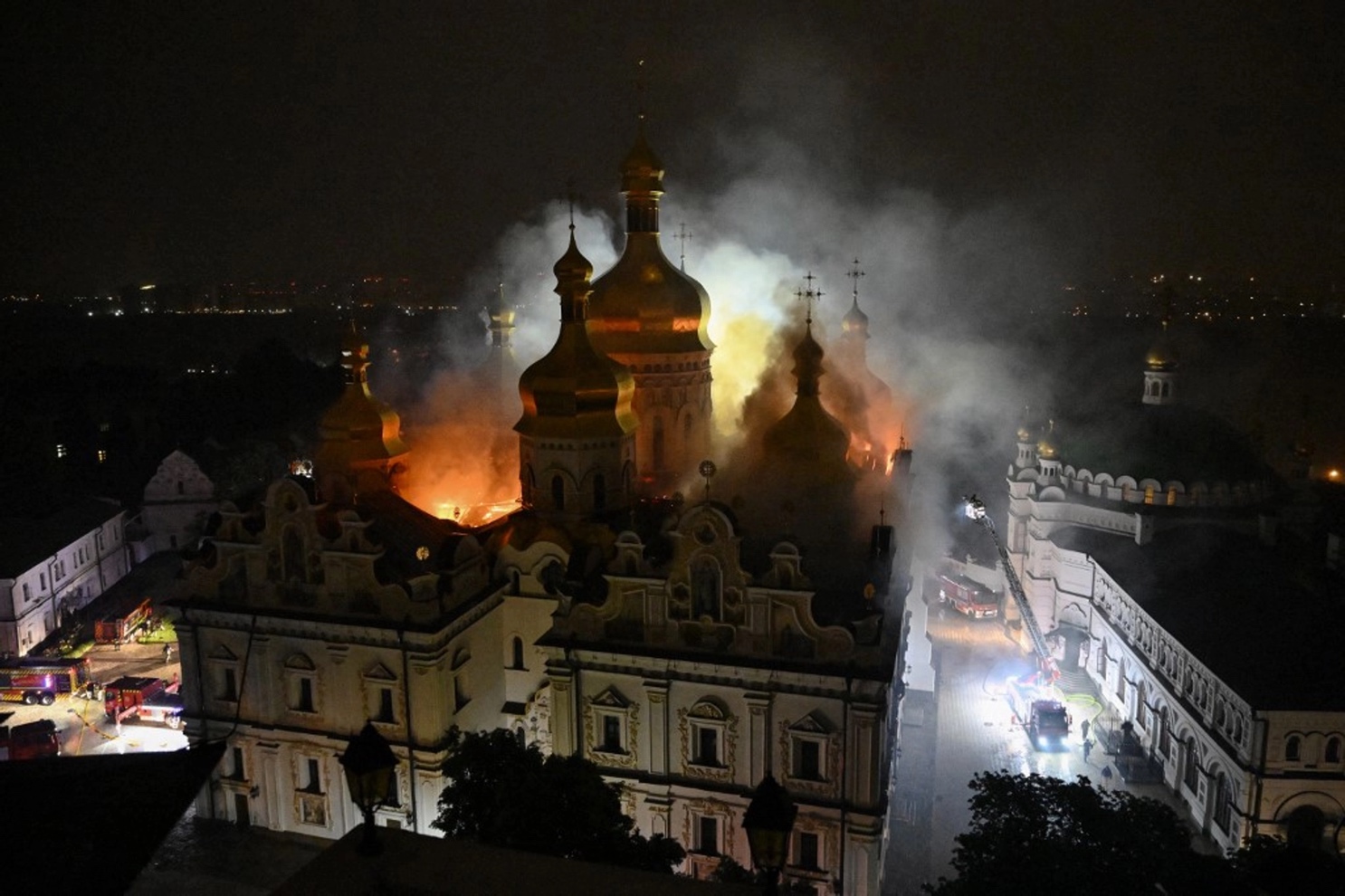
The Kyiv-Pechersk Lavra — known in English as the Monastery of the Caves — is one of the most sacred sites in Eastern Orthodox Christianity, a labyrinthine complex of golden-domed churches, underground cave shrines, and ancient relics that has defined the spiritual geography of Ukraine since 1051 AD. It survived the Mongol sack of Kyiv. It survived the German occupation, though Soviet retreating forces blew up the original Dormition Cathedral in 1941. It has been a UNESCO World Heritage Site for decades. On the night of June 15, a Russian Shahed-type kamikaze drone — a cheap, Iranian-designed loitering munition mass-produced in Russia — set the cathedral’s roof on fire.
The Security Service of Ukraine (SBU) confirmed the weapon’s identity after retrieving fragments from the scene. The markings indicated the components were manufactured at Russia’s Alabuga Special Economic Zone. The strike hit the Stefanovsky Chapel of the Assumption Cathedral at approximately 1:50 a.m. Priests and monastery personnel launched an emergency evacuation of ancient icons, religious relics, and priceless artifacts while flames spread across the roof. Firefighters brought the blaze under control by morning, and the cathedral’s vault was preserved — a fact the site’s director described as the most important outcome of the night.
President Zelensky visited the Lavra in the morning and stood before the damaged cathedral with Ukrainian officials. “Two Russian drones deliberately attacked the part of the city where the Lavra and the Mystetskyi Arsenal are located,” he said. The Russian Defense Ministry claimed, as it almost always does after its most egregious strikes on civilian sites, that the damage was caused by a malfunctioning American-made Patriot interceptor missile — a claim demolished by the physical evidence investigators collected before Moscow had even finished writing the statement. The French foreign minister compared the attack to bombing Notre-Dame. A Kyiv resident who had once studied theology at the Lavra put it another way: “Notre Dame caught fire by accident. Here the situation is different.”
681 Weapons, One Night: The Scale of Russia’s Assault on Kyiv
The attack that set the Lavra on fire was not a targeted strike — it was the climax of one of the largest combined aerial barrages Russia has launched against Ukraine since the full-scale invasion began. In the span of a single night, Russian forces fired 70 missiles and 611 drones at Ukrainian territory. The missiles included six Zirkon hypersonic cruise missiles, 34 Iskander-M ballistic missiles and S-400 air defense missiles repurposed as offensive weapons, and 30 Iskander-K and Kh-101 cruise missiles. The drones included Shahed-type kamikaze drones, Gerbera and Italmas variants, Banderol loitering munitions, and Parodiya decoy drones designed to exhaust Ukrainian air defenses.
Ukrainian air defenses performed well given the scale of the assault. F-16 fighter jets, Patriot and other air defense systems, and mobile fire groups downed all 30 cruise missiles, five of the six Zirkons, 15 ballistic missiles, and 582 drones. Zelensky credited a recently arrived package of Patriot interceptor missiles with preventing far greater destruction. “We had a package of missiles for Patriot, it was recently delivered to Ukraine,” he told reporters. “Now, after we have used them, we can talk about it. There were enough missiles to knock down the ballistics.” Still, 20 ballistic missiles and 27 drones found their targets, striking 42 locations across the country. Debris from intercepted weapons fell on 12 additional locations.
This was the second strike in June 2026 with 70 or more missiles — a pace that analysts say is deliberately designed to overwhelm Ukrainian defenses and force Ukraine to exhaust interceptor stocks faster than they can be replenished. Russian forces also adapted their tactics: Air Force Spokesperson Colonel Yuriy Ihnat noted that Russia replaced Kalibr cruise missiles with Iskander-K variants and flew drones at lower altitudes using faster jet-powered models, making interception more difficult. In Kyiv, the attack left 140,000 households without power, sparked 30 car fires, and struck residential buildings across nine city districts, from Obolon to Pechersk. Some 42,000 people, including 3,400 children, sheltered in the Kyiv Metro.
Culture Under Fire: The Film Studio, the Arsenal, and the Terminal
The Lavra was not the only cultural institution Russia destroyed. Directly across the road from the monastery, a drone struck the Mystetskyi Arsenal — one of Ukraine’s leading contemporary art museums and exhibition spaces — setting the building on fire. Nearby, the Oleksandr Dovzhenko National Film Studio was hit, and the fire that followed consumed a two-story building housing 100,000 costumes: the largest and oldest cinema costume collection in Ukraine. The collection included pieces from some of the most iconic films in Ukrainian and Soviet cinematic history, among them Shadows of Forgotten Ancestors, the 1965 masterpiece by director Sergei Parajanov.
Studio director Andrii Donchyk surveyed the damage on the morning of June 15. “This has set us back years,” he said. “The costs involved are enormous, and the studio simply doesn’t have that kind of money.” He described a dream he had carried for the studio’s centennial anniversary next year — a fashion show featuring costumes from the collection. “That dream will never come true now.” Also struck was Nova Poshta’s Kyiv Innovation Terminal — the company’s flagship automated sorting facility, a €30 million ($35 million) complex spanning 24,000 square meters that could process 50,000 parcels per hour using Dutch-engineered conveyor systems that scanned barcodes from six sides at three parcels per second. All employees were evacuated safely; the building and its equipment were not.
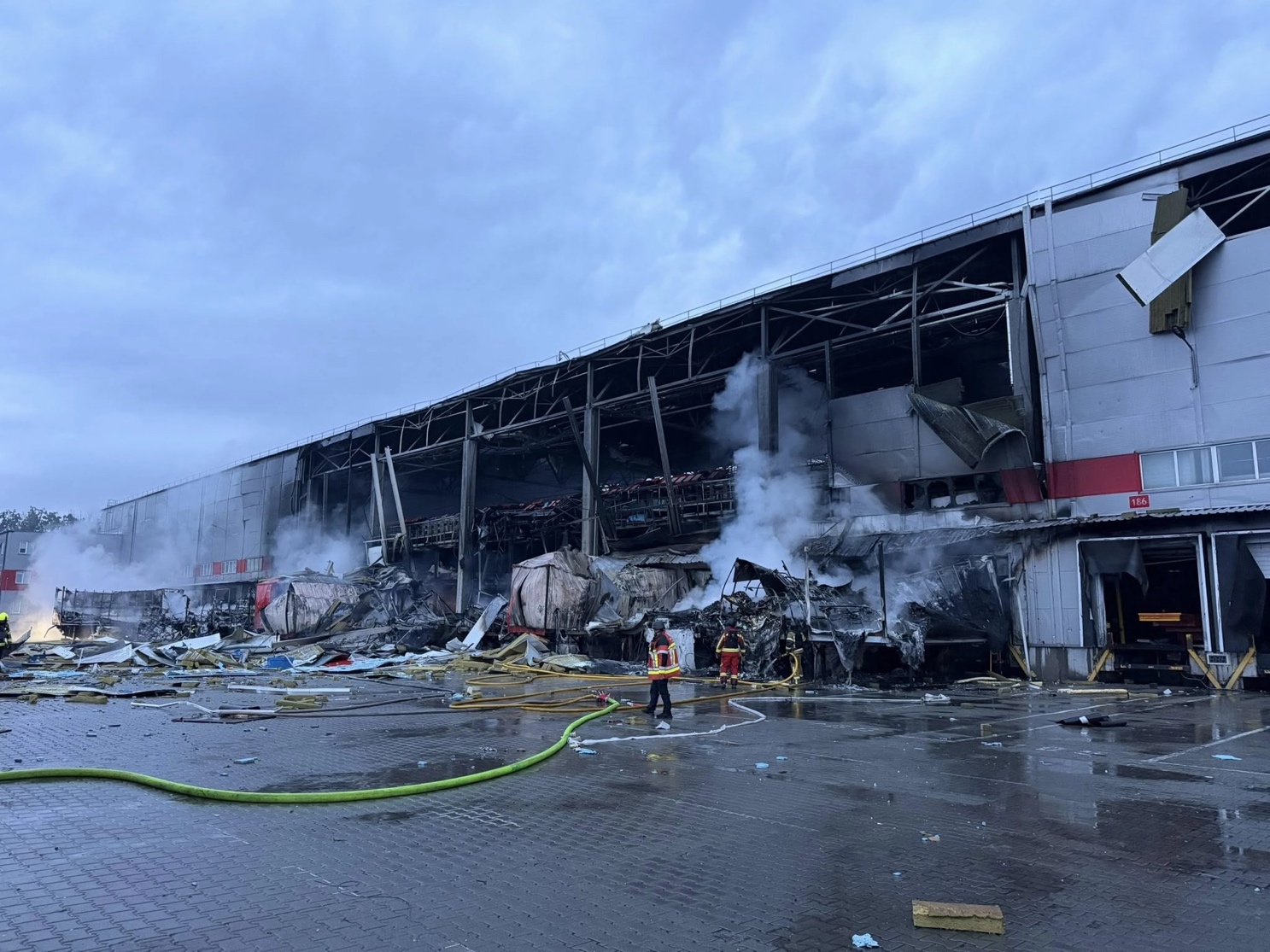
Firefighters work at the site of Nova Poshta’s destroyed Kyiv sorting terminal following a Russian missile strike. (Photo courtesy of Nova Poshta)
The pattern is deliberate. May’s mass attack damaged the National Art Museum, the Kyiv Opera Theater, the Chornobyl Museum (which lost over 40 percent of its collection), and the Dynamo Kyiv stadium. The June 14 evening attack, hours before the overnight barrage, set fire to the Kharkiv Art Museum. The Dnipro strike on June 15 damaged the historic House of Organ and Chamber Music and destroyed a college building. Russia is not accidentally hitting cultural sites. It is systematically targeting the physical fabric of Ukrainian identity — the places that carry memory, continuity, and meaning.
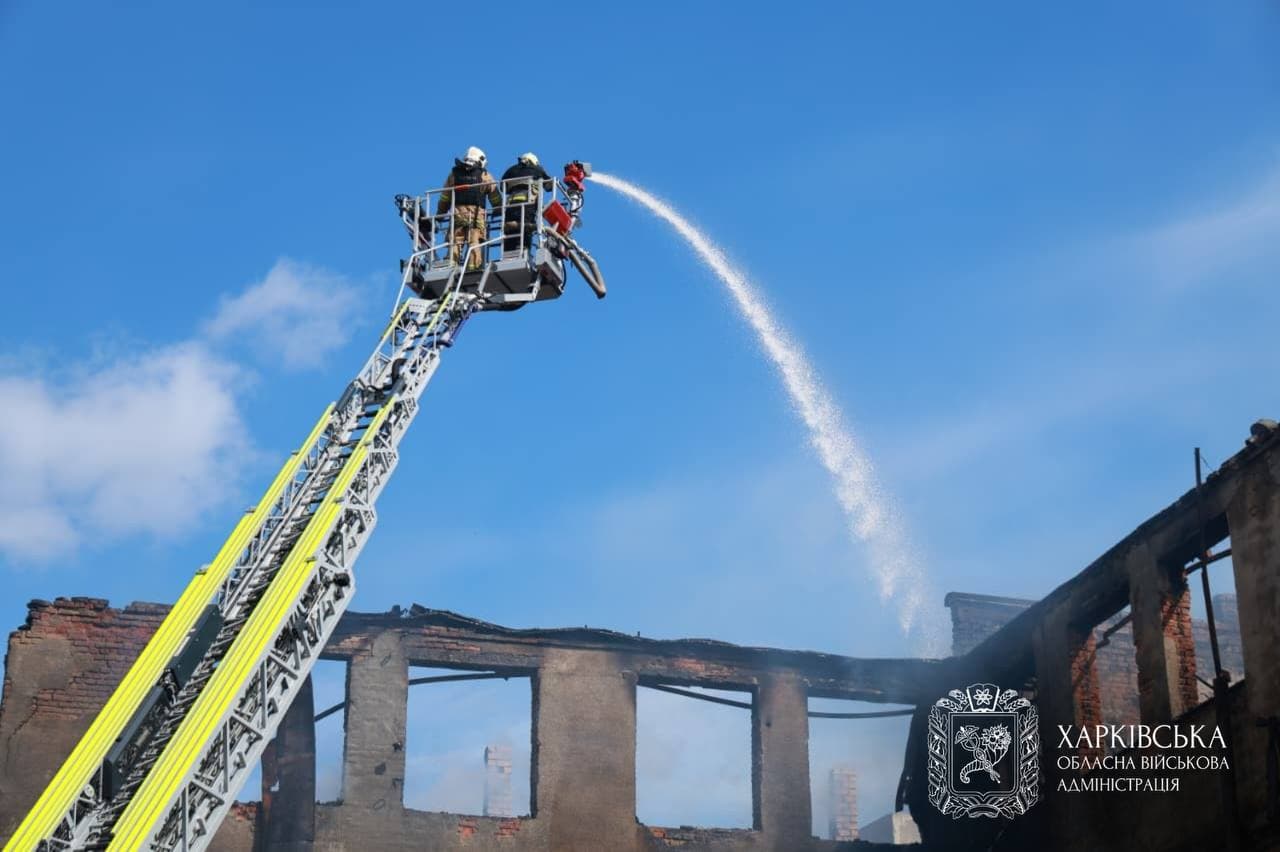
Firefighters extinguish a blaze in a destroyed building in Kharkiv, Kharkiv Oblast, following an overnight Russian attack on the region. (Kharkiv Oblast Military Administration)
‘The Missile Struck Those Who Save Lives’: The Double-Tap Strike in Kharkiv
A double-tap strike is a deliberate tactic: hit a target, wait for emergency responders to arrive, then hit the same location again. It is classified as a war crime under international law. In the early hours of June 15, Russian forces executed one in Kharkiv’s Kholodnohirskyi district — a northwestern industrial area that is also a key railway hub. Russian forces first struck a civilian enterprise with attack drones, then, as the emergency response teams arrived and began working to contain the aftermath, launched several additional missile strikes directly at them.
Five people were killed. Four were named emergency responders: Dmytro Boiko, Danylo Tishchenko, Serhii Makovetskyi, and Vadym Zinchenko. The fifth was Oleksii Dorozhkin, a staff member of the city’s emergency services department. Kharkiv City Emergency Department Director Bohdan Hladkykh told Ukrainian public broadcaster Suspilne that one of the missiles struck approximately 30 meters from a group of rescuers who had just left the grounds of the struck enterprise and were standing in a forest belt. “Unfortunately,” he said, “the missile struck those who save lives.”
Among the 13 people injured was Oleksandra Shchebilova, a newly graduated emergency responder who had joined the State Emergency Service in 2026. She lost her right arm in the attack. She had graduated this year from the National University of Civil Protection. A one-month-old infant was also among the hospitalized. Governor Oleh Syniehubov confirmed the casualty figures; two men remained in serious condition in intensive care as of the morning of June 15. The attack began at approximately 1:30 a.m.
Targeting the Healers: FPV Drone Strikes Ambulance in Zaporizhia Oblast
The Kharkiv double-tap was not the only attack on emergency and medical personnel that day. In Kushuhum, a community located just south of Zaporizhzhia City, a Russian first-person view (FPV) drone struck an on-duty emergency medical vehicle, injuring the nurse inside. Kushuhum Hromada Head Volodymyr Sosunovsky confirmed the strike; geolocated footage published on June 15 showed the aftermath of the attack on the ambulance.
An FPV drone — short for first-person view — is a small, high-speed drone piloted remotely using a headset that feeds the operator live video from the drone’s camera. Originally developed for racing, FPV drones have been adapted into lethal precision weapons capable of threading through windows and striking moving vehicles. They are cheap to produce, difficult to intercept, and have become one of the most common tools of frontline warfare in this conflict. Their use against an ambulance on active medical duty is not a targeting error — it is a choice.
The strike fits a pattern that ISW and Ukrainian officials have documented repeatedly: Russian forces targeting ambulances, medical vehicles, and first responders as a deliberate tactic to deter emergency response, slow casualty treatment, and demoralize communities. Taken together with the double-tap strike against Kharkiv’s rescuers in the same twenty-four hours, June 15 stands as a particularly grim demonstration of what Russian military doctrine has come to mean in practice for the people whose job it is to keep others alive.
Russia’s Lie Machine: Blaming a Patriot Missile for the Drone Strike on the Lavra
The Russian Defense Ministry’s statement came with a kind of clockwork predictability. After the attack on Kyiv’s Okhmatdyt Children’s Hospital in 2024, Russia blamed Ukrainian air defense. After the strikes on Ukrainian shopping centers and apartment buildings, Russia claimed they were military targets. Now, with drone fragments from Russian-manufactured weapons sitting on the grounds of one of Eastern Orthodoxy’s holiest sites, Moscow issued the same denial: the Kyiv-Pechersk Lavra was hit not by a Russian weapon, but by a malfunctioning American-made Patriot interceptor missile. The ministry added, with characteristic creative embellishment, that the malfunction may have been caused by “expired” missiles supplied by Western partners.
The claim did not survive contact with reality. Investigators from Ukraine’s Security Service retrieved fragments of a Geran-2 drone — the Russian military’s designation for the Shahed kamikaze drone produced under license from Iran — from the impact site at the Stefanovsky Chapel. Components bore markings indicating manufacture at Russia’s Alabuga Special Economic Zone. Air Force Spokesperson Ihnat acknowledged that some Patriot interceptor debris may have been present at the site — interceptors that had likely downed a Zirkon missile overhead — but stated flatly that Ukrainian investigations had already confirmed a Russian Geran-2 struck the Lavra. Guardian reporters at the scene described security officers standing over two Shahed drone remains before the Russian Defense Ministry had even finished composing its denial.
Russia’s Foreign Ministry Spokesperson Maria Zakharova amplified the false claim. Russian officials accused Ukraine of “staging” the strike to provoke a Western response. Ukraine’s Center for Countering Disinformation documented what it described as a large-scale coordinated information campaign pushing this narrative. The effort is consistent with a broader Russian cognitive warfare strategy: use coordinated messaging and plausible-sounding technical claims to create enough uncertainty among international audiences that the truth becomes contested rather than clear. In this case, it failed — the fragments told the story too quickly.
The World Responds: Western Leaders React to the Strike on Sacred Ground
The international response to the Lavra strike was swift and, by the standards of four years of diplomatic language about the war in Ukraine, unusually direct. French Foreign Minister Jean-Noël Barrot said the attack was the equivalent of bombing Notre-Dame or Saint-Denis — a comparison that landed with particular weight in France, which lived through the 2019 Notre-Dame fire and spent years restoring it. French President Emmanuel Macron said the attack was impossible to justify and stood as evidence of Russia’s rejection of peace efforts. EU foreign policy chief Kaja Kallas called the damage a war crime and announced that new sanctions would be adopted the same day.
US envoy Keith Kellogg drew a parallel to Nazi Germany’s bombing of St. Paul’s Cathedral in London during the Blitz and challenged anyone to identify a military necessity for the strike. “Someone tell me the military necessity of the Russian attack. There is none,” he wrote. Estonian Foreign Minister Margus Tsahkna accused Russia of displaying contempt for humanity’s shared heritage by striking a monastery that had stood for nearly a millennium. Moldovan President Maia Sandu observed that a Kremlin that claims to defend Christian values had just set fire to one of Christianity’s most revered sites. Lithuanian President Gitanas Nausėda described the attack as demonstrating Russia’s insane disregard for spiritual traditions Moscow claims as its own.
Metropolitan Epiphanius, head of the Orthodox Church of Ukraine, condemned the strike as a crime against Christianity, history, and humanity. Ukraine’s Deputy Prime Minister and Culture Minister Tetyana Berezhna said: “When the Kyiv-Pechersk Lavra comes under attack, this is not only about Ukraine. It is about heritage that belongs to all humanity.” UNESCO condemned the strike on the Lavra and related monastic buildings, including Saint-Sophia Cathedral. Ukraine’s Foreign Minister Andrii Sybiha called for the immediate activation of all international mechanisms — UNESCO procedures, war crimes accountability frameworks — and said Putin had permanently placed his name on the list of history’s worst barbarians.
G7 Summit and the Silence from Moscow: Zelensky’s Rebuffed Peace Offer
As the smoke cleared from Kyiv on the morning of June 15, the leaders of the world’s seven largest democracies were gathering in Évian-les-Bains, France for their annual summit. Zelensky was scheduled to join them on June 16 for a dedicated session on Ukraine — air defense, sanctions, the five-point peace framework that the UK, France, Germany, and Ukraine had drafted together at the E3 summit the week before. Hours before the Russian attack began, Zelensky had spoken by phone with Trump and relayed the latest battlefield developments. The two were set to meet at the G7.
In the aftermath of the overnight barrage, Zelensky revealed that Ukraine had made a specific offer: a face-to-face meeting with Putin on the sidelines of the G7 summit, with Trump and Macron both present. “We gave a message that we are ready to meet with Putin during G7, because Trump is there and Macron is there,” Zelensky said. “Europe and the United States agreed. Russia demonstrated again that they are not ready to speak.” A Ukrainian official told Reuters that the invitation had been delivered directly to Russian representatives. No clear answer was received. Putin had previously said he saw no point in a meeting with Zelensky.
The G7 summit thus convened with the war’s central dynamic starkly visible: Ukraine offering dialogue, Russia answering with drone strikes on monasteries. Zelensky called for a decisive and meaningful response from G7 leaders, specifically naming additional air defense systems as Ukraine’s most urgent need. US-mediated peace talks have been effectively frozen since February, when Washington became consumed by its conflict with Iran. Russian Foreign Minister Lavrov, meanwhile, claimed Russia remains committed to terms allegedly agreed at the Alaska Summit of August 2025 while accusing the EU and UK of sabotaging those arrangements — a Kremlin strategy ISW assesses as exploiting the lack of public records from Alaska to falsely portray Russia as the willing party in stalled talks.
EU Tightens the Noose: New Sanctions Target Shadow Fleet, Propagandists, and Navalny’s Killers
The European Council adopted a new package of sanctions against Russia on June 15, adding 34 individuals and 47 entities to its restricted lists. The package — adopted directly in response to the previous night’s large-scale strike on Kyiv and the attack on the Kyiv-Pechersk Lavra — targets four categories of Russian activity: the military-industrial complex, the shadow fleet used to export oil in violation of Western price caps, hybrid warfare and propaganda networks, and officials responsible for human rights violations including the death of Alexei Navalny.
Notable entities sanctioned include drone manufacturers LLC Rustakt, LLC ASFPV, and LLC IONOS, and Chinese companies Shenzhen Minghuaxin and Xinxiang Richful Lubricant Additive Company, reflecting the EU’s growing attention to China’s role in supplying Russia’s war machine. The shadow fleet measures targeted two individuals and 24 entities involved in Russian oil exports, including operations connected to Lukoil and companies registered in Russia, Liberia, Hong Kong, UAE, Turkey, and Azerbaijan. On the propaganda front, sanctioned individuals included Alexandra Jost — a blogger known as “Sasha meets Russia” — and Maria Volkonskaya, editor-in-chief of the Russian state-controlled Krymskaya Gazeta.
The Navalny-related measures listed 15 individuals including Russian judges, prosecutors, FSB officers, and law enforcement personnel involved in his imprisonment and the administration of the lethal toxin epibatidine that killed him in February 2024. EU foreign policy chief Kallas noted that Western sanctions have already cost Russia an estimated €1 to €1.3 trillion ($1.2 to $1.5 trillion). Work is simultaneously underway on a 21st sanctions package that would include a freeze on the current pricing mechanism for Russian energy imports through the end of 2026 — a measure designed to prevent Moscow from profiting from the price spike driven by the US-Iran conflict. The EU also extended Crimea-related sanctions through June 2027.
Kostyantynivka: AI-Generated Flags and a Battle Russia Is Trying to Win on Video Before Winning on the Ground
Russian forces have been fighting to seize Kostyantynivka — a mid-sized industrial city in Donetsk Oblast that sits just south of the heavily fortified Slovyansk-Kramatorsk agglomeration — for months. On June 15, a series of videos appeared online showing Russian soldiers raising flags on the western outskirts of Kostyantynivka, in the city’s southwest, and in the settlement of Dovha Balka to the southwest. The Russian Ministry of Defense claimed Dovha Balka had been seized. Russian state media described the footage as evidence of a historic breakthrough.
ISW assessed with confidence that the flag-raising videos may be AI-generated — consistent with a pattern of Russian information operations that have used artificially generated footage over recent months to fabricate claims of advances. The 19th Army Corps Commander, Brigadier General Alexander Bakulin, stated directly that Russia is conducting information operations about the situation in Kostyantynivka, and that Russian commanders had already reported to their chain of command that the city had been seized — and are now attacking in order to make those reports a reality. The same pattern appeared in the Kupyansk and Borova directions on June 14, where videos from elements of the Russian 47th Tank Division showed flag raisings across multiple settlements; Ukrainian forces struck the positions shortly after.
On the actual ground situation: Bakulin estimated approximately 93 to 153 Russian infiltrators are operating inside Kostyantynivka — not the hundreds Russian sources have claimed. He noted that Ukrainian forces in Kostyantynivka are taking stronger counteractions than they managed in Pokrovsk, where similar infiltration tactics preceded Russia’s eventual seizure of the city. ISW’s assessment is that Russian forces will likely make tactical gains in Kostyantynivka over the summer but remain unlikely to achieve a rapid operational breakthrough against the broader Donetsk Fortress Belt. Russian forces would still need to fight through several additional fortified cities and have not optimized their doctrine for either maneuver warfare or sustained urban combat.
The Hulyaipole Trap: Russian Commanders Falsify Maps, Then Order Attacks to Match Them
In Zaporizhia Oblast, Ukrainian Southern Defense Forces Spokesperson Colonel Vladyslav Voloshyn revealed on June 15 a troubling operational dynamic unfolding near Hulyaipole. Russian forces, he said, have received orders to seize four specific settlements — Vozdvyzhivka, Kosivtsevo, Ternuvate, and Verkhnya Tersa, all northwest of Hulyaipole — by mid-June 2026. The reason the orders are so urgent is revealing: Russian military command maps already show these settlements as having been seized. They have not been. Russian commanders who reported their capture upward through the chain of command are now under pressure to launch actual assaults to make those false reports a reality.
This dynamic — fabricating tactical success on paper, then ordering men to die making it true on the ground — is a recurring feature of the Russian military’s relationship with its own command structure. It echoes directly the Kostyantynivka situation, where Bakulin reported that Russian commanders had already reported the city’s seizure to higher command and were now attacking to match the claim. In the Hulyaipole direction, Voloshyn reported that Russian forces are rotating in fresh units and have recently received a large number of motorcycles for faster assault movement — a sign that the intensification is not merely rhetorical. Ukrainian strikes against Russian logistics are hampering the effort, preventing full force deployment and limiting the fire support available to assault groups.
The Oleksandrivka direction to the east saw additional activity on June 14 and 15, where Russian forces continued offensive operations without confirmed advances. A Kremlin-affiliated milblogger acknowledged that small Ukrainian groups are operating near Berezove, southeast of Oleksandrivka. Another milblogger reported Ukrainian counterattacks near Piddubne and Voskresenka. Russian forces also conducted a limited infiltration mission in the Pokrovsk direction, where Ukrainian drone footage published June 12 captured the aftermath of a strike on a Russian servicemember east of Novooleksandrivka. Elsewhere on the southern axis, Russian forces continued limited operations southwest of Hulyaipole and in western Zaporizhia Oblast without confirmed advances; limited Russian activity near Kherson City’s Antonivskyi Bridge likewise produced no territorial change.
Ukraine’s Military Reform: Fixed Contracts, Higher Pay, and a Promise Not to Abandon the Soldiers
On the same morning that Kyiv was clearing debris from the overnight attack, Ukraine’s Defense Ministry held a briefing at which Deputy Defense Minister Mstyslav Banik unveiled the most significant overhaul of military personnel policy since the full-scale invasion began. The reforms, developed under recently-appointed Defense Minister Mykhailo Fedorov, are designed to address a central contradiction that has ground at Ukrainian morale for four years: soldiers mobilized in the early months of the war have been serving indefinitely, with no fixed end date, no guaranteed path home, and, until now, no clear answer to the question of what completing their service would actually mean.
Under the new contracts, which can be signed beginning June 15, infantry soldiers — the most exposed and most desperately short-staffed role in the Ukrainian military — can sign contracts as short as 10 months and will receive base pay of up to Hr 300,000 ($6,700) per month for time spent on the zero line. That is a roughly 15-fold increase over the previous minimum base pay of Hr 20,000 ($335) for non-combat roles, which itself rises to Hr 30,000 ($670). Drone operators, artillerymen, and medics can sign 24-month contracts with a 6-month grace period upon completion. Soldiers who decline to sign the new contracts will continue serving under current terms until demobilization — they will not be penalized, Banik said.
The reforms also address the persistent problem of soldiers going absent without leave in order to transfer to better-commanded units. Under the new system, transfers within a corps can be requested through the Armiia+ military app without bureaucratic obstruction, and soldiers returning from AWOL status to effective combat units will have their processing fast-tracked. The Defense Ministry also announced an expansion of recruitment of foreign volunteer fighters, with private companies potentially authorized to screen candidates abroad before they undergo Ukrainian security vetting. Skepticism about whether the state will honor these commitments remains high among some soldiers, who cite the 2024 removal of demobilization provisions from the mobilization law as grounds for distrust.
The Fuel War: Ukraine’s Deep Strikes Force Russia to Sell Substandard Gasoline
One of the quieter measures of how well Ukraine’s long-range strike campaign is working arrived in a report from Russian business newspaper Kommersant on June 15: the Russian government has again extended its emergency permission for refineries to sell substandard gasoline and diesel on the domestic market. The measure was originally introduced in Fall 2025 as a temporary response to fuel shortages caused by Ukrainian strikes on Russian oil refineries in September and October of that year. It was supposed to expire on May 1, 2026. It did not expire, because the fuel crisis has not resolved.
Ukraine’s intensified strike campaign against Russian refineries and logistics infrastructure since March 2026 has renewed and expanded the shortage. A Kremlin-aligned milblogger reported on June 14 that there is little to no gasoline available in all of occupied Donetsk Oblast, with gas stations sporadically selling small quantities before running out, and sales at stations along the Donetsk-Rostov Oblast border limited to quotas. Zaporizhia Oblast’s occupation head acknowledged delivery difficulties. Occupied Kherson Oblast suspended some bus routes due to fuel shortages. One Russian frontline unit is reportedly attempting to buy fuel at its own expense but cannot find a gas station in Rostov Oblast willing to provide enough.
The fuel shortage ripples into Russia’s ability to project prestige as well as military power. St. Petersburg-based outlet Fontanka reported that the Russian Defense Ministry does not plan to hold its annual Navy Day parade in St. Petersburg this summer — an event Russia has held every year since 2017 — likely due to Ukrainian strike risk. Ukraine has struck Russian oil infrastructure and military assets in St. Petersburg numerous times in recent months, including strikes that coincided with the opening and closing days of Russia’s St. Petersburg International Economic Forum in early June. The parade’s cancellation is one more public demonstration that Ukraine’s ability to strike over 1,000 kilometers inside Russia is beginning to reshape what Russia can afford to do in plain sight.
Deep Strikes and Crimea’s Crumbling Defenses
As Russia launched hundreds of weapons at Ukrainian cities on the night of June 14-15, Ukraine was simultaneously striking inside Russia. Russian opposition outlet Astra reported footage showing a fire in Reutov, Moscow Oblast, following what it assessed as a Ukrainian strike. The location was striking: the fire broke out approximately 600 meters from the JSC rocket design bureau Mashinostroyeniya, the facility responsible for developing the Zirkon hypersonic missile — the same weapon Russia was firing at Kyiv that same night — as well as the Avangard strategic missile system. Moscow Mayor Sobyanin confirmed that four drones had been downed near Moscow City. In the Kursk Oblast rear, Ukrainian forces struck a Russian drone operator training center near Bolshiye Ugony, roughly 45 kilometers from the international border.
In Crimea, a more systemic problem is emerging. Krym Realii reported that Crimean occupation head Aksyonov has taken matters into his own hands, personally working to strengthen the BARS-Crimea paramilitary reserve detachment by increasing mobile air defense groups. Top occupation officials are privately furious at the Russian Defense Ministry’s inadequate response to intensifying Ukrainian strikes. Most tellingly, Aksyonov has reportedly given orders to prepare alternate premises for the occupation government should Ukrainian strikes damage the Council of Ministers and parliament buildings in Simferopol. A source noted that when Crimean occupation council chairman Vladimir Konstantinov raised the growing security crisis with Dmitry Medvedev, Medvedev responded by citing Putin’s recent claim that the war would soon come to an end. When occupation governors are quietly identifying backup government facilities while Moscow tells them the war is nearly over, the gap between the Kremlin’s narrative and its actual strategic situation is becoming impossible to manage.
Ukraine also continued its campaign against the bridges connecting Crimea to occupied mainland Ukraine. Occupation head Saldo of Kherson Oblast reported that Ukrainian drones struck the Chonhar Bridge, completely blocking traffic through the Dzhankoi checkpoint, and also struck the bridge connecting occupied Henichesk with the Arabat Spit. These bridges are critical links in Russia’s logistics chain from southwestern Russia to Crimea and to occupied Kherson and Zaporizhia Oblasts. ISW assesses that continued interdiction of these routes will have cascading effects on Russian logistics and may complicate preparations for future offensive operations.
Mine Warfare and the Black Sea: Ukraine Adds Fifth Minesweeper to Its Fleet
On June 15, the Ukrainian Navy formally received a fifth mine countermeasures vessel — an Alkmaar-class minesweeper transferred from the Netherlands under the Maritime Capabilities Coalition. Navy Commander Oleksii Neizhpapa raised the Ukrainian flag aboard the ship, named Henichesk — honoring both the occupied Ukrainian city in Kherson Oblast and a Ukrainian minesweeper lost while covering a special operations mission in 2022. The ceremony was attended by naval commanders from the Netherlands, Belgium, Romania, Lithuania, and Latvia.
The Alkmaar class was developed jointly by Belgium, the Netherlands, and France as a Cold War-era mine countermeasures platform. Built from non-magnetic materials to avoid triggering magnetically-fused naval mines, these ships are designed for coastal minehunting and route clearance — exactly what Ukraine needs as it works to restore safe navigation in the Black Sea. Ukraine previously received two Sandown-class vessels from the UK (Cherkasy and Chernihiv) and two Alkmaar-class vessels from Belgium and the Netherlands (Melitopol and Mariupol). The UN estimated at the end of 2025 that approximately 13,500 square kilometers of Ukrainian waters may be contaminated with mines as a result of the war — a challenge that will require years of sustained clearance work, and every vessel added to this fleet represents capacity Ukraine will need long after the shooting stops.
Lukashenko’s Confession: ‘Belarus Is Laid Out Like an Open Palm Before the Ukrainian Military’
In a wide-ranging interview with BelTA News Agency on June 15, Belarusian leader Alexander Lukashenko delivered an unusually candid strategic assessment of his country’s position in the war. Responding to Ukrainian statements that Russia was planning a new offensive from Belarusian territory, Lukashenko dismissed the premise and ruled out Belarusian participation — then explained why in terms that revealed more about his country’s military vulnerabilities than his diplomacy likely intended. “Belarus is laid out like an open palm before the Ukrainian military,” he said, acknowledging directly that his country cannot defend itself against Ukrainian strikes if it enters the conflict.
Lukashenko said he and Putin had discussed the matter and reached the same conclusion: Belarusian entry into the war is unacceptable, would dramatically extend the front line in ways neither country could defend, and risks drawing NATO forces into direct involvement. He also offered a public apology to Zelensky for past sharp criticism, attributing his previous remarks to a reaction to Zelensky’s statements about Ukraine having 500 prepared strike targets inside Belarus. “Maybe I went too far,” he said. His final stated reason for staying out was personal: “Even my own roots, my ancestors’ graves are somewhere between Chernihiv and Kyiv. Are we supposed to cast it all aside, forget it, and start a war? No.”
On the same day, Russian Foreign Minister Lavrov met with Lukashenko in Minsk to discuss foreign policy coordination and the war. Lukashenko said he would meet Putin in the near future. Meanwhile, Russian forces continued their buffer zone operations in northern Sumy Oblast, with geolocated footage confirming a recent advance in central Bezsalivka northwest of Sumy City, and a milblogger claiming Russian forces had reached the outskirts of Velyka Rybytsya to the northeast. The stated intentions of Minsk and the operational realities on Ukraine’s northern border continue to tell different stories.
What Putin Watches: A Former Kremlin Broadcaster Describes the President’s Private News
Dmitry Skorobutov, a former editor-in-chief of the Vesti news program on Russia’s state-controlled Rossiya-1 channel, gave an interview describing in specific terms how Russian state television has been producing tailored, privately-delivered news bulletins for Putin since 2011. The internal project was codenamed “The Main Viewer.” According to Skorobutov, after the public broadcast aired, the production crew would remain to prepare a second version — adjusting what to include, what to embellish, and what to remove — to present Putin with “an ideal picture of the beautiful Russia of today.”
The practice began after the mass protests on Bolotnaya Square in 2011 — the largest street demonstrations Russia had seen in a generation — when Putin’s entourage became alarmed at his exposure to accurate information about public sentiment. The filtering has increased further since the full-scale invasion. Frontline reporting began being restricted significantly after Ukraine sank the Black Sea Fleet flagship Moskva in April 2022. “He knows little about real events and very little about what’s happening in the war,” Skorobutov said.
Skorobutov, who was granted political asylum in Switzerland in 2020 after becoming a public critic of censorship in Russian state media, was once a Putin supporter. He changed his views after leaving state television following a management dispute in 2017. His account is consistent with what other former Russian media insiders have described. What it suggests about the decision-making at the apex of Russian power — where a leader systematically insulated from bad news authorizes strikes on monasteries and claims his forces are winning — is a question with implications well beyond the boundaries of this war.
Closing
Bishop Avraamii stood in the courtyard of the Lavra on the morning after and asked a simple question: “Why?” He did not mean it as a riddle. He meant it the way people mean it when they already know the answer and are simply refusing to accept that the world could be arranged this way. Russia understands perfectly well what the Kyiv-Pechersk Lavra represents. It understands that Kyiv is the source of Ukrainian history and spiritual tradition. A regime that strikes what it understands is not confused about its objectives. The fire on the roof of the Dormition Cathedral was extinguished by morning. The 100,000 costumes at the Dovzhenko Film Studio are ash. The nurse in the ambulance near Zaporizhzhia is in hospital. Five emergency responders lie in the Kharkiv morgue. And somewhere in the Russian command system, officers are writing reports claiming settlements they have not taken, ordering men to die to make the paperwork true. In France, the G7 leaders are taking photos and drafting statements, and the man who sent the drones has not yet answered a single invitation to speak.
A Prayer for Ukraine
1. For the Dormition Cathedral and the Hands That Saved It
Lord, in the dark before dawn, priests carried icons out of a burning cathedral while firefighters climbed toward the flames. They did not know if the vault would hold. They saved what they could and trusted You with what they could not. The fire is out now, and the cathedral still stands — which feels, on a night like this, like a small act of grace in a landscape of devastation. Protect what remains. Sustain the people who run toward the fire instead of away from it. And let the bells of the Lavra ring again long after this war is over.
2. For Oleksandra Shchebilova, Who Lost Her Arm Saving Others
Father, she graduated this year. She joined the State Emergency Service in 2026, which means she chose this work knowing there was a war. She went to Kharkiv in the middle of the night to help people, and Russia sent a second missile into the same site to kill the people doing the helping. She lost her right arm. She is still alive, which is the only grace in this sentence. Hold her in this. Be present to her in whatever comes next — the hospital, the recovery, the long reckoning with what a young life looks like now. Do not let her be forgotten by the world that sent the weapons her attackers used to build a safer one.
3. For the Five Rescuers Who Died in Kharkiv, and the Nurse Struck in Her Ambulance
God of justice, their names are Dmytro Boiko, Danylo Tishchenko, Serhii Makovetskyi, Vadym Zinchenko, and Oleksii Dorozhkin. They arrived at the scene of one strike and were killed by the next one, deliberately. In Kushuhum, a nurse in an ambulance was struck by a drone while on duty. Russia knew they would come. That knowledge is what makes this a war crime and not merely a strike. Receive these men. Grant their families a grief that is not swallowed by injustice. And let the names of the people who ordered these strikes not escape the record of history or the reach of accountability.
4. For Zelensky at the G7, Carrying Ukraine’s Survival into a Room Full of Summits
Lord, he stood in front of a burning monastery in the morning and then traveled to France to ask world leaders to do more, again. He offered Putin a meeting at the G7 and received silence. He will stand in the room tomorrow and make the case for air defense systems, for sanctions, for the five-point framework, for a world that does not allow this to continue. Give him clarity. Give him the words that cut through the fatigue of allied governments. And if the leaders in that room are moved by what they saw this week in Kyiv, let it translate into something more durable than a statement.
5. For the Long Arc of Justice in This War
God of history, the costumes from Shadows of Forgotten Ancestors are ash. The roof of the Dormition Cathedral is charred. The sorting machines at Nova Poshta are rubble. The names of the dead are growing longer and the pace of accountability is slower than the pace of destruction. We are not asking You to make sense of this — we do not believe it makes sense. We are asking You to be present to the people who must live inside it, and to hold those who caused it accountable, and to ensure that the end of this war, when it comes, carries the weight of what has been lost.
In Your mercy, in Your justice, in Your time — bring this war to its end and let the ending be worthy of what Ukraine has endured.