
Russia plunged Chornobyl into darkness during a 339-drone, 33-missile assault on Ukraine—then sent its foreign minister to Davos to reject every peace proposal on the table.
The Day’s Reckoning
The power went out at Chornobyl before dawn. Not a neighborhood substation. Not a city block. The lines feeding the New Safe Confinement—the steel shell sealing Reactor Four’s radioactive core—fell dark after Russian missiles cut through Ukraine’s grid.
At the same hour in Davos, Russian and American envoys shook hands inside warm conference rooms while Moscow’s foreign minister stepped to a podium and rejected every peace proposal on the table.
Across Kyiv, apartment buildings cooled by the minute. Pumps stopped. Pipes fell silent. In a city of winter and concrete, 335,000 people woke without electricity, heat, or running water as temperatures slid below freezing.
This was not a single strike. It was a system.
Russian forces launched a coordinated aerial assault—ballistic missiles, cruise missiles, hypersonics, and hundreds of drones—designed to overwhelm air defenses and tear into the same energy nodes Ukraine’s engineers had just repaired. Substations burned. Switching stations failed. Transformers shattered. Nearly half the capital’s housing stock lost heating.
And in the dead zone north of Kyiv, the most dangerous place in modern nuclear history went black.
The war that began with tanks on highways had become something colder and more deliberate. Training missiles repurposed as battlefield weapons. Nuclear safety turned into leverage. Diplomacy staged in parallel with catastrophe.
In Davos, diplomats debated frameworks and guarantees. In Ukraine, firefighters climbed through smoke and ice. Engineers raced to restart grids they knew would be hit again. Parents layered children in winter coats indoors.
By morning, power was partially restored at Chornobyl. The message had already landed.
Russia had shown the world that nuclear fear, civilian cold, and diplomatic theater now belong to the same battlefield.
Blackout at the World’s Most Dangerous Place
The lights went out in the dead zone first.
Somewhere along the lines that feed the Chornobyl Nuclear Power Plant, Russian missiles tore into the substations that keep history’s most infamous reactor sealed and silent. The New Safe Confinement—the vast steel arch entombing Reactor Four’s radioactive core—slid onto emergency power. Monitoring screens flickered. Ventilation systems fell quiet. Safety systems designed to guard half a continent from contamination suddenly depended on backup generators.
In Vienna, IAEA director general Rafael Grossi delivered the news with the voice of a man who has spent too many nights imagining the worst. Chornobyl had lost all external power. Again.
The substations were not incidental targets. They were the arteries. They fed electricity to the containment shell, to the sensors watching spent fuel rods, to the ventilation that keeps radioactive dust from drifting into the forests and rivers of northern Ukraine. Enough radioactive material sits in storage there to poison half of Europe if the systems fail.
Ukrainian engineers moved fast. Within hours, power was back. The Energy Ministry confirmed the restoration.
The strike had already done its work.
In Moscow’s orbit, the response came wrapped in contempt. Russia’s UN envoy in Vienna, Mikhail Ulyanov, dismissed the blackout as a “minor power outage.” State media called Ukrainian warnings “dramatization.” Translation: nothing to see here.
But the pattern is written across Ukraine’s nuclear map. At Zaporizhzhia, Russian troops turned Europe’s largest nuclear plant into a military base, parking armor beside reactors and launching drones from its grounds. Now Chornobyl’s safety systems had been put in the dark.
This was not collateral damage. It was leverage.
For families in Kyiv, the fear was simpler and closer: frozen pipes, dead radiators, apartments growing colder by the hour. For officials in European capitals, the blackout carried a different chill. Proof that Russia was willing to turn nuclear safety into a weapon—and that the world’s most dangerous place could be switched off at will.
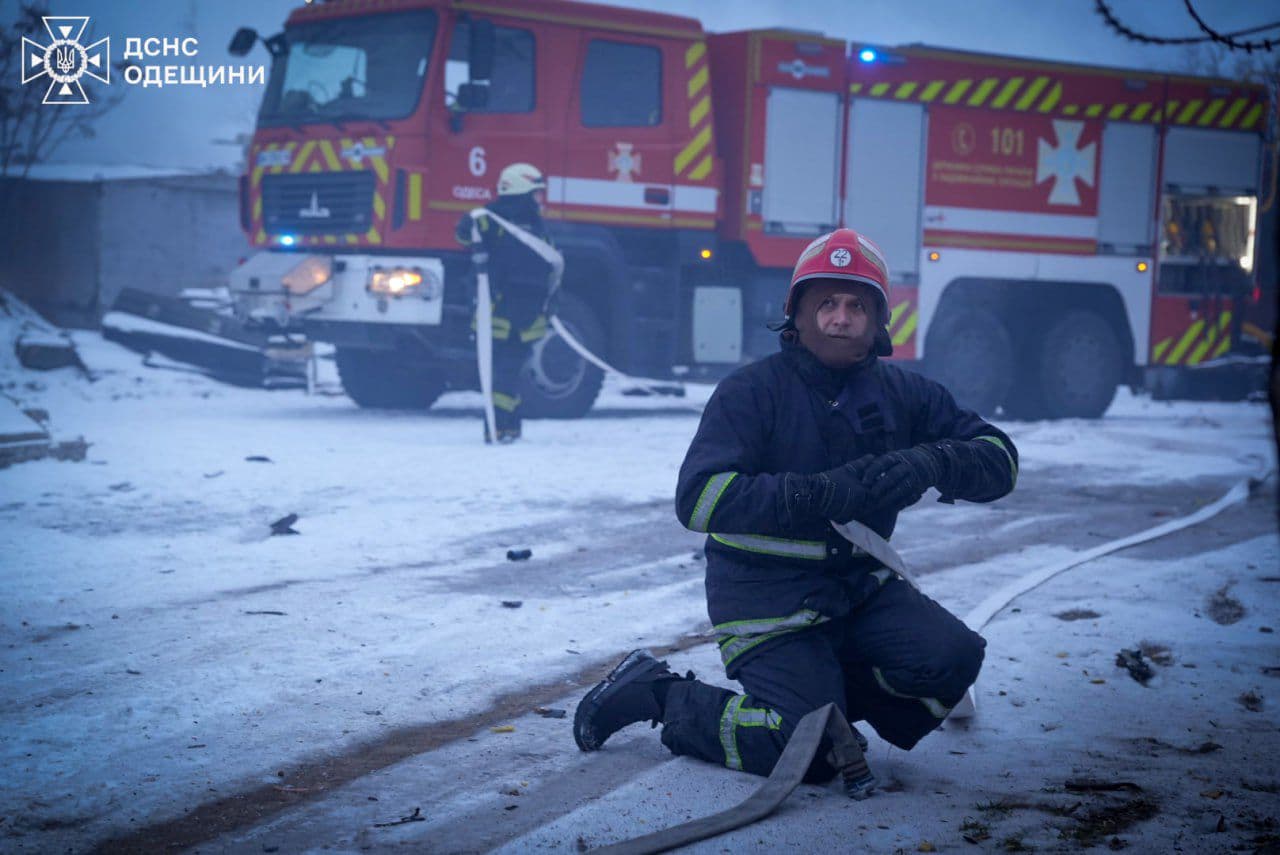
The image shows firefighters working at the site after Russia’s overnight attack on Odesa. (DSNS / Telegram)
Night of 339 Shadows: When the Sky Wouldn’t Let Kyiv Sleep
At 2 a.m., the sirens stitched their warning across Kyiv. Few people moved. After 1,427 days of war, the sound had settled into the city like weather.
Then the sky caught fire.
Russia opened the night with a single, coordinated wave: eighteen Iskander-M ballistic missiles, one Zircon hypersonic missile moving faster than sound, fifteen Kh-101 cruise missiles—and 339 drones, roughly 250 of them Iranian-designed Shaheds. One of the largest aerial barrages of the war rolled in low and fast.
Air-defense crews went to work. Radar screens filled. Interceptors lifted. By dawn, Ukraine had knocked down 315 drones and 27 missiles. But the weapons that slipped through left their signatures across the map. The Zircon—too fast to stop—hit an infrastructure facility in Vinnytsia Oblast. Cruise missiles and drones struck with the kind of precision that comes from careful intelligence: Kyiv, Zaporizhzhia, Rivne, Odesa, Kharkiv, Poltava, Dnipropetrovsk.
“Updated tactics,” President Zelensky said later. Translation: Moscow had learned how to drown defenses in volume and force triage—what do you save, and what do you let pass?
The price of that defense landed on a spreadsheet. Roughly €80 million in interceptors—Patriots, NASAMS, and others—burned through the night, each shot costing hundreds of thousands to swat down drones Russia can build for a few thousand. Economic warfare, written in contrails.
Ukraine had received a shipment of vital missiles the day before. Without it, the damage would have been catastrophic. Even with it, the arithmetic is brutal: Ukraine’s ammunition is finite. Russia’s launch capacity looks endless.
Some of the incoming missiles carried 2026 manufacturing stamps. Sanctions hadn’t stopped the lines. Parts from China, Iran, and North Korea kept the factories humming.
At DTEK, engineers watched the grid go dark for 335,000 customers. They clawed back 162,000 connections. 173,000 stayed black. Across Kyiv, 5,635 buildings—46 percent of the housing stock—lost heat.
Repairs began before the smoke cleared.
So did the counting.
The Man Who Came to Davos to Kill Peace
Sergey Lavrov walked into Davos with a script and no intention of changing a single line.
As European and American diplomats gathered in heated rooms to talk about peace frameworks and reconstruction, Russia’s foreign minister took the stage and delivered a speech that functioned as a blanket rejection of every proposal on offer. No compromise. No opening. No pause.
Only no.
He spoke of the war’s so-called “root causes”—NATO expansion, alleged discrimination against Russian speakers—phrases worn smooth by repetition. They sounded familiar. They were meant to. But they served as cover for the real message: Ukraine must submit.
Lavrov dismissed the US-Ukrainian-European twenty-point peace plan outright. Then he laid out Moscow’s price. Not just the four regions Russia claims to have annexed. Not even the territory it partially occupies. Moscow wants “Novorossiya”—a fantasy map stretching across eastern and southern Ukraine, land Russian troops have never fully controlled but Putin’s ideologues insist already belongs to the Kremlin.
He rejected European security guarantees for Ukraine, calling them unacceptable interference in Russia’s sphere of influence. Translation: Ukraine would exist only at Moscow’s pleasure.
Then came the line that stripped away any remaining pretense. Lavrov rejected even a ceasefire. Any pause, he said, would only allow Ukraine to “attack the Russian Federation again.”
The inversion was complete. Russia, the invader, cast itself as the threatened party. Ukraine, fighting for survival, recast as the aggressor.
The speech did exactly what it was meant to do. It locked negotiations into impossibility. It told Russian audiences that victory remained the goal. And it warned Europe that no number of conferences or communiqués would soften Moscow’s demands.
In Davos, diplomats discussed peace.
Lavrov came to bury it.
Two Hours, One Handshake, Zero Change
They met for two hours inside the USA House at Davos. Coffee. Polite smiles. The choreography of diplomacy.
When Trump’s envoys—Steve Witkoff and Jared Kushner—emerged alongside Putin’s economic advisor, Kirill Dmitriev, both sides called the talks “constructive.” In diplomatic language, that meant nothing had moved.
The real signal had come earlier, on Dmitriev’s phone. As his plane touched down, he posted celebratory graphics about the “collapse of globalism” and “the end of the new world order.” Translation: Moscow saw opportunity. Trump’s tariff threats against European allies over Greenland. His trade wars. His disruption of transatlantic norms. For the Kremlin, it looked like a crack widening in the Western wall.
The timing was brutal.
While hands were shaking in Davos, Russian missiles were cutting power to Ukraine’s nuclear plants and plunging Kyiv into darkness. The contrast played like theater: warmth and chandeliers on one stage, smoke and freezing apartments on another. The optics suggested a war between equals—two sides negotiating a dispute—rather than an invasion grinding a country into the cold.
Trump added to the fog with remarks that landed like static. “When Russia is ready, Ukraine is not ready. When Ukraine is ready, Russia is not ready,” he told reporters, assigning equal blame for a war that has never been symmetrical.
Reality told a different story.
Ukraine had accepted the twenty-point framework Trump’s team proposed. Kyiv had signaled it would postpone NATO membership in exchange for binding security guarantees. Zelensky had shown up to every peace conference and made concessions no wartime leader makes lightly.
Moscow had done the opposite. It rejected every proposal, kept firing, and—through Lavrov’s Davos speech the same day—restated demands that would end Ukrainian sovereignty.
In Davos, the meeting ended where it began: with a handshake and a statement.
In Ukraine, the night kept burning.
Where Armored Columns Go to Die
Twenty kilometers from the front near Kupyansk, Russian drivers reach the same decision point every time.
Go forward and die.
Stop and fail.
There is no third option.
Ukrainian forces have turned the approaches to Kupyansk into something new in modern war: a corridor of death where machines hunt before soldiers ever see an enemy. Inside this zone, unmanned systems are destroying up to 88 percent of Russian assault units before they reach firing range.
It begins far out on the steppe. Long-range reconnaissance drones spot convoys forming and columns rolling. Their feeds stream into command centers where operators mark targets and cue strike teams.
Then the strike comes.
FPV attack drones dive from the sky. Larger strike drones follow. Vehicles burn before they can spread out. Troop carriers erupt. Fuel trucks vanish in fireballs visible for kilometers.
Closer in, where Russian infantry tries to slip forward on foot, smaller drones take over. They sweep tree lines, ditches, shell holes. Men scatter. There is nowhere to hide. The swarm finds them.
Electronic-warfare teams jam Russian drone feeds. Mobile fire groups keep moving, never staying long enough to be targeted. Command posts stitch the picture together in real time, redirecting drones as columns try to reroute or retreat.
For Russian commanders, Kupyansk has become a tactical nightmare. Mechanized assaults require mass — and mass is exactly what Ukrainian drones erase. Infantry infiltration avoids detection, but men cannot carry heavy weapons far and cannot survive without armor.
Every path leads into the same invisible wall.
And Kupyansk is only the test case.
Ukrainian planners want to push the kill zone out to 50 kilometers and beyond — turning entire sectors into drone-monitored wastelands where vehicles cannot move and infantry cannot survive the march. The technology is ready. The doctrine is written.
What they need now is scale.
Enough drones.
Enough operators.
Enough command nodes.
Enough sky to make every front look like Kupyansk.
When Practice Weapons Start Killing
The missiles that came in on January 20 were never meant for war.
They were RM-48U training rounds — retired S-300 and S-400 air defense missiles once used to teach Russian crews how to track and fire without burning through real combat stockpiles. Weapons designed for classrooms and drills, not cities.
Now they were falling on Ukraine.
Russian forces had converted the training rounds into improvised ballistic missiles, possibly fitting them with live warheads and firing them at ground targets. What landed on Ukrainian soil was either a hollow threat meant to terrorize by volume — or a sign that Russia was scraping the bottom of its arsenal.
Both possibilities told the same story.
If the missiles carried no warheads, Moscow was trying to keep fear alive with noise and fireballs, counting on civilians to run for shelters even when the blast might be nothing more than a crater. If they did carry explosives, it meant something worse: Russia was running low on real ballistic missiles and had turned to its training inventory to keep the pressure on.
For years, Russia has fired S-300 and S-400 air defense missiles at cities — a misuse of expensive interceptors never designed for ground attack. Those systems are supposed to protect Russian skies. Burning them against apartment blocks and power stations only made sense if there was nothing better left to fire.
Now even those stocks appear strained.
Iskanders. Kalibrs. Purpose-built strike missiles. Too many fired. Too few replaced.
So the training rounds came out.
For Ukrainian air defenders, the shift created new danger. Radar libraries built to recognize known missile signatures suddenly faced unfamiliar flight profiles. Was the incoming weapon armed? Would it detonate or simply punch a hole in the ground? It did not matter. Every launch still demanded a full defensive response.
The improvisation fits a broader pattern. Commercial drones turned into bombers. Sanctions workarounds keeping factories running. Training weapons becoming battlefield tools.
It is what happens when an army fights longer than it planned — and starts emptying its practice lockers to stay in the war.
When the Hunters Found the Shield
The video went up on January 20, and Ukrainian officers watched it in silence.
First came the hit on the road near Pokrovsk: a HIMARS launcher rolling 43 kilometers behind the front line. An FPV drone drops in, fast and steady. A flash. The launcher is gone.
Then the second clip. Farther north, near Kharkiv, 44 kilometers from active fighting. A Patriot battery — launcher and radar station — sitting where it was supposed to be safe. Another drone descends. Another strike. Another plume of smoke.
The message was unmistakable. The hunt had moved deep into the rear.
Russian forces had pushed their drone reach far beyond the front line, into the space where Ukraine keeps its most precious weapons. The systems that protect cities from ballistic missiles. The launchers that strike Russian command posts and supply hubs. The backbone of Ukraine’s defense.
The trick was in the sky.
“Mothership” drones — large fixed-wing aircraft like the Molniya-2 — carried smaller FPV drones under their wings. Guided by Starlink satellite links, the mothership cruised high and far into Ukrainian territory, then released its payload. The attack drones fanned out, hunting for targets while the carrier loitered above, relaying signals and extending their range far beyond what any single drone could manage.
Russian military bloggers argued over whether the Patriot was real or a decoy. But the argument missed the point. Decoy or not, the drones had reached it. And that changed everything.
Every Patriot system now needed more guards. More camouflage. More movement. More dispersion. Each layer of protection stole time and attention from the job those systems exist to do: stop the next wave of missiles.
For Ukrainian air defense planners, the map became a trap. Keep Patriots close to the front and risk losing them to drones. Pull them back and leave cities exposed just as Russia is launching 300 drones and dozens of missiles in a single night.
Point-defense systems to shield these assets are scarce. Jamming helps, but Starlink-linked drones keep flying. Mobile fire teams can shoot some down, but those teams are needed everywhere.
The shield is still standing.
But now it is being hunted.
The Minister Who Turned War Into a Spreadsheet
The room was quiet when Mykhailo Fedorov said the number.
Fifty thousand.
Not a projection. Not a range. A target.
Ukraine’s new defense minister — 35 years old, the youngest in the nation’s history — leaned forward and spoke with the calm precision of an engineer explaining a production line.
“The strategic goal is to kill 50,000 Russians per month,” he said. “If we reach this figure, we will see what happens to the enemy.”
It was not bravado. It was arithmetic.
Fedorov sees the war as an industrial system: inputs, outputs, capacity, failure points. Russia treats manpower as expendable, but even expendable resources have limits. Mobilization is meeting resistance. Contract bonuses are climbing into budget-breaking territory. The demographic cost of losing hundreds of thousands of men aged 18 to 45 will echo through Russia’s economy for decades.
Fifty thousand a month is the threshold where offense collapses.
Ukraine believes it can reach it.
The confidence comes from data. The Army of Drones Bonus system tracks Russian losses with digital precision, assigning ePoints for destroyed vehicles and killed troops. Planners see which units perform best, which weapons systems deliver results, and how tactics change casualty curves. The fog of war has been replaced by dashboards.
Next comes Mission Control — a real-time tracking system for drone types, flight paths, launch sites, and strike effectiveness. The same model will expand to artillery, creating a unified picture of every shot fired and every target hit.
Fedorov is also building profiles on drone crews: commanders, performance scores, efficiency ratings. Units that produce results get more resources. Units that do not get replaced.
Special teams are already hunting Russian drone operators. The next step is scale.
Drone assault units are being formed with new structures and doctrine. Code 9.2 proved the model at Kupyansk, where 88 percent of Russian forces were destroyed before reaching Ukrainian lines.
“The future belongs to drone assault units,” Fedorov said.
That same day, President Zelensky appointed Colonel Pavlo Yelizarov as deputy commander of the Air Force, tasking him with building an integrated anti-drone shield. Yelizarov’s Lasar Group had already destroyed roughly 20 percent of all Russian tanks hit by Ukrainian drones.
Now he is building the dome.
This is how Ukraine plans to win.
Not with speeches.
With numbers.
When a Flush Becomes a Victory
In Kyiv’s darkened apartments, war arrived in the most ordinary way.
The toilets would not flush.
Power outages had shut down the pumps that move water through the city’s veins. Pipes ran dry. Radiators went cold. Thousands of families woke to apartments without electricity, heating, or running water — and the quiet panic of realizing there was no way to do the most basic thing.
“I honestly do not know how to cope when you cannot even use the toilet at home or keep your child warm,” said Oles, a 30-year-old architect with a three-year-old daughter. His home had lost everything at once. Water. Heat. Light.
In another building, M. watched the temperature fall to 13 degrees Celsius. Cold enough that even her cat curled tight and shivered.
This is what infrastructure collapse looks like in real life.
Electricity powers the pumps. Pumps move the water. Water feeds the heating system. Heating keeps pipes from freezing and bursting. Remove power and the chain snaps — one failure pulling down the next until the whole system goes quiet.
For Kateryna, a 33-year-old data scientist, the brief return of electricity felt like a holiday. “By morning, there was no hope the power would come back,” she said. “Later it turned on for a few hours, and a bit of cold water became available — enough to flush the toilet.”
Enough to celebrate.
Some buildings fared better. In Liubov’s block, neighbors pooled resources to run generators. Elevators stayed dead. Heating worked only in short bursts. But there was light.
Others were not so lucky.
“At this point,” M. said, “it feels easier to live in a village where you have an outdoor toilet and do not have to flush it.” In war, rural life becomes resilience. Cities become fragile.
Group chats lit up across Kyiv as people checked on friends and colleagues. Who had power. Who had heat. Who had nothing.
But there was nowhere to go. “We cannot even go to relatives,” M. said. “They have the same situation.”
Ukrainian Railways sent 40 emergency crews into the city, working through the night to restore heat to 5,635 buildings.
Until then, a working toilet was not a convenience.
It was a small victory.
The President and the Blackout
On January 20, the choice in front of President Volodymyr Zelensky was drawn in cold and light.
In Davos, presidents, prime ministers, and finance ministers gathered in warm halls to talk about Ukraine’s reconstruction, security guarantees, and the shape of a future peace.
In Kyiv, nearly half the city sat without heat. Power lines to Chornobyl had been cut. Apartments were going dark as temperatures dropped.
“Undoubtedly, I choose Ukraine in this case, rather than the economic forum,” Zelensky told reporters. “But everything can change at any moment.”
The pause mattered.
If Davos could deliver air defense systems, energy support, binding guarantees — then leaving the country during crisis might be worth the risk. But speeches and photo lines could not compete with coordinating emergency response and standing with a freezing capital.
His team was already there. Presidential chief of staff Andriy Yermak, security chief Rustem Umerov, and parliamentary leader David Arakhamia were meeting advisers from France, Germany, and Britain. They were drafting what Zelensky called the final stage of Ukraine’s prosperity and security documents.
And progress was real.
Horizon Capital announced more than 150 million euros raised for its Catalyst Fund, with a goal of 300 million for reconstruction. The European Bank for Reconstruction and Development pledged 30 million. The International Finance Corporation added 50 million. Development agencies from Sweden, the Netherlands, Norway, and France joined in.
Investors were lining up. A wind farm in Odesa Oblast was already on the table.
American firms were submitting bids for the US-Ukraine minerals fund. Initial investments could arrive within months. For the first decade, profits would stay in Ukraine.
Naftogaz was circling projects from 20 million dollars to multi-billion scale.
But while deals were signed in Switzerland, Ukrainian engineers were racing through Kyiv’s blackout, trying to restart heat for thousands of frozen apartments.
Zelensky left the door open for Davos — if a meeting with President Trump could produce real results.
Russia knew the summit calendar. The strikes on January 20 were not random. They were timed to force the dilemma.
Go abroad and be accused of abandoning your people.
Stay home and miss the moment when the world is watching.
It was information warfare, played on two stages.
In Europe, they discussed Ukraine’s future.
In Ukraine, they fought for the lights.
Two Leaders, Two Futures
At the White House on January 20, Donald Trump sounded like a man circling a problem without touching it.
“I’m trying to resolve the issue of Russia and Ukraine,” he told reporters. “When Russia is ready, Ukraine is not ready. When Ukraine is ready, Russia is not ready.” Then the aside: “On average, they lose 25,000 people a month. And I’m trying to bring this matter to an end.”
The words floated in the air, detached from the battlefield.
The framing put invader and defender on the same moral plane. It ignored the record. Ukraine had accepted the twenty-point peace framework Trump’s team proposed. Kyiv had offered to postpone NATO membership in exchange for binding security guarantees. Russia had rejected every plan and, through Lavrov’s speech in Davos that same day, doubled down on demands that would erase Ukrainian sovereignty.
Trump added that he had ended eight wars during his presidency. “It comes easy,” he said.
In Kyiv, Zelensky was drawing maps.
His proposal was blunt: a joint European armed force of no fewer than three million personnel. Russia, he warned, plans an army of two to two and a half million by 2030. Europe needs the mass to answer it.
This would not replace NATO. It would anchor it. Ukraine would be the cornerstone, supplying hard-earned combat experience, battlefield-tested systems, and logistics built under fire. “We share our technologies,” Zelensky said. “They share intelligence. We give interceptors that have already been tested in combat.”
The idea landed as Washington rattled sabers at Europe over Greenland. Trump threatened tariffs on eight NATO allies—ten percent starting February 1, rising to twenty-five percent by June—until Denmark agreed to sell. He posted AI images of European leaders staring at Oval Office maps where Greenland and Canada wore American flags.
Brussels prepared its answer. The Anti-Coercion Instrument. Retaliatory tariffs. Ursula von der Leyen warned in Davos: the response would be “unflinching, united, and proportional.”
Two visions, moving in opposite directions.
One traded in equivalence and slogans.
The other counted battalions.
Europe listened.
She Played for a Country at War
Oleksandra Oliynykova walked onto Rod Laver Arena carrying a message she was not supposed to deliver.
Temporary tattoos. A white T-shirt. And words tournament officials would rather not see on center court:
“I need your help to protect Ukrainian children and women. But I cannot talk about it here.”
She is 25. It was her Grand Slam debut. Across the net stood reigning champion Madison Keys.
For one set, the upset felt real. Oliynykova pushed Keys into a tiebreak and led 6–4, two points from taking the opening frame. The stadium leaned forward. The moment stretched.
Then the champion took control. The match ended 7–6, 6–1.
The scoreline did not tell the story.
Oliynykova had chosen to train at home, in Ukraine, under air raid sirens and missile alerts, while many of her peers relocated to safer facilities abroad. She accepted the risk as part of her duty. Her father is serving in the Ukrainian military. She had texted him before walking onto court.
“I know it was his dream to see me on this court,” she said afterward. “I will do everything to make him even more proud. I made his dream come true.”
She played under Ukraine’s flag. She wore her message in plain sight. She stood on one of tennis’s biggest stages and reminded the world that her country is still fighting for its children, its women, and its future.
In a tournament built on applause and sponsors and spotless white lines, she carried the war with her.
And when the match ended, she went back to training.
Back to Ukraine.
Moldova Walks Away as Washington Builds a Fantasy Table
On January 20, Moldova closed the door on Moscow’s world.
Foreign Minister Mihai Popsoi confirmed that Chisinau had begun the final legal steps to leave the Russian-led Commonwealth of Independent States. Three more agreements were being denounced. Dozens more would follow. When the paperwork is finished, Moldova will no longer belong to the post-Soviet bloc that once defined its orbit.
The move followed a hard-fought election. Pro-European President Maia Sandu’s party secured a parliamentary majority despite Russian interference efforts. Now the country is finishing what it started: cutting the last formal ties to the Kremlin’s political ecosystem.
Sixty more CIS agreements are on the list.
While Moldova was stepping out of Moscow’s shadow, Washington staged a different kind of spectacle.
President Trump invited Ukraine to join his new “Board of Peace for Gaza” — alongside Russia and Belarus.
The offer landed like a parody.
Zelensky’s reply was unusually blunt. “Russia is our enemy. Belarus is their ally. It would be difficult to imagine” sitting at the same table.
Belarus has served as a launchpad for Russian invasions. Its ruler, Alexander Lukashenko, opened his territory for attacks on Kyiv. Now Ukraine was being asked to share a peace board with the very states waging war against it.
The proposal went further. Trump suggested expanding the board to “other conflict zones, including Ukraine.” A body that could one day sit in judgment of the war while counting Russia and Belarus as members.
There was a price for a permanent seat: one billion dollars.
Supporters called it a bold alternative to the United Nations. Critics called it a bypass of the institutions Trump despises. Hungary and Vietnam accepted. Belarus reacted “positively.” The Kremlin said it was reviewing.
France refused.
Trump responded by threatening 200 percent tariffs on French wine and champagne.
In Europe’s east, Moldova is dismantling Moscow’s old architecture.
In Washington, a new one is being sketched on a napkin.
The Day’s Meaning: When Fear Becomes a Weapon
January 20, 2026, showed that this war is no longer about lines on a map.
It is about risk. About leverage. About how far a state is willing to go to make the world flinch.
When Russian missiles cut power to Chornobyl, they were not chasing tanks or command posts. They were aiming at fear itself. The blackout was a warning shot: nuclear safety can be turned into a bargaining chip, catastrophe into coercion. Moscow was signaling that its tolerance for danger exceeds Europe’s tolerance for confrontation.
That is why Lavrov could stand in Davos and reject every peace proposal without blinking. The Kremlin believes Western unity is brittle, American commitment unpredictable, and European resolve limited by markets, elections, and gas prices. In that calculation, pressure works. Risk works. Escalation works.
The same logic played out in the sky.
Three hundred thirty-nine drones and thirty-three missiles forced Ukraine to burn through eighty million euros in interceptors in a single night. It is an exchange rate built for the attacker. Russia can assemble drones faster than Ukraine can replace Patriots. Every successful defense still drains a magazine. Every interception turns allied aid into fragments on the ground.
Attrition, weaponized.
Yet the day also showed how Ukraine is changing.
At Kupyansk, drones have replaced artillery as the first line of defense, turning entire sectors into no-go zones. Fedorov’s data-driven war turns casualties into metrics and tactics into algorithms. In Kyiv’s neighborhoods, generators and local networks keep heat alive when the grid fails. Decentralization has become survival.
Russia is improvising too. Training missiles fired as weapons. Air defense systems used for ground attack. Production lines stitched together with imported parts. It is adaptation under strain.
Which side breaks first is now the central question.
Can Ukraine hold long enough for Russian shortcuts to become shortages?
Will Western support keep pace with a defense that costs tens of millions per night?
Can Davos deliver guarantees strong enough to change Moscow’s math?
On this day, Kyiv went dark and Chornobyl went silent.
The pattern is clear. Russia is willing to risk nuclear fear, civilian cold, and diplomatic isolation to win.
What remains uncertain is whether the world is willing to match that resolve to stop it.
Prayer For Ukraine
- For protection over civilians living in darkness and cold
Pray for families across Kyiv and other cities who endured another night without heat, water, or electricity. Ask God to shelter children, the elderly, and the sick from illness and fear, and to strengthen those restoring power and warmth under constant threat. - For safety around nuclear facilities and critical infrastructure
Pray for God’s hand of protection over Chornobyl, Ukraine’s nuclear plants, power stations, and water systems. Ask that catastrophe be restrained, that reckless attacks be turned away, and that engineers and emergency crews be guarded as they work. - For Ukrainian defenders standing between cities and destruction
Pray for air defense crews, drone operators, mobile fire teams, and frontline soldiers who are holding the shield over Ukraine’s skies and borders. Ask for alert minds, steady hands, courage, and protection in every mission. - For wisdom and strength for national leadership
Pray for President Zelensky and Ukraine’s leadership as they carry the impossible weight of war, diplomacy, and civilian survival. Ask God to grant clarity, endurance, and favor in every decision. - For unity and resolve among Ukraine’s allies
Pray that Western leaders will not grow weary, divided, or distracted. Ask that support remain strong, timely, and sufficient to defend Ukrainian lives and secure a just and lasting peace.