
A day when weather became Russia’s ally, a Chornobyl widow died in Kyiv from the same nation that caused both disasters, and Ukrainian drones turned a Russian oil refinery into an inferno 600 kilometers from the border.
The Day’s Reckoning
November 15 arrived wrapped in fog.
At dawn near Novopavlivka, Russian tank crews watched the mist roll across the Vovcha River and saw opportunity. Ukrainian drone operators two kilometers away stared at blank screens where surveillance feeds should have been. Atmospheric conditions had just erased Ukraine’s most effective defensive system.
In Kyiv, emergency officials gathered in rooms where charts showed sixty percent of the nation’s gas production capacity already destroyed. Winter was three weeks away. Russian missiles had methodically dismantled the infrastructure that would keep twenty million people warm. The mathematics were simple and terrifying: not enough gas, not enough generators, not enough time.
Six hundred kilometers inside Russia, Ukrainian drones converged on the Ryazan oil refinery. The facility produced 840,000 tons of aviation kerosene annually—fuel that powered the very aircraft launching glide bombs at Ukrainian cities. Explosions lit the predawn sky. Local officials would blame “falling debris.” Nobody believed them.
The day’s contradictions defined the war’s current phase. Russia exploited weather that grounded Ukrainian technology, then watched its refineries burn from strikes they couldn’t stop. Ukraine faced infrastructure collapse through systematic bombardment yet maintained offensive operations deep in enemy territory. Neither side could decisively break the other. Neither side could stop trying.
Day 1,361 had arrived. Fog would lift by afternoon. The refinery fires would burn for days. The gas production capacity would stay destroyed. And tomorrow would bring its own impossible calculations—more fog, more strikes, more desperate repairs, more grinding attrition that nobody could sustain but nobody could abandon.
The mathematics of this war made no sense. But the war continued anyway.
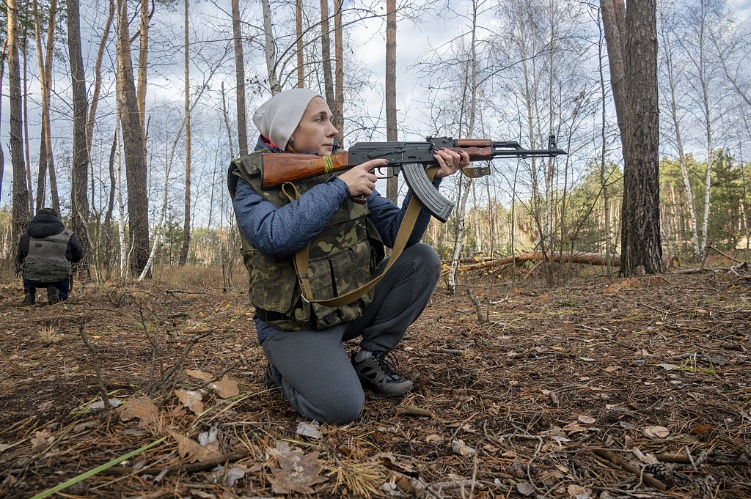
Training for survival: A student at the Kharkiv Regional Center for Training Citizens for National Resistance practices with live ammunition in field conditions. Kharkiv Oblast has been under bombardment since February 2022. (Serhii Masin/Anadolu via Getty Images)
When Fog Became an Ally
The fog rolled in thick across the Vovcha River just before dawn on November 15. Russian commanders with the 80th Tank Regiment had been watching weather forecasts for days, waiting for this moment.
At Ukrainian observation posts two kilometers away, drone operators stared at blank screens. The “wall of drones”—thousands of tactical strike and loitering munitions that had protected twelve hundred kilometers of frontline since early 2024—had just vanished into gray nothing. Ukraine’s most effective defensive system required one thing Russia could not jam or shoot down: visibility.
The assault came through the mist like ghosts. Ten pieces of armor—tanks, infantry fighting vehicles, and support equipment—crossed a pontoon bridge between Yalta and Dachne. Infantry dismounted in Novopavlivka itself. By the time Ukrainian forces detected the incursion and coordinated a response, the attackers had already begun withdrawing.
Volunteer Serhii Sternenko reported Ukrainian strikes destroyed two tanks and five infantry vehicles, but the damage was done. Russian milbloggers celebrated, noting Moscow had exploited similar weather windows across the entire front—Pokrovsk, Velykomykhailivka, Hulyaipole. The operation showed sophisticated planning: weather reconnaissance, pre-positioned bridging, coordinated waves timed to atmospheric conditions.
The solution was obvious but insufficient. Traditional artillery operated regardless of visibility—mortars and tube systems needed different targeting data than video feeds, but they functioned in fog, rain, darkness. Ukraine possessed these weapons. Just not enough of them to cover the entire front.
The Novopavlivka assault proved what analysts had warned: over-reliance on any single weapons system created exploitable gaps. Russia would keep testing Ukrainian defenses under every possible condition until they found the vulnerabilities.
Modern warfare hadn’t rendered old weapons obsolete. It had merely expanded the arsenal. Armies needed both.
Striking Back Through the Sky
Ukrainian pilots received targeting coordinates for the M-30 highway between Pokrovsk and Selydove on November 14. The road had become a Russian lifeline—motorcycles and light vehicles racing supplies forward under fog cover that grounded Ukrainian drones.
The 7th Rapid Reaction Corps launched GBU-62 Joint Direct Attack Munition-Extended Range bombs at dawn. Explosions cratered the highway approximately fifty kilometers from Russian staging areas, turning the supply route into a kill zone.
Simultaneously, the Eastern Group of Forces struck a transport hub and manpower concentration near Shevchenko. More GBU-62s fell on a Nebo-U radar station in occupied Crimea. Ukrainian forces were attempting what Russia had perfected over months: battlefield air interdiction that shaped terrain before ground forces arrived.
Moscow had spent summer and fall methodically hammering Ukrainian rear areas with glide bombs and Shaheds—ammunition depots, fortified positions, railway junctions, supply concentrations. Those preparatory fires created conditions for Russia’s advances around Pokrovsk and Kurakhove. Ukraine lacked the inventory to match that intensity but possessed enough precision munitions to make Russian logistics commanders nervous.
The asymmetry remained brutal. Russia could afford to experiment, to waste dozens of drones testing Ukrainian air defenses, to saturate targets with overwhelming numbers. Ukraine had to make every strike count, husband precious munitions, choose targets with surgical precision.
When a GBU-62 destroyed a bridge in occupied Zaporizhzhia, it represented not just tactical success but strategic calculation—one less weapon for the next urgent target, one more entry in the endless ledger of insufficient supply.
Yet these strikes proved Ukraine could reach deep into Russian logistics, could threaten the rear areas that enabled Moscow’s offensive operations, could turn air interdiction against its originator.
Quantity had quality all its own. But quality could partially compensate when employed with intelligence and precision.
The Factory Floor War
Major General Vadym Skibitskyi delivered the numbers to Reuters with clinical precision: Russia would manufacture 120,000 glide bombs in 2025. Five hundred of them could fly two hundred kilometers. Some would eventually reach four hundred.
Russian forces were already launching two hundred to two hundred fifty glide bombs daily. Up from one hundred seventy in October. The quantity, Skibitskyi noted carefully, was “enormous.”
Add seventy thousand long-range drones. Thirty thousand Shaheds alone.
The arithmetic was brutal. Russian factories operated multiple shifts, retrofitting Soviet-era unguided bombs with guidance kits, assembling Iranian-designed drones from domestically produced and imported components. The effort wasn’t sophisticated by Western standards—roughly half the North Korean shells arriving needed refurbishment before use.
But it was effective. Russia could afford waste.
Every Ukrainian missile destroyed by Russian air defense represented months of coalition meetings, procurement negotiations, training programs, logistics planning. Every Russian glide bomb destroyed cost Moscow perhaps a few thousand dollars and minimal political capital.
North Korea’s role illustrated both dependency and resourcefulness. Pyongyang had supplied 6.5 million artillery shells since 2023, enabling firing rates Ukrainian forces couldn’t counter. But stockpiles were running low—deliveries halved in 2025, September seeing none at all.
Russia adapted. Twelve thousand North Korean workers were arriving at the Alabuga Special Economic Zone in Tatarstan by year’s end, joining twenty-five thousand more potentially coming for drone manufacturing. These workers would return home with knowledge of large-scale drone production, potentially establishing North Korean manufacturing capability that could supply Russia indefinitely.
The exchange illustrated modern warfare’s industrial dimension. Technology mattered, but production capacity determined what reached battlefields. Russia maintained massive stockpiles of unguided bombs from Soviet times—weapons that had been expensive then but were essentially free now, requiring only guidance kits to transform them into precision munitions.
Ukraine’s challenge wasn’t matching Russian production. That was impossible. It was convincing Western partners to accelerate their own manufacturing at scales approaching wartime rather than peacetime standards.
Hunting Trains in the Dark
Russian drones equipped with thermal cameras hunted locomotives across Ukraine’s railway network throughout autumn. The attacks tripled since July according to Deputy Prime Minister Oleksiy Kuleba. Eight hundred strikes since January had damaged over three thousand objects. One billion dollars in destruction.
Station heads in places like Lozova reported being targeted because their facilities connected Dnipro, Slovyansk, Poltava, and Kharkiv—transportation hubs whose destruction would isolate entire sectors of the front. Ukrzaliznytsia head Oleksandr Pertsovskyi described Russian forces picking off individual locomotives, hunting the rolling stock that moved ammunition and supplies forward.
The campaign had three objectives: destroy southern logistics to prevent grain shipments to seaports; disrupt rail traffic to cut off frontline oblasts; comprehensively destroy everything in Donetsk and Luhansk.
This wasn’t random terror. Russia was systematically attacking arteries sustaining Ukraine’s fortress belt in Donetsk Oblast—particularly the E-40 Izyum-Slovyansk highway and T-0514 Dobropillya-Lyman highway, both running twenty to thirty-five kilometers from frontlines. These were calculated strikes against specific logistics bottlenecks.
Simultaneously, Russia intensified its gas infrastructure campaign as winter approached. Naftogaz Chief Executive Serhii Koretskyi revealed Moscow had knocked out sixty percent of Ukraine’s gas production through October strikes, after destroying forty percent the previous winter.
Russian forces couldn’t reach underground storage facilities, but they could strike compressor pumps that extracted gas and pipelines distributing it. The sophistication was notable: Russia knew infrastructure locations from Soviet-era construction records and understood which components to target for maximum effect.
The dual campaign demonstrated Russia’s understanding that modern warfare extended far beyond frontlines. Destroy enough infrastructure and Ukrainian forces at the front would run short of ammunition. Disable enough heating capacity and civilian morale would crack.
The calculus was deliberate. Russia couldn’t decisively defeat Ukrainian forces in direct combat but might grind down Ukraine’s ability to sustain defense through accumulated infrastructure destruction.
Ukraine countered by dispersing operations, repairing damage with remarkable speed, striking back at Russian energy targets. But the asymmetry remained obvious. Russia could absorb Ukrainian strikes against its vast energy complex. Ukraine struggled to maintain basic services while defending territory.
Winter would test whether Ukrainian resilience or Russian attrition proved stronger.
The Widow of Two Disasters
The drone struck Nataliia Khodemchuk’s apartment building in Kyiv’s Troieshchyna district sometime after midnight on November 15. Fire consumed her home completely. Emergency services pulled her from the flames and rushed her to the Burn Center near the Chernihivska metro station.
She was seventy-three years old. Doctors could not save her.
Nataliia was the widow of Valerii Khodemchuk, who died instantly when Chornobyl’s Reactor Four exploded at 1:23 a.m. on April 26, 1986. He was the first victim of that catastrophe. His body was never recovered, entombed forever in the reactor remains where a monument now stands.
She had spent thirty-nine years preserving his memory. Visiting the power plant. Attending anniversary ceremonies. Raising their two children. Telling their grandchildren stories about the husband and father stolen by Soviet incompetence.
Now the same nation that built Chornobyl without adequate safety measures had killed her with a drone built with deliberate malice.
The symmetry was almost unbearable.
President Volodymyr Zelensky captured it: “Ukrainians who survived Chornobyl, who helped rebuild the country after that disaster, are once again facing danger—the terror of an aggressor state.”
Soviet authorities had responded to the 1986 disaster with lies, denial, forced evacuations. Liquidators sent to clean radioactive debris with inadequate protection. Populations left uninformed about contamination. An entire generation marked by radiation exposure.
Russia responded to its war of conquest with similar callousness. Residential buildings as acceptable targets. Civilian infrastructure as military objectives. Human lives as statistical noise in pursuit of territorial gain.
Elsewhere across Ukraine that day, Russian attacks killed at least nine civilians and wounded fifty-three. A sixty-five-year-old man died in Dnipropetrovsk Oblast. One person in Kherson, seven injured. Five wounded in Sumy Oblast including two teenagers.
The casualties accumulated with numbing regularity. One here, two there, seven in a capital city strike. Numbers that would constitute national emergencies in peacetime barely registered as headlines after nearly four years of war.
Each death represented families destroyed, communities diminished, futures erased. But from the strategic perspective they were merely points on a chart measuring Russia’s terror campaign.
The gap between human tragedy and military analysis reflected war’s essential obscenity: reducing individual lives to aggregate statistics, personal grief to operational assessments, meaning to mathematics.
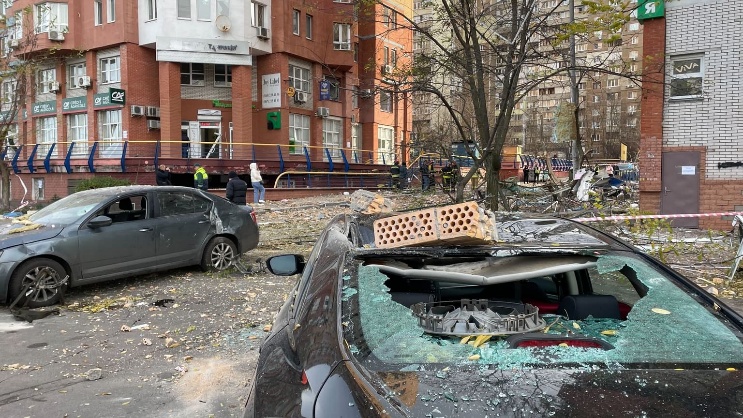
Morning after terror: Debris from Russia’s overnight drone and missile barrage litters a Kyiv street. Seven people died in the capital, thirty-six were wounded, nine districts damaged. This is how Kyiv wakes up on day 1,361. (Olena Zashko/The Kyiv Independent)
Murder as Content
The Rusich Sabotage Assault Reconnaissance Group posted the execution video to Telegram on November 15 without shame or euphemism. Three Ukrainian servicemembers dead in an unspecified frontline area. The group treated murder as achievement.
Rusich’s leader, Alexei Milchakov—a self-proclaimed Nazi serving within the 417th Reconnaissance Battalion of the 42nd Motorized Rifle Division—operated in western Zaporizhia Oblast according to recent intelligence, though execution reports suggested operations near Pokrovsk. Russian milbloggers complained that Milchakov and his unit engaged primarily in rear-area propaganda rather than actual combat.
The execution video served that purpose. Content creation through atrocity.
The public nature of the acknowledgment was strategic. Russia’s military command had consistently endorsed and sometimes ordered war crimes on the battlefield, treating Geneva Conventions as irrelevant suggestions rather than binding law. By allowing units like Rusich to broadcast executions, Moscow sent messages to multiple audiences.
Ukrainian forces faced death whether they surrendered or fought. Russian domestic audiences saw enemies treated with maximum brutality. International observers learned that Russia would not be constrained by humanitarian norms.
The calculation assumed outrage would not translate into meaningful consequences. An assumption largely validated by three years of documented war crimes producing limited practical repercussions.
The specific individuals executed would likely never be identified. Their families might spend years uncertain whether loved ones were prisoners or dead, waiting for exchange lists that would never include their names, hoping for information that would never arrive.
Russian authorities maintained no transparent accounting of prisoners, no adherence to Red Cross protocols, no acknowledgment of obligations under international law. Ukrainian servicemembers understood that capture might mean torture, execution, or indefinite disappearance into Russia’s prison system.
This knowledge shaped battlefield decisions. Units fought longer, broke out more aggressively, accepted higher casualties avoiding capture.
Russia’s war crimes thus achieved tactical objectives by reducing Ukrainian soldiers’ willingness to surrender. But simultaneously they hardened Ukrainian resistance and reduced any incentive for negotiated settlements.
Cruelty might serve short-term tactical goals. But strategically it ensured the war’s continuation until one side achieved complete military victory or exhaustion.
Defending What Can’t Be Defended
Former Prime Minister Arseniy Yatsenyuk opened the emergency Kyiv Security Forum session on Ukraine’s energy crisis with brutal clarity: “Putin’s plan is not only to occupy Ukraine; part of his plan is to freeze Ukraine.”
The convening brought Ukraine’s most seasoned energy experts—Naftogaz board members, DTEK executives, former prime ministers, the EU’s ambassador. Two-thirds of the national budget now funded defense, leaving minimal resources for infrastructure protection and repair.
Nataliya Boyko from Naftogaz described the relentless pace: “Gas infrastructure is attacked constantly. Just last Friday there was another massive, combined strike.” Despite continuous bombardment, Ukraine had entered heating season having injected full storage volumes, offset domestic production losses with emergency imports and new LNG contracts including two hundred million dollars in American supplies. Workers toiled around the clock under constant air raid alerts, replacing expensive custom equipment that Russia destroyed faster than procurement could occur.
The effort was heroic, Boyko noted. But fundamentally unpredictable—sustainability depended on factors beyond Ukrainian control.
Dmytro Sakharuk from DTEK revealed electricity conditions were even worse. Russia now targeted not just large substations but small regional networks, creating damage that exhausted spare equipment inventories. Engineers scoured Europe for compatible Soviet-era transformers and turbines—Romania, Poland, Greece, Croatia—anywhere that once operated similar systems.
Recovery effectiveness depended entirely on air defense: “You can rebuild endlessly, but without serious protection you can’t talk about stability.” Several stations had been struck by five or six ballistic missiles simultaneously in recent weeks. No amount of repair work could counter that intensity without interception capability.
Former Prime Minister Volodymyr Groysman noted that “no one in recent modern history has restored an energy system under bombardment,” praising Ukrainian workers while appealing for coalition air defense comparable to what protected Israel when Iran attacked.
Andriy Kobolyev discussed decentralization through private investment, suggesting American interest in Ukrainian shale gas resources might attract large-scale support that budget deficit discussions would not.
EU Ambassador Katarína Mathernová committed three billion euros while cautioning that maintaining state-owned utilities remained essential—energy security could not be entirely privatized.
The gathering represented Ukraine’s approach to winter: acknowledge the crisis, mobilize every available resource, appeal for maximum international support, prepare populations for hardship, and maintain operations through determination and ingenuity.
It was not a strategy guaranteed to succeed. But it was the only strategy available.
As Groysman concluded: “Our greatest generator is our people—those who fight, who repair, who teach, who heal, who rebuild. As long as they live and work, Ukraine will live.”
Stealing While the Country Burns
President Volodymyr Zelensky announced the comprehensive reset on November 15: management overhauls and financial audits across Energoatom, Naftogaz, Ukrhydroenergo, and the Gas Transmission System Operator. The announcement came amid the biggest corruption scandal of his presidency.
High-level officials had enriched themselves through bribes from state energy firm contractors, including those building defenses for Ukraine’s energy infrastructure. Two ministers—Justice Minister Herman Halushchenko and Energy Minister Svitlana Hrynchuk—had already resigned.
The National Anti-Corruption Bureau uncovered evidence that Timur Mindich, a close Zelensky ally, allegedly led a group receiving kickbacks from energy construction and procurement, then laundering proceeds through a network managed by businessman Oleksandr Tsukerman. The operation had laundered approximately one hundred million dollars.
Zelensky emphasized that new supervisory boards and leadership must be formed quickly, with competitions for CEOs launched immediately. Naftogaz would hold urgent board elections to ensure refreshed leadership by early 2026. Ministers were directed to maintain “constant and substantive communication with law enforcement and anti-corruption bodies,” with any discovered schemes receiving “immediate and fair response.”
The timing was particularly damaging.
Ukraine faced its most severe energy crisis of the war. Sixty percent of gas production destroyed. Electricity infrastructure under relentless attack. Officials responsible for defending that infrastructure were stealing reconstruction funds.
The gap between frontline sacrifice and rear-area corruption was obscene. Soldiers died defending energy facilities while administrators profited from contracts to protect them.
Zelensky’s response acknowledged the political damage—corruption during wartime eroded both domestic morale and Western support. Whether management changes would fundamentally alter systemic problems remained uncertain.
Transparency in the energy sector was declared an “absolute priority.” But priorities and implementation were different things.
The announcement represented necessary acknowledgment that even during existential war, governance failures could not be ignored, lest they undermine the entire defense effort.
Twelve Hundred Coming Home
National Security and Defense Council Secretary Rustem Umerov announced the agreement on November 15: negotiations mediated by Turkey and the United Arab Emirates had produced commitment to release twelve hundred Ukrainian prisoners using the Istanbul framework.
The consultations over recent days had generated “clear commitment to activate the Istanbul framework to facilitate the swap,” with technical consultations scheduled soon to finalize procedural and organizational steps. Umerov expressed hope that returned Ukrainians would celebrate New Year’s and Christmas at home with families.
The announcement represented rare good news in a conflict where prisoner exchanges had become increasingly difficult. Russia had consistently rejected Ukraine’s “all-for-all” proposal, preferring to maintain leverage through prisoner retention.
Since February 2022, Kyiv had brought home over fifty-eight hundred people through exchanges—a significant number, but one representing only a fraction of Ukrainians held in Russian captivity. Thousands more remained imprisoned throughout Russia’s vast territory, in facilities ranging from formal detention centers to improvised basement dungeons in occupied territories, their treatment ranging from nominally legal imprisonment to outright torture.
The Istanbul framework’s activation suggested diplomatic channels remained functional despite war’s intensity. Turkey and the UAE had positioned themselves as mediators, maintaining relationships with both Kyiv and Moscow that enabled back-channel negotiations when official diplomacy stalled.
The timing was deliberate. Winter approached, and returning prisoners before holidays provided both humanitarian benefit and morale boost. Russia also gained advantage from exchanges—recovering its own captured personnel, demonstrating to domestic audiences that Moscow cared for soldiers’ welfare, reducing international pressure about prisoner treatment.
But the fundamental calculus favored Ukraine. Russian prisoners could theoretically be replaced through mobilization, while trained Ukrainian personnel represented irreplaceable defense capability. Every Ukrainian soldier returned from captivity added one more experienced fighter to forces facing manpower shortages.
The mathematics of attrition made prisoner recovery strategically valuable beyond its obvious humanitarian importance.
Six Hundred Kilometers from the Border
Ukrainian drones converged on the Ryazan oil refinery sometime after midnight on November 15. The facility produced 840,000 tons of TS-1 aviation kerosene annually for Russian Aerospace Forces. Footage showed explosions and fires engulfing the refinery complex.
Ryazan Oblast Governor Pavel Malkov predictably claimed that air defense had downed twenty-five drones with falling debris starting fires at an “unspecified business”—the euphemism fooling nobody. Russian milbloggers acknowledged the successful refinery strike, with some criticizing Malkov’s transparent dishonesty about debris.
Ukrainian forces also struck a Russian base in occupied Tokmak in Zaporizhzhia Oblast’s rear areas, targeting military infrastructure supporting Russian operations in the southern sector. Additionally, strikes hit a Russian manpower concentration near Vovchansk in Kharkiv Oblast and a Nebo-U radar station in occupied Crimea.
The operations illustrated Ukraine’s continued ability to reach deep behind Russian lines, threatening logistics hubs and command infrastructure that Moscow had assumed were secure. Each individual strike might cause only temporary disruption but sustained over months they degraded Russia’s ability to support frontline operations.
Ukraine lacked the inventory to match Russian production capacity in missiles and drones but could reach targets that Russia struggled to adequately defend.
The campaign would not win the war through decisive strategic bombing—Ukraine lacked the weapons for that. But it imposed costs, created uncertainty, and demonstrated that Russia’s war of conquest would not be consequence-free within Russian territory itself.
Moscow had spent months systematically hammering Ukrainian rear areas with glide bombs and Shaheds—ammunition depots, fortified positions, railway junctions, supply concentrations. Those preparatory fires created conditions for Russia’s recent advances.
Ukraine was attempting the same concept in reverse. Limited inventory. Surgical precision. Maximum strategic effect.
Every refinery burning was one less facility producing fuel for the aircraft launching those glide bombs. Every command post destroyed was one more disruption to offensive planning. Every radar station eliminated was one less system tracking Ukrainian aircraft.
The mathematics remained brutal. Russia could afford to experiment, to waste dozens of drones testing defenses, to saturate targets with overwhelming numbers. Ukraine had to make every strike count.
But these strikes proved Ukraine could project power deep into Russian territory. Could threaten the logistics that enabled Moscow’s offensive operations. Could turn air interdiction against its originator.
Quality could partially compensate for quantity when employed with intelligence and precision.

Six hundred kilometers inside Russia: Flames engulf the Ryazan oil refinery after Ukrainian drones struck overnight. The facility produced 840,000 tons of aviation kerosene annually for Russian warplanes. Moscow blamed “falling debris.” (Supernova+/Telegram)
Trading Space for Time
Ukrainian forces withdrew from Novovasylivske in Zaporizhzhia Oblast on November 15 to “more favorable defensive positions,” according to Southern Defense Forces confirmation. Russian pressure intensified throughout the Zaporizhzhia sector, with gains threatening to outflank Hulyaipole—one of the most stable parts of the front line since early 2022.
Geolocated footage showed Russian forces raising flags in Yablukove northeast of Hulyaipole, indicating they had seized the settlement. The Russian Ministry of Defense credited elements of the 114th Motorized Rifle Regiment with the capture.
Nearly forty combat engagements occurred in the Oleksandrivske and Hulyaipole directions over the previous day, with Russian forces attempting to penetrate deep into Ukrainian defenses. Ukraine pulled back from Novovasylivske because Russian forces had destroyed all shelters and fortifications in the settlement, making continued defense untenable without unacceptable casualties.
The withdrawal followed similar retreats from Rivnopillia on November 11 and five other settlements the day before. Commander-in-Chief Oleksandr Syrskyi acknowledged that Russian forces had captured three settlements in Zaporizhzhia Oblast, though he did not specify their names.
Spokesperson Vladyslav Voloshyn described the situation as “difficult,” noting that Russian forces were exploiting poor weather to move in small groups using motorcycles and foot patrols. Over three fifty Russian strikes using over fifteen hundred rounds of ammunition had hit Zaporizhzhia and southern Dnipropetrovsk oblasts over the past day alone. The intensity was grinding down Ukrainian defensive positions through accumulated damage and exhaustion.
Meanwhile, Russia appeared to be setting conditions to deploy involuntarily mobilized reservists to occupied Ukraine. Luhansk Oblast Head Oleksiy Kharchenko reported that the Russian Ministry of Defense had gathered the first group of active reservists under Russia’s recent covert mobilization initiative, sent to training centers for two-month preparation courses.
Russia’s law on active reservists officially called for their deployment within Russia’s borders—but Moscow defined the four illegally annexed Ukrainian oblasts as Russian territory. The legal sleight-of-hand suggested Russia intended to commit these reservists to combat operations in occupied areas, expanding force generation while avoiding declaring formal mobilization that might provoke domestic unrest.
Russian advances in Zaporizhzhia posed strategic concerns beyond immediate territorial losses. Hulyaipole sat astride critical supply routes, and its flanking would complicate Ukraine’s ability to hold the broader sector. More significantly, Russian gains demonstrated Moscow’s ability to generate offensive momentum in multiple sectors simultaneously—Pokrovsk, Kurakhove, Velykomykhailivka, Hulyaipole, Kupyansk—forcing Ukrainian commands to make impossible choices about where to concentrate limited reserves.
Ukraine could not reinforce everywhere. Some sectors had to accept gradual attrition and tactical withdrawals while priority directions received whatever forces could be scraped together.
What November 15 Revealed
Two wars happened simultaneously.
Russian tanks exploited fog near Novopavlivka to conduct mechanized assaults that Ukrainian drones couldn’t detect. Ukrainian forces struck the Ryazan refinery six hundred kilometers inside Russia, turning aviation fuel into flames Moscow blamed on debris.
In Kyiv, emergency officials calculated that sixty percent of gas production was already destroyed with winter three weeks away. In Zaporizhzhia, Russian forces ground forward through accumulated artillery preparation, forcing tactical withdrawals from settlements where continued defense meant unacceptable casualties.
The contradictions defined the war’s current phase.
Russia enjoyed overwhelming advantages in weapons production, territorial depth, and willingness to absorb casualties. Yet Ukrainian forces struck refineries deep in Russian territory, maintained defenses across vast frontlines, and continued operating despite systematic infrastructure destruction.
Ukraine faced chronic shortages in personnel, ammunition, and air defense. Yet held Kyiv, contested every village, and systematically degraded Russian logistics infrastructure.
Neither side could achieve decisive advantage. Both accepted grinding attrition that accumulated losses faster than either could sustainably replace them.
The fog that enabled Russian mechanized assaults would eventually lift, restoring Ukrainian drone surveillance. The Ryazan refinery burning would eventually be repaired, though each successive strike delayed restoration longer. The twelve hundred prisoners negotiated for exchange represented hope for those families but despair for thousands more still awaiting release.
Nataliia Khodemchuk died in flames from the same nation that killed her husband thirty-nine years earlier. The span between disasters measured how little essential behavior changed despite political transformations. Russia in 1986 built reactors without adequate safety. Russia in 2025 conducted war without adequate humanity.
The methods differed. The disregard remained constant.
Winter approached with Ukraine’s gas production sixty percent destroyed, railway infrastructure systematically targeted, electricity generation under relentless attack. Emergency sessions convened, diplomats pledged support, engineers worked around the clock under air raid sirens. It was heroic, admirable, and fundamentally unsustainable without dramatically increased Western weapons deliveries.
Russia could not defeat Ukraine militarily, but might succeed in making Ukrainian territory too damaged to effectively defend or govern. Ukraine could not defeat Russia militarily, but might convince Western partners that preventing Russian victory served their interests sufficiently to justify sustained, large-scale support.
The arithmetic remained brutal: Russia produced 120,000 glide bombs annually while Ukraine received perhaps a few thousand precision missiles from coalition partners. North Korea’s dwindling artillery stockpiles meant Moscow had to increase drone production, but increasing from thirty thousand to seventy thousand Shaheds still represented production scales Ukraine could never match.
Yet Ukrainian forces continued striking targets deep in Russia, continued holding frontlines, continued destroying enemy air defense systems worth hundreds of millions of dollars.
Quantity had quality all its own. But quality partially compensated when employed with intelligence and precision.
Day 1,361. The parallel realities persisted. The fog would lift. The fires would burn. The gas production capacity would stay destroyed. And nobody knew which reality would ultimately matter more.