
On a single winter night, Putin flew a “wonder weapon” toward Europe’s doorstep, plunged half of Kyiv into darkness, and watched Washington capture a Russian oil tanker—three messages of power colliding in one day.
The Day’s Reckoning
The missile came first.
Just after midnight, an Oreshnik intermediate-range ballistic missile—nuclear-capable and sold by the Kremlin as unstoppable—cut across the winter sky toward western Ukraine. It landed in Lviv Oblast, roughly 60 kilometers from Poland’s border. Close enough for NATO capitals to start counting minutes. Close enough for geography’s old promises to collapse.
Moscow said it was retaliation for a Ukrainian drone strike on Putin’s residence. U.S. intelligence said that strike never happened. The flight path told the real story: a message written in fire along Europe’s frontier.
Then the power went out.
As temperatures dropped to minus-9 Celsius, with forecasts sliding toward minus-15, Russia unleashed one of the war’s largest infrastructure barrages. Two hundred forty-two drones and dozens of missiles pushed through the night toward Kyiv and surrounding regions, hunting thermal plants and boiler nodes. By morning, nearly half the capital—about 6,000 apartment buildings—sat without heat or electricity. Four civilians were dead, including a 56-year-old paramedic killed in a deliberate double-tap while answering the first call. A Russian drone struck the Qatari Embassy. Even mediation had no immunity.
Across the ocean, a different kind of force moved.
Near Trinidad, the U.S. Coast Guard boarded and seized the oil tanker Olina, a sanctioned shadow-fleet vessel carrying Venezuelan crude. It was Washington’s fifth capture in weeks. Hours later, President Trump said Russia chose “not to defend” the ship. A protection racket exposed.
Three theaters. One night.
Russia reached for intimidation at Europe’s doorstep, froze a capital to bend civilians, and watched its war revenues pulled from the water. Maximum theater. Maximum exposure.
This was the day the contradictions sharpened: a Kremlin trying to look invincible while its shields thinned—and the world, finally, counting the cost.
The Hazel Tree’s Warning: When a “Wonder Weapon” Writes Fear Across Europe
The missile had a name meant to sound harmless. Hazel tree. Oreshnik.
Putin had unveiled it with theater—Mach 10, multiple warheads, impossible to stop. A weapon built to make generals lean forward and civilians look up. When the first one slammed into Dnipro in November 2024, Western planners took notes.
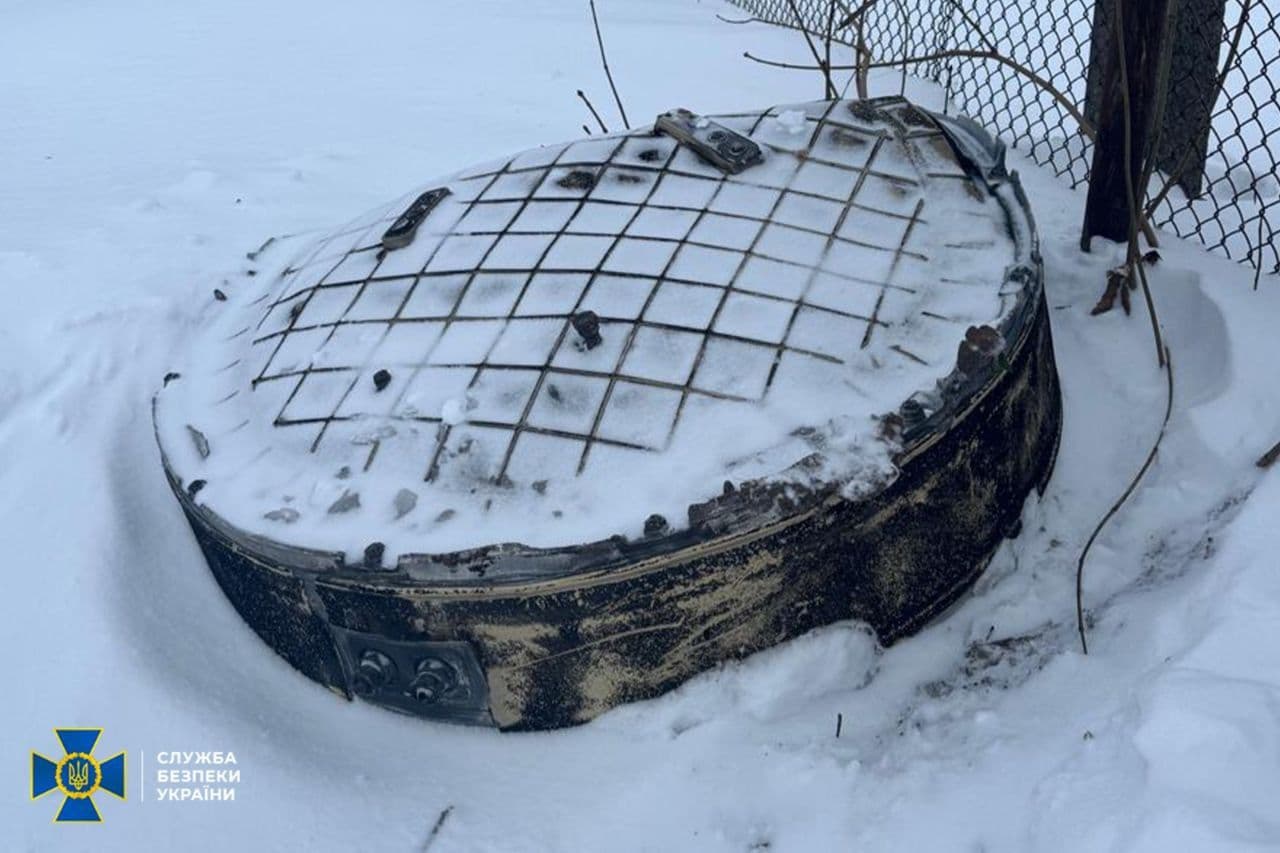
A purpoted fragment of a Russian Oreshnik missile fired againt Lviv Oblast, Ukraine, overnight. (SBU/Telegram)
The second time, on the night of January 8–9, it flew toward Lviv Oblast.
Not toward a hardened bunker. Not toward a command node. But toward western Ukraine—roughly 70 kilometers from Poland. Close enough for Warsaw, Budapest, and Bucharest to start running flight-time math in their heads. Close enough for the Cold War to feel suddenly unfinished.
Ukrainian security officers moved through the impact site at dawn, photographing fragments still warm from reentry. The missile was real. The payload was not. The warhead appeared to contain dummy components. Electronic warfare expert Serhiy Beskrestnov traced the damage: two floors pierced, an archive burned in a basement. Not apocalypse. Not even close.
The target told the story. Lviv had never been hit by a ballistic missile before. Mayor Andriy Sadovyi said it plainly: this was about symbolism. A line drawn near NATO’s doorstep.
Moscow claimed retaliation for a Ukrainian drone strike on Putin’s Valdai residence. The CIA had already called the story fiction. A pretext written after the decision.
The timing wasn’t accidental. Days earlier, the Coalition of the Willing finalized legally binding security guarantees for Ukraine, including a European-led peacekeeping force. The Kremlin had labeled such troops “legitimate targets.” The Oreshnik’s arc was the reminder.
Analysts saw the theater. Retired Major General Mick Ryan called it psychological warfare. Economist Timothy Ash called it irrational—too costly for too little effect.
Then came the diplomacy. Britain, France, and Germany condemned the strike. Ukraine called emergency sessions of the UN Security Council and NATO. Instead of fear, Moscow produced unity.
For ordinary Europeans, the message landed harder. In Poland, Romania, and Hungary, people checked maps and counted minutes.
Geography no longer felt like protection.
The hazel tree had crossed the border in their minds.
When the City Went Cold: Kyiv’s Night Without Heat
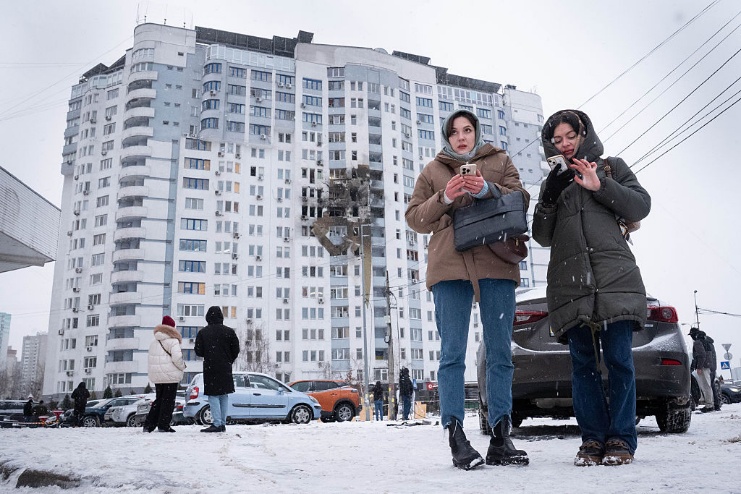
Local people near a residential area hit by a Russian drone attack in the eastern part of Kyiv. The double-tap strike on the capital killed four people and injured 25, with rescue workers among the victims. (Stefan Rousseau/PA Images via Getty Images)
The lights went first. Then the radiators.
At 11:45 p.m., as families in Kyiv stacked extra blankets and checked weather apps sliding toward minus-15, the sky filled with engines. Mayor Vitali Klitschko would later call it the most painful strike the capital’s infrastructure had endured. In waves, 242 attack drones came in low and loud. Iskander-M ballistic missiles followed. Then Kalibr cruise missiles arced up from the Black Sea.
Air-defense crews worked the night. Tracers stitched the dark. Interceptors found 226 drones and 18 missiles. But the ones that slipped through knew exactly where to go.
Two thermal power plants in Kyiv Oblast—feeding heat to both banks of the Dnipro—took direct hits. A third, privately operated plant was struck. Boiler nodes across the city absorbed repeated blows. The system buckled in sequence: pumps failed, pressure dropped, distribution lines froze.
By dawn, the cold had a map.
Nearly 6,000 apartment buildings—about half the city—had no heat. Four hundred seventeen thousand households lost electricity. In stairwells, breath turned to fog. In kitchens, taps coughed and stopped as pipes split. District by district, water pressure sagged. DTEK cut emergency power on the left bank while scheduled blackouts rolled on the right.
This was not about targets on a battlefield. It was about bedrooms and nurseries. About elders counting pills by flashlight. About parents timing kettle boils before the power fell again.
The cold settled into walls. It crept along radiators that no longer warmed. It pressed on windows rimed with ice.
And across a city of millions, winter took its seat.
When a City Is Told to Leave: Kyiv’s Winter Evacuation
The second strike came while the sirens were still fading.
Paramedic Serhii Mykolaiovych Smoliak, 56, had already answered the first call when the drone returned. The explosion tore through the street as rescue workers moved in. Five medics and five emergency personnel were wounded. Smoliak was killed where he stood. A deliberate double-tap. Hit the civilians. Then hit the people who come to save them.
Across Kyiv, the damage spread outward like a bruise.
In Darnytskyi, a drone fell into the courtyard of a residential complex, smashing a small shop and blowing out the windows of a nine-story building. In Dniprovskyi, two apartment blocks burned. In Pechersk, debris ripped open the face of another high-rise. In Desnianskyi, a shopping center and a sanatorium took hits. In Brovary, east of the capital, rescuers pulled a mother, father, grandmother, and five-year-old child from beneath collapsed concrete.
Then a Russian drone struck the Qatari Embassy.
A nation that had mediated prisoner exchanges. A nation that had delivered humanitarian aid. No neutrality. No immunity. No lines.
Deputy Energy Minister Mykola Kolisnyk said the purpose was simple: create social instability. Make winter unbearable. Former housing minister Oleksiy Kucherenko confirmed what building managers already knew—heating systems were being drained because repairs would take days or weeks. Pipes left full would freeze and shatter.
By afternoon, Mayor Vitali Klitschko did something no mayor wants to do.
He told people to leave.
“I appeal to residents of the capital who have the opportunity to temporarily leave the city for places where there are alternative sources of power and heat to do so.”
Four million people live in Kyiv. Half of them had no heat.
Hospitals and maternity wards were reconnected first. Everyone else waited. Families layered coats inside their apartments. Elderly neighbors counted candles. Parents debated whether to put children on trains.
Maryna Polischuk, 45, rode out the night in her hallway, then underground parking. “We can’t plan our future,” she said. “We live day by day.”
Ivan Fedorovskyi, who lost his sister in Kharkiv in 2023, didn’t soften it. Europe has the money and the weapons, he said.
“But it lacks the will.”
This was the campaign’s design: make cities unlivable. Freeze civilians into submission.
Winter, as policy.
When the Sea Turned Against Moscow: America Boards Russia’s Oil Lifeline
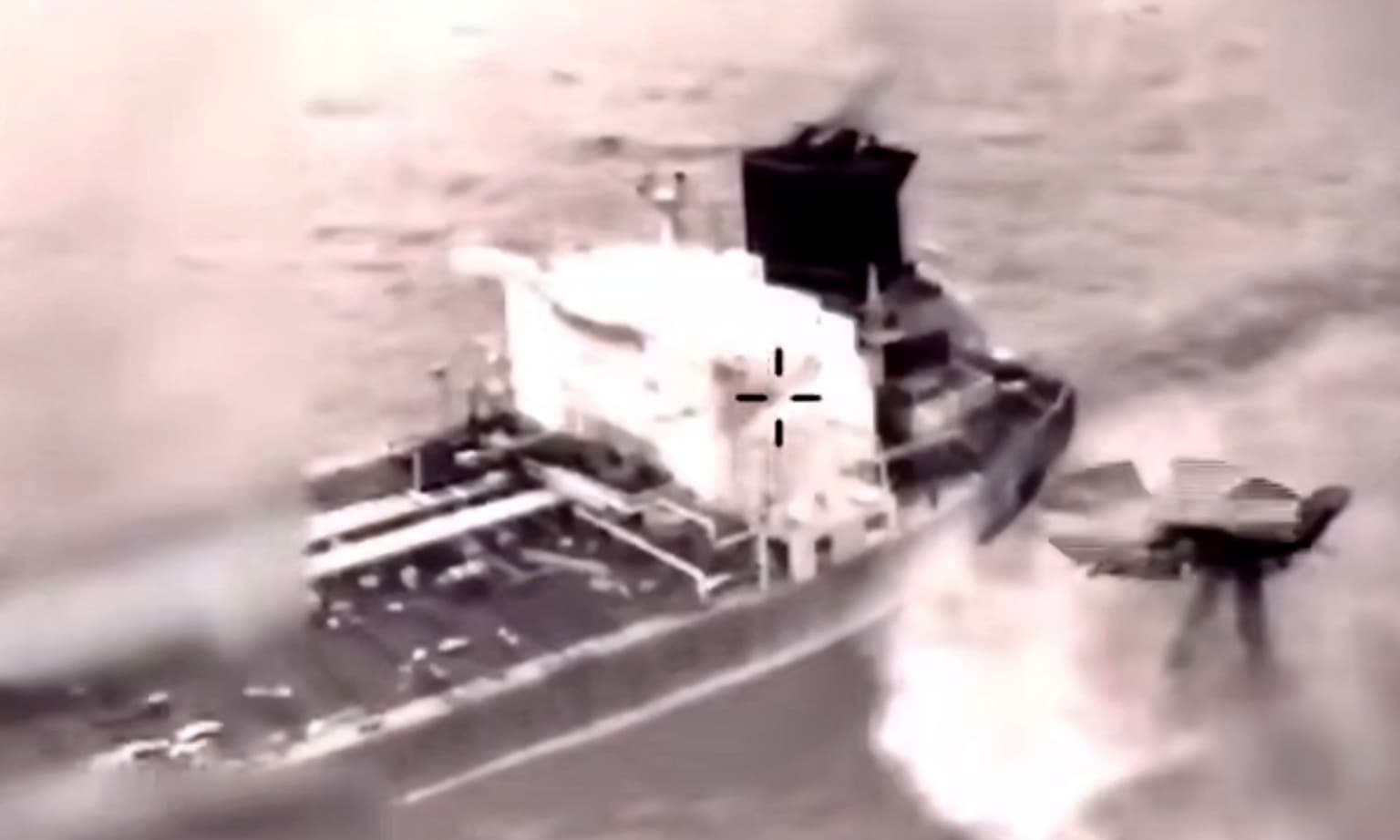
U.S. forces boarded Russian-linked shadow fleet tanker Olina. (U.S. Southern Command / X)
While Kyiv sat in the dark, a boarding team climbed a steel ladder in the Caribbean.
Near Trinidad, the U.S. Coast Guard pulled alongside the oil tanker Olina and went over the rail. It was the fifth shadow-fleet seizure in weeks, and it unfolded at almost the same moment Russian missiles were tearing into Ukrainian thermal plants. Two theaters. Two messages. One night.
The Olina was a familiar ghost ship. Formerly Minerva M. Sanctioned by the United States, the European Union, and Britain. Repainted with a Timor-Leste flag to hide its trail. Loaded on December 24 with roughly 700,000 barrels of Venezuelan crude—the kind of cargo that keeps Russia’s war machine running.
U.S. Southern Command called it Operation Southern Spear and said the mission was simple: end illicit activity, restore security in the Western Hemisphere. Defense Secretary Pete Hegseth put it more bluntly—only lawful energy commerce would be allowed. Everything else would be stopped.
President Trump broke the news himself, posting first and then telling reporters that Russia had chosen “not to defend” the ship. A half-shrug in public. A humiliation in Moscow.
The significance was in what didn’t happen.
For years, shadow-fleet operators assumed Russian flags came with protection. Diplomatic pressure. Naval muscle if needed. A shield. That shield folded the moment American boots hit the deck. Moscow backed away rather than risk a confrontation over a rust-streaked tanker.
The seizure followed Trump’s January 3 removal of Venezuela’s dictator Nicolás Maduro, part of a coordinated campaign to tear down the economic scaffolding that let Russia and its allies dodge sanctions. Each tanker taken meant millions lost. Each interdiction raised insurance costs and choked supply lines.
In Moscow, outrage masked embarrassment. Dmitry Medvedev called the seizures “criminal,” then turned on Russia’s own transport ministry for granting the ships Russian flags at all. Protection, he admitted, had always been paper-thin.
This was economic warfare without a shot fired.
A ladder on a hull.
A bridge secured.
A revenue stream cut.
And a message carried by the sea: Russia’s oil lifeline could be boarded anywhere.
Blood for Meters: The Front Where Progress Is Counted in Graves
Dawn came to Pokrovsk with the sound of engines and boots in frozen mud.
More than ten battalion-sized Russian units pressed in around Myrnohrad, probing with infiltration teams, then surging in waves. Colonel General Oleksandr Syrskyi put the tempo plainly: about fifty combat engagements a day in this sector alone. Reserves kept arriving. The pressure kept building. Northern Pokrovsk held—for now—but the 7th Rapid Reaction Corps called the fight what it was: difficult.
The cost showed up on intercepted radios.
Ukrainian intelligence released a recording from a commander in the 2nd Battalion of Russia’s 237th Airborne Regiment. His order was not ambiguous: execute Ukrainian prisoners near Pokrovsk. A war crime delivered as routine. Humanity punished. Atrocity rewarded.
On the map, the line crept. Geolocated footage confirmed Russian pushes in western Novomarkove and northwest of Stupochky and Ivanopillya—gains measured in hundreds of meters, bought with casualties the Soviet Union would have called catastrophic. The same feeds showed Ukrainian units breaking assaults and smashing infiltration teams. Ground taken at noon was contested again by nightfall.
To the south, near Kostyantynivka–Druzhkivka, Russia stitched together whatever it could find: Chechen Sever-Akhmat infantry, tank regiment elements, ad-hoc battalions pulled into improvised groups. Personnel shortages made coherence a luxury.
Innovation filled the gaps. Russian drones trailed ropes to snare Ukrainian UAVs mid-air. The countermeasures followed days later. Advantage here lasts a week—if you’re lucky.
On the Sumy axis, Russian troops edged north of Hrabovske, but Ukrainian fire made evacuations a nightmare. A milblogger admitted wounded had to move in “easily identifiable groups carrying bodies and equipment.” Fire control decided who lived long enough to be carried.
Near Hulyaipole, Ukrainian troops pushed back to Pryluky’s western edge, clawing back ground Russia had slipped into.
Farther north, Ukrainian drones struck the Oryol thermal plant. Fires burned. Power went out. A mirror held up to Russia’s freeze campaign.
This is the grind. Russia trades lives for meters. Ukraine trades space for time. No breakthrough. Just the arithmetic of exhaustion—counted in bodies, not blocks.
The Cabinet Under Fire: When Zelensky Rebuilds His War Team
The resignations landed while the sirens were still echoing.
On January 9, as Kyiv counted blackout hours and the front line chewed through another day, two of Ukraine’s most senior ministers handed in their papers. Defense Minister Denys Shmyhal. Digital Transformation Minister Mykhailo Fedorov. Parliament Speaker Ruslan Stefanchuk confirmed the filings and set the votes for the following week.
It was not routine. It was wartime triage.
President Volodymyr Zelensky was rebuilding his command team with peace talks approaching and Russian missiles still hunting power plants. Fedorov—the architect of Ukraine’s digital state and a driving force behind the Brave1 military-innovation platform—was slated to take over defense. A technologist for a battlefield that now runs on code, drones, and data.
Shmyhal, Ukraine’s longest-serving prime minister from 2020 to 2025, was being moved to the country’s most fragile portfolio: energy. The ministry had sat vacant for two months after a corruption scandal. Now it would oversee a grid under daily attack and a winter measured in outages. Shmyhal was also nominated as first deputy prime minister—an acknowledgment that continuity still mattered.
The shake-up followed another jolt weeks earlier, when Zelensky dismissed his powerful chief of staff, Andriy Yermak, and replaced him with intelligence chief Kyrylo Budanov. It was a signal that the presidency was shifting from palace politics to war management.
These were not promotions or demotions. They were redeployments.
Zelensky needs ministers who can negotiate with Washington by day and keep the lights on by night. Who can talk security guarantees in one room and drone production in the next. Who can absorb public anger, parliamentary pressure, and the weight of a country that refuses to collapse.
Both men are loyalists. Technocrats. Crisis managers.
The reshuffle says what the sirens already do: Ukraine is entering another phase of the war.
And leadership is part of the battlefield.
When Diplomacy Speaks and War Answers: The Day the Scripts Fell Apart
The statements sounded practiced. The timing did not.
As Kyiv shivered through blackouts and an Oreshnik missile cut toward NATO’s border, Europe’s leaders reached for familiar lines. Italian Prime Minister Giorgia Meloni called for reopening “high-level dialogue with Russia,” urging a special envoy because too many voices, she said, had muddied Europe’s message. French President Emmanuel Macron echoed the need for “the right framework” to talk directly with Moscow.
It read like a memo from another war.
Meloni’s appeal landed on the same day Russia fired a nuclear-capable missile toward Poland’s frontier and froze half of Kyiv. The contrast was almost cruel. After 1,416 days of invasion, Europe was still asking whether conversation might succeed where sanctions, weapons, and warnings had not.
Across the Atlantic, the tone shifted—but the substance thinned.
President Trump told reporters he would commit to Ukraine’s future defense “only because I believe Russia would not invade again.” Translation: America’s guarantee depended on one man’s confidence in another man’s restraint. The Coalition of the Willing had spent weeks drafting legally binding assurances; Trump reduced them to a gut feeling about Putin.
Then, in a room full of oil executives, he pivoted. Greenland. Territory. “We are going to do something with Greenland, whether they like it or not,” he said, arguing the United States needed it before Russia or China took it first. Real estate logic on a day of missile warnings.
“I feel strongly they wouldn’t re-invade,” he told the New York Times, as if his willingness to “agree” to defend Ukraine were the hinge on which war turns.
In Brussels, EU foreign policy chief Kaja Kallas cut through the fog. Talk of territorial concessions, she warned, is a trap. Moscow demands what it never controlled, issues ultimatums, and waits for the West to prepare to concede.
The loudest diplomatic signal was silence.
While Britain, France, and Germany condemned Russia’s Oreshnik strike as “escalatory and unacceptable,” the American president said nothing about the war’s most provocative missile deployment. The omission landed harder than any statement.
Kyiv, for its part, kept selling a future: an $800 billion prosperity plan to bind Ukraine to American investment and interests for a decade. If values no longer carried the room, perhaps returns would.
Words filled the day. Missiles answered them. And the gap between the two kept widening.
The Day’s Meaning: When Intimidation Met Its Limits
January 9 revealed two wars running in parallel. One was built on spectacle and fear. The other on endurance and denial of collapse.
Russia chose theater. A “wonder weapon” arced toward Europe’s edge. Power plants burned. Civilians were pushed into winter without heat. The message was meant to be unmistakable: Moscow can still frighten capitals and freeze cities.
But the same day stripped the performance of its mask.
Economic shields failed in open water. A shadow tanker was boarded and taken. The protection Moscow sells to its networks proved optional when confronted by enforcement. The revenue streams that keep the war moving became liabilities that draw attention, raise costs, and invite interdiction.
At the front, the arithmetic stayed brutal and unchanged. Russia traded lives for meters and called it progress. Ukraine traded space for time and called it survival. Neither side broke through. Only the burn rate told the story—and it favored the defender.
Diplomacy spoke in two voices. Europe reached for dialogue as missiles flew. Washington’s commitments sounded conditional, personal, and thin. The contrast mattered. Ambiguity invites testing. Testing invites escalation. Escalation demands answers that statements cannot provide.
What January 9 exposed was not just contradiction. It exposed momentum.
Russia can still terrorize, but it cannot turn terror into decision. It can still strike infrastructure, but it cannot break a society that has learned to live by generators and move by siren. It can still launch expensive symbols, but it cannot protect the money that buys them.
Ukraine, meanwhile, keeps absorbing nights like this and showing up the next morning. The cost is real. The strain is visible. The will remains.
The inflection point is approaching. Not because one side found a miracle, but because sustainability is becoming the battlefield.
The question for the days ahead is not whether intimidation can continue. It can.
The question is whether it can still decide the war.
Prayer for Ukraine
- Pray for protection over Ukraine’s cities and energy infrastructure as winter deepens — that air defenses hold, repairs come quickly, and civilians are spared from Russia’s freeze campaign.
- Pray for the families of the fallen and wounded, especially first responders — for comfort for the loved ones of paramedic Serhii Smoliak, strength for injured medics, and protection over all who run toward danger to save others.
- Pray for Ukrainian leadership during this critical transition — that President Zelensky and his reshaped cabinet would be granted wisdom, unity, and endurance as they lead a nation under fire and navigate high-stakes negotiations.
- Pray for moral clarity and resolve among Western leaders — that hesitation, ambiguity, and political calculation would give way to decisive action that defends sovereignty and restrains aggression.
- Pray for Ukraine’s soldiers on the front lines — for protection in the grinding battles around Pokrovsk, Sumy, Hulyaipole, and beyond; for courage under fire; and for an end to the violence consuming lives for meters of ground.