
In one brutal night before the invasion’s fourth anniversary, Russia unleashed its largest strike package in months, planted bombs in Lviv’s Old Town, and pushed the war from the sky into Ukraine’s streets.
The Day’s Reckoning
At 12:25 a.m., Viktoria Shpylka stepped onto a cobbled shopping street in Lviv’s Old Town.
She was 23. The call sounded routine — a reported break-in at a retail store. Officers fanned out beneath streetlamps and shuttered balconies. Then the first device detonated.
Reinforcements rushed in.
The second device exploded after they arrived.
Two days before the fourth anniversary of Russia’s full-scale invasion, the war shifted under Ukrainians’ feet. Missiles still came from the sky — 347 drones and missiles in a single night — but bombs were now waiting on the pavement. Railways were struck. Water systems were hit. Police officers responding to ordinary calls became targets of a remote-triggered trap.
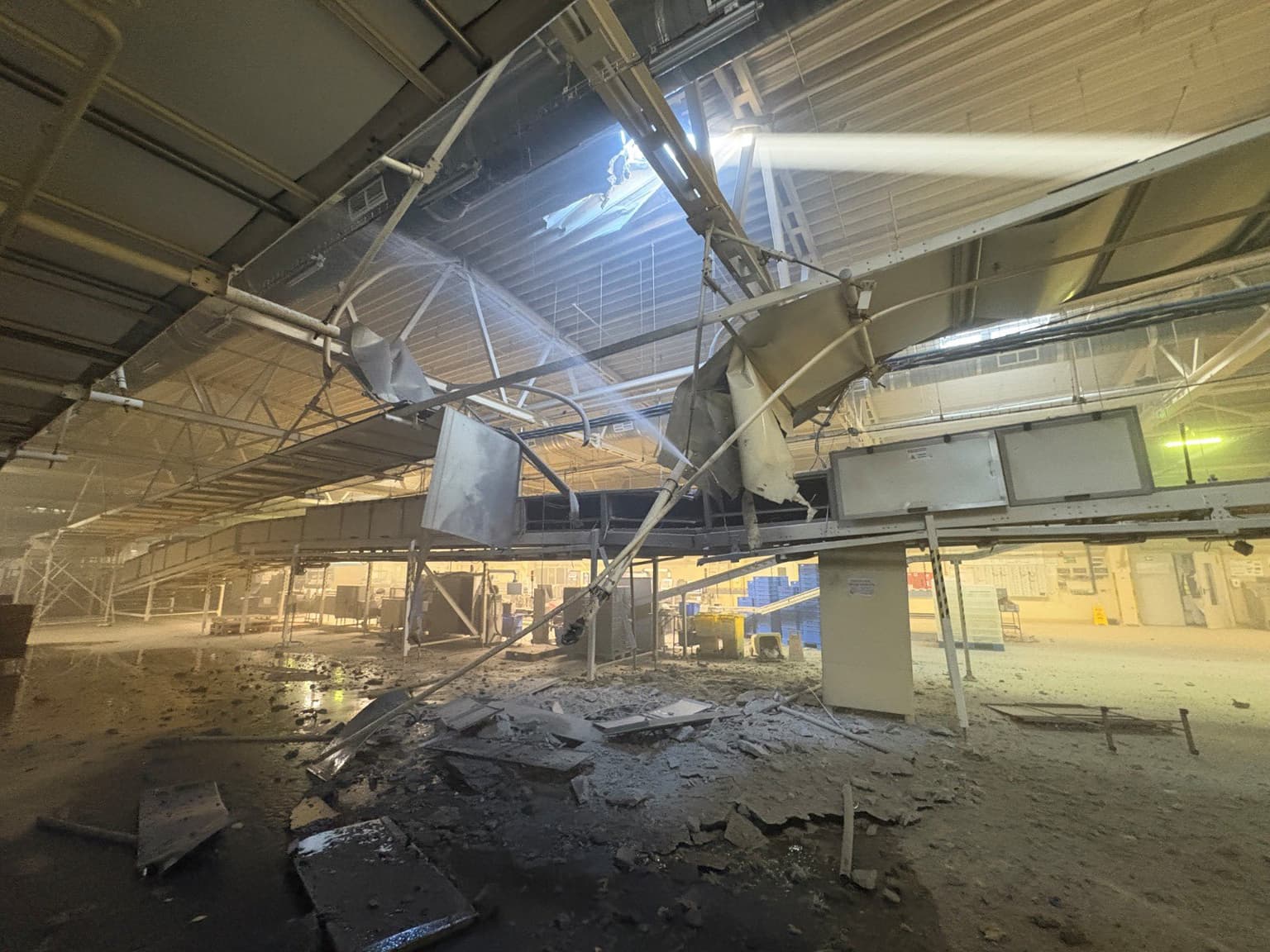
At 4:00 a.m., Kyiv’s walls began to shake. Temperatures hovered near minus ten degrees Celsius as ballistic missiles rolled across roughly half the country under air raid alert. In Fastiv, a building collapsed. In Sumy Oblast, a 17-year-old boy was killed. A married couple died after a strike drone hunted down the ambulance carrying wounded brothers from an earlier attack. A Mondelez factory producing Oreo and Milka was hit near the Russian border.
Ukraine answered in kind. Drones ignited an oil depot in occupied Luhansk, destroyed two Tor air defense systems worth more than $50 million, forced temporary closure of all four Moscow airports, and struck a Druzhba pipeline pumping station 1,100 kilometers inside Russia.
Three hundred and forty-seven projectiles in the dark.
And a widening sense that the war is no longer contained by front lines — only by reach.
347 in the Dark: When the Sky Filled with Fire
Just before midnight, the radar screens began to multiply.
Dots became swarms.
From Bryansk, Kursk, and Oryol. From Shatalovo in Smolensk Oblast, Millerovo in Rostov Oblast, Primorsko-Akhtarsk in Krasnodar Krai, and occupied Crimea — 297 drones lifted into the night. Roughly 200 were Shahed-type, joined by Gerbera-, Italmas-, and other strike drones. Behind them came 50 missiles: four Zircon hypersonic cruise missiles from Crimea; 22 Iskander-M and S-400 ballistic missiles from Bryansk, Belgorod, and occupied Donetsk Oblast; 18 Kh-101 cruise missiles from Volgograd Oblast; and additional Iskander-K and Kh-59/69 cruise missiles from Kursk Oblast.
The sky became a calculation problem.
Air defense crews worked without pause. Track. Lock. Fire. They shot down 33 missiles and 274 drones — every Iskander-K and Kh-59/69, and all but one Kh-101. But saturation leaves gaps. Fourteen missiles and 23 strike drones hit 14 locations. Falling debris struck five more.
At 4:30 a.m., MiG-31K aircraft capable of carrying Kinzhal aeroballistic missiles took off. Tu-95MS and Tu-160 strategic bombers were already airborne. Poland’s Operational Command scrambled fighters and an early warning aircraft, placing ground-based air defense on heightened alert to “ensure security in areas adjacent to the Ukrainian border.”
Three hundred and forty-seven projectiles.
Ukrainian crews saved dozens of targets.
They could not save them all.
They Went After the Veins: Railways, Water, and the Machinery of Survival
On Sunday night, Zelensky drew a line.
This was no longer just about the power grid.
Russia had shifted its aim to railways, water systems, and the logistics that keep Ukrainian cities alive under strain — from transformers to arteries.
Oleksiy Kuleba, Ukraine’s Deputy Prime Minister, detailed the impact. Railway infrastructure was struck in Donetsk, Zaporizhia, Mykolaiv, and Odesa oblasts. Two locomotives were damaged. At least 16,000 customers lost power in Mykolaiv City. DTEK reported severe damage to an electrical substation in Odesa. Civilian, commercial, medical, and residential sites were hit across Kyiv City and Kyiv, Odesa, Sumy, Mykolaiv, Dnipropetrovsk, and Zaporizhia oblasts. At least 19 civilians were injured. One was killed.
“When logistics facilities are increasingly becoming targets — first of all the railway, but also facilities that work on water supply,” Zelensky said, assigning new tasks to air defense, the Ministry of Defense, and government agencies. He called for strengthened drone protection in border areas, where civilian vehicles, rescuers, and repair crews are increasingly targeted.
The escalation fits a pattern. This week alone: more than 1,300 attack drones, over 1,400 guided aerial bombs, and 96 missiles — dozens ballistic. Since October, Russia has systematically struck energy and heating infrastructure during one of the coldest winters in years. Now it is striking movement itself.
In late January, seven railway drone attacks hit within 24 hours. Days before February 22, a strike on a civilian passenger train in Kharkiv region killed five and injured two. Ukrzaliznytsia responded by concealing some intercity train schedules — turning timetables into wartime secrets to keep kamikaze drones from finding them.
Not just freezing a country.
Slowing it down.
Midnight in Lviv: A Bomb Meant for the Ones Who Answer the Call
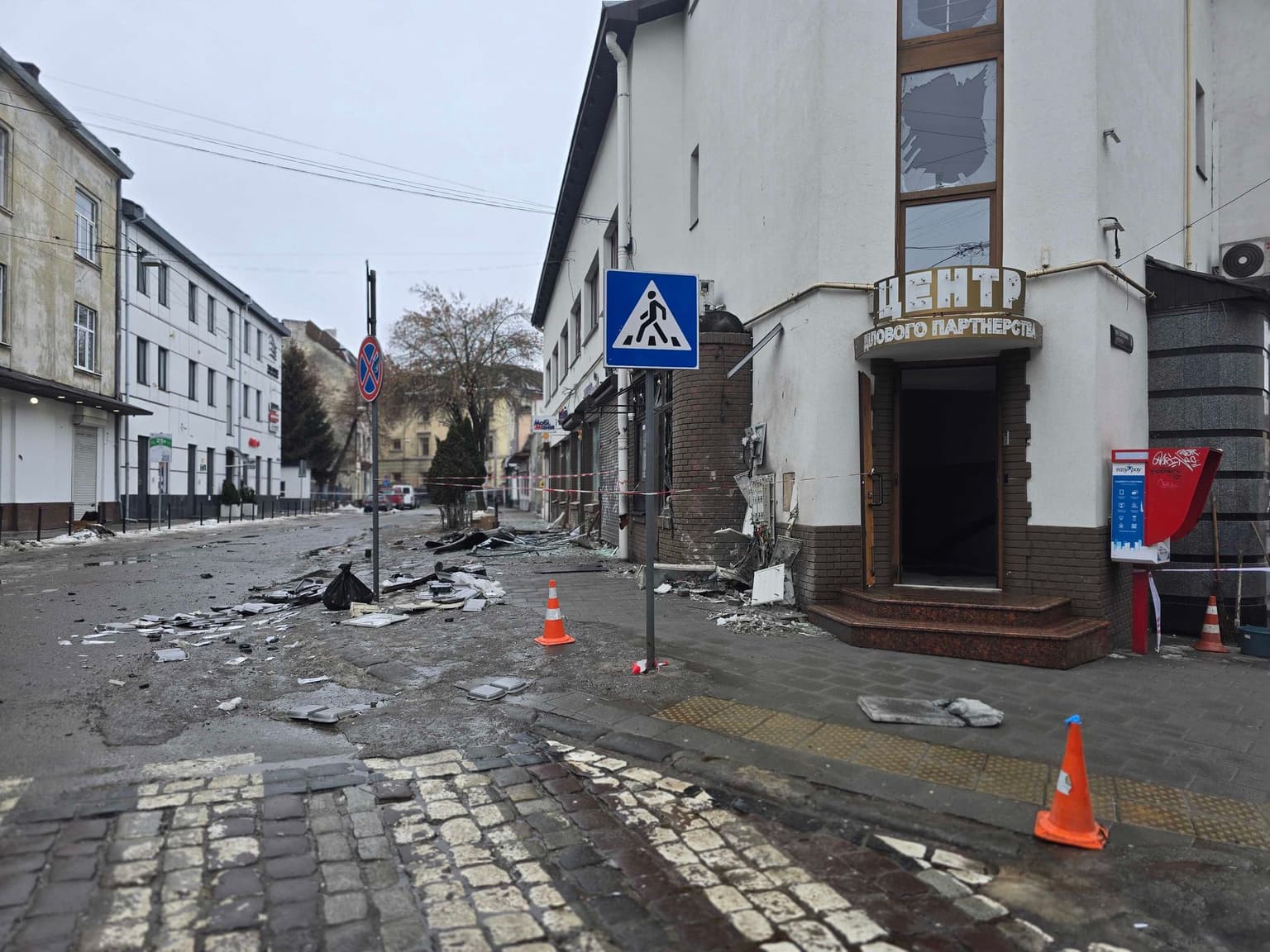
At 12:25 a.m., glass burst across a shopping street in Lviv’s Old Town.
Police had responded to what sounded ordinary — a reported break-in at a retail store. Viktoria Shpylka was among them. She was 23 years old.
The first device detonated after officers arrived.
More units rushed in.
The second device exploded when they reached the scene.
Shpylka was killed. Twenty-five people were injured, most of them law enforcement officers who had come to help.
By morning, investigators were moving quickly. A 33-year-old woman from Kostopil in Rivne Oblast was arrested in Staryi Sambir near the Polish border. She had been living temporarily in Lviv since September 2025. According to the Prosecutor’s Office, she planted the explosives the day before, left by taxi, and detonated them remotely.
Zelensky did not hedge. “The perpetrators were recruited via Telegram. The attack was organized by Russia.” Interior Minister Ihor Klymenko added that there was “every reason to believe” the crime was carried out on Russian orders and noted that deadly traps for Ukrainian officers are not new.
Mayor Andriy Sadovyi called it “a hostile special operation aimed at killing as many law enforcement officers as possible.” He said Lviv was chosen deliberately — full of tourists and military personnel at the time.
This was not isolated. Ukrainian and Moldovan authorities recently foiled a Russian assassination plot targeting political and defense figures. Russian agents assassinated former Verkhovna Rada Chairperson Andriy Parubiy in August 2025. Zelensky warned that intelligence suggests more such attacks will follow.
The goal is not only blood.
It is doubt — to make people hesitate before dialing for help.
Before Dawn in Kyiv: The Walls Began to Shake Again
At 4:00 a.m., the suburbs of Kyiv woke to impact.
Windows rattled. Sirens rose. Ballistic missiles streaked toward the capital, triggering air raid alerts across roughly half the country. At 4:30 a.m., more explosions followed. Then more. The blasts rolled through the early morning darkness. Zircon hypersonic missiles launched from Crimea were reported, though not every launch was officially confirmed.
Sixty kilometers southwest of Kyiv, in the Fastiv district, a building gave way. Concrete folded in on itself. A 49-year-old man was killed. Seven others were injured; three remained in serious condition. Across Kyiv Oblast, 17 people were wounded in total — four of them children. A woman and a child from the suburbs were hospitalized.
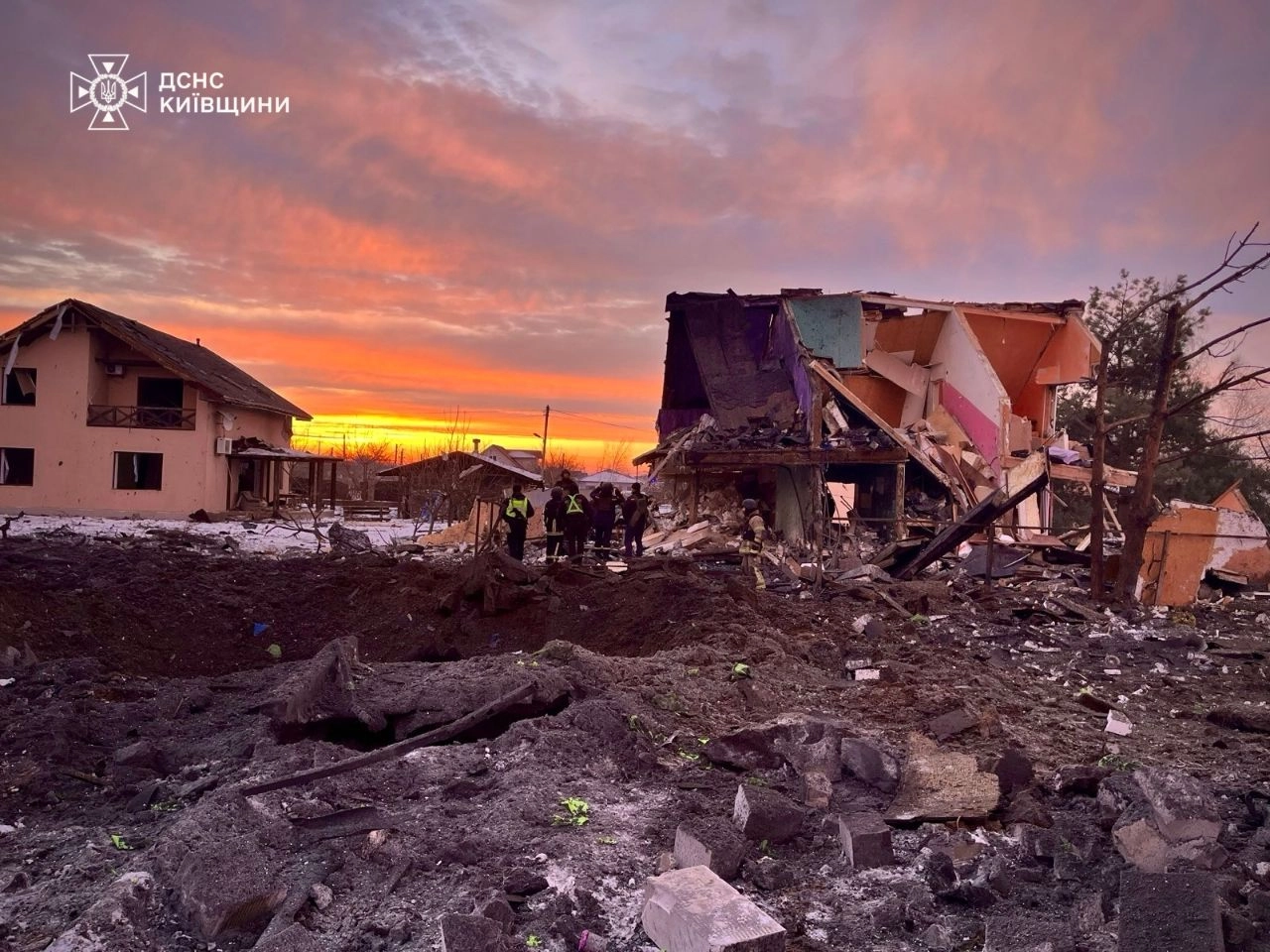
Rescue crews moved through air that bit at the lungs. Temperatures hovered near minus ten degrees Celsius as emergency services, medics, and police worked beneath floodlights and drifting smoke. Kyiv Regional Military Administration head Mykola Kalashnyk delivered updates from the scene, speaking over the noise of generators and heavy equipment.
An early report suggested a residential roof fire in the Sviatoshynskyi district. It was later unconfirmed.
The casualties were not.
One dead. Seventeen injured. The fourth year of the war beginning its final week with the capital once again absorbing Russian fire before dawn.
Hunted on the Road: When Even the Ambulance Was Not Safe
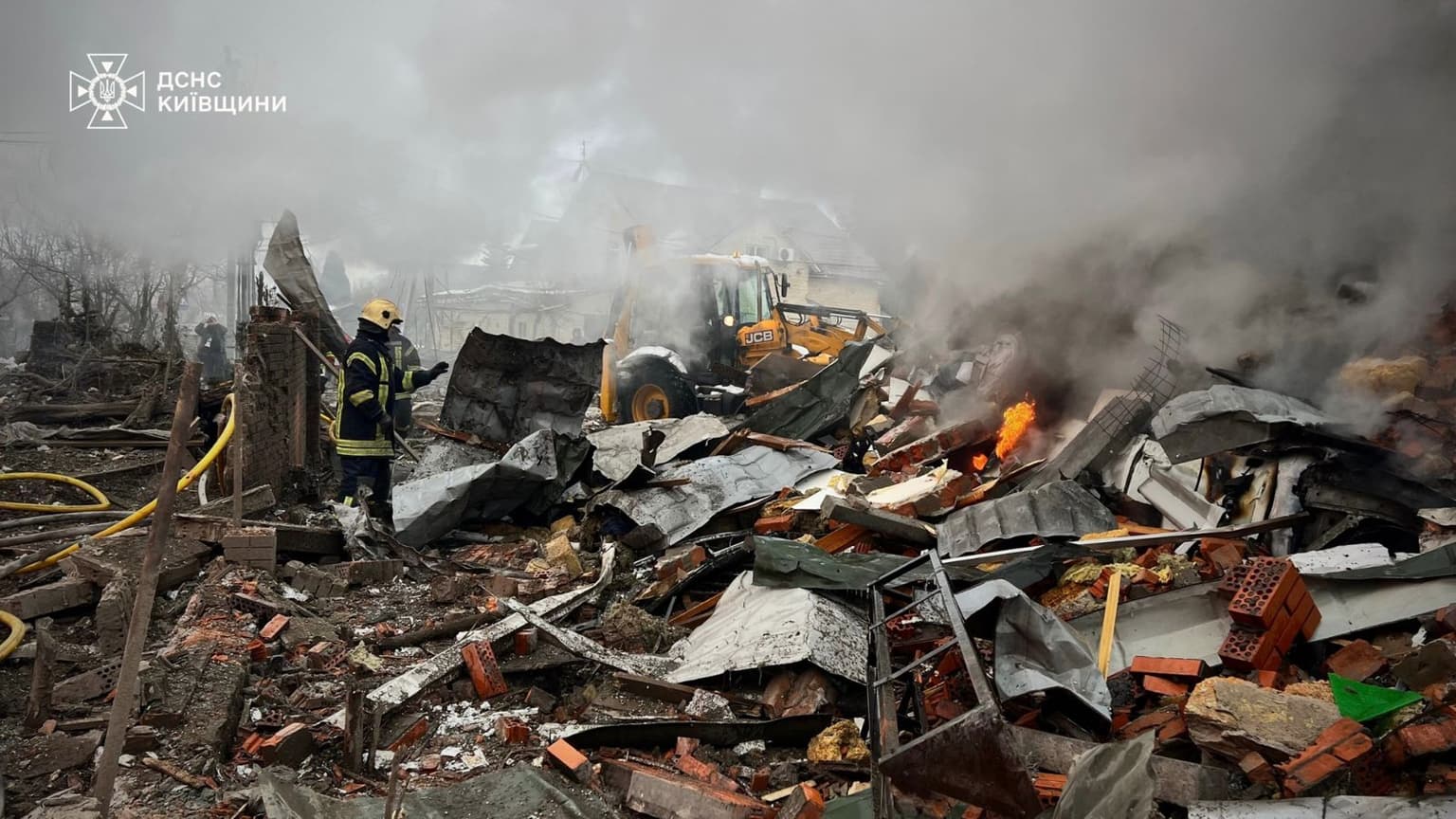
Near Znob-Novhorodske, less than four kilometers from the Russian border, the first drone dropped its explosive.
Two brothers were wounded.
An ambulance was dispatched. Siren on. Doors closed. Medics working as the vehicle pulled away toward hospital.
A second drone followed.
It tracked the ambulance as it moved along the road. Then it struck.
The vehicle was destroyed. Both brothers were killed. One of them was 17 years old.
Elsewhere in Sumy Oblast that same day, a married couple died in a separate strike.
February 22 was not random violence. It was method.
Thirty kilometers from the border, in Trostyanets, a missile hit a production facility belonging to Mondelez — the American multinational that makes Oreo, Milka, and Toblerone. The blast did not just strike Ukrainian soil. It hit a U.S.-owned business operating in Europe.
Foreign Minister Andrii Sybiha addressed the contradiction directly: “When Russian missiles hit such sites, they are not only targeting Ukraine. They are targeting American business interests in Europe. Moscow cannot speak of economic dialogue with the United States while attacking U.S.-owned production facilities.”
At the same time, Washington continued efforts to broker a peace deal. The United States and Russia had agreed to establish an economic working group alongside political and military negotiations.
On the road near Znob-Novhorodske, none of that mattered.
The drone had already chosen its target.
Moscow Grounded, Tatarstan in Flames: Ukraine Carries the War North
By afternoon, departures boards in Moscow began to freeze.
Dozens of Ukrainian drones moved toward the capital’s region on February 22, forcing temporary flight suspensions at all four airports — Domodedovo, Sheremetyevo, Vnukovo, and Zhukovsky. Passengers waited beneath fluorescent lights while airspace closed above them.
Mayor Sergey Sobyanin said more than 20 drones were shot down. Russia’s Defense Ministry reported 29 more intercepted over Bryansk Oblast, with additional drones downed over Kaluga, Belgorod, Tula, Kursk, and Tver oblasts.
Ukrainian officials have been explicit about the logic: disrupt aviation, and ordinary Russians feel the war in missed flights, grounded jets, and silent runways.
Hours later, the war traveled even farther.
In the early hours of February 23, an oil pumping station near Almetyevsk in Tatarstan — roughly 1,100 kilometers from the Ukrainian border — was struck. Open-source analysts geolocated footage confirming fire at the Kaleikino pumping station, owned by Transneft-Prikamye JSC, part of Russia’s state oil pipeline monopoly. Supernova+, a Russian monitoring channel, called it “one of the key starting oil pumping stations… where oil actually enters the famous Druzhba pipeline” — the same pipeline entangled in recent disputes with Slovakia and Hungary over aid to Ukraine.
In Belgorod, Ukrainian strikes damaged the Frunzenskaya electrical substation, triggering power outages. Governor Vyacheslav Gladkov said a full damage assessment would follow the next morning.
Kyiv did not comment publicly on the Tatarstan strike.
But Transneft had already warned in September 2025 of reduced output after earlier Ukrainian drone strikes on export ports and refineries.
The war now reaches 1,100 kilometers.
And it does not always whisper.
Fire Behind the Lines: Oil, Air Defenses, and the Cost of Reach
Before dawn, fuel was already burning in occupied Luhansk.
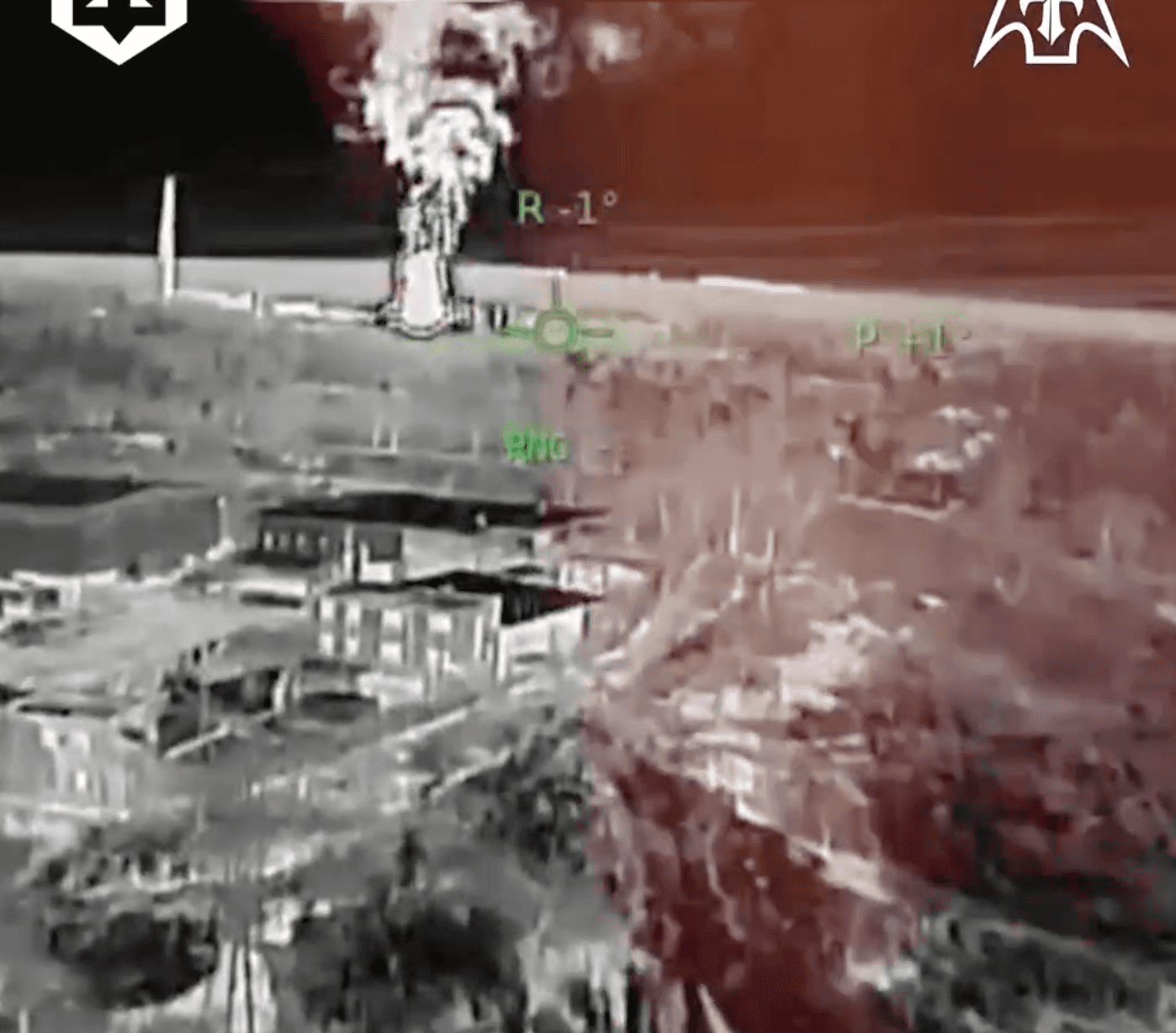
Ukraine’s Unmanned Systems Forces — the elite drone branch commanded by Robert “Magyar” Brovdi — sent two drones into an oil depot in southern Luhansk City, roughly 97 kilometers from the front. Leonid Pasechnik, head of the self-proclaimed Luhansk People’s Republic, confirmed the strike. A fuel tank caught fire. Geolocated footage showed flames still rising into the morning light.
The same night, the drone unit “Madyar Birds” hunted air defenses.
Two Tor anti-aircraft missile systems were destroyed in occupied Donetsk Oblast — one in Kyslyche, the other in Topolyne, about 95 kilometers from the front. The operation was coordinated with the Unmanned Systems Forces’ Deep Strike Center. Estimated value: more than $50 million.
The damage did not stop there.
Satellite imagery confirmed destruction from earlier attacks. At the Votkinsk Machine Building Plant in Udmurtia, a workshop associated with Russian missile production was damaged in the February 20–21 FP-5 Flamingo cruise missile strike. In Samara Oblast, imagery showed two vertical stabilization columns damaged at the Neftogorsk Gas Processing Plant — key infrastructure for refining petroleum products for transport.
At Pugachevka Airfield in Oryol Oblast, a source affiliated with Russian intelligence claimed February 19–20 strikes destroyed an Mi-8 helicopter and a Ka-52 attack helicopter. In Pskov Oblast, imagery from the February 18–19 strike on the Velikiye Luki oil depot revealed scorching around multiple fuel tanks — contradicting the governor’s claim that only one tank had been hit. The SBU’s “Alpha” UAV unit said its drones navigated through anti-drone netting to reach the target.
Fuel. Air defenses. Production lines.
The war’s quiet arithmetic of attrition.
Grinding Toward Slovyansk: Pressure Without Breakthrough
The eastern front moved — but did not break.
In the Slovyansk direction, Kostyantyn Mashovets reported Russian forces seized Zakitne northeast of Slovyansk, advanced south of Kryva Luka, and began fighting for Kalenyky to the east. Units from the 20th and 3rd Combined Arms Armies are pressing between the Siverskyi Donets River and the E40 highway, a narrowing corridor that allows concentration of force. The aim: cut off Lyman from the northwest and set conditions to envelop Slovyansk from the north. Mashovets assessed that taking Slovyansk and Kramatorsk would demand far greater resources than the seizures of Pokrovsk and Myrnohrad.
Colonel Viktor Trehubov confirmed attempts to bypass Lyman via Drobysheve and Stavky toward Raihorodok. Russian assault groups infiltrated the outskirts of Lyman, a Ukrainian brigade reported, but no significant gains followed.
In Kupyansk, a Russian milblogger said command ordered troops to infiltrate through the Soyuz gas pipeline, drawing criticism over collapses in the aging infrastructure. A Ukrainian brigade in Borova said similar attempts occurred in January. Nearby, Ukraine’s 16th Army Corps released footage of drones striking a TOS-1A thermobaric system near occupied Bohdanivske, five kilometers behind the line.
Around Pokrovsk, Russian attacks probed toward Hryshyne, Serhiivka, Rodynske, Bilytske, Udachne, and Molodetske. Ukrainian officials said Russian drones now mine supply routes up to 15 kilometers behind the front at night while forces install antennas and cables to offset blocked Starlink terminals. Strikes once reached Pavlohrad; they have decreased since terminals were cut.
In Kostyantynivka-Druzhkivka, a Russian milblogger called reported advances near Torske and Dobropillya “premature and exaggerated,” hinting at pressure to inflate gains.
Zaporizhia saw Ukrainian strikes on depots and armor in Polohy, and on the M-18 bridge at Vasylivka. In Crimea, two Project 22460 Okhotnik vessels near Inkerman and two Be-12 aircraft at Yevpatoria were hit.
Near Yampil and Lyman, rising water from the Zherebets River slowed Russian logistics.
Pressure everywhere.
Breakthrough nowhere.
World War III Has Begun”: Zelensky Draws the Line Before Year Four
Two days before the fourth anniversary of the invasion, Volodymyr Zelensky leaned forward in a BBC interview and said the phrase aloud.
“I believe that Putin has already started it. The question is how much territory he will be able to seize and how to stop him.”
It was not rhetoric. It was framing.
Asked whether conceding the 20 percent of Donetsk Oblast Moscow has failed to capture since 2014 — along with occupied parts of Kherson and Zaporizhzhia — would be a “reasonable request” for a ceasefire, Zelensky rejected it outright. “I see it as abandoning hundreds of thousands of our people who live there. And I am sure that this ‘withdrawal’ would divide our society.”
On Donald Trump and security guarantees, he was careful but firm. “It is not only President Trump, we’re talking about America… Congress is needed. Because the presidents change, but institutions stay.” His bet, he made clear, rests on American institutions, not personalities.
On the battlefield, he sounded defiant. “Will we lose? Of course not, because we are fighting for Ukraine’s independence.” He said Ukraine had regained roughly 300 square kilometers in recent counterattacks, enabled by sweeping outages of Russian-operated Starlink terminals. Speaking to AFP, he added: “You can’t say that we’re losing the war… The question is whether we will win. That is the question — but it’s a very costly question.”
Then came the part that lingers.
“We also don’t have enough weapons. That depends not just on us, but on our partners.”
“Why Not Now?”: Boris Johnson Urges Europe to Act Before a Ceasefire
On the BBC, Boris Johnson did not hedge.
Sitting beside Admiral Sir Tony Radakin, the former UK prime minister asked the question bluntly: if Europe is prepared to deploy troops to Ukraine after a ceasefire, why wait?
“If we are willing to do it in the context of a ceasefire, which of course puts all the initiative, all the power in Putin’s hands, why not do it now?” Johnson said. A ceasefire that leaves Ukraine weakened, he warned, risks turning it into a “vassal state of Russia,” where Putin — not Ukrainians — decides who enters the country.
Radakin agreed that Western support has moved too slowly. He called it “incrementalism,” acknowledging Kyiv’s frustration. Johnson described delays as “needless,” pointing to the West’s failure to act decisively after Crimea in 2014 as “tragic” and arguing that inaction over Syria’s chemical weapons emboldened Putin further.
The UK Ministry of Defence pushed back, citing “the highest ever level of military support,” including a recent £500 million air defence package and £200 million accelerated for deployment preparation. The exchange came after Defence Secretary John Healey said British troops would deploy after a peace deal — a sequencing Johnson clearly rejects.
Radakin also urged the government to “resolve” its pledge to spend 3.5% of national income on defence by 2035. Russia, he said, is “weak” — but still “dangerous.”
The debate is no longer theoretical.
It is about whether deterrence begins before peace — or only after it.
“Spectator or Actor?”: Munich’s Ghost and the Warning of 1938
In Munich, history hangs in the air.
Roderich Kiesewetter stood at the Security Conference and cut through the diplomatic language. “The decisive point is: spectator or actor,” he said, arguing that the transatlantic relationship built on trust has fractured. In his telling, the U.S. strategic hierarchy now places the American homeland first, the Indo-Pacific second, and Europe far down the list.
Secretary Rubio’s tone this year sounded warmer than J.D. Vance’s speech the year before, Kiesewetter noted — but omissions speak. “He didn’t even mention Ukraine. And that is a warning sign for us Europeans.”
His prescription was direct: begin Taurus training and deliveries, tighten pressure on Russia’s shadow fleet, limit Russian state structures in Germany, and deploy European air defense systems over western Ukraine to free Ukrainian assets for the front.
Then he invoked the city itself.
“In Munich, 87 years ago, Europe’s fate was sealed,” he said, referencing 1938 and the stripping of Czechoslovakia’s fortifications. “That is the same if the Donbas is given up. There Ukraine has its fortifications.” History, he argued, is being copied “like a digital twin into the high-tech age” by the U.S. and Russia — and Europe risks being ruined by it.
If Europe refuses to provide long-range strike capabilities, he warned, Russia’s blackout strategy could render Ukraine “ungovernable,” driving civilians west and straining European societies. Unanimity rules, he suggested, could be set aside in favor of coalitions willing to act.
His bleakest vision: a Ukraine that survives as “a modern North Korea.”
He closed with a challenge to Germany itself: never again defenseless — not toward Washington, Moscow, or Beijing.
Moscow Pays Its Tab: €500 Million in Weapons for Tehran
While Moscow demanded territorial concessions from Kyiv, another ledger was being settled.
The Financial Times reported — citing leaked internal documents and sources familiar with the matter — that Russia and Iran have agreed to a €500 million arms deal, roughly $589 million. The package includes 500 Verba MANPADS, 2,500 9M336 surface-to-air missiles, and 500 Mowgli-2 night vision sights. Deliveries are scheduled in three tranches between 2027 and 2029.
The request traces back to July 2025, weeks after the June 2025 Israel-Iran war devastated Iran’s air defense systems. Tehran asked for the Verba systems. By December 2025 and January 2026, cargo flights from Russia to Iran were confirmed. Iran’s ambassador to Russia, Kazem Jalali, acknowledged the shipments contained military cargo.
Mid-January 2026 brought more. Russia reportedly delivered attack helicopters and Spartak armored vehicles, including at least one Mi-28 helicopter from a November 2023 agreement.
The transaction exposes a quiet imbalance. Throughout its war in Ukraine, Russia has leaned heavily on Iran, North Korea, and other partners for drones and ammunition. But Moscow’s own battlefield demands limited its ability to return the favor. Some partners strained under the one-sided flow and began to distance themselves.
This deal suggests the Kremlin is repairing those relationships — on a timeline it believes will not disrupt its current war effort.
Russia has, however, delayed contracted deliveries before.
In war, debts accumulate.
And eventually, they are paid.
The Lines Hold: Assaults Without Advance
In northern Sumy Oblast, Russian forces attacked near Kindrativka, Oleksiivka, Myropillya, and Kucherov. Drone operators from the 1443rd and 30th Motorized Rifle Regiments struck Ukrainian positions. But the line did not move. No confirmed advance followed.
In Kharkiv Oblast, Russian milbloggers claimed attacks northeast of Kharkiv City near Vovchanski Khutory, Symynivka, and Starytsya, and southeast of Velykyi Burluk near Dvorichanske. The Institute for the Study of War reported no evidence of confirmed gains in either sector.
On the southern axis, the pattern repeated. In the Hulyaipole direction, Russian forces attacked across a broad arc but did not advance. A Russian milblogger claimed Ukrainian counterattacks near Pryluky, Boikove, and Rizdvyanka. Geolocated footage showed Ukrainian strikes on Russian positions west of Myrne. In western Zaporizhia Oblast near Orikhiv and Mahdalynivka, Ukrainian forces maintained or recently improved their positions.
In Kherson, neither side reported ground activity.
There was movement — drones, artillery, probing assaults.
But no breakthrough.
The pressure continues.
The map does not change.
What February 22nd Revealed
Two wars unfolded at once.
In the sky, 347 drones and missiles tested the limits of Ukrainian air defense. On the ground in Lviv, a bomb waited for the police. In Sumy Oblast, a drone hunted an ambulance. The front line did not need to move for the war to widen.
This day revealed a shift in method. Russia is no longer striking only power plants. It is targeting railways, water systems, logistics — the mechanics of movement. The objective is not just to freeze Ukraine, but to slow it, fracture it, exhaust it. The Lviv bombing carried the same logic: attack trust itself. Make officers hesitate. Make civilians wonder whether help will come.
At the same time, Moscow settled accounts abroad. A €500 million arms deal with Iran signaled repayment for years of drone support, even as Russia demands territorial concessions from Kyiv.
Ukraine answered with reach. Moscow’s airports closed. A Druzhba pipeline pumping station burned 1,100 kilometers from the border. Air defenses worth more than $50 million were destroyed. Missile production sites and refineries showed fresh damage under satellite imagery.
Diplomatically, the rhetoric hardened. Zelensky spoke of World War III already underway. Boris Johnson questioned waiting for a ceasefire before deploying European troops. In Munich, Roderich Kiesewetter warned of a “digital twin” of 1938.
The pattern is escalation without collapse.
The war’s character remains the same.
Its radius expands.
Day 1,459. Two days before the anniversary.
The scale is growing. The limits are not yet clear.
Prayer For Ukraine
1. Protection for Civilians Under the Drones
Lord, as 347 drones and missiles filled the sky and railways, water systems, and homes were struck, we ask for Your covering over every city and village. Shield families from further attacks, protect rescuers and repair crews, and guard those who must work through the night to keep Ukraine alive.
2. Comfort for the Families of the Fallen
We lift before You the family of 23-year-old Viktoria Shpylka, the two brothers killed in Sumy, the married couple lost in the strikes, and the 49-year-old man in Fastiv. Draw near to their loved ones. Be their refuge in grief and their strength in the long days ahead.
3. Wisdom and Unity for Ukraine’s Leaders
Grant President Zelensky and Ukraine’s military and civic leaders clarity, courage, and unity as they face shifting tactics and escalating threats. Give them discernment in negotiations, resilience in battle, and steadfast resolve in defending their people.
4. Strength for Those Defending and Rebuilding
Strengthen air defense crews, frontline soldiers, drone operators, medics, and engineers repairing substations, rail lines, and bridges. Protect them from fatigue and fear. Let their work preserve life and push back darkness.
5. Restraint, Conviction, and a Path to Just Peace
We pray for innocent Russian families who also live under fear and propaganda. Stir hearts toward truth. Restrain those who order violence. And Lord, bring a just and lasting peace that preserves Ukraine’s sovereignty and ends this war.
Sustain Ukraine. Guard her people. And bring this conflict to an end.
It’s heartbreaking to read about the drone attack on the ambulance near Znob-Novhorodske and the young lives lost. Given the increasing targeting of first responders mentioned in the article, does anyone know if there are specific medical protocols or specialized trauma kits being recommended for volunteer crews working in these high-risk border zones? I was looking for more details on this and came across a discussion involving a specialist here https://www.olficamera.com/forums/users/darell1/engagements/ but I’m still trying to understand which mobile equipment is most effective for such extreme conditions. Would appreciate any insights from those on the ground.