
Hours before diplomats met in Geneva, Russia unleashed its largest pre-negotiation strike package of the year—while Ukrainian drones burned an explosives plant deep inside Russian territory.
The Day’s Reckoning
The first delegates walked into conference rooms in Geneva as 396 drones and 29 missiles were still in the air.
Air-raid alerts were sounding across Sumy, Chernihiv, Dnipropetrovsk, Ivano-Frankivsk, Kharkiv, and Odesa oblasts. Power plants burned. Transformers ruptured. In Kharkiv Oblast alone, at least 28,000 consumers lost electricity. Tens of thousands more in Odesa City were left without power as diplomats discussed possible energy-strike moratoriums.
Four hundred twenty-five weapons launched hours before talks opened. Thirteen locations hit. The largest single-month Russian strike package count of the war.
Inside the negotiations, US, Ukrainian, and Russian delegations laid out five tracks—territorial, military, political, economic, security. Moscow sent the same officials who had spent the previous day insisting there would be no compromise. Duma Defense Committee Chairperson Andrei Kartapolov repeated that Ukraine could only “win” by joining the Russian Federation. Deputy Chairperson Yuri Shvytkin described Russian battlefield gains as a “favorable backdrop” for settlement.
Translation: surrender now.
A Tsargrad op-ed tied to oligarch Konstantin Malofeev was even more blunt. Russia sought to “create the impression” it wanted resolution. Real peace would come only after Ukrainian frontlines collapsed—“still a long way off.” The delegation’s job was simple: avoid blame.
Sixteen hundred kilometers inside Russia, SBU Alpha drones struck the Metafrax Chemicals plant in Perm Krai. Methanol. Hexamine. Pentaerythritol. Precursors for explosives. Flames rose over Gubakha as residents reported multiple blasts. No sanctuary at that distance.
In Krasnodar Krai, Ukrainian strikes ignited the Ilsky Oil Refinery and again set the Tamanneftegaz terminal ablaze. In Kyiv, former Energy Minister Herman Halushchenko was placed in custody on 200 million hryvnias bail—$4.6 million—after audio surfaced of him discussing a prison cell for a NABU detective with “unpleasant neighbors.”
Near Sloviansk, three energy workers were killed when a Russian FPV drone struck their civilian car ten kilometers from the front.
Geneva convened. The grid flickered. The pattern repeated.
425 Weapons Before Geneva Spoke
At 2:00 a.m., the sky over Ukraine filled with engines.
Three hundred ninety-six drones lifted from Kursk, Oryol, Bryansk, Millerovo, Primorsko-Akhtarsk, Shatalovo, and occupied Hvardiiske—roughly 250 of them Shaheds. Twenty-nine missiles followed: four Iskander-M ballistic missiles from Rostov Oblast and occupied Crimea; twenty Kh-101 cruise missiles from the Caspian Sea; four Iskander-K cruise missiles from Kursk Oblast; one Kh-59/69 from airspace over occupied Donetsk Oblast.
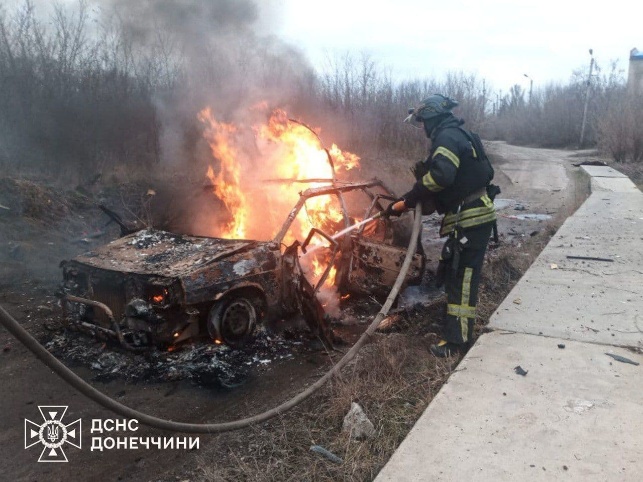
A fireman douses a burning car that was struck by a Russian drone, killing three energy workers inside, in Sloviansk, Donetsk Oblast.
Four hundred twenty-five weapons.
Hours before Geneva.
Ukrainian air defenses fought back. Three hundred sixty-seven drones were downed. Twenty-five missiles intercepted—including all Iskander-K, Kh-101, and Kh-59/69 cruise missiles. F-16 and Mirage jets carried much of that load, Air Force Spokesperson Colonel Yuriy Ihnat said.
But ballistic missiles broke through.
None were intercepted overnight. Advanced Western systems are required to stop them—scarce systems, rationed carefully. Four ballistic missiles and 18 drones struck 13 locations. Debris fell in eight more.
Energy and transport infrastructure in Sumy, Chernihiv, Dnipropetrovsk, Ivano-Frankivsk, Kharkiv, and Odesa oblasts were hit. At least 28,000 consumers in Kharkiv Oblast lost electricity. Tens of thousands more in Odesa City went dark. Nine people were injured, including children, across twelve targeted regions.
The timing was not accidental. Before Alaska in August 2025. Before Geneva and Moscow in November. Before December’s trilateral talks. Before Abu Dhabi—twice.
Strike packages between 400 and 700 weapons, launched around negotiations.
The war’s record remains September 2025: 823 drones and missiles. In one recent month, Russia fired 96 ballistic missiles—the highest monthly total so far.
Even “smaller” packages devastate.
Four hundred twenty-five weapons.
That was the message carried into Geneva.
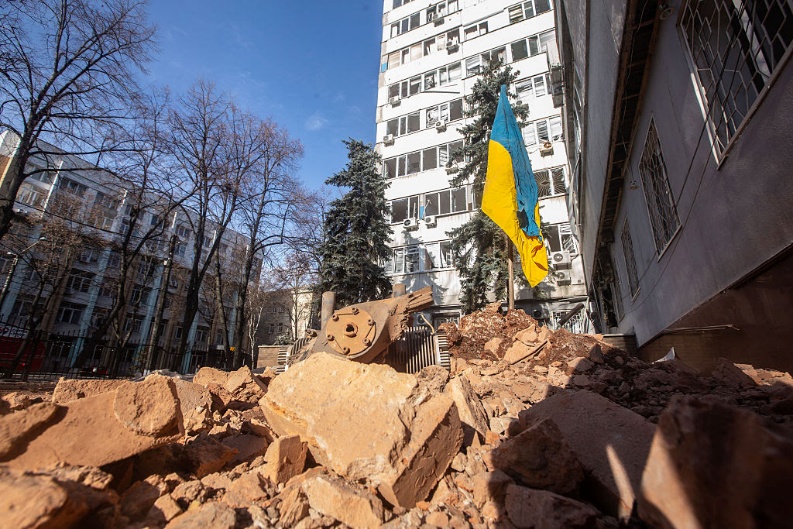
The Ukrainian flag stands atop fragments of a Russian drone that crashed into a building in Sumy, northeastern Ukraine. (Francisco Richart/Anadolu via Getty Images)
The Pause That Fuels the Next Barrage
In Geneva, the word “moratorium” hangs in the air again.
A short-term pause on energy strikes. A humanitarian gesture. A step toward de-escalation.
Ukraine has heard it before.
During the March–April 2025 moratorium, Russian forces used the quiet to stockpile drones and missiles. During the January–February 2026 pause, they rebuilt strike packages again—agreeing only after severely damaging Ukraine’s national energy grid. Even then, blackouts continued. Years of accumulated destruction could not be repaired in weeks.
The night before these talks opened, President Volodymyr Zelensky warned—citing Ukrainian intelligence—that Russia was preparing another large combined missile and drone strike. Hours later, 425 weapons proved him right.
The pattern is documented.
Comply publicly. Rearm privately. Strike immediately when the pause ends.
At the Munich Security Conference, DTEK CEO Maksym Timchenko laid out the cost of surviving this cycle. His company will spend 300 million euros to restore four gigawatts of destroyed generation capacity. Half from DTEK. Half from partners by year’s end. Four gigawatts would secure the 2026–2027 heating season.
“We know how to do it,” Timchenko said. “But orders for equipment need to be placed now.” Some components require a year to produce. Many must match Soviet-era specifications increasingly rare in Europe. The government needs a full list and funding commitments by May to prepare for winter.
Naftogaz reported 229 Russian attacks last year alone—more than the previous three years combined. Fourteen hundred ninety-nine drones and missiles. October was worst: 25 attacks, nearly 60 percent of gas production knocked offline. Since 2022: 401 attacks. Seventeen hundred drones and missiles.
“2025 was unprecedented,” CEO Serhii Koretskyi wrote.
Another moratorium is being discussed.
Moscow knows exactly how to use it.
Smiles in Geneva, Surrender in Moscow
In Geneva, the folders were opened and the microphones adjusted.
In Moscow, the message did not change.
A Kremlin source told TASS the talks would span five tracks—territorial, military, political, economic, and security. On paper, it sounded comprehensive. In practice, Russian officials spent the day restating positions that left no room to move.
State Duma deputies and Federation Council senators—speaking as much to the Russian public as to foreign diplomats—repeated Moscow’s original war aims. Not limited territorial adjustments. Not negotiated lines.
Total submission.
Duma Defense Committee Chairperson Andrei Kartapolov declared Ukraine could only “win” by joining the Russian Federation. Deputy Chairperson Yuri Shvytkin framed Russia’s battlefield performance and technological superiority as a “favorable backdrop” for talks.
Translation: negotiate from weakness. Or don’t negotiate at all.
Officials insisted Russia should negotiate only with the United States and invoked the “spirit of Anchorage”—the Kremlin’s claim that the August 2025 Alaska Summit produced an understanding based on Putin’s public demands for Ukrainian and NATO capitulation.
Then came the candor.
A Tsargrad op-ed, published by the network founded by Kremlin-affiliated oligarch Konstantin Malofeev, spelled out the strategy. Russia, it said, must “create the impression” it seriously sought resolution. Real peace would come only when Ukrainian frontlines collapsed— “still a long way off.” The delegation’s task: give Ukraine and the West no reason to blame Russia for lack of progress.
Malofeev’s outlet exists to prepare Russian ultranationalists—the core of Putin’s constituency—for prolonged war. The message was clear: no compromise, no retreat from original aims.
The Kremlin had not conditioned Russian society for concessions.
So, Russia arrived in Geneva with briefcases in hand—and surrender as its only offer.
“Western Pirates”: Patrushev Draws a Naval Line
Nikolai Patrushev did not raise his voice.
He did not need to.
In an interview with Argumenty i Fakty, the Russian presidential aide and former Security Council secretary answered recent Western seizures of Russian shadow fleet oil tankers with escalation. Britain. France. The Baltic states. He accused them of trying to block Russia’s access to the Atlantic Basin.
Russia, he said, must deliver a “firm rebuff.”
The Russian Navy must maintain permanent presence in the “main maritime directions” of the world to deter what he called “Western pirates.” NATO, he warned, was preparing to blockade Kaliningrad Oblast. If peaceful resolution failed, the Navy would forcibly break any blockade. It was, he insisted, the “most powerful and flexible geopolitical instrument” of Russia’s armed forces.
Reading between the lines: tanker seizures equal blockade. Blockade equals justification.
Patrushev’s language implied the United States and Europe were imposing economic strangulation. In reality, Western authorities had seized only a handful of shadow fleet vessels—some operating as far away as the Indian Ocean and Caribbean Sea. On the very day his interview was published, France released the tanker GRINCH after it paid a fine worth millions of euros.
The threats aimed outward—toward Washington and European capitals. Stop the seizures. Or face consequences.
Patrushev also singled out Finland. He complained Helsinki was acquiring corvettes capable of striking northwestern Russia. Finland shares land and maritime borders with Russia; vessels docked in Finnish waters would inherently be within range.
The complaint was less about geography than narrative.
Kremlin officials have repeatedly targeted Finland in rhetoric designed to frame NATO activity as aggression. The language sets conditions. It builds justification in advance.
The shadow fleet sails.
The warnings grow louder.
No Sanctuary at 1,600 Kilometers
The explosions began in the dark over Gubakha.
Sixteen hundred kilometers from the nearest Ukrainian-controlled territory, SBU Alpha drones reached Perm Krai and struck the Metafrax Chemicals plant—an industrial node producing methanol, urotropine, urea, and pentaerythritol, all precursors for weapons-grade explosives. Flames climbed into the night sky. The facility, under international sanctions and absorbed into Russia’s military-industrial complex, had been targeted before by HUR drones.
This time, the reach was unmistakable.
Local Telegram channels reported multiple blasts before fire tore through the plant. Perm Krai Governor Dmitry Makhonin confirmed a Ukrainian drone attack but offered no operational details, stating only that no casualties were recorded. Residents described repeated detonations. Mobile internet disruptions followed.
Sixteen hundred kilometers is not symbolic. It is strategic.
The strike underscored the expanding range and consistency of Kyiv’s deep-strike program—forcing Russia to defend not just border regions, but its interior industrial spine.
Simultaneously, Ukrainian forces hit the Ilsky Oil Refinery in Krasnodar Krai—6.6 million tons annual capacity, one of southern Russia’s largest. Geolocated footage showed fire engulfing the facility. Residents reported more than ten explosions near Ilsky settlement. A petroleum storage tank burned across 700 square meters. Seventy-two personnel and 21 vehicles were required to contain the blaze.
The SBU Alpha unit also struck the Tamanneftegaz oil terminal—reserve capacity exceeding one million cubic meters. It was the second successful hit in less than a month; the previous damage was assessed at over $50 million.
Russia’s Defense Ministry claimed its air defenses destroyed or intercepted 151 Ukrainian drones overnight and another 27 by morning—stretching across the Black Sea, occupied Crimea, Sea of Azov, Krasnodar, Kaluga, Bryansk, Kursk, Perm, and Belgorod.
The geography tells the story.
Russia’s air defenses were forced to defend thousands of kilometers at once.
“Unpleasant Neighbors”: A Minister’s Fall in Open Court
The courtroom was quiet when the judge announced it.
Two months in custody. Bail set at 200 million hryvnias—$4.6 million.
Former Energy Minister Herman Halushchenko stood facing charges he called “manipulative.” Earlier, he had said he could pay up to 30 million hryvnias. Now he told reporters, “I’m not satisfied with the bail. I will raise the money for lawyers so they can file an appeal.”
If released, he would wear an electronic bracelet. He could not leave Kyiv without permission. He would surrender foreign passports, report address changes, and avoid contact with other suspects.
Then prosecutors described what the case had become about.
In court, they revealed that Halushchenko—then serving as justice minister—and Deputy Justice Minister Yevhen Pikalov had discussed which prison cell should hold NABU detective Ruslan Mahamedrasulov. The detective had been arrested amid a broader crackdown on anti-corruption agencies. Critics called it retaliation for investigating Zelensky allies in the Energoatom case.
Pikalov allegedly relayed an SBU request to place Mahamedrasulov in a “free cell with unpleasant neighbors.” A photo of the cell was reportedly sent. Halushchenko allegedly approved it. The detective’s lawyer later described his conditions as “horrible.” He was eventually released after public criticism mounted.
Halushchenko denied giving instructions. The conversation, he said, was taken “out of context.”
He also denied family involvement in money laundering. His son’s education at Switzerland’s College Alpin Beau Soleil—annual cost up to $200,000—was paid for by “different people,” including a “wealthy godfather” whose name he refused to disclose.
“My family has been living in a rented apartment since 2022,” he said.
But NABU outlined a different financial trail: over $112 million funneled through former advisor Ihor Mironyuk; more than $7.4 million sent to accounts controlled by Halushchenko’s family; 1.3 million Swiss francs and 2.4 million euros withdrawn in cash and transferred to Switzerland.
The case triggered the largest political reshuffle since the full-scale invasion. Former Deputy Prime Minister Oleksiy Chernyshov was placed in custody on 51.6 million hryvnias bail—since paid. Former Energy Minister Svitlana Hrynchuk, Andriy Yermak, and Rustem Umerov were investigated but not charged.
The courtroom lights stayed on.
The reshuffle is not finished.
Ten Kilometers from the Front
They were driving to work.
Three employees of the Sloviansk Thermal Power Station were in a civilian car in Mykolaivka, ten kilometers from the front line, when a Russian FPV drone found them. The blast tore through the vehicle. All three were killed. A fourth energy worker survived with injuries, according to the regional state emergency service.
The town services the power plant east of Sloviansk—an installation already scarred by months of targeting. The plant has been knocked out repeatedly. Months earlier, a Russian glide bomb hit its laboratory building, killing two workers and injuring five.
Now another shift never arrived.
Russia’s use of FPV drones against civilians in front-line areas—first practiced at scale in Kherson—has expanded steadily. Drone crews have increased range, in some cases using unjammable fiber-optic cables. Each technical adjustment pulls more settlements into reach.
The strike came the morning after Russia’s latest mass missile and drone assault on Ukraine’s energy infrastructure. Ukrenergo reported emergency blackouts in five regions. Sumy and Odesa oblasts suffered heating outages.
Across the country, the toll continued to rise. A 68-year-old woman was killed near Kyrykivka in Sumy Oblast. Six others—including two children—were injured there. Six civilians were wounded in Kherson Oblast as coastal communities were shelled. Two men were injured near Kupiansk in Kharkiv Oblast. One civilian was wounded in Zaporizhzhia Oblast as Russian forces targeted 35 settlements.
In Odesa, long-range strikes damaged infrastructure and residential homes, injuring three civilians. The city was left without heating and water supply, President Volodymyr Zelensky said.
Ten kilometers from the front.
The war reaches farther than maps suggest.
When the Screens Went Dark, the Lines Moved
The advance slowed the moment the signals faltered.
Over the course of a week, Ukrainian forces recaptured 201 square kilometers—territory nearly equal to everything Russia gained the previous December. It was the most land Kyiv had retaken in such a short window since the June 2023 counteroffensive.
The Institute for the Study of War assessed that Ukrainian counterattacks likely exploited the recent disruption of Russian access to Starlink. Russian milbloggers themselves complained the loss was causing communication breakdowns and command-and-control failures on the battlefield.
Without reliable links, coordination frays.
Observers had noted interference with Starlink antennas used by Russian forces after Elon Musk announced “measures” to end Kremlin use of the system. Kyiv had long argued that Russian drones were relying on Starlink to bypass Ukrainian electronic jamming and strike with precision.
The effect showed quickly. During the period of disruption, Russian forces advanced on only one day. On the others, Ukrainian units pushed forward.
Most of the reclaimed land lay roughly 80 kilometers east of Zaporizhzhia city—ground where Russian troops had steadily gained since summer 2025. Southern Defense Forces Spokesperson Colonel Vladyslav Voloshyn said Ukrainian units conducted clearing operations near Verbove and along the Dnipropetrovsk–Zaporizhzhia oblast borders, retaking positions Russian forces had infiltrated. He stressed these were not full counteroffensive operations, despite Russian claims.
Even a Kremlin-affiliated milblogger acknowledged Ukrainian forces had entered Orestopil, though he insisted neither side controlled the settlement.
By mid-February, Moscow held 19.5 percent of Ukraine—up from 18.6 percent a year earlier. Roughly seven percent, including Crimea and part of Donbas, had been under Russian control before February 2022.
Two hundred one square kilometers.
Not decisive. But proof that when the screens go dark, the front can shift.
Paying the Dead More Than the Living
In Moscow’s budget ledgers, the dead now cost more than the living.
More than one-third of Russia’s annual military personnel spending for the war in Ukraine goes to survivor benefits for families of soldiers already killed. According to the Conflict Intelligence Team, death payments consume about 38 percent of the roughly $70 billion Russian taxpayers spend each year to sustain a 700,000-man force in Ukraine. Army salaries account for 33 percent. Regional signing bonuses absorb around 20 percent.
The math tells its own story.
Total personnel payments surged from about $39 billion between mid-2023 and mid-2024 to $52 billion in 2025. Recruiting men to fight—and compensating the families of those who do not return—has become one of the Kremlin’s most expensive lines of war.
In mid-2023, Russian commanders shifted from fast armored assaults to slower infantry pushes, trying to preserve tanks and fighting vehicles as Ukrainian drones shredded them. The result: incremental gains, soaring casualties.
Recruiters strain to refill the ranks. The national average signing bonus for a private heading to Ukraine is about $31,500—a life-changing sum in poorer regions. But those bonuses are paid largely from regional budgets. Roads go unrepaired. Schools go unfunded. Local governments drain coffers to meet Kremlin quotas.
Even in wealthier regions, high bonuses fail to draw enough volunteers. Stable jobs at home compete with the risk of death or maiming. In poorer regions like Buryatia and Chukotka, casualty rates run highest.
If Russia ended the war, the savings from these war-related payments alone would erase the national deficit.
Ukraine and some Western allies estimate roughly 1.2 million Russian casualties since February 2022, including 400,000 to 500,000 killed. Mediazona has confirmed 177,433 deaths by name—researchers estimate that figure likely represents 45 to 65 percent of the true total.
The battlefield bleeds.
The budget reflects it.
The Flag Returns — and the Fury with It
The Russian tricolor will fly again at the Paralympics.
The International Paralympic Committee confirmed that six Russian and four Belarusian athletes will compete under their national flags at the 2026 Milan-Cortina Games—the first time the Russian flag will appear at the Paralympics since Sochi in 2014.
In Kyiv, Valeriy Shuskevych did not hide his anger.
“I am very, very angry and outraged,” the president of Ukraine’s Paralympic Committee told AFP. “This is terrible.”
Since Russia’s 2022 full-scale invasion, athletes from Russia and Belarus had been barred from competing under their national flags. A partial suspension in 2023 allowed participation only as neutrals. Now, following a general assembly vote by the IPC—and after Russian and Belarusian athletes were permitted to accumulate ranking points through a successful appeal at the Court of Arbitration for Sport—the ban has been lifted.
The six Russian athletes will compete in alpine skiing, cross-country skiing, and snowboarding. Among them: three-time alpine gold medalist Alexey Bugaev. The four Belarusian athletes will race in cross-country skiing.
Shuskevych was clear about what Ukraine would not do.
“There is no question of boycotting,” he said. Ukraine finished second in the medal table at the Beijing Paralympics four years ago. “If we do not go, it would mean allowing Putin to claim a victory over Ukrainian Paralympians and over Ukraine by excluding us from the Games. That will not happen!”
Ukraine’s Paralympic team includes athletes whose disabilities were sustained on the battlefield. Hundreds of Ukrainian athletes and coaches have been killed since the invasion began. Hundreds of sports facilities have been destroyed by Russian missiles and drones.
The Games will go on.
So will the war.
Promised Jobs, Delivered to the Front
The offers sounded ordinary.
Security work. Migration assistance. High salaries. Fast-tracked citizenship.
Nigeria’s foreign ministry issued a warning after what it called “rising and alarming cases” of illegal recruitment. Citizens, it said, were being lured abroad under false pretenses—promised lucrative employment or education opportunities—only to be deployed into combat zones.
Two Nigerians are already dead.
Ukrainian officials said the men were killed fighting alongside Russian forces during an assault in eastern Luhansk region. Ukraine’s military intelligence agency delivered a blunt assessment: “A trip to Russia is a real chance to end up in an assault unit of ‘suicide bombers’ and, ultimately, to rot in Ukrainian soil.”
Nigeria said recruiters promised high salaries and signing bonuses. Some victims reportedly signed contracts written in foreign languages without proper legal guidance. Upon arrival, travel documents were confiscated.
The pattern extends beyond one country.
Ukrainian officials estimate more than 1,400 individuals from 36 African nations have been recruited to fight for Russia. Kenya has said over 200 of its nationals may have joined the Russian military. South Africa acknowledged 17 citizens traveled to join Russian forces and later sent distress calls seeking help to return home.
After a call between President Cyril Ramaphosa and Vladimir Putin, South Africa announced both leaders “pledged their support to the process of returning South Africans fighting alongside Russian forces in Ukraine.”
Russia’s outreach across Africa has deepened in recent years—expanding political, military, and security ties while offering training and arms.
Now the recruitment pitch is reaching individual men.
The destination is not a job site.
It is the front line.
Fallout Rooms and Forward Voices
In Nitra, workers check rusted doors that were built for another century’s fear.
Slovakia has begun refurbishing Cold War-era nuclear fallout shelters—concrete chambers designed to withstand chemical and biological attack. The war in neighboring Ukraine still feels distant to many Slovaks, and Prime Minister Robert Fico, close to Vladimir Putin and opposed to sending military aid to Kyiv, insists there is nothing to fear from Russia.
But the repairs continue.
Since 2022, Nitra city council has been maintaining its 17 shelters, budgeting 40,000 euros this year alone—a fraction of what full restoration would require. “After the conflict started there was a bit of panic,” city hall spokesman Tomas Holubek said. Civil protection officer Dalibor Bubinak was blunt: obsolete ventilation, outdated wiring, inadequate water supply. “None is in a technical condition fit to protect residents from hazardous substances.”
Nationwide, Slovakia has roughly 1,500 shelters with space for 250,000 people. After Communism fell, many were transferred to municipalities, businesses, or homeowners. Some became bars or cultural venues. Others were abandoned. Now the government pledges to double shelter capacity and “raise public awareness and preparedness levels.”
Two hundred kilometers north, the tone shifts.
Lithuania’s Finance Minister Kristupas Vaitiekūnas speaks not of shelters but of solidarity. Once part of the same Soviet state as Russia, Lithuania understands what is at stake. “We see not only the past but what is happening today,” he said.
He dismissed fears about Ukraine joining the EU. Cheap agricultural products? “Competition is always good.” Military innovation? “The EU will benefit.”
Reconstruction can wait, he added. “Now the main issue is to help Ukraine win this war.”
In Slovakia, doors are reinforced.
In Lithuania, the argument is moral.
The Day’s Meaning
Geneva opened beneath a sky still thick with smoke.
Four hundred twenty-five Russian drones and missiles had flown hours before diplomats took their seats. Energy grids burned while delegations discussed moratoriums Moscow had already learned how to exploit. The Kremlin spoke the language of negotiation abroad while telling ultranationalists at home that only Ukrainian collapse would bring “real peace.”
The pattern did not hide.
Patrushev threatened naval escalation over shadow fleet seizures even as France quietly released a tanker after collecting its fines. Russia warned of blockades it could not credibly break. Europe kept seizing ships anyway.
Sixteen hundred kilometers inside Russia, Ukrainian drones ignited an explosives plant. Oil terminals burned. Air defenses scattered across thousands of kilometers chased shadows in the dark.
On the ground, Ukrainian forces recaptured 201 square kilometers in a week—exploiting Russian communication failures after Starlink access faltered. Territory changed hands because signals dropped and orders failed to arrive.
In Moscow’s ledgers, 38 percent of personnel spending now goes to death benefits—more for the fallen than for the living. Regions empty budgets to recruit men. African governments warn citizens that promised jobs lead instead to assault units.
In Kyiv, a former energy minister stood in court on $4.6 million bail while prosecutors detailed Swiss accounts and prison cells for investigators. Corruption exposed under fluorescent light.
Ten kilometers from the front, three power plant workers were killed by an FPV drone. Odesa went dark. Twenty-eight thousand in Kharkiv lost power. Civilians across Sumy, Kherson, Kupiansk, Zaporizhzhia were killed or wounded.
At the Paralympics, the Russian flag will rise again. Ukrainian athletes—some disabled defending their country—will compete beneath it.
Slovakia refurbishes shelters it says it does not need. Lithuania speaks plainly about why Ukraine belongs in Europe.
The talks proceed.
The strikes continue.
The contradiction is the message.
Prayer For Ukraine
- Pray for protection over Ukraine’s energy workers and frontline communities. Ask God to shield those who repair power stations under threat of drones and missiles, to comfort the families of the three workers killed near Sloviansk, and to restore light, heat, and water to cities left in darkness.
- Pray for wisdom and discernment in the Geneva negotiations. Ask that truth would prevail over deception, that leaders would see through strategies designed only to delay and rearm, and that any path toward peace would be just, lasting, and protective of Ukraine’s sovereignty.
- Pray for Ukrainian defenders conducting counterattacks and deep strikes. Ask for clarity in command, protection in the field, and continued resilience as they exploit communication disruptions and reclaim territory under immense pressure.
- Pray for justice and integrity within Ukraine’s leadership. Ask that corruption be exposed fully and fairly, that courts act with transparency, and that public trust be strengthened through accountability rather than weakened by scandal.
- Pray for vulnerable people beyond Ukraine’s borders who are being recruited into this war under false promises. Ask that young men in Africa and elsewhere be protected from deception, that governments intervene effectively, and that the cycle of exploitation and loss be broken.