
As Moscow unleashed its largest energy assault of the war to plunge Ukraine into winter blackouts, Kyiv struck back—igniting Russian power plants, oil refineries, and Putin’s illusion that his infrastructure was untouchable.
The Day’s Reckoning
The night of October 29-30 began with engines—653 of them, spread across the sky like mechanical locusts. Add 52 missiles of various types. 705 projectiles total, all aimed at one target: the infrastructure that keeps Ukrainians warm, lit, and alive as winter closes in.
By dawn, the damage was catastrophic. Thermal power plants burned in multiple oblasts. A seven-year-old girl in Vinnytsia became the day’s youngest fatality. In Zaporizhzhia, residential towers collapsed into rubble, killing two and wounding twenty-seven, including six children. Emergency blackouts swept every oblast—a bureaucratic phrase that meant millions of Ukrainians woke to cold and darkness.
In Dnipropetrovsk, 192 miners found themselves trapped beneath the earth while flames consumed their workplace above. For hours they waited in absolute darkness, listening to distant explosions, calculating oxygen, wondering if rescue would arrive before collapse.
Russia’s strategy was transparent: if bullets and tanks couldn’t break Ukraine, maybe winter would.
Ukraine’s answer came before Moscow’s bombers had even landed.
In Oryol Oblast, surveillance cameras captured two massive explosions tearing through the region’s largest thermal power plant. The city went dark. Governor Klychkov claimed intercepted drone debris caused the damage—the standard lie when air defenses fail completely.
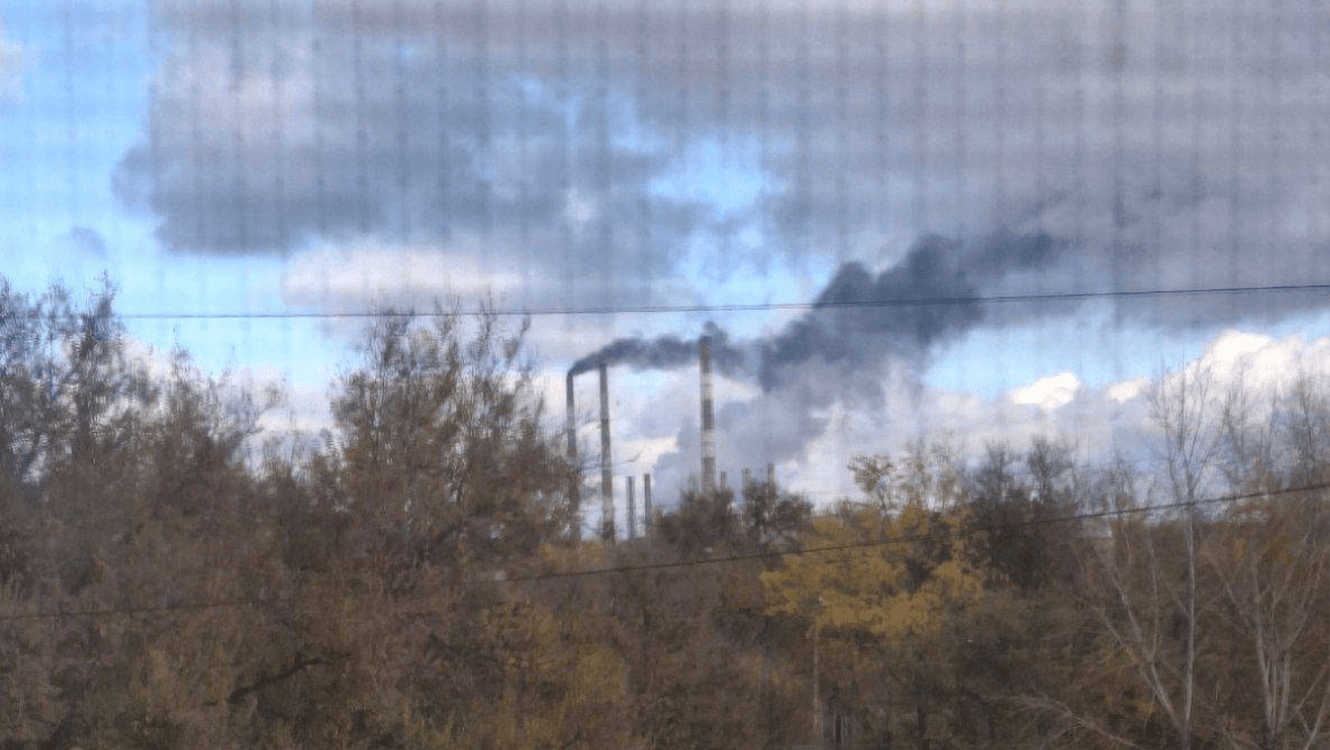
A picture of a reported fire at the Luhansk thermal power plant. (Telegram)
In Vladimir, a critical electrical substation with 4,010 MVA capacity erupted in flames. In Yaroslavl, the Novo-Yaroslavsky oil refinery—Russia’s fifth-largest, processing fifteen million tons annually—burned through the night. In occupied Luhansk, another power plant collapsed into blackout.
The pattern was unmistakable: Ukraine wasn’t just defending anymore. It was making Russia pay the same price in darkness and cold that Moscow tried to impose.
Meanwhile, diplomatic theater played out on multiple continents. Trump ordered America’s first nuclear weapons tests since 1992, then met Xi Jinping in Seoul where both promised to “help” end the war—though neither specified how. Poland’s jets chased Russian reconnaissance planes for the second time in three days. Ukraine closed its Havana embassy after discovering over a thousand Cubans fighting for Russia.
And in Pokrovsk, Russian forces pushed deeper into the city while Putin staged a propaganda stunt offering journalists “safe passage” to witness encirclements that military analysts confirmed didn’t exist.
October 30 revealed the war’s new equation: whoever controlled energy infrastructure controlled survival. Russia bet it could destroy Ukraine’s power grid faster than Ukraine could strike back. By nightfall, Russian refineries and power plants burning hundreds of kilometers from any front line suggested Moscow had miscalculated badly.
The race against winter was on. And both sides now understood that staying warm meant making the other side freeze.
Seven Hundred Five: The Arithmetic of Apocalypse
The assault began at 2:47 a.m. from launch sites stretching across half a continent. Millerovo. Rostov. Kursk. Oryol. Smolensk. Primorsko-Akhtarsk. Occupied Crimea. Russian forces hurled everything skyward.
Four Kinzhal aeroballistic missiles from Nizhny Novgorod. Five Iskander-M ballistics from Rostov. Eight Kalibr cruise missiles from naval positions. Thirty Kh-101s from bombers over Saratov. Then the swarm: 653 drones, including roughly four hundred Shaheds, spreading like a plague across Ukrainian airspace.
Ukrainian air defenders shot down 623 of them—an interception rate that testified to months of refined coordination and NATO-supplied systems working overtime. But mathematics is cruel: sixteen missiles and sixty-three drones still got through. Seventy-nine strikes. Twenty locations. All chosen with calculated precision.
The targets revealed Moscow’s strategy without ambiguity: thermal power plants that generate electricity, substations that distribute it, the infrastructure separating modern civilization from medieval darkness.
In Zaporizhzhia, residential buildings collapsed. A dormitory vanished into rubble. Two dead. Twenty-seven wounded, including six children whose ages started with single digits.
In Vinnytsia Oblast, a seven-year-old girl became the day’s youngest fatality. Four others wounded. Critical infrastructure burning. Vehicles melting in explosion heat.
Across Kyiv, Mykolaiv, Cherkasy, Poltava, Dnipropetrovsk, Chernihiv, Sumy, Ivano-Frankivsk, and Lviv oblasts, lights flickered and died. By morning, Ukrenergo imposed rolling blackouts “on all oblasts of Ukraine.” Translation: nowhere was safe, nowhere was spared, and winter was coming.
“This is exclusively terror,” Zelensky said, his words aimed at allies who might still be listening. “Normal people do not fight like this.”
He called for oil sanctions, financial pressure, secondary sanctions on those funding the war. Whether anyone heard him over the sound of Europe’s hedging remained unclear.
Ukraine’s Answer: Three Hundred Kilometers Deep
Ukraine didn’t wait for diplomatic responses. While Russian drones still buzzed over Ukrainian cities, Ukrainian strikes already streaked toward Russian territory—aimed at the energy installations that keep Russian industry humming and Russian citizens warm.
In Oryol Oblast, surveillance footage captured the moment: two massive explosions ripping through the region’s largest thermal power plant at 4:15 a.m. The city went dark. Residents reported the strikes sounded nothing like drones—something larger, faster, more devastating had found its mark.
The plant, owned by RIR Energo under state giant Rosatom, boasted 330 megawatts of capacity. Past tense appropriate. Governor Klychkov claimed debris from intercepted drones caused the damage—the standard Russian excuse when nothing was actually intercepted. He insisted power had been “almost completely restored.” Independent analysis by opposition outlet Astra showed two distinct strikes and citywide blackouts that told a different story.
Farther east in Vladimir, explosions rocked a major electrical substation with 4,010 MVA capacity. Governor Avdeyev confirmed infrastructure strikes but declined to specify which facility, as if vagueness could obscure what residents had already witnessed.
Then Yaroslavl: the Novo-Yaroslavsky oil refinery—Russia’s fifth-largest, processing fifteen million tons of crude annually—erupted in flames. Air defenses fired uselessly into darkness. Morning revealed damage requiring months to repair.
The timing was exquisite. Hours after Russia tried to freeze Ukraine, Ukraine demonstrated it could return the favor. The attacks came one day after Russia’s massive assault on Ukrainian thermal power plants—Moscow’s third major DTEK strike in October alone.
The message transcended tactics: if Russia believed it could wage infrastructure war with impunity, Ukraine would teach otherwise. Russia’s industrial heartland was no longer beyond reach.
Occupied Luhansk Goes Dark
As if to punctuate Ukraine’s point, another fire erupted—this one at the Luhansk thermal power plant near occupied Shchastia. The blaze shut down boiler rooms and pumping stations across Russian-held territories. Leonid Pasechnik, Moscow’s puppet administrator, called it “an accident on the power grids” and convened an emergency meeting. His words betrayed the chaos that follows when critical infrastructure collapses.
Ukrainian journalist Andriy Tsaplienko reported it as a “hit.” Kyiv offered no comment, maintaining the careful ambiguity surrounding successful long-range operations. But the timing—simultaneous with strikes on Russian territory proper—suggested coordination rather than coincidence.
For residents of occupied Luhansk, the blackout offered a preview of what Ukrainian civilians endure daily: sudden darkness, cold creeping through walls, infrastructure vanishing in seconds. The difference was that Ukrainians had grown accustomed to such nights.
For those living under Russian occupation, this was novelty. And lesson.
Sloviansk: Morning Rockets, Midday Bombs
Russia’s energy offensive didn’t end with the overnight assault. At 10:07 a.m., multiple-launch rocket systems rained down on Sloviansk in Donetsk Oblast. The residential Lisnyi district took direct hits. Apartment blocks shattered. A boiler house vanished. Three civilians dead.
Then Russian bombs found the Sloviansk Thermal Power Plant—830 megawatts of capacity located just outside the city. Whether the plant was operational remained unclear, but its symbolic value was undeniable: infrastructure that couldn’t be quickly replaced, knowledge that couldn’t be easily transferred, equipment that had taken years to install and calibrate.
Zelensky condemned the attack in his evening address: “This is pure terror. Normal people do not fight like this.”
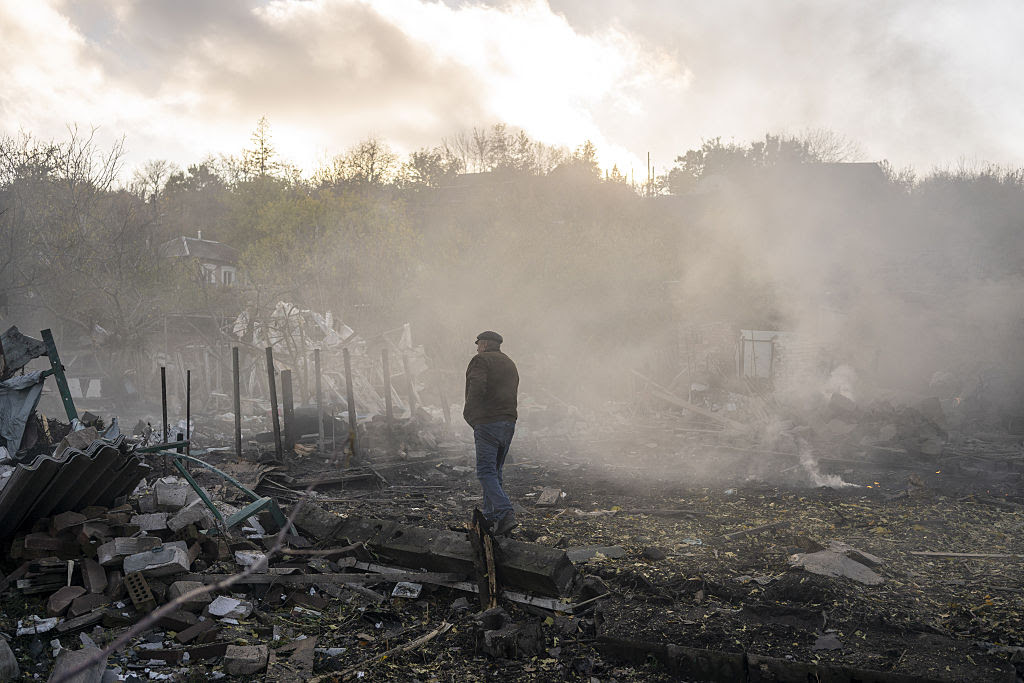
A view of the destruction and damage following a Russian missile attack in the city of Kramatorsk, Ukraine. (Jose Colon/Anadolu via Getty Images)
Later that afternoon, Russian forces struck Kramatorsk with Geran-2 drones. An 82-year-old pensioner became the day’s oldest fatality. Three others wounded. The attacks followed a pattern: morning rockets, midday bombs, afternoon drones—a relentless drumbeat designed to exhaust defenders, terrify civilians, and demonstrate that nowhere in Ukraine remained beyond Russia’s reach.
The calculus was simple and savage: destroy enough power plants, and you destroy the ability to resist. Make survival itself the full-time occupation of every Ukrainian, and they’ll have no energy left for fighting.
One Hundred Ninety-Two Minutes Underground
A Russian missile struck a DTEK coal enterprise in Dnipropetrovsk Oblast at 3:42 a.m. Suddenly 192 miners found themselves trapped far beneath the surface—listening to explosions echo through rock, watching lights flicker and die, calculating oxygen, wondering if rescue would arrive before collapse.
For hours they waited in darkness that was absolute, broken only by headlamps and emergency lighting. Then, one by one, the elevators began to move. By day’s end, every miner reached the surface. None injured, though their workplace burned above them—a small miracle carved from catastrophe.
It marked the fourth large-scale attack on DTEK facilities in two months. Each strike reinforced Moscow’s strategy: target not soldiers but the foundations of survival. DTEK, Ukraine’s largest private energy company, had become a recurring bullseye in Russia’s campaign to cripple power generation and grind down morale.
Images from that night showed walls of fire stretching across the industrial skyline, reflected in black pools of water below.
For Ukraine’s miners, the message was clear: even in the earth’s depths, the war could still find them. There was no place safe, no corner where Russia’s reach did not extend.
The Gas Station Strike: When Ordinary Became Lethal
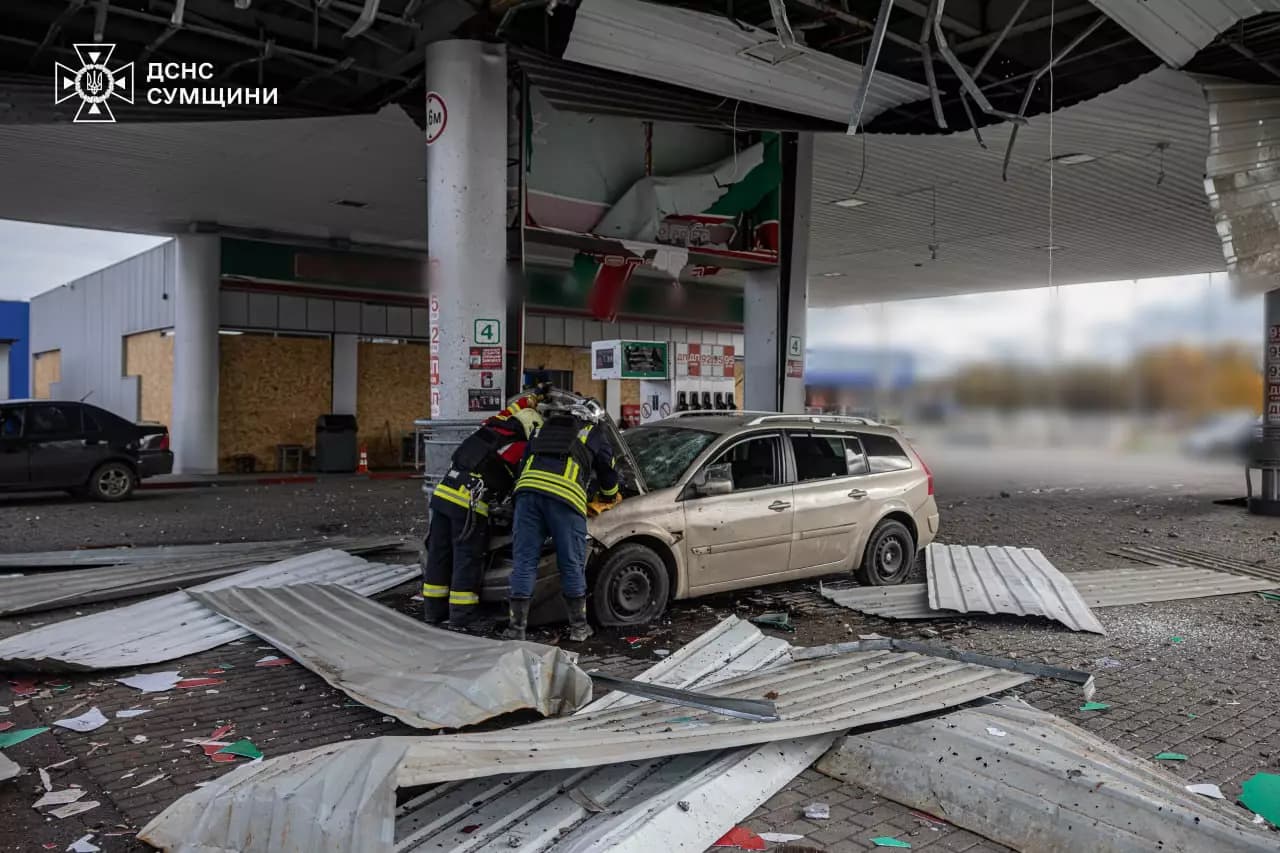
Russia attacked Sumy with an Italmas long-range drone hitting a gas station. (Sumy Emergence Service)
In Sumy, Maksym Tkachov had just finished refueling his car when the Italmas long-range drone screamed out of the sky. The blast tore through both his legs—through-and-through wounds requiring immediate surgery. Concussion. Three other civilians wounded in the strike.
Tkachov managed the local television station. He’d spent his career reporting on the war. Now the war had reported on him.
Rescue workers surveyed the devastation, dismantled damaged structures, ensured fire safety while Tkachov was rushed to hospital. The Institute of Mass Information confirmed he was stable but facing months of recovery.
The attack fit a disturbing pattern: Russia had stepped up strikes on gas stations in front-line areas in recent months. The last Sumy attack occurred October 18, injuring two. These weren’t military targets. They were civilian infrastructure, places where ordinary people performed ordinary tasks—until a drone turned ordinary into lethal.
For Ukrainian journalists, the irony was bitter: you can tell the story of war, but war tells its own story about you.
Kremenchuk: When a Tokarev Spoke
At 4:20 p.m. in Kremenchuk, Poltava Oblast, a man being escorted to a recruitment center pulled a Soviet-era Tokarev pistol from his clothing during a search for illegal items. He fired several rounds. Two soldiers wounded.
The man had been flanked by draft officers and a police representative. Standard procedure for forced mobilization. Until it wasn’t.
The incident underscored bubbling tensions around a necessary but resented measure: forcefully drafting men aged 25 to 60 to keep Ukrainian units manned. What was initially dismissed as Russian disinformation has become widespread reality—military-aged men grabbed off streets, often into waiting minivans, as Ukraine’s manpower shortage collides with declining volunteer rates.
This practice has spawned violence against recruitment officers, many of whom are soldiers deemed unfit for combat missions. Earlier that same day, residents of Odesa attacked recruitment officers at a wholesale market.
The Kremenchuk shooting revealed a painful truth: Ukraine faces two wars. One against Russia—winnable with weapons. Another against war-weariness within its own borders—requiring something harder to manufacture: belief that sacrifice still matters, that the cause justifies the cost, that tomorrow will be better than today.
The Exploding Parcel: Kyiv’s Postal Hazard

The results of an explosion at a postal office in Kyiv’s Solomyanskyi District. (State Customs Service).
A parcel exploded at a postal office in Kyiv’s Solomianskyi District during routine inspection of prohibited items. Five employees wounded—two customs officials, three Ukrposhta workers. The blast occurred during procedures designed to catch exactly this kind of threat.
Thanks to those procedures, another dangerous parcel was identified and seized before it too could detonate.
Ukrainian media attributed the explosion to someone attempting to mail part of a grenade launcher—a detail that would be absurd if it weren’t so dangerous. The State Customs Service identified the sender and suspended all his shipments.
The incident served as reminder: war transforms every aspect of normal life into potential threat. Even the mail, that most mundane of civilian services, becomes weaponized.
Pokrovsk: The City Russia Claims But Doesn’t Control
Russian forces advanced along the Donetska Railway in central Pokrovsk, pushing deeper into a city that has become Moscow’s eastern obsession. Geolocated footage confirmed the gains. The Ukrainian military acknowledged some advances while disputing Russian claims of complete encirclement.
The Russian military command has concentrated 11,000 personnel for the Pokrovsk effort. Yet the rate of advance remains glacial. Heavy autumn rains prevent Russian forces from establishing logistics. Ukrainian defenders continue slowing the pace, particularly on the eastern flank near Myrnohrad.
Ukrainian soldiers reported that Russian infiltration tactics and drone strikes against supply lines complicate defensive operations. Russian forces, including drone operators, continue dressing as civilians—perfidy under international law—to conduct infiltration missions without detection.
A German media photo captured the tactic: a Russian soldier dressed as a civilian, wearing no military insignia, positioned in a Pokrovsk high-rise. The image crystallized how modern urban warfare blurs every line between combatant and civilian.
Commander-in-Chief General Oleksandr Syrskyi visited Ukrainian commanders in the area and flatly declared Russian claims of encircling forces within Pokrovsk or Myrnohrad to be false.
Reading between the lines: Russia was using information warfare to supplement military operations, claiming victories not yet achieved in hopes of manifesting them through repetition.
Putin’s Ceasefire Theater: The Corridor That Kills
Speaking from a military hospital in Moscow, Vladimir Putin unveiled his latest propaganda gambit: a unilateral micro-ceasefire to allow journalists to witness Ukrainian forces he claimed were encircled in Kupyansk and Pokrovsk.
Five to six hours. Unimpeded entry and exit corridors. Security guarantees for journalists and Russian forces required.
Translation: a staged media opportunity to portray the situation in ways that benefit Russia.
Ukrainian Foreign Ministry spokesperson Heorhii Tykhyi had a different message for journalists: “I do not recommend that any reporters trust any of Putin’s proposals for ‘corridors’ in the warzone.”
He referenced August 29, 2014—Ilovaisk. Ukrainian servicemen offered a “green corridor” to withdraw from encirclement. They died in their hundreds when Russian troops opened fire during evacuation. Tykhyi had been there, filming a documentary, and witnessed the massacre firsthand.
“Putin’s only goal is to prolong the war,” Tykhyi wrote. “And he has never kept any of his ceasefire pledges.”
He added a warning: visits to Russian-occupied territory without Ukrainian permission violate the law and carry “long-term reputational and legal consequences.” The ministry was watching.
The Institute for the Study of War assessed Putin’s offer as staged theater—particularly as Russia publicly rejected Trump’s frontline freeze proposal.
The micro-ceasefire was propaganda, not peace.
Krasnohirske: The Flag Goes Up
Geolocated footage showed a Russian soldier raising a flag in central Krasnohirske, north of Hulyaipole. The advance was confirmed: Russian forces had pushed to southern Krasnohirske and west of both Krasnohirske and Pryvilne to the left bank of the Yanchur River.
The gain, while modest in scale, demonstrated Russia’s continued ability to generate localized tactical successes despite heavy losses and resource constraints. Russian forces attacked along multiple axes—north toward Rybne, northeast near Novohryhorivka and Pryvilne, east near Zelenyi Hai.
A Russian first-person view drone struck a civilian in Hulyaipilska Hromada. Another non-combatant wounded in a conflict where the distinction between military and civilian targets has become increasingly meaningless to the aggressor.
Sumy’s Quiet Advance: Taking Back the Border
Geolocated footage revealed a quiet Ukrainian success in northern Sumy Oblast: forces had advanced in eastern Kostyantynivka on the international border, likely liberating Kindrativka to the south at an earlier date.
These advances, though small, mattered strategically. Every meter of border territory recovered reduced Russia’s ability to launch ground assaults or position artillery within striking distance of Ukrainian cities.
Fighting continued near Oleksiivka and across Kursk and Sumy oblasts, where Russian forces deployed TOS-A1 thermobaric artillery—weapons that incinerate everything within their blast radius.
The northern front remained active but secondary to the eastern and southern axes where Russian forces concentrated their main efforts. Yet every advance Ukraine made here forced Russia to divert resources, diluting the concentration of force Moscow needed to achieve breakthrough elsewhere.
Trump Orders Nuclear Tests: The First Since 1992
Donald Trump announced on October 30 that America would resume nuclear weapons testing for the first time since 1992. The decision came in direct response to Russia’s ostentatious displays of nuclear capability—specifically Putin’s recent tests of the Burevestnik nuclear-powered missile and Poseidon unmanned underwater vehicle.
“Because of other countries testing programs, I have instructed the Department of War to start testing our nuclear weapons on an equal basis,” Trump wrote on Truth Social. “Because of the tremendous destructive power, I hated to do it but had no choice!”
He noted Russia ranked second in nuclear weapons, with China a “distant third” but projected to reach parity “within five years.” Trump didn’t specify whether the U.S. would test nuclear warheads or delivery systems—an ambiguity Russian officials exploited by claiming America would test warheads, allegedly giving Russia a “free hand” to do the same.
The announcement preceded Trump’s meeting with Chinese President Xi Jinping in South Korea. Trump emerged claiming Xi had agreed to work with Washington toward ending Russia’s war—though details remained vague and China’s record of supplying Moscow with dual-use goods and purchasing Russian oil suggested any Chinese “help” would be carefully calibrated to avoid angering the Kremlin.
“We talked about it for a long time,” Trump told reporters. “We agree the sides are locked in fighting, and sometimes you have to let them fight—crazy—but he’s going to help us.”
Translation: Trump viewed the war less as moral crisis than as geopolitical problem requiring management.
Poland’s Jets: Second Intercept in Three Days
At 9:47 a.m. on October 30, two Polish MiG-29 fighters scrambled to intercept a Russian Il-20 reconnaissance aircraft over the Baltic Sea. The Soviet-era plane, designed for electronic surveillance, flew without a filed flight plan and with its transponder turned off—standard Russian procedure when probing NATO airspace.
The Russian aircraft didn’t violate Polish airspace but operated in Poland’s zone of responsibility, forcing the intercept. The incident followed an identical case from October 28.
Translation: Russia was either testing Polish response times or conducting routine reconnaissance missions with brazen disregard for international norms.
“Every day, Polish soldiers stand watch over the nation’s skies with unwavering dedication,” the Polish military wrote on X—a statement that doubled as reassurance to citizens and warning to Moscow.
NATO countries regularly scramble jets in response to Russian aerial activity, but recent months had seen an uptick. Poland downed several Russian drones in early September. Estonia and Lithuania reported Russian warplanes briefly entering airspace in recent months.
The pattern suggested Russia was probing for weaknesses, testing reaction speeds, or simply reminding NATO that its air forces operated wherever they pleased. Poland’s consistent intercepts demonstrated one nation’s answer: constant vigilance, immediate response, zero tolerance for intrusion.
Ukraine Closes Havana Embassy: One Thousand Seventy-Six Reasons Why
Ukraine announced it was closing its embassy in Havana and downgrading diplomatic ties with Cuba. The reason: over a thousand Cuban citizens had been recruited to fight Russia’s full-scale invasion.
Foreign Minister Andrii Sybiha made the announcement the same day Ukraine voted against a U.N. General Assembly resolution to end the U.S. embargo against Cuba—a symbolic vote that carried real diplomatic weight.
“Our vote is not against the Cuban people—we respect their right to live in prosperity,” Sybiha wrote. “It is against the inaction of Cuba’s authorities in response to massive recruitment of Cuban citizens to the Russian occupation army. Thousands of them have signed contracts, joining the ranks of soldiers directly engaged in combat operations on Ukrainian soil.”
Ukraine’s military intelligence agency reported that at least 1,076 Cuban nationals have fought or are fighting for Russia. The number represented more than military statistics—it embodied Havana’s decision to enable Russia’s war through willing export of cannon fodder.
The embassy closure sent a message: neutrality in this war was complicity. Countries that claimed to stand apart while feeding Russia’s military machine would face consequences.
Cuba had chosen its side by allowing recruitment. Ukraine responded by choosing not to maintain diplomatic fiction.
Lukoil Sells to Gunvor: Sanctions Reshape the Circle
As Trump’s sanctions on Russian oil companies began to bite, Lukoil announced it would sell its foreign assets to Gunvor—a company founded by Gennady Timchenko, a close Putin associate who divested his stake in 2014 when U.S. sanctions landed on him personally.
Lukoil attributed the sale to sanctions imposed by “certain countries”—diplomatic code for Trump’s October 22 restrictions that disrupted Russian oil exports to China and India. Gunvor had offered to buy the assets. The two companies agreed on key terms. The deal required authorization from the U.S. Treasury’s Office of Foreign Assets Control.
The transaction revealed how sanctions reshape Russian business: when Western pressure makes international operations untenable, assets migrate toward entities within Putin’s circle.
Gunvor, registered in Cyprus and headquartered in Switzerland, had long denied links to Putin. But the U.S. Treasury’s 2014 statement was unambiguous: “Timchenko’s activities in the energy sector have been directly linked to Putin” and “Putin has investments in Gunvor and may have access to Gunvor funds.”
Whether the sale would reduce Russian oil revenue or merely rearrange deck chairs remained to be seen. Lukoil’s assets spanned the U.S., Latin America, former Soviet countries, the Middle East, Africa, and Romania—a portfolio worth billions that would now operate under slightly different ownership but serve the same ultimate patron.
Russia Returns to Syria: Six-Month Pause Ends
Russian military aircraft landed at Khmeimim air base in Syria after a six-month pause, signaling Moscow’s effort to maintain its foothold following longtime ally Bashar al-Assad’s ouster. Flight-tracking data confirmed the flights. A Kremlin-connected source verified the restart to Bloomberg.
Putin recently met new Syrian President Ahmed al-Sharaa in Moscow during Sharaa’s first official visit since taking office. The future of Russia’s military bases at Khmeimim and Tartus—its only Mediterranean naval facility—reportedly dominated discussion.
Assad had fled to Russia in December 2024 after being toppled, leaving questions about whether Moscow could maintain influence with Damascus’s new government. Sharaa indicated he intended stable relations with Russia despite the change in power, even as he pursued broader diplomatic outreach including meetings with Trump and restored ties with Ukraine.
For Russia, maintaining Syrian bases mattered strategically—they projected power into the Middle East and Mediterranean, supported operations across Africa, and symbolized Russia’s claim to great power status.
Losing them would confirm what Ukraine’s resistance already suggested: that Russia’s sphere of influence was contracting, not expanding, and that even victories achieved through brutal force could prove temporary.
Rheine, Germany: A Ukrainian’s Unexplained Death
A disabled Ukrainian man born in 2000 was found dead in Rheine, Germany on October 21. Local police ruled it suicide. His family and Ukrainian journalist Andriy Tsaplienko suspected otherwise. Personal belongings and documents were missing.
Ukraine’s Foreign Ministry reported on October 30 that authorities believed the man “died between October 20 and 21” and that the medical certificate listed suicide as cause of death. The Ukrainian Consulate submitted an official request for re-examination and further investigation.
The case remained under consulate control while the body was prepared for repatriation. Whether German authorities would investigate further or close the matter remained unclear.
For the family, uncertainty compounded grief: their son had escaped war only to die in circumstances that made no sense, in a country that should have been sanctuary.
The incident served as reminder: Ukraine’s war follows its people across borders. Death finds Ukrainians on front lines and in foreign cities, in trenches and in apartments far from home. Geography offers no immunity. Safety remains relative. And for too many families, grief arrives without adequate explanation.
The Day’s Toll: Seven Dead, Fifty-Seven Wounded
Ukrainian officials compiled the arithmetic: seven civilians killed, fifty-seven injured in Russian attacks. The Ukrainian Air Force intercepted 592 of 653 drones and 31 of 52 missiles—remarkable defensive success that nonetheless left seventy-nine strikes recorded at twenty locations.
In Zaporizhzhia Oblast alone, two dead and twenty-seven injured, including seven children. One killed and thirteen others injured in additional attacks throughout the day. Vinnytsia Oblast lost a seven-year-old girl and saw four others wounded. Twelve injured in Kherson Oblast. Two in Kharkiv Oblast. Two killed and seven injured in Donetsk Oblast. One killed and four wounded in Sumy Oblast.
The numbers told only part of the story. Behind each statistic stood a family receiving devastating news, a hospital bed occupied by someone who had been healthy hours before, a funeral being planned, a child learning what it means to be orphaned by war.
Ukraine’s General Staff reported Russia has lost 1,140,860 troops since February 24, 2022—including 960 casualties suffered in the past day alone. Also destroyed: 11,305 tanks, 23,514 armored fighting vehicles, 65,993 vehicles and fuel tanks, 34,089 artillery systems, 1,531 multiple launch rocket systems, 1,232 air defense systems, 428 airplanes, 346 helicopters, 75,707 drones, 28 ships and boats, and one submarine.
Nearly 1.2 million Russian casualties. Over eleven thousand tanks destroyed. More than seventy-five thousand drones eliminated. The scale of destruction suggested industrial-age warfare prosecuted with twenty-first-century weapons—producing casualties at rates unseen since World War Two.
Yet Russia continued fighting. The losses didn’t deter. The casualties didn’t dissuade. The destroyed equipment was replaced, the dead soldiers conscripted anew, the offensive operations resumed without pause.
Whatever calculus Putin used to measure success clearly discounted human cost entirely.
What October 30 Revealed
Two wars happened simultaneously. Russia unleashed 705 projectiles to plunge Ukraine into darkness while Ukraine ignited Russian power plants hundreds of kilometers from any front line. In Seoul, Trump and Xi discussed peace while Moscow rejected every ceasefire proposal. The parallel realities persisted.
The day exposed the war’s new calculus: whoever controlled energy infrastructure controlled survival. Russia bet it could destroy Ukraine’s power grid faster than Ukraine could strike back. By nightfall, burning Russian refineries and power plants suggested Moscow had miscalculated.
But the arithmetic remained brutal. Seven Ukrainian civilians dead. Fifty-seven wounded. A seven-year-old girl in Vinnytsia. An 82-year-old pensioner in Kramatorsk. 192 miners trapped underground. Emergency blackouts across every oblast. Russia’s strategy was transparent: if bullets couldn’t break Ukraine, maybe winter would.
Ukraine’s counterstrikes demonstrated reach and resolve—Oryol, Vladimir, Yaroslavl, occupied Luhansk all burning. Yet questions remained: Could Ukraine sustain this tempo of long-range strikes? Could Russia replace destroyed energy infrastructure faster than Ukraine could destroy it? Would Europe’s energy assistance arrive before winter truly bit?
On the ground, Russian forces pushed deeper into Pokrovsk while losing Krasnohirske in the south and border territory in Sumy. Small gains, heavy losses, glacial progress—the eastern offensive continued grinding forward through autumn mud and Ukrainian resistance.
Meanwhile, diplomatic theater played out across continents. Trump ordering nuclear tests. Xi promising to “help” end the war. Poland intercepting Russian planes. Ukraine closing its Havana embassy. Cuba, of all countries, feeding Russia’s war machine with a thousand mercenaries.
The question was no longer who would win battles but who would endure seasons. Whether spring would arrive with functional power grids, intact supply lines, and intact morale—or with populations exhausted, infrastructure destroyed, and belief shattered.
October 30 made clear the war’s next chapter would be fought as much in darkness as in daylight. And whoever commanded energy commanded everything.