
Ukraine Daily Briefing | May 24, 2026 | Day 1,551 of the Full-Scale Invasion
Prepared by Dayana Bozhyk
Overnight May 23–24, Russia launched the largest aerial assault of 2026: 90 missiles and 600 drones struck Ukraine, with an Oreshnik intermediate-range ballistic missile deployed against Bila Tserkva in Kyiv Oblast — the first time the nuclear-capable weapon has targeted the capital’s region — while strikes damaged the Foreign Ministry, Cabinet of Ministers, the Chornobyl Museum, and every district of Kyiv City. Ukraine responded simultaneously, striking the Tamanneftegaz oil terminal, two Novorossiysk warships, the Vtorovo petroleum pipeline station feeding Moscow’s airports, and multiple military logistics nodes deep inside Russia.
THE DAY’S RECKONING
The numbers arrived in the first hours of Sunday morning, and they were unlike anything 2026 had produced. Ninety missiles. Six hundred drones. One Oreshnik — the nuclear-capable intermediate-range ballistic missile whose MIRVed warheads streak down from the upper atmosphere in clusters, each cluster carrying six kinetic rods. The target this time was not Dnipro, as in November 2024, nor Lviv, as in January 2026. It was Bila Tserkva, 80 kilometers from central Kyiv, in the capital’s own oblast.
Two people died in Kyiv. Seventy-seven were wounded. The Chornobyl Museum — which had reopened to the public days earlier after extensive renovations — was struck and nearly destroyed. The National Art Museum was damaged. The Cabinet of Ministers and Foreign Ministry buildings were hit. The Lukyanivska metro station entrance was blown in. Rescue crews responded to more than 40 distinct locations spanning every administrative district of the capital.
Ukraine did not strike Moscow during Russia’s Victory Day celebrations on May 9. The Kremlin had threatened to deploy the Oreshnik if it did. Ukraine did not. Russia struck Kyiv anyway. The logic is not proportionality or deterrence. The logic is punishment without pretext — or rather, pretext manufactured after the decision was already made.
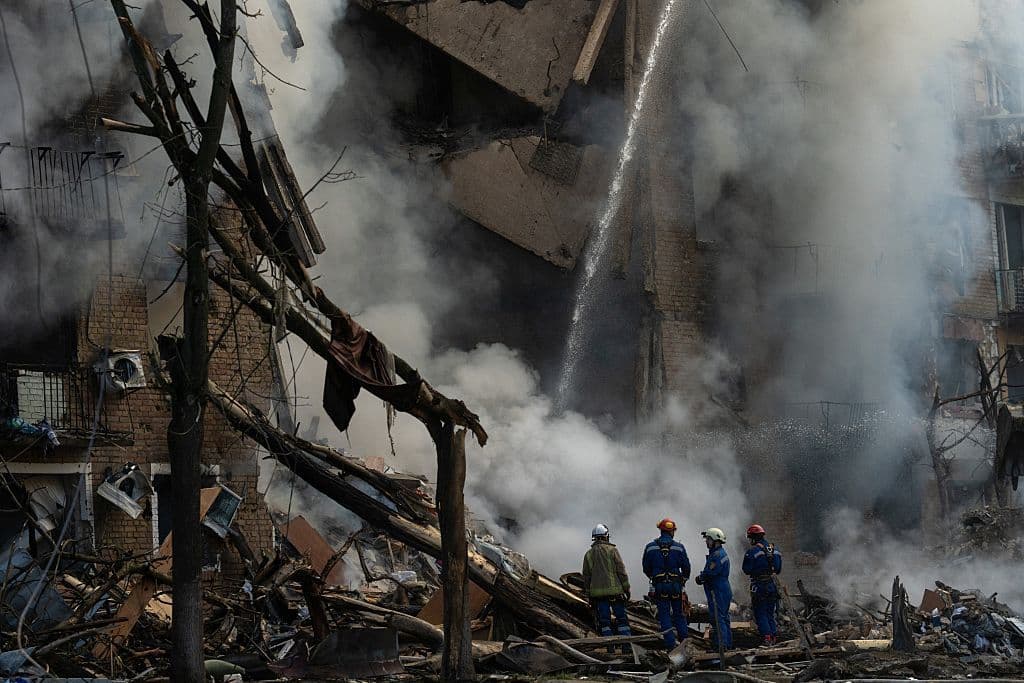
Rescuers operate at the site of a heavily damaged building as smoke rises following Russian strikes in Kyiv, amid the Russian invasion of Ukraine. (Photo by OLEKSII FILIPPOV / AFP via Getty Images)
Ukraine did not absorb the night passively. While the Oreshnik descended toward Bila Tserkva, SBU Alpha drones hit the Vtorovo pipeline station in Vladimir Oblast, igniting an 800 square-meter fire at the facility that pumps fuel to Moscow’s three major airports. Ukrainian forces also struck two warships at the Novorossiysk naval base and the Tamanneftegaz oil terminal — a 20 million-ton-per-year Black Sea export hub. The Atesh partisan network, operating inside Novorossiysk, had already disabled communication towers and a transformer substation to blind Russian air defenses before the drones arrived.
THE STRIKE PACKAGE: ORESHNIK, KINZHALS, ZIRCONS, AND 600 DRONES
The Ukrainian Air Force confirmed the composition of the overnight assault: one Oreshnik IRBM from Kapustin Yar; two Kinzhal hypersonic missiles launched from MiG-31K aircraft at Lipetsk; three Zircon hypersonic missiles from mobile launchers in occupied Crimea and Kursk Oblast; 30 Iskander-M and S-400 ballistic missiles; 54 Kh-101, Iskander-K, and Kalibr cruise missiles; and 600 Shahed, Gerbera, Italmas, and Parodiya decoy drones. It was the most missiles in a single strike since December 2024, and it required simultaneous launch coordination across multiple remote staging points.
Ukrainian defenses intercepted 55 missiles and 549 drones — an overall interception rate that included 91.5 percent of all drones and 81.5 percent of cruise missiles. Ballistic missiles remained the critical gap: only 36.7 percent of Iskander-M and S-300 trajectories were downed. Ukraine relies on Patriot systems for ballistic interception, and the global Patriot interceptor shortage — which Russia has tracked and exploited — constrained the defense.
ISW assessed the tactical architecture of the strike: Russia launched the drones first, in massive numbers, over an extended period, to exhaust Ukrainian air defenses before releasing the ballistic and hypersonic platforms, which Ukrainian forces struggle to intercept. Ukraine’s drone interception rate exceeded its six-month average. More than 40 percent of all intercepted Shaheds were taken down by Ukrainian interceptor drones, not missile systems. The defense held better than Russia intended. It did not hold well enough.
An additional 19 Russian missiles failed to reach their targets due to guidance failures. Sixteen missiles and 51 drones broke through, striking 54 locations across the country and leaving debris across 23 more. Poland scrambled its Air Force and placed radar networks on high alert throughout the night as Russian long-range aviation tracked toward NATO’s southeastern frontier.
KYIV: EVERY DISTRICT STRUCK, THE CHORNOBYL MUSEUM DESTROYED
Rescue teams responded to more than 40 distinct locations across Kyiv’s eight administrative districts. In the central Shevchenkivskyi district, a missile tore through the upper floors of a nine-story apartment block, killing one resident and severely injuring three others in an expanding structural fire. A nearby five-story building suffered total compartmental collapses from the first to the fifth floors. A business center was struck, trapping workers in a basement shelter until first responders cleared the entry points.
The Lukyanivska metro station entrance pavilion was blown apart, suspending passenger services. The historic Ukrposhta headquarters on Maidan Nezalezhnosti sustained glass and structural damage. In Pecherskyi district, a missile struck the 13th floor of a 20-story residential high-rise. In Solomyanskyi, the 23rd floor of a 24-story residential complex caught fire with partial external wall collapses. In the Darnytskyi district, a drone struck a student dormitory roof, igniting a 250 square-meter blaze; emergency workers evacuated 10 residents and rescued 12 others from smoke-filled corridors.
In the Podil historic area, a cruise missile nearly completely destroyed the National Chornobyl Museum — which had reopened days prior after renovation — and cracked the neighboring Kontraktova House landmark. The Kyiv Opera Theater postponed its ballet performance. The Lobanovskyi Football Stadium, National Philharmonic, Ukraine House, and National Art Museum were all damaged. The Ukrainian Ministry of Foreign Affairs and Cabinet of Ministers buildings were struck.
Mayor Klitschko confirmed two killed and 77 wounded, including two children, with 31 hospitalized and three in critical condition. Zelensky reported three missiles hit a water supply facility, a market was set on fire, dozens of residential buildings and several schools were damaged. The Kvadrat shopping mall and Lukianivskyi market were reported completely destroyed. The Albanian ambassador’s residence was struck, putting the diplomat’s life at serious risk; Tirana summoned Russia’s ambassador and called for accountability under international humanitarian law.
THE ORESHNIK AGAINST BILA TSERKVA: THIRD USE, FIRST TIME TARGETING KYIV OBLAST
The Oreshnik was launched from the Kapustin Yar test range in Astrakhan Oblast and reentered the atmosphere at hypersonic velocity, deploying MIRVed warheads over Bila Tserkva — a city of roughly 200,000 people, 80 kilometers south of central Kyiv. Footage showed six submunition clusters with each carrying six kinetic rods, in a strike pattern observers noted differed from the January 2026 Lviv deployment, suggesting ongoing refinement of the delivery system. One source reported the Oreshnik used kinetic energy projectiles in place of a conventional explosive payload, indicating Russia may be using live deployments in Ukraine to test and calibrate the weapon.
This was Russia’s third operational Oreshnik deployment of the full-scale war — after Dnipro in November 2024 and Lviv Oblast in January 2026 — and the first time it has been used against Kyiv Oblast. Zelensky had warned on May 23 that Ukrainian, European, and U.S. intelligence detected launch preparations at Kapustin Yar. Ukrainian Air Force Colonel Yurii Ihnat confirmed the launch origin and weapon type.
EU High Representative Kaja Kallas condemned the Oreshnik deployment as “a political scare-tactic and reckless nuclear brinkmanship,” arguing Moscow was leveraging psychological terror to compensate for operational stagnation on the battlefield. EU foreign ministers scheduled an emergency review to coordinate tighter sanctions targeting missile production and sanctions evasion networks. Ukrainian Foreign Minister Sybiha called for emergency sessions of the UN Security Council and OSCE.
RUSSIA’S JUSTIFICATION VS. ITS PRACTICE
The Russian MoD claimed the strikes were retaliation for Ukrainian “terrorist attacks” and civilian harm in Russia. Deputy Security Council Chair Medvedev pointed specifically to a Ukrainian strike on occupied Starobilsk on May 22, which Russia claimed hit a pedagogical college dormitory. The Ukrainian General Staff reported that strike targeted a headquarters of Russia’s Rubikon Center for Advanced Unmanned Technologies. ISW cannot independently verify which account is correct.
What ISW can assess: the Kremlin had already threatened Oreshnik strikes against Kyiv’s decision-making centers if Ukraine struck Moscow during May 9 Victory Day celebrations. Ukraine did not strike. Russia struck Kyiv anyway. The justification arrived after the targeting decision. The practice — of striking civilian infrastructure, cultural sites, water facilities, schools, and residential high-rises as a systematic tool of the war — long predates any specific Ukrainian action.
Russian nationalist milbloggers, notably, were not convinced by their own government’s framing. They criticized the strikes as expensive and militarily pointless, noted the Oreshnik hit no clear military target in Bila Tserkva, and argued that frontline Russian forces remain under-resourced while the Kremlin spends heavily on strategic spectacle. One milblogger argued that Ukraine’s advantage in FPV drones is enabling Ukrainian advances precisely because Russia is prioritizing prestige weapons over frontline supply.
UKRAINE’S COUNTERSTRIKE: VTOROVO, NOVOROSSIYSK, TAMANNEFTEGAZ
Overnight May 23–24, SBU Alpha drones struck the Vtorovo linear production and dispatching station in Vladimir Oblast, Russia. The facility is a hub for petroleum product pipelines operated by Transneft, pumping raw materials from central Russian refineries to export ports and domestic consumers — including fuel supply to Sheremetyevo, Domodedovo, and Vnukovo airports near Moscow. The strike caused an 800 square-meter fire. Vladimir Oblast Governor Avdeev acknowledged it. “The SBU is already preparing new special operations,” SBU chief Khmara said. “Our long-range sanctions will continue to work.”
Simultaneously, Ukrainian forces struck the Tamanneftegaz oil terminal at Volna in Krasnodar Krai, hitting a marine loading arm — the mechanical conduit for transferring petroleum to export tankers. The terminal handles 20 million tons of oil per year and is a critical Black Sea export gateway for the Russian military’s fuel logistics. Ukraine also struck two warships at Novorossiysk naval base: a Krivak-II class patrol ship Pytlivy and a hovercraft missile boat.
The attacks were enabled in part by the Atesh partisan network, which reported that its operatives disabled communication towers and a transformer substation in the Novorossiysk area the night before the strike, blinding Russian radar and preventing air defense units from tracking low-flying targets. The Grushovaya oil depot — the largest oil storage facility in the Caucasus region, with 1.2 million ton capacity — was confirmed struck, with fires recorded. The General Staff also confirmed a separate strike on the Sheskharis oil terminal and the tanker Chrysalis, identified as part of Russia’s shadow fleet.
FRONTLINE: KOSTYANTYNIVKA ADVANCE, POKROVSK PRESSURE, QUIET AT KUPYANSK
Ukrainian forces recently advanced in eastern Minkivka in the Kostyantynivka-Druzhkivka tactical area, supported by strikes against Russian positions at the southern and southwestern outskirts of Kostyantynivka. In the Pokrovsk direction, a Ukrainian brigade officer reported Russian forces increasing pressure through small-group infiltration missions — attempting to accumulate troops behind Ukrainian positions — while relying heavily on drones for battlefield air interdiction of Ukrainian logistics. A Russian milblogger claimed Russian forces seized Vasylivka northwest of Pokrovsk and advanced southwest.
In the Kupyansk direction, Russian forces continued limited operations but did not advance. A Ukrainian brigade spokesperson confirmed Russian forces are increasingly using ATVs and motorcycles for assault approaches. In the Borova direction, a Russian milblogger claimed advances in northeastern Novoplatonivka and described Bohuslavka as a contested gray zone. Russian forces conducted limited operations in the Slovyansk, Dobropillya, Novopavlivka, and Oleksandrivka directions without confirmed advances.
In western Zaporizhzhia, Ukrainian forces maintained or advanced in eastern Vozdvyzhivka northwest of Hulyaipole. Russian forces reported a deteriorating situation in Stepnohirsk and Mala Tokmachka. In Kharkiv Oblast, Russian forces continued limited operations in the north and northeast of the oblast without advance. In northern Sumy Oblast, Russian forces conducted limited operations along the border but did not advance.
UKRAINIAN LONG-RANGE STRIKES IN THE RUSSIAN REAR
Ukrainian forces struck a Russian drone control point near Tetkino and a manpower concentration near Volfinsky in Kursk Oblast, and a drone control point near Borisovka in Belgorod Oblast. A Ukrainian OSINT channel reported a strike against a training ground of an Akhmat spetsnaz battalion of the Russian National Guard.
In occupied Luhansk Oblast, Ukrainian forces struck a material and technical equipment warehouse, an ammunition warehouse, and a fuel and lubricants warehouse near Biloutsk, roughly 85 kilometers from the frontline. The SBU reported additional strikes on Russian deployment points, a drone repair base, an occupation police station, and equipment and fuel depots in occupied Luhansk City, Kadiivka, Bilokurakyne, and the Sievierodonetsk and Svatove raions.
In occupied Zaporizhzhia Oblast, Ukrainian Unmanned Systems Forces struck two fuel trucks near Preslav and Azovske, a Tigr vehicle near Azovske, and a vehicle near occupied Kostyantynivka. In occupied Crimea, Ukrainian forces struck an ammunition storage facility in occupied Mizhhirya, roughly 220 kilometers from the frontline.
SABOTAGE: MILITARY CAMP FIRE AT KRASNODAR KRAI AIRFIELD
The “Kuban Insurgent Movement” claimed responsibility on May 23 for setting fire to a military camp of the 960th Assault Aviation Regiment at the Primorsk-Akhtarsk airfield in Krasnodar Krai. The Russian Emergency Situations Ministry for Krasnodar Krai acknowledged a fire on the grounds of a military unit near Primorsk-Akhtarsk on May 22. The regiment belongs to the 4th Composite Aviation Division of the 4th Guards Air and Air Defense Forces Army of the Russian Aerospace Forces.
CIVILIAN CASUALTIES BEYOND KYIV: CHERKASY, BOHODUKHIV, NIKOPOL, KHERSON
In Cherkasy, a strike drone hit a densely populated residential block, igniting a 400 square-meter fire across floors five through nine. Eleven civilians were injured, including two children; nine residents were pulled from burning upper floors. In Bohodukhiv, Kharkiv Oblast, a tactical strike drone hit a residential sector, shattering windows across an apartment block and damaging 15 vehicles. Twelve people were injured and hospitalized.
In the Nikopol district of Dnipropetrovsk Oblast, Russian artillery and drones struck residential buildings, wounding seven civilians. Among the injured: a three-month-old infant and a four-year-old child, both listed in stable condition; two men extracted from debris in critical condition remain in intensive care. In Kherson, a woman was rushed to surgery in critical condition with severe blast trauma and open shrapnel wounds after Russian artillery struck the Korabelnyi district; investigators are working to establish her identity. In Zaporizhzhia Oblast, a loitering munition struck a private home in Bilenke, wounding a 63-year-old man and a 63-year-old woman.
In Odesa, Russian tactical aviation launched cruise missiles into civilian transport infrastructure on the evening of May 23, wounding nine people, including three children aged 8–12 who remain hospitalized. Separately, a car bomb exploded on Universytetska Street in Odesa’s Primorskyi district shortly before midnight on May 23. A Volkswagen sedan was destroyed; two passengers survived with shrapnel wounds. The SBU opened a criminal investigation under Article 258 of the Criminal Code — terrorist act — while running parallel investigations into whether the bombing was directed by hostile foreign intelligence or domestic criminal elements.
DIPLOMATIC RESPONSE: ALBANIA’S AMBASSADOR AT RISK, EU EMERGENCY REVIEW, MACRON CALLS LUKASHENKO
The Albanian ambassador’s residence in Kyiv was directly struck, placing the diplomat’s life at serious risk. Albanian Foreign Minister Hoxha summoned Russia’s ambassador in Tirana and called for those responsible to be held accountable under international humanitarian law. Embassies of Albania, Argentina, Palestine, North Macedonia, Portugal, and Montenegro had already been damaged in a December 2024 Russian missile strike in Kyiv; the EU mission and British Council were severely damaged in August 2025.
Canadian Prime Minister Carney condemned the strikes and stated they only prolong suffering without changing the reality that Russia is losing. Finnish President Stubb and Austrian FM Meinl-Reisinger said the defense of Kyiv is the defense of Europe. The presidents of Lithuania and Latvia described terrorizing civilians as the Kremlin’s primary operational tool. Estonian FM Tsahkna backed Ukrainian FM Sybiha’s call for concrete international action. Moldovan President Sandu defined the overnight deaths as an unambiguous war crime. Hungarian FM Anita Orbán called the attack a horrific reminder of the conflict’s human cost.
EU Foreign Ministers scheduled an emergency review for the following week to coordinate a new sanctions package targeting missile production entities and sanctions evasion networks. EU High Representative Kallas stated that Russia is using the Oreshnik to compensate for operational stagnation on the battlefield — “a political scare-tactic and reckless nuclear brinkmanship.”
French President Macron called Belarusian leader Lukashenko on May 24 — the first recorded direct contact between the two since the full-scale invasion began — warning against Belarus allowing itself to be drawn into Russia’s war and calling on Lukashenko to take steps to improve Belarus-Europe relations. Belarusian state media confirmed the call was France-initiated. Ukraine’s Border Guard Service spokesperson Demchenko stated on the same day that no troop buildup had been recorded on the Belarusian border as of that morning, though intelligence units reported increased Russian pressure on Belarus to join the war.
NATO AID DISPUTE: UK, FRANCE, CANADA BLOCK 0.25% GDP PROPOSAL
The UK, France, Canada, Italy, and Spain blocked a NATO proposal under which each member state would contribute 0.25 percent of GDP to military aid for Ukraine, the Telegraph reported on May 24, citing an alliance source. NATO Secretary General Rutte had already told reporters on May 22 that the proposal would likely fail due to opposition from unnamed members. The proposal had been intended for finalization at the July NATO summit in Ankara, where Zelensky has been invited but has not confirmed attendance.
Rutte acknowledged at the same NATO Foreign Ministers meeting that burden-sharing remains deeply uneven: only six or seven allies are carrying the primary weight of supporting Ukraine. The blocking of the proposal follows the UK’s May 19 quiet issuance of license waivers permitting imports of diesel and jet fuel refined from Russian oil in third countries, and licenses for maritime transport of Russian LNG. British Trade Minister Bryant apologized for the “clumsy” rollout; the licenses remain in effect. France’s rejection of the spending plan also raised questions about the coherence of the Franco-British “Coalition of the Willing.”
KYIV’S BUSINESSES THE MORNING AFTER
Yevhen Prusak, 35, had opened his Hogo café in Podil on May 23 — the day before the strike. A cruise missile hit the National Chornobyl Museum less than 100 meters away. The shockwave blew out the café windows. He opened again on the morning of May 24. “I turned on the coffee machine and saw that it still worked,” he told the Kyiv Independent. “Then I picked up the coffee grinder from the floor — it was working too.”
Stanislav Zavertailo, 46, owner of the Zavertailo and Honey café chains, found shattered windows and bent frames at the Podil branch. The walls cracked along the seams but held. He opened the same morning. “It’s been a hard year, and people are exhausted today, but the main thing is that everyone is alive,” he said. Andy Hunder, president of the American Chamber of Commerce in Ukraine, told the Kyiv Independent that 47 percent of its members had damage or destruction to their premises from the overnight attack.

Yevhen Prusak makes coffee, just hours after a shockwave from a missile strike caused severe damage to the newly opened business. (Kateryna Hodunova/Kyiv Independent)
Ninety missiles. Six hundred drones. One Oreshnik against Kyiv’s oblast. The Chornobyl Museum destroyed the week after it reopened. A three-month-old infant wounded in Nikopol. A car bomb in Odesa. A café owner opening for his second day in business and finding the coffee machine still works.
Russia struck because it chose to, not because Ukraine gave it reason. Ukraine struck back — pipelines, warships, oil terminals — because it has built the tools to reach. The Albanian ambassador survived a direct hit on his residence. Forty-seven percent of the American Chamber of Commerce members in Ukraine woke up to damaged premises.
Day 1,551. The Oreshnik descended over Kyiv Oblast for the first time. The coffee grinder on the floor still worked. Both facts are true.
A PRAYER FOR UKRAINE
1. For the Two Who Died in Kyiv
Lord, two people died in Kyiv overnight on May 24. They were in apartment buildings — a nine-story block in Shevchenkivskyi district, where a missile came through the upper floors. They were home. Whatever they were before sleep found them, whatever they planned for Sunday morning — a coffee, a phone call, a late breakfast — they did not have it. Receive them. Hold the families who are now being told what the night took. And hold the 77 injured across the capital — especially the three in critical condition, the two children, the people who are still in the balance as this is written.
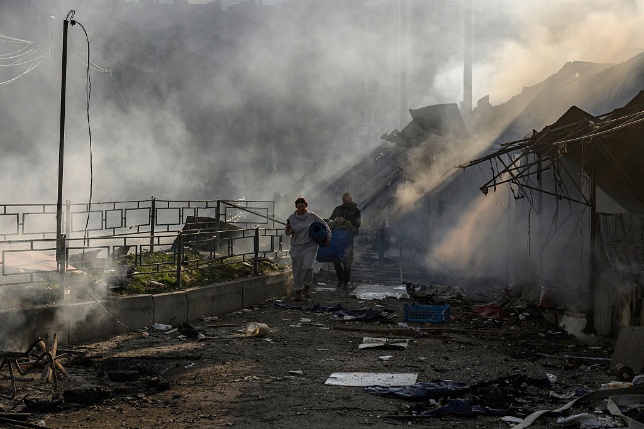
The aftermath of missile strikes in Kyiv, following one of the largest combined missile and drone operations on the Ukrainian capital overnight. (Maxym Marusenko/NurPhoto via Getty Images)
2. For the Three-Month-Old in Nikopol
Father, a three-month-old infant was injured in Nikopol on May 24 when Russian artillery and drones struck residential buildings across the Dnipropetrovsk region. Three months old. The child is listed in stable condition, and for that we are grateful. But we ask that You keep that child stable, keep them healing, keep the parents who are watching them in a hospital room from losing what they nearly lost. And for the four-year-old also hospitalized — for the doctors working in the Dnipro regional hospitals today — let their hands be steady and their resources sufficient.
3. For the Workers Who Built the Chornobyl Museum
God of memory, the National Chornobyl Museum in Kyiv reopened to the public days before Russia destroyed it. Someone spent years building that museum. Curators, archivists, educators, volunteers who believed that the story of Chornobyl — the accident, the cover-up, the liquidators, the evacuees, the land that is still not fully safe — deserved a permanent home in Ukraine’s capital. They finished the renovation. They held a reopening. And then a Russian cruise missile came through the Podil neighborhood and the museum was gone. Comfort everyone for whom that building was a life’s work. Let the records and artifacts that survived be gathered. And let the story it preserved be told again, because the obliteration of memory is one of the things Russia most wants and Ukraine most resists.
4. For the Operators Who Flew Toward Moscow’s Airports
Lord, SBU Alpha drone operators flew toward Vladimir Oblast overnight — in the same hours that the Oreshnik descended over Bila Tserkva — and struck the Vtorovo station, the pipeline hub that pumps fuel to Sheremetyevo, Domodedovo, and Vnukovo. The fire burned across 800 square meters. These operators were not watching the news. They were working. They were carrying out the only kind of answer available: not a mirror image of what was done to Kyiv, but precision, sustained, into the infrastructure of the machine that keeps the war going. Sustain them. Protect them. And let what they are building — the long-range strike capability that Ukraine has assembled from scratch under fire — be enough, in time, to change the calculation.
5. For Yevhen, Who Opened Anyway
God of ordinary courage, a young man opened a café in Podil on May 23. A cruise missile came through the neighborhood that night, less than 100 meters away. His windows shattered. He picked up the coffee grinder from the floor. It worked. He opened on May 24. This is not heroism in the military sense. It is the quieter kind: the refusal to allow a destroyed window to become a destroyed life. There are thousands of Yevhens in Kyiv this morning — people sweeping glass, boarding windows, opening doors, serving coffee to neighbors who need it. Bless their stubborn normalcy. Let them keep finding that the machine still works. And let the world see, in their persistence, what Ukraine is actually made of — not only the weapons and the airmen and the frontline brigades, but the person who opens anyway on Sunday morning because what else would you do.