
Four hundred fifty drones and seventy-one missiles tore into Ukraine’s power grid just days before negotiations, revealing how Moscow uses “ceasefires” not to pause war—but to prepare the next strike.
The Day’s Reckoning
At 3:47 a.m., the sirens began—and did not stop. Not for one wave. For twenty-three hours, because the waves kept coming.
Four hundred fifty drones. Seventy-one missiles. Launched from six directions. Zircon anti-ship missiles arcing out of Crimea. Iskander ballistic missiles fired from Bryansk. Kh-22s tearing through the night sky. Kh-101s launched from the Caspian Sea. And the swarm—Shahed drones mixed with Gerbera decoys—funneling in from Kursk, Oryol, Smolensk, Rostov, and Krasnodar, all converging at once.
It came the day after Russia’s brief “energy infrastructure moratorium” expired. And the day before trilateral talks were set to begin in Abu Dhabi.
Ukrainian air defense crews fought through the night and into the next day. Four hundred twelve drones destroyed. Zircons intercepted. Iskanders broken apart in flight. In any other war, the numbers would read as success. But twenty-seven missiles and thirty-one drones still got through. They struck twenty-seven locations. Wreckage fell across seventeen more.
In Kyiv, combined heat-and-power plants burned. Substations failed. Darnytskyi and Dniprovskyi districts went dark—1,170 high-rise buildings without heat as temperatures plunged to minus twenty. In Kharkiv, CHPP-5 and two substations were hit, cutting power to 200,000 people and triggering a state of emergency. Power plants across Dnipropetrovsk, Vinnytsia, and Odesa oblasts were damaged. Entire settlements lost electricity.
Ukraine’s largest energy company called it the most devastating Russian strike of 2026.
As the last fires were still burning, negotiators in Abu Dhabi prepared for talks. Hours later, NATO Secretary General Mark Rutte arrived in Kyiv, lit candles for the dead on Maidan Nezalezhnosti, and told the Verkhovna Rada the truth the night had already made clear: attacks like these do not signal peace.
Day 1,441—when the moratorium ended, the sirens did not, and the meaning of negotiations was written in darkness and cold.
The Pause That Armed the Strike
Count the days, the way Ukrainians did.
After the January 23–24 talks in Abu Dhabi, Russia agreed to stop striking energy infrastructure. The pause was supposed to last until the next round of negotiations—first penciled in for February 1, then pushed to February 4–5.
Ten days. Maybe twelve, depending on how you counted.
President Zelensky explained the logic carefully. Washington proposed the moratorium to cool the war. Ukraine, the United States, and Russia would use the pause to explore de-escalation. Breathing room. Proof of good faith.
In Moscow, the pause meant something else.
Those days were spent stacking missiles.
When the strikes came on February 3, the pattern was unmistakable. The package was one-and-a-half times larger than anything Russia had launched before Abu Dhabi. Ukrainian Air Force spokesman Colonel Yuriy Ihnat recognized it immediately: unusually heavy concentrations of ballistic and semi-ballistic weapons—Kh-22s and Kh-32s, Zircons, Onyx missiles, Iskander-Ms—chosen because they were hardest to stop.
Thirty-eight ballistic missiles in one salvo. Ten intercepted. The rest punched through.
The logic was brutal and simple. Launch almost nothing for days. Let stockpiles grow. Then unleash everything at once, overwhelming air defenses by volume alone. Drones modified with mines and cluster munitions. Ballistic missiles packed into single windows. Maximum damage. Minimum political risk.
And during the “pause”? Russian forces never stopped striking. They just changed targets. Railways. Logistics hubs. Supply lines. The grid got a moment’s reprieve. The arteries feeding it did not.
On January 31—still inside the moratorium—Ukraine’s power system collapsed anyway. No missile strike that day. It didn’t need one. Months of prior damage had left the grid so fragile that a technical failure cascaded nationwide.
The Kremlin agreed to the moratorium only after ensuring the damage would continue doing its work on its own. Like removing life support after the organs have already failed.
DTEK later called the February 2–3 assault the most devastating strike of 2026. Four hundred fifty drones. Seventy-one missiles. Timed forty-eight hours before talks resumed.
Negotiations restarted February 4.
The strikes restarted February 3.
Eleven Degrees Inside: How Winter Entered Kyiv’s Homes
The thermometer read eleven degrees Celsius. Inside.
In a central Kyiv living room where ninety-year-old Valentyna Bardash lived alone.
She held the thermometer up for visitors in winter coats, then led them to the kitchen. A gas flame burned constantly on the stove—not for food, but for survival. “I keep warm with gas,” she said. “I heat water all the time.”
She stretched out her hands. Twisted fingers. Still cold, even inches from the flame. “This is the greatest discomfort,” she said softly.
Valentyna had worked as an economist at one of Kyiv’s largest factories. She had lived in this apartment since the mid-1950s, when the ten-section building across from the Bolshevik factory was new—nearly three hundred apartments meant for workers. Now she wore winter clothes indoors. The elevator no longer worked without electricity. Leaving the building was almost impossible. Her son and neighbors helped when they could.
She was not leaving. This was her home.
For two weeks, the building at 60 Beresteisky Avenue had no heat. Not because it was hit directly—but because Russian strikes shattered Kyiv’s energy system, and the failures cascaded outward. Entire districts froze together.
Writer and filmmaker Iryna Tsilyk pointed to icicles hanging from the facade. Pipes burst one after another. As another rupture echoed through the building, she and neighbor Serhii Korovka ran to the attic. Water poured from pipes the management company had not replaced in twenty years.
“Since January 19, there’s been no heating,” Serhii said, breath fogging the air. “One rupture, then another. Now I track them all. I’m the local plumber.” He smiled, lips stiff with cold.
The basement was worse. Water streamed down walls into the bomb shelter, pooling where residents were meant to hide from air raids. Some apartments fell to five degrees. Families with children left. Those who stayed wrapped themselves in layers and still shivered.
Empty cribs. Water-stained ceilings. A building freezing from the inside.
This was the “most devastating strike of 2026” made real. Not maps. Not numbers. But elderly women unable to warm their hands, neighbors racing through attics, and kitchens lit by gas flames instead of light bulbs.
Valentyna remembered Moscow trips in the 1970s—talk of “brotherly peoples,” and the slur whispered when Ukrainians arrived. “They were always like this,” she said.
The next day, negotiators would sit in climate-controlled rooms in Abu Dhabi.
In Kyiv, Valentyna kept the gas burning. It was the only heat she had.
Paper Guarantees, Burning Power Plants
The framework appeared in print on February 3.
That same morning, the strikes began.
As the Financial Times laid out Europe’s proposed enforcement plan for a future ceasefire, Russian missiles were already in the air. The contrast could not have been sharper. On paper, a system of deterrence. In reality, exploding substations.
The plan itself was serious. Months of quiet work by Ukrainian, European, and American officials had produced a multi-tiered response mechanism meant to prevent Russia from doing what it had done before—sign a pause, exploit it, then strike again.
The first violation would trigger a warning within twenty-four hours. Continued attacks would authorize Ukrainian forces to act. If that failed, the “Coalition of the Willing”—European states, Britain, Norway, Iceland, Turkey—would intervene. If escalation continued, a Western-backed force, with U.S. involvement, would follow within seventy-two hours.
The logic assumed deterrence still mattered.
While those timelines were being debated, Russia launched four Zircon missiles from occupied Crimea. Thirty-two Iskander-M ballistic missiles from Bryansk. Seven Kh-22/32s from the same airspace. Twenty-eight Kh-101 and Iskander-K cruise missiles from the Caspian Sea and Kursk. Four hundred fifty drones followed from six launch regions.
Twenty-seven missiles and thirty-one drones hit. Power plants burned. Substations failed. Two hundred thousand people in Kharkiv lost electricity. Districts of Kyiv went dark. Thermal facilities across four oblasts were damaged.
This was Moscow’s reply to enforcement theory.
It demonstrated the assumption Europe’s framework could not answer: that Russia calculates costs the same way deterrence models expect. The February 3 strike—deliberately timed forty-eight hours before talks in Abu Dhabi, deliberately breaking the energy moratorium meant to enable them—showed a different logic. Violate first. Absorb consequences later. Strike while negotiations are still being scheduled.
Hours after the attack, NATO Secretary General Mark Rutte stood in Kyiv and promised solid security guarantees—troops, aircraft, funding. Necessary steps. Real commitments.
But as plans multiplied, one question burned unanswered beneath the wreckage: what stops a power plant from being hit tonight, not seventy-two hours from now?
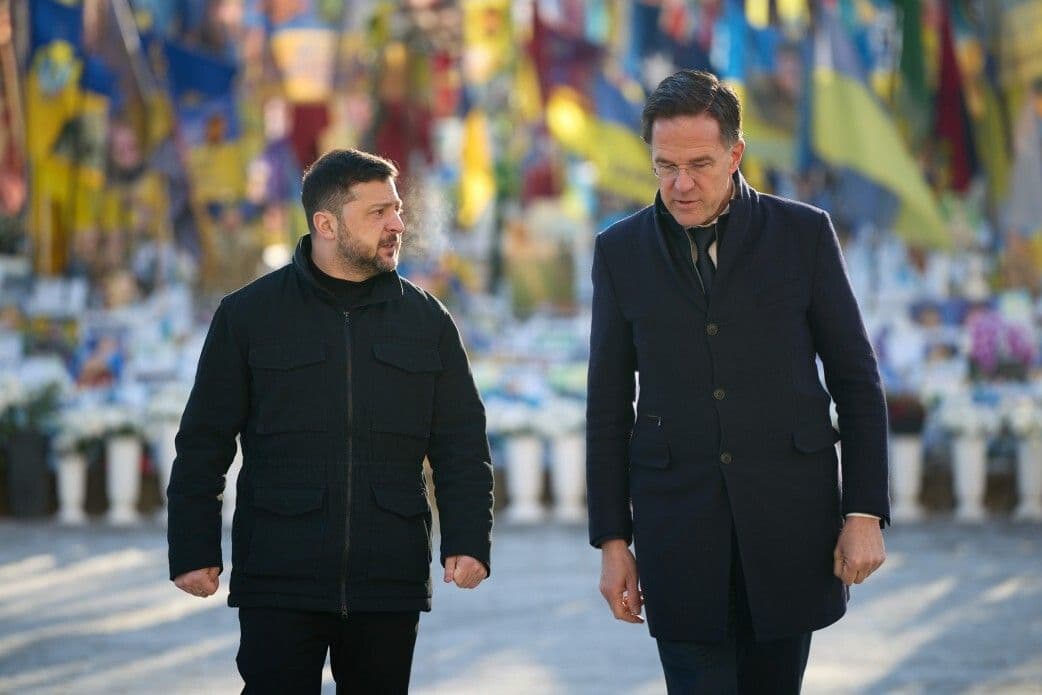
President Volodymyr Zelensky and NATO Secretary General Mark Rutte, who is on a visit to Ukraine, honor the memory of fallen Ukrainian soldiers in Kyiv, Ukraine. (President of Ukraine/Anadolu via Getty Images)
Candles After the Strike: Rutte’s Truth in Kyiv
Watch his hands as he placed the candles.
Not the practiced gesture of protocol—but mourning.
Mark Rutte arrived in Kyiv on February 3, hours after Russia’s largest winter strike finally ended. He stood beside President Zelensky at the Maidan memorial, laid flowers for the dead, then walked to the Verkhovna Rada to say what the night had already proven.
“Direct talks are now underway, and this is important progress,” he told parliament. “But Russian attacks like those last night do not signal seriousness about peace.”
The contradiction was unavoidable. Negotiations were advancing. Frameworks were forming. And at the same time, Russia had launched seventy-one missiles and four hundred fifty drones—an assault timed precisely to shape those talks before they began.
Rutte did not soften the reality. Peace, he said, would require difficult choices. Ukraine needed absolute certainty that the sacrifices already made would not be repeated again and again.
He described security guarantees not as abstractions, but as presence: troops on the ground, jets in the air, ships on the Black Sea. Some European states were already preparing deployments. The United States would provide the backstop.
But his most urgent appeal was not about tomorrow’s guarantees. It was about tonight’s defenses.
“Dig deep into your stockpiles,” he urged allies. Air defense first.
The numbers explained why. Ukrainian forces intercepted 412 drones and dozens of missiles—an extraordinary defense. Still, twenty-seven missiles and thirty-one drones struck home. Every interception burned through ammunition. Every empty launcher widened the gap for the next wave.
Rutte confirmed NATO allies were preparing to allocate fifteen billion dollars in 2026 through the Prioritized Ukraine Requirements List, which already supplied most of Ukraine’s air defense ammunition. It was not theory. It was triage.
His visit carried weight. Candles lit hours after the strike. Truth spoken without illusion.
But candles do not stop ballistic missiles.
Speeches do not restore heat.
And promises cannot warm apartments already frozen.
Congress at the Brink: One Name Between Action and Delay
In Washington, the number was written on every face: 217.
That was how many signatures lawmakers had gathered by February 3. One short of forcing a vote. One name away from dragging the Ukraine Support Act onto the House floor through a discharge petition.
Representative Marcy Kaptur did not hide her frustration. “Russia is taking advantage of Washington’s hesitation,” she said. One more signature, she repeated. Just one.
The timing could not have been harsher. As Russia unleashed its largest strike of 2026 and NATO’s secretary general stood in Kyiv asking for air defenses, lawmakers in Washington were explaining why multiple bipartisan bills sat stalled—the Ukraine Support Act, the Peace Through Strength Against Russia Act, the Sanctioning Russia Act. All written. All waiting. All unmoved.
Congressman Tom Suozzi spoke with the images of the night still fresh. “There’s so many people living without heat right now,” he said. “Could you imagine the monster that would say, I can gain power by taking away people’s heat in sub-zero weather?”
The press conference opened the fifth annual Ukrainian Week, expected to draw thousands of advocates to Washington. But the focus was not ceremony. It was leverage—sanctions, economic pressure, laws meant to choke the machinery that kept Russian missiles flying.
“You cannot reward monsters,” Suozzi said again. “We cannot reward a monster for what he is doing to the people of Ukraine.”
The math was unforgiving. Discharge petitions require 218 signatures. The count stood at 217. Leadership had not scheduled a vote. Urgency pressed from the outside. Procedure held the line inside.
While Congress counted names, Kyiv counted hours without heat. Ninety-year-old Valentyna Bardash kept her gas stove burning through the night, not for food, but warmth.
The monster had already acted.
The question was whether Washington would.
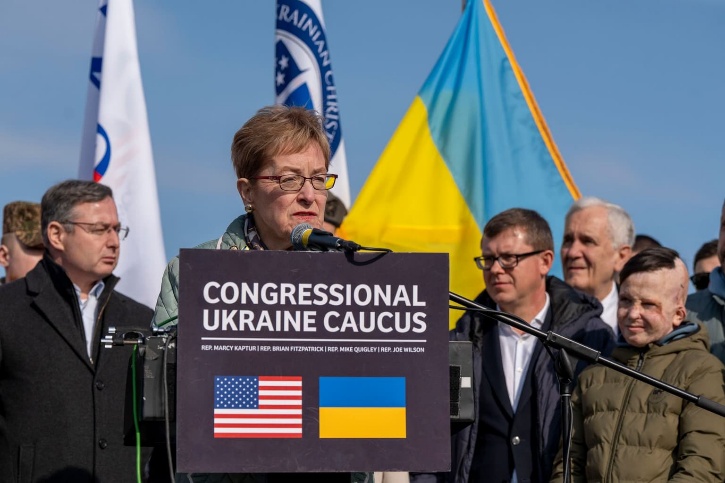
Congresswoman Marcy Kaptur, co-chair of the Congressional Ukraine Caucus, delivers remarks at a press conference in Washington, D.C.. (Serge Petchenyi)
The Assassination Plot That Reached NATO’s Core
The sentence was handed down quietly on February 3.
Three and a half years in prison for a man who had volunteered to help kill a president.
Pavel K., a fifty-year-old Polish citizen from Hrubieszów, had offered himself to Russian intelligence. His target was not abstract. He proposed spying on security arrangements at Rzeszow airport—where President Volodymyr Zelensky transited during wartime visits to Poland. He declared his willingness to cooperate with Russian military intelligence and to join the Wagner Group.
The plot surfaced in 2024, when Ukraine’s Security Service detected the offer and alerted Polish authorities. Evidence was shared. Lines stayed open. The arrest came before the plan could move from intent to execution. A potential breach of allied security—during one of the war’s most sensitive diplomatic corridors—was stopped before it became history.
That same day, Poland revealed something more unsettling.
A sixty-year-old employee of the Ministry of National Defense—on the job since the 1990s—was escorted from his office by Military Police. Investigators suspected he had been working with Russian and Belarusian intelligence services. His actions had been tracked for months. Patterns mapped. Contacts analyzed. He was taken for questioning by prosecutors in Warsaw.
Polish media described it as unprecedented in recent years: a long-serving defense ministry insider allegedly feeding information to adversary services throughout the full-scale invasion of Ukraine.
Together, the cases exposed the war behind the war. Not drones skirting airspace or missiles crossing borders—but people. Human sources cultivated slowly, embedded deep inside NATO states, positioned to watch security procedures, decision-making, movement.
Russia was not only probing defenses.
It was reaching for the hands that controlled them.
The Man Who Hid at Home and Guided the Shells
He almost never left his apartment.
The forty-one-year-old man stayed inside in Donetsk Oblast, avoiding the draft, waiting—he believed—for Russian forces to occupy the region fully. From his phone, he reached out first. A message to a Russian chatbot. A signal of willingness. That was enough.
Russian intelligence answered.
On February 3, Ukrainian counterintelligence detained him, suspecting he had been coordinating strikes on the frontline town of Druzhkivka and nearby areas. He was not moving through checkpoints or scouting roads himself. He didn’t need to.
Instead, he used his mother.
She went out to collect volunteer aid. She walked through the city. She passed Ukrainian soldiers, watched convoys roll toward the front, stood in lines, listened. She did not know what her son was doing.
When she came home, he asked questions. Where were the soldiers today? Which roads were busy? What vehicles did she see moving east?
He typed the answers into his phone and sent them on.
Russian forces planned to use the information to locate Ukrainian units and adjust shelling. Coordinates gathered from kitchen-table conversations. Targeting built from a mother’s errands.
The Security Service of Ukraine detained him at his home. During the search, officers seized his smartphone. Inside were messages linking him directly to an FSB handler.
He was formally charged under Article 111 of Ukraine’s Criminal Code—high treason committed under martial law. The penalty: life imprisonment, with confiscation of property.
The SBU moved quickly to secure any Ukrainian positions that might have been exposed.
The case revealed how Russia now hunts for intelligence. Not only trained operatives or long-built networks—but men trying to disappear, offered safety in exchange for betrayal. And it showed Ukraine’s response: monitoring, interception, arrest before the shells arrive.
He never left the apartment.
But the war was already coming from his phone.
Allies in the Shadows, Missiles in the Sky
While Ukraine absorbed Russia’s largest strike of 2026, Belarus chose the same day to speak—quietly.
On February 3, Minsk announced that its military delegation had met with China’s Office for International Military Cooperation to discuss implementing bilateral cooperation plans. Major General Valery Revenko led the talks. The language was technical. The timing was not.
Belarus already hosts Russian forces. It already serves as a launch platform for strikes against northern Ukraine. Any expansion of military cooperation with China—even limited to training, logistics, or dual-use technology—adds weight to the structure sustaining Moscow’s war.
The announcement landed as missiles flew and power plants burned, underscoring a parallel reality: while Western leaders debated enforcement frameworks, the authoritarian partnership network remained intact.
No sirens. No explosions. Just a reminder that isolation had not fractured the axis supporting Russia’s offensive.
The Drone That Carried Another Drone
On February 3, the wreckage photos appeared online.
Serhiy “Flash” Beskrestnov, an advisor to Ukraine’s Defense Ministry, laid them out carefully. Bent foam. Wiring. Fragments that told a new story. For the first time, Russian forces had used a Gerbera drone as a mothership—carrying a smaller first-person-view drone into Ukrainian airspace.
Gerbera drones were never meant for this role. They are the cheaper cousins of Russia’s Shahed/Geran platforms: lightweight foam airframes, typically sent to soak up air-defense fire, deliver small explosive payloads, or collect electronic intelligence. Their strength is range—three hundred to six hundred kilometers—not precision.
Now that range was being repurposed.
Instead of striking alone, the Gerbera ferried an FPV drone deep into Ukraine’s rear, preserving the smaller drone’s battery for the final phase. Ukrainian forces did not recover the FPV itself, leaving open whether it was intended for reconnaissance or attack. The implication mattered more than the answer.
Russia had tried mothership tactics before. Molniya fixed-wing FPVs had carried drones during strikes on Zaporizhzhia in October 2025. But Molniya’s range was limited. Gerbera’s was not. The change expanded the menu of targets—training grounds, air-defense systems, logistics hubs—far beyond the front.
Mothership drones increasingly enable precision strikes without warning. Defending against them is costly. Shooting down small FPVs with traditional air defenses makes no economic sense. Interceptor drones and point-defense systems become essential.
The same day Beskrestnov published his analysis, a Ukrainian Special Forces officer described another scene near Pokrovsk: Russian troops advancing in fog and snow, often on foot, sometimes on motorcycles or in cars. Some were well equipped. Many were elderly. Most were exhausted.
The contrast was stark. Sophisticated drone innovation overhead. Poorly equipped infantry pushing forward below.
This is the war now—technology stretching farther even as the human element frays. Innovation and exhaustion advancing together, neither slowing the other.
Meters Taken, Lines Held: The War That Would Not Break
Away from the sirens and summits, the war on the ground kept moving the way it has for months—slowly, violently, and without resolution.
Near Slovyansk, Russian forces edged forward into southern Stavky, northeast of Lyman. Claims followed—advances near Sosnove, movement south of Nykyforivka—then disputes. Some said Nykyforivka had fallen. Others said Ukrainian troops still clung to parts of it. Clearing operations dragged on. Nothing decisive.
Farther south, the 51st Combined Arms Army faced a problem it could not solve cleanly. Instead of tightening its planned encirclement of Pokrovsk, it was forced to defend the Dobropillya salient. Ukrainian pressure there pulled Russian units outward, dispersing forces meant to attack. What had been designed as a two-pronged operation narrowed into one, stretching timelines and consuming resources.
Around Pokrovsk itself, geolocated footage showed Russian advances near Zatyshok and Svitle. But the assaults were small—fire teams of two or three soldiers, not mechanized pushes. Ukrainian artillery officers reported no major armored attacks in days. Russia probed instead, prioritizing Novooleksandrivka and Hryshyne, searching for a weak seam toward Dobropillya.
South near Hulyaipole, Russian troops advanced west of Dorozhnyanka. Pressure continued across western Zaporizhzhia Oblast. No breakthrough followed.
In Zaporizhzhia City, the war touched civilians again. A drone strike around 6 p.m. killed two eighteen-year-olds and wounded at least twenty others, including four children. The air alert had already been sounding for twenty-three straight hours.
Everywhere, the pattern repeated. Russian forces pushed without rupture. Ukrainian forces held without reversal. Gains measured in hundreds of meters. Counterstrikes denying consolidation.
Ukrainian units struck back—hitting Russian positions in Kreminna Raion, destroying an electronic warfare station near Baranivka, striking a drone training and production site near Komysh-Zorya, and hitting troop concentrations near Khliborobne.
The line bent. It did not break.
Pressure without breakthrough. Resistance without collapse.
The war advanced by meters while diplomacy waited for something the battlefield refused to give.
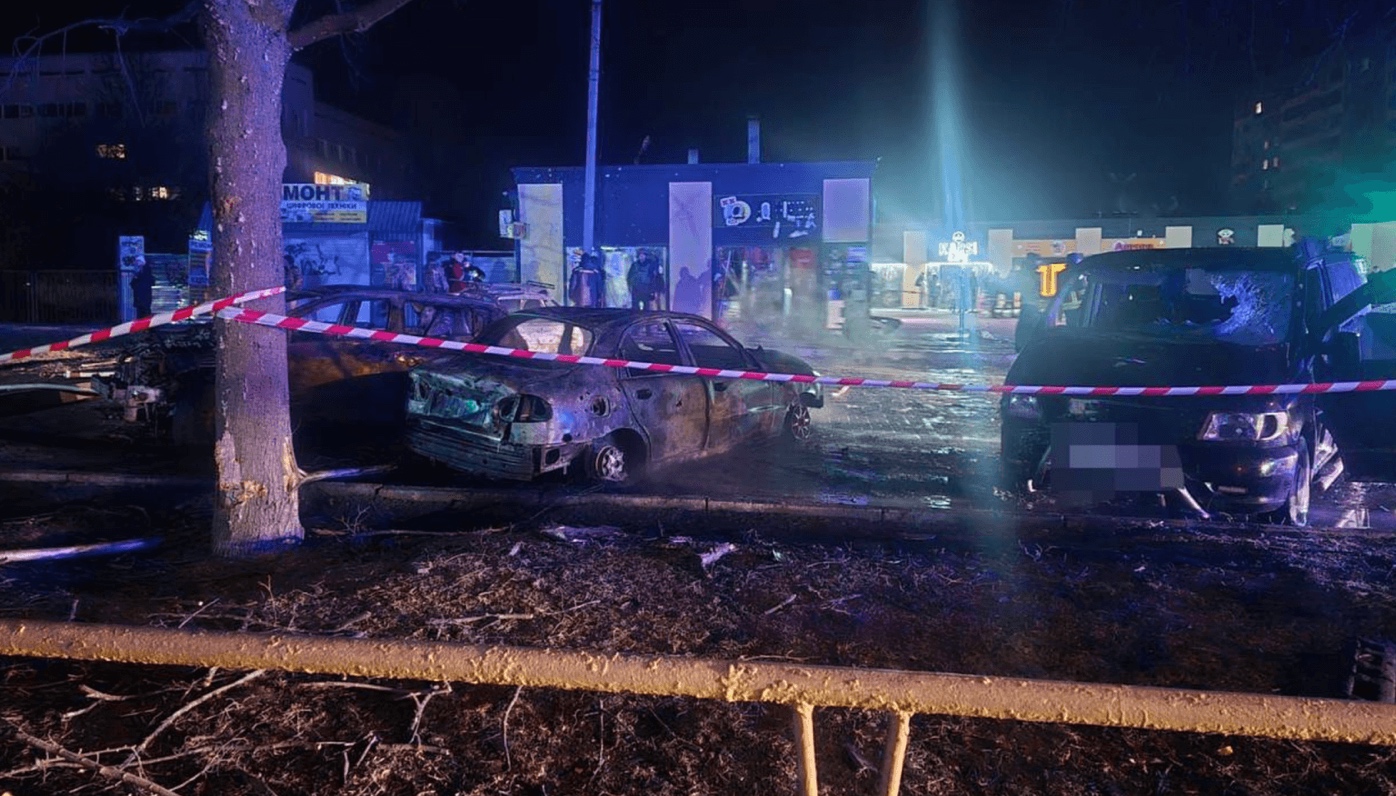
Burned-out cars sit at the site of a Russian drone strike in Zaporizhzhia. (State Emergency Service of Ukraine)
The Day’s Meaning
Two wars unfolded at once.
Missiles tore into power plants as NATO’s secretary general promised security guarantees. Diplomats spoke of enforcement frameworks while ninety-year-old Valentyna Bardash held out hands she could not warm in a dark Kyiv apartment.
February 3 made the disconnect unmistakable.
Russia launched the most devastating strike of 2026 forty-eight hours before talks resumed in Abu Dhabi. Not an accident. A message. The so-called energy moratorium was revealed for what it was: time to stockpile, not time to de-escalate. Four hundred fifty drones and seventy-one missiles ensured Ukrainian negotiators would arrive representing a country plunged back into cold and darkness.
That same day, Moscow’s demands were laid bare—Ukraine constrained, NATO dismantled or neutered, Eastern Europe reordered to fit Russian dominance. Everything else was negotiable. These were not. The strike underlined the point more clearly than any statement.
Western officials discussed graduated responses and Coalition of the Willing timelines, assuming deterrence still worked on rational calculation. February 3 suggested a different operating logic: violate first, absorb consequences later, continue until stopped by force or exhaustion.
NATO Secretary General Mark Rutte arrived in Kyiv with real commitments—troops, jets, ships, air defenses—and an honest warning that peace would require hard choices. The promises mattered. But so did the gap between promise and need.
While he spoke, 1,170 high-rise buildings in Kyiv had no heat. While frameworks were drafted, Russian forces advanced near Slovyansk, pressed Pokrovsk, and struck Zaporizhzhia, killing two eighteen-year-olds. Diplomatic progress and battlefield violence moved in parallel, never touching.
Other signals flickered—India cutting oil purchases, Polish counterintelligence arrests, new Russian drone tactics, incremental shifts along the front. None resolved the central question.
Could agreements constrain a war used as leverage? Could guarantees protect civilians tonight, not later?
February 3 answered only one thing clearly: Moscow saw negotiations not as a path out of war, but as another way to fight it.
Prayer For Ukraine
• Pray for civilians enduring winter without heat or power—that the elderly, the sick, and families with children would be protected through the cold nights, and that emergency aid would reach those most at risk.
• Pray for Ukrainian air defense crews, firefighters, medics, and utility workers—those standing between missiles and cities, flames and homes—that they would have strength, protection, and the resources they need to save lives.
• Pray for wisdom and clarity for Ukrainian leaders and diplomats—that negotiations would not become cover for further violence, and that truth would not be sacrificed for the appearance of progress.
• Pray for unity and resolve among Ukraine’s partners—that promised aid, air defenses, and security commitments would arrive without delay and match the scale of the threat.
• Pray for an end to the war driven by justice, not exhaustion—that aggression would be restrained, civilians spared, and peace would come through accountability rather than surrender.