
As Putin bombs Kyiv during Christmas and claims phantom victories, Ukraine exposes the hard math behind a war Russia can prolong—but can no longer win.
The Day’s Reckoning
The night began before most of Kyiv was asleep. Air-raid sirens cut through Christmas darkness as radar screens lit up with inbound tracks—first missiles, then more missiles, then drones in numbers too large to count quickly. By the time the attack ended ten hours later, nearly 500 drones and 40 missiles had crossed Ukrainian skies. Russia’s response to peace proposals arrived not in documents or diplomatic language, but in fire.
As President Volodymyr Zelensky traveled toward a high-stakes meeting with Donald Trump in Florida, Moscow staged its own argument. Christmas weekend became a demonstration of doctrine: negotiate while bombing, talk peace while striking civilian infrastructure, signal compromise while weaponizing holidays. The message was not subtle. Kinzhals and Shaheds spoke more clearly than any communiqué.
This was day 1,403 of the invasion, and the war had settled into a grim rhythm. Russia could meet its mobilization targets. It could replace the men it lost. What it still could not do was build the reserves needed for decisive maneuver. Victories were proclaimed, then quietly questioned—even inside Russia—by military bloggers calling official claims fiction. Advances continued, but only in meters. Breakthroughs remained imaginary.
The paradox hardened into pattern. Moscow had manpower, but no momentum. It could grind forward, but not surge. It could exhaust itself and Ukraine simultaneously, but not impose an ending. The arithmetic of attrition had created a ceiling no amount of recruitment could break.
By morning, shattered windows and cold apartments told the human cost. By evening, the strategic meaning was clear. This was a war trapped in equilibrium—violent, relentless, and unresolved—where both sides could continue, but neither could yet force the outcome they wanted.
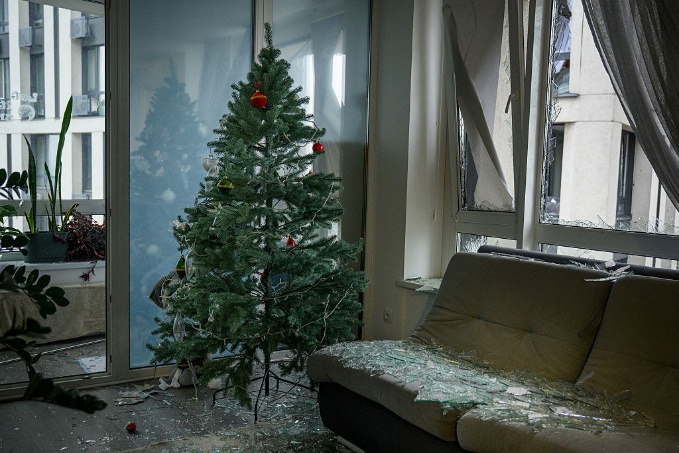
Windows are shattered in an apartment badly damaged during Russian strikes in Kyiv. Russia attacked Ukraine with hundreds of missiles and drones on Saturday, killing two people in Kyiv and surrounding areas, and injuring at least 46 others, according to authorities. (Elise Blanchard/Getty Images)
The Night Kyiv Couldn’t Sleep: Ten Hours Under Fire
At 2 a.m., Kyiv’s radar screens began to fill. The first launches were Kinzhals—hypersonic missiles screaming toward the city fast enough to give air-defense crews only minutes to react. Iskander ballistic missiles followed, their trajectories designed to overwhelm interceptors. Then came Kalibr cruise missiles. And finally the drones—hundreds of them—lifting off in waves from Kursk, Oryol, Rostov, Smolensk, and occupied Crimea. By dawn, 519 drones had been committed to the attack.
Air-defense crews fought what became the most intense defensive operation of the winter. The Ukrainian Air Force tracked ten Iskander-M/Kinzhal missiles from Ryazan and Bryansk, seven Iskander-K/Kalibr cruise missiles from Rostov Oblast and the Black Sea, twenty-one Kh-101 cruise missiles from airspace over Vologda Oblast, and two Kh-22s fired from the Black Sea. Roughly 300 Shahed-type drones poured in behind them, meant to exhaust defenses through sheer volume.
Inside the city, Mayor Vitali Klitschko’s updates traced the damage block by block. Drones and falling debris slammed into apartment buildings. Fires climbed floor by floor. In the Dniprovskyi district, flames crawled up an eighteen-story building as rescuers searched rubble on the fifth floor for someone still trapped. The toll hardened quickly: 28 wounded, including two children. Thirteen hospitalized. At least one dead.
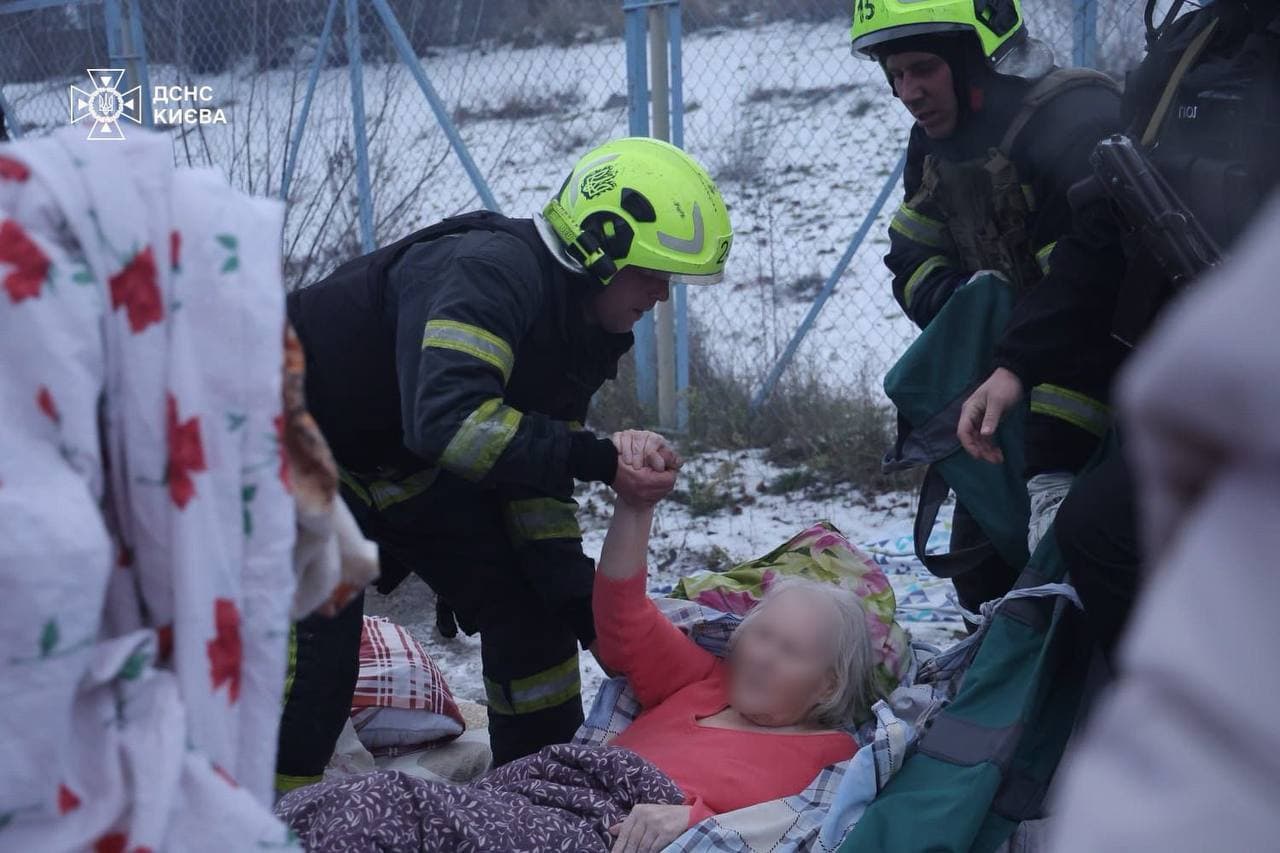
First responders help an elderly woman whose home was damaged in a Russian air attack on Kyiv on the morning. (Courtesy of State Emergency Service)
By 1 p.m., the Air Force released its tally. Ukrainian defenses had shot down 474 drones, six Iskander-M/Kinzhal missiles, four Iskander-K/Kalibr cruise missiles, and nineteen Kh-101s—more than a 90 percent interception rate. It wasn’t enough. Heat was cut to a third of the capital. Four thousand residential buildings went cold. Some neighborhoods lost water entirely, on top of daily outages already stretching fifteen hours.
The targeting wasn’t random. Energy facilities, gas production sites, and industrial infrastructure were hit across Kyiv, Chernihiv, and Odesa oblasts, leaving nearly 600,000 people without power. From Uman to Vyshhorod to Bila Tserkva, civilian buildings collapsed, lives were lost, and Christmas ended in smoke and broken glass.
As Zelensky prepared to present peace proposals abroad, Moscow answered at home. “Kinzhals and Shaheds are speaking for them,” he said. And over Kyiv, they spoke all night.
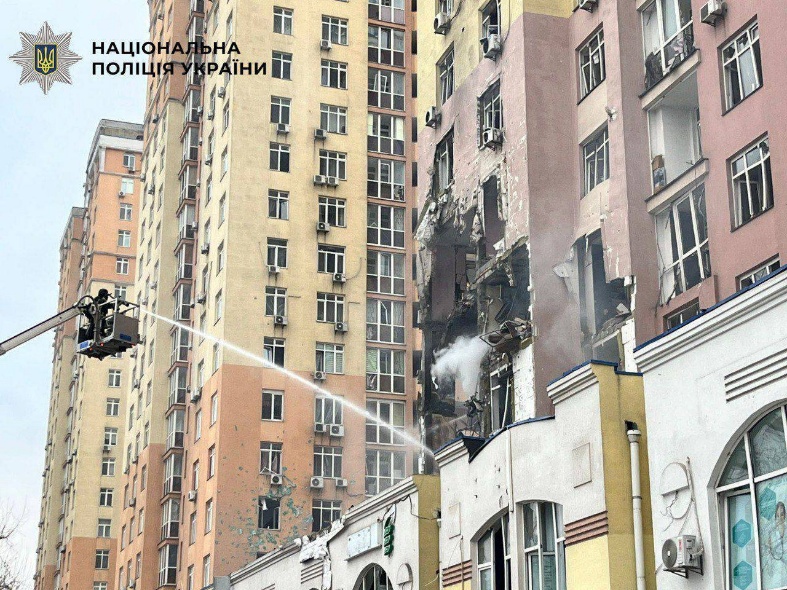
One of the aparment buildings hit by drones in the Russian attack on Kyiv. (National Police of Ukraine)
Numbers Without Breakthroughs: The Ceiling Russia Can’t Break
The numbers looked formidable on paper. In an interview with Suspilne, Ukraine’s military intelligence chief Kyrylo Budanov laid them out plainly: Russia had already met its 2025 mobilization target—403,000 recruits—and would exceed it, reaching 103 percent by year’s end. For 2026, the Kremlin had set an even higher bar: 409,000 more soldiers.
But the numbers told a different story once they left the spreadsheet and entered the battlefield.
Russia wasn’t building strength. It was treading water. Every new recruit went straight into a depleted unit, filling holes left by the dead and wounded. None were forming fresh brigades. None were massing for breakthroughs. To concentrate forces in one sector, commanders had to strip another bare—leaving flanks exposed. Ukrainian forces exploited those gaps near Hulyaipole and, more decisively, around Kupyansk.
Budanov described the constraint bluntly. Russia was “constantly” burning through its operational reserve just to sustain current fighting. There was no accumulation phase. No surge capacity. Enough manpower to keep attacking—but never enough to overwhelm a front. That limitation made new offensives impossible and capped cross-border pressure in Sumy and Kharkiv.
The mobilization system revealed the bind. Most recruits were contract soldiers, lured with signing bonuses reaching two million rubles—roughly $25,000. Moscow was buying time, not victory. By December, more than 150 foreign nationals from 25 countries had joined Russian ranks, part of a broader effort that had pulled over 18,000 foreign fighters from 128 countries into the war.
Still, nothing changed. Russia had optimized for grinding positional warfare, not maneuver. Human-wave assaults consumed men as quickly as they arrived. As of December 27, Ukraine reported Russian losses exceeding 1.2 million killed, wounded, captured, or missing.
The math was relentless. Russia could recruit for years. It just couldn’t turn numbers into decision.
When the Lie Collapsed: Kupyansk and the Moment Moscow Lost Control
On December 27, the Russian Defense Ministry returned to Kupyansk with unusual urgency. After weeks of silence—and weeks of criticism from its own military bloggers—it suddenly released detailed situational reports claiming Russian forces controlled the city center and northeastern districts. The faces delivering the message weren’t generals or official spokesmen. They were company commanders from the 1427th, 1468th, and 1843rd motorized rifle regiments of the 6th Combined Arms Army.
The shift itself told the story. Senior voices had lost credibility. So Moscow sent lower-ranking officers to speak from the “front,” hoping proximity would substitute for truth. It was an implicit admission that the propaganda machine was failing inside Russia’s own information space.
The gambit collapsed almost immediately.
A Russian military journalist—himself a retired colonel—pointed out that state media had quietly reduced Kupyansk coverage after Ukrainian advances. Bloggers noticed. And once they noticed, they spoke. These weren’t fringe critics but nationalist commentators with large followings, openly questioning why victories disappeared from coverage if they were real.
The evidence was impossible to bury. Geolocated footage showed Ukrainian forces advancing along the P-07 Kupyansk–Shevchenkove highway and the P-79 route toward Chuhuiv, securing intersections and government buildings Russia claimed to control. Even bloggers usually loyal to the Defense Ministry acknowledged Ukrainian gains while accusing commanders of systematic lying.
Denials followed. State Duma defense committee member Andrei Kolesnik accused Ukraine of faking control. Others suggested “repositioning.” Critics called it manipulation.
On the ground, reality was clearer. Russian drone operators were reportedly working “constantly and without breaks,” a sign of strain. Ukrainian forces noted more drones—but fewer assaults. Russian units were pulling back, accumulating forces on the east bank of the Oskil River.
The Kremlin tried everything: commanders on camera, deputies denying facts, media recalibrating coverage. None of it held. Too much footage. Too many admissions. Too many contradictions.
Kupyansk didn’t just expose battlefield losses. It exposed something more dangerous to Moscow—loss of narrative control at the moment leverage mattered most.
A Stage Set for Defeat: Putin’s War of Make-Believe
Vladimir Putin arrived at a command post in occupied Ukraine dressed for the cameras. Wearing military fatigues, he listened as Chief of the General Staff Valery Gerasimov and frontline commanders briefed him on sweeping victories—Myrnohrad, Rodynske, Artemivka in Donetsk Oblast; Huliaipole and Stepnohirsk in Zaporizhzhia. On screen, it looked like conquest. Off screen, it unraveled almost immediately.
Within hours, Ukraine’s General Staff issued a blunt rebuttal. Russian claims, they said, were fiction. Fighting continued in Huliaipole and Myrnohrad. Defensive operations held. The lies, they noted pointedly, were aimed outward—at foreign partners—and had intensified precisely as peace negotiations accelerated.
Independent analysts found no evidence to support Putin’s declarations. But the timing was familiar. Moscow had learned to announce victories just ahead of diplomatic moments, creating an illusion of momentum meant to harden negotiating positions. This appearance came one day before President Volodymyr Zelensky’s scheduled meeting with Donald Trump—no coincidence, just choreography.
Putin used the setting to clarify Russia’s terms. Speaking from the command post, he repeated the claim that Kyiv was the aggressor and insisted Russia was merely “finishing” the war. He restated maximalist demands: full control of the entire Donbas, including territories Russia did not hold. Compromise was dismissed. Negotiation was reframed as submission.
“Intelligent people have appeared in the West,” Putin said, praising voices urging Ukraine to accept what he called “decent terms.” He claimed Moscow’s interest in negotiated Ukrainian withdrawal had dropped “to zero.” The meaning was unmistakable. Russia would accept only total capitulation—or continue the war.
“If the Kyiv authorities are unwilling to settle the matter peacefully,” he warned, “we will resolve all challenges using armed force.” It wasn’t diplomacy. It was an ultimatum delivered in uniform.
The theater was polished. The message was not. Russia’s “offers” were demands, its peace talk a threat, its victories staged. And behind the performance lay a war that refused to cooperate with the script.
From Cause to Coordinates: The End of Denis Kapustin
Denis Kapustin died on the Zaporizhzhia front the way modern wars now end lives—suddenly, remotely, without ceremony. Known by his nom de guerre “White Rex,” the leader of the Russian Volunteer Corps was killed when a Russian FPV drone found its target during a combat mission. One man, one signal, one explosion. Ideology didn’t matter in that moment. Physics did.
Kapustin’s path to that battlefield had been long and jagged. A Russian citizen who moved to Germany in the early 2000s, he drifted through violent soccer hooliganism and extremist circles tied to the mixed-martial-arts scene before German authorities revoked his residency. By 2017, he had relocated to Ukraine, supported the Euromaidan movement, and, when Russia launched its full-scale invasion, organized fellow Russians willing to fight their own state.
Under Ukraine’s military intelligence, the Russian Volunteer Corps became a symbol as much as a unit. Its cross-border raids into Belgorod and Kursk embarrassed Moscow, capturing Russian soldiers and puncturing the myth of an impermeable border. They proved something uncomfortable for the Kremlin—that resistance to Putin existed not only abroad, but among Russians themselves.
But Kapustin’s death marked how the war had changed. The early phase, fueled by volunteers and belief, had been swallowed by industrial warfare. Drones replaced daring. Algorithms replaced slogans. Courage still mattered—but only when paired with coordination, logistics, and technology.
The Russian Volunteer Corps announced his death with defiance. “We will definitely take revenge, Denis. Your legacy lives on.”
If it does, it won’t be carried by symbols or speeches. It will arrive quietly—through better drones, tighter targeting, and systems that no longer care who believes what. That is how this war remembers its volunteers.
Lives for Meters: How Russia Fights When It Can’t Break Through
Across the front, the pattern repeated with grim consistency. Russian units adapted tactically—but only within hard limits they couldn’t escape. Near Pokrovsk, Ukrainian defenders watched the same sequence unfold again and again. A single Russian soldier would move forward first—poorly equipped, sometimes sick or already wounded—just enough to draw fire. Only after Ukrainian positions revealed themselves did better-trained assault groups advance.
A Ukrainian brigade spokesperson described it plainly. The first man wasn’t meant to survive. He was bait.
It was Russia’s manpower crisis reduced to its cruelest math. Prison recruits or minimally trained contract soldiers were spent to expose defenses. Information mattered. Lives didn’t. Warfare collapsed into a ledger where some bodies counted and others were written off.
In Myrnohrad, five kilometers northeast of Pokrovsk, that arithmetic played out street by street. City Military Administration head Yuriy Tretyak reported sustained urban combat on the outskirts as Russian forces pushed toward southeastern districts. Guided glide bombs fell more frequently. Artillery and FPV drones struck daily. Fewer than 1,000 civilians remained, trapped inside a city turned killzone. Evacuations became impossible—any moving vehicle drew drone fire.
Farther east, the Siversk direction showed the same logic. Ukrainian brigades reported small Russian infiltration groups pushing into Dronivka, probing supply routes between Siversk and Yampil. Russian military bloggers boasted that drone operators denied Ukrainian movement along roads near Slovyansk and Rai-Oleksandrivka. The brag gave away the truth: Russia relied on aerial surveillance and interdiction because ground maneuver no longer worked.
From Sumy to Zaporizhzhia, Russian forces pressed everywhere—Kupiansk, Borova, Lyman, Kostyantynivka-Druzhkivka, Orikhiv, Kherson. Pressure without breakthrough. Numbers without momentum.
Russia had adapted to drone-dominated, positional war. But adaptation didn’t erase the ceiling. It learned how to grind. It still couldn’t surge. And so the war advanced the only way left—one expendable life at a time.
Votes Under Fire: Why Peace Can’t Begin at the Ballot Box
As President Volodymyr Zelensky traveled toward his December 28 meeting with Donald Trump, the choices before him narrowed instead of widening. Speaking to journalists along the way, he framed the dilemma starkly: Ukraine could not negotiate peace, could not hold elections, could not move forward—without real security guarantees. Not promises. Not language. Protection.
The timing was cruelly instructive. Hours earlier, missiles and drones had torn through Kyiv’s night sky. “If the American side raises the issue of a referendum or elections,” Zelensky said, “this absolutely cannot take place under the conditions in which we are living today—especially air attacks.” He pushed back against claims of clinging to power. He was ready for elections, he insisted. Just not elections held under bombardment.
His conditions were precise. A safe sky. Security across the country, at least for the duration of voting. Legal readiness so results would be recognized as legitimate. International observers everywhere. Ukraine had learned from Russia’s staged referendums what illegitimacy looked like.
Then came the warning. Zelensky revealed intelligence showing Moscow intended to allow Ukrainians in Russia and occupied territories to vote—manufacturing grounds to later claim those voters lacked access and invalidate the entire election. It was classic cognitive warfare: sabotage democracy, then declare it fake.
Diplomacy offered reassurance, but little clarity. France’s Coalition of the Willing prepared plans for troops, aid, and deterrence. Poland’s prime minister repeated the refrain: guarantees must be concrete. Canada pledged $1.8 billion, unlocking IMF financing and easing budget pressure. Europe approved a massive loan package.
Still, the core question hung unanswered. The peace plan Zelensky carried was nearly complete—but the final gaps involved territory and nuclear control, lines Ukraine said it would not cross.
Money could stabilize the state. It couldn’t stop missiles. And until security moved from theory to reality, peace—and elections—remained hostage to the sky.
The Day’s Meaning: When Mathematics Finally Overpowers Will
December 27 exposed the war’s deepest truth: momentum no longer decides outcomes. Math does.
Russia demonstrated scale without leverage. It could recruit hundreds of thousands more soldiers. It could launch nearly 500 drones in a single night. It could stage command-post visits and declare victories on camera. What it could not do was convert volume into decision. The ceiling held—on manpower, on maneuver, on credibility.
Ukraine showed the other side of the equation. Air defenses worked with extraordinary efficiency, but even success had limits. Ten percent getting through was enough to darken neighborhoods, freeze apartments, and remind civilians that defense alone cannot end a war. Technology could blunt terror, not remove it.
Together, these realities formed an equilibrium neither side could break. Russia’s advances would remain measured in meters, paid for with lives it could replace but not multiply into breakthrough. Ukraine could deny victory, impose cost, and hold the line—but not force a conclusion without guarantees that existed only in draft form.
Diplomacy moved in parallel, but not in sync. Putin’s threats were not bargaining chips; they were declarations that pressure would continue regardless of talks. Zelensky’s peace framework carried legitimacy abroad but collided with a battlefield that refused pauses. Negotiation existed, but violence remained the dominant language.
What this day clarified was not who was winning, but how the war would end. Not through sudden collapse. Not through sweeping offensives. Through exhaustion—economic, political, demographic—until continuation became more expensive than compromise.
The unanswered question was whether either side would accept that arithmetic before it extracted its full price. Whether diplomacy could impose what force could not. And whether populations asked to endure “one more year” would eventually decide the math themselves.
For now, the war kept counting. And counting favored no one.