
Russia launched the largest drone barrage of the war—480 drones killing dozens in Kharkiv—but the real story unfolded on the battlefield. Ukrainian counterattacks in Zaporizhia forced Moscow to pull elite airborne and naval infantry units away from eastern offensives, exposing a strategic dilemma: Russia cannot advance everywhere at once. As redeployments accelerate, Ukraine’s tactical pressure is beginning to collide with Moscow’s ambitious plan to seize the Donbas “Fortress Belt” before summer.
The Day’s Reckoning
March 7, 2026 — Day 1,473 of Russia’s full-scale invasion — exposed a brutal equation at the center of the war: every Russian success in one sector now risks collapse in another.
Elite Russian airborne units that should have been preparing for summer assaults on Ukraine’s Fortress Belt instead rushed south to contain Ukrainian gains near Hulyaipole. Pacific Fleet naval infantry—forces Moscow normally deploys only in emergencies—redeployed from Dobropillya not to exploit victories but to prevent a defensive breakdown. The 68th Army Corps abandoned positions near Pokrovsk, surrendering ground Russian troops had spent months fighting to secure, and shifted toward Zaporizhia where Ukrainian counterattacks were tearing into Russian defensive lines.
While Russian commanders struggled with this redeployment dilemma, the Kremlin unleashed the largest aerial assault of the war. Four hundred eighty Iranian-designed drones swarmed Ukrainian cities. In Kharkiv alone, 47 civilians were killed and 68 wounded as drones struck residential districts near military targets. Rescue teams pulled victims from shattered apartment blocks while Russian state television showed only “precision strikes” on defense factories.
Ukraine responded with precision of its own. ATACMS missiles destroyed a Russian Shahed drone launch complex near occupied Donetsk, targeting not just the drones but the infrastructure behind the attacks. Earlier strikes had already crippled two Russian frigates in Novorossiysk, reducing the Black Sea Fleet’s ability to launch Kalibr cruise missiles. At sea, Swedish authorities seized a tanker tied to the transport of stolen Ukrainian grain from Crimea—another blow in the economic shadow war.
The day revealed the war’s central contradiction. Russia still possesses the capacity for devastating bombardment and relentless frontline pressure. But it cannot concentrate forces for breakthrough operations while simultaneously plugging gaps created by Ukrainian counterattacks.
The redeployments continue.
And with them, Moscow’s timetable for conquering the Donbas fortress cities begins to unravel.
Night of Fire: When 480 Drones Fell on Ukraine
The engines came first.
Across the night of March 6–7, Ukraine’s radar screens filled with incoming threats. Two Zircon hypersonic missiles launched from occupied Crimea. Thirteen Iskander-M and S-400 ballistic missiles followed from Bryansk, Kursk, and Voronezh. Fourteen Kalibr cruise missiles rose from Russian warships in the Black Sea.
Then came the real storm.
Four hundred eighty drones.
Most were Iranian-designed Shaheds—about 290—joined by Gerbera and Italmas variants launched from sites across Bryansk, Kursk, Smolensk, and occupied Crimea. It was the largest drone barrage of the war, the product of Iranian designs and Russian mass production.
The ballistic missiles revealed Moscow’s calculation. Ukraine’s Patriot interceptors—the only reliable defense against ballistic threats—were scarce after U.S. production shifted toward Middle Eastern crises. Russian planners aimed directly at that weakness.
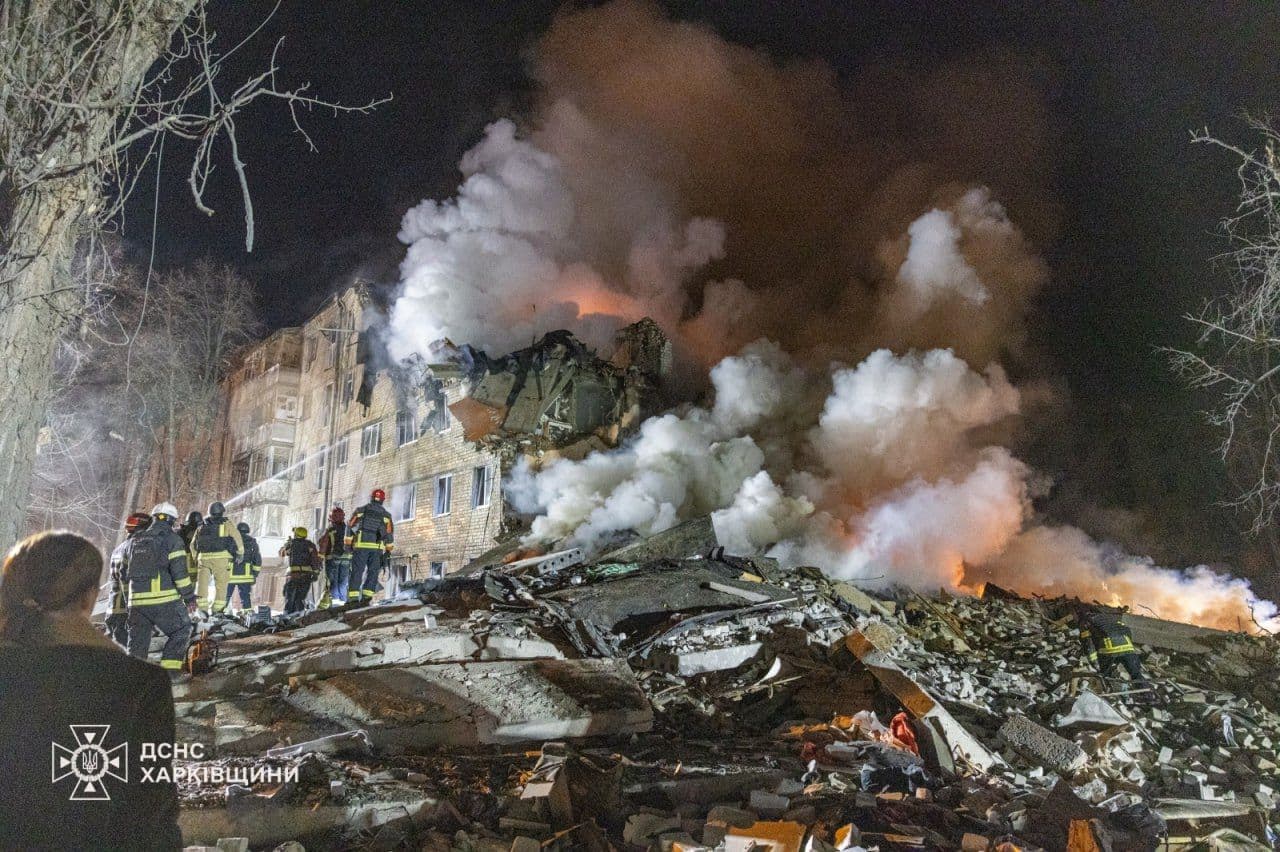
The aftermath of a Russian attack on a residential building in Kharkiv, Ukraine. (State Emergency Service)
Ukraine responded with everything available. F-16 fighters scrambled into the darkness. Soviet-era aircraft joined the intercepts. Mobile air-defense units tracked targets across fifteen oblasts. By morning, Ukraine reported destroying both Zircon missiles, 12 of 13 ballistic missiles, all 14 Kalibr missiles, and 355 drones.
But 125 drones slipped through.
In Kharkiv, the result was devastating. Forty-seven civilians were killed—the deadliest aerial attack since the full-scale invasion began. Sixty-eight more were injured as rescuers pulled bodies from shattered apartment buildings.
Russian state television showed precision strikes on defense factories.
It did not show the neighborhoods burning beside them.
Across fifteen regions—from Kyiv to Odesa—the barrage struck infrastructure and cities alike. Russia proved it could still unleash massive aerial power.
But even this storm of missiles and drones could not solve Moscow’s deeper problem: too few forces to win everywhere it is trying to fight.
Burning the Launchers: Ukraine Hits the Source
While Russian drones were still burning Ukrainian cities, Ukraine struck back at the machinery behind the assault.
Ukrainian forces fired ATACMS and SCALP-EG missiles at a Shahed launch site near occupied Donetsk City. The target was chosen with precision. Ukraine was not merely trying to destroy drones on the ground. It was aiming at the launch crews, logistics, maintenance points, and coordination systems that made mass drone attacks possible.
These sites are the beating heart of Russia’s drone campaign. They store, prepare, fuel, and direct the Shaheds before they are sent toward Ukrainian homes and power systems. Destroy one site, and fewer drones rise the next night.
The timing mattered. Russia had just launched its largest drone barrage of the war: 480 drones in one assault. Ukraine answered not with volume, but with accuracy. Where Moscow relied on saturation, Kyiv targeted the infrastructure that made saturation possible.
That pattern has defined Ukraine’s long-range strike doctrine. Command posts, fuel depots, ammunition warehouses, logistics hubs, and now drone launch sites have all become targets. It is a strategy built around degrading Russian military capacity rather than mirroring Russia’s attacks on civilians.
Russian air defenses detected the incoming missiles. Electronic warfare systems activated. The launch site still burned.
The exchange captured the difference between the two air campaigns. Russia sends swarms. Ukraine hunts the launchers.
Strategic depth may protect Russia.
It does not make Russia untouchable.
The Frigates That Fell Silent: Ukraine Cripples Russia’s Kalibr Fleet
The consequences were confirmed later, but the damage had already been done at sea.
Ukrainian strikes on Russia’s Novorossiysk naval base severely damaged two key Black Sea Fleet frigates: Admiral Essen and Admiral Makarov. Both are Admiral Grigorovich–class warships built specifically to launch Kalibr cruise missiles against Ukrainian targets.
Ukrainian security sources reported that Admiral Essen suffered critical damage. Not temporary disruption. The ship can no longer launch Kalibr missiles — the weapon system that defined its role in the fleet.
The significance extends beyond a single vessel.
Grigorovich-class frigates form the backbone of Russia’s naval strike capability in the Black Sea. Each carries eight vertical launch cells for Kalibr cruise missiles. With two frigates disabled, sixteen launch cells disappeared from Russia’s arsenal.
The consequences are immediate. Fewer launch platforms mean smaller missile salvos and reduced capacity to coordinate the large bombardments Russia has repeatedly directed against Ukrainian cities and infrastructure.
The damage may extend further. Ukrainian officials indicated that other ships at Novorossiysk may also have been hit, potentially weakening the fleet even more.
The strike itself was remarkable for where it happened. Novorossiysk is among Russia’s most heavily defended naval ports. S-400 air defense systems ring the base. Electronic warfare systems attempt to disrupt incoming weapons. Russian warships themselves carry layered defenses.
Ukrainian missiles still reached their targets.
Even as Russia continued launching Kalibr missiles during large aerial assaults, Ukraine had already begun dismantling the ships that fire them.
Two frigates damaged.
Sixteen launch cells gone.
In the quieter naval war beyond the front line, Ukraine continues eroding Russia’s ability to strike from the sea.
The Southward Rush: When Russia’s Elite Forces Became Firefighters
Follow the elite units and the crisis becomes clear.
Russia’s 76th Guards Air Assault Division—one of its most capable airborne formations—had moved toward Pokrovsk late in 2025 as Russian advances slowed. VDV paratroopers are normally reserved for breakthroughs, not slow attrition battles. Their presence signaled Moscow’s determination to keep momentum in a key offensive sector.
But the plans began shifting south.
By late January, elements of the 76th Division—including the 104th, 234th, and 237th VDV Regiments—were repositioned toward the Orikhiv direction in Zaporizhia. Russian planners hoped to exploit earlier gains around Hulyaipole and push deeper toward Ukrainian defensive lines during the coming spring and summer campaigns.
Then events moved faster than the plan.
Russia’s electronic warfare campaign briefly disrupted Ukrainian Starlink communications, degrading battlefield coordination for roughly two weeks. It should have created an opening for Russian advances.
Instead, Ukraine used the window to prepare counterattacks.
When Ukrainian forces struck in Zaporizhia and Dnipropetrovsk oblasts, the VDV units that had moved south for offensive operations suddenly found themselves fighting defensive battles.
Reinforcements followed. Elements of the 68th Army Corps—including the 39th Motorized Rifle Brigade—abandoned positions near Pokrovsk and Dobropillya and rushed toward Hulyaipole. Tanks from the formation were soon shelling Ukrainian positions south of Hirke. Drone units joined the fight days later.
Even Russia’s Pacific Fleet naval infantry—units usually committed only during major crises—were pulled south. Elements of the 40th Naval Infantry Brigade and the 55th Naval Infantry Division appeared near Polohy and Hulyaipole.
The pattern told the story.
The forces meant to drive Russia’s next offensive were instead being used as emergency reinforcements. Every elite unit rushing south meant one fewer available for assaults against Ukraine’s fortified cities.
What began as a tactical counterattack had unraveled an entire Russian timetable.
The Offensive That Exists Only on Paper
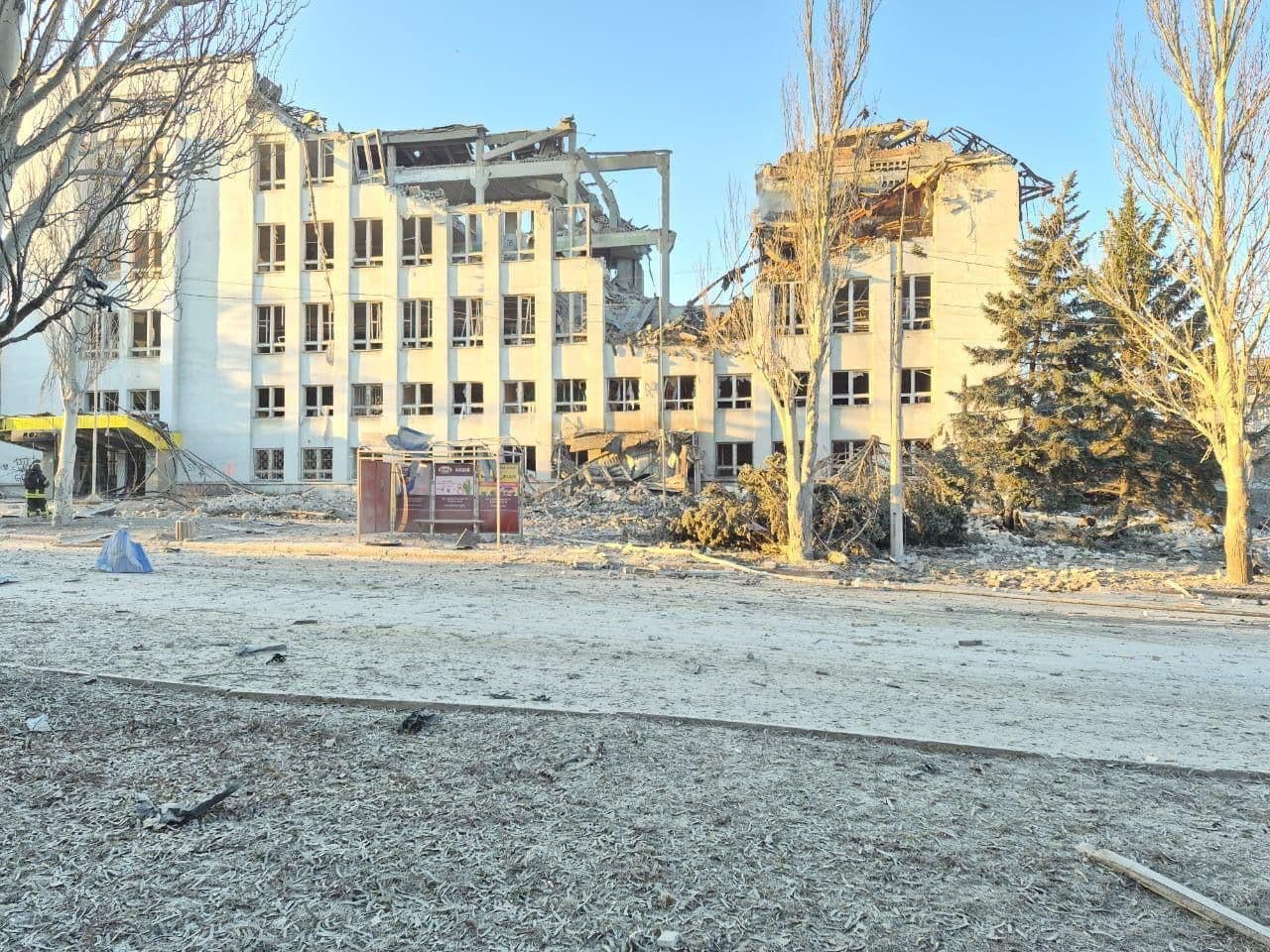
The aftermath of a Russian attack on the city of Kramatorsk in Donetsk Oblast, Ukraine. (Vadym Filashkin/Telegram)
Ukrainian commanders defending the Slovyansk–Kostyantynivka sector began hearing something startling from intercepted orders: Moscow wanted all four fortress cities—Slovyansk, Kramatorsk, Druzhkivka, and Kostyantynivka—taken before summer.
On paper, the objective looked decisive. On the ground, it bordered on fantasy.
Ukraine’s Fortress Belt is not a single defensive line. It is a system built over years—layered trenches, fortified strongpoints, pre-registered artillery zones, and defenders who know every road, ridge, and kill corridor. Russian forces had been hammering these defenses for months. The front lines moved, but never far enough to open the cities themselves.
And the pace of Russian advances had slowed, not accelerated, since the start of the year.
Breaking fortified urban defenses requires overwhelming concentration of force—armor, artillery, infantry, logistics—all focused on one decisive axis. Russia no longer has that luxury.
Units that might have formed the spearhead for such an offensive are already being pulled elsewhere. Ukrainian counterattacks in Zaporizhia forced Russian commanders to redeploy elite formations south to stabilize their lines. Forces meant to prepare for assaults in Donetsk were suddenly fighting defensive battles hundreds of kilometers away.
Every redeployment diluted the offensive Moscow hoped to build.
Russian commanders had tried before to attack in several directions at once. Each time the result was the same: pressure everywhere, breakthrough nowhere. Advances measured in meters rather than operational collapse.
Even earlier gains—like the capture of Pokrovsk and Myrnohrad—created new vulnerabilities that demanded troops to defend them. What Russian planners saw as improved positions became new responsibilities consuming the very forces needed for a breakthrough.
The dilemma is now unavoidable.
Russia can keep attacking the Fortress Belt without the mass needed to break it.
Or it can concentrate forces—and watch other fronts begin to unravel.
The Frontline Hammering: 201 Assaults and Still No Breakthrough
Beyond the shifting redeployments and strategic calculations, the war along the front line followed its familiar rhythm—relentless pressure without decisive result.
Russian forces launched 201 assaults across the front in a single day. Ukrainian defenders repelled most of them while mounting counterattacks of their own and striking Russian positions more than a thousand times with artillery, drones, and missiles.
The numbers captured the war’s daily reality better than any single headline: constant combat, grinding losses, and lines that move only by meters.
The heaviest pressure fell along the eastern front where Russian troops repeatedly pushed toward Ukrainian defensive belts. Attack waves came again and again, probing trenches, testing strongpoints, searching for weakness. Ukrainian defenders held their positions, forcing Russian units back after each attempt.
Farther south, fighting intensified in areas where Ukrainian counterattacks had recently forced Russia to rush reinforcements. Russian forces attempted to stabilize their lines with repeated assaults. Ukrainian defenders absorbed the blows and answered with strikes of their own.
The pattern repeated across the battlefield. Attacks launched. Attacks repelled. Counterstrikes followed. Drones circled overhead far more frequently than artillery, reflecting how both armies have adapted to shortages and battlefield realities.
Even beyond Ukraine’s borders, fighting continued as Russian forces tried to roll back a Ukrainian foothold inside Russian territory. The attacks came repeatedly. The line held.
There were moments of tactical success. Ukrainian units cleared infiltrating Russian troops from a contested village after close fighting in the streets. But such victories remained local, measured in positions retaken rather than breakthroughs achieved.
Taken together, the battlefield resembled a grinding mosaic of violence. Pressure everywhere, decision nowhere.
Two hundred and one attacks.
Lines battered all day.
And when night fell, the front still held.
Fire Behind the Lines: Ukraine Reaches Deep Into Russia
While Russian commanders shifted troops along the front, Ukrainian forces carried the war far beyond it.
Long-range strikes hit Russia’s Bryansk Oil Refinery, one of the country’s largest fuel-processing facilities and a key supplier for military logistics. The attack damaged equipment and forced parts of the refinery offline. It was not the first strike of its kind. Ukraine has repeatedly targeted Russian refining infrastructure, slowly eroding the fuel supply that feeds armored vehicles, aircraft, and supply convoys.
Another strike carried even greater symbolism.
Ukrainian drones reached the Kursk nuclear power plant, a sensitive facility inside Russian territory that Moscow had previously portrayed as untouchable. Even if the damage was limited, the message was unmistakable: distance no longer guaranteed safety.
Farther south, Ukrainian strikes hit the headquarters of Russia’s Southern Military District in Rostov-on-Don for the second time in recent weeks. The complex coordinates Russian military operations across southern Ukraine. Each successful strike forces commanders to shift communications, relocate staff, and rebuild command networks under pressure.
Closer to the border, Ukrainian drones struck a Russian drone-control position and a concentration of Russian troops in Belgorod region. These were tactical targets—smaller but directly tied to battlefield operations.
Together the attacks reveal a consistent pattern in Ukraine’s long-range strategy. Refineries that fuel the war. Command centers that direct it. Military sites that support daily operations.
None of these strikes decides the war in a single night.
But each one adds friction to Russia’s system. A refinery burns and fuel supplies tighten. A command center is struck and coordination falters. A drone base is destroyed and surveillance disappears.
Strategic depth once gave Russia security.
Now it offers only distance—and distance is no longer enough.
Caught at Sea: Sweden Stops the Ship Carrying Stolen Ukrainian Grain
Far from the front lines, another battlefield opened quietly on the Baltic Sea.
Swedish authorities boarded the cargo vessel Caffa in Swedish territorial waters, ending a voyage tied to Russia’s shadow trade network. The ship had spent months disguising its identity—sailing under a Russian flag before switching to a Guinean registry and eventually operating with status so unclear Swedish officials considered it effectively stateless.
Such flag-hopping has become common among ships moving sanctioned Russian goods.
But the Caffa carried a darker history than sanctions evasion.
Ukrainian intelligence reported the vessel had previously transported grain taken from occupied Crimea. The cargo had left Sevastopol and sailed to Syria the previous summer—Ukrainian harvests seized in occupied territory and sold abroad under falsified documentation.
Kyiv had already sanctioned the ship. Swedish authorities now acted on that evidence.
Swedish Coast Guard vessels intercepted the Caffa and took control. Officials explained that vessels operating with deliberately unclear flag status could be detained under Swedish law. The ship qualified.
The seizure marked a shift in Europe’s economic campaign against Moscow. Western enforcement had largely focused on tankers carrying Russian oil in violation of sanctions and price caps. Intercepting a vessel linked to stolen Ukrainian grain widened the battlefield.
The ship had been sailing north from Morocco, likely toward Russia, continuing commercial operations despite its sanctions status. Sweden’s intervention ended that journey.
The action will not change the fighting on Ukraine’s front lines. Tanks will not stop advancing because of one captured cargo ship.
But the message travels farther than the vessel ever did.
Russia’s shadow trade—whether oil or stolen grain—is no longer invisible.
And even far from the war, the consequences are beginning to catch up.
A Border Dispute Turns Into an Information War
What began as a detention at Hungary’s border quickly became political theater.
Seven Ukrainian bank employees traveling through Hungary with currency and gold were detained by Hungarian authorities. Within hours, the incident exploded. Hungary’s foreign minister accused Ukraine of “terrorism,” framing the case as a kidnapping. Kyiv answered with its own sharp accusation, saying Hungary had taken hostages and seized money.
The Ukrainians were later released and returned home.
The damage did not return with them.
Kyiv warned Ukrainian citizens against travel to Hungary. Budapest hit back inside the European Union, blocking sanctions and financial support measures for Ukraine. A narrow border dispute had become leverage in a much larger confrontation.
Then the information war took over.
Pro-government Hungarian media circulated dramatic images supposedly showing the detained Ukrainians. The pictures spread fast, feeding outrage online. Later analysis found they had been generated by artificial intelligence.
The reaction was massive. What should have been a minor diplomatic quarrel became a viral spectacle amplified by bot-like accounts and networks linked to earlier Russian-style influence campaigns.
The timing mattered. Tensions between Kyiv and Budapest were already high after Russian strikes damaged energy infrastructure tied to oil flows toward Hungary. At the same time, Hungary’s government was under growing political pressure at home ahead of elections.
The detention became useful.
For Budapest, it fed nationalist anger and justified a harder line against Ukraine. For Russian information networks, it opened another crack inside Europe’s pro-Ukraine coalition.
No formal alliance was needed.
Each side benefited from the same storm.
In this war, division can be manufactured far from the battlefield—then carried back into Europe’s politics like shrapnel.
One Drone War, Two Fronts
Evidence presented by President Volodymyr Zelensky pointed to something far larger than weapons transfers between Moscow and Tehran.
Shahed drones striking targets in the Middle East were found to contain Russian components. The same drone family Iran supplied to Russia for attacks on Ukrainian cities was now appearing in strikes against American forces and regional partners.
But the cooperation appeared to go deeper than hardware.
Ukrainian intelligence indicated that Russia had also provided intelligence assistance to Iran to help refine drone strikes on American positions. Reports of that cooperation had surfaced earlier in Western media. Ukrainian investigators now said they had physical evidence linking Russian technology and support to the attacks.
The implication was stark.
The war technologies developed in Ukraine were no longer confined to Europe. They were spreading across battlefields.
For three years, Iranian drones had helped Russia bombard Ukrainian cities. Now those same systems—modified with Russian improvements—were appearing thousands of kilometers away, targeting American forces and partners in the Middle East.
Zelensky warned that the pattern revealed something more organized than parallel conflicts.
Russia and Iran were not simply trading weapons. They were building a shared war ecosystem: Iranian manufacturing supplying the platforms, Russian components improving performance, and intelligence support helping guide strikes.
What worked in Ukraine could be tested elsewhere.
The result was a single drone war stretching across regions. Ukrainian civilians faced Shaheds over Kharkiv. American soldiers faced related systems in the Middle East.
Zelensky argued that the response must match the threat.
If the cooperation between Moscow and Tehran crosses theaters, defense cannot remain divided by geography. The same technology linking these battlefields means the security of Europe and the Middle East is now tied together.
One network.
One weapons system.
Two fronts of the same war.
Enough to Endure, Not Enough to Break Through
The weapons keep coming west to east across Europe, but they arrive with a quiet ceiling built into them.
Another American package reached Ukraine with armored vehicles, artillery ammunition, and air defense munitions. It was useful, necessary, and familiar. The shipments kept Ukrainian defenses alive, but they did not change the shape of the war. This was support designed to hold the line, not to shatter it.
Britain continued sending Storm Shadows, some of the most dangerous long-range missiles in Ukraine’s arsenal. They gave Kyiv the power to strike deep, hitting command posts, logistics hubs, and strategic sites far behind Russian lines. Europe added artillery shells, small arms ammunition, and spare parts—the hard, unglamorous cargo of a war sustained day after day.
But the absences mattered as much as the deliveries.
There were no major new waves of F-16s. No deep stock of ATACMS for sustained long-range pressure. No broad expansion of advanced air defenses able to shield Ukrainian cities from repeated mass attacks. The most decisive tools still arrived in narrow quantities, if they arrived at all.
That has become the pattern of the war’s fourth year.
Western aid has been enough to prevent collapse. Enough to keep brigades supplied, guns firing, and damaged systems repaired. Enough to deny Russia the easy victory it once imagined.
But not enough to give Ukraine the full weight needed for decisive offensive transformation.
So, Ukraine fights with what arrives, plans around what may come next, and stretches each delivery across a front that never sleeps.
The arsenal is real.
So is the limit built into it.
War as a Laboratory: Ukraine’s Innovation Edge
On Ukraine’s battlefields, new weapons are not tested in laboratories. They are tested under fire.
Ukrainian commanders say the war has created a brutal advantage: every engagement becomes an experiment. When units discover a weakness—whether in drones, reconnaissance, or electronic warfare—engineers begin working on solutions immediately. Prototypes appear quickly. Soldiers test them in combat. The successful ones move into production. The failures disappear just as fast.
The cycle moves far faster than traditional military development.
Colonel Serhiy Dobriansky, who oversees innovation programs for Ukraine’s armed forces, describes the process simply: wartime urgency eliminates bureaucracy. Combat reveals problems instantly, and the battlefield demands answers just as quickly.
International partnerships have accelerated the process. Ukrainian and British engineers are scaling production of interceptor drones designed to hunt Russian UAVs in the air. NATO programs are testing Ukrainian counter-drone technology developed directly from front-line experience. Western research initiatives in Canada and Sweden are exploring electronic warfare and autonomous systems built around lessons learned in Ukrainian combat zones.
American cooperation has expanded reconnaissance capabilities as well. Synthetic-aperture radar systems tested on Ukrainian drones allow surveillance in poor weather or darkness, conditions where conventional sensors fail.
The result is an unusual partnership.
Western nations provide industrial capacity, research networks, and advanced technologies. Ukraine provides something impossible to replicate in peacetime: constant combat testing.
Each side supplies what the other lacks.
The advantage does not solve Ukraine’s biggest problems. Innovation cannot replace manpower or erase Russia’s numerical advantages.
But it does create a battlefield edge.
When ideas move from concept to combat in weeks instead of years, even a smaller force can keep adapting faster than the enemy trying to overwhelm it.
The Winter That Refused to Break Ukraine
The strategy was simple: freeze the country into surrender.
When winter arrived, Russia began a sustained campaign to destroy Ukraine’s power grid. Missiles and drones targeted generation plants, substations, and transmission lines across the country. The goal was clear—plunge cities into darkness, force families to endure subzero temperatures without heat, and break civilian morale.
The attacks came in waves.
Through December, January, and February, Russia launched repeated strikes against energy infrastructure. One barrage alone unleashed more than seven hundred weapons—missiles, drones, and hypersonic systems—an assault designed to overwhelm defenses and cripple the grid.
For a time, the damage was severe. By early February, Ukraine’s electricity production had fallen to roughly a quarter of normal capacity. Rolling blackouts spread across major cities. Some neighborhoods endured more than a day without power.
But something else was happening at the same time.
Repair crews were racing the attacks.
Police, firefighters, and energy workers moved toward each strike site as soon as the explosions stopped. Linemen climbed damaged towers in bitter winter cold to restring cables. Engineers replaced transformers and rerouted electricity through surviving lines. Even as Russia fired again, teams were already restoring what had been destroyed.
The work was dangerous. Follow-up strikes sometimes targeted repair crews themselves. Workers were killed. Others returned to the grid the next day.
Ukrainian air defenses adapted as well. Soldiers used everything available—fighter aircraft, electronic warfare systems, machine guns mounted on trucks, even improvised drone interceptors—to bring down incoming weapons.
Gradually the grid recovered.
By late February, electricity production had rebounded sharply. Lights returned to homes across the country.
Russia had proven it could damage Ukraine’s infrastructure.
But winter proved something else.
Darkness alone could not break the country.
The Hidden Cost: The Casualties Russia Does Not Count
Every day on the front line produces numbers Moscow refuses to publish.
Ukrainian military estimates reported 1,760 Russian casualties—killed and wounded—in a single day of combat. The figure reflects the relentless rhythm of the war: assaults launched across multiple sectors, waves of infantry and armor pressing forward, and defenders answering with artillery, drones, and missiles.
The toll accumulates quickly.
Alongside personnel losses, Ukrainian forces reported heavy equipment destruction—dozens of tanks and armored vehicles, artillery systems, drones, and support vehicles. The battlefield consumes machines as steadily as it consumes soldiers.
Moscow releases none of these totals.
Official casualty reporting effectively stopped years ago. Russian authorities now acknowledge only isolated deaths framed as heroic sacrifice. The broader cost of the war—the daily stream of wounded and dead—remains hidden from public view.
Even allowing for exaggeration in Ukrainian reporting, the scale remains staggering. Western analysts often assume the figures may be inflated. Yet even reduced estimates still suggest more than a thousand Russian casualties in a single day of fighting.
Month after month, the numbers compound.
Such losses are sustainable only because Russia continues mobilizing replacements. Fresh troops arrive to fill depleted units. But each new wave often arrives with less training and fewer experienced leaders than the one before.
That creates a quiet contradiction inside Russia’s strategy.
The same relentless offensives that produce incremental territorial gains also drain the manpower and equipment needed to exploit those gains. The war continues through sheer scale—throwing bodies and machines into the fight faster than the battlefield can destroy them.
The casualties keep mounting.
The attacks keep coming.
And the arithmetic of attrition continues, whether Moscow counts it or not.
The Day’s Meaning: When Ambition Meets Arithmetic
Watch elite Russian airborne units racing south to defend positions they were meant to attack. Count hundreds of drones striking Ukrainian cities while Russian casualties climb into the thousands in a single day of combat. Listen to commanders demanding summer breakthroughs even as redeployments pull elite units away from offensive sectors.
The day revealed the war’s central arithmetic.
Russia still demonstrated formidable strength. It launched massive drone barrages, struck across multiple Ukrainian regions, and maintained pressure along the frontline. It absorbed casualty levels that would cripple most militaries. On paper, the numbers projected power.
But those numbers could not erase constraints.
The same forces attacking across the front could not simultaneously defend threatened sectors and concentrate for decisive offensives. Ukrainian counterattacks in southern Zaporizhia forced Russian redeployments that drained elite units from the eastern axis where Moscow hoped to break Ukraine’s defensive belt.
Every division rushed south meant one fewer unit available for the summer offensive.
Ukrainian long-range strikes compounded the pressure. Refineries, command facilities, and logistics nodes inside Russia continued absorbing damage. None was decisive alone, but together they complicated Russian planning and stretched operational flexibility.
Western support followed a similar pattern. Weapons and ammunition continued arriving in quantities sufficient to sustain Ukrainian defenses but not yet to enable decisive counteroffensives.
The war therefore remained defined by attrition.
Russia could still generate attacks and casualties at extraordinary scale. Ukraine could still disrupt those offensives through tactical innovation and targeted strikes. Both sides demonstrated resilience. Neither achieved decisive advantage.
The redeployments revealed the deeper reality: strategic ambitions colliding with battlefield mathematics. Forces required everywhere could only exist somewhere. Each Ukrainian counterstroke forced Russia to move the same limited elite units across a widening map.
Prayer For Ukraine
For protection of those under attack
Lord, as waves of drones and missiles continue to strike Ukrainian cities, we ask for Your protection over families, children, and the elderly who live under the threat of sudden violence. Guard the skies over Ukraine. Strengthen the defenders who work day and night to intercept these attacks. Bring safety to neighborhoods that have endured too many nights of sirens and explosions.
For soldiers and commanders on the frontline
Father, the battlefield continues to consume lives through relentless assaults and counterattacks. We pray for the Ukrainian soldiers defending their homeland. Give them courage, wisdom, and endurance. Protect them in moments of danger, comfort those who are wounded, and be near to the families who wait anxiously for their return.
For wisdom among national and international leaders
God of truth and justice, decisions made in capitals across the world shape the course of this war. Grant wisdom to Ukraine’s leaders and to the leaders of nations supporting Ukraine. Guide them toward decisions that strengthen justice, restrain aggression, and bring lasting security.
For justice in the face of deception and manipulation
Lord, we see how disinformation, political theater, and false narratives are used to divide nations and weaken support for Ukraine. Shine light where lies are spread. Expose manipulation and protect truth so that justice is not distorted by propaganda.
For endurance and hope among the Ukrainian people
Merciful God, Ukraine has endured years of war, loss, and hardship. Yet the people continue rebuilding, repairing power lines, restoring cities, and defending their country.
Strengthen their spirits. Renew their hope. Let resilience grow into victory and bring the day when this war ends and peace returns to the land.